1
Lecture- 39
Other terms that nearly mean the same thing are:
• Genetically engineered organisms
• Transgenics
2
Genetically modified organisms (GMOs) can be defined as
organisms in which the genetic material (DNA) has been
altered in a way that does not occur naturally by mating
and/or natural recombination. Selected individual genes
are transferred from one organism into another, also
between nonrelated species. Foods produced from or using
GM organisms are often referred to as GM foods.
3
•Many genetically modified organisms (GMOs) have been produced
with the help of recombinant DNA technology.
•A GMO is made by making modifications in the genome of an
organism. This may or may not involve the introduction of a foreign
DNA molecule.
•If a foreign gene(s) is introduced in an organism, the organism is
known as a transgenic organism. The E.coli transgenics containing
human somatostatin, insulin and leukocyte (IFNα) interferon genes
were constructed in the years 1977, 1979 and 1980, respectively.
•Subsequently, transgenics of E. coli containing several other foreign
genes were constructed. Genetically-modified microorganisms have
been successfully used in environmental pollution control and
extraction of minerals from crude ores.
4
• In the year 1980, a research group led by Jon Wright succeeded in
making transgenic mouse embryos. Five years later production of
transgenic rabbits, sheep and pigs were reported by R. E. Hammer and
coworkers.
• Transgenic goats containing human blood protein antithrombin were
made in 2009.
• The protein produced in the milk of these goats was approved by the
US Food and Drug Administration for use as a drug under the name
ATryn.
• A research group led by Donald Jarvis, working at University of
Wyoming, USA, reported in 2012 the construction of spider gene-
expressing silkworms producing super-tough silk.
• These transgenic silkworms may be used in future for manufacturing
tough silk fibers.
5
• The first transgenic plant was constructed in 1984 by
introduction of the insecticidal protein gene of Bacillus
thuringiensis (Bt) in tobacco plant by Marc Van Montagu and Jeff
Schell, working in the Plant Genetic Systems company.
• This company, based in Ghent, Belgium, was founded by these
scientists, who were the first to construct Agrobacterium
tumefaciens-derived Ti plasmid vectors for introduction of foreign
genes into plants.
• The resulting Bt tobacco plants showed resistance to attacks by
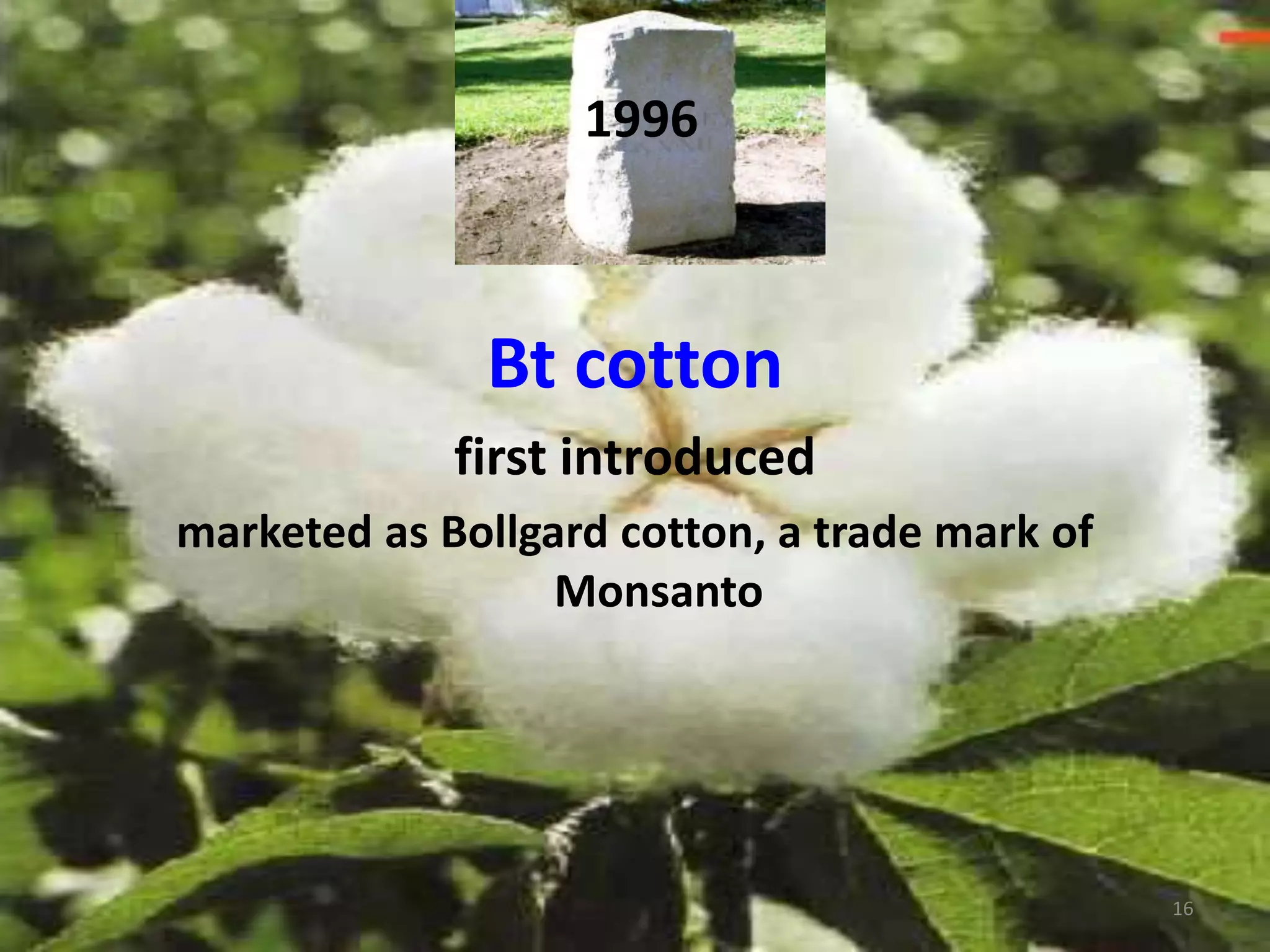
lepidopteran larvae. Subsequently, Bt cotton, marketed as Bollgard
cotton, was introduced by Monsanto company in 1996.
• Bt cotton proved to be a big farm level success globally as this
crop did not require the spray of expensive and harmful chemical
pesticides for control of lepidopteran insects.
6
• In the year 1994 Calgene company came up with Flavr Savr tomato which became
first commercially grown genetically-engineered food crop.
• The Flavr Savr tomatoes have a higher economic value because of their increased
shelf-life. SemBioSys Genetics Inc., a Canada-based biotech company, has produced in
2008 transgenic safflower plants containing human insulin gene.
• Human insulin obtained from the flowers of these plants may find therapeutic use in
near future. Genetically modified poplar trees have been developed by the Flanders
Institute of Biotechnology, Belgium.
• These trees, for which field trials were started in 2009, contain 17% more cellulose
and 20% less lignin. The wood from these trees is expected to be very useful in bioethanol
and paper industries.
• Several other transgenic plants, containing foreign genes from different sources, have
been produced. These plants have new and improved characteristics like more yield,
enhanced nutritional quality, disease resistance, production of new compounds, etc.
• In some countries transgenic plants have become controversial because of
environmental concerns, potential health risks and ethical issues.
• Transfer of genes between plant species for crop
improvement can be achieved through natural
methods (plant breeding) and artificial methods
(genetic transformation).
• Genetic transformation facilitates introduction of only
specific desirable genes without co-transfer of any
undesirable genes from donor species, which normally
occurs by conventional breeding method.
7
• The capacity to introduce and express diverse
foreign genes in plants was first described in
tobacco
• Resistance conferred to plants is generally
against viruses, insects, herbicides and post
harvest deterioration
8
Insect resistance
• Insect resistance genes can be of plant,
bacterial or any other origin.
• Genes conferring insect resistance to plants
that have been obtained from microorganisms
are Bt gene from Bacillus thuringiensis and ipt
(isopentenyl transferase) from Agrobacterium
tumefaciens.
9
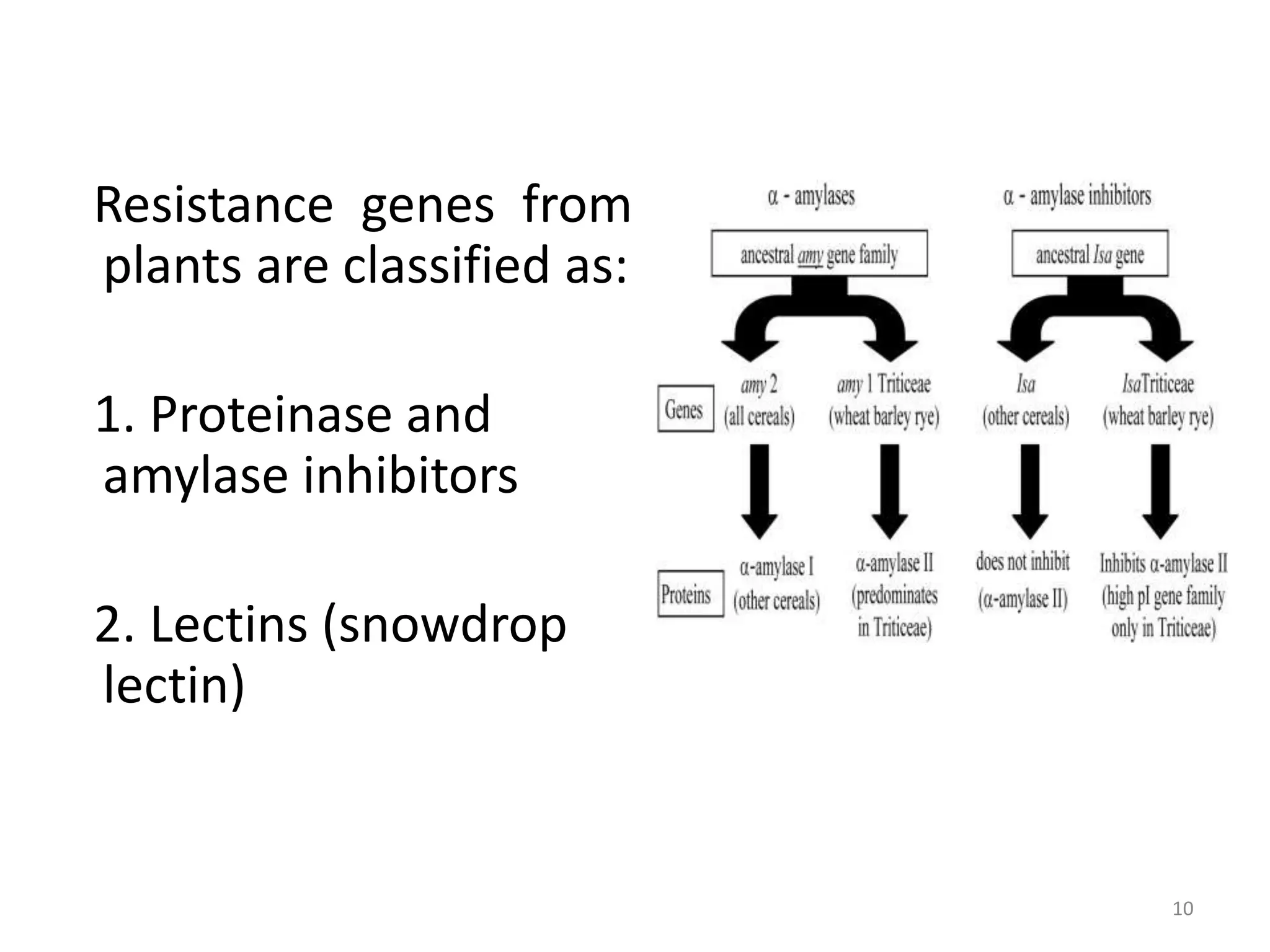
Resistance genes from
plants are classified as:
1. Proteinase and
amylase inhibitors
2. Lectins (snowdrop
lectin)
10
• Bacillus thuringiensis is an entomocidal
bacterium that produces an insect control
protein.
• Several genes encoding these toxins have
been isolated.
• DNA constructs containing promoter and the
active coding sequences of these toxin genes
have been expressed in plants to confer insect
resistance.
11
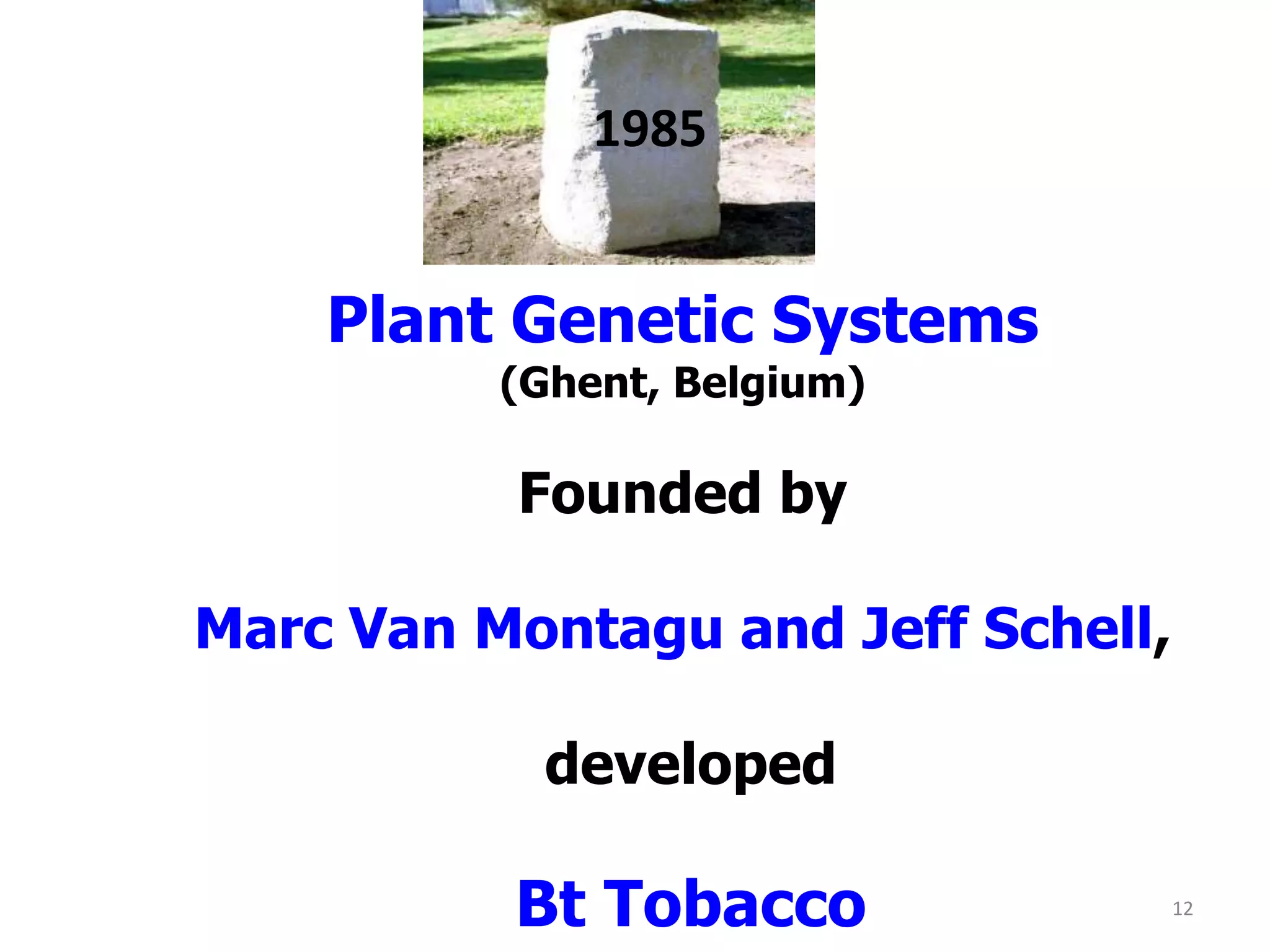
1985
Plant Genetic Systems
(Ghent, Belgium)
Founded by
Marc Van Montagu and Jeff Schell,
developed
Bt Tobacco 12
GMO for quality
• The first commercial transgenic food
product was “Flavr Savr”(Transgenic tomato)
with delayed ripening developed by Calgene,
USA in 1994.
13
• Long shelf life of tomatoes was developed by two
approaches :
1. Antisense RNA technology against polygalacturonase
encoding genes (used by Calgene).
2. Using gene for 1-aminocyclopropane-1-carboxylic acid
(ACC) deaminase which degrades ACC to ethylene.
Genes encoding ACC and ACO (ACC oxidase) have been
cloned from many species.
14
• In 1995 potato varieties expressing Bt crystal
protein toxic to Colorado potato beetle were
made commercially available
• In the following years, cotton varieties
expressing Bt crystal protein toxic to a number
of lepidopteran pests were introduced
15
1996
Bt cotton
first introduced
marketed as Bollgard cotton, a trade mark of
Monsanto
16
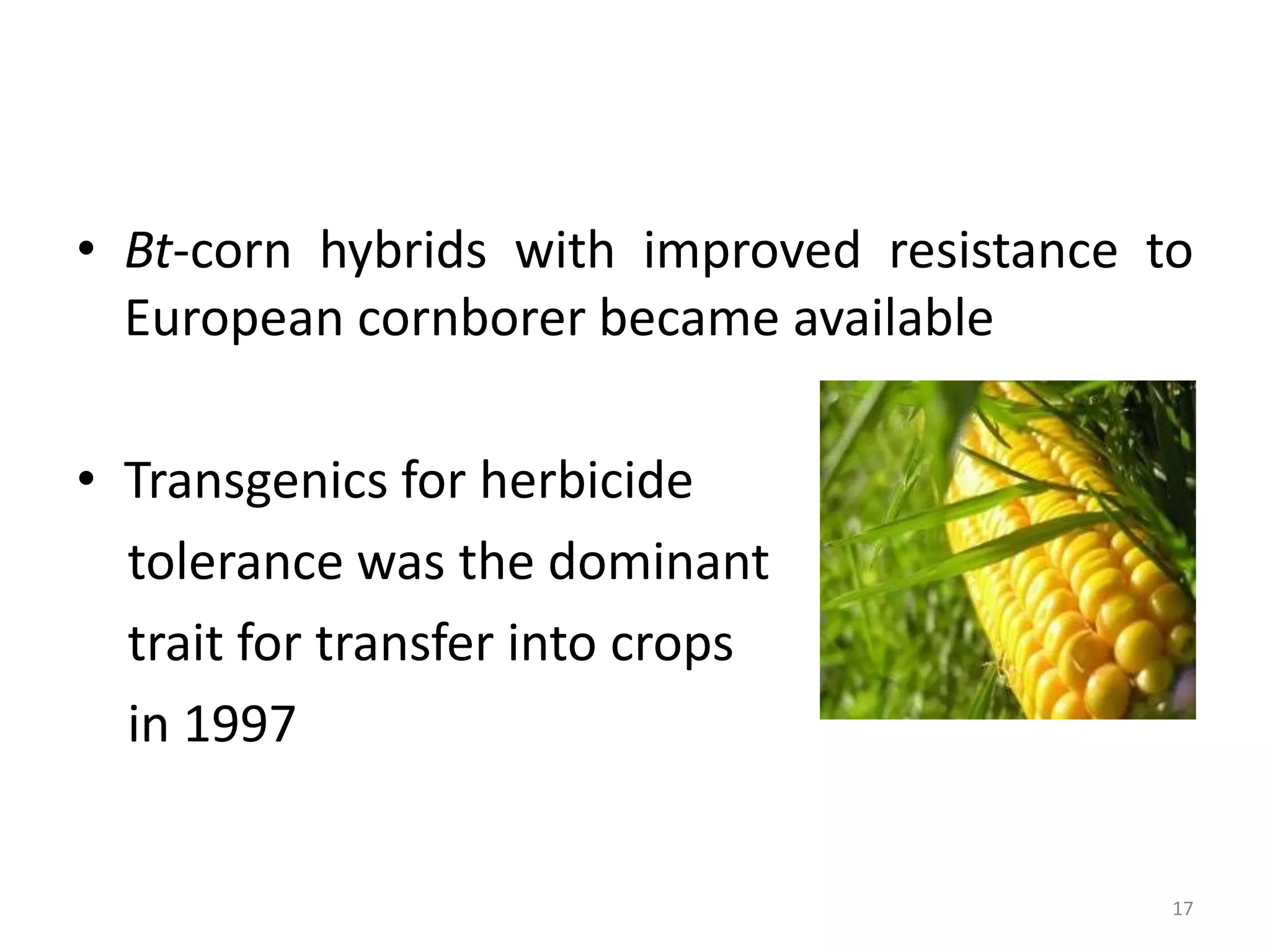
• Bt-corn hybrids with improved resistance to
European cornborer became available
• Transgenics for herbicide
tolerance was the dominant
trait for transfer into crops
in 1997
17
2008
• Scientists in Hebrew University Jerusalem, Israel enhanced
the scent of flowers by ten-fold
• caused it to emit a scent during day and night - irrespective
of the natural rhythm of scent production
• patented by Yissum, the Hebrew University's technology
transfer company
• Israel is the Middle East's flower-producing superpower ;
third only to the Netherlands and Kenya in supplying the EU
with flowers
Scent Enhancement in
Flowers
18
• Raman and colleagues (University of Texas )
have manipulated the flavor enzymes found in
Arabidopsis thaliana by genetic engineering
• Allene oxide synthase (AOS)
• Hydroperoxide lyase (HPL)
Fruits with more flavors2008
19
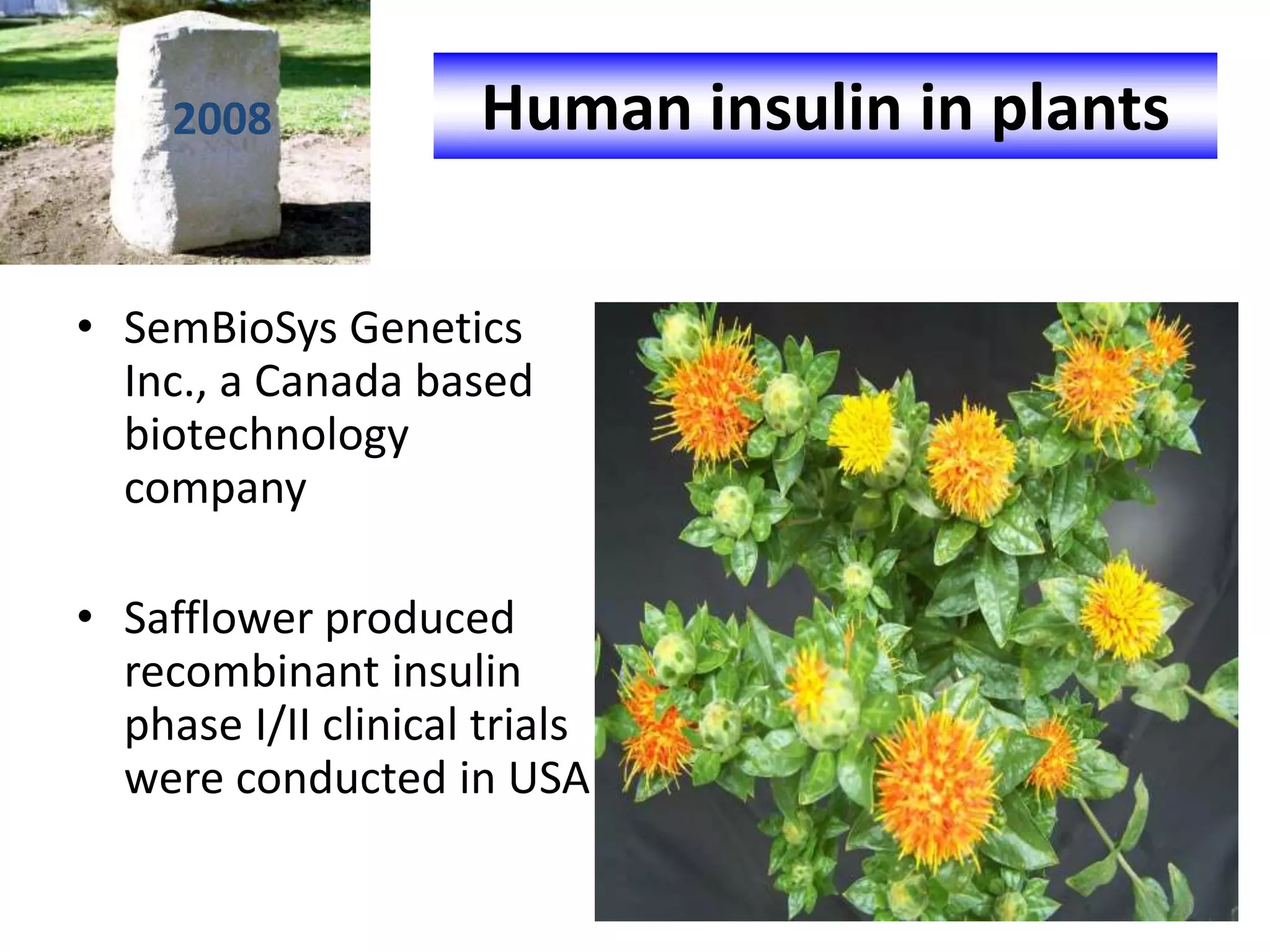
• SemBioSys Genetics
Inc., a Canada based
biotechnology
company
• Safflower produced
recombinant insulin
phase I/II clinical trials
were conducted in USA
Human insulin in plants2008
20
Advantages of GM Plants
• Yield improvement of major food crops
• Introduction of useful traits like resistance to
diseases, pests and insects to various crop
varieties
• Increased shelf life.
21

Lectut btn-202-ppt-l39. genetically modified organisms-i

  • 1.
  • 2.
    Other terms thatnearly mean the same thing are: • Genetically engineered organisms • Transgenics 2 Genetically modified organisms (GMOs) can be defined as organisms in which the genetic material (DNA) has been altered in a way that does not occur naturally by mating and/or natural recombination. Selected individual genes are transferred from one organism into another, also between nonrelated species. Foods produced from or using GM organisms are often referred to as GM foods.
  • 3.
    3 •Many genetically modifiedorganisms (GMOs) have been produced with the help of recombinant DNA technology. •A GMO is made by making modifications in the genome of an organism. This may or may not involve the introduction of a foreign DNA molecule. •If a foreign gene(s) is introduced in an organism, the organism is known as a transgenic organism. The E.coli transgenics containing human somatostatin, insulin and leukocyte (IFNα) interferon genes were constructed in the years 1977, 1979 and 1980, respectively. •Subsequently, transgenics of E. coli containing several other foreign genes were constructed. Genetically-modified microorganisms have been successfully used in environmental pollution control and extraction of minerals from crude ores.
  • 4.
    4 • In theyear 1980, a research group led by Jon Wright succeeded in making transgenic mouse embryos. Five years later production of transgenic rabbits, sheep and pigs were reported by R. E. Hammer and coworkers. • Transgenic goats containing human blood protein antithrombin were made in 2009. • The protein produced in the milk of these goats was approved by the US Food and Drug Administration for use as a drug under the name ATryn. • A research group led by Donald Jarvis, working at University of Wyoming, USA, reported in 2012 the construction of spider gene- expressing silkworms producing super-tough silk. • These transgenic silkworms may be used in future for manufacturing tough silk fibers.
  • 5.
    5 • The firsttransgenic plant was constructed in 1984 by introduction of the insecticidal protein gene of Bacillus thuringiensis (Bt) in tobacco plant by Marc Van Montagu and Jeff Schell, working in the Plant Genetic Systems company. • This company, based in Ghent, Belgium, was founded by these scientists, who were the first to construct Agrobacterium tumefaciens-derived Ti plasmid vectors for introduction of foreign genes into plants. • The resulting Bt tobacco plants showed resistance to attacks by lepidopteran larvae. Subsequently, Bt cotton, marketed as Bollgard cotton, was introduced by Monsanto company in 1996. • Bt cotton proved to be a big farm level success globally as this crop did not require the spray of expensive and harmful chemical pesticides for control of lepidopteran insects.
  • 6.
    6 • In theyear 1994 Calgene company came up with Flavr Savr tomato which became first commercially grown genetically-engineered food crop. • The Flavr Savr tomatoes have a higher economic value because of their increased shelf-life. SemBioSys Genetics Inc., a Canada-based biotech company, has produced in 2008 transgenic safflower plants containing human insulin gene. • Human insulin obtained from the flowers of these plants may find therapeutic use in near future. Genetically modified poplar trees have been developed by the Flanders Institute of Biotechnology, Belgium. • These trees, for which field trials were started in 2009, contain 17% more cellulose and 20% less lignin. The wood from these trees is expected to be very useful in bioethanol and paper industries. • Several other transgenic plants, containing foreign genes from different sources, have been produced. These plants have new and improved characteristics like more yield, enhanced nutritional quality, disease resistance, production of new compounds, etc. • In some countries transgenic plants have become controversial because of environmental concerns, potential health risks and ethical issues.
  • 7.
    • Transfer ofgenes between plant species for crop improvement can be achieved through natural methods (plant breeding) and artificial methods (genetic transformation). • Genetic transformation facilitates introduction of only specific desirable genes without co-transfer of any undesirable genes from donor species, which normally occurs by conventional breeding method. 7
  • 8.
    • The capacityto introduce and express diverse foreign genes in plants was first described in tobacco • Resistance conferred to plants is generally against viruses, insects, herbicides and post harvest deterioration 8
  • 9.
    Insect resistance • Insectresistance genes can be of plant, bacterial or any other origin. • Genes conferring insect resistance to plants that have been obtained from microorganisms are Bt gene from Bacillus thuringiensis and ipt (isopentenyl transferase) from Agrobacterium tumefaciens. 9
  • 10.
    Resistance genes from plantsare classified as: 1. Proteinase and amylase inhibitors 2. Lectins (snowdrop lectin) 10
  • 11.
    • Bacillus thuringiensisis an entomocidal bacterium that produces an insect control protein. • Several genes encoding these toxins have been isolated. • DNA constructs containing promoter and the active coding sequences of these toxin genes have been expressed in plants to confer insect resistance. 11
  • 12.
    1985 Plant Genetic Systems (Ghent,Belgium) Founded by Marc Van Montagu and Jeff Schell, developed Bt Tobacco 12
  • 13.
    GMO for quality •The first commercial transgenic food product was “Flavr Savr”(Transgenic tomato) with delayed ripening developed by Calgene, USA in 1994. 13
  • 14.
    • Long shelflife of tomatoes was developed by two approaches : 1. Antisense RNA technology against polygalacturonase encoding genes (used by Calgene). 2. Using gene for 1-aminocyclopropane-1-carboxylic acid (ACC) deaminase which degrades ACC to ethylene. Genes encoding ACC and ACO (ACC oxidase) have been cloned from many species. 14
  • 15.
    • In 1995potato varieties expressing Bt crystal protein toxic to Colorado potato beetle were made commercially available • In the following years, cotton varieties expressing Bt crystal protein toxic to a number of lepidopteran pests were introduced 15
  • 16.
    1996 Bt cotton first introduced marketedas Bollgard cotton, a trade mark of Monsanto 16
  • 17.
    • Bt-corn hybridswith improved resistance to European cornborer became available • Transgenics for herbicide tolerance was the dominant trait for transfer into crops in 1997 17
  • 18.
    2008 • Scientists inHebrew University Jerusalem, Israel enhanced the scent of flowers by ten-fold • caused it to emit a scent during day and night - irrespective of the natural rhythm of scent production • patented by Yissum, the Hebrew University's technology transfer company • Israel is the Middle East's flower-producing superpower ; third only to the Netherlands and Kenya in supplying the EU with flowers Scent Enhancement in Flowers 18
  • 19.
    • Raman andcolleagues (University of Texas ) have manipulated the flavor enzymes found in Arabidopsis thaliana by genetic engineering • Allene oxide synthase (AOS) • Hydroperoxide lyase (HPL) Fruits with more flavors2008 19
  • 20.
    • SemBioSys Genetics Inc.,a Canada based biotechnology company • Safflower produced recombinant insulin phase I/II clinical trials were conducted in USA Human insulin in plants2008 20
  • 21.
    Advantages of GMPlants • Yield improvement of major food crops • Introduction of useful traits like resistance to diseases, pests and insects to various crop varieties • Increased shelf life. 21