Next-generation sequencing (NGS), developed in 2005, allows for the simultaneous sequencing of numerous DNA samples quickly and cost-effectively. Key NGS technologies include Roche/454 FLX, Illumina/Solexa, and Applied Biosystems SOLiD, each utilizing distinct methods for sample preparation, amplification, and result analysis. These techniques, which involve processes like pyrosequencing and bridge PCR, enable high-throughput sequencing of DNA with varying read lengths and are revolutionizing genomic research.
Introduction of NGS by Shahzeb Khan, highlighting high-throughput DNA sequencing, its development in 2005, and key features like cost-effectiveness and speed.
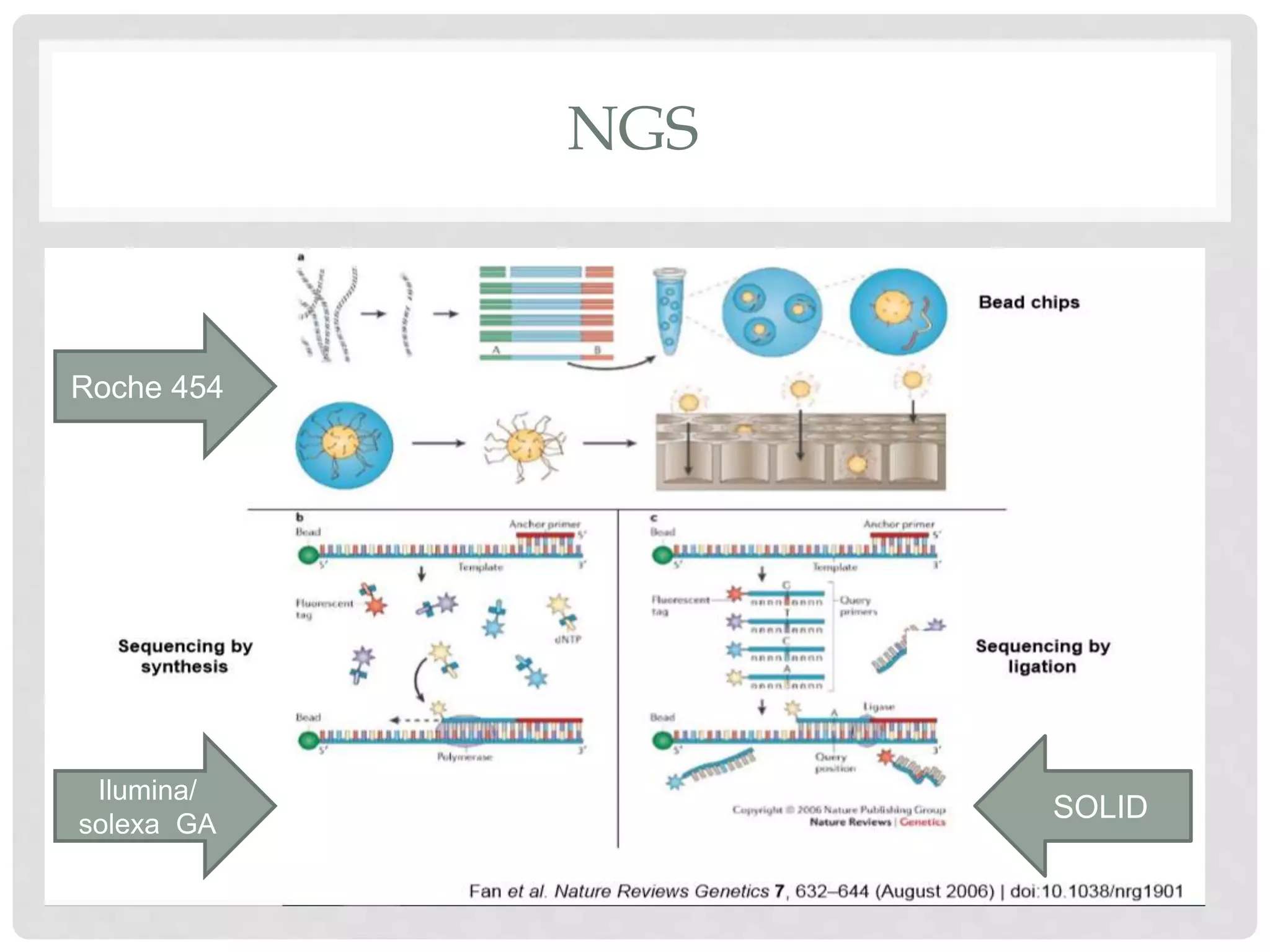
Overview of widely used NGS sequencers: Roche/454FLX, Illumina/Solexa, and Applied Biosystems SOLID.
Examines three common features of NGS systems: sample preparation, amplification methods, and analysis of results.
Detailing Roche/454FLX as the first NGS technology, its read length, and sequencing principles using pyrosequencing.Introduces Illumina/Solexa technology with a focus on read lengths, bridge PCR, and the sequencing process.
Discusses Applied Biosystems SOLID technology, including amplification methods using emulsion PCR and sequencing by ligation.
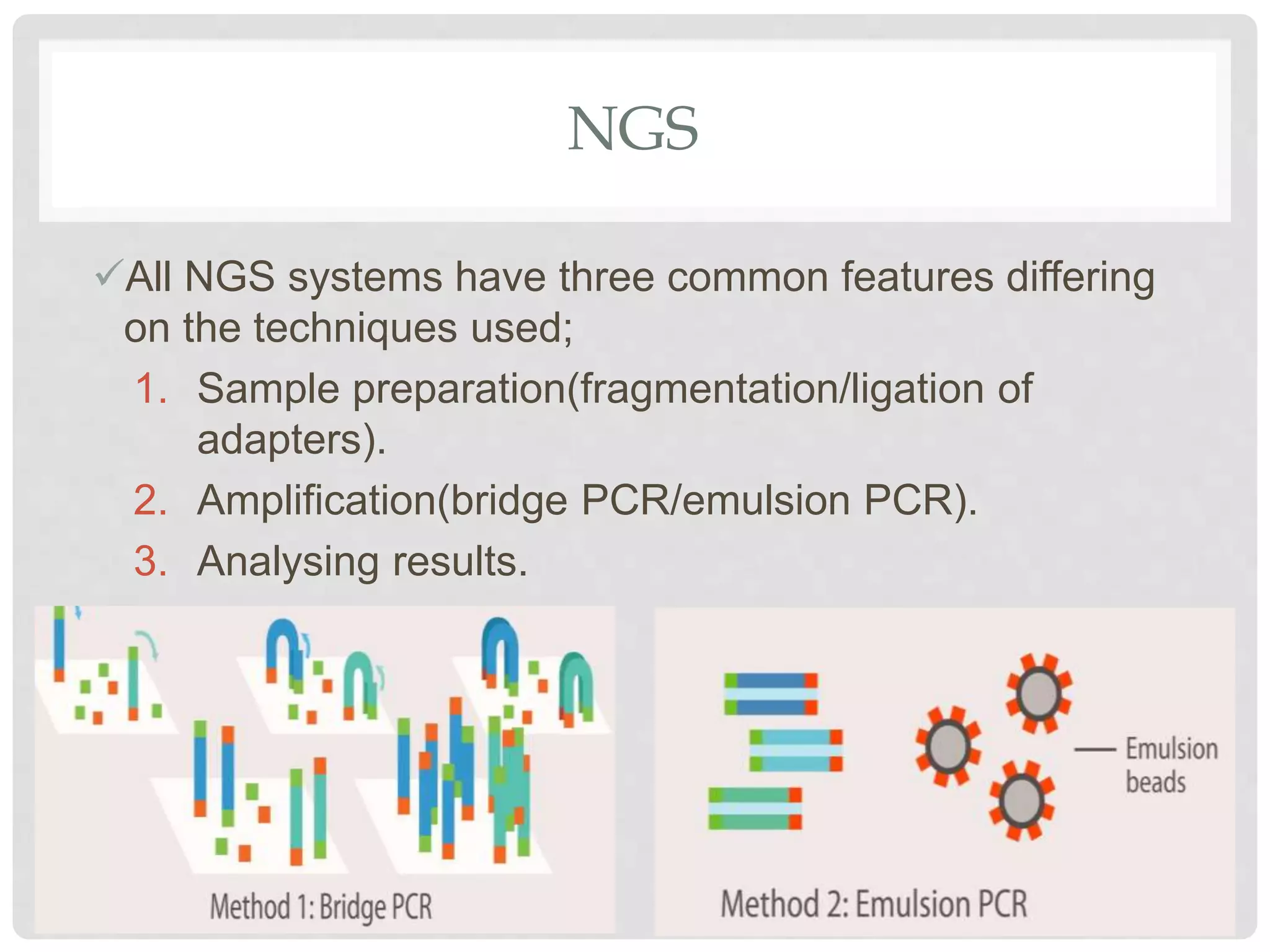
NGS
All NGS systemshave three common features differing
on the techniques used;
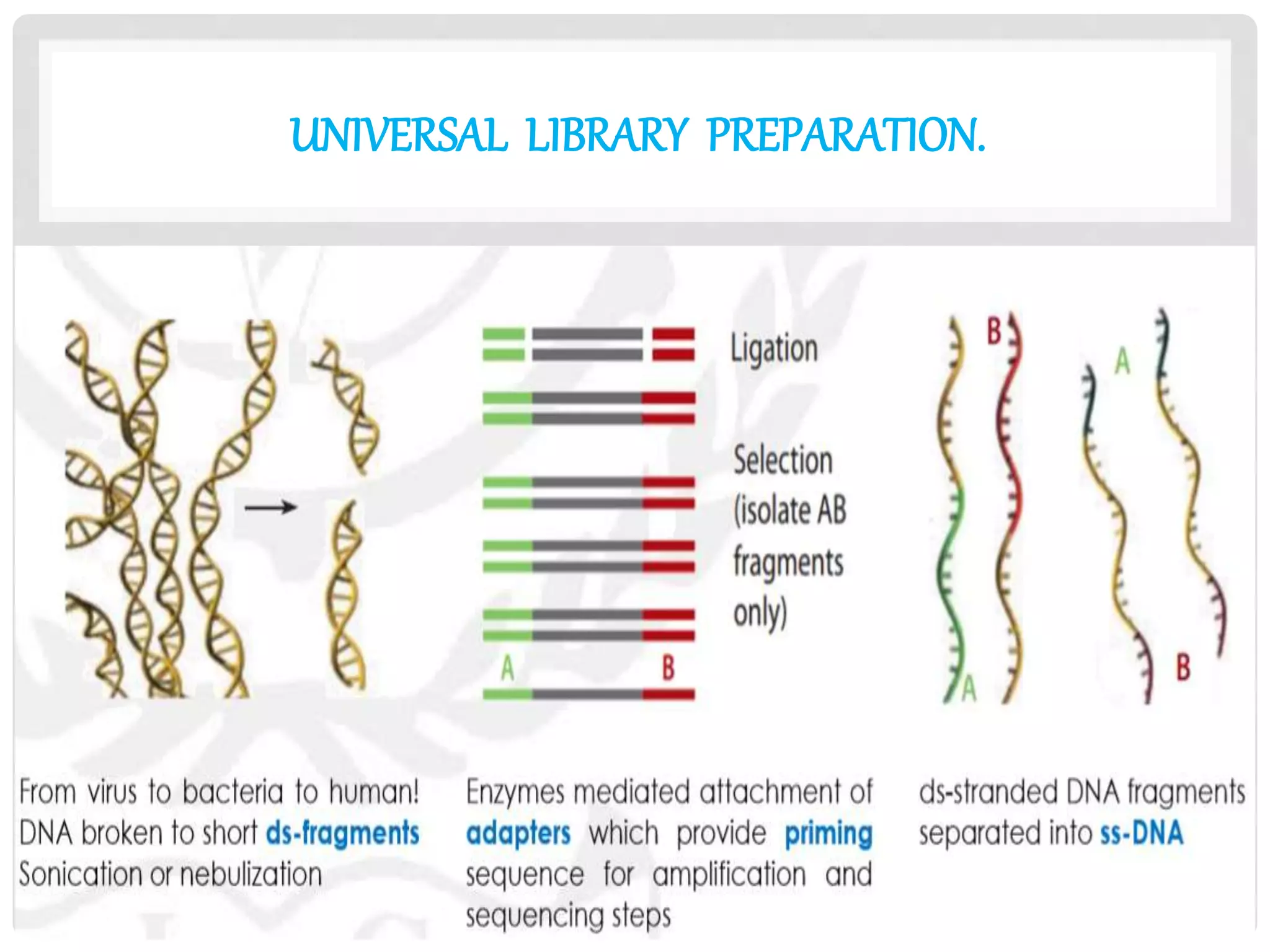
1. Sample preparation(fragmentation/ligation of
adapters).
2. Amplification(bridge PCR/emulsion PCR).
3. Analysing results.
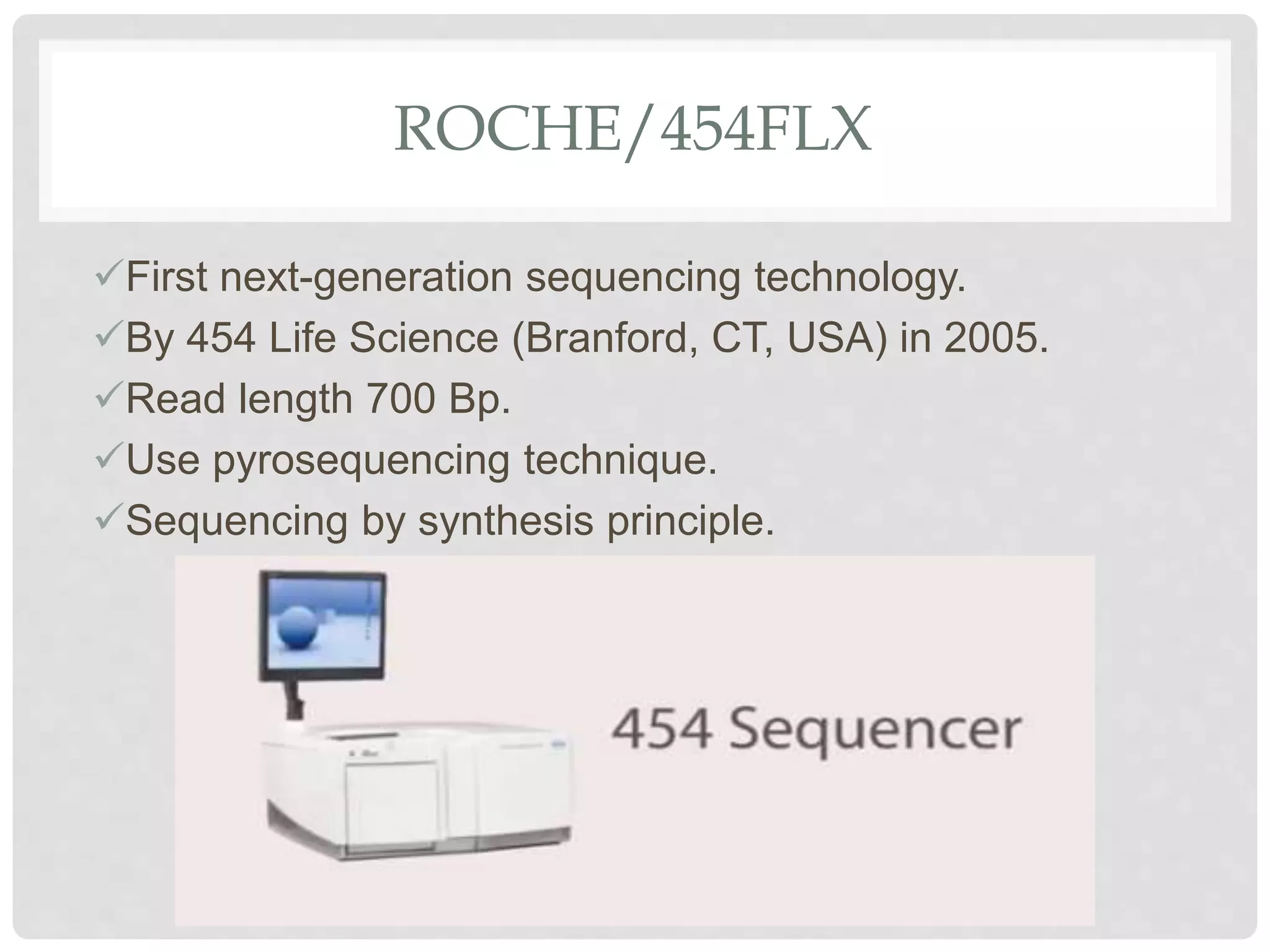
ROCHE/454FLX
First next-generation sequencingtechnology.
By 454 Life Science (Branford, CT, USA) in 2005.
Read length 700 Bp.
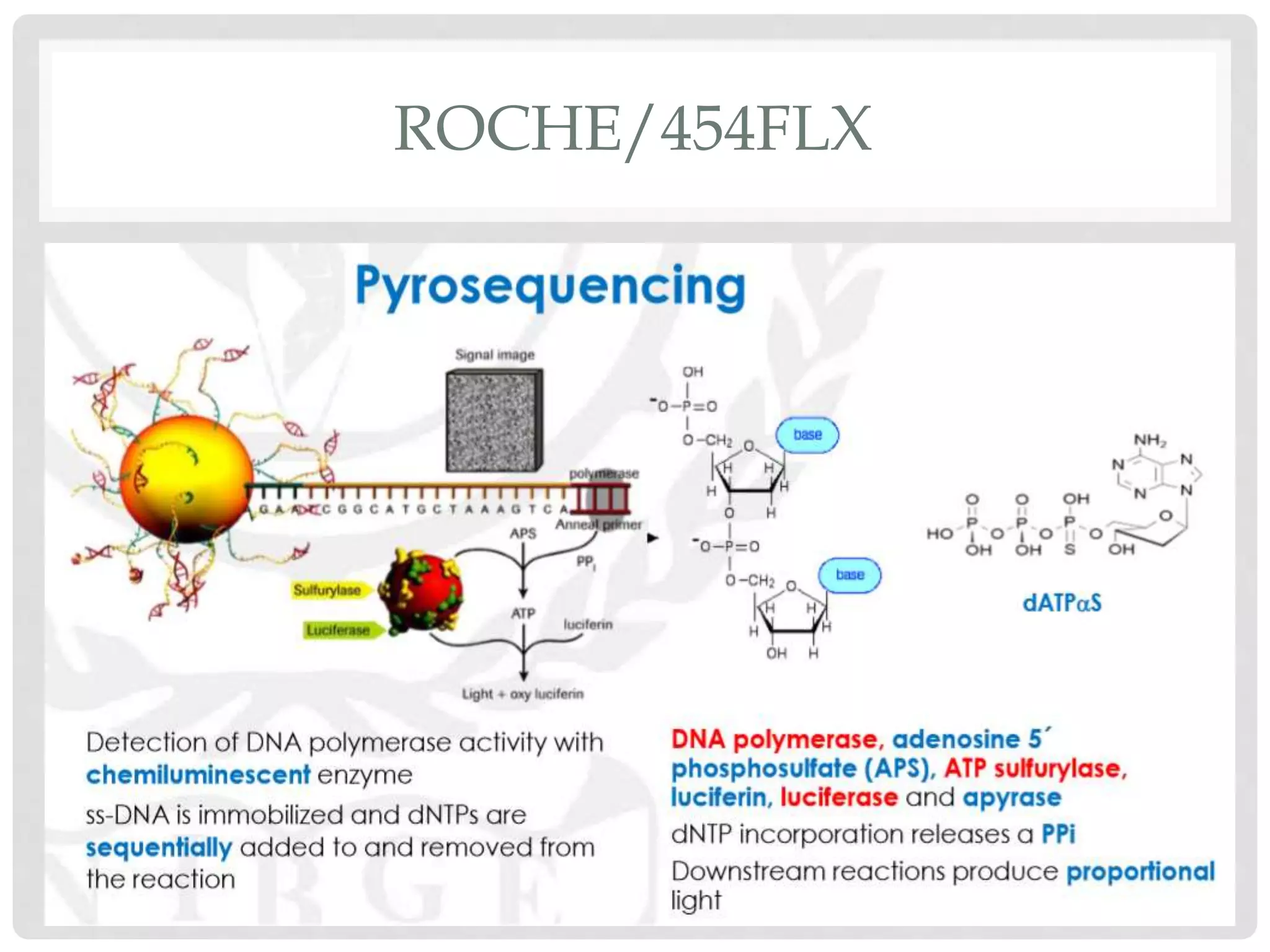
Use pyrosequencing technique.
Sequencing by synthesis principle.
8.
ROCHE/454FLX
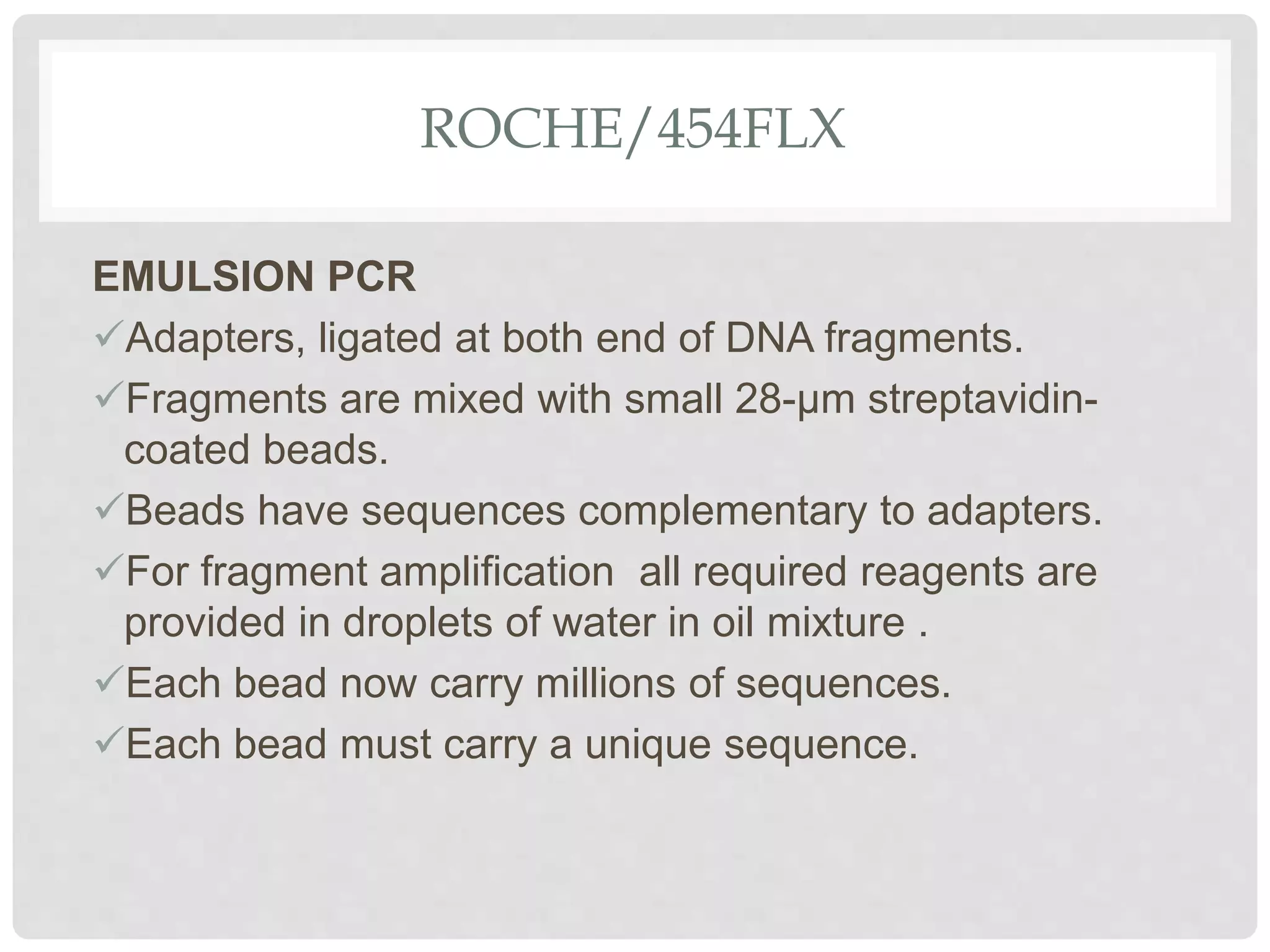
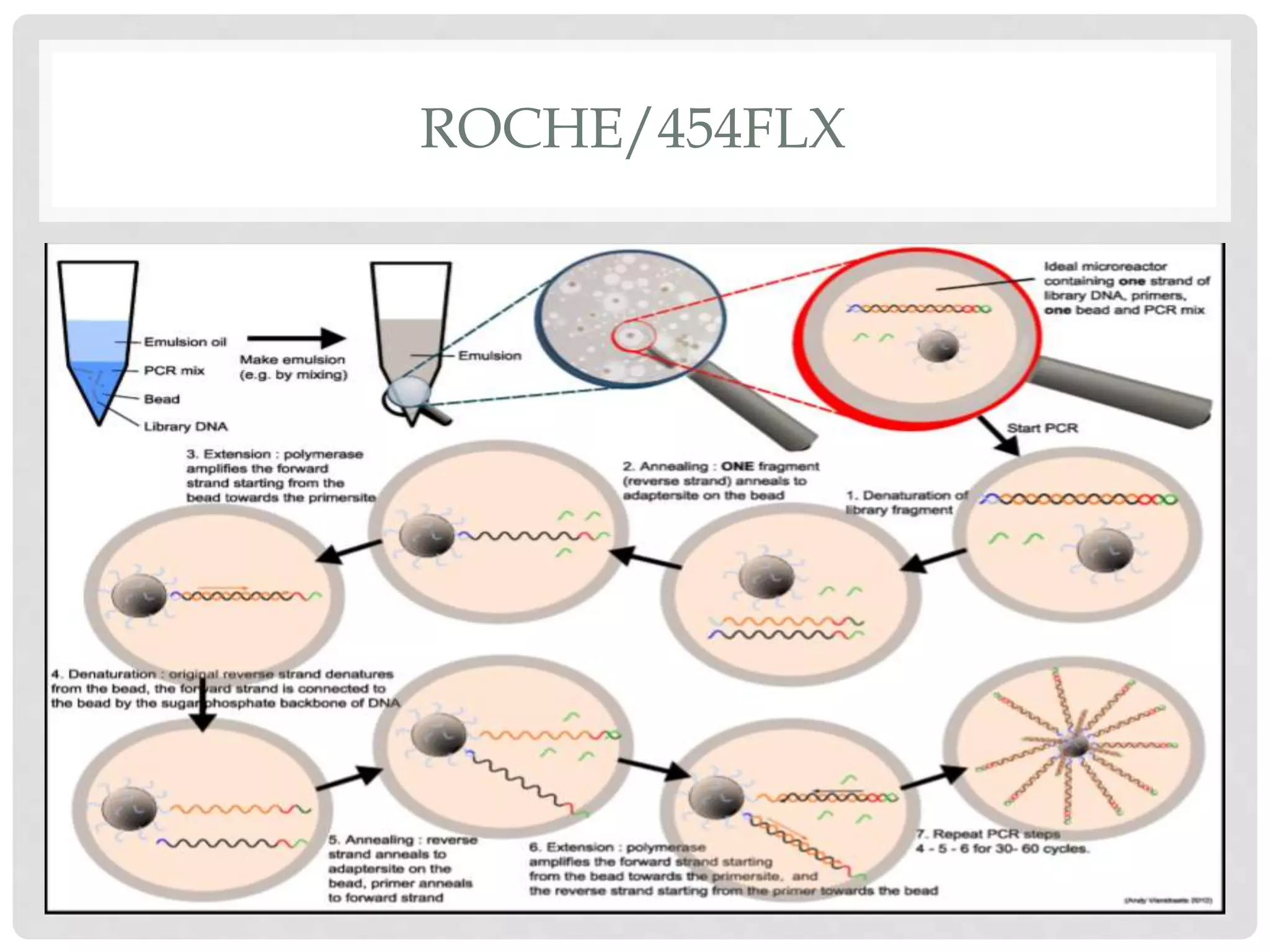
EMULSION PCR
Adapters, ligatedat both end of DNA fragments.
Fragments are mixed with small 28-µm streptavidin-
coated beads.
Beads have sequences complementary to adapters.
For fragment amplification all required reagents are
provided in droplets of water in oil mixture .
Each bead now carry millions of sequences.
Each bead must carry a unique sequence.
ROCHE/454FLX
SEQUENCING
Beads incubated withDNA-polymerase are loaded onto
PTP well.
PTP wells are filled with 1µm bead having sulfurylase
and leuciferase.
PTP wells are loaded onto 454FLX sequencer provided
with dNTPS and buffers.
Four nucleotides are added in sequential manner.
When a nucleotide is incorporated a light signal is picked
by CCD camera.
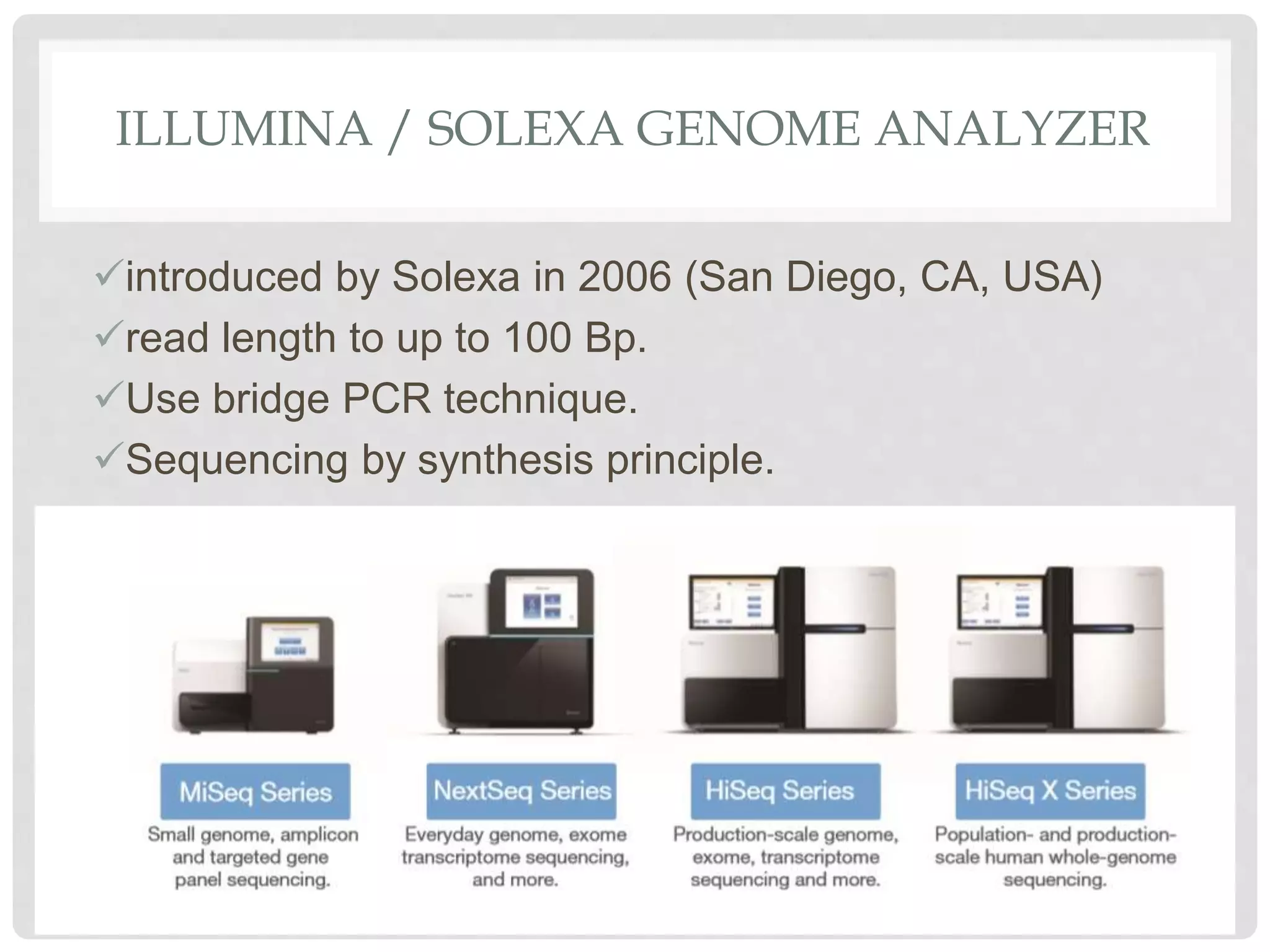
ILLUMINA / SOLEXAGENOME ANALYZER
introduced by Solexa in 2006 (San Diego, CA, USA)
read length to up to 100 Bp.
Use bridge PCR technique.
Sequencing by synthesis principle.
13.
ILLUMINA / SOLEXAGENOME ANALYZER
BRIDGE PCR
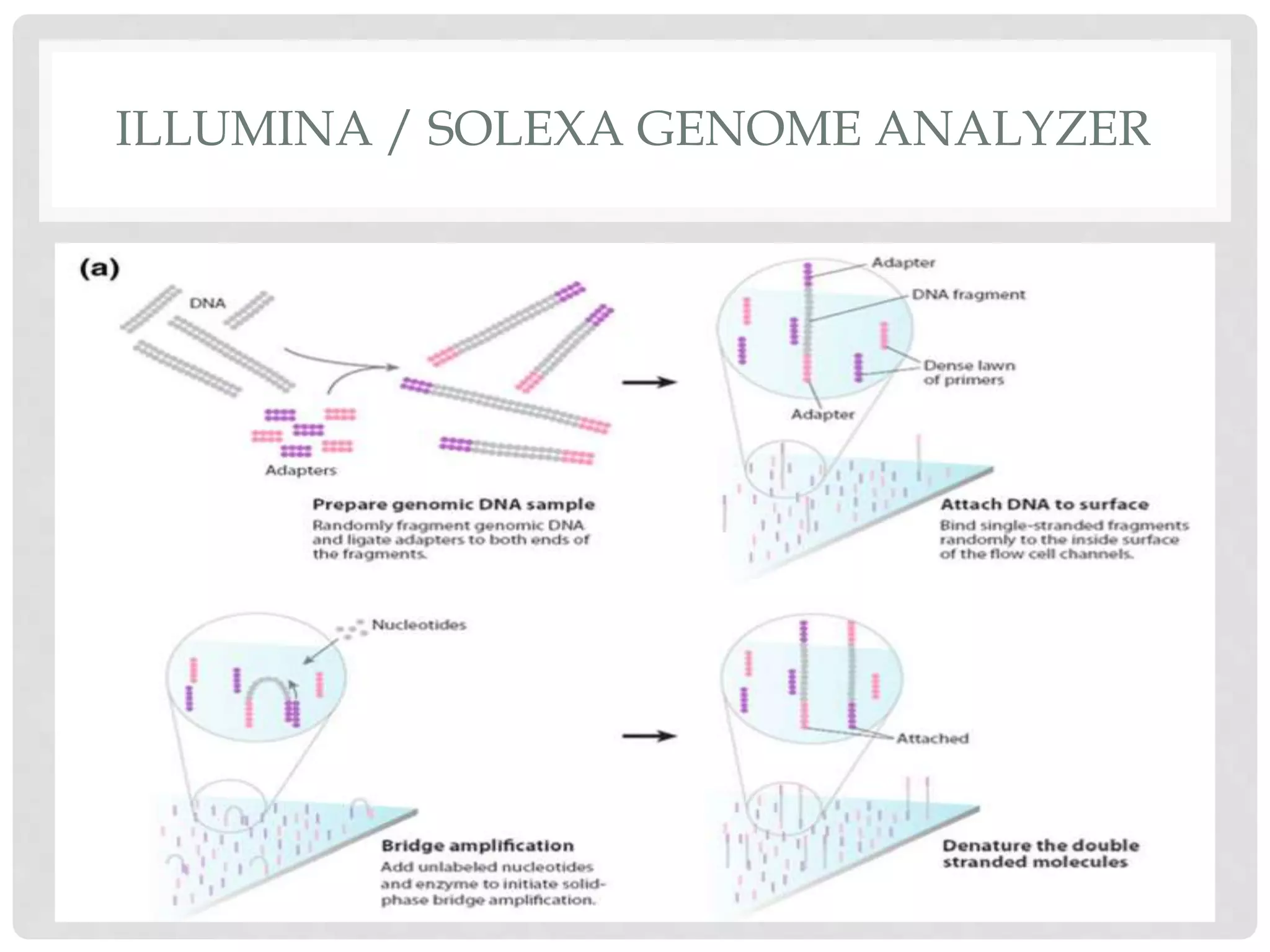
Adapters, ligated at both end of DNA fragments.
Fragments, immobilised on a flow cell having
primers complementary to adapters.
A bridge structure is created.
After several PCR cycles 1000s of s.s DNA
fragments are synthesised.
ILLUMINA / SOLEXAGENOME ANALYZER
SEQUENCING
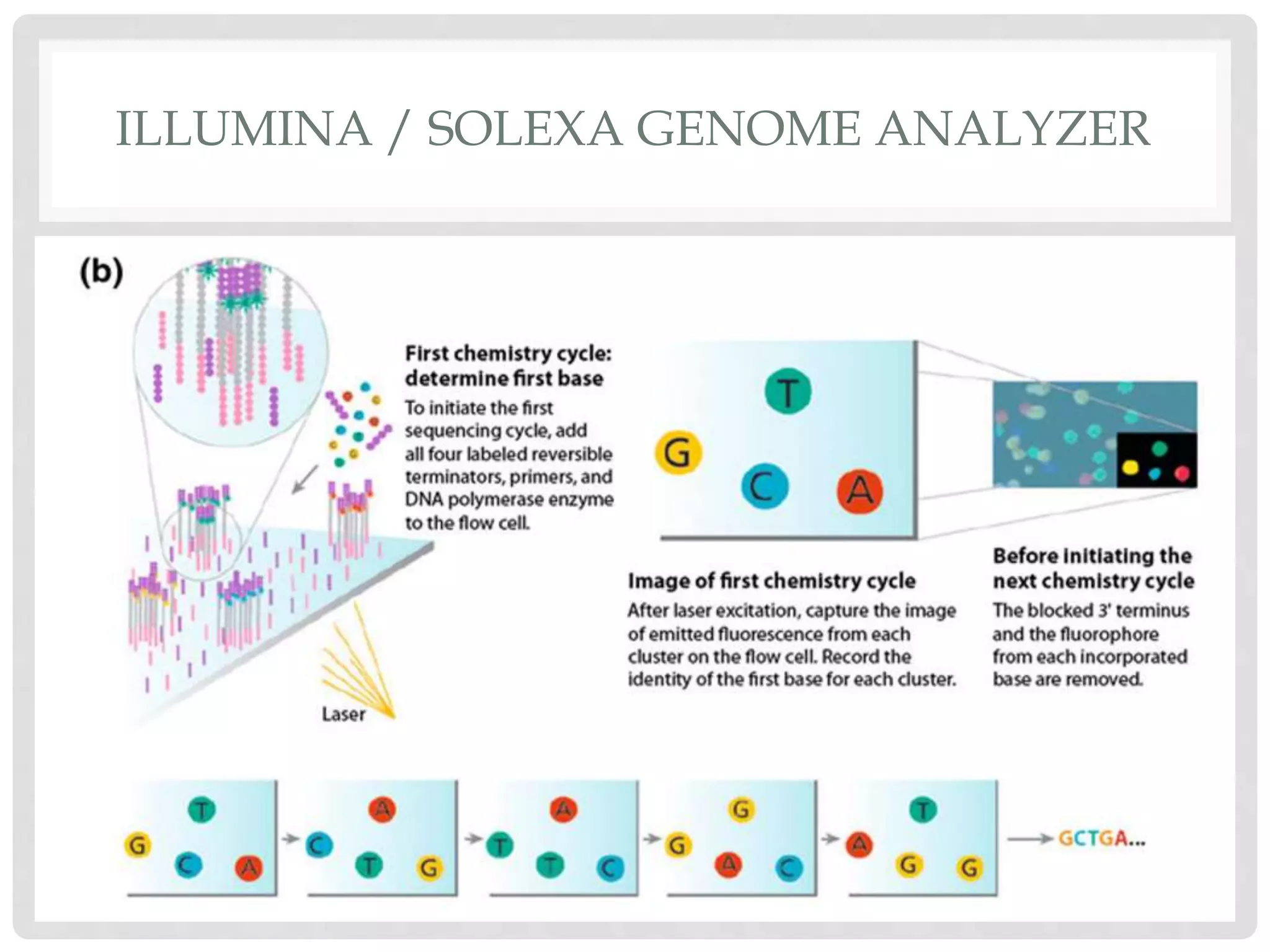
We need homogenous population of strands for
sequencing.
The cluster of fragments are supplied onto another
surface having primers.
Four reversible blocked nucleotides (3´-OH is chemically
blocked) are added.
After the acquisition of images in each cycle, the 3´-OH
blocking group is chemically removed.
Another cycle can be initiated.
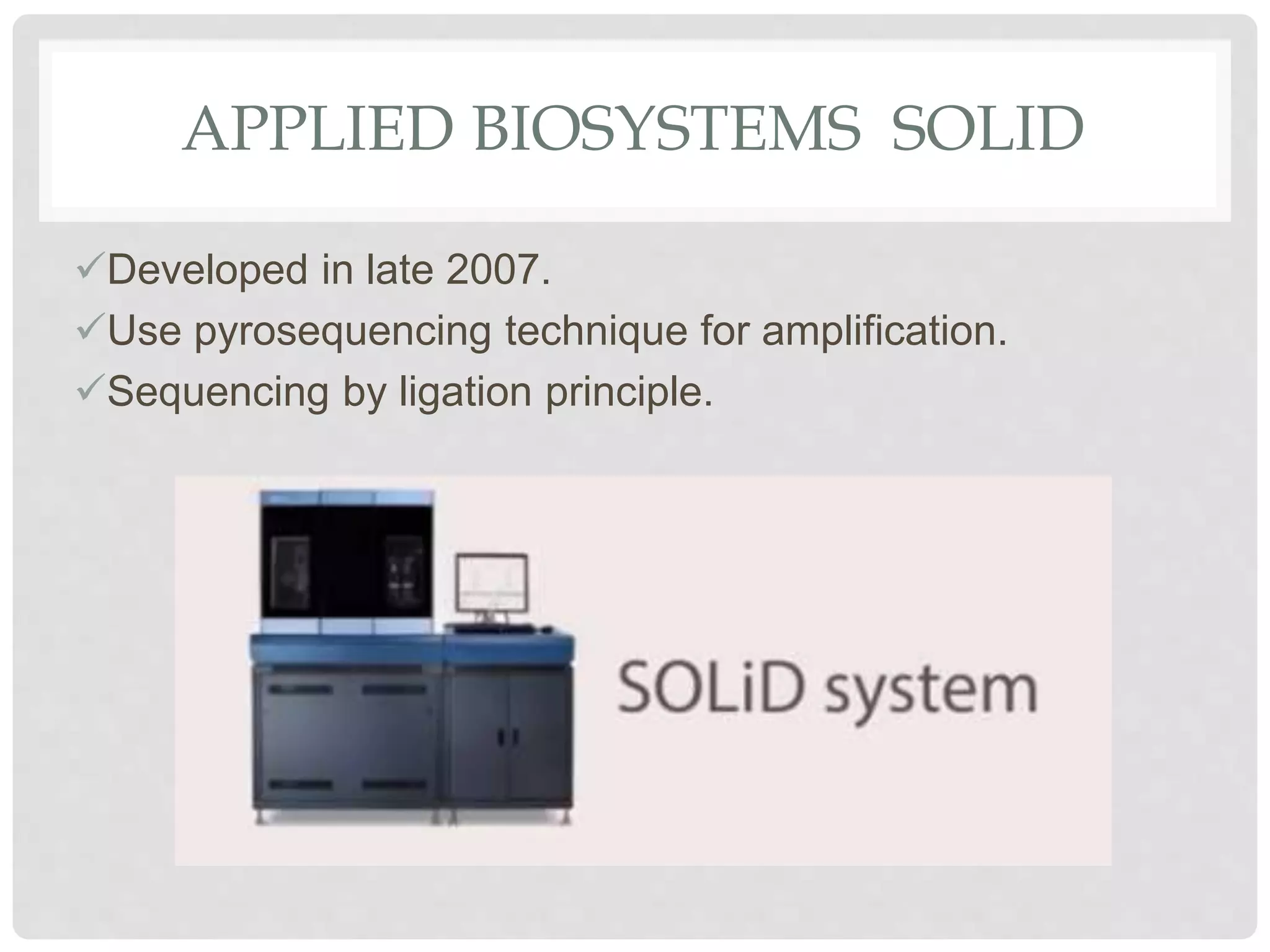
APPLIED BIOSYSTEMS SOLID
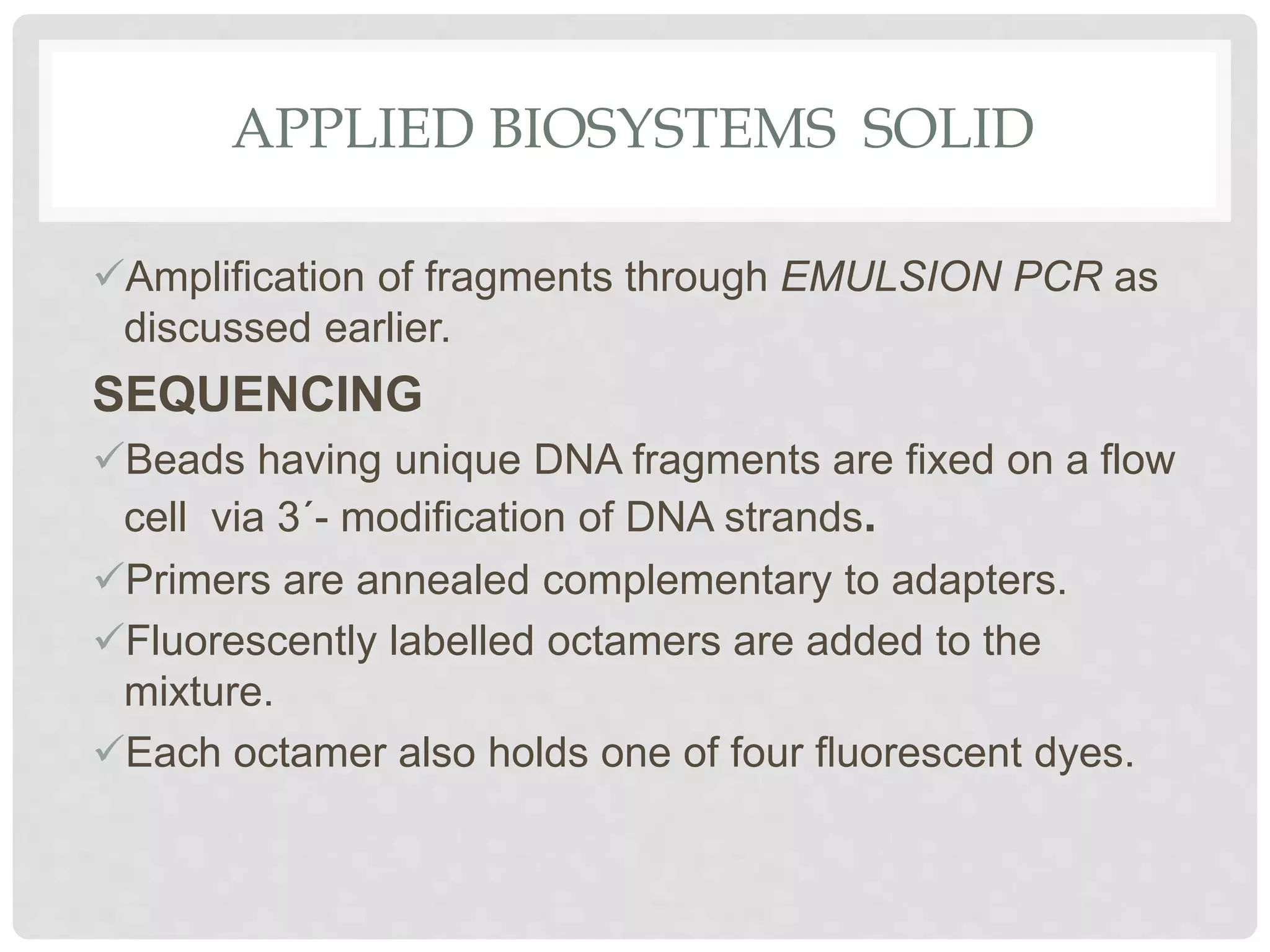
Amplificationof fragments through EMULSION PCR as
discussed earlier.
SEQUENCING
Beads having unique DNA fragments are fixed on a flow
cell via 3´- modification of DNA strands.
Primers are annealed complementary to adapters.
Fluorescently labelled octamers are added to the
mixture.
Each octamer also holds one of four fluorescent dyes.
19.
APPLIED BIOSYSTEMS SOLID
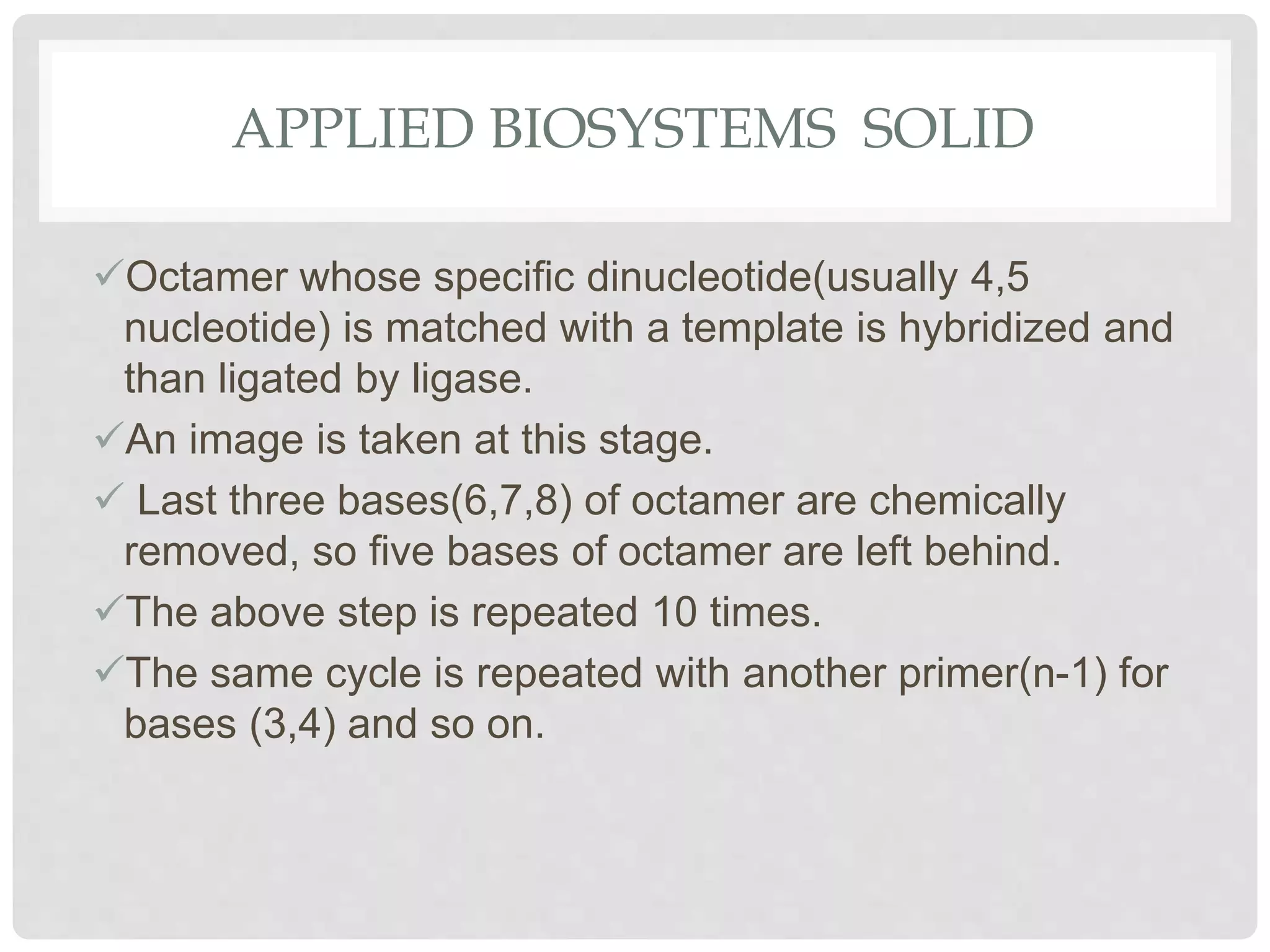
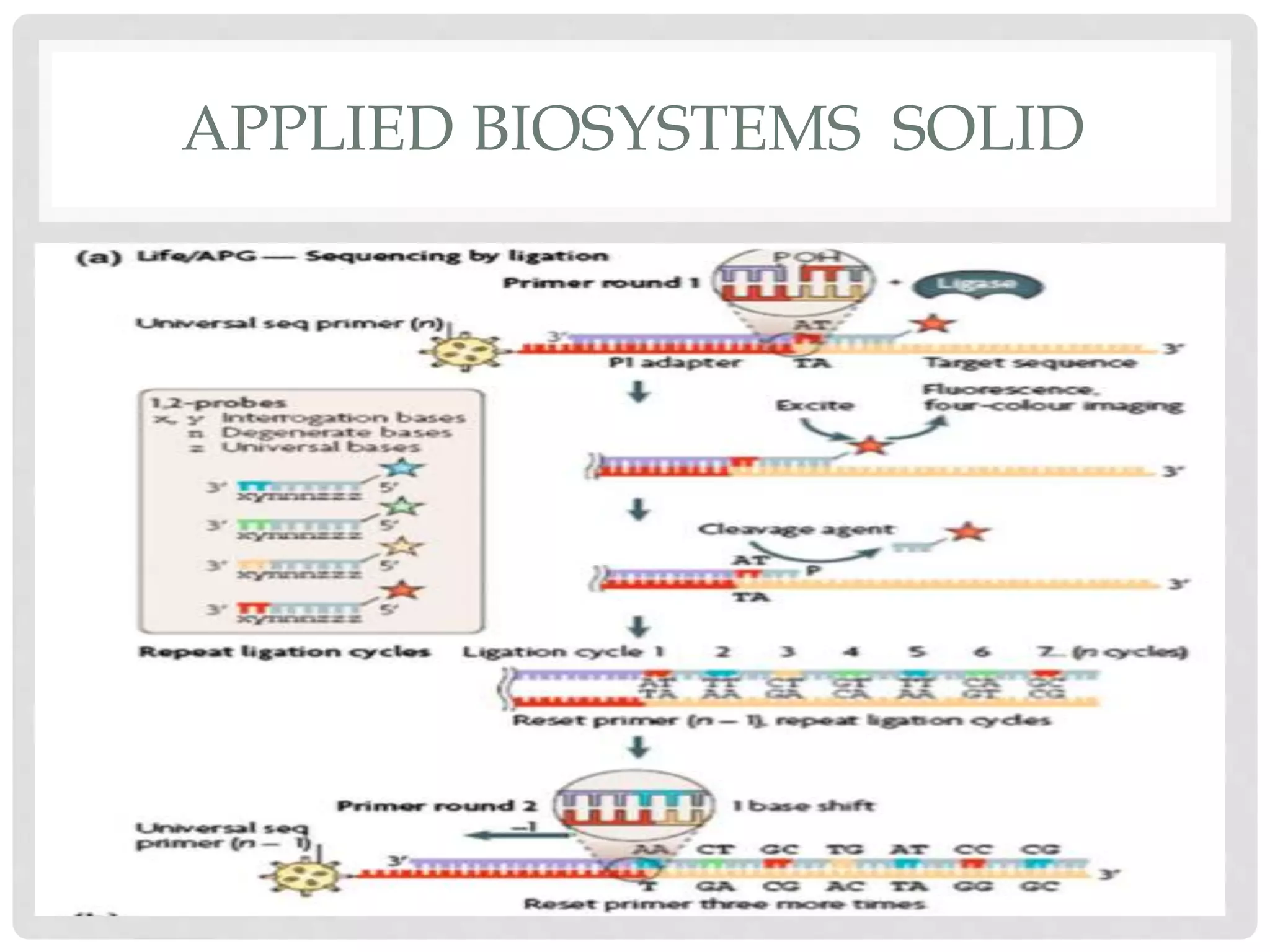
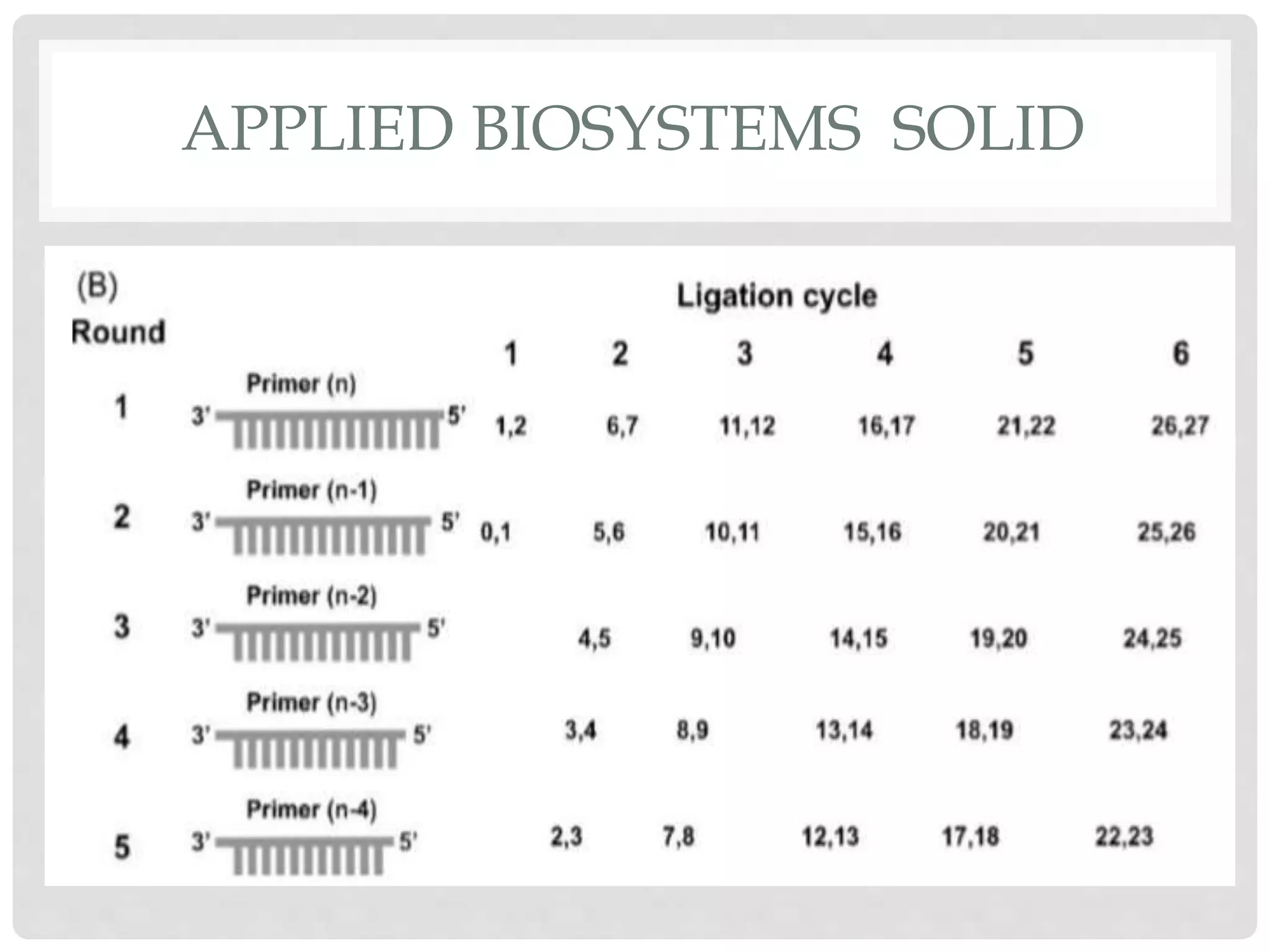
Octamerwhose specific dinucleotide(usually 4,5
nucleotide) is matched with a template is hybridized and
than ligated by ligase.
An image is taken at this stage.
Last three bases(6,7,8) of octamer are chemically
removed, so five bases of octamer are left behind.
The above step is repeated 10 times.
The same cycle is repeated with another primer(n-1) for
bases (3,4) and so on.