Genetic
Transformation
1
Lecture- 35
2
•The gene cloning method described by Stanley Cohen and coworkers
requires the introduction of the recombinant vector molecules into
suitable host cells. These researchers used transformation method to
introduce the recombinant plasmid molecules into E. coli cells.
•Transformation is the entry or introduction of naked DNA into the living
cells. In the year 1944 Oswald Avery, Colin MacLeod and Maclyn
McCarty proved that the genetic transformation discovered by
Frederick Griffith in 1928 in Diplococcus pneumoniae was due to the
introduction of naked DNA into the bacterial cells.
•The transfection method developed by Morton Mandel and Akiko Higa
(1970) for E. coli became the basis for the subsequent bacterial
transformation methods. The transformation of E. coli with the purified
plasmid DNA was achieved for the first time by Stanley Cohen and
coworkers in the year 1972.
INTRODUCTION
3
Subsequently, the following organisms/cells of
organisms were transformed for the first time in the
years mentioned in brackets: yeast (1978), cultured
mammalian cells (1980), Drosophila melanogaster
(1982) and cultured plant cells (1983).
In 1987, B. M. Chassy and J. L. Flickinger
introduced the electroporation technique for
transformation of living cells. In the same year,
Theodore Klein, Edward Wolf, Ray Wu and John
Sanford developed high velocity microprojectiles to
deliver DNA into cells.
On the basis of this method a gene gun machine for
commercial use was developed by DuPont company.
Genetic transformation is the entry or
introduction of naked DNA into the living
cells.
4
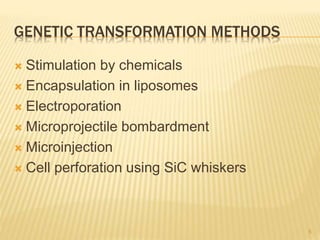
GENETIC TRANSFORMATION METHODS
 Stimulation by chemicals
 Encapsulation in liposomes
 Electroporation
 Microprojectile bombardment
 Microinjection
 Cell perforation using SiC whiskers
5
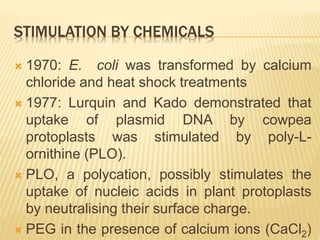
STIMULATION BY CHEMICALS
 1970: E. coli was transformed by calcium
chloride and heat shock treatments
 1977: Lurquin and Kado demonstrated that
uptake of plasmid DNA by cowpea
protoplasts was stimulated by poly-L-
ornithine (PLO).
 PLO, a polycation, possibly stimulates the
uptake of nucleic acids in plant protoplasts
by neutralising their surface charge.
 PEG in the presence of calcium ions (CaCl2)6
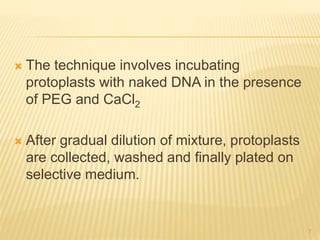
 The technique involves incubating
protoplasts with naked DNA in the presence
of PEG and CaCl2
 After gradual dilution of mixture, protoplasts
are collected, washed and finally plated on
selective medium.
7
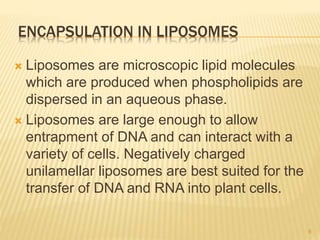
ENCAPSULATION IN LIPOSOMES
 Liposomes are microscopic lipid molecules
which are produced when phospholipids are
dispersed in an aqueous phase.
 Liposomes are large enough to allow
entrapment of DNA and can interact with a
variety of cells. Negatively charged
unilamellar liposomes are best suited for the
transfer of DNA and RNA into plant cells.
8
ELECTROPORATION
 The process by which macromolecules
present in the extra cellular medium are
internalized by living cells on exposure to
a brief electric pulse.
 The technique allows introduction of DNA
into living cells/protoplasts by passing
short pulse of electricity which has a
voltage peak value of 250-350 volts with
RC constant in milliseconds range.
9
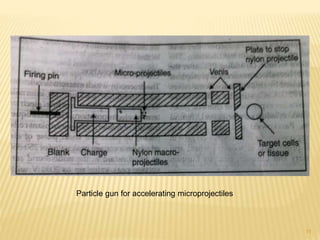
MICROPROJECTILE BOMBARDMENT
 Exogenous DNA molecules are adsorbed on
the surface of microscopic tungsten
microprojectiles which are then accelerated
to high velocities by a particle gun onto the
target cells.
 The advantage in this approach is that a
naked DNA molecule can be directly
transferred into intact living cells or tissues.
10
Particle gun for accelerating microprojectiles
11
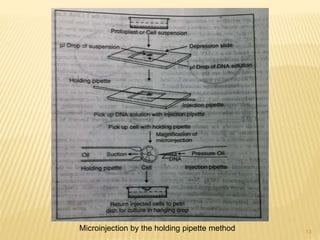
MICROINJECTION
 Living cells/protoplasts are surface attached
on a slide by embedding in agro or polylysine
using a holding pipette.
 The DNA is transferred by injecting it with
micro needles into the surface attached
cells/protoplasts.
12
Microinjection by the holding pipette method 13
CELL PERFORATION USING SiC WHISKERS
 Recipient cells are perforated by vortexing in
the presence of SiC (silicon carbide)
whiskers along with DNA.
 Cell perforation thereby allows direct entry of
exogenous DNA.
 This method was initially used for genetic
transformation of maize suspension cells and
later extended to transform other plants.
14

Lectut btn-202-ppt-l35. genetic transformation

  • 1.
  • 2.
    2 •The gene cloningmethod described by Stanley Cohen and coworkers requires the introduction of the recombinant vector molecules into suitable host cells. These researchers used transformation method to introduce the recombinant plasmid molecules into E. coli cells. •Transformation is the entry or introduction of naked DNA into the living cells. In the year 1944 Oswald Avery, Colin MacLeod and Maclyn McCarty proved that the genetic transformation discovered by Frederick Griffith in 1928 in Diplococcus pneumoniae was due to the introduction of naked DNA into the bacterial cells. •The transfection method developed by Morton Mandel and Akiko Higa (1970) for E. coli became the basis for the subsequent bacterial transformation methods. The transformation of E. coli with the purified plasmid DNA was achieved for the first time by Stanley Cohen and coworkers in the year 1972. INTRODUCTION
  • 3.
    3 Subsequently, the followingorganisms/cells of organisms were transformed for the first time in the years mentioned in brackets: yeast (1978), cultured mammalian cells (1980), Drosophila melanogaster (1982) and cultured plant cells (1983). In 1987, B. M. Chassy and J. L. Flickinger introduced the electroporation technique for transformation of living cells. In the same year, Theodore Klein, Edward Wolf, Ray Wu and John Sanford developed high velocity microprojectiles to deliver DNA into cells. On the basis of this method a gene gun machine for commercial use was developed by DuPont company.
  • 4.
    Genetic transformation isthe entry or introduction of naked DNA into the living cells. 4
  • 5.
    GENETIC TRANSFORMATION METHODS Stimulation by chemicals  Encapsulation in liposomes  Electroporation  Microprojectile bombardment  Microinjection  Cell perforation using SiC whiskers 5
  • 6.
    STIMULATION BY CHEMICALS 1970: E. coli was transformed by calcium chloride and heat shock treatments  1977: Lurquin and Kado demonstrated that uptake of plasmid DNA by cowpea protoplasts was stimulated by poly-L- ornithine (PLO).  PLO, a polycation, possibly stimulates the uptake of nucleic acids in plant protoplasts by neutralising their surface charge.  PEG in the presence of calcium ions (CaCl2)6
  • 7.
     The techniqueinvolves incubating protoplasts with naked DNA in the presence of PEG and CaCl2  After gradual dilution of mixture, protoplasts are collected, washed and finally plated on selective medium. 7
  • 8.
    ENCAPSULATION IN LIPOSOMES Liposomes are microscopic lipid molecules which are produced when phospholipids are dispersed in an aqueous phase.  Liposomes are large enough to allow entrapment of DNA and can interact with a variety of cells. Negatively charged unilamellar liposomes are best suited for the transfer of DNA and RNA into plant cells. 8
  • 9.
    ELECTROPORATION  The processby which macromolecules present in the extra cellular medium are internalized by living cells on exposure to a brief electric pulse.  The technique allows introduction of DNA into living cells/protoplasts by passing short pulse of electricity which has a voltage peak value of 250-350 volts with RC constant in milliseconds range. 9
  • 10.
    MICROPROJECTILE BOMBARDMENT  ExogenousDNA molecules are adsorbed on the surface of microscopic tungsten microprojectiles which are then accelerated to high velocities by a particle gun onto the target cells.  The advantage in this approach is that a naked DNA molecule can be directly transferred into intact living cells or tissues. 10
  • 11.
    Particle gun foraccelerating microprojectiles 11
  • 12.
    MICROINJECTION  Living cells/protoplastsare surface attached on a slide by embedding in agro or polylysine using a holding pipette.  The DNA is transferred by injecting it with micro needles into the surface attached cells/protoplasts. 12
  • 13.
    Microinjection by theholding pipette method 13
  • 14.
    CELL PERFORATION USINGSiC WHISKERS  Recipient cells are perforated by vortexing in the presence of SiC (silicon carbide) whiskers along with DNA.  Cell perforation thereby allows direct entry of exogenous DNA.  This method was initially used for genetic transformation of maize suspension cells and later extended to transform other plants. 14