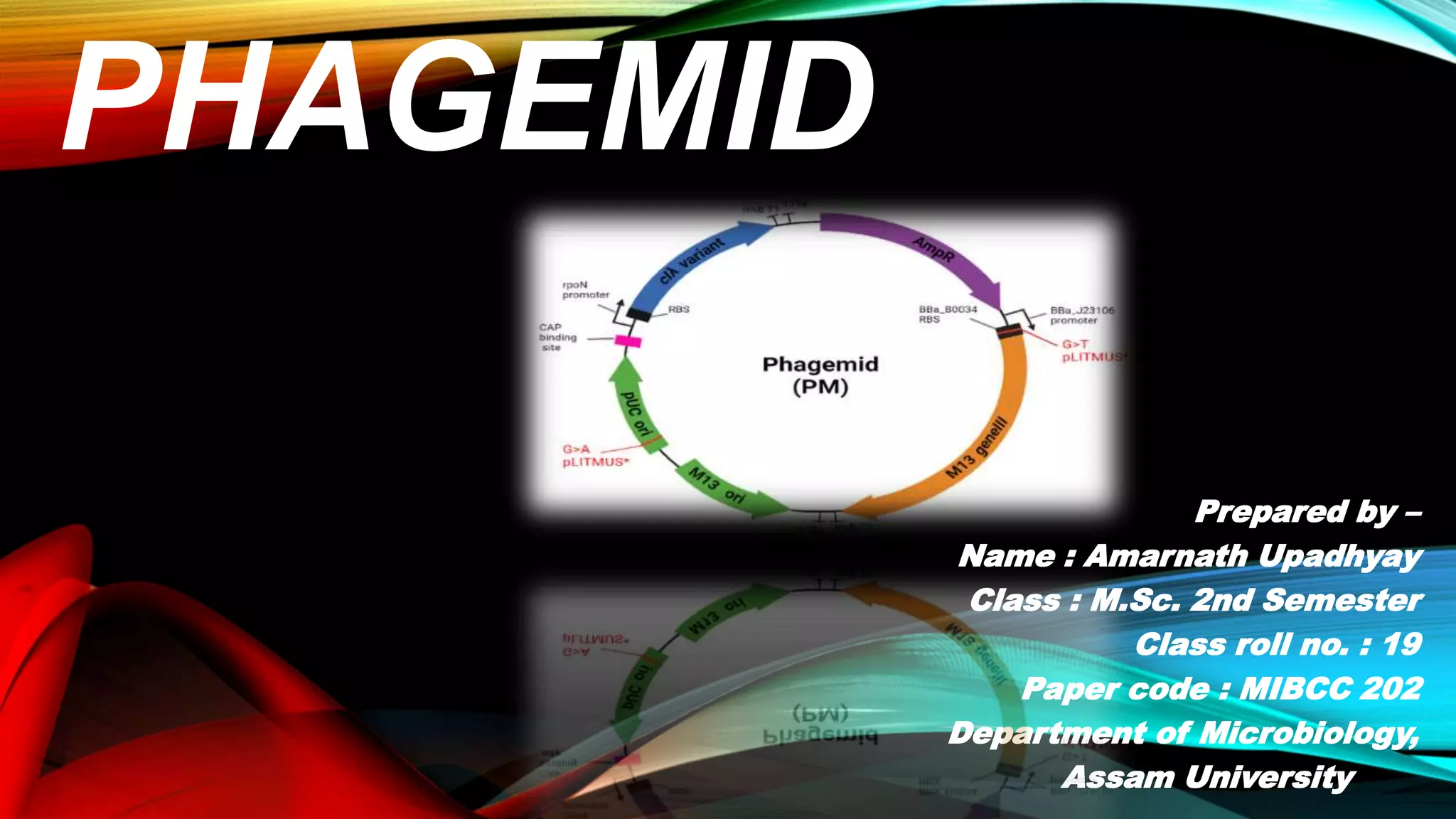
PHAGEMID
Prepared by –
Name : Amarnath Upadhyay
Class : M.Sc. 2nd Semester
Class roll no. : 19
Paper code : MIBCC 202
Department of Microbiology,
Assam University
CONTENTS:
 INTRODUCTION
 DESCRIBING THE PHAGEMID VECTORS
 CONSTRUCTION OF PHAGEMID VECTORS
 USES OF PHAGEMID VECTORS
 ADVANTAGES OVER OTHER PHAGE VECTORS
 CONCLUSION
 REFERENCES
INTRODUCTION
Although M13 vectors are very useful for the production of single-stranded
versions of cloned genes, they do have one disadvantage. There is a limit to
the size of DNA fragment that can be cloned with an M13 vector.
Phagemids (plasmid with a phage origin) are cloning vectors designed to
simplify commonly used cloning and sequencing procedures.
It has both bacteriophage and plasmid properties. Unlike commonly used
plasmids, phagemid vectors differ by having the ability to be packaged into the
capsid of a bacteriophage, due to their having a genetic sequence that signals
for packaging.
PHAGEMID VECTORS
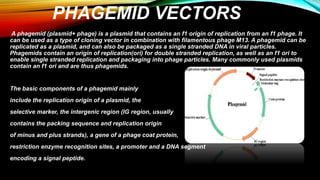
A phagemid (plasmid+ phage) is a plasmid that contains an f1 origin of replication from an f1 phage. It
can be used as a type of cloning vector in combination with filamentous phage M13. A phagemid can be
replicated as a plasmid, and can also be packaged as a single stranded DNA in viral particles.
Phagemids contain an origin of replication(ori) for double stranded replication, as well as an f1 ori to
enable single stranded replication and packaging into phage particles. Many commonly used plasmids
contain an f1 ori and are thus phagemids.
The basic components of a phagemid mainly
include the replication origin of a plasmid, the
selective marker, the intergenic region (IG region, usually
contains the packing sequence and replication origin
of minus and plus strands), a gene of a phage coat protein,
restriction enzyme recognition sites, a promoter and a DNA segment
encoding a signal peptide.
CONSTRUCTION OF PHAGEMID
VECTORS:
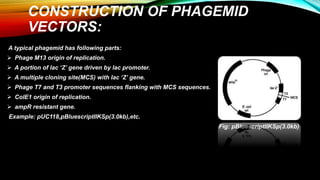
A typical phagemid has following parts:
 Phage M13 origin of replication.
 A portion of lac ‘Z’ gene driven by lac promoter.
 A multiple cloning site(MCS) with lac ‘Z’ gene.
 Phage T7 and T3 promoter sequences flanking with MCS sequences.
 ColE1 origin of replication.
 ampR resistant gene.
Example: pUC118,pBluescriptIIKSp(3.0kb),etc.
Fig: pBluescriptIIKSp(3.0kb)
USES:
The vector is a multipurpose vector as it can serve as the following:
 A cloning vector
 An expression vector
 A sequencing vector
 A ribo-probe vector (used as RNA probes)
ADVANTAGES OVER OTHER
PHAGE VECTORS:
 Carrying capacity
 Higher efficiency
 More stable
 Sequencing purposes
 Site-directed mutagenesis
 Hybridization probes
CONCLUSION:
Phagemid vectors are indispensable tools in phage display technology. Many
phagemid vectors have been constructed according to the different
requirements and objectives of experiments, which have greatly promoted the
applications of phage display. In short, improvements are still needed in
developing phagemid vectors. It can be envisioned that phagemid vectors will
play more important roles in the fields of biosensor, molecular recognition,
protein interactions, drug development, molecular imaging and molecular
evolution.
REFERENCES:
 Filamentous fusion phage: novel expression vectors that display cloned
antigens on the virion surface by Smith, G. P. (1985) ( data retrieved on 8th
Sept,2022).
 Phage Display in Biotechnology and Drug Discovery by CRC Press/Taylor
& Francis, Boca Raton, USA. ( data retrieved on 8th Sept,2022).
 https://en.wikipedia.org/wiki/Phagemid (data retrieved on 8th Sept,2022).
 https://academic.oup.com/synbio/article/3/1/ysy015/5068535 (data retrieved
on 8th Sept,2022).
 https://www.creative-biogene.com/products/phagemid-vector.html (data
retrieved on 8th Sept,2022).
 https://www.sciencedirect.com/topics/biochemistry-genetics-and-
molecular- biology/phagemid (data retrieved on 8th Sept,2022).
THANKYOU…

PHAGEMID.pdf

  • 1.
    PHAGEMID Prepared by – Name: Amarnath Upadhyay Class : M.Sc. 2nd Semester Class roll no. : 19 Paper code : MIBCC 202 Department of Microbiology, Assam University
  • 2.
    CONTENTS:  INTRODUCTION  DESCRIBINGTHE PHAGEMID VECTORS  CONSTRUCTION OF PHAGEMID VECTORS  USES OF PHAGEMID VECTORS  ADVANTAGES OVER OTHER PHAGE VECTORS  CONCLUSION  REFERENCES
  • 3.
    INTRODUCTION Although M13 vectorsare very useful for the production of single-stranded versions of cloned genes, they do have one disadvantage. There is a limit to the size of DNA fragment that can be cloned with an M13 vector. Phagemids (plasmid with a phage origin) are cloning vectors designed to simplify commonly used cloning and sequencing procedures. It has both bacteriophage and plasmid properties. Unlike commonly used plasmids, phagemid vectors differ by having the ability to be packaged into the capsid of a bacteriophage, due to their having a genetic sequence that signals for packaging.
  • 4.
    PHAGEMID VECTORS A phagemid(plasmid+ phage) is a plasmid that contains an f1 origin of replication from an f1 phage. It can be used as a type of cloning vector in combination with filamentous phage M13. A phagemid can be replicated as a plasmid, and can also be packaged as a single stranded DNA in viral particles. Phagemids contain an origin of replication(ori) for double stranded replication, as well as an f1 ori to enable single stranded replication and packaging into phage particles. Many commonly used plasmids contain an f1 ori and are thus phagemids. The basic components of a phagemid mainly include the replication origin of a plasmid, the selective marker, the intergenic region (IG region, usually contains the packing sequence and replication origin of minus and plus strands), a gene of a phage coat protein, restriction enzyme recognition sites, a promoter and a DNA segment encoding a signal peptide.
  • 5.
    CONSTRUCTION OF PHAGEMID VECTORS: Atypical phagemid has following parts:  Phage M13 origin of replication.  A portion of lac ‘Z’ gene driven by lac promoter.  A multiple cloning site(MCS) with lac ‘Z’ gene.  Phage T7 and T3 promoter sequences flanking with MCS sequences.  ColE1 origin of replication.  ampR resistant gene. Example: pUC118,pBluescriptIIKSp(3.0kb),etc. Fig: pBluescriptIIKSp(3.0kb)
  • 6.
    USES: The vector isa multipurpose vector as it can serve as the following:  A cloning vector  An expression vector  A sequencing vector  A ribo-probe vector (used as RNA probes)
  • 7.
    ADVANTAGES OVER OTHER PHAGEVECTORS:  Carrying capacity  Higher efficiency  More stable  Sequencing purposes  Site-directed mutagenesis  Hybridization probes
  • 8.
    CONCLUSION: Phagemid vectors areindispensable tools in phage display technology. Many phagemid vectors have been constructed according to the different requirements and objectives of experiments, which have greatly promoted the applications of phage display. In short, improvements are still needed in developing phagemid vectors. It can be envisioned that phagemid vectors will play more important roles in the fields of biosensor, molecular recognition, protein interactions, drug development, molecular imaging and molecular evolution.
  • 9.
    REFERENCES:  Filamentous fusionphage: novel expression vectors that display cloned antigens on the virion surface by Smith, G. P. (1985) ( data retrieved on 8th Sept,2022).  Phage Display in Biotechnology and Drug Discovery by CRC Press/Taylor & Francis, Boca Raton, USA. ( data retrieved on 8th Sept,2022).  https://en.wikipedia.org/wiki/Phagemid (data retrieved on 8th Sept,2022).  https://academic.oup.com/synbio/article/3/1/ysy015/5068535 (data retrieved on 8th Sept,2022).  https://www.creative-biogene.com/products/phagemid-vector.html (data retrieved on 8th Sept,2022).  https://www.sciencedirect.com/topics/biochemistry-genetics-and- molecular- biology/phagemid (data retrieved on 8th Sept,2022).
  • 10.