Project
Project Title: Laplace Transform
Defination:
In mathematics the Laplace transform is an integral transform named after its discoverer Pierre-
Simon Laplace (/ləˈplɑːs/). It takes a function of a positive real variable t (often time) to a function of
a complex variable s (frequency).
The Laplace transform is invertible on a large class of functions. The inverse Laplace transform takes
a function of a complex variable s (often frequency) and yields a function of a real variable t (time).
Given a simple mathematical or functional description of an input or output to a system, the Laplace
transform provides an alternative functional description that often simplifies the process of analyzing
the behavior of the system, or in synthesizing a newsystembased on a set of specifications
Equation of Laplace Transform:
Supposethatf(t) is apiecewisecontinuousfunction. TheLaplace transformof f(t) is denoted
and definedas
Restrictions:
There are two governing factors that determine whether Laplace transforms can be used:
 f(t) must be at least piecewise continuous for t ≥ 0
 |f(t)| ≤ Meγt
where M and γ are constants
Example Compute L{1}
Solution
There’s not really a whole lot do here other than plug the function f(t) = 1 into (1)
Now, at this point notice that this is nothing more than the integral in the previous example
with . Therefore, all we need to do is reuse (2) with the appropriate
substitution. Doing this gives,
Or, with some simplification we have,
Histroy:
The Laplace transform is named after mathematician and astronomer Pierre-Simon Laplace, who
used a similar transform (now called z transform) in his work on probability theory. The current
widespread use of the transform came about soon after World War II although it had been used in the
19th century by Abel, Lerch, Heaviside, and Bromwich.
From1744, Leonhard Euler investigated integrals of the form
as solutions of differential equations but did not pursue the matter very far. Joseph Louis
Lagrange was an admirer of Euler and, in his work on integratingprobability density functions,
investigated expressions of the form
which some modern historians have interpreted within modern Laplace transformtheory
These types of integrals seem first to have attracted Laplace's attention in 1782 where he was
following in the spirit of Euler in using the integrals themselves as solutions of equations. However, in
1785, Laplace took the critical step forward when, rather than just looking for a solution in the form
of an integral, he started to apply the transforms in the sense that was later to become popular. He
used an integral of the form:
in to a Mellin transform, to transform the whole of a difference equation, in order to look for solutions
of the transformed equation. He then went on to apply the Laplace transform in the same way and
started to derive some of its properties,beginning to appreciate its potential power.
Laplace also recognised that Joseph Fourier's method of Fourier series for solving the diffusion
equation could only apply to a limited region of space because those solutions were periodic. In 1809,
Laplace applied his transformto find solutions that diffused indefinitely in space.
Properties:
The Laplace transform has a number of properties that make it useful for analyzing linear dynamical
systems. The most significant advantage is thatdifferentiation and integration become multiplication
and division, respectively, by s (similarly to logarithms changing multiplication of numbers to
addition of their logarithms). Because of this property, the Laplace variable s is also known
as operator variable in the L domain: either derivative operator or (for s−1
)integration operator. The
transform turns integral equations and differential equations to polynomial equations, which are
much easier to solve. Once solved,use of the inverse Laplace transformreverts to the time domain.
Given the functions f(t) and g(t),and their respective Laplace transforms F(s) and G(s):
the following table is a list of properties of unilateral Laplace transform
Properties of the unilateral Laplace transform
Time domain 's' domain Comment
Linearity
Can be proved using basic rules of
integration.
Frequency-
domain
derivative
F′ is the first derivative of F.
Frequency-
domain
general
derivative
More general form, nth derivative
of F(s).
Derivative
f is assumed to be a differentiable
function, and its derivative is
assumed to be ofexponential type.
This can then be obtained
by integration by parts
Initial value theorem:
Final value theorem:
,
The final value theoremis useful because it gives the long-termbehaviour without having to
perform partial fraction decompositions or otherdifficult algebra. If has a pole in the right-
hand plane orpoles on the imaginary axis (e.g., if or ), the behaviour
of this formula is undefined.
Importance of Laplace transform:
The main idea behind the Laplace Transformation is that we can solve an equation (orsystemof
equations) containing differential and integral terms by transforming the equation in "t-space" to one
in "s-space". This makes the problemmuch easier to solve. The kinds of problems where the Laplace
Transformis invaluable occur in electronics..
Laplace Transform transforms a function into an entirely new variable space(traditionally)
Since derivate of all order are eliminated this turns a probelminto entirely simplified expression.
Application of laplace in engineering:
The Laplace transformis used frequently in engineering and physics; the output of a linear time-
invariant systemcan be calculated by convolving its unitimpulse response with the input signal.
Performing this calculation in Laplace space turns the convolution into a multiplication; the latter
being easier to solve because of its algebraic form.
Real-Life Applications
 Semiconductor mobility
 Call completion in wireless networks
 Vehicle vibrations on compressed rails
 Behavior of magnetic and electric fields above the atmosphere
In science and engineering:
Solving a differential equation
 One common application of Laplace transformis solving differential equations
 However,such application MUST satisfy the following two conditions:
 The variable(s) in the function for the solution,e.g., x, y,z, t must cover
 the range of (0,∞).
 That means the solution function, e.g., u(x) or u(t) MUST also be VALID
 for the range of (0,∞)
 ALL appropriate conditions forthe differential equation MUST be available
In Physics:
In nuclear physics,the Laplace transformgoverns radioactive decay: the number of radioactive
atoms N in a sample of a radioactive isotopedecaysat a rate proportional to N. This leadsto the first
order lineardifferential equation..Moreever it is used in calculating the wave equation.
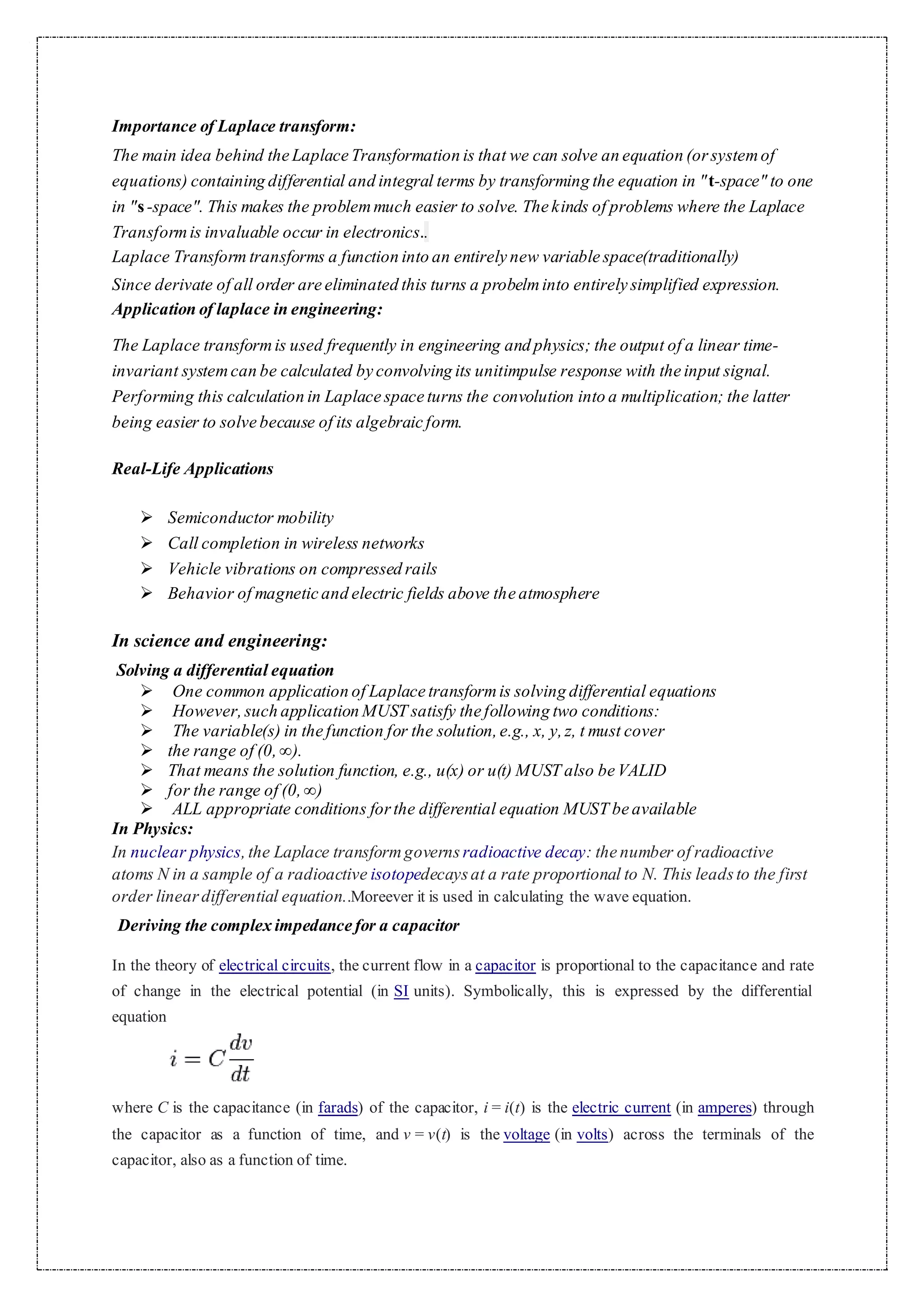
Deriving the complex impedance for a capacitor
In the theory of electrical circuits, the current flow in a capacitor is proportional to the capacitance and rate
of change in the electrical potential (in SI units). Symbolically, this is expressed by the differential
equation
where C is the capacitance (in farads) of the capacitor, i = i(t) is the electric current (in amperes) through
the capacitor as a function of time, and v = v(t) is the voltage (in volts) across the terminals of the
capacitor, also as a function of time.
Taking the Laplace transform of this equation, we obtain
where
and
Solving for V(s) we have
The definition of the complex impedance Z (in ohms) is the ratio of the complex voltage V divided by the
complex current I while holding the initial state Vo at zero:
Using this definition and the previous equation, we find:
which is the correct expression for the complex impedance of a capacitor.
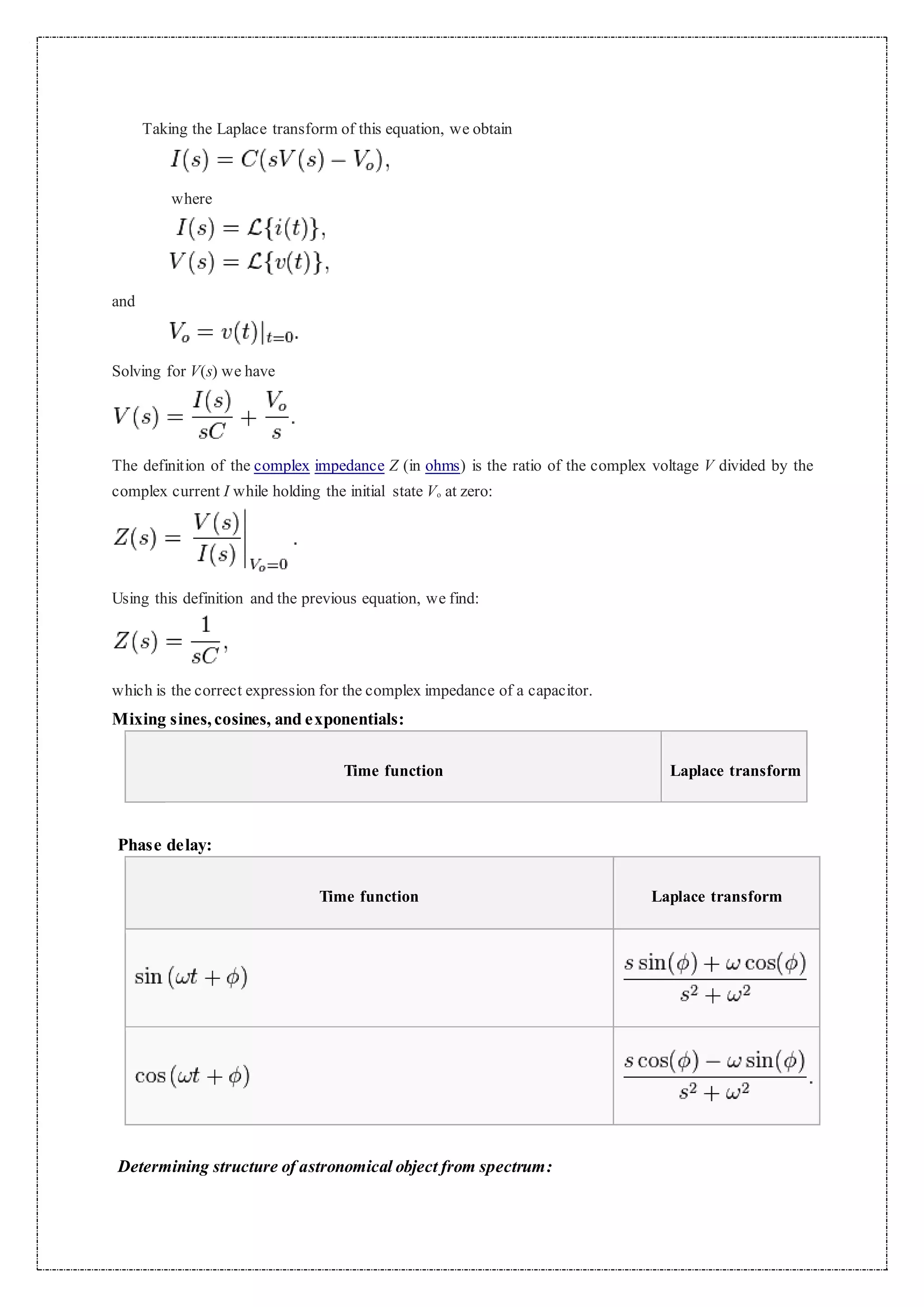
Mixing sines,cosines, and exponentials:
Time function Laplace transform
Phase delay:
Time function Laplace transform
Determining structure of astronomical object from spectrum:
The wide and general applicability of the Laplace transform and its inverse is illustrated by an
application in astronomy which provides some information on the spatial distribution of matter of
an astronomical source of radiofrequency thermal radiation too distant to resolve as more than a
point, given its flux density spectrum, rather than relating the time domain with the spectrum
(frequency domain).
Assuming certain properties of the object, e.g. spherical shape and constant temperature, calculations
based on carrying out an inverse Laplace transformation on the spectrum of the object can produce
the only possible model of the distribution of matter in it (density as a function of distance from the
center) consistent with the spectrum.[20]
When independent information othe structure of an object is
available, the inverse Laplace transform method has been found to be in gLaplace transform converts
complex ordinary differential equations (ODEs) into differential equations that have polynomials in
it.
Practical uses:
 sending signals over any two-way communication medium
 study of control systems
 analysis of HVAC (Heating, Ventilation and Air Conditioning)
 simplify calculations in systemmodelling
 analysis of linear time-invariant systems
 quickly solve differential equations occurring in the analysis of electronic circuits
In electrical engineering:
Time domain Laplace domain
v(t) i(t) F(s) V(S) I(S)
Resistor R
Inductor L
L=di(t)dt
Capacitor C

Laplace transform

  • 1.
    Project Project Title: LaplaceTransform Defination: In mathematics the Laplace transform is an integral transform named after its discoverer Pierre- Simon Laplace (/ləˈplɑːs/). It takes a function of a positive real variable t (often time) to a function of a complex variable s (frequency). The Laplace transform is invertible on a large class of functions. The inverse Laplace transform takes a function of a complex variable s (often frequency) and yields a function of a real variable t (time). Given a simple mathematical or functional description of an input or output to a system, the Laplace transform provides an alternative functional description that often simplifies the process of analyzing the behavior of the system, or in synthesizing a newsystembased on a set of specifications Equation of Laplace Transform: Supposethatf(t) is apiecewisecontinuousfunction. TheLaplace transformof f(t) is denoted and definedas Restrictions: There are two governing factors that determine whether Laplace transforms can be used:  f(t) must be at least piecewise continuous for t ≥ 0  |f(t)| ≤ Meγt where M and γ are constants Example Compute L{1} Solution There’s not really a whole lot do here other than plug the function f(t) = 1 into (1) Now, at this point notice that this is nothing more than the integral in the previous example with . Therefore, all we need to do is reuse (2) with the appropriate substitution. Doing this gives, Or, with some simplification we have,
  • 2.
    Histroy: The Laplace transformis named after mathematician and astronomer Pierre-Simon Laplace, who used a similar transform (now called z transform) in his work on probability theory. The current widespread use of the transform came about soon after World War II although it had been used in the 19th century by Abel, Lerch, Heaviside, and Bromwich. From1744, Leonhard Euler investigated integrals of the form as solutions of differential equations but did not pursue the matter very far. Joseph Louis Lagrange was an admirer of Euler and, in his work on integratingprobability density functions, investigated expressions of the form which some modern historians have interpreted within modern Laplace transformtheory These types of integrals seem first to have attracted Laplace's attention in 1782 where he was following in the spirit of Euler in using the integrals themselves as solutions of equations. However, in 1785, Laplace took the critical step forward when, rather than just looking for a solution in the form of an integral, he started to apply the transforms in the sense that was later to become popular. He used an integral of the form: in to a Mellin transform, to transform the whole of a difference equation, in order to look for solutions of the transformed equation. He then went on to apply the Laplace transform in the same way and started to derive some of its properties,beginning to appreciate its potential power. Laplace also recognised that Joseph Fourier's method of Fourier series for solving the diffusion equation could only apply to a limited region of space because those solutions were periodic. In 1809, Laplace applied his transformto find solutions that diffused indefinitely in space. Properties: The Laplace transform has a number of properties that make it useful for analyzing linear dynamical systems. The most significant advantage is thatdifferentiation and integration become multiplication and division, respectively, by s (similarly to logarithms changing multiplication of numbers to addition of their logarithms). Because of this property, the Laplace variable s is also known as operator variable in the L domain: either derivative operator or (for s−1 )integration operator. The transform turns integral equations and differential equations to polynomial equations, which are much easier to solve. Once solved,use of the inverse Laplace transformreverts to the time domain. Given the functions f(t) and g(t),and their respective Laplace transforms F(s) and G(s):
  • 3.
    the following tableis a list of properties of unilateral Laplace transform Properties of the unilateral Laplace transform Time domain 's' domain Comment Linearity Can be proved using basic rules of integration. Frequency- domain derivative F′ is the first derivative of F. Frequency- domain general derivative More general form, nth derivative of F(s). Derivative f is assumed to be a differentiable function, and its derivative is assumed to be ofexponential type. This can then be obtained by integration by parts Initial value theorem: Final value theorem: , The final value theoremis useful because it gives the long-termbehaviour without having to perform partial fraction decompositions or otherdifficult algebra. If has a pole in the right- hand plane orpoles on the imaginary axis (e.g., if or ), the behaviour of this formula is undefined.
  • 4.
    Importance of Laplacetransform: The main idea behind the Laplace Transformation is that we can solve an equation (orsystemof equations) containing differential and integral terms by transforming the equation in "t-space" to one in "s-space". This makes the problemmuch easier to solve. The kinds of problems where the Laplace Transformis invaluable occur in electronics.. Laplace Transform transforms a function into an entirely new variable space(traditionally) Since derivate of all order are eliminated this turns a probelminto entirely simplified expression. Application of laplace in engineering: The Laplace transformis used frequently in engineering and physics; the output of a linear time- invariant systemcan be calculated by convolving its unitimpulse response with the input signal. Performing this calculation in Laplace space turns the convolution into a multiplication; the latter being easier to solve because of its algebraic form. Real-Life Applications  Semiconductor mobility  Call completion in wireless networks  Vehicle vibrations on compressed rails  Behavior of magnetic and electric fields above the atmosphere In science and engineering: Solving a differential equation  One common application of Laplace transformis solving differential equations  However,such application MUST satisfy the following two conditions:  The variable(s) in the function for the solution,e.g., x, y,z, t must cover  the range of (0,∞).  That means the solution function, e.g., u(x) or u(t) MUST also be VALID  for the range of (0,∞)  ALL appropriate conditions forthe differential equation MUST be available In Physics: In nuclear physics,the Laplace transformgoverns radioactive decay: the number of radioactive atoms N in a sample of a radioactive isotopedecaysat a rate proportional to N. This leadsto the first order lineardifferential equation..Moreever it is used in calculating the wave equation. Deriving the complex impedance for a capacitor In the theory of electrical circuits, the current flow in a capacitor is proportional to the capacitance and rate of change in the electrical potential (in SI units). Symbolically, this is expressed by the differential equation where C is the capacitance (in farads) of the capacitor, i = i(t) is the electric current (in amperes) through the capacitor as a function of time, and v = v(t) is the voltage (in volts) across the terminals of the capacitor, also as a function of time.
  • 5.
    Taking the Laplacetransform of this equation, we obtain where and Solving for V(s) we have The definition of the complex impedance Z (in ohms) is the ratio of the complex voltage V divided by the complex current I while holding the initial state Vo at zero: Using this definition and the previous equation, we find: which is the correct expression for the complex impedance of a capacitor. Mixing sines,cosines, and exponentials: Time function Laplace transform Phase delay: Time function Laplace transform Determining structure of astronomical object from spectrum:
  • 6.
    The wide andgeneral applicability of the Laplace transform and its inverse is illustrated by an application in astronomy which provides some information on the spatial distribution of matter of an astronomical source of radiofrequency thermal radiation too distant to resolve as more than a point, given its flux density spectrum, rather than relating the time domain with the spectrum (frequency domain). Assuming certain properties of the object, e.g. spherical shape and constant temperature, calculations based on carrying out an inverse Laplace transformation on the spectrum of the object can produce the only possible model of the distribution of matter in it (density as a function of distance from the center) consistent with the spectrum.[20] When independent information othe structure of an object is available, the inverse Laplace transform method has been found to be in gLaplace transform converts complex ordinary differential equations (ODEs) into differential equations that have polynomials in it. Practical uses:  sending signals over any two-way communication medium  study of control systems  analysis of HVAC (Heating, Ventilation and Air Conditioning)  simplify calculations in systemmodelling  analysis of linear time-invariant systems  quickly solve differential equations occurring in the analysis of electronic circuits In electrical engineering: Time domain Laplace domain v(t) i(t) F(s) V(S) I(S) Resistor R Inductor L L=di(t)dt
  • 7.