Modulation of Digital Data
1. Digital-to-Analog Conversion
2. Amplitude Shift Keying (ASK)
3. Frequency Shift Keying (FSK)
4. Phase Shift Keying (PSK)
5. Quadrature Amplitude Modulation (QAM)
6. Bit/Baud Comparison
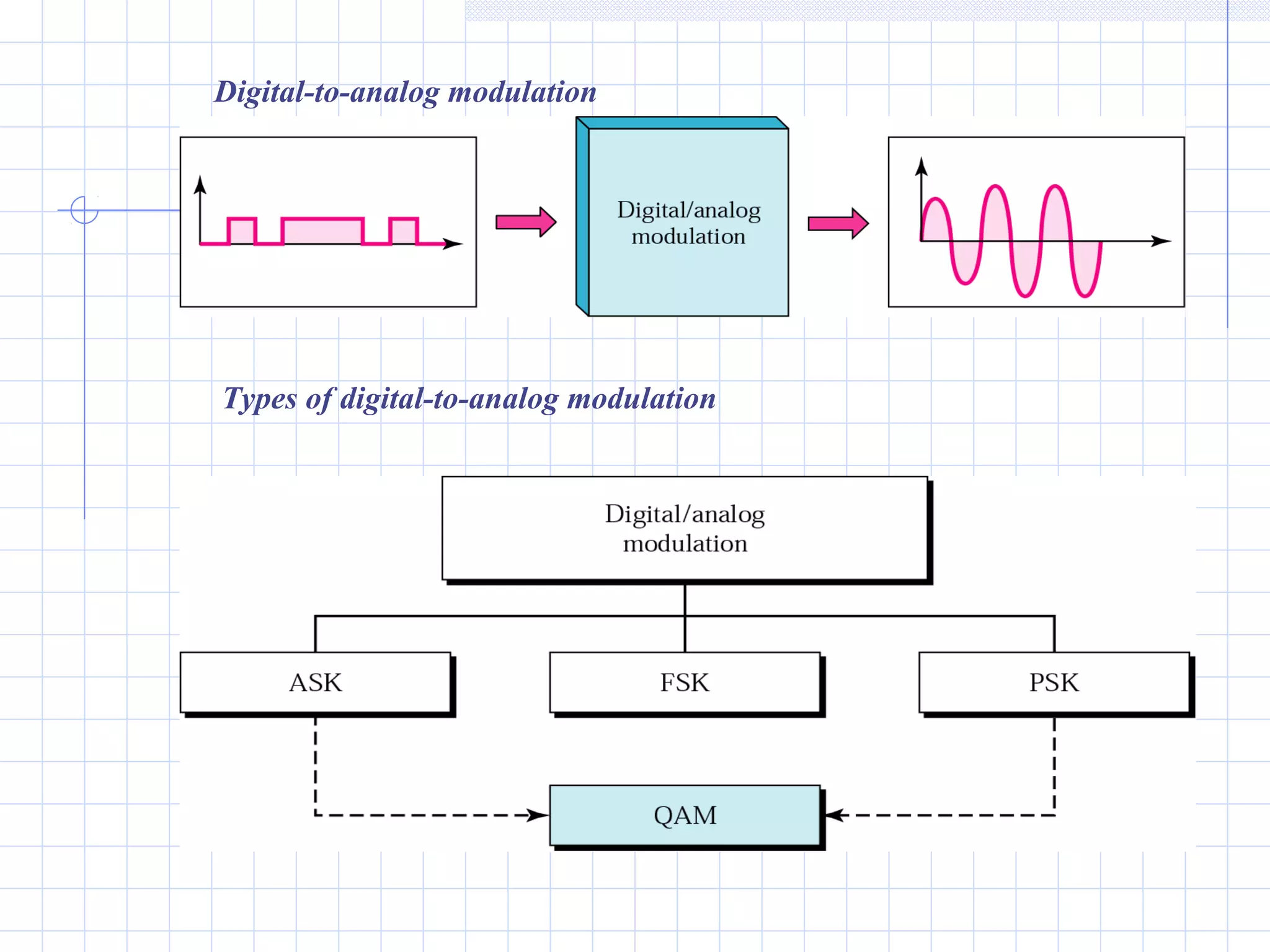
Digital-to-analog modulation
Types of digital-to-analog modulation
Aspects to digital-to Analog conversion
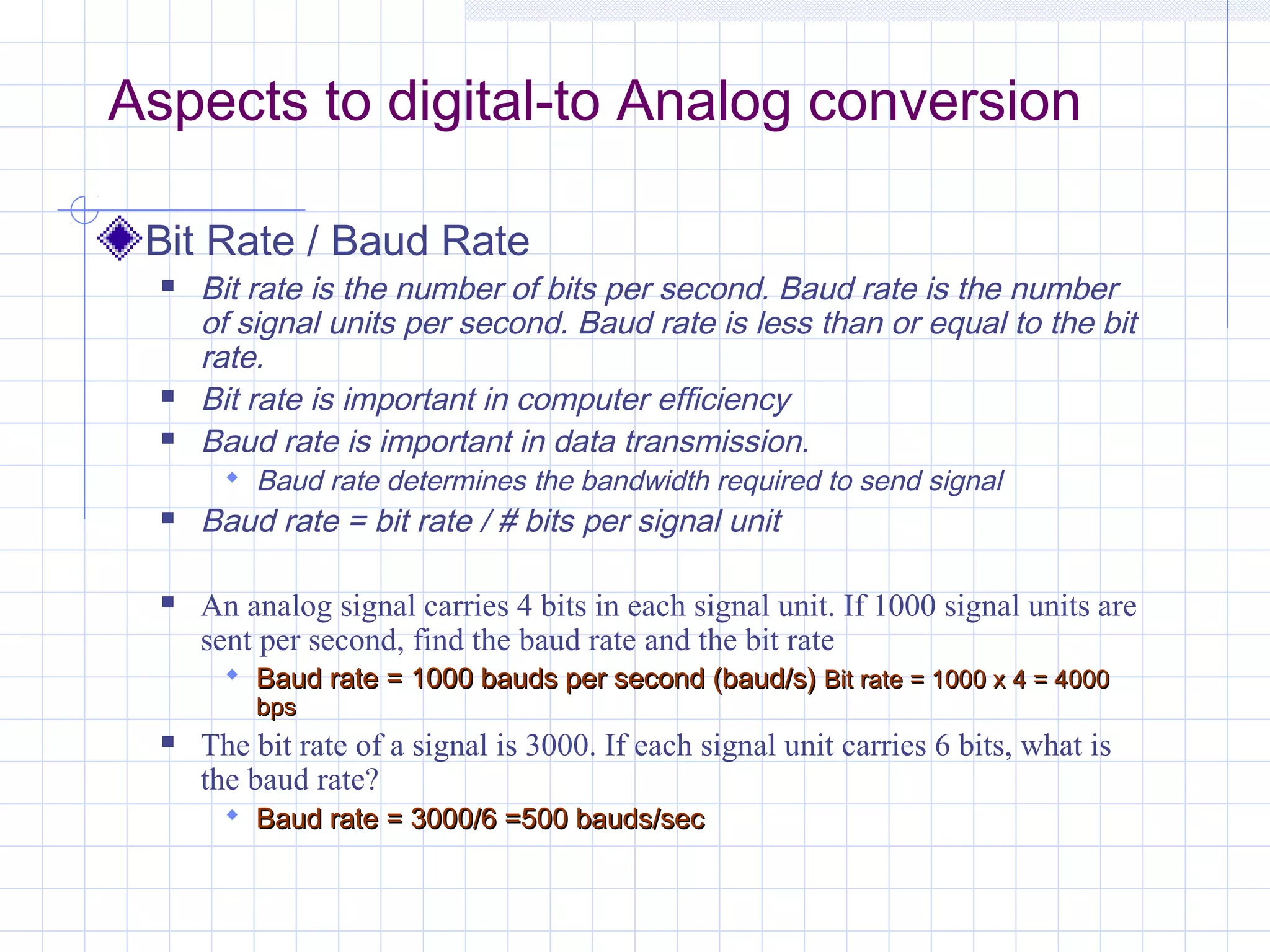
Bit Rate / Baud Rate
 Bit rate is the number of bits per second. Baud rate is the number
of signal units per second. Baud rate is less than or equal to the bit
rate.
 Bit rate is important in computer efficiency
 Baud rate is important in data transmission.
 Baud rate determines the bandwidth required to send signal
 Baud rate = bit rate / # bits per signal unit
 An analog signal carries 4 bits in each signal unit. If 1000 signal units are
sent per second, find the baud rate and the bit rate
 Baud rate = 1000 bauds per second (baud/s)Baud rate = 1000 bauds per second (baud/s) Bit rate = 1000 x 4 = 4000Bit rate = 1000 x 4 = 4000
bpsbps
 The bit rate of a signal is 3000. If each signal unit carries 6 bits, what is
the baud rate?
 Baud rate = 3000/6 =500 bauds/secBaud rate = 3000/6 =500 bauds/sec
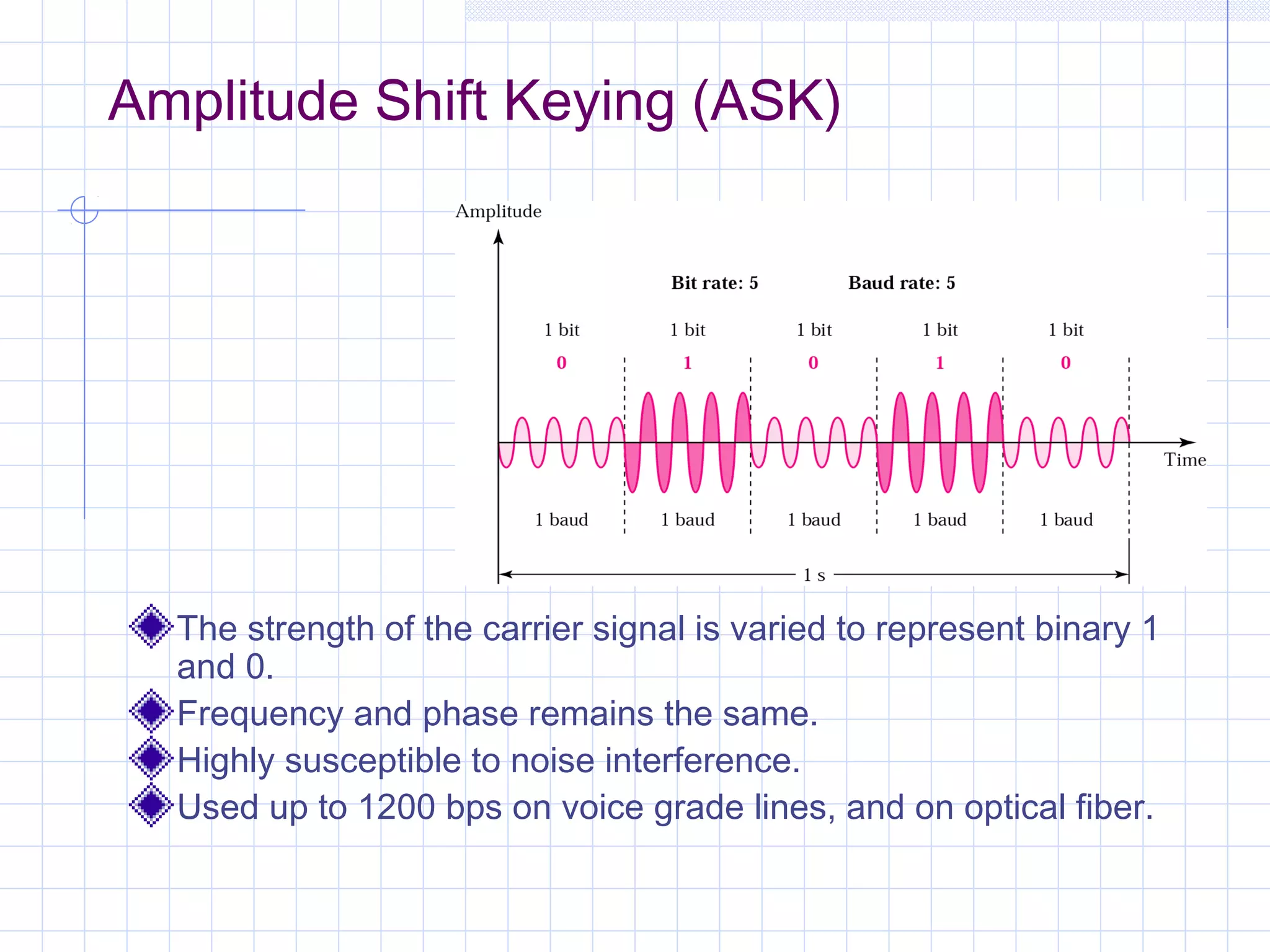
Amplitude Shift Keying (ASK)
The strength of the carrier signal is varied to represent binary 1
and 0.
Frequency and phase remains the same.
Highly susceptible to noise interference.
Used up to 1200 bps on voice grade lines, and on optical fiber.
ASK
The simplest and most common form of ASK
operates as a switch, using the presence of a
carrier wave to indicate a binary one and its
absence to indicate a binary zero. This type
of modulation is called on-off keying (OOK),
and is used at radio frequencies to transmit
Morse code (referred to as continuous wave
operation)
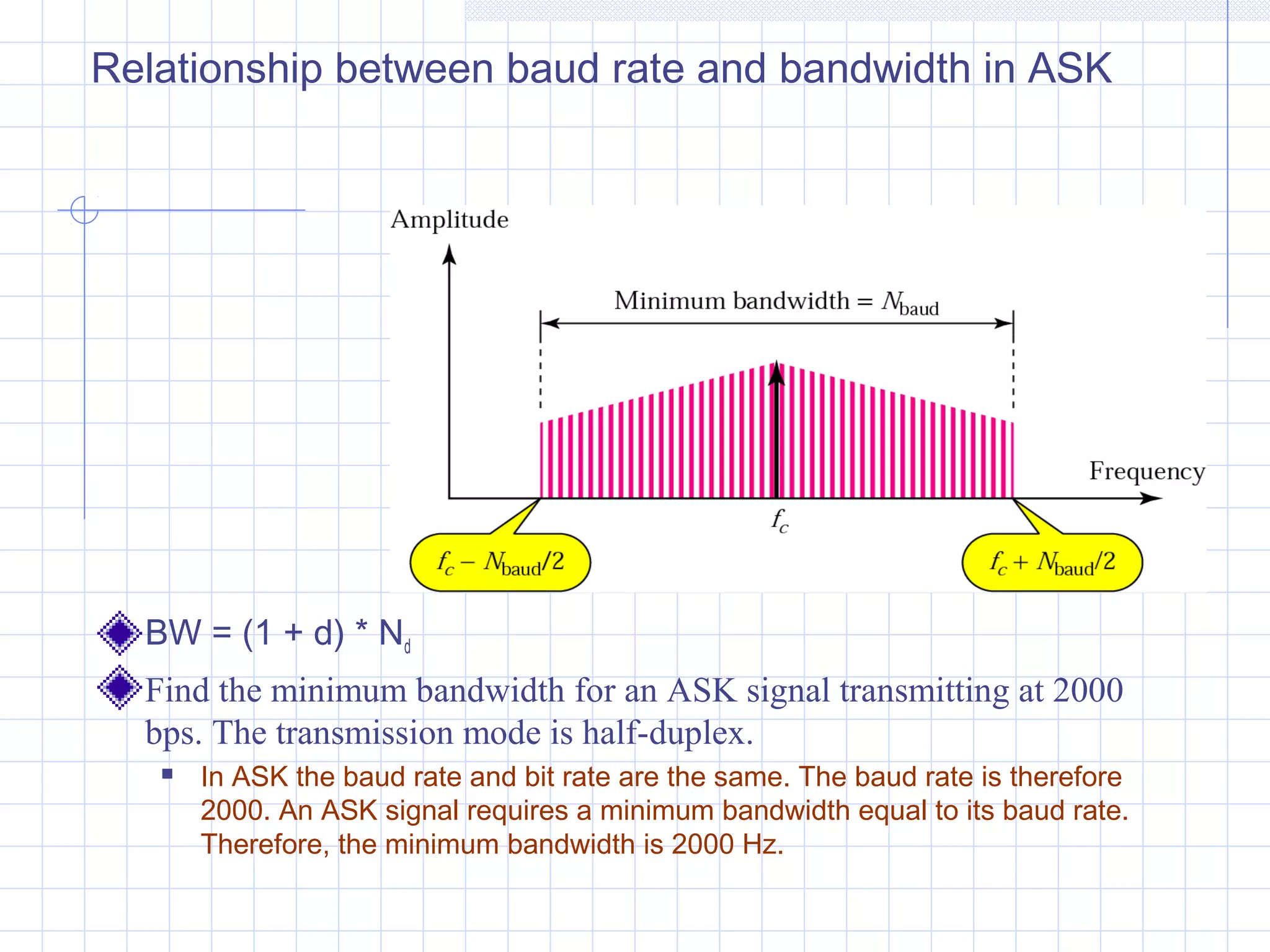
Relationship between baud rate and bandwidth in ASK
BW = (1 + d) * Nd
Find the minimum bandwidth for an ASK signal transmitting at 2000
bps. The transmission mode is half-duplex.
 In ASK the baud rate and bit rate are the same. The baud rate is therefore
2000. An ASK signal requires a minimum bandwidth equal to its baud rate.
Therefore, the minimum bandwidth is 2000 Hz.
Full duplex ASK
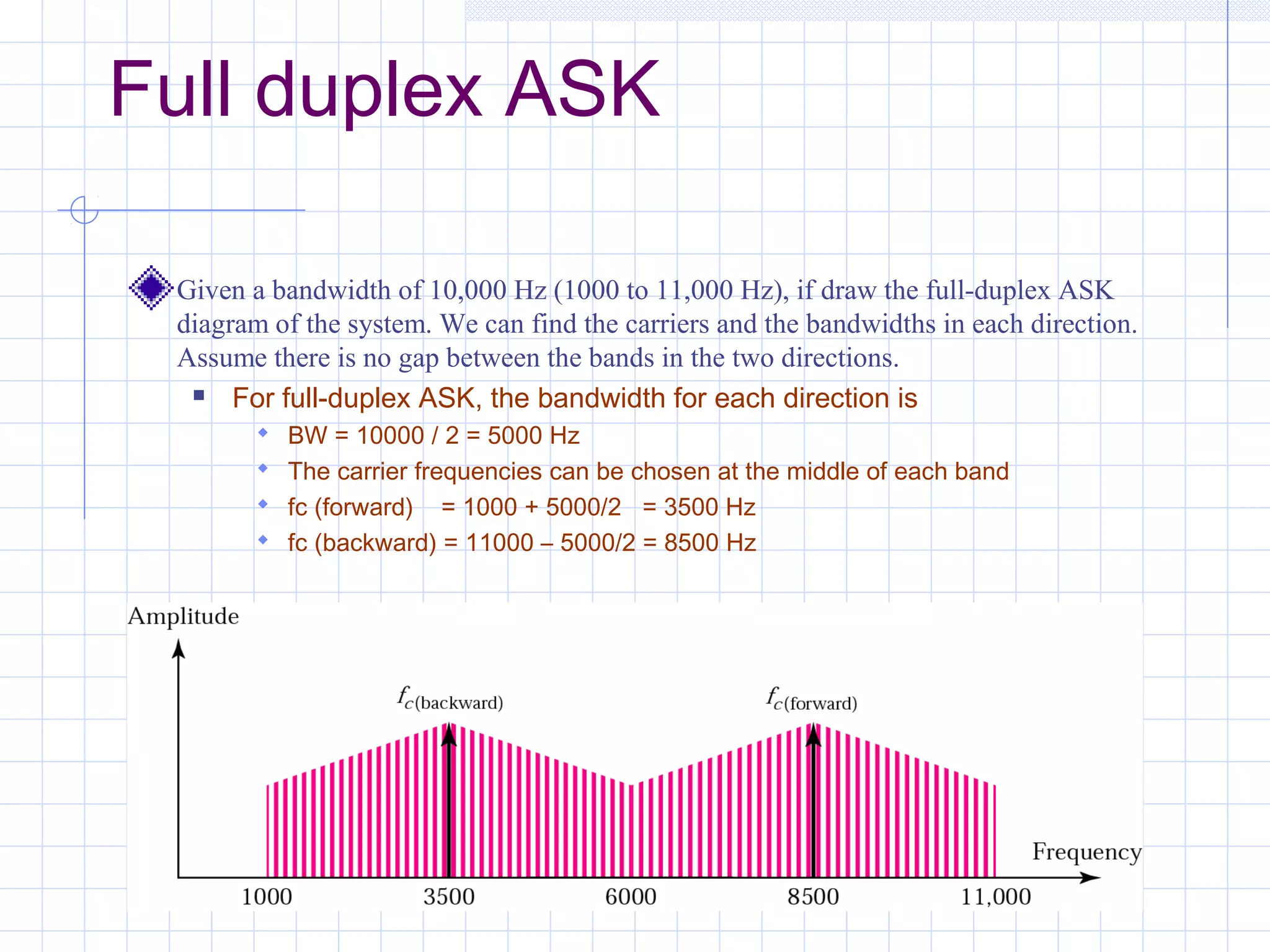
Given a bandwidth of 10,000 Hz (1000 to 11,000 Hz), if draw the full-duplex ASK
diagram of the system. We can find the carriers and the bandwidths in each direction.
Assume there is no gap between the bands in the two directions.
 For full-duplex ASK, the bandwidth for each direction is
 BW = 10000 / 2 = 5000 Hz
 The carrier frequencies can be chosen at the middle of each band
 fc (forward) = 1000 + 5000/2 = 3500 Hz
 fc (backward) = 11000 – 5000/2 = 8500 Hz
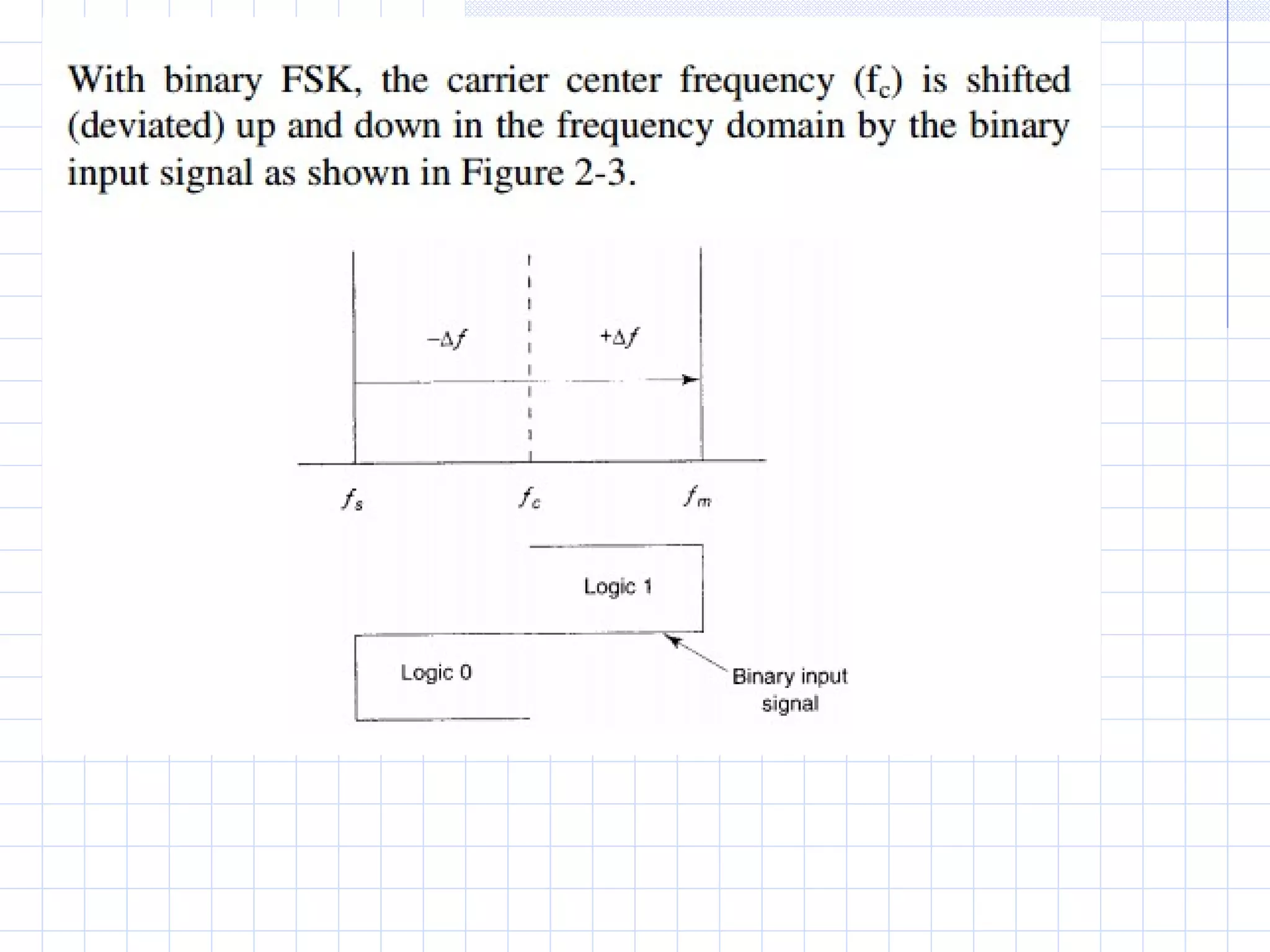
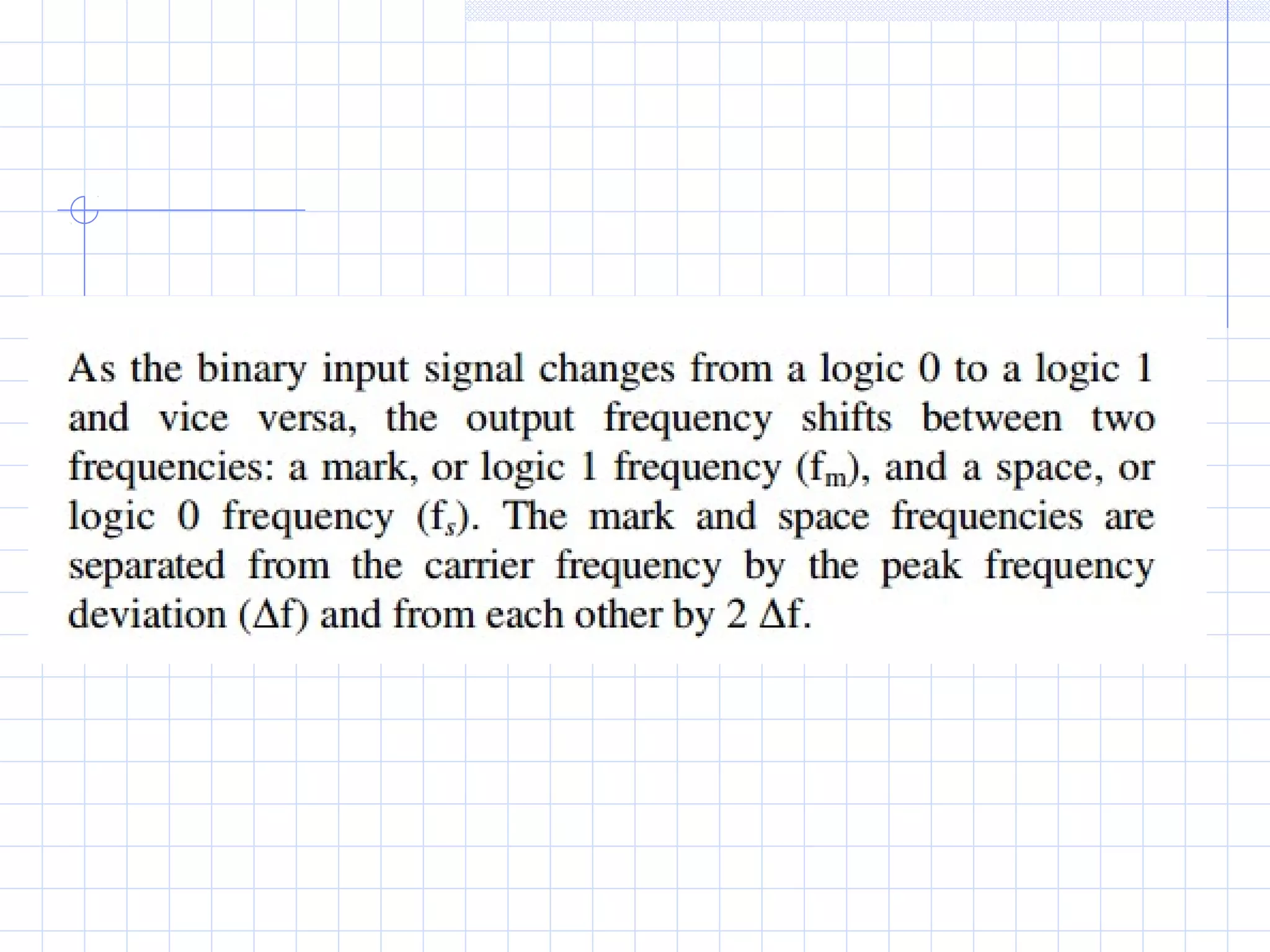
Frequency Shift Keying
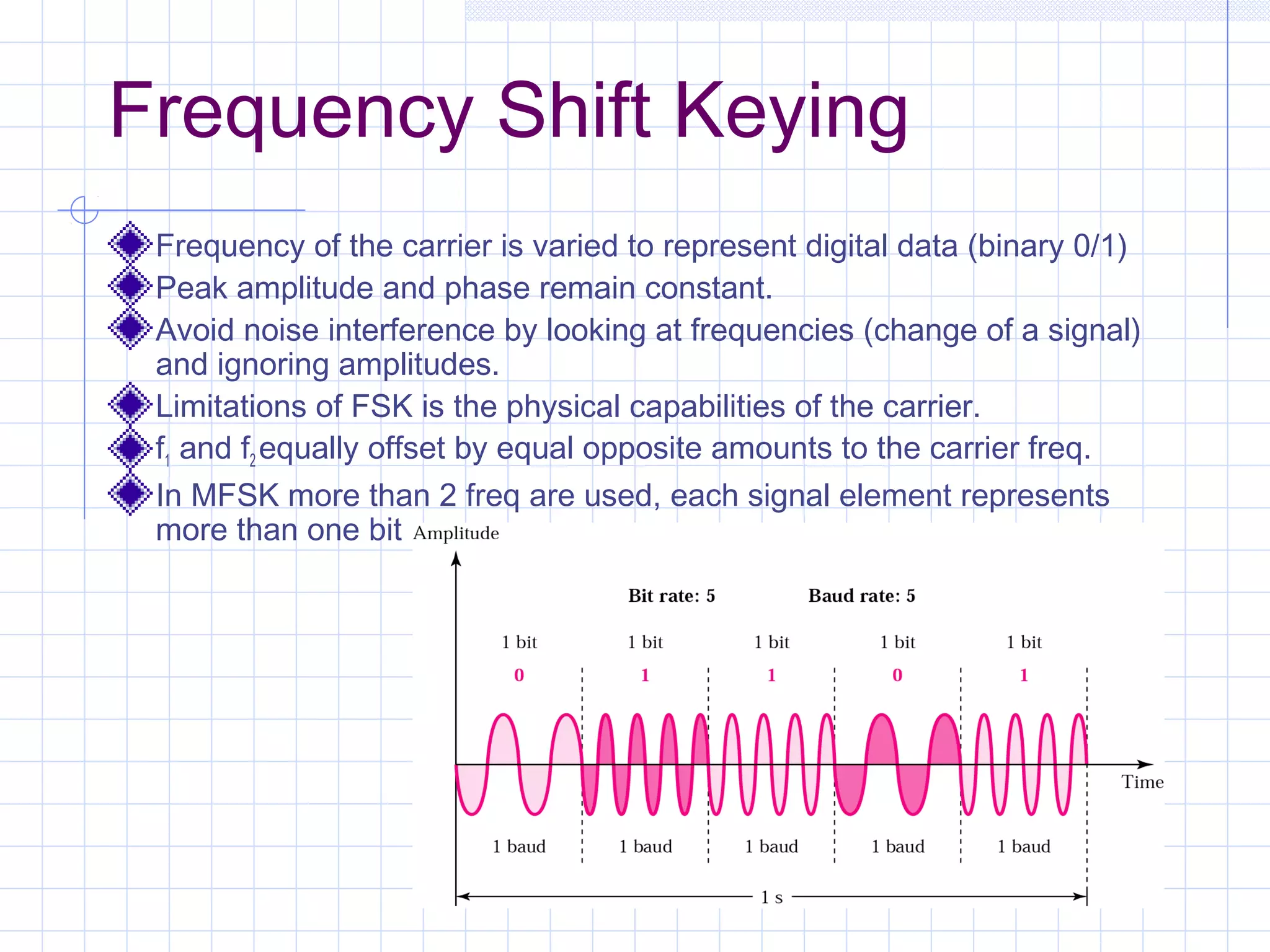
Frequency of the carrier is varied to represent digital data (binary 0/1)
Peak amplitude and phase remain constant.
Avoid noise interference by looking at frequencies (change of a signal)
and ignoring amplitudes.
Limitations of FSK is the physical capabilities of the carrier.
f1 and f2 equally offset by equal opposite amounts to the carrier freq.
In MFSK more than 2 freq are used, each signal element represents
more than one bit
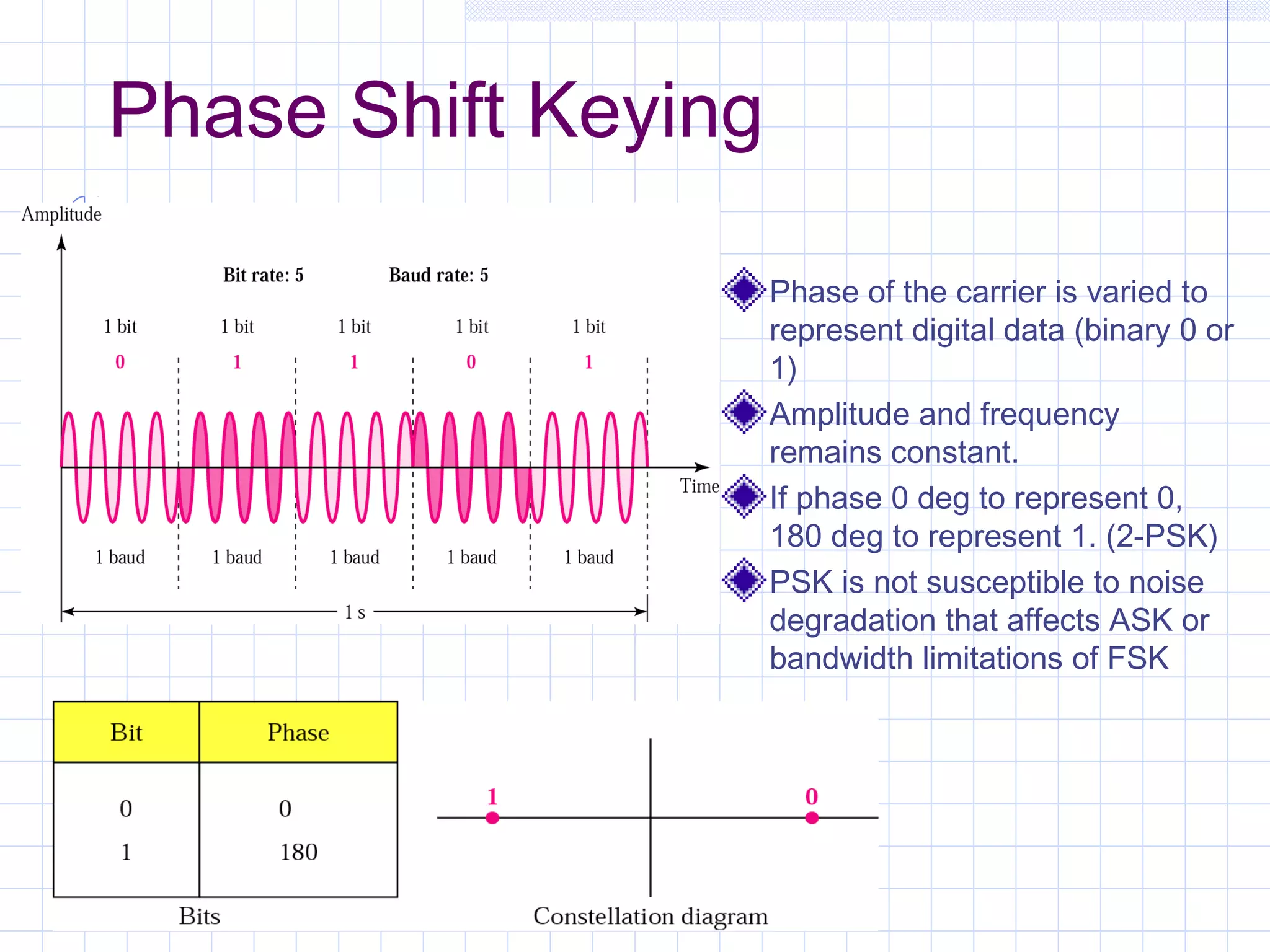
Phase Shift Keying
Phase of the carrier is varied to
represent digital data (binary 0 or
1)
Amplitude and frequency
remains constant.
If phase 0 deg to represent 0,
180 deg to represent 1. (2-PSK)
PSK is not susceptible to noise
degradation that affects ASK or
bandwidth limitations of FSK
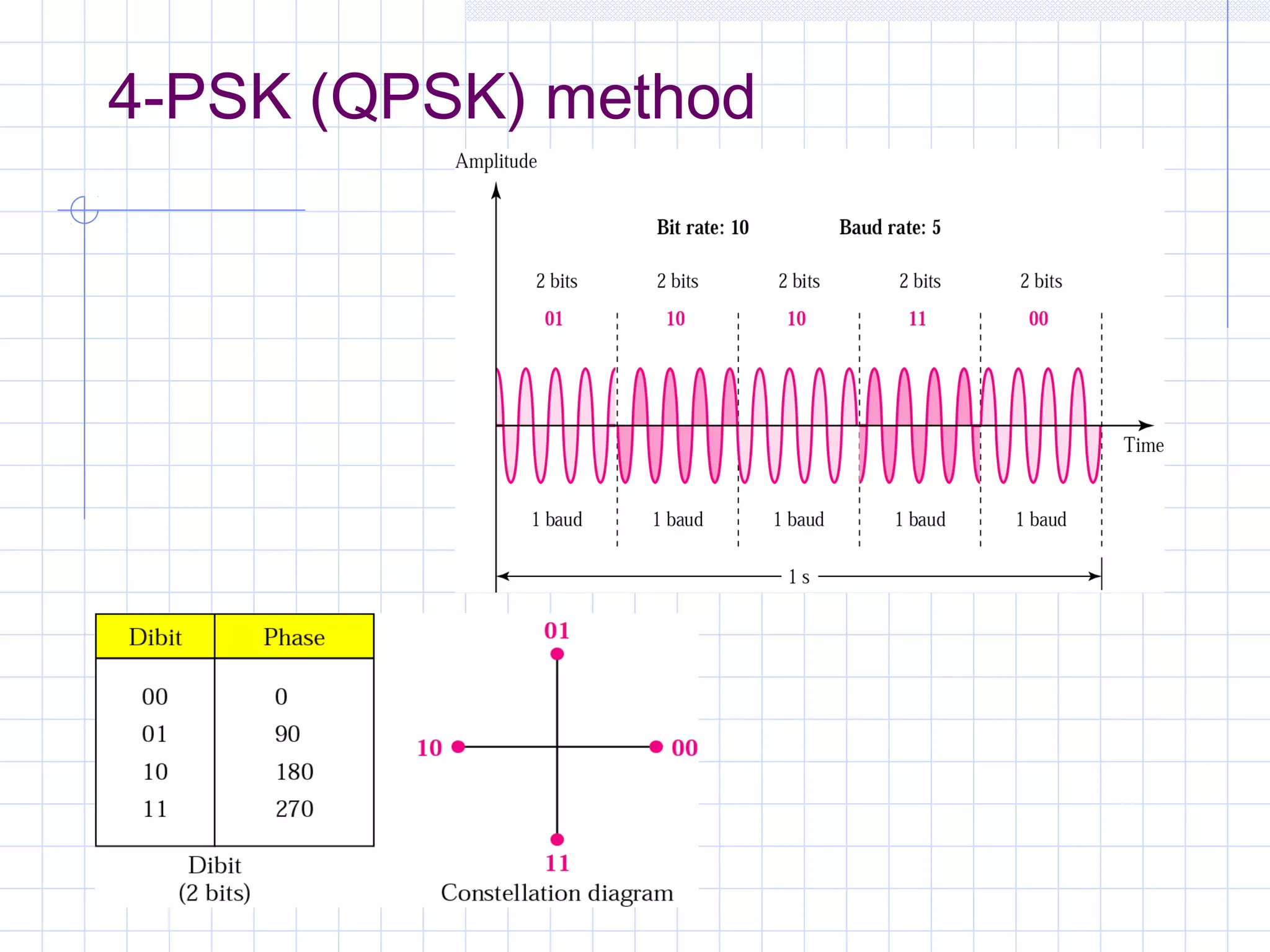
4-PSK (QPSK) method
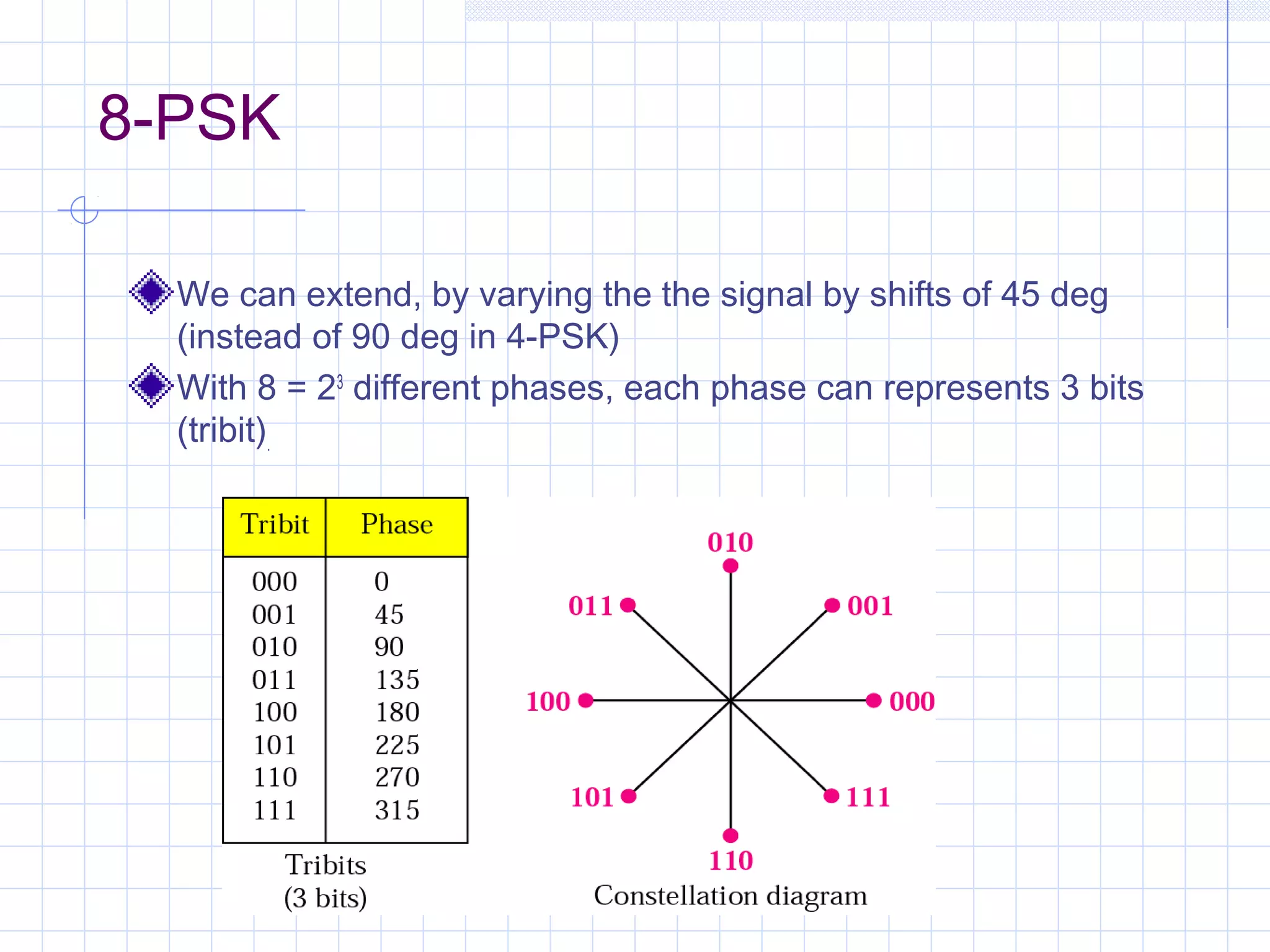
8-PSK
We can extend, by varying the the signal by shifts of 45 deg
(instead of 90 deg in 4-PSK)
With 8 = 23
different phases, each phase can represents 3 bits
(tribit).
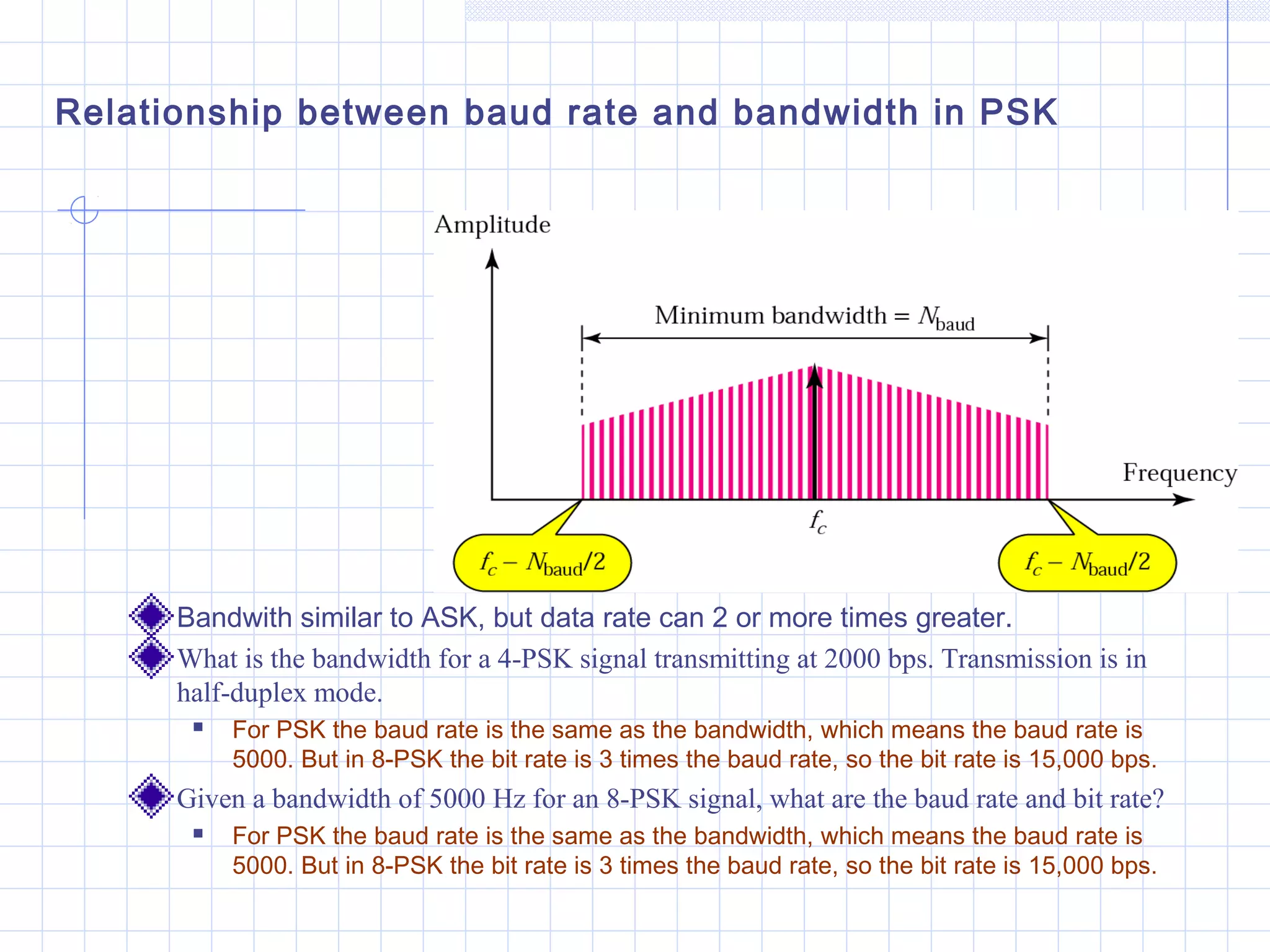
Relationship between baud rate and bandwidth in PSK
Bandwith similar to ASK, but data rate can 2 or more times greater.
What is the bandwidth for a 4-PSK signal transmitting at 2000 bps. Transmission is in
half-duplex mode.
 For PSK the baud rate is the same as the bandwidth, which means the baud rate is
5000. But in 8-PSK the bit rate is 3 times the baud rate, so the bit rate is 15,000 bps.
Given a bandwidth of 5000 Hz for an 8-PSK signal, what are the baud rate and bit rate?
 For PSK the baud rate is the same as the bandwidth, which means the baud rate is
5000. But in 8-PSK the bit rate is 3 times the baud rate, so the bit rate is 15,000 bps.
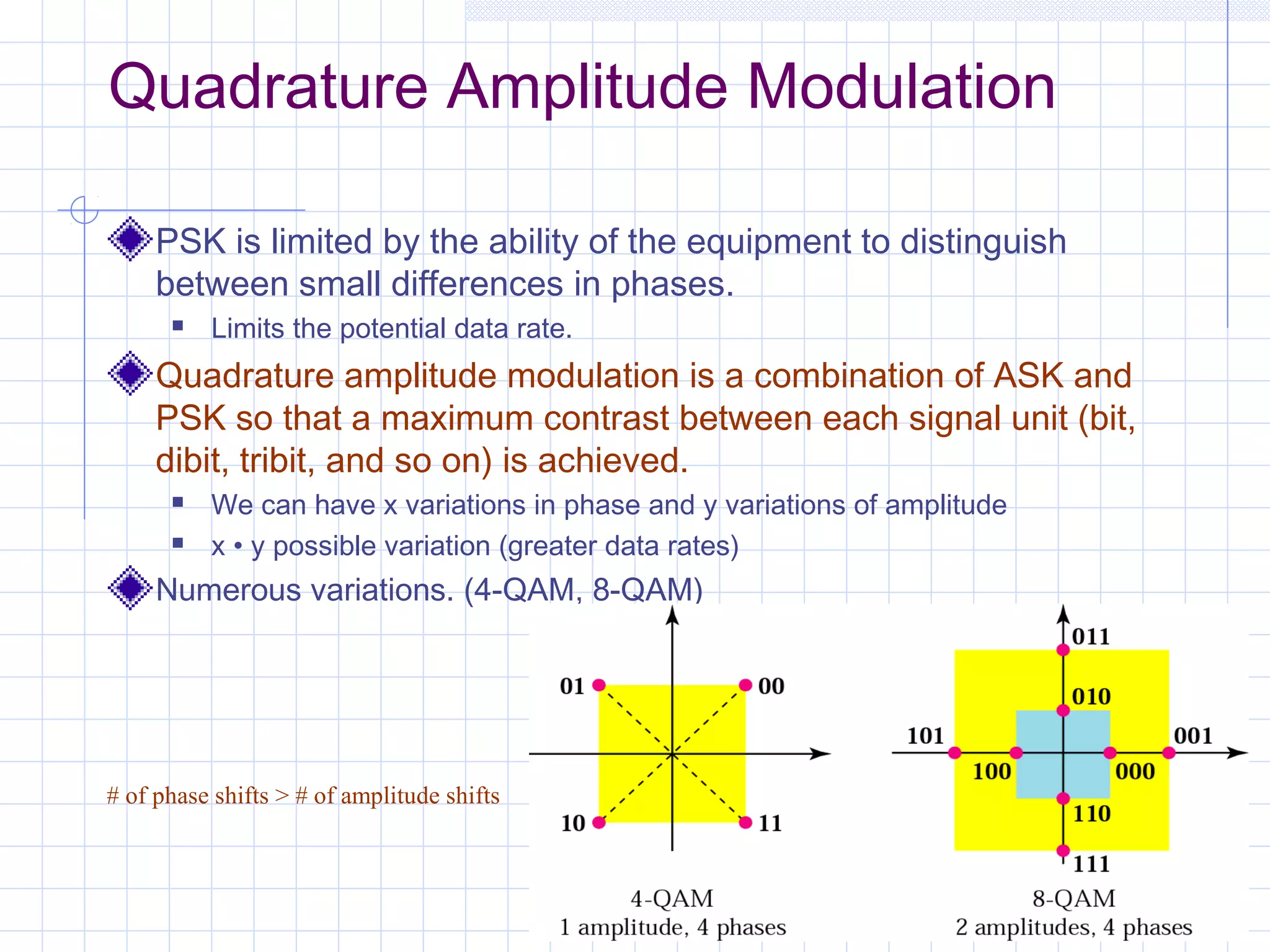
Quadrature Amplitude Modulation
PSK is limited by the ability of the equipment to distinguish
between small differences in phases.
 Limits the potential data rate.
Quadrature amplitude modulation is a combination of ASK and
PSK so that a maximum contrast between each signal unit (bit,
dibit, tribit, and so on) is achieved.
 We can have x variations in phase and y variations of amplitude
 x • y possible variation (greater data rates)
Numerous variations. (4-QAM, 8-QAM)
# of phase shifts > # of amplitude shifts
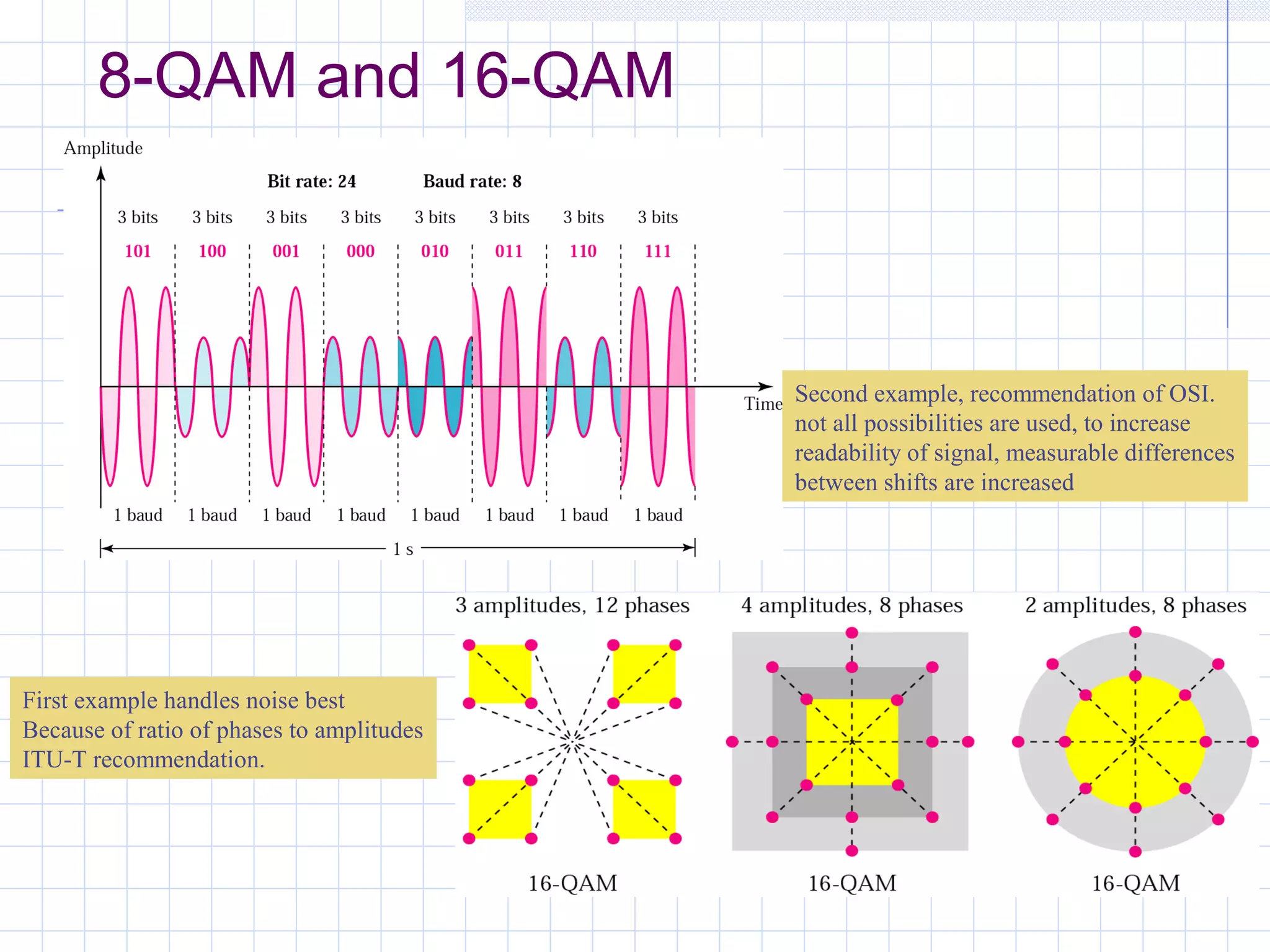
8-QAM and 16-QAM
First example handles noise best
Because of ratio of phases to amplitudes
ITU-T recommendation.
Second example, recommendation of OSI.
not all possibilities are used, to increase
readability of signal, measurable differences
between shifts are increased
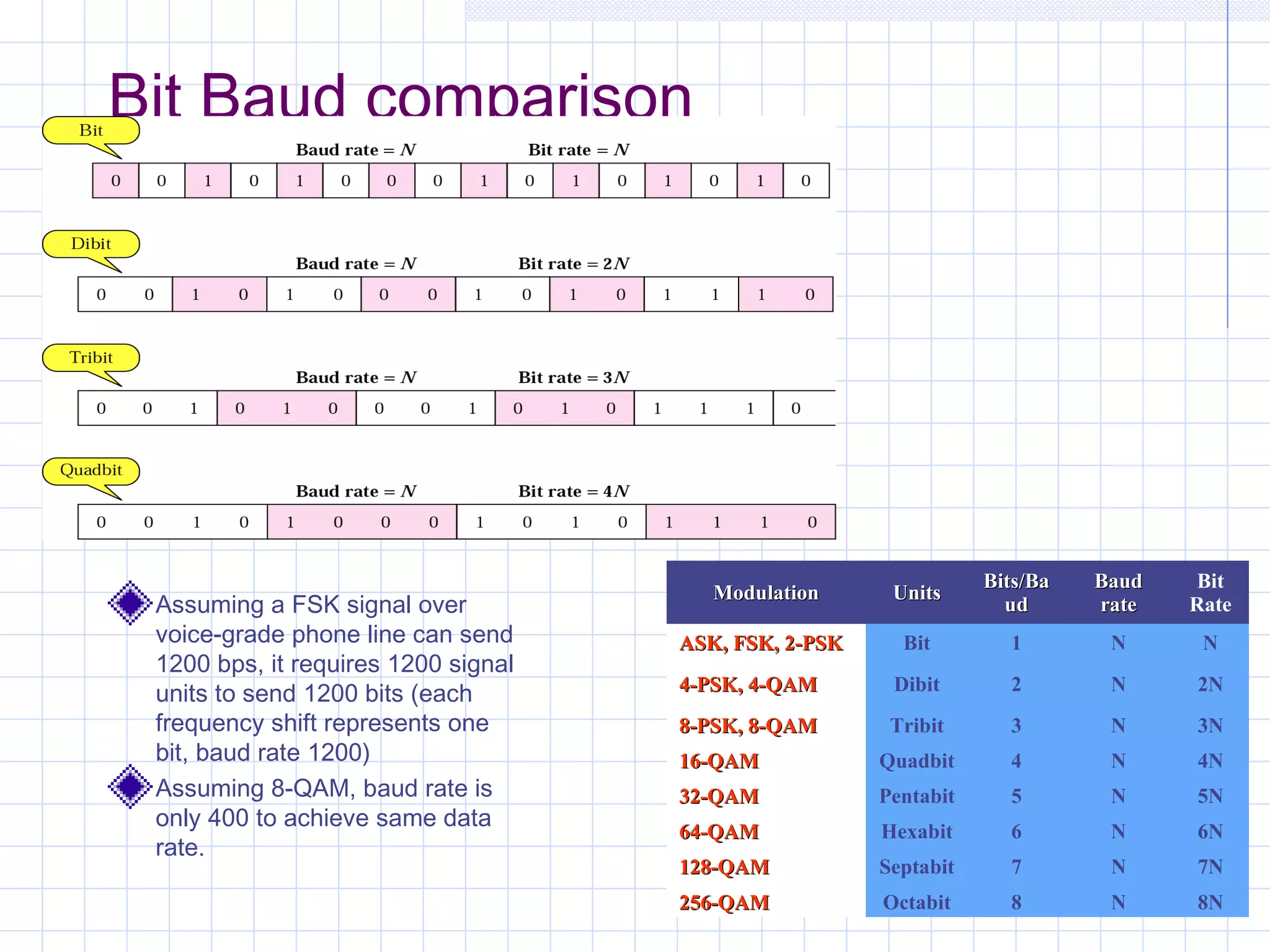
Bit Baud comparison
Assuming a FSK signal over
voice-grade phone line can send
1200 bps, it requires 1200 signal
units to send 1200 bits (each
frequency shift represents one
bit, baud rate 1200)
Assuming 8-QAM, baud rate is
only 400 to achieve same data
rate.
ModulationModulation UnitsUnits
Bits/BaBits/Ba
udud
BaudBaud
raterate
Bit
Rate
ASK, FSK, 2-PSKASK, FSK, 2-PSK Bit 1 N N
4-PSK, 4-QAM4-PSK, 4-QAM Dibit 2 N 2N
8-PSK, 8-QAM8-PSK, 8-QAM Tribit 3 N 3N
16-QAM16-QAM Quadbit 4 N 4N
32-QAM32-QAM Pentabit 5 N 5N
64-QAM64-QAM Hexabit 6 N 6N
128-QAM128-QAM Septabit 7 N 7N
256-QAM256-QAM Octabit 8 N 8N

Modulation of digital_and_analog_data

  • 1.
    Modulation of DigitalData 1. Digital-to-Analog Conversion 2. Amplitude Shift Keying (ASK) 3. Frequency Shift Keying (FSK) 4. Phase Shift Keying (PSK) 5. Quadrature Amplitude Modulation (QAM) 6. Bit/Baud Comparison
  • 2.
    Digital-to-analog modulation Types ofdigital-to-analog modulation
  • 3.
    Aspects to digital-toAnalog conversion Bit Rate / Baud Rate  Bit rate is the number of bits per second. Baud rate is the number of signal units per second. Baud rate is less than or equal to the bit rate.  Bit rate is important in computer efficiency  Baud rate is important in data transmission.  Baud rate determines the bandwidth required to send signal  Baud rate = bit rate / # bits per signal unit  An analog signal carries 4 bits in each signal unit. If 1000 signal units are sent per second, find the baud rate and the bit rate  Baud rate = 1000 bauds per second (baud/s)Baud rate = 1000 bauds per second (baud/s) Bit rate = 1000 x 4 = 4000Bit rate = 1000 x 4 = 4000 bpsbps  The bit rate of a signal is 3000. If each signal unit carries 6 bits, what is the baud rate?  Baud rate = 3000/6 =500 bauds/secBaud rate = 3000/6 =500 bauds/sec
  • 4.
    Amplitude Shift Keying(ASK) The strength of the carrier signal is varied to represent binary 1 and 0. Frequency and phase remains the same. Highly susceptible to noise interference. Used up to 1200 bps on voice grade lines, and on optical fiber.
  • 5.
    ASK The simplest andmost common form of ASK operates as a switch, using the presence of a carrier wave to indicate a binary one and its absence to indicate a binary zero. This type of modulation is called on-off keying (OOK), and is used at radio frequencies to transmit Morse code (referred to as continuous wave operation)
  • 6.
    Relationship between baudrate and bandwidth in ASK BW = (1 + d) * Nd Find the minimum bandwidth for an ASK signal transmitting at 2000 bps. The transmission mode is half-duplex.  In ASK the baud rate and bit rate are the same. The baud rate is therefore 2000. An ASK signal requires a minimum bandwidth equal to its baud rate. Therefore, the minimum bandwidth is 2000 Hz.
  • 7.
    Full duplex ASK Givena bandwidth of 10,000 Hz (1000 to 11,000 Hz), if draw the full-duplex ASK diagram of the system. We can find the carriers and the bandwidths in each direction. Assume there is no gap between the bands in the two directions.  For full-duplex ASK, the bandwidth for each direction is  BW = 10000 / 2 = 5000 Hz  The carrier frequencies can be chosen at the middle of each band  fc (forward) = 1000 + 5000/2 = 3500 Hz  fc (backward) = 11000 – 5000/2 = 8500 Hz
  • 8.
    Frequency Shift Keying Frequencyof the carrier is varied to represent digital data (binary 0/1) Peak amplitude and phase remain constant. Avoid noise interference by looking at frequencies (change of a signal) and ignoring amplitudes. Limitations of FSK is the physical capabilities of the carrier. f1 and f2 equally offset by equal opposite amounts to the carrier freq. In MFSK more than 2 freq are used, each signal element represents more than one bit
  • 11.
    Phase Shift Keying Phaseof the carrier is varied to represent digital data (binary 0 or 1) Amplitude and frequency remains constant. If phase 0 deg to represent 0, 180 deg to represent 1. (2-PSK) PSK is not susceptible to noise degradation that affects ASK or bandwidth limitations of FSK
  • 12.
  • 13.
    8-PSK We can extend,by varying the the signal by shifts of 45 deg (instead of 90 deg in 4-PSK) With 8 = 23 different phases, each phase can represents 3 bits (tribit).
  • 14.
    Relationship between baudrate and bandwidth in PSK Bandwith similar to ASK, but data rate can 2 or more times greater. What is the bandwidth for a 4-PSK signal transmitting at 2000 bps. Transmission is in half-duplex mode.  For PSK the baud rate is the same as the bandwidth, which means the baud rate is 5000. But in 8-PSK the bit rate is 3 times the baud rate, so the bit rate is 15,000 bps. Given a bandwidth of 5000 Hz for an 8-PSK signal, what are the baud rate and bit rate?  For PSK the baud rate is the same as the bandwidth, which means the baud rate is 5000. But in 8-PSK the bit rate is 3 times the baud rate, so the bit rate is 15,000 bps.
  • 15.
    Quadrature Amplitude Modulation PSKis limited by the ability of the equipment to distinguish between small differences in phases.  Limits the potential data rate. Quadrature amplitude modulation is a combination of ASK and PSK so that a maximum contrast between each signal unit (bit, dibit, tribit, and so on) is achieved.  We can have x variations in phase and y variations of amplitude  x • y possible variation (greater data rates) Numerous variations. (4-QAM, 8-QAM) # of phase shifts > # of amplitude shifts
  • 16.
    8-QAM and 16-QAM Firstexample handles noise best Because of ratio of phases to amplitudes ITU-T recommendation. Second example, recommendation of OSI. not all possibilities are used, to increase readability of signal, measurable differences between shifts are increased
  • 17.
    Bit Baud comparison Assuminga FSK signal over voice-grade phone line can send 1200 bps, it requires 1200 signal units to send 1200 bits (each frequency shift represents one bit, baud rate 1200) Assuming 8-QAM, baud rate is only 400 to achieve same data rate. ModulationModulation UnitsUnits Bits/BaBits/Ba udud BaudBaud raterate Bit Rate ASK, FSK, 2-PSKASK, FSK, 2-PSK Bit 1 N N 4-PSK, 4-QAM4-PSK, 4-QAM Dibit 2 N 2N 8-PSK, 8-QAM8-PSK, 8-QAM Tribit 3 N 3N 16-QAM16-QAM Quadbit 4 N 4N 32-QAM32-QAM Pentabit 5 N 5N 64-QAM64-QAM Hexabit 6 N 6N 128-QAM128-QAM Septabit 7 N 7N 256-QAM256-QAM Octabit 8 N 8N