This document discusses the Laplace transform of periodic functions. It defines periodic functions as functions that repeat their values over a fixed time period. The Laplace transform can be used to change periodic functions into other functions in terms of the variable s. Specifically, the formula for the Laplace transform of a periodic function f(t) with period T is 1/(1-e-as) from 0 to T of e-st f(t) dt. The document proves this formula and provides examples of finding the Laplace transforms of periodic functions like sin(pt) and square waves. It concludes with some applications of Laplace transforms in engineering.
Laplace Transform
The LaplaceTransform is an operator that uses a definite
integral to change a function of one variable denoted by t to
another function denoted by s.
If f(t) is a function of t satisfying certain conditions, then the
definite integral is denoted as L[f(t)] , it is defined by
L[f(t)] = 0
∞
𝑒−𝑠𝑡. f(t)dt
3.
Periodic Function
A functionf(t) is said to be periodic if there exists constant
period T (T>0) such that f(t + T) = f(t) for all values of t.
f(t + 2T) = f(t + T + T) = f(t + T) = f(t)
In general, f(t + nT) = f(t) for all t, where n is an integer and T is
The period of the function.
Thus Formula for Laplace Transform of Periodic function is:
L[f(t)] =
𝟏
𝟏−𝒆−𝒂𝒔 𝟎
𝒂
𝒆−𝒂𝒕f(t)dt
4.
Proof of Theorem
Iff(t) is a periodic function with period T, then f(t + T) = f(t)
L[ f(t) ] = 0
∞
𝑒−𝑠𝑡
f(t)dt
= 0
𝑇
𝑒−𝑠𝑡 f(t)dt + 𝑇
2𝑇
𝑒−𝑠𝑡 f(t)dt + 2𝑇
3𝑇
𝑒−𝑠𝑡 f(t)dt + …
= 𝐼1 + 𝐼2 + 𝐼3 + …
Now Substitute t = T+ u in 𝐼2 … (i)
∴ 𝐼2 = 𝑇
2𝑇
𝑒−𝑠𝑡
f(t)dt
= 0
𝑇
𝑒−𝑠(𝑇+𝑢) 𝑓(𝑇 + 𝑢) du
= 𝑒−𝑠𝑇
0
𝑇
𝑒−𝑠𝑢
𝑓 𝑢 𝑑𝑢 𝑓 𝑇 + 𝑢 = 𝑓 𝑢
= 𝑒−𝑠𝑇 𝐼1
Diff (i) w.r.t,
1= 0+
𝑑𝑢
𝑑𝑡
dt= du
When t=T then u=0
When t=2T then
u=T
5.
Similarly ,put t=2T+u…(ii)
∴ 𝐼3 = 2𝑇
3𝑇
𝑒−𝑠𝑡
𝑓 𝑡 𝑑𝑡
= 0
𝑇
𝑒−𝑠(2𝑇+𝑢)
𝑓 2𝑇 + 𝑢 𝑑𝑢
= 𝑒−2𝑠𝑇
0
𝑇
𝑒−𝑠𝑢
𝑓 𝑢 𝑑𝑢 [𝑓 2𝑇 + 𝑢 = 𝑓(𝑢)]
= 𝑒−2𝑠𝑇
𝐼1
On continuing the same way, we get
𝐼4 = 𝑒−3𝑠𝑇
𝐼1
𝐼5 = 𝑒−4𝑠𝑇
𝐼1
𝐼6 = 𝑒−6𝑠𝑇
𝐼1 & so on…
∴ L[f(t)] = 𝐼1 + 𝐼2 + 𝐼3+ 𝐼4 + … .
∴ L[f(t)] = 𝐼1 + 𝑒−𝑠𝑇
𝐼1+ 𝑒−2𝑠𝑇
𝐼1 + 𝑒−3𝑠𝑇
𝐼1 + …
But it is geometric progression (infinite series)
Here first term → 𝐼1 & common ratio → 𝑒−𝑠𝑇
[ r < 1]
The sum of infinite GP is
𝑎
1−𝑟
→
𝐼1
1− 𝑒−𝑠𝑇 =
1
1− 𝑒−𝑠𝑇 0
𝑇
𝑒−𝑠𝑡
f(t)dt
Diff (ii) w.r.t,
1= 0+
𝑑𝑢
𝑑𝑡
dt=du
When t=2T then
u=0
When t= 3T then
u=T
L[f(t)] =
1
1−𝑒−𝑠𝑇 0
𝑇
𝑒−𝑠𝑡
𝑓(𝑡 𝑑𝑡)
6.
Find the Laplacetransform of f(t)= | sin p t|, t >=0.
Sol: We first note that f [t +
П
𝑝
] = |sin p [t +
П
𝑝
]|
= |sin (pt+П)|= |sin pt|
؞ f(t) is a periodic function with period
П
𝑝
Now, L f(t) =
1
1− 𝑒−П𝑠/𝑝 0
П/𝑝
𝑒−𝑠𝑡
|sin pt|dt
=
1
1− 𝑒−П𝑠/𝑝 0
П/𝑝
𝑒−𝑠𝑡
sin pt dt [∵ sin pt > 0, for 0≤ t ≤
П
𝑝
]
=
1
1− 𝑒−П𝑠/𝑝 [
𝑒−𝑠𝑡
𝑠2+𝑝2 ( −s sin pt − pcos pt)] П/𝑝
0
Examples
𝑒𝑎𝑥
sin 𝑏𝑥 𝑑𝑥 =
𝑒𝑎𝑥
𝑎2+ 𝑏2 [ a sin 𝑏𝑥 - b cos 𝑏𝑥 ] + c
7.
=
1
1− 𝑒−П𝑠/𝑝 .
1
𝑠2+𝑝2[𝑒−𝑠П/𝑝
0 + 𝑝 − (0 − 𝑝) ]
=
1
𝑠2+𝑝2 .
1
1− 𝑒−П𝑠/𝑝 .p. (1+ 𝑒−П𝑠/𝑝)
=
𝑝
𝑠2+𝑝2 (
𝑒П𝑠/2𝑝+𝑒−П𝑠/2𝑝
𝑒П𝑠/2𝑝 − 𝑒−П𝑠/2𝑝 )
=
𝑝
𝑠2+𝑝2 cot h (
П𝑠
2𝑝
)
The function f(t)= |sin p t |is known as full –sine wave rectifier and its
graph
shown below.
8.
Find laplace transformof f(t) = 1, for 0 ≤ t < a and f(t) = -1, a < t
< 2a and f(t) is periodic with period 2a.
Sol. Since f(t) is periodic with period 2a,
L[f(t)] =
1
1 − 𝑒−2𝑎𝑠 0
2𝑎
𝑒−𝑠𝑡
𝑓 𝑡 𝑑𝑡
=
1
1 − 𝑒−2𝑎𝑠 [ 0
𝑎
𝑒−𝑠𝑡
(1)𝑑𝑡 + 𝑎
2𝑎
𝑒−𝑠𝑡
−1 𝑑𝑡 ]
=
1
1 − 𝑒−2𝑎𝑠 [{-
𝑒−𝑠𝑡
𝑠
}𝑎
0
+ {
𝑒−𝑠𝑡
𝑠
}2𝑎
𝑎
]
=
1
𝑠
.
1
1 − 𝑒−2𝑎𝑠 . (1 − 𝑒−𝑎𝑠)
2
9.
=
1
𝑠
.
1 − 𝑒−𝑎𝑠
1+ 𝑒−𝑎𝑠
=
1
𝑠
.
𝑒𝑎𝑠/2 − 𝑒−𝑎𝑠/2
𝑒𝑎𝑠/2+ 𝑒−𝑎𝑠/2
=
1
𝑠
tanh{
𝑎𝑠
2
}
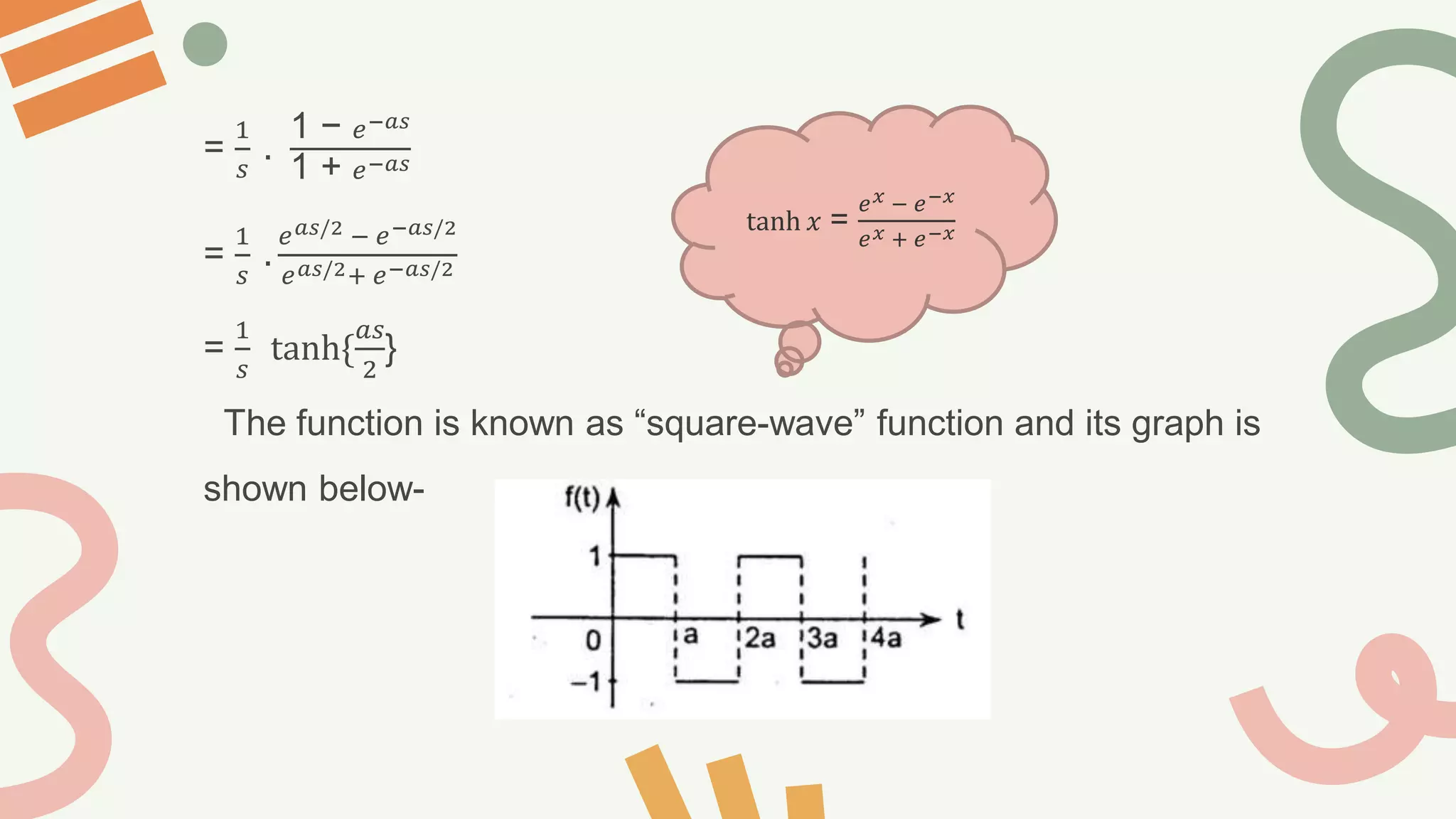
The function is known as “square-wave” function and its graph is
shown below-
tanh 𝑥 =
𝑒𝑥 − 𝑒−𝑥
𝑒𝑥 + 𝑒−𝑥
10.
Applications of Laplacetransform
• Using laplace transform, we can change periodic function
of one variable denoted by t into another variable denoted
by s.
• The laplace transform is used to solve differential
equations and is extensively used in mechanical and
electrical engineering.
• The laplace transform reduces a linear differential
equation to an algebraic equation, which can be solved by
the formal rules of algebra.
11.
Applied Mathematics– III By G.V.
Kumbhojkar
Higher Engineering Mathematics by
B. S. Grewal
https://youtu.be/1cuB7fm0M4Q
Class notes

![Laplace Transform
The Laplace Transform is an operator that uses a definite
integral to change a function of one variable denoted by t to
another function denoted by s.
If f(t) is a function of t satisfying certain conditions, then the
definite integral is denoted as L[f(t)] , it is defined by
L[f(t)] = 0
∞
𝑒−𝑠𝑡. f(t)dt](https://image.slidesharecdn.com/em3miniproject-211220120121/75/EM3-mini-project-Laplace-Transform-2-2048.jpg)
![Periodic Function
A function f(t) is said to be periodic if there exists constant
period T (T>0) such that f(t + T) = f(t) for all values of t.
f(t + 2T) = f(t + T + T) = f(t + T) = f(t)
In general, f(t + nT) = f(t) for all t, where n is an integer and T is
The period of the function.
Thus Formula for Laplace Transform of Periodic function is:
L[f(t)] =
𝟏
𝟏−𝒆−𝒂𝒔 𝟎
𝒂
𝒆−𝒂𝒕f(t)dt](https://image.slidesharecdn.com/em3miniproject-211220120121/75/EM3-mini-project-Laplace-Transform-3-2048.jpg)
![Proof of Theorem
If f(t) is a periodic function with period T, then f(t + T) = f(t)
L[ f(t) ] = 0
∞
𝑒−𝑠𝑡
f(t)dt
= 0
𝑇
𝑒−𝑠𝑡 f(t)dt + 𝑇
2𝑇
𝑒−𝑠𝑡 f(t)dt + 2𝑇
3𝑇
𝑒−𝑠𝑡 f(t)dt + …
= 𝐼1 + 𝐼2 + 𝐼3 + …
Now Substitute t = T+ u in 𝐼2 … (i)
∴ 𝐼2 = 𝑇
2𝑇
𝑒−𝑠𝑡
f(t)dt
= 0
𝑇
𝑒−𝑠(𝑇+𝑢) 𝑓(𝑇 + 𝑢) du
= 𝑒−𝑠𝑇
0
𝑇
𝑒−𝑠𝑢
𝑓 𝑢 𝑑𝑢 𝑓 𝑇 + 𝑢 = 𝑓 𝑢
= 𝑒−𝑠𝑇 𝐼1
Diff (i) w.r.t,
1= 0+
𝑑𝑢
𝑑𝑡
dt= du
When t=T then u=0
When t=2T then
u=T](https://image.slidesharecdn.com/em3miniproject-211220120121/75/EM3-mini-project-Laplace-Transform-4-2048.jpg)
![Similarly ,put t=2T+u …(ii)
∴ 𝐼3 = 2𝑇
3𝑇
𝑒−𝑠𝑡
𝑓 𝑡 𝑑𝑡
= 0
𝑇
𝑒−𝑠(2𝑇+𝑢)
𝑓 2𝑇 + 𝑢 𝑑𝑢
= 𝑒−2𝑠𝑇
0
𝑇
𝑒−𝑠𝑢
𝑓 𝑢 𝑑𝑢 [𝑓 2𝑇 + 𝑢 = 𝑓(𝑢)]
= 𝑒−2𝑠𝑇
𝐼1
On continuing the same way, we get
𝐼4 = 𝑒−3𝑠𝑇
𝐼1
𝐼5 = 𝑒−4𝑠𝑇
𝐼1
𝐼6 = 𝑒−6𝑠𝑇
𝐼1 & so on…
∴ L[f(t)] = 𝐼1 + 𝐼2 + 𝐼3+ 𝐼4 + … .
∴ L[f(t)] = 𝐼1 + 𝑒−𝑠𝑇
𝐼1+ 𝑒−2𝑠𝑇
𝐼1 + 𝑒−3𝑠𝑇
𝐼1 + …
But it is geometric progression (infinite series)
Here first term → 𝐼1 & common ratio → 𝑒−𝑠𝑇
[ r < 1]
The sum of infinite GP is
𝑎
1−𝑟
→
𝐼1
1− 𝑒−𝑠𝑇 =
1
1− 𝑒−𝑠𝑇 0
𝑇
𝑒−𝑠𝑡
f(t)dt
Diff (ii) w.r.t,
1= 0+
𝑑𝑢
𝑑𝑡
dt=du
When t=2T then
u=0
When t= 3T then
u=T
L[f(t)] =
1
1−𝑒−𝑠𝑇 0
𝑇
𝑒−𝑠𝑡
𝑓(𝑡 𝑑𝑡)](https://image.slidesharecdn.com/em3miniproject-211220120121/75/EM3-mini-project-Laplace-Transform-5-2048.jpg)
![Find the Laplace transform of f(t)= | sin p t|, t >=0.
Sol: We first note that f [t +
П
𝑝
] = |sin p [t +
П
𝑝
]|
= |sin (pt+П)|= |sin pt|
؞ f(t) is a periodic function with period
П
𝑝
Now, L f(t) =
1
1− 𝑒−П𝑠/𝑝 0
П/𝑝
𝑒−𝑠𝑡
|sin pt|dt
=
1
1− 𝑒−П𝑠/𝑝 0
П/𝑝
𝑒−𝑠𝑡
sin pt dt [∵ sin pt > 0, for 0≤ t ≤
П
𝑝
]
=
1
1− 𝑒−П𝑠/𝑝 [
𝑒−𝑠𝑡
𝑠2+𝑝2 ( −s sin pt − pcos pt)] П/𝑝
0
Examples
𝑒𝑎𝑥
sin 𝑏𝑥 𝑑𝑥 =
𝑒𝑎𝑥
𝑎2+ 𝑏2 [ a sin 𝑏𝑥 - b cos 𝑏𝑥 ] + c](https://image.slidesharecdn.com/em3miniproject-211220120121/75/EM3-mini-project-Laplace-Transform-6-2048.jpg)
![=
1
1− 𝑒−П𝑠/𝑝 .
1
𝑠2+𝑝2 [𝑒−𝑠П/𝑝
0 + 𝑝 − (0 − 𝑝) ]
=
1
𝑠2+𝑝2 .
1
1− 𝑒−П𝑠/𝑝 .p. (1+ 𝑒−П𝑠/𝑝)
=
𝑝
𝑠2+𝑝2 (
𝑒П𝑠/2𝑝+𝑒−П𝑠/2𝑝
𝑒П𝑠/2𝑝 − 𝑒−П𝑠/2𝑝 )
=
𝑝
𝑠2+𝑝2 cot h (
П𝑠
2𝑝
)
The function f(t)= |sin p t |is known as full –sine wave rectifier and its
graph
shown below.](https://image.slidesharecdn.com/em3miniproject-211220120121/75/EM3-mini-project-Laplace-Transform-7-2048.jpg)
![Find laplace transform of f(t) = 1, for 0 ≤ t < a and f(t) = -1, a < t
< 2a and f(t) is periodic with period 2a.
Sol. Since f(t) is periodic with period 2a,
L[f(t)] =
1
1 − 𝑒−2𝑎𝑠 0
2𝑎
𝑒−𝑠𝑡
𝑓 𝑡 𝑑𝑡
=
1
1 − 𝑒−2𝑎𝑠 [ 0
𝑎
𝑒−𝑠𝑡
(1)𝑑𝑡 + 𝑎
2𝑎
𝑒−𝑠𝑡
−1 𝑑𝑡 ]
=
1
1 − 𝑒−2𝑎𝑠 [{-
𝑒−𝑠𝑡
𝑠
}𝑎
0
+ {
𝑒−𝑠𝑡
𝑠
}2𝑎
𝑎
]
=
1
𝑠
.
1
1 − 𝑒−2𝑎𝑠 . (1 − 𝑒−𝑎𝑠)
2](https://image.slidesharecdn.com/em3miniproject-211220120121/75/EM3-mini-project-Laplace-Transform-8-2048.jpg)