Chapter 2  Analog Control System Eddy Irwan Shah Bin Saadon Dept. of Electrical Engineering PPD, UTHM [email_address] 019-7017679
Outline: Introduction Laplace Transform – Table/ Theorem/ Eg. Common Time Domain Input Function Transfer Function – Open/ Closed Loop & Eg. Electrical Elements Modelling – Table & Eg. Mechanical Elements Modelling - Table & Eg. Block Diagram Reduction - Table & Eg. System Response – Poles/ Zeros, Second Order, Steady State Error, Stability Analysis
Intro - Objective of this chapter After completing this chapter you will be able to: Describe the fundamental of Laplace transforms. Apply the Laplace transform to solve linear ordinary differential equations. Apply Mathematical model, called a transfer function for linear time-invariant electrical, mechanical and electromechanical systems.
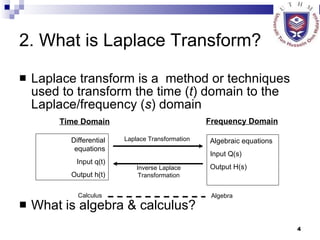
2. What is Laplace Transform? Laplace transform is a  method or techniques used to transform the time ( t ) domain to the Laplace/frequency ( s ) domain  What is algebra & calculus? Time Domain Frequency Domain Differential equations Input q(t) Output h(t) Algebraic equations Input Q(s) Output H(s) Calculus Algebra Laplace Transformation Inverse Laplace Transformation
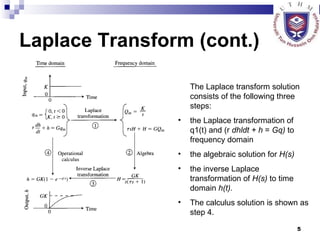
Laplace Transform (cont.) The Laplace transform solution consists of the following three steps:  the Laplace transformation of q1(t) and (r  dhldt + h  =  Gq)  to frequency domain  the algebraic solution for  H(s) the inverse Laplace transformation of  H(s)  to time domain  h(t).  The calculus solution is shown as step 4.
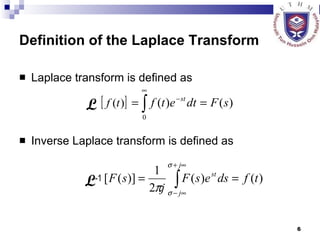
Definition of the Laplace Transform Laplace transform is defined as  Inverse Laplace transform is defined as L   L -1
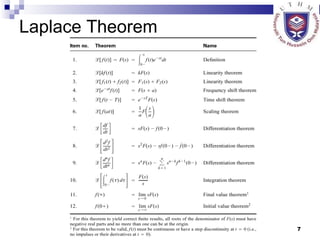
Laplace Theorem
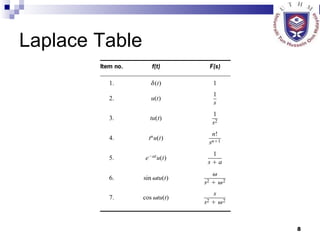
Laplace Table
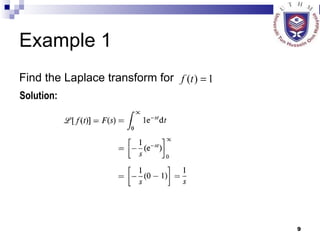
Example 1 Find the Laplace transform for Solution:
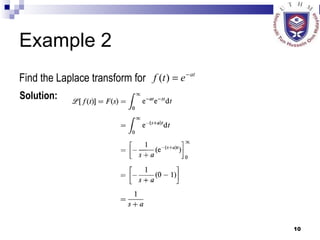
Example 2 Find the Laplace transform for Solution:
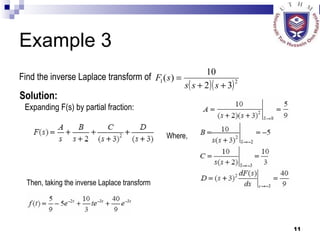
Example 3 Find the inverse Laplace transform of Solution: Expanding F(s) by partial fraction: Where, Then, taking the inverse Laplace transform
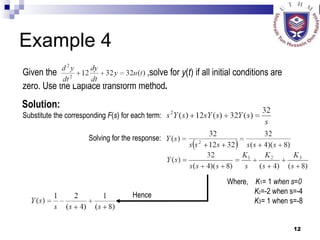
Example 4 Given the   ,solve for  y ( t ) if all initial conditions are  zero. Use the Laplace transform method .   Solution: Substitute the corresponding  F ( s ) for each term:  Solving for the response:  Where,  K 1 = 1  when s=0 K 2 =-2 when s=-4 K 3 = 1 when s=-8 Hence
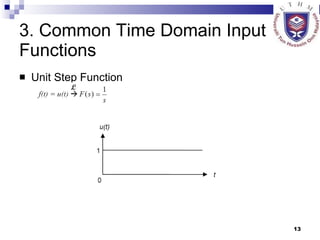
3. Common Time Domain Input Functions Unit Step Function
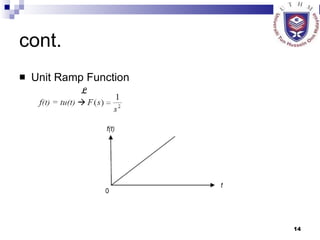
Unit Ramp Function cont.
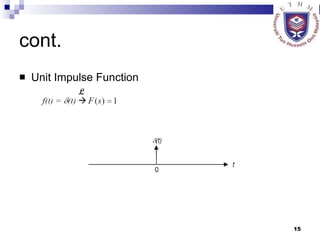
Unit Impulse Function cont.
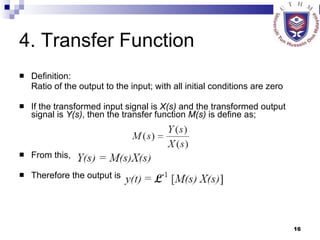
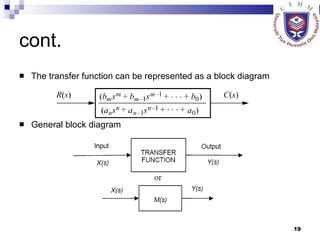
4. Transfer Function Definition: Ratio of the output to the input; with all initial conditions are zero  If the transformed input signal is  X(s)  and the transformed output signal is  Y(s) , then the transfer function  M(s)  is define as; From this,  Therefore the output is
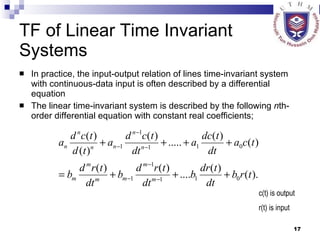
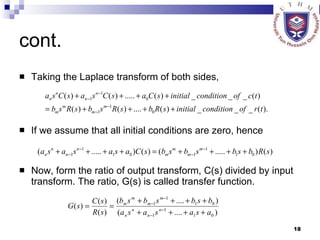
TF of Linear Time Invariant Systems In practice, the input-output relation of lines time-invariant system with continuous-data input is often described by a differential equation The linear time-invariant system is described by the following  n th-order differential equation with constant real coefficients;  c(t) is output r(t) is input
cont. Taking the Laplace transform of both sides, If we assume that all initial conditions are zero, hence Now, form the ratio of output transform, C(s) divided by input transform. The ratio, G(s) is called transfer function.
cont. The transfer function can be represented as a block diagram  General block diagram
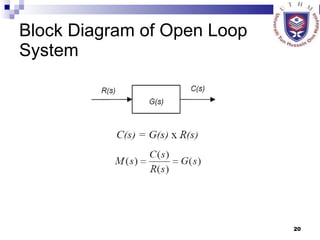
Block Diagram of Open Loop System
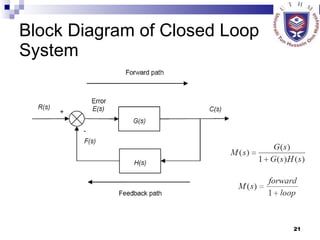
Block Diagram of Closed Loop System
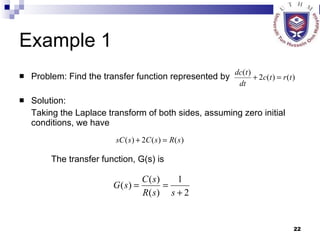
Example 1 Problem: Find the transfer function represented by Solution: Taking the Laplace transform of both sides, assuming zero initial conditions, we have The transfer function, G(s) is
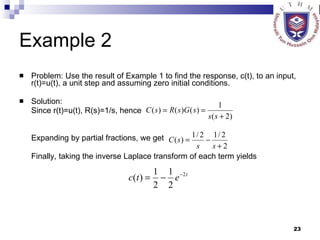
Example 2 Problem: Use the result of Example 1 to find the response, c(t), to an input, r(t)=u(t), a unit step and assuming zero initial conditions. Solution: Since r(t)=u(t), R(s)=1/s, hence Expanding by partial fractions, we get Finally, taking the inverse Laplace transform of each term yields
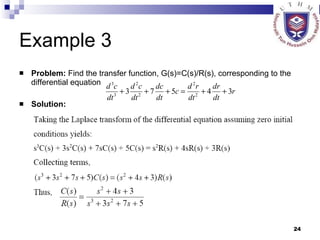
Example 3 Problem:  Find the transfer function, G(s)=C(s)/R(s), corresponding to the differential equation Solution:
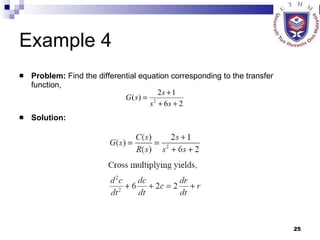
Example 4 Problem:  Find the differential equation corresponding to the transfer function, Solution:
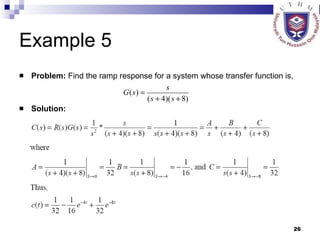
Example 5 Problem:  Find the ramp response for a system whose transfer function is, Solution:

Meeting w3 chapter 2 part 1

  • 1.
    Chapter 2 Analog Control System Eddy Irwan Shah Bin Saadon Dept. of Electrical Engineering PPD, UTHM [email_address] 019-7017679
  • 2.
    Outline: Introduction LaplaceTransform – Table/ Theorem/ Eg. Common Time Domain Input Function Transfer Function – Open/ Closed Loop & Eg. Electrical Elements Modelling – Table & Eg. Mechanical Elements Modelling - Table & Eg. Block Diagram Reduction - Table & Eg. System Response – Poles/ Zeros, Second Order, Steady State Error, Stability Analysis
  • 3.
    Intro - Objectiveof this chapter After completing this chapter you will be able to: Describe the fundamental of Laplace transforms. Apply the Laplace transform to solve linear ordinary differential equations. Apply Mathematical model, called a transfer function for linear time-invariant electrical, mechanical and electromechanical systems.
  • 4.
    2. What isLaplace Transform? Laplace transform is a method or techniques used to transform the time ( t ) domain to the Laplace/frequency ( s ) domain What is algebra & calculus? Time Domain Frequency Domain Differential equations Input q(t) Output h(t) Algebraic equations Input Q(s) Output H(s) Calculus Algebra Laplace Transformation Inverse Laplace Transformation
  • 5.
    Laplace Transform (cont.)The Laplace transform solution consists of the following three steps: the Laplace transformation of q1(t) and (r dhldt + h = Gq) to frequency domain the algebraic solution for H(s) the inverse Laplace transformation of H(s) to time domain h(t). The calculus solution is shown as step 4.
  • 6.
    Definition of theLaplace Transform Laplace transform is defined as Inverse Laplace transform is defined as L L -1
  • 7.
  • 8.
  • 9.
    Example 1 Findthe Laplace transform for Solution:
  • 10.
    Example 2 Findthe Laplace transform for Solution:
  • 11.
    Example 3 Findthe inverse Laplace transform of Solution: Expanding F(s) by partial fraction: Where, Then, taking the inverse Laplace transform
  • 12.
    Example 4 Giventhe ,solve for y ( t ) if all initial conditions are zero. Use the Laplace transform method . Solution: Substitute the corresponding F ( s ) for each term: Solving for the response: Where, K 1 = 1 when s=0 K 2 =-2 when s=-4 K 3 = 1 when s=-8 Hence
  • 13.
    3. Common TimeDomain Input Functions Unit Step Function
  • 14.
  • 15.
  • 16.
    4. Transfer FunctionDefinition: Ratio of the output to the input; with all initial conditions are zero If the transformed input signal is X(s) and the transformed output signal is Y(s) , then the transfer function M(s) is define as; From this, Therefore the output is
  • 17.
    TF of LinearTime Invariant Systems In practice, the input-output relation of lines time-invariant system with continuous-data input is often described by a differential equation The linear time-invariant system is described by the following n th-order differential equation with constant real coefficients; c(t) is output r(t) is input
  • 18.
    cont. Taking theLaplace transform of both sides, If we assume that all initial conditions are zero, hence Now, form the ratio of output transform, C(s) divided by input transform. The ratio, G(s) is called transfer function.
  • 19.
    cont. The transferfunction can be represented as a block diagram General block diagram
  • 20.
    Block Diagram ofOpen Loop System
  • 21.
    Block Diagram ofClosed Loop System
  • 22.
    Example 1 Problem:Find the transfer function represented by Solution: Taking the Laplace transform of both sides, assuming zero initial conditions, we have The transfer function, G(s) is
  • 23.
    Example 2 Problem:Use the result of Example 1 to find the response, c(t), to an input, r(t)=u(t), a unit step and assuming zero initial conditions. Solution: Since r(t)=u(t), R(s)=1/s, hence Expanding by partial fractions, we get Finally, taking the inverse Laplace transform of each term yields
  • 24.
    Example 3 Problem: Find the transfer function, G(s)=C(s)/R(s), corresponding to the differential equation Solution:
  • 25.
    Example 4 Problem: Find the differential equation corresponding to the transfer function, Solution:
  • 26.
    Example 5 Problem: Find the ramp response for a system whose transfer function is, Solution: