The Laplace Transform
The University of Tennessee
Electrical and Computer Engineering Department
Knoxville, Tennessee
wlg
The Laplace Transform
The Laplace Transform of a function, f(t), is defined as;
∫
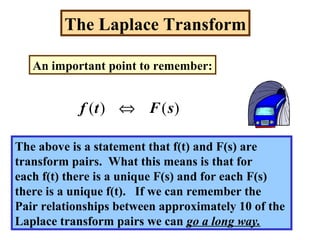
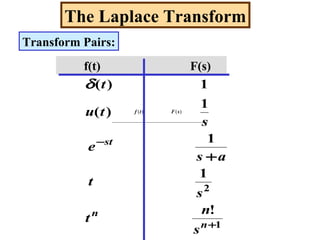
∞
−
==
0
)()()]([ dtetfsFtfL st
The Inverse Laplace Transform is defined by
∫
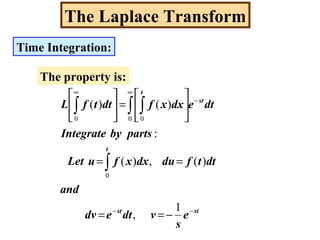
∞+
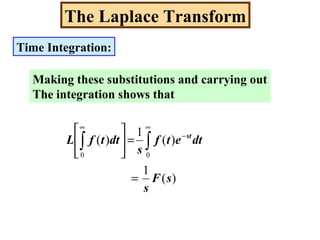
∞−
−
==
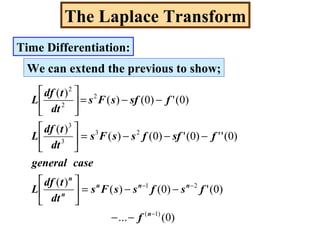
j
j
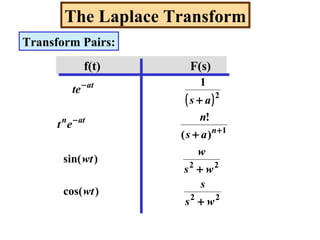
ts
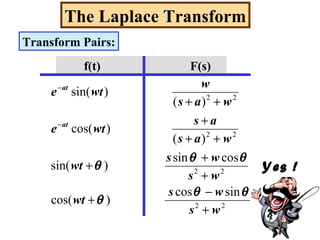
dsesF
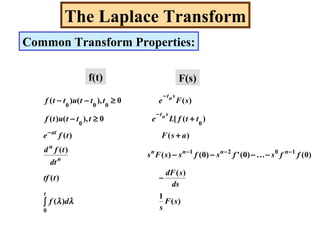
j
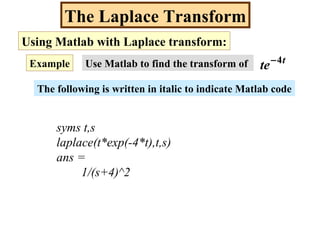
tfsFL
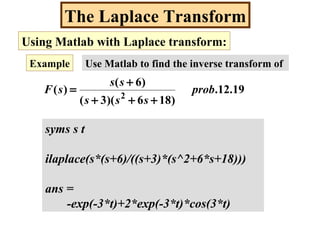
σ
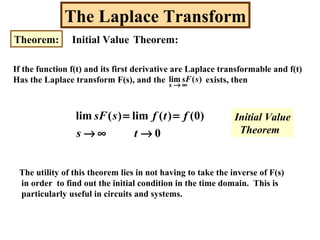
σ
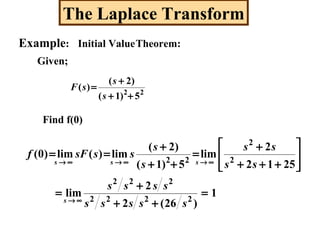
π
)(
2
1
)()]([1
*notes
Eq A
Eq B
The Laplace Transform
We generally do not use Eq B to take the inverse Laplace. However,
this is the formal way that one would take the inverse. To use
Eq B requires a background in the use of complex variables and
the theory of residues. Fortunately, we can accomplish the same
goal (that of taking the inverse Laplace) by using partial fraction
expansion and recognizing transform pairs.
*notes
The Laplace Transform
Laplace Transform of the unit step.
*notes
|0
0
1
1)]([
∞−
∞
−
∫
−
== stst
e
s
dtetuL
s
tuL
1
)]([ =
The Laplace Transform of a unit step is:
s
1
The Laplace Transform
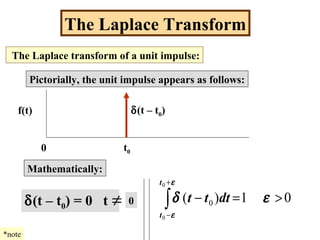
The Laplace transform of a unit impulse:
Pictorially, the unit impulse appears as follows:
0 t0
f(t) δ(t – t0)
Mathematically:
δ(t – t0) = 0 t ≠ 0
*note
01)(
0
0
0 >=−∫
+
−
εδ
ε
ε
dttt
t
t
The Laplace Transform
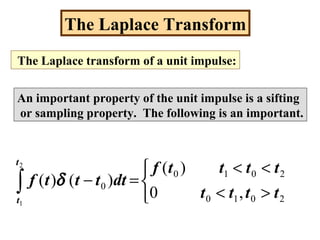
The Laplace transform of a unit impulse:
An important property of the unit impulse is a sifting
or sampling property. The following is an important.
∫ 


><
<<
=−
2
1
2010
2010
0
,0
)(
)()(
t
t
tttt
ttttf
dttttf δ
The Laplace Transform
The Laplace transform of a unit impulse:
In particular, if we let f(t) = δ(t) and take the Laplace
1)()]([ 0
0
=== −−
∞
∫
sst
edtettL δδ
The Laplace Transform
An important point to remember:
)()( sFtf ⇔
The above is a statement that f(t) and F(s) are
transform pairs. What this means is that for
each f(t) there is a unique F(s) and for each F(s)
there is a unique f(t). If we can remember the
Pair relationships between approximately 10 of the
Laplace transform pairs we can go a long way.
The Laplace Transform
Building transform pairs:
eL(
∫∫
∞
+−
∞
−−−
==
e
tasstatat
dtedteetueL
0
)(
0
)]([
asas
e
tueL
st
at
+
=
+
−
=
∞−
−
1
)(
)]([ |0
as
tue at
+
⇔− 1
)(A transform
pair
The Laplace Transform
Building transform pairs:
∫
∞
−
=
0
)]([ dttettuL st
∫ ∫
∞ ∞
∞
−=
0 0
0
| vduuvudv
u = t
dv = e-st
dt
2
1
)(
s
ttu ⇔
A transform
pair
The Laplace Transform
Building transform pairs:
22
0
11
2
1
2
)(
)][cos(
ws
s
jwsjws
dte
ee
wtL st
jwtjwt
+
=






+
−
−
=
+
= −
∞ −
∫
22
)()cos(
ws
s
tuwt
+
⇔ A transform
pair
The Laplace Transform
Time Shift
∫ ∫
∫
∞ ∞
−−+−
∞
−
=
∞→∞→→→
+==−=
−=−−
0 0
)(
)()(
,.,0,
,
)()]()([
dxexfedxexf
SoxtasandxatAs
axtanddtdxthenatxLet
eatfatuatfL
sxasaxs
a
st
)()]()([ sFeatuatfL as−
=−−
The Laplace Transform
Frequency Shift
∫
∫
∞
+−
∞
−−−
+==
=
0
)(
0
)()(
)]([)]([
asFdtetf
dtetfetfeL
tas
statat
)()]([ asFtfeL at
+=−
The Laplace Transform
Example: Using Frequency Shift
Find the L[e-at
cos(wt)]
In this case, f(t) = cos(wt) so,
22
22
)(
)(
)(
)(
was
as
asFand
ws
s
sF
++
+
=+
+
=
22
)()(
)(
)]cos([
was
as
wteL at
++
+
=−
The Laplace Transform
Time Integration:
The property is:
stst
t
st
t
e
s
vdtedv
and
dttfdudxxfuLet
partsbyIntegrate
dtedxxfdttfL
−−
−
∞∞
−==
==






=





∫
∫ ∫∫
1
,
)(,)(
:
)()(
0
0 00
The Laplace Transform
Time Integration:
Making these substitutions and carrying out
The integration shows that
)(
1
)(
1
)(
00
sF
s
dtetf
s
dttfL st
=
=





∫∫
∞
−
∞
The Laplace Transform
Time Differentiation:
If the L[f(t)] = F(s), we want to show:
)0()(]
)(
[ fssF
dt
tdf
L −=
Integrate by parts:
)(),(
)(
,
tfvsotdfdt
dt
tdf
dv
anddtsedueu stst
===
−== −−
*note
The Laplace Transform
Time Differentiation:
Making the previous substitutions gives,
[ ]
∫
∫
∞
−
∞
−∞−
+−=
−−=





0
0
0
)()0(0
)()( |
dtetfsf
dtsetfetf
dt
df
L
st
stst
So we have shown:
)0()(
)(
fssF
dt
tdf
L −=



The Laplace Transform
Time Differentiation:
We can extend the previous to show;
)0(...
)0(')0()(
)(
)0('')0(')0()(
)(
)0(')0()(
)(
)1(
21
23
3
3
2
2
2
−
−−
−−
−−=





−−−=





−−=





n
nnn
n
n
f
fsfssFs
dt
tdf
L
casegeneral
fsffssFs
dt
tdf
L
fsfsFs
dt
tdf
L
The Laplace Transform
Transform Pairs:
____________________________________
)()( sFtf
f(t) F(s)
1
2
!
1
1
1
)(
1)(
+
−
+
n
n
st
s
n
t
s
t
as
e
s
tu
tδ
The Laplace Transform
Transform Pairs:
f(t) F(s)
( )
22
22
1
2
)cos(
)sin(
)(
!
1
ws
s
wt
ws
w
wt
as
n
et
as
te
n
atn
at
+
+
+
+
+
−
−
The Laplace Transform
Transform Pairs:
f(t) F(s)
22
22
22
22
sincos
)cos(
cossin
)sin(
)(
)cos(
)(
)sin(
ws
ws
wt
ws
ws
wt
was
as
wte
was
w
wte
at
at
+
−
+
+
+
+
++
+
++
−
−
θθ
θ
θθ
θ Yes !
The Laplace Transform
Common Transform Properties:
f(t) F(s)
)(
1
)(
)(
)(
)0(...)0(')0()(
)(
)()(
)([0),()(
)(0),()(
0
1021
00
000
sF
s
df
ds
sdF
ttf
ffsfsfssFs
dt
tfd
asFtfe
ttfLetttutf
sFetttuttf
t
nnnn
n
n
at
sot
sot
∫
−
−−−−
+
+≥−
≥−−
−−−
−
−
−
λλ
The Laplace Transform
Using Matlab with Laplace transform:
Example Use Matlab to find the transform of t
te 4−
The following is written in italic to indicate Matlab code
syms t,s
laplace(t*exp(-4*t),t,s)
ans =
1/(s+4)^2
The Laplace Transform
Using Matlab with Laplace transform:
Example Use Matlab to find the inverse transform of
19.12.
)186)(3(
)6(
)( 2
prob
sss
ss
sF
+++
+
=
syms s t
ilaplace(s*(s+6)/((s+3)*(s^2+6*s+18)))
ans =
-exp(-3*t)+2*exp(-3*t)*cos(3*t)
The Laplace Transform
Theorem: Initial Value
If the function f(t) and its first derivative are Laplace transformable and f(t)
Has the Laplace transform F(s), and the exists, then)(lim ssF
0
)0()(lim)(lim
→∞→
==
ts
ftfssF
The utility of this theorem lies in not having to take the inverse of F(s)
in order to find out the initial condition in the time domain. This is
particularly useful in circuits and systems.
Theorem:
∞→s
Initial Value
Theorem
The Laplace Transform
Initial ValueTheorem:Example:
Given;
22
5)1(
)2(
)(
++
+
=
s
s
sF
Find f(0)
1
)26(2
2
lim
2512
2
lim
5)1(
)2(
lim)(lim)0(
2222
222
2
2
22
=
++
+
=








+++
+
=
++
+
==
sssss
ssss
ss
ss
s
s
sssFf
∞→s∞→s ∞→s
∞→s
The Laplace Transform
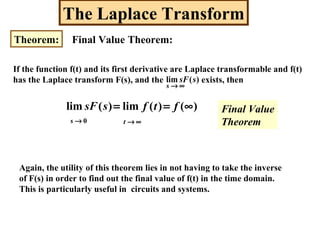
Theorem: Final Value Theorem:
If the function f(t) and its first derivative are Laplace transformable and f(t)
has the Laplace transform F(s), and the exists, then)(lim ssF
∞→s
)()(lim)(lim ∞== ftfssF
0→s ∞→t
Again, the utility of this theorem lies in not having to take the inverse
of F(s) in order to find out the final value of f(t) in the time domain.
This is particularly useful in circuits and systems.
Final Value
Theorem
The Laplace Transform
Final Value Theorem:Example:
Given:
[ ] ttesFnote
s
s
sF t
3cos)(
3)2(
3)2(
)( 21
22
22
−
=
++
−+
= −
Find )(∞f .
[ ] 0
3)2(
3)2(
lim)(lim)( 22
22
=
++
−+
==∞
s
s
sssFf
0→s0→s
Laplace transform

Laplace transform

  • 1.
    The Laplace Transform TheUniversity of Tennessee Electrical and Computer Engineering Department Knoxville, Tennessee wlg
  • 2.
    The Laplace Transform TheLaplace Transform of a function, f(t), is defined as; ∫ ∞ − == 0 )()()]([ dtetfsFtfL st The Inverse Laplace Transform is defined by ∫ ∞+ ∞− − == j j ts dsesF j tfsFL σ σ π )( 2 1 )()]([1 *notes Eq A Eq B
  • 3.
    The Laplace Transform Wegenerally do not use Eq B to take the inverse Laplace. However, this is the formal way that one would take the inverse. To use Eq B requires a background in the use of complex variables and the theory of residues. Fortunately, we can accomplish the same goal (that of taking the inverse Laplace) by using partial fraction expansion and recognizing transform pairs. *notes
  • 4.
    The Laplace Transform LaplaceTransform of the unit step. *notes |0 0 1 1)]([ ∞− ∞ − ∫ − == stst e s dtetuL s tuL 1 )]([ = The Laplace Transform of a unit step is: s 1
  • 5.
    The Laplace Transform TheLaplace transform of a unit impulse: Pictorially, the unit impulse appears as follows: 0 t0 f(t) δ(t – t0) Mathematically: δ(t – t0) = 0 t ≠ 0 *note 01)( 0 0 0 >=−∫ + − εδ ε ε dttt t t
  • 6.
    The Laplace Transform TheLaplace transform of a unit impulse: An important property of the unit impulse is a sifting or sampling property. The following is an important. ∫    >< << =− 2 1 2010 2010 0 ,0 )( )()( t t tttt ttttf dttttf δ
  • 7.
    The Laplace Transform TheLaplace transform of a unit impulse: In particular, if we let f(t) = δ(t) and take the Laplace 1)()]([ 0 0 === −− ∞ ∫ sst edtettL δδ
  • 8.
    The Laplace Transform Animportant point to remember: )()( sFtf ⇔ The above is a statement that f(t) and F(s) are transform pairs. What this means is that for each f(t) there is a unique F(s) and for each F(s) there is a unique f(t). If we can remember the Pair relationships between approximately 10 of the Laplace transform pairs we can go a long way.
  • 9.
    The Laplace Transform Buildingtransform pairs: eL( ∫∫ ∞ +− ∞ −−− == e tasstatat dtedteetueL 0 )( 0 )]([ asas e tueL st at + = + − = ∞− − 1 )( )]([ |0 as tue at + ⇔− 1 )(A transform pair
  • 10.
    The Laplace Transform Buildingtransform pairs: ∫ ∞ − = 0 )]([ dttettuL st ∫ ∫ ∞ ∞ ∞ −= 0 0 0 | vduuvudv u = t dv = e-st dt 2 1 )( s ttu ⇔ A transform pair
  • 11.
    The Laplace Transform Buildingtransform pairs: 22 0 11 2 1 2 )( )][cos( ws s jwsjws dte ee wtL st jwtjwt + =       + − − = + = − ∞ − ∫ 22 )()cos( ws s tuwt + ⇔ A transform pair
  • 12.
    The Laplace Transform TimeShift ∫ ∫ ∫ ∞ ∞ −−+− ∞ − = ∞→∞→→→ +==−= −=−− 0 0 )( )()( ,.,0, , )()]()([ dxexfedxexf SoxtasandxatAs axtanddtdxthenatxLet eatfatuatfL sxasaxs a st )()]()([ sFeatuatfL as− =−−
  • 13.
    The Laplace Transform FrequencyShift ∫ ∫ ∞ +− ∞ −−− +== = 0 )( 0 )()( )]([)]([ asFdtetf dtetfetfeL tas statat )()]([ asFtfeL at +=−
  • 14.
    The Laplace Transform Example:Using Frequency Shift Find the L[e-at cos(wt)] In this case, f(t) = cos(wt) so, 22 22 )( )( )( )( was as asFand ws s sF ++ + =+ + = 22 )()( )( )]cos([ was as wteL at ++ + =−
  • 15.
    The Laplace Transform TimeIntegration: The property is: stst t st t e s vdtedv and dttfdudxxfuLet partsbyIntegrate dtedxxfdttfL −− − ∞∞ −== ==       =      ∫ ∫ ∫∫ 1 , )(,)( : )()( 0 0 00
  • 16.
    The Laplace Transform TimeIntegration: Making these substitutions and carrying out The integration shows that )( 1 )( 1 )( 00 sF s dtetf s dttfL st = =      ∫∫ ∞ − ∞
  • 17.
    The Laplace Transform TimeDifferentiation: If the L[f(t)] = F(s), we want to show: )0()(] )( [ fssF dt tdf L −= Integrate by parts: )(),( )( , tfvsotdfdt dt tdf dv anddtsedueu stst === −== −− *note
  • 18.
    The Laplace Transform TimeDifferentiation: Making the previous substitutions gives, [ ] ∫ ∫ ∞ − ∞ −∞− +−= −−=      0 0 0 )()0(0 )()( | dtetfsf dtsetfetf dt df L st stst So we have shown: )0()( )( fssF dt tdf L −=   
  • 19.
    The Laplace Transform TimeDifferentiation: We can extend the previous to show; )0(... )0(')0()( )( )0('')0(')0()( )( )0(')0()( )( )1( 21 23 3 3 2 2 2 − −− −− −−=      −−−=      −−=      n nnn n n f fsfssFs dt tdf L casegeneral fsffssFs dt tdf L fsfsFs dt tdf L
  • 20.
    The Laplace Transform TransformPairs: ____________________________________ )()( sFtf f(t) F(s) 1 2 ! 1 1 1 )( 1)( + − + n n st s n t s t as e s tu tδ
  • 21.
    The Laplace Transform TransformPairs: f(t) F(s) ( ) 22 22 1 2 )cos( )sin( )( ! 1 ws s wt ws w wt as n et as te n atn at + + + + + − −
  • 22.
    The Laplace Transform TransformPairs: f(t) F(s) 22 22 22 22 sincos )cos( cossin )sin( )( )cos( )( )sin( ws ws wt ws ws wt was as wte was w wte at at + − + + + + ++ + ++ − − θθ θ θθ θ Yes !
  • 23.
    The Laplace Transform CommonTransform Properties: f(t) F(s) )( 1 )( )( )( )0(...)0(')0()( )( )()( )([0),()( )(0),()( 0 1021 00 000 sF s df ds sdF ttf ffsfsfssFs dt tfd asFtfe ttfLetttutf sFetttuttf t nnnn n n at sot sot ∫ − −−−− + +≥− ≥−− −−− − − − λλ
  • 24.
    The Laplace Transform UsingMatlab with Laplace transform: Example Use Matlab to find the transform of t te 4− The following is written in italic to indicate Matlab code syms t,s laplace(t*exp(-4*t),t,s) ans = 1/(s+4)^2
  • 25.
    The Laplace Transform UsingMatlab with Laplace transform: Example Use Matlab to find the inverse transform of 19.12. )186)(3( )6( )( 2 prob sss ss sF +++ + = syms s t ilaplace(s*(s+6)/((s+3)*(s^2+6*s+18))) ans = -exp(-3*t)+2*exp(-3*t)*cos(3*t)
  • 26.
    The Laplace Transform Theorem:Initial Value If the function f(t) and its first derivative are Laplace transformable and f(t) Has the Laplace transform F(s), and the exists, then)(lim ssF 0 )0()(lim)(lim →∞→ == ts ftfssF The utility of this theorem lies in not having to take the inverse of F(s) in order to find out the initial condition in the time domain. This is particularly useful in circuits and systems. Theorem: ∞→s Initial Value Theorem
  • 27.
    The Laplace Transform InitialValueTheorem:Example: Given; 22 5)1( )2( )( ++ + = s s sF Find f(0) 1 )26(2 2 lim 2512 2 lim 5)1( )2( lim)(lim)0( 2222 222 2 2 22 = ++ + =         +++ + = ++ + == sssss ssss ss ss s s sssFf ∞→s∞→s ∞→s ∞→s
  • 28.
    The Laplace Transform Theorem:Final Value Theorem: If the function f(t) and its first derivative are Laplace transformable and f(t) has the Laplace transform F(s), and the exists, then)(lim ssF ∞→s )()(lim)(lim ∞== ftfssF 0→s ∞→t Again, the utility of this theorem lies in not having to take the inverse of F(s) in order to find out the final value of f(t) in the time domain. This is particularly useful in circuits and systems. Final Value Theorem
  • 29.
    The Laplace Transform FinalValue Theorem:Example: Given: [ ] ttesFnote s s sF t 3cos)( 3)2( 3)2( )( 21 22 22 − = ++ −+ = − Find )(∞f . [ ] 0 3)2( 3)2( lim)(lim)( 22 22 = ++ −+ ==∞ s s sssFf 0→s0→s

Editor's Notes

  • #3 In the undergraduate curriculum, usually there are 3 transform pairs that are studied. These are The Laplace Transform The Fourier Transform The Z-Transform The Laplace transform is usually used in solving continuous linear differential equations of the type encountered in circuit theory and systems. The advantage of the Laplace transform is that it makes cumbersome differential equations algebraic and therefore the math becomes simpler to handle. In the end we can take the inverse and go back to the time domain. In systems, for example, we stay with the Laplace variable “s” while investigating system stability, system performance. We use tools such as the root locus and block diagrams which are directly in the s variable. Even Bode is used where s is replaced by jw. We are “walking” with one foot in s but thinking the time domain. The Fourier transform is used very much in communication theory, field theory and generally in the study of signal spectrum and both analog and digital filter analysis and design. The Z-transform is sort of similar to the Laplace transform. In fact, many of the manipulations such as partial fraction expansion, taking the inverse, interrupting stability are very similar to those performed in the Laplace. The big difference is that the Z-transform is used for discrete systems and difference equations. At the University of Tennessee you will be studying the Fourier and Z-transforms in your junior year and you will also study the Laplace transform again.
  • #4 Normally, even in the junior year, you will still use partial fraction expansion and recognition of transform paisr to find the inverse Laplace transform. This is true in most undergraduate programs. However, at UTK we have a graduate course that is required of all graduate students in electrical engineering in which an in-depth study is made of using Eq B for taking the inverse Laplace. A similar integral is encountered for taking the inverse in both Fourier and Z-transforms. It might also be noted that not all functions have a Laplace transform. For a function to be Laplace transformable it must be of exponential order. This boils down to saying that the integral from 0 to infinity of e-at|f(t)|dt must be less than infinity. In this course, and most courses in undergraduate studies, the functions we are interested in taking the Laplace will be of exponential order.
  • #5 The unit step is called a singularity function because it does not possess a derivative at t = 0. We also say that it is not defined at t = 0. Along this line, you will note that many text books define the Laplace by using a lower limit of 0- rather than absolute zero. One must ask, if you integrate from 0 to infinity for a unit step, how are you handling the lower limit when the step is not defined at t = 0? We will not get worked up over this. You can take this apart later after you become experts in transforms.
  • #6 I remember when I was first introduced to the unit impulse function, in an electrical engineering course at Auburn University. Essentially, we were told that the unit impulse function was a function that was infinitely high and had zero width but the area under the function was 1. Such an explanation would probably always disturb a mathematician because I expect the proper way to define the function is in a limiting process as a function that is 1/delta in height and delta wide and we take the limit as delta goes to zero. At this point, the best thing to do is not to worry about it. Accept it as we have defined it here and go ahead and use it. Probably one day in a higher level math course you may give more attention to its attributes.
  • #18 As noted earlier, some text will use 0- on the lower part of the defining integral of the Laplace transform. When this is done, f(0) above will become f(0-).