Laplace TransformLaplace Transform
Submitted By:
Md. Al Imran Bhuyan
ID: 143-19-1616
Department of ETE
Daffodil International
University
Submitted to:
Engr. Md. Zahirul Islam
Senior Lecturer
Department of ETE
Daffodil International
University
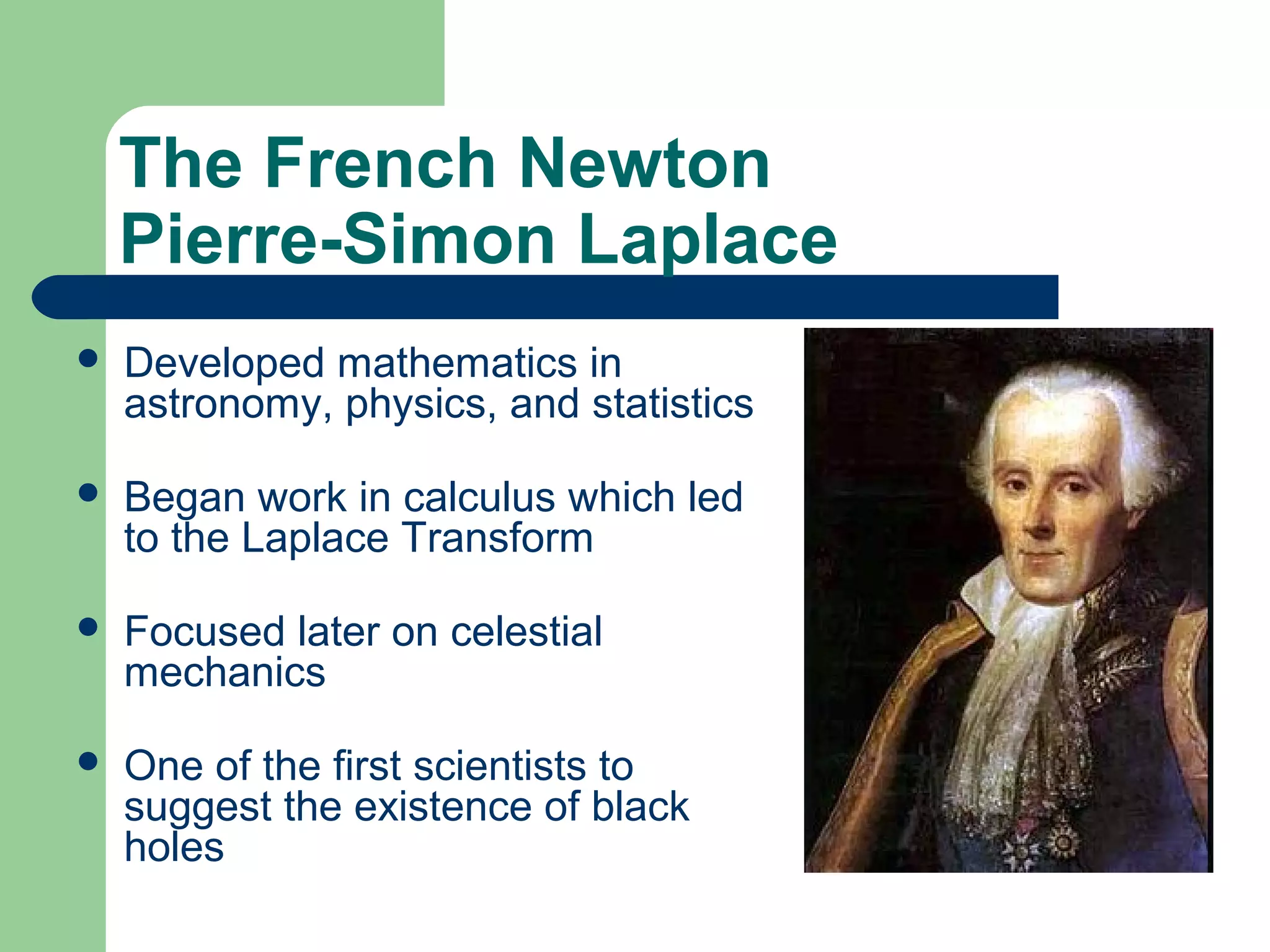
The French Newton
Pierre-Simon Laplace
 Developed mathematics in
astronomy, physics, and statistics
 Began work in calculus which led
to the Laplace Transform
 Focused later on celestial
mechanics
 One of the first scientists to
suggest the existence of black
holes
History of the Transform
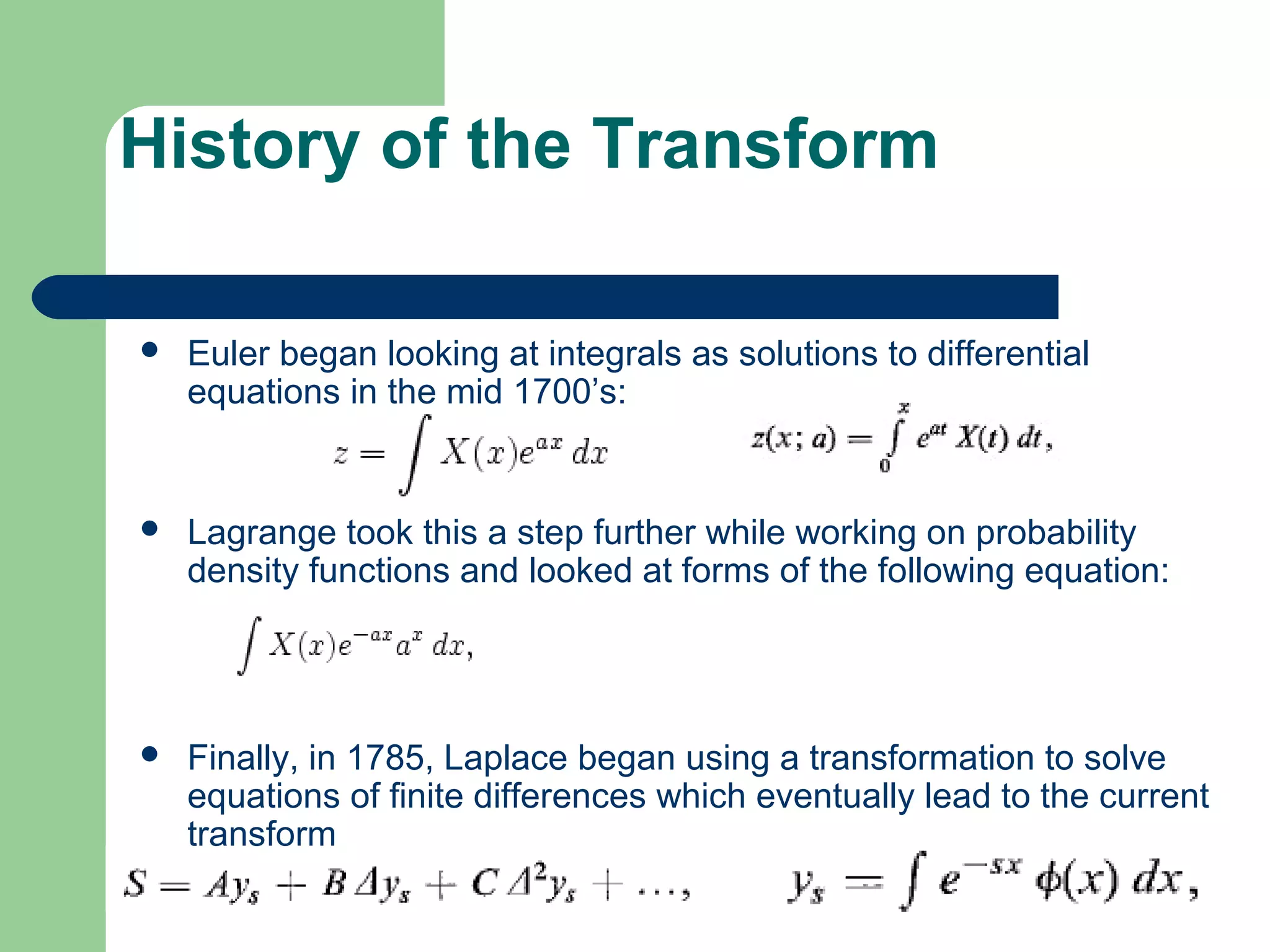
 Euler began looking at integrals as solutions to differential
equations in the mid 1700’s:
 Lagrange took this a step further while working on probability
density functions and looked at forms of the following equation:
 Finally, in 1785, Laplace began using a transformation to solve
equations of finite differences which eventually lead to the current
transform
Definition
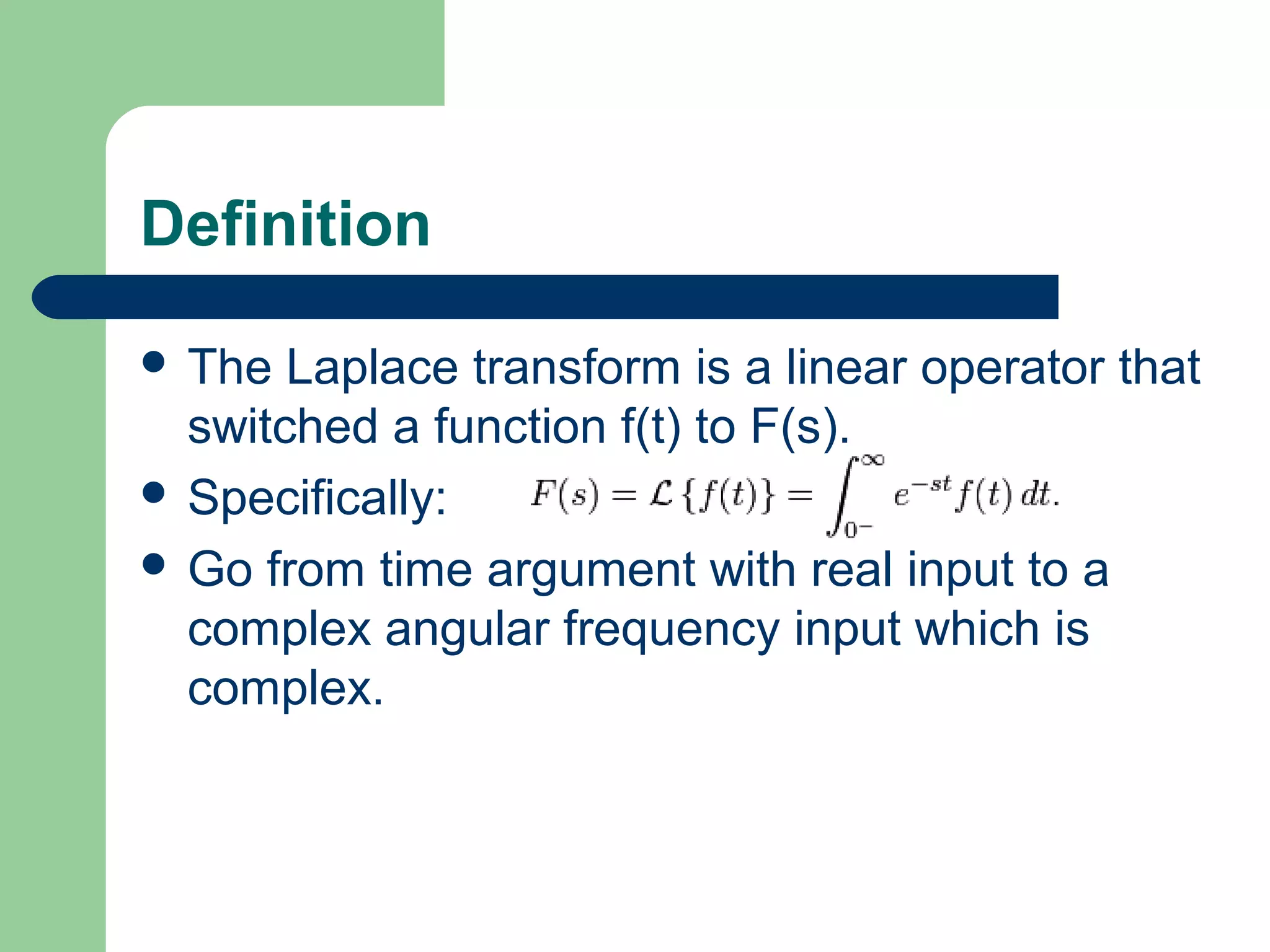
 The Laplace transform is a linear operator that
switched a function f(t) to F(s).
 Specifically:
 Go from time argument with real input to a
complex angular frequency input which is
complex.
Laplace Transform TheoryLaplace Transform Theory
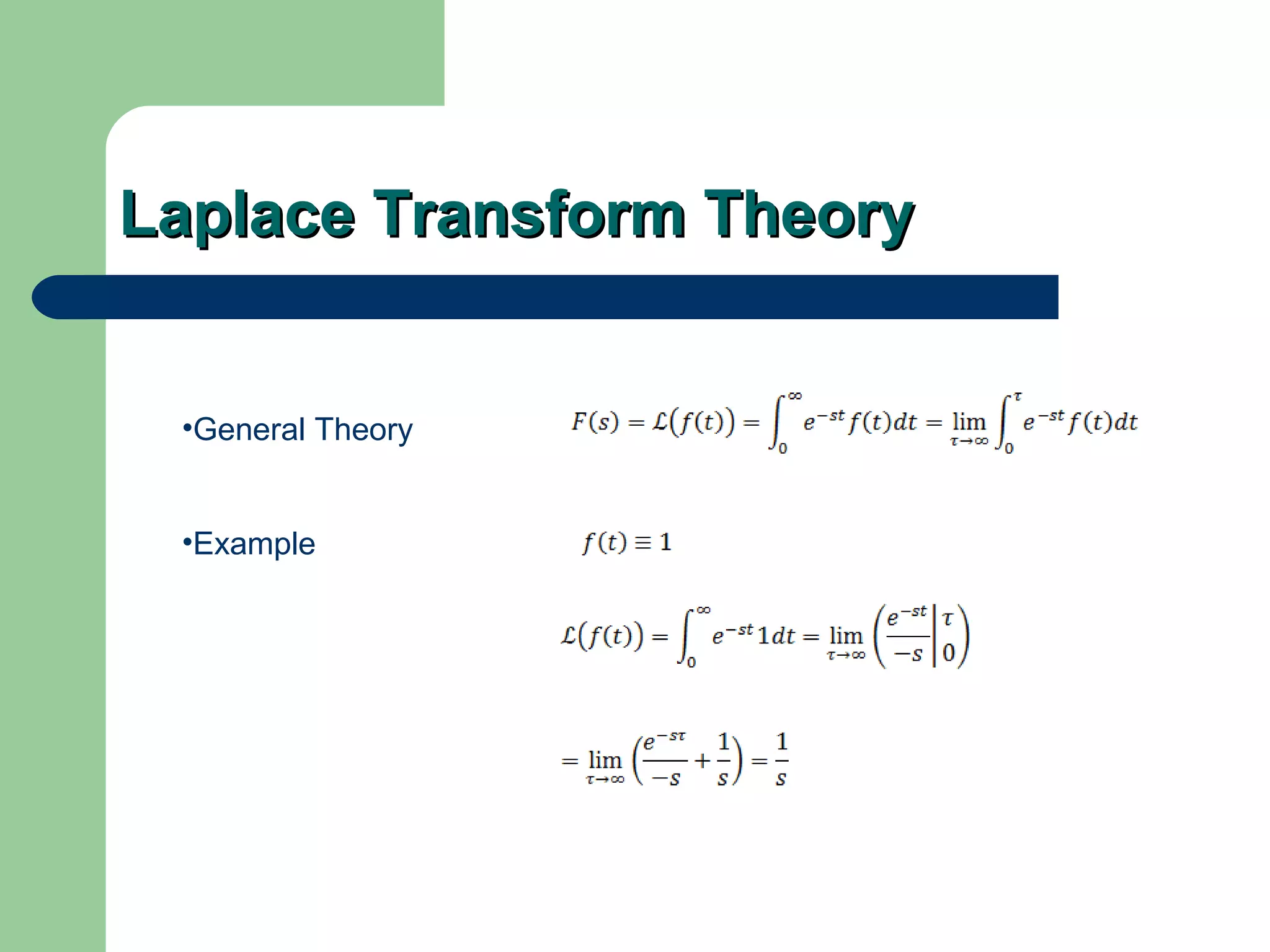
•General Theory
•Example
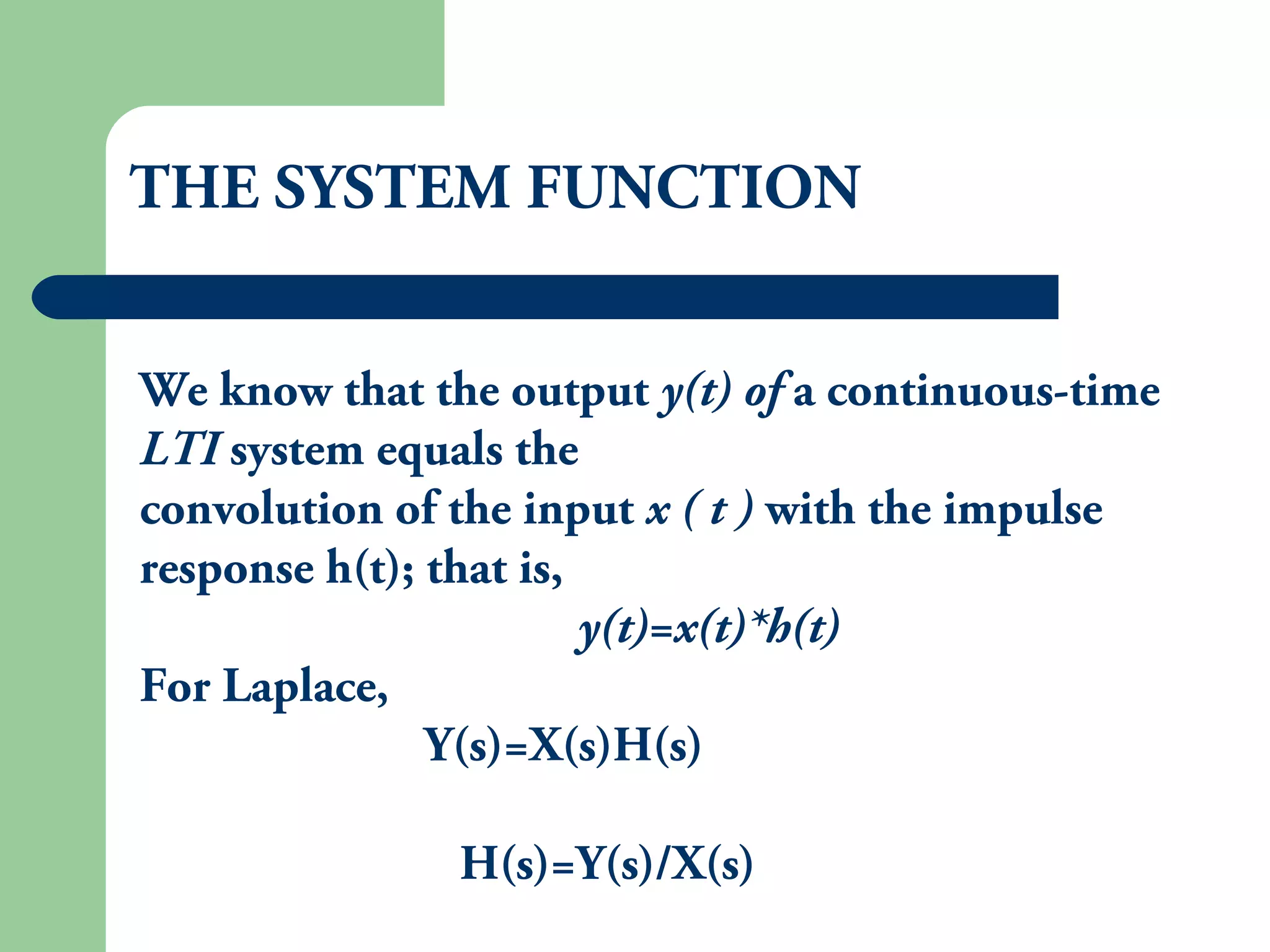
THE SYSTEM FUNCTION
We know that the output y(t) of a continuous-time
LTI system equals the
convolution of the input x ( t ) with the impulse
response h(t); that is,
y(t)=x(t)*h(t)
For Laplace,
Y(s)=X(s)H(s)
H(s)=Y(s)/X(s)
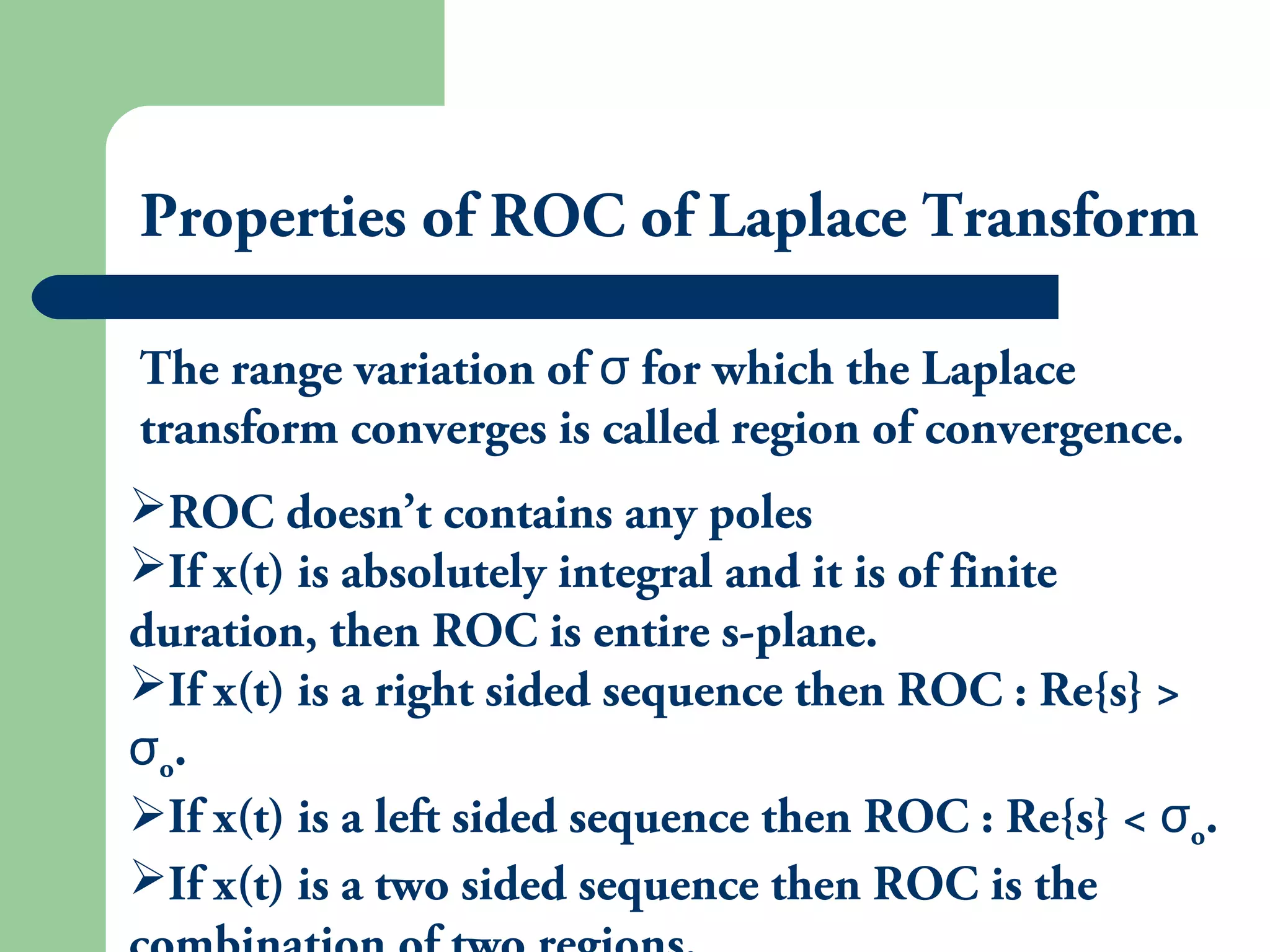
Properties of ROC of Laplace Transform
The range variation of for which the Laplaceσ
transform converges is called region of convergence.
ROC doesn’t contains any poles
If x(t) is absolutely integral and it is of finite
duration, then ROC is entire s-plane.
If x(t) is a right sided sequence then ROC : Re{s} >
σo.
If x(t) is a left sided sequence then ROC : Re{s} < σo.
If x(t) is a two sided sequence then ROC is the
Real-Life ApplicationsReal-Life Applications
Semiconductor mobilitySemiconductor mobility
Call completion inCall completion in
wireless networkswireless networks
Vehicle vibrations onVehicle vibrations on
compressed railscompressed rails
Behavior of magneticBehavior of magnetic
and electric fieldsand electric fields
above the atmosphereabove the atmosphere
Ex. Semiconductor MobilityEx. Semiconductor Mobility
MotivationMotivation

semiconductors are commonly madesemiconductors are commonly made
with super lattices having layers ofwith super lattices having layers of
differing compositionsdiffering compositions

need to determine properties ofneed to determine properties of
carriers in each layercarriers in each layer
concentration of electrons and holesconcentration of electrons and holes
mobility of electrons and holesmobility of electrons and holes

conductivity tensor can be related toconductivity tensor can be related to
Laplace transform of electron and holeLaplace transform of electron and hole
densitiesdensities
Presentation on laplace transforms

Presentation on laplace transforms

  • 1.
    Laplace TransformLaplace Transform SubmittedBy: Md. Al Imran Bhuyan ID: 143-19-1616 Department of ETE Daffodil International University Submitted to: Engr. Md. Zahirul Islam Senior Lecturer Department of ETE Daffodil International University
  • 2.
    The French Newton Pierre-SimonLaplace  Developed mathematics in astronomy, physics, and statistics  Began work in calculus which led to the Laplace Transform  Focused later on celestial mechanics  One of the first scientists to suggest the existence of black holes
  • 3.
    History of theTransform  Euler began looking at integrals as solutions to differential equations in the mid 1700’s:  Lagrange took this a step further while working on probability density functions and looked at forms of the following equation:  Finally, in 1785, Laplace began using a transformation to solve equations of finite differences which eventually lead to the current transform
  • 4.
    Definition  The Laplacetransform is a linear operator that switched a function f(t) to F(s).  Specifically:  Go from time argument with real input to a complex angular frequency input which is complex.
  • 5.
    Laplace Transform TheoryLaplaceTransform Theory •General Theory •Example
  • 6.
    THE SYSTEM FUNCTION Weknow that the output y(t) of a continuous-time LTI system equals the convolution of the input x ( t ) with the impulse response h(t); that is, y(t)=x(t)*h(t) For Laplace, Y(s)=X(s)H(s) H(s)=Y(s)/X(s)
  • 7.
    Properties of ROCof Laplace Transform The range variation of for which the Laplaceσ transform converges is called region of convergence. ROC doesn’t contains any poles If x(t) is absolutely integral and it is of finite duration, then ROC is entire s-plane. If x(t) is a right sided sequence then ROC : Re{s} > σo. If x(t) is a left sided sequence then ROC : Re{s} < σo. If x(t) is a two sided sequence then ROC is the
  • 8.
    Real-Life ApplicationsReal-Life Applications SemiconductormobilitySemiconductor mobility Call completion inCall completion in wireless networkswireless networks Vehicle vibrations onVehicle vibrations on compressed railscompressed rails Behavior of magneticBehavior of magnetic and electric fieldsand electric fields above the atmosphereabove the atmosphere
  • 9.
    Ex. Semiconductor MobilityEx.Semiconductor Mobility MotivationMotivation  semiconductors are commonly madesemiconductors are commonly made with super lattices having layers ofwith super lattices having layers of differing compositionsdiffering compositions  need to determine properties ofneed to determine properties of carriers in each layercarriers in each layer concentration of electrons and holesconcentration of electrons and holes mobility of electrons and holesmobility of electrons and holes  conductivity tensor can be related toconductivity tensor can be related to Laplace transform of electron and holeLaplace transform of electron and hole densitiesdensities

Editor's Notes

  • #3 A French mathematician and astronomer from the late 1700’s. His early published work started with calculus and differential equations. He spent many of his later years developing ideas about the movements of planets and stability of the solar system in addition to working on probability theory and Bayesian inference. Some of the math he worked on included: the general theory of determinants, proof that every equation of an even degree must have at least one real quadratic factor, provided a solution to the linear partial differential equation of the second order, and solved many definite integrals. He is one of only 72 people to have his name engraved on the Eiffel tower.
  • #4 Laplace also recognized that Joseph Fourier&amp;apos;s method of Fourier series for solving the diffusion equation could only apply to a limited region of space as the solutions were periodic. In 1809, Laplace applied his transform to find solutions that diffused indefinitely in space