Advanced Engineering Mathematics (ALA)
Laplace Transforms
LAPLACE
TRANSFORMS
The Laplace transform is a widely used integral
transform in mathematics and electrical engineering named
after Pierre-Simon Laplace that transforms a function of time into a
function of complex frequency. The inverse Laplace transform takes
a complex frequency domain function and yields a function defined
in the time domain. The Laplace transform is related to the Fourier
transform, but whereas the Fourier transform expresses a function
or signal as a superposition of sinusoids, the Laplace transform
expresses a function, more generally, as a superposition of moments.
Given a simple mathematical or functional description of an input
or output to a system, the Laplace transform provides an alternative
functional description that often simplifies the process of analyzing
the behaviour of the system, or in synthesizing a new system based
on a set of specifications.[
The Laplace transform is a frequency domain approach for
continuous time signals irrespective of whether the system is
stable or unstable. The Laplace transform of a function(t),
defined for all real numbers t ≥ 0, is the function F(s), which is a
transform defined by:
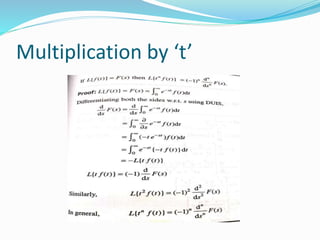
Multiplication by ‘t’
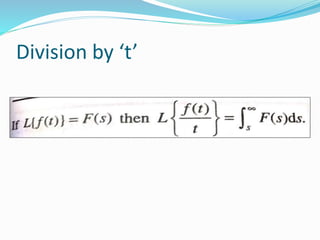
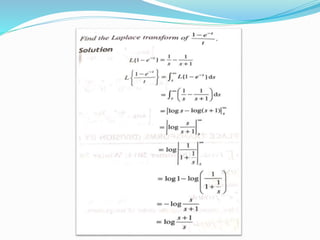
Division by ‘t’
APPLICATIONS OF LAPLACE
TRANSFORMS
Application in Electric Circuit Theory
The Laplace transform can be applied to solve the switching transient phenomenon in the
series or parallel RL,RC or RLC circuits [4]. A simple example of showing this application
follows next. Let us consider a series RLC circuit as shown in Fig 1. to which a d.c. voltage Vo
is suddenly applied Now, applying Kirchhoff’s Voltage Law (KVL) to the circuit, we have,
Ri + Ldi/dt + 1/C R idt = Vo (3) Differentiating both sides, Ld2 i/di2 + 1/Ci + Rdi/dt = 0; or, d2
i/dt2 + (R/L)di/dt + (1/LC)i = 0 (4) Now, applying laplace transform to this equation, let us
assume that the solution of this equation is i(t) = Kest where K and s are constants which may
be real, imaginary or complex. Now, from eqn (4), LKs2 e st + RKest + 1/CKest = 0 which on
simplification gives, or, s2 + (R/L)s + 1/LC = 0
Application in Power Systems
Load Frequency control Power systems are comprised of generation, transmission and
distribution systems. A generating system consists of a turbogenerator set in which a
turbine drives the electrical generator and the generator serves the loads through
transmission and distribution lines. It is required that the system voltage and frequency
has to be maintained at some pre-specified standards eg. frequency have to be
maintained at 50 or 60 Hz and voltage magnitude should be 0.95-1.05 per unit. In an
interconnected power system, Load Frequency Control (LFC) and Automatic Voltage
Regulator (AVR) equipment are installed for each generator. The controllers are set for a
particular operating condition and take care of small changes in load demand to
maintain the frequency and voltage within specified limits. Changes in real power is
dependent on the rotor angle, δ and thus system frequency and the reactive power is
dependent on the voltage magnitude that is, the generator excitation. In order to design
the control system, the initial step is the modeling of generator, load, prime mover
(turbine) and governer [5].
Other applications:
1) Application of Laplace
transforms for the solution of
transient mass- and heat-transfer
problems in flow systems
2)It is used in circuit analysis (in
electrical engineering)
THANKYOU

Laplace transforms

  • 1.
    Advanced Engineering Mathematics(ALA) Laplace Transforms
  • 2.
  • 3.
    The Laplace transformis a widely used integral transform in mathematics and electrical engineering named after Pierre-Simon Laplace that transforms a function of time into a function of complex frequency. The inverse Laplace transform takes a complex frequency domain function and yields a function defined in the time domain. The Laplace transform is related to the Fourier transform, but whereas the Fourier transform expresses a function or signal as a superposition of sinusoids, the Laplace transform expresses a function, more generally, as a superposition of moments. Given a simple mathematical or functional description of an input or output to a system, the Laplace transform provides an alternative functional description that often simplifies the process of analyzing the behaviour of the system, or in synthesizing a new system based on a set of specifications.[
  • 4.
    The Laplace transformis a frequency domain approach for continuous time signals irrespective of whether the system is stable or unstable. The Laplace transform of a function(t), defined for all real numbers t ≥ 0, is the function F(s), which is a transform defined by:
  • 8.
  • 10.
  • 12.
  • 13.
    Application in ElectricCircuit Theory The Laplace transform can be applied to solve the switching transient phenomenon in the series or parallel RL,RC or RLC circuits [4]. A simple example of showing this application follows next. Let us consider a series RLC circuit as shown in Fig 1. to which a d.c. voltage Vo is suddenly applied Now, applying Kirchhoff’s Voltage Law (KVL) to the circuit, we have, Ri + Ldi/dt + 1/C R idt = Vo (3) Differentiating both sides, Ld2 i/di2 + 1/Ci + Rdi/dt = 0; or, d2 i/dt2 + (R/L)di/dt + (1/LC)i = 0 (4) Now, applying laplace transform to this equation, let us assume that the solution of this equation is i(t) = Kest where K and s are constants which may be real, imaginary or complex. Now, from eqn (4), LKs2 e st + RKest + 1/CKest = 0 which on simplification gives, or, s2 + (R/L)s + 1/LC = 0
  • 14.
    Application in PowerSystems Load Frequency control Power systems are comprised of generation, transmission and distribution systems. A generating system consists of a turbogenerator set in which a turbine drives the electrical generator and the generator serves the loads through transmission and distribution lines. It is required that the system voltage and frequency has to be maintained at some pre-specified standards eg. frequency have to be maintained at 50 or 60 Hz and voltage magnitude should be 0.95-1.05 per unit. In an interconnected power system, Load Frequency Control (LFC) and Automatic Voltage Regulator (AVR) equipment are installed for each generator. The controllers are set for a particular operating condition and take care of small changes in load demand to maintain the frequency and voltage within specified limits. Changes in real power is dependent on the rotor angle, δ and thus system frequency and the reactive power is dependent on the voltage magnitude that is, the generator excitation. In order to design the control system, the initial step is the modeling of generator, load, prime mover (turbine) and governer [5].
  • 15.
    Other applications: 1) Applicationof Laplace transforms for the solution of transient mass- and heat-transfer problems in flow systems 2)It is used in circuit analysis (in electrical engineering)
  • 16.