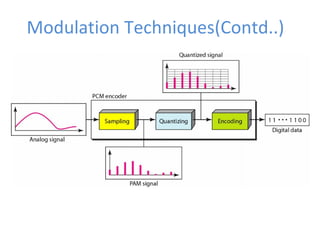
Modulation Techniques(Contd..)
Sampling
• The signals we use in the real world, such as our voices, are
called "analog" signals.
• To process these signals in computers, we need to convert
the signals to "digital" form.
• While an analog signal is continuous in both time and
amplitude, a digital signal is discrete in both time and
amplitude.
• To convert a signal from continuous time to discrete time, a
process called sampling is used.
• The value of the signal is measured at certain intervals in
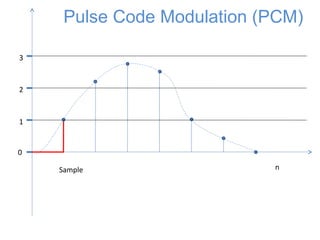
time. Each measurement is referred to as a sample.
•
How many Samples
• How many samples are necessary to ensure we are
preserving the information contained in the signal?
• If the signal contains high frequency components, we will
need to sample at a higher rate to avoid losing information
that is in the signal.
• In general, to preserve the full information in the signal, it is
necessary to sample at twice the maximum frequency of the
signal. This is known as the Nyquist rate.
• The Sampling Theorem states that a signal can be exactly
reproduced if it is sampled at a frequency F, where F is
greater than twice the maximum frequency in the signal.
0
1
2
3
t
x(t)
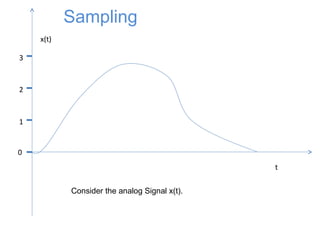
Sampling
Consider the analog Signal x(t).
0
1
2
3
n
x[n]
Sampling
The signal is first sampled
• A modulation system in which amplitude of
discrete carrier signal changes in accordance
with the instantaneous amplitude of
modulating signal(message signal) keeping
width and position of carrier constant is called
as PAM.
•
Pulse Amplitude Modulation
(PAM)
PAM
• PAM signal is discrete in time but analog in
amplitude!
PAM Generator
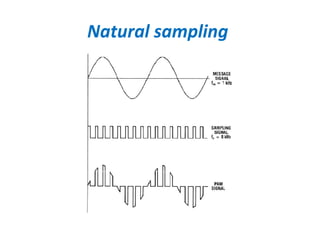
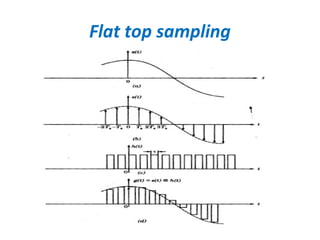
• There are 2 types of PAM :
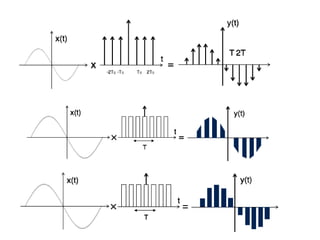
1.Natural sampling
2.Flat top sampling
Types of PAM
Natural sampling
Flat top sampling
• In PAM, the amplitude of regular interval of
periodic pulses is varied in proposition to the
sample of modulating signal or message signal.
• This is an analog type of modulation. In the pulse
amplitude modulation, the message signal is
sampled at regular periodic or time intervals and
this each sample is made proportional to the
magnitude of the message signal.
PAM Basics
PAM Basics
• These sample pulses can be transmitted
directly using wired media or we can use a
carrier signal for transmitting through
wireless.
• There are two types of sampling techniques
for transmitting messages using pulse
amplitude modulation, they are
• FLAT Top PAM
• Natural PAM
• FLAT TOP PAM: The amplitude of each pulse is
directly proportional to instantaneous modulating
signal amplitude at the time of pulse occurrence and
then keeps the amplitude of the pulse for the rest of
the half cycle.
• Natural PAM: The amplitude of each pulse is directly
proportional to the instantaneous modulating signal
amplitude at the time of pulse occurrence and then
follows the amplitude of the modulating signal for
the rest of the half cycle.
PAM Basics
• It is the base for all digital modulation
techniques and it is simple process for both
modulation and demodulation technique.
• No complex circuitry is required for both
transmission and reception. Transmitter and
receiver circuitry is simple and easy to
construct.
• PAM can generate other pulse modulation
signals and can carry the message or
information at same time.
Advantages
0
1
2
3
t
x(t)
Pulse Code Modulation (PCM)
Consider the analog Signal x(t).
0
1
2
3
n
x[n]
Pulse Code Modulation (PCM)
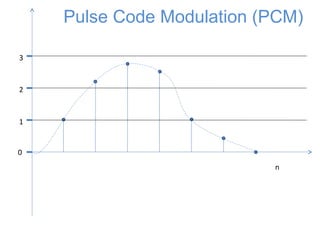
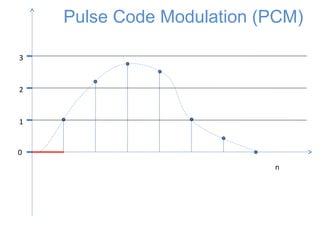
The signal is first sampled
0
1
2
3
n
Pulse Code Modulation (PCM)
0
1
2
3
n
Pulse Code Modulation (PCM)
0
1
2
3
Sample n
Pulse Code Modulation (PCM)
0
1
2
3
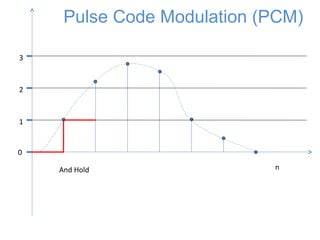
And Hold n
Pulse Code Modulation (PCM)
0
1
2
3
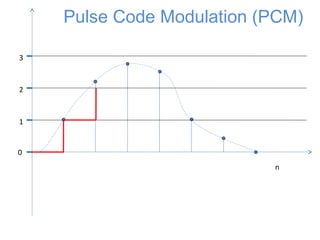
n
Pulse Code Modulation (PCM)
0
1
2
3
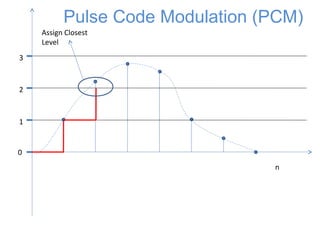
Assign Closest
Level
n
Pulse Code Modulation (PCM)
0
1
2
3
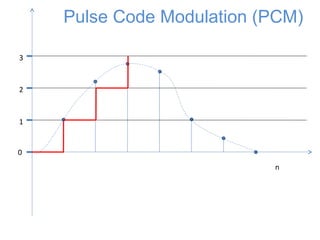
n
Pulse Code Modulation (PCM)
0
1
2
3
n
Pulse Code Modulation (PCM)
0
1
2
3
n
Pulse Code Modulation (PCM)
0
1
2
3
n
Pulse Code Modulation (PCM)
0
1
2
3
n
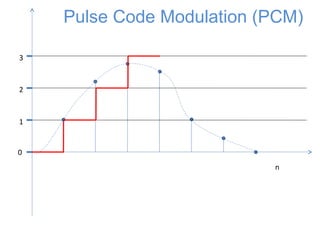
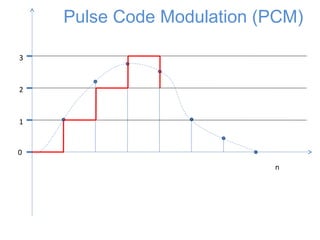
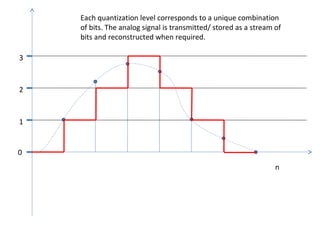
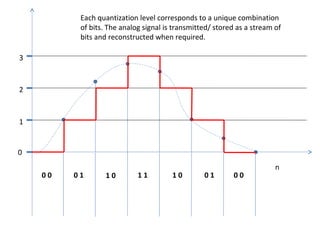
Each quantization level corresponds to a unique combination
of bits. The analog signal is transmitted/ stored as a stream of
bits and reconstructed when required.
0
1
2
3
n
0 0 0 1 1 0 1 1 1 0 0 1 0 0
Each quantization level corresponds to a unique combination
of bits. The analog signal is transmitted/ stored as a stream of
bits and reconstructed when required.
0
1
2
3
t
x(t) Original Signal
Pulse Code Modulation (PCM)
0
1
2
3
t
x~(t)
Quantized Signal
It is quite apparent that the quantized signal is not exactly the
same as the original analog signal. There is a fair degree of
quantization error here. However; as the number of quantization
levels is increased the quantization error is reduced and the
quantized signal gets closer and closer to the original signal
Pulse Code Modulation (PCM)
0
t
x~(t)
Quantized Signal
It is quite apparent that the quantized signal is not exactly the
same as the original analog signal. There is a fair degree of
quantization error here. However; as the number of quantization
levels is increased the quantization error is reduced and the
quantized signal gets closer and closer to the original signal
Pulse Code Modulation (PCM)
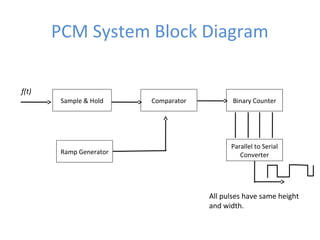
PCM System Block Diagram
Sample & Hold Comparator
Ramp Generator
Binary Counter
Parallel to Serial
Converter
All pulses have same height
and width.
f(t)
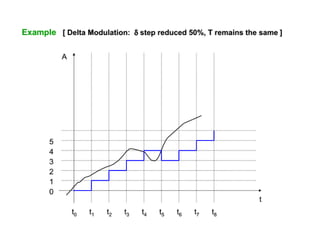
Delta Modulation
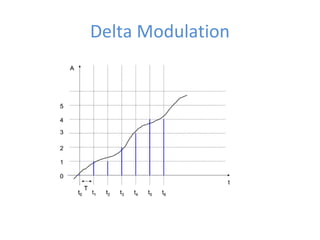
• Delta modulation is a system of digital modulation developed
after pulse code modulation.
• In this system, at each sampling time, say the Kth sampling
time, the difference between the sample value at sampling
time K and the sample value at the previous sampling time (K-
1) is encoded into just a single bit. i.e. at each sampling time
we ask simple question
Has the signal amplitude increased or decreased since the last
sample was taken?
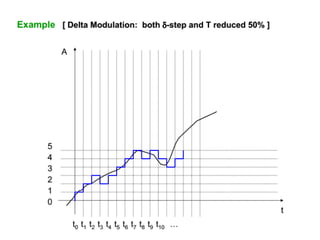
Delta Modulation
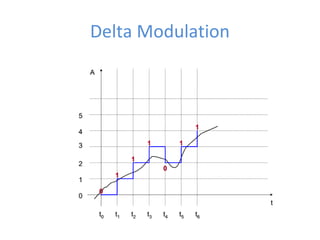
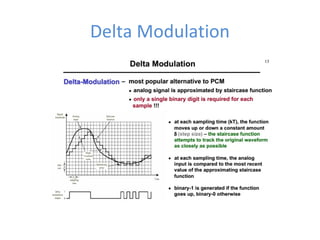
• If signal amplitude has increased, then
modulator's output is at logic level 1. If the
signal amplitude has decreased, the
modulator output is at logic level 0. Thus, the
output from the modulator is a series of zeros
and ones to indicate rise and fall of the
waveform since the previous value.
Delta Modulation
Delta Modulation
Delta Modulation
Pcm
Pcm
Pcm

Pcm

  • 1.
  • 2.
    Sampling • The signalswe use in the real world, such as our voices, are called "analog" signals. • To process these signals in computers, we need to convert the signals to "digital" form. • While an analog signal is continuous in both time and amplitude, a digital signal is discrete in both time and amplitude. • To convert a signal from continuous time to discrete time, a process called sampling is used. • The value of the signal is measured at certain intervals in time. Each measurement is referred to as a sample. •
  • 3.
    How many Samples •How many samples are necessary to ensure we are preserving the information contained in the signal? • If the signal contains high frequency components, we will need to sample at a higher rate to avoid losing information that is in the signal. • In general, to preserve the full information in the signal, it is necessary to sample at twice the maximum frequency of the signal. This is known as the Nyquist rate. • The Sampling Theorem states that a signal can be exactly reproduced if it is sampled at a frequency F, where F is greater than twice the maximum frequency in the signal.
  • 4.
  • 5.
  • 7.
    • A modulationsystem in which amplitude of discrete carrier signal changes in accordance with the instantaneous amplitude of modulating signal(message signal) keeping width and position of carrier constant is called as PAM. • Pulse Amplitude Modulation (PAM)
  • 8.
    PAM • PAM signalis discrete in time but analog in amplitude!
  • 9.
  • 10.
    • There are2 types of PAM : 1.Natural sampling 2.Flat top sampling Types of PAM
  • 11.
  • 12.
  • 13.
    • In PAM,the amplitude of regular interval of periodic pulses is varied in proposition to the sample of modulating signal or message signal. • This is an analog type of modulation. In the pulse amplitude modulation, the message signal is sampled at regular periodic or time intervals and this each sample is made proportional to the magnitude of the message signal. PAM Basics
  • 14.
    PAM Basics • Thesesample pulses can be transmitted directly using wired media or we can use a carrier signal for transmitting through wireless. • There are two types of sampling techniques for transmitting messages using pulse amplitude modulation, they are • FLAT Top PAM • Natural PAM
  • 15.
    • FLAT TOPPAM: The amplitude of each pulse is directly proportional to instantaneous modulating signal amplitude at the time of pulse occurrence and then keeps the amplitude of the pulse for the rest of the half cycle. • Natural PAM: The amplitude of each pulse is directly proportional to the instantaneous modulating signal amplitude at the time of pulse occurrence and then follows the amplitude of the modulating signal for the rest of the half cycle. PAM Basics
  • 16.
    • It isthe base for all digital modulation techniques and it is simple process for both modulation and demodulation technique. • No complex circuitry is required for both transmission and reception. Transmitter and receiver circuitry is simple and easy to construct. • PAM can generate other pulse modulation signals and can carry the message or information at same time. Advantages
  • 17.
    0 1 2 3 t x(t) Pulse Code Modulation(PCM) Consider the analog Signal x(t).
  • 18.
    0 1 2 3 n x[n] Pulse Code Modulation(PCM) The signal is first sampled
  • 19.
  • 20.
  • 21.
  • 22.
    0 1 2 3 And Hold n PulseCode Modulation (PCM)
  • 23.
  • 24.
  • 25.
  • 26.
  • 27.
  • 28.
  • 29.
    0 1 2 3 n Each quantization levelcorresponds to a unique combination of bits. The analog signal is transmitted/ stored as a stream of bits and reconstructed when required.
  • 30.
    0 1 2 3 n 0 0 01 1 0 1 1 1 0 0 1 0 0 Each quantization level corresponds to a unique combination of bits. The analog signal is transmitted/ stored as a stream of bits and reconstructed when required.
  • 31.
  • 32.
    0 1 2 3 t x~(t) Quantized Signal It isquite apparent that the quantized signal is not exactly the same as the original analog signal. There is a fair degree of quantization error here. However; as the number of quantization levels is increased the quantization error is reduced and the quantized signal gets closer and closer to the original signal Pulse Code Modulation (PCM)
  • 33.
    0 t x~(t) Quantized Signal It isquite apparent that the quantized signal is not exactly the same as the original analog signal. There is a fair degree of quantization error here. However; as the number of quantization levels is increased the quantization error is reduced and the quantized signal gets closer and closer to the original signal Pulse Code Modulation (PCM)
  • 34.
    PCM System BlockDiagram Sample & Hold Comparator Ramp Generator Binary Counter Parallel to Serial Converter All pulses have same height and width. f(t)
  • 35.
    Delta Modulation • Deltamodulation is a system of digital modulation developed after pulse code modulation. • In this system, at each sampling time, say the Kth sampling time, the difference between the sample value at sampling time K and the sample value at the previous sampling time (K- 1) is encoded into just a single bit. i.e. at each sampling time we ask simple question Has the signal amplitude increased or decreased since the last sample was taken?
  • 36.
    Delta Modulation • Ifsignal amplitude has increased, then modulator's output is at logic level 1. If the signal amplitude has decreased, the modulator output is at logic level 0. Thus, the output from the modulator is a series of zeros and ones to indicate rise and fall of the waveform since the previous value.
  • 37.
  • 38.
  • 39.