By :
T.ANIL KUMAR(14A81A0237)&
S HEMANTH DURGA REDDY(14A81A0236)
SRI VASAVI ENGINEERING COLLEGE
TADEPALLIGUDEM
B.Tech 3rd year EEE
WHAT IS MATHS ?
In Ramanujan’s point of view maths
is defined as “A pattern connected
with Calculus, Geometry,
Trignomentry and etc., combined
together to form a solution
CREATIVITY HOLDS TWO THINGS
Engineering + Maths = Everything
Enginnering – Maths = Nothing
DIFFERENT METHODS IN MATHS
 Laplace transforms
 Calculus
 Z- transforms
 Complex numbers
 Probability
 Fourier series
 Limits
 Trigonometry etc....
LAPLACE TRANSFORMS
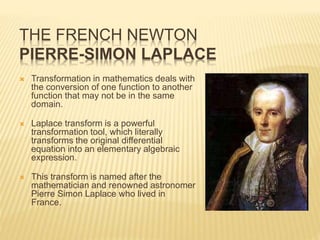
THE FRENCH NEWTON
PIERRE-SIMON LAPLACE
 Transformation in mathematics deals with
the conversion of one function to another
function that may not be in the same
domain.
 Laplace transform is a powerful
transformation tool, which literally
transforms the original differential
equation into an elementary algebraic
expression.
 This transform is named after the
mathematician and renowned astronomer
Pierre Simon Laplace who lived in
France.
DEFINITION
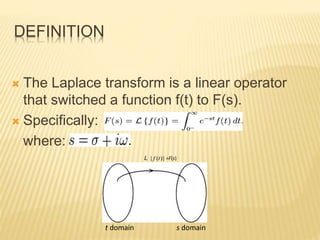
 The Laplace transform is a linear operator
that switched a function f(t) to F(s).
 Specifically:
where:
{ ( )}f tL =F(s)
t domain s domain
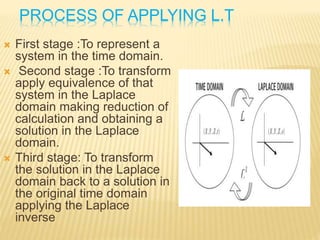
PROCESS OF APPLYING L.T
 First stage :To represent a
system in the time domain.
 Second stage :To transform
apply equivalence of that
system in the Laplace
domain making reduction of
calculation and obtaining a
solution in the Laplace
domain.
 Third stage: To transform
the solution in the Laplace
domain back to a solution in
the original time domain
applying the Laplace
inverse
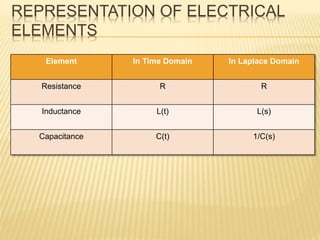
REPRESENTATION OF ELECTRICAL
ELEMENTS
Element In Time Domain In Laplace Domain
Resistance R R
Inductance L(t) L(s)
Capacitance C(t) 1/C(s)
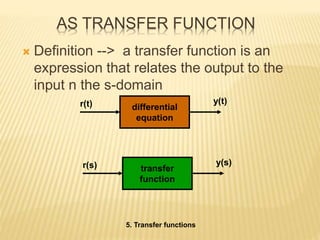
AS TRANSFER FUNCTION
 Definition --> a transfer function is an
expression that relates the output to the
input n the s-domain
differential
equation
r(t) y(t)
transfer
function
r(s) y(s)
5. Transfer functions
APPLICATIONS OF LAPLACE TRANSFORMS
 Electrical circuits
 Control Systems
 Signals & Systems
FOURIER SERIES
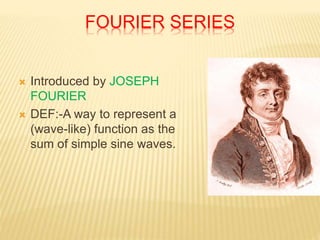
 Introduced by JOSEPH
FOURIER
 DEF:-A way to represent a
(wave-like) function as the
sum of simple sine waves.
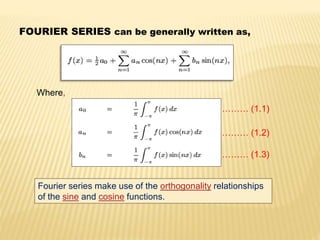
Fourier series make use of the orthogonality relationships
of the sine and cosine functions.
FOURIER SERIES can be generally written as,
Where,
……… (1.1)
……… (1.2)
……… (1.3)
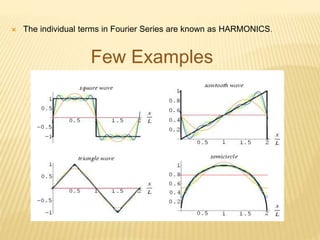
 The individual terms in Fourier Series are known as HARMONICS.
Few Examples
APPLICATIONS
 Used in Harmonic Analysis
 Transient Analysis
 Conversion of Response from Time
Domain to Frequency Domain
 Power Electronics
Electrical Engineering (A.C. Circuits):
 Resistors, inductors, capacitors, power
engineering, analysis of electric magnetic
fields and their interactions with materials
and structures.
CONCLUSION
Machines Rule The World We Rule
The Machines Without Calculations
There Are No Machines
REFERENCES
 WWW.WIKIPEDIA.COM
 WWW.SCRIBD.COM
APPLICATION MATHS FOR EEE

APPLICATION MATHS FOR EEE

  • 1.
    By : T.ANIL KUMAR(14A81A0237)& SHEMANTH DURGA REDDY(14A81A0236) SRI VASAVI ENGINEERING COLLEGE TADEPALLIGUDEM B.Tech 3rd year EEE
  • 2.
    WHAT IS MATHS? In Ramanujan’s point of view maths is defined as “A pattern connected with Calculus, Geometry, Trignomentry and etc., combined together to form a solution
  • 3.
    CREATIVITY HOLDS TWOTHINGS Engineering + Maths = Everything Enginnering – Maths = Nothing
  • 4.
    DIFFERENT METHODS INMATHS  Laplace transforms  Calculus  Z- transforms  Complex numbers  Probability  Fourier series  Limits  Trigonometry etc....
  • 5.
  • 6.
    THE FRENCH NEWTON PIERRE-SIMONLAPLACE  Transformation in mathematics deals with the conversion of one function to another function that may not be in the same domain.  Laplace transform is a powerful transformation tool, which literally transforms the original differential equation into an elementary algebraic expression.  This transform is named after the mathematician and renowned astronomer Pierre Simon Laplace who lived in France.
  • 7.
    DEFINITION  The Laplacetransform is a linear operator that switched a function f(t) to F(s).  Specifically: where: { ( )}f tL =F(s) t domain s domain
  • 8.
    PROCESS OF APPLYINGL.T  First stage :To represent a system in the time domain.  Second stage :To transform apply equivalence of that system in the Laplace domain making reduction of calculation and obtaining a solution in the Laplace domain.  Third stage: To transform the solution in the Laplace domain back to a solution in the original time domain applying the Laplace inverse
  • 9.
    REPRESENTATION OF ELECTRICAL ELEMENTS ElementIn Time Domain In Laplace Domain Resistance R R Inductance L(t) L(s) Capacitance C(t) 1/C(s)
  • 10.
    AS TRANSFER FUNCTION Definition --> a transfer function is an expression that relates the output to the input n the s-domain differential equation r(t) y(t) transfer function r(s) y(s) 5. Transfer functions
  • 11.
    APPLICATIONS OF LAPLACETRANSFORMS  Electrical circuits  Control Systems  Signals & Systems
  • 12.
    FOURIER SERIES  Introducedby JOSEPH FOURIER  DEF:-A way to represent a (wave-like) function as the sum of simple sine waves.
  • 13.
    Fourier series makeuse of the orthogonality relationships of the sine and cosine functions. FOURIER SERIES can be generally written as, Where, ……… (1.1) ……… (1.2) ……… (1.3)
  • 14.
     The individualterms in Fourier Series are known as HARMONICS. Few Examples
  • 15.
    APPLICATIONS  Used inHarmonic Analysis  Transient Analysis  Conversion of Response from Time Domain to Frequency Domain  Power Electronics
  • 16.
    Electrical Engineering (A.C.Circuits):  Resistors, inductors, capacitors, power engineering, analysis of electric magnetic fields and their interactions with materials and structures.
  • 17.
    CONCLUSION Machines Rule TheWorld We Rule The Machines Without Calculations There Are No Machines
  • 18.