
Just-In-Time (JIT)
Name: Deepak kumar
sahoo
Roll no: MT14IND007
Department: Industrial
engg..
Institute: VNIT
1
Just-In Time
 Just-In-Time is defined as "the production of the
minimum number of different units, in the smallest
possible quantities, at the latest possible time,
thereby eliminating the need for inventory.
 JIT- do it right in the first time.
 JIT- production is based on demand.
 JIT exceeds the concept of inventory reduction; it is
an all-encompassing philosophy geared to
eliminate waste, anything that does not add value.
2
Just-in-Time
 JIT philosophy means getting the right
quantity of goods at the right place and the
right time
 A broad JIT view – or lean production/lean
systems - is one that encompasses the entire
organization
3
History of JIT
Manufacturing
 Evolved in Japan after World War II, as a
result of their diminishing market share in
the auto industry.
 Toyota Motor Company- Birthplace of the
JIT Philosophy Under Taiichi Ohno.
 JIT is now on the rise in American
Industries.
4
JIT Means …
 Keeping work flows moving
 Eliminating inventories
 Reducing travel distances
 Eliminating defects and scrap
 Maximizing usage of space
5
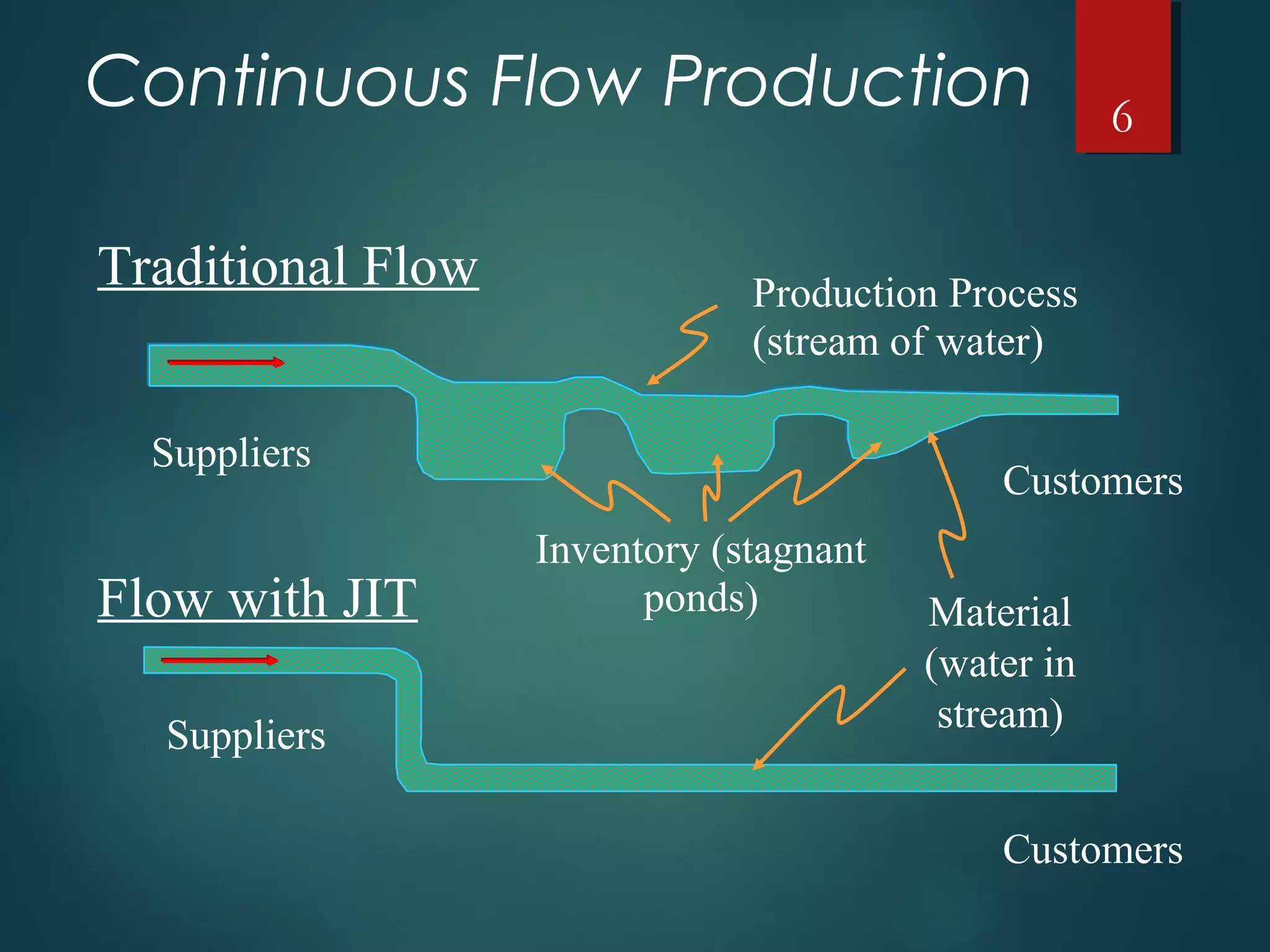
Continuous Flow Production
Flow with JIT
Traditional Flow
Customers
Suppliers
Customers
Suppliers
Production Process
(stream of water)
Inventory (stagnant
ponds) Material
(water in
stream)
6
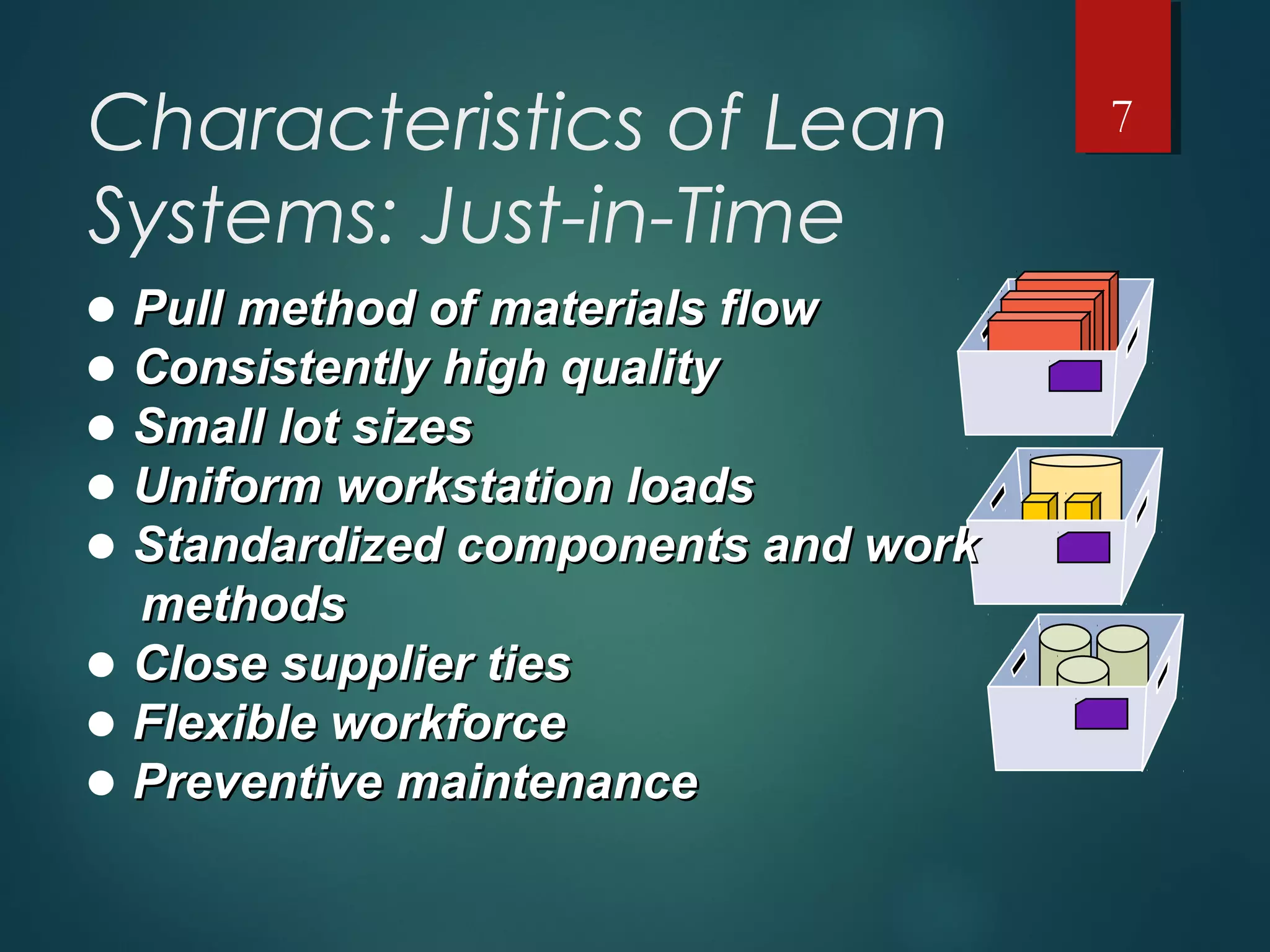
Characteristics of Lean
Systems: Just-in-Time
• Pull method of materials flowPull method of materials flow
• Consistently high qualityConsistently high quality
• Small lot sizesSmall lot sizes
• Uniform workstation loadsUniform workstation loads
• Standardized components and workStandardized components and work
methodsmethods
• Close supplier tiesClose supplier ties
• Flexible workforceFlexible workforce
• Preventive maintenancePreventive maintenance
7
Pull system: System for moving work where a
workstation pulls output from the preceding station
as needed (control-based systems that signals the
requirement for parts as they are needed in
reality).
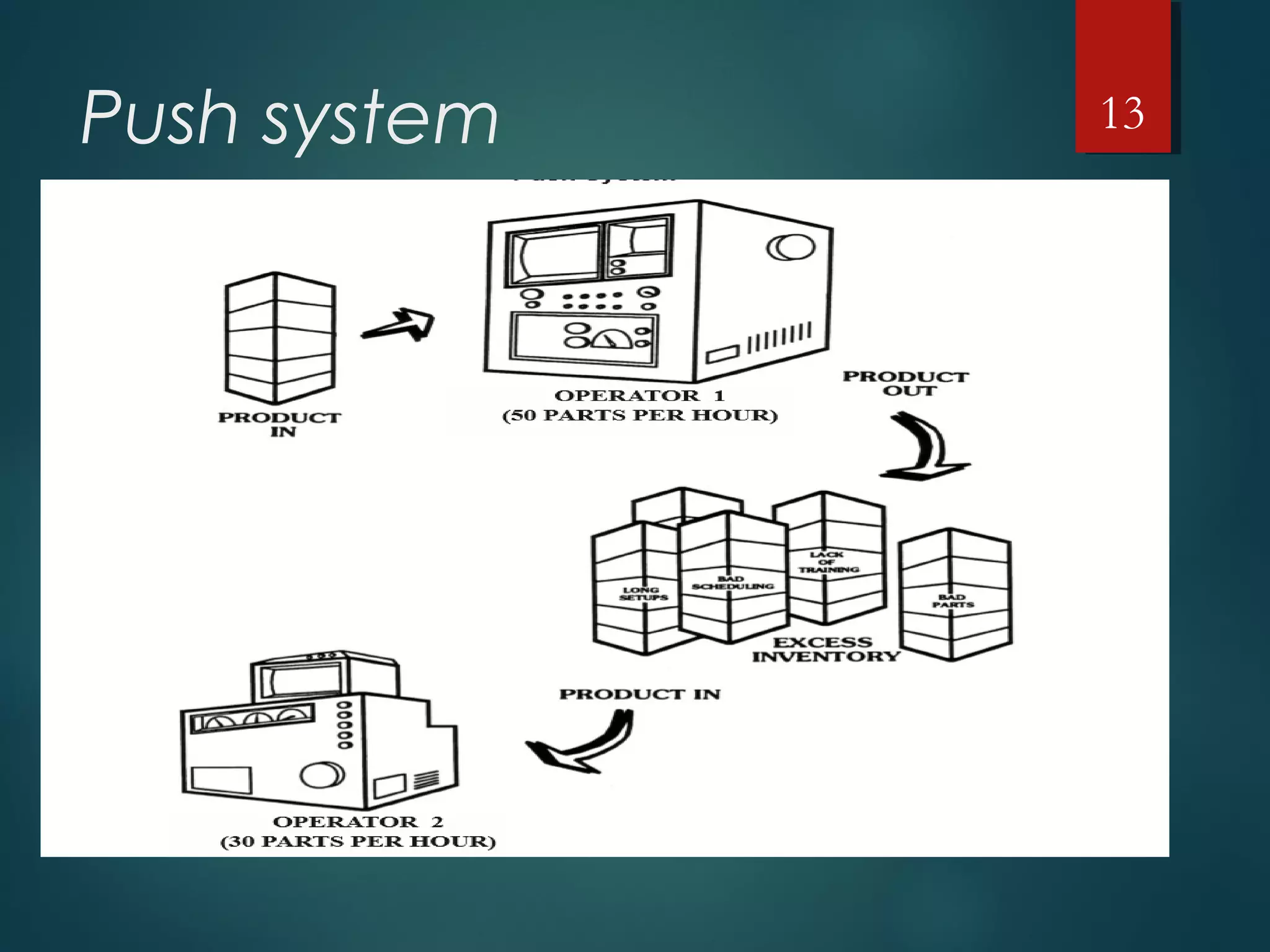
Push system: System for moving work where
output is pushed to the next station as it is
completed (planning-based systems that
determine when workstations will probably need
parts if everything goes according to plan)
8
Pull system
 No operation can produce goods until it has
received a signal from its customers. When the
operator gets a signal from the customer, he
then has authorization to produce a certain
number of parts in a specific time period.
 The most effective pull (kanban) signals are
visual indicators such as empty containers or
empty floor space. If you have an empty
container, fill it up; if you have no container then
do not produce that part..
9
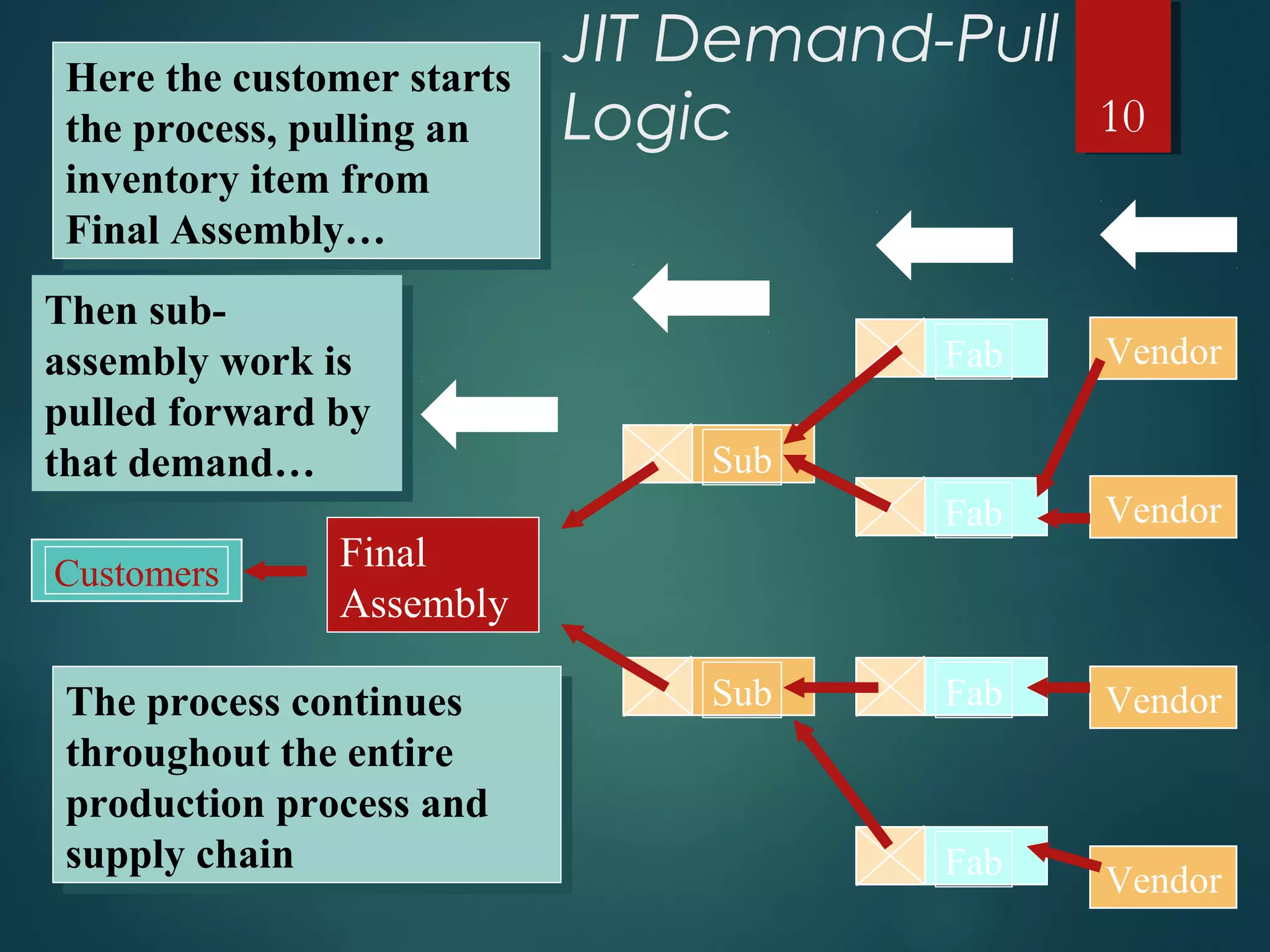
JIT Demand-Pull
Logic
Customers
Sub
Sub
Fab
Fab
Fab
Fab
Vendor
Vendor
Vendor
Vendor
Final
Assembly
Here the customer starts
the process, pulling an
inventory item from
Final Assembly…
Here the customer starts
the process, pulling an
inventory item from
Final Assembly…
Then sub-
assembly work is
pulled forward by
that demand…
Then sub-
assembly work is
pulled forward by
that demand…
The process continues
throughout the entire
production process and
supply chain
The process continues
throughout the entire
production process and
supply chain
10
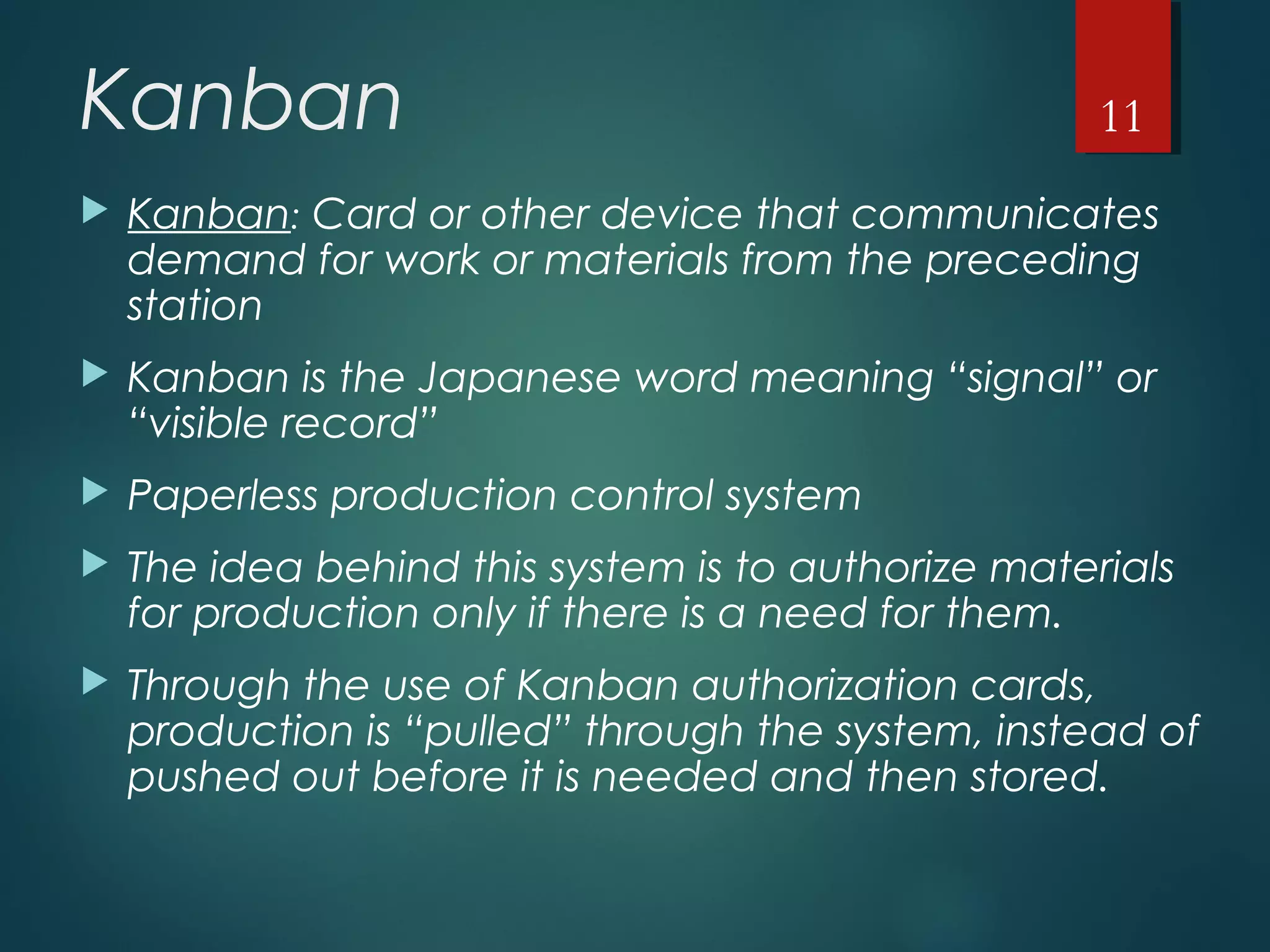
Kanban
 Kanban: Card or other device that communicates
demand for work or materials from the preceding
station
 Kanban is the Japanese word meaning “signal” or
“visible record”
 Paperless production control system
 The idea behind this system is to authorize materials
for production only if there is a need for them.
 Through the use of Kanban authorization cards,
production is “pulled” through the system, instead of
pushed out before it is needed and then stored.
11
Kanban Process 12
Push system 13
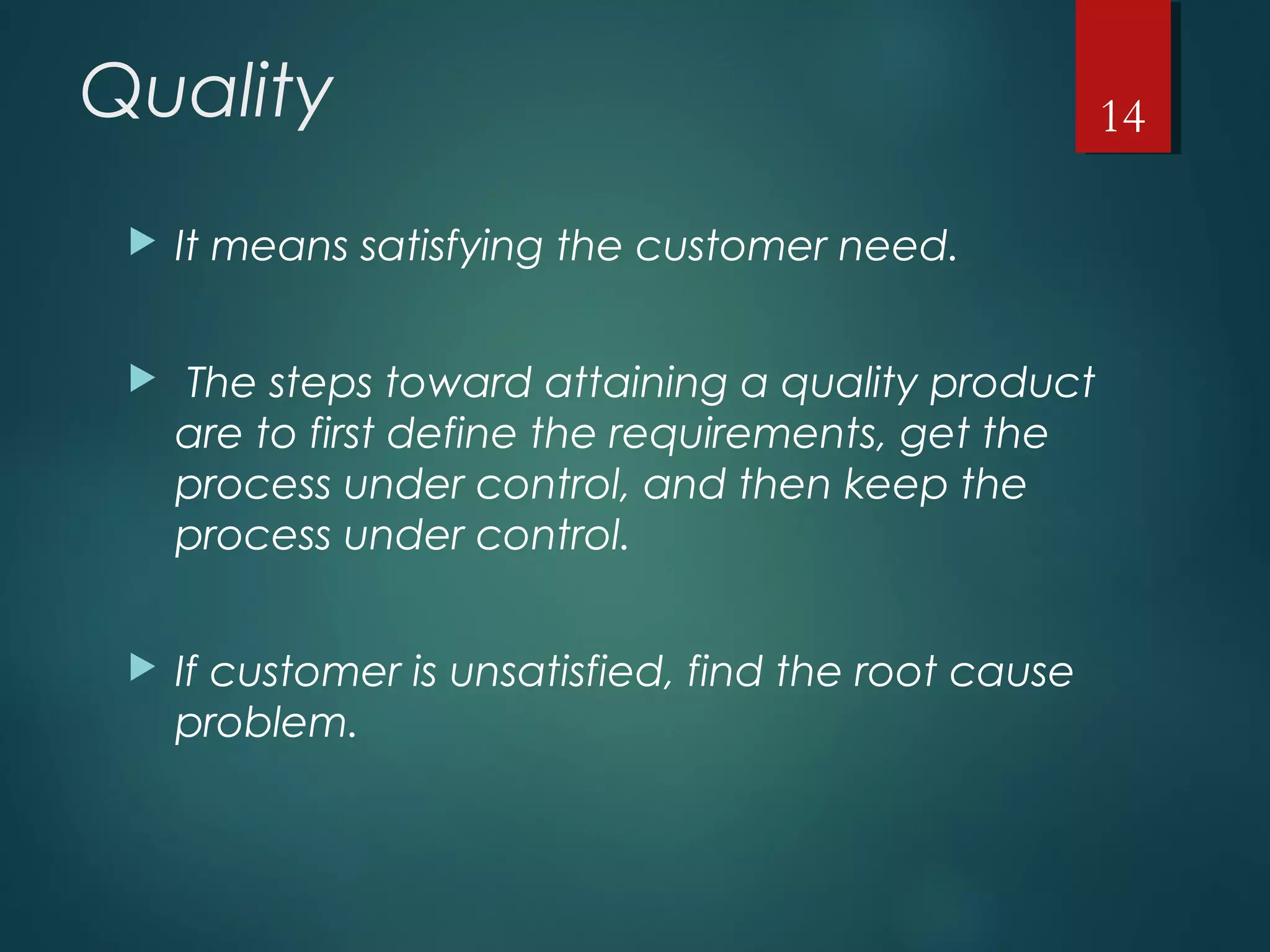
Quality
 It means satisfying the customer need.
 The steps toward attaining a quality product
are to first define the requirements, get the
process under control, and then keep the
process under control.
 If customer is unsatisfied, find the root cause
problem.
14
Getting to the root cause 15
Keeping process under
control
 Statistical Process Control (SPC) is a method of
managing a process by gathering information
about it and using that information to adjust the
process to prevent problems from occurring.
 Using Poka- yoke theory.
16
Uniform work station load
 Uniform Plant Load states that balance
between operations is more important than
speed, and ideally we should never produce
faster than the customer requirement rate
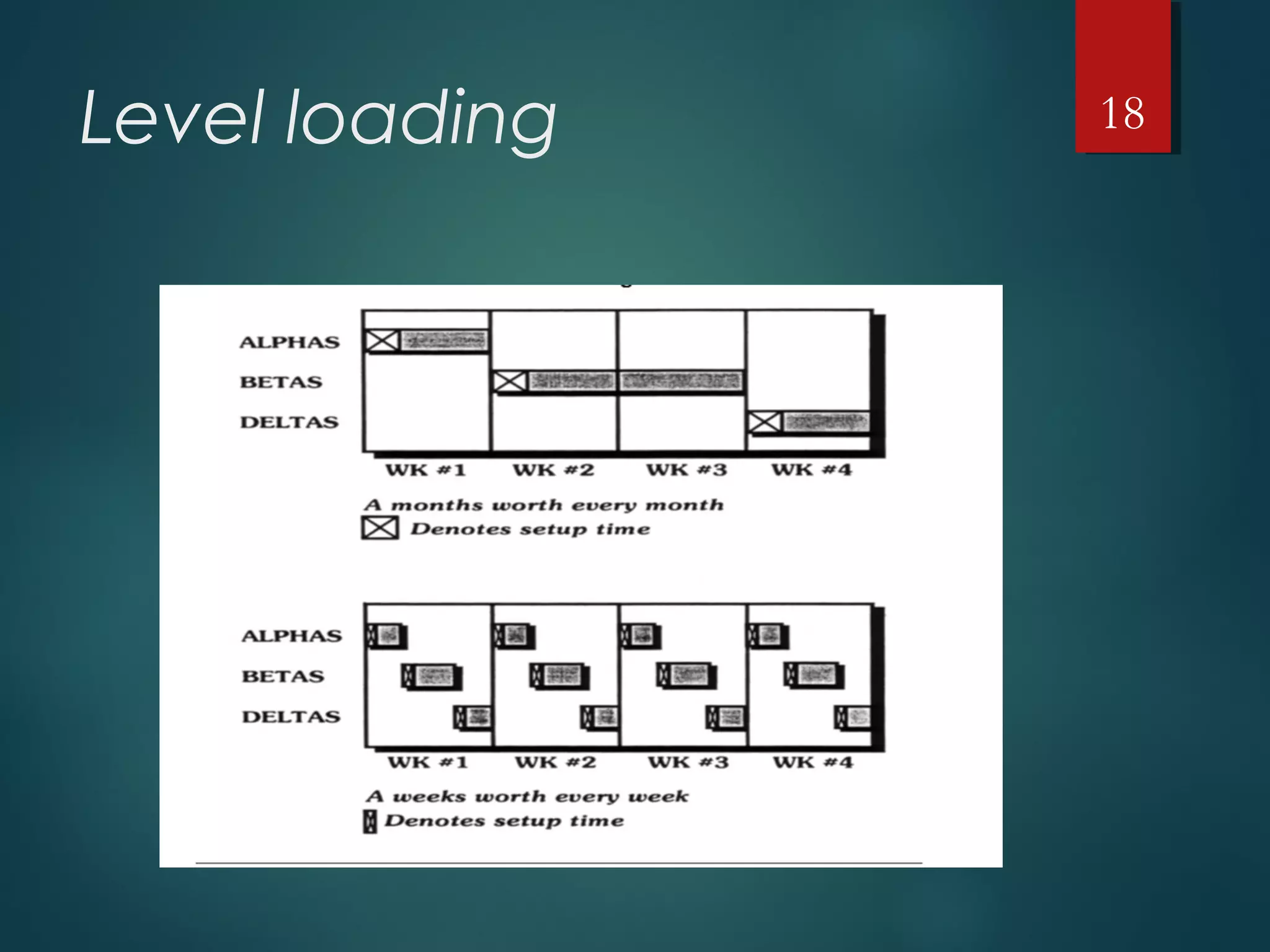
 The concept of Uniform Plant Load incorporates
two radically different facets of production. They
are rate of production (cycle time) and
frequency of production (level loading).
17
Level loading 18
Traditional Systems
Compared to JIT
19
Priorities
 Traditionally
 Accept all customer orders
 Provide a large number of options from
which customers may order
 JIT
 low cost/high quality within limited market
20
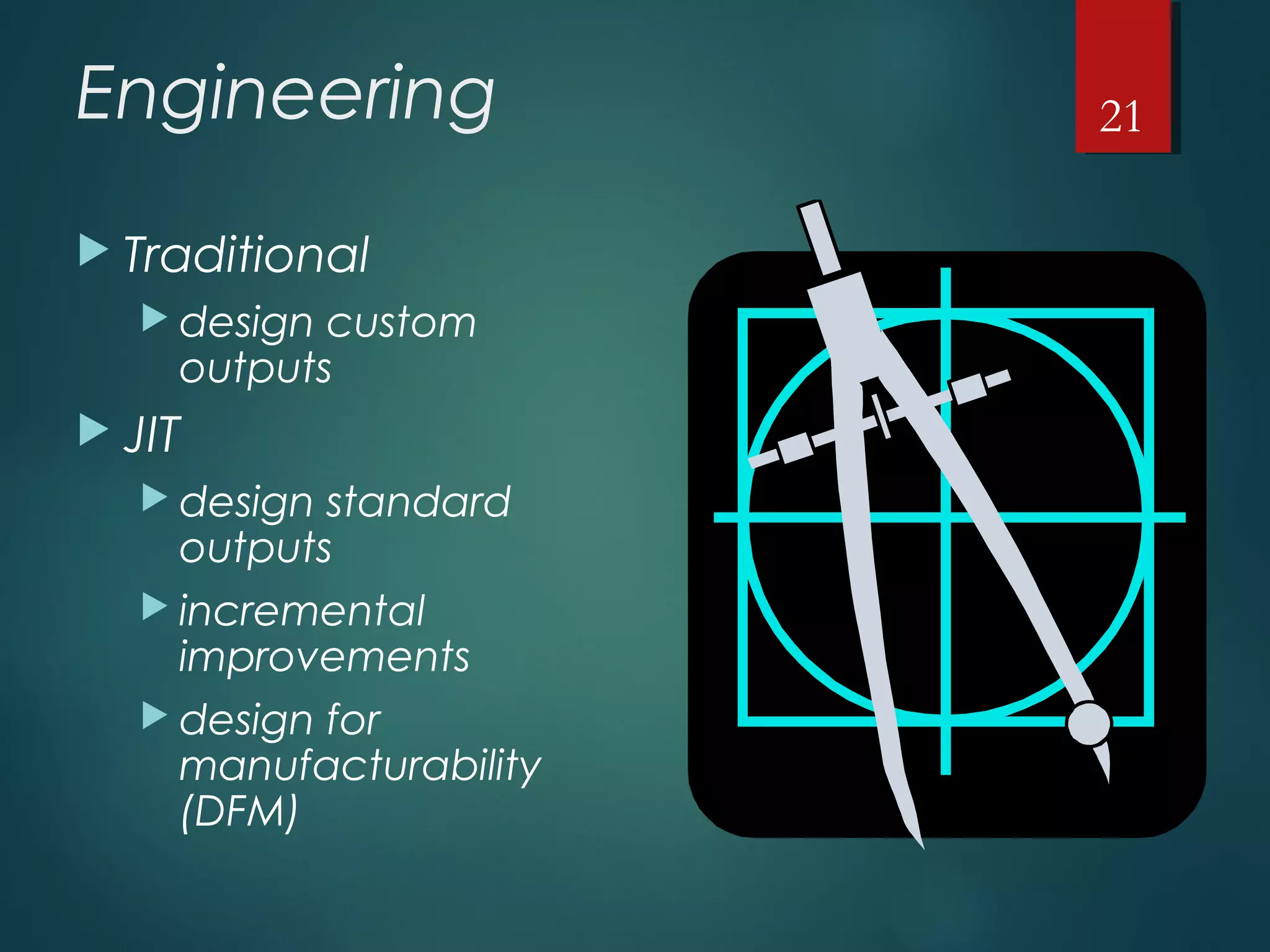
Engineering
 Traditional
 design custom
outputs
 JIT
 design standard
outputs
 incremental
improvements
 design for
manufacturability
(DFM)
21
Layout
 Traditional
 job shop approach of using widely spread-out
equipment with space for stockrooms, tool cribs,
and work-in-process inventories between the
equipment
 To handle and move all this inventory, automated
or semi automated materials handling equipment
(conveyors, forklifts) is required, which takes even
more space.
 JIT
 Equipment is moved as close together as possible
so that parts can be actually handed from one
worker or machine to the next.
 Use of cells, and flow lines dictates small lots of parts
with minimal work-in-process and material-moving
equipment.
 manual transfer
22
Workforce
 Traditional
 competitive attitude between workers and managers
 status symbols and privileges
 much of the employees’ time is nonworking time:
looking for parts, moving materials, setting up
machines, getting instructions, and so on. When
actually working, they tend to work fast.
 JIT
 broadly skilled flexible workers who can uncover
and solve problems
 cooperative attitudes
23
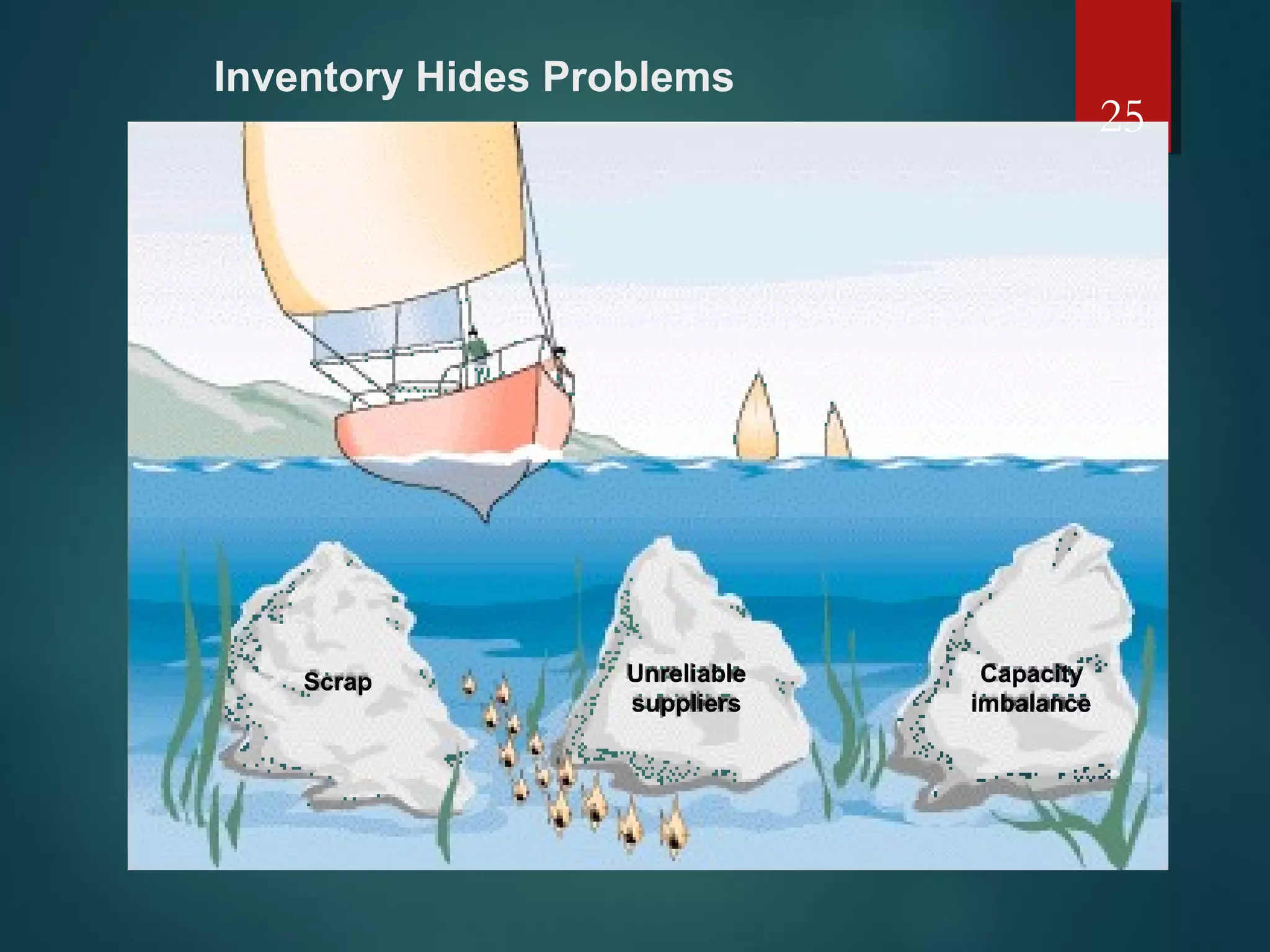
Inventories
 Traditional
 used to buffer
operations
 large WIP buffers
 JIT
 inventory is seen as
an evil
 small WIP buffers
24
Scrap Unreliable
suppliers
Capacity
imbalance
Inventory Hides Problems
25
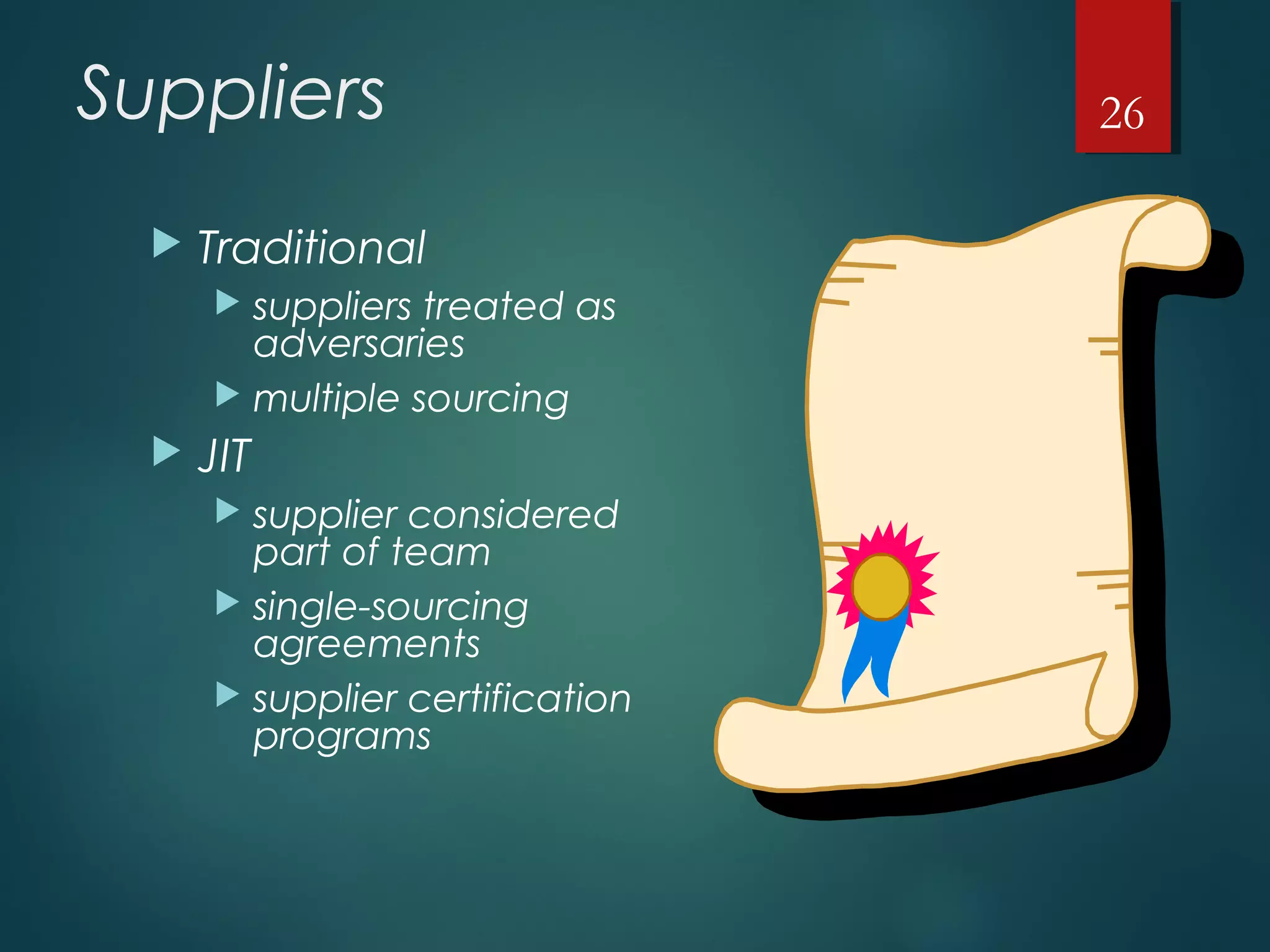
Suppliers
 Traditional
 suppliers treated as
adversaries
 multiple sourcing
 JIT
 supplier considered
part of team
 single-sourcing
agreements
 supplier certification
programs
26
Planning and Control
 Traditional
 focus is on planning
 planning complex and computerized
 JIT
 focus is on control
 procedures kept simple and visual
 rather than planning and forecasting for an
uncertain future, the firm attempts to respond
to what actually happens in real time with
flexible, quick operations.
27
Quality
 Traditional
 inspect goods at critical points
 scrap rates tracked
 JIT
 goal is zero defects
 workers themselves inspect parts
28
Maintenance
 Traditional
 corrective maintenance, repairing a machine
when it breaks down
 done by experts who do nothing but repair
broken equipment
 equipment run fast
 JIT
 preventive maintenance, conducting
maintenance before the machine is expected
to fail, or at regular intervals.
 done by equipment operators
 equipment run slow (minimizes their chance of
breakdown while maximizing their output)
29
Barriers in India for
implementing jit
 Management: Management is cited a major
attribute of Lean barrier if management has lack of
focus for Lean Manufacturing, does not creates
urge of urgency, does not provides support to Lean
Manufacturing activities and does not have long
term vision, itself turn out to be a barrier in Lean
Manufacturing implementation.
 Conflicts: Conflicts with Other program are
prominent barrier in Lean Manufacturing
implementation.
30
Barriers in India for
implementing jit
 Employee: having resistance to change major
reason as having a fear of failure, lower confidence
and lesser capability to collaborate for common
projects becomes big barrier in Lean Manufacturing
implementation.
 Financial: Lean Manufacturing many times does
not produce any direct financial payback rather it
supports the process of identification and elimination
of waste hence reduction of cost.
31
COMPANIES THAT USE JIT
There are so many companies that are using JIT
planning. Any car, motorbike or aircraft
manufacture uses JIT. This means that the
examples are countless. For example,
Toyota
Dell
Harley Davidson
Walmart
 McDonalds
Xerox
32
Typical Benefits of JIT
 Cost savings: inventory reductions, reduced scrap, fewer
defects, fewer changes due to both customers and
engineering, less space, decreased labor hours, les
rework.
 Revenue increases: better service and quality to the
customer.
 Investment savings: less space, reduced inventory,
increased the volume of work produced in the same
facility.
 Workforce improvements: more satisfied, better trained
employees.
 Uncovering problems: greater visibility to problems that
JIT allows, if management is willing to capitalize on the
opportunity to fix these problems.
33
Potential Problems
Implementing JIT
 Applicable primarily to repetitive operations
 Requires discipline
 Based on cooperation and trust
 Requires change of philosophy
34
Summary
JIT- A philosophy of
continuous improvement
that puts emphasis on
prevention rather than
correction, and
demands a company
wide focus on quality.
35
Refrences
 Singh B., Garg S.K., Sharma S.K, (2010),
Scope for Lean implementation: a survey
of 127 Indian industries"", International
Journal of Rapid Manufacturing, Vol. X,
No. Y, pp1-11.
 “http://en.wikipedia.org/wiki/Just_in_time
 http://www.slideshare.net/swatiluthra5/just-in-time-ma
 http://www.slideshare.net/manojlawate/j
ust-in-time-16335484?related=1
36
THANK YOU
37
Questions:
 1. Explain the concepts of JIT?
 2. How JIT helps in eliminating wastes in
industry? Explain it through example.
 3. Differentiate between traditional
manufacturing system & JIT
manufacturing system?
 4. Why India fails in implementing JIT?
 5. List out the merits & demerits of JIT
implementation? Also explain problem
faced by industry while implementing JIT.
38

jit

  • 1.
    Just-In-Time (JIT) Name: Deepakkumar sahoo Roll no: MT14IND007 Department: Industrial engg.. Institute: VNIT 1
  • 2.
    Just-In Time  Just-In-Timeis defined as "the production of the minimum number of different units, in the smallest possible quantities, at the latest possible time, thereby eliminating the need for inventory.  JIT- do it right in the first time.  JIT- production is based on demand.  JIT exceeds the concept of inventory reduction; it is an all-encompassing philosophy geared to eliminate waste, anything that does not add value. 2
  • 3.
    Just-in-Time  JIT philosophymeans getting the right quantity of goods at the right place and the right time  A broad JIT view – or lean production/lean systems - is one that encompasses the entire organization 3
  • 4.
    History of JIT Manufacturing Evolved in Japan after World War II, as a result of their diminishing market share in the auto industry.  Toyota Motor Company- Birthplace of the JIT Philosophy Under Taiichi Ohno.  JIT is now on the rise in American Industries. 4
  • 5.
    JIT Means … Keeping work flows moving  Eliminating inventories  Reducing travel distances  Eliminating defects and scrap  Maximizing usage of space 5
  • 6.
    Continuous Flow Production Flowwith JIT Traditional Flow Customers Suppliers Customers Suppliers Production Process (stream of water) Inventory (stagnant ponds) Material (water in stream) 6
  • 7.
    Characteristics of Lean Systems:Just-in-Time • Pull method of materials flowPull method of materials flow • Consistently high qualityConsistently high quality • Small lot sizesSmall lot sizes • Uniform workstation loadsUniform workstation loads • Standardized components and workStandardized components and work methodsmethods • Close supplier tiesClose supplier ties • Flexible workforceFlexible workforce • Preventive maintenancePreventive maintenance 7
  • 8.
    Pull system: Systemfor moving work where a workstation pulls output from the preceding station as needed (control-based systems that signals the requirement for parts as they are needed in reality). Push system: System for moving work where output is pushed to the next station as it is completed (planning-based systems that determine when workstations will probably need parts if everything goes according to plan) 8
  • 9.
    Pull system  Nooperation can produce goods until it has received a signal from its customers. When the operator gets a signal from the customer, he then has authorization to produce a certain number of parts in a specific time period.  The most effective pull (kanban) signals are visual indicators such as empty containers or empty floor space. If you have an empty container, fill it up; if you have no container then do not produce that part.. 9
  • 10.
    JIT Demand-Pull Logic Customers Sub Sub Fab Fab Fab Fab Vendor Vendor Vendor Vendor Final Assembly Here thecustomer starts the process, pulling an inventory item from Final Assembly… Here the customer starts the process, pulling an inventory item from Final Assembly… Then sub- assembly work is pulled forward by that demand… Then sub- assembly work is pulled forward by that demand… The process continues throughout the entire production process and supply chain The process continues throughout the entire production process and supply chain 10
  • 11.
    Kanban  Kanban: Cardor other device that communicates demand for work or materials from the preceding station  Kanban is the Japanese word meaning “signal” or “visible record”  Paperless production control system  The idea behind this system is to authorize materials for production only if there is a need for them.  Through the use of Kanban authorization cards, production is “pulled” through the system, instead of pushed out before it is needed and then stored. 11
  • 12.
  • 13.
  • 14.
    Quality  It meanssatisfying the customer need.  The steps toward attaining a quality product are to first define the requirements, get the process under control, and then keep the process under control.  If customer is unsatisfied, find the root cause problem. 14
  • 15.
    Getting to theroot cause 15
  • 16.
    Keeping process under control Statistical Process Control (SPC) is a method of managing a process by gathering information about it and using that information to adjust the process to prevent problems from occurring.  Using Poka- yoke theory. 16
  • 17.
    Uniform work stationload  Uniform Plant Load states that balance between operations is more important than speed, and ideally we should never produce faster than the customer requirement rate  The concept of Uniform Plant Load incorporates two radically different facets of production. They are rate of production (cycle time) and frequency of production (level loading). 17
  • 18.
  • 19.
  • 20.
    Priorities  Traditionally  Acceptall customer orders  Provide a large number of options from which customers may order  JIT  low cost/high quality within limited market 20
  • 21.
    Engineering  Traditional  designcustom outputs  JIT  design standard outputs  incremental improvements  design for manufacturability (DFM) 21
  • 22.
    Layout  Traditional  jobshop approach of using widely spread-out equipment with space for stockrooms, tool cribs, and work-in-process inventories between the equipment  To handle and move all this inventory, automated or semi automated materials handling equipment (conveyors, forklifts) is required, which takes even more space.  JIT  Equipment is moved as close together as possible so that parts can be actually handed from one worker or machine to the next.  Use of cells, and flow lines dictates small lots of parts with minimal work-in-process and material-moving equipment.  manual transfer 22
  • 23.
    Workforce  Traditional  competitiveattitude between workers and managers  status symbols and privileges  much of the employees’ time is nonworking time: looking for parts, moving materials, setting up machines, getting instructions, and so on. When actually working, they tend to work fast.  JIT  broadly skilled flexible workers who can uncover and solve problems  cooperative attitudes 23
  • 24.
    Inventories  Traditional  usedto buffer operations  large WIP buffers  JIT  inventory is seen as an evil  small WIP buffers 24
  • 25.
  • 26.
    Suppliers  Traditional  supplierstreated as adversaries  multiple sourcing  JIT  supplier considered part of team  single-sourcing agreements  supplier certification programs 26
  • 27.
    Planning and Control Traditional  focus is on planning  planning complex and computerized  JIT  focus is on control  procedures kept simple and visual  rather than planning and forecasting for an uncertain future, the firm attempts to respond to what actually happens in real time with flexible, quick operations. 27
  • 28.
    Quality  Traditional  inspectgoods at critical points  scrap rates tracked  JIT  goal is zero defects  workers themselves inspect parts 28
  • 29.
    Maintenance  Traditional  correctivemaintenance, repairing a machine when it breaks down  done by experts who do nothing but repair broken equipment  equipment run fast  JIT  preventive maintenance, conducting maintenance before the machine is expected to fail, or at regular intervals.  done by equipment operators  equipment run slow (minimizes their chance of breakdown while maximizing their output) 29
  • 30.
    Barriers in Indiafor implementing jit  Management: Management is cited a major attribute of Lean barrier if management has lack of focus for Lean Manufacturing, does not creates urge of urgency, does not provides support to Lean Manufacturing activities and does not have long term vision, itself turn out to be a barrier in Lean Manufacturing implementation.  Conflicts: Conflicts with Other program are prominent barrier in Lean Manufacturing implementation. 30
  • 31.
    Barriers in Indiafor implementing jit  Employee: having resistance to change major reason as having a fear of failure, lower confidence and lesser capability to collaborate for common projects becomes big barrier in Lean Manufacturing implementation.  Financial: Lean Manufacturing many times does not produce any direct financial payback rather it supports the process of identification and elimination of waste hence reduction of cost. 31
  • 32.
    COMPANIES THAT USEJIT There are so many companies that are using JIT planning. Any car, motorbike or aircraft manufacture uses JIT. This means that the examples are countless. For example, Toyota Dell Harley Davidson Walmart  McDonalds Xerox 32
  • 33.
    Typical Benefits ofJIT  Cost savings: inventory reductions, reduced scrap, fewer defects, fewer changes due to both customers and engineering, less space, decreased labor hours, les rework.  Revenue increases: better service and quality to the customer.  Investment savings: less space, reduced inventory, increased the volume of work produced in the same facility.  Workforce improvements: more satisfied, better trained employees.  Uncovering problems: greater visibility to problems that JIT allows, if management is willing to capitalize on the opportunity to fix these problems. 33
  • 34.
    Potential Problems Implementing JIT Applicable primarily to repetitive operations  Requires discipline  Based on cooperation and trust  Requires change of philosophy 34
  • 35.
    Summary JIT- A philosophyof continuous improvement that puts emphasis on prevention rather than correction, and demands a company wide focus on quality. 35
  • 36.
    Refrences  Singh B.,Garg S.K., Sharma S.K, (2010), Scope for Lean implementation: a survey of 127 Indian industries"", International Journal of Rapid Manufacturing, Vol. X, No. Y, pp1-11.  “http://en.wikipedia.org/wiki/Just_in_time  http://www.slideshare.net/swatiluthra5/just-in-time-ma  http://www.slideshare.net/manojlawate/j ust-in-time-16335484?related=1 36
  • 37.
  • 38.
    Questions:  1. Explainthe concepts of JIT?  2. How JIT helps in eliminating wastes in industry? Explain it through example.  3. Differentiate between traditional manufacturing system & JIT manufacturing system?  4. Why India fails in implementing JIT?  5. List out the merits & demerits of JIT implementation? Also explain problem faced by industry while implementing JIT. 38

Editor's Notes

  • #3 Just-In-Time Manufacturing or JIT, is a philosophy of continuous improvement that puts emphasis on prevention rather than correction, and demands a company wide focus on quality. It is also an operational management approach to achieve world class manufacturing. I would also like to emphasize that JIT is a philosophy, and that the philosophy bases production of demand.
  • #5 Jit philosophy evolved in Japan after World War II, as a result of their diminishing market share in the auto industry. Toyota Motor Company is the birthplace of the JIT philosophy under Taiichi Ohno. Taiichi’s JIT philosophy also encompasses many of W. Edwards Deming’s 14 points of Management concepts. Pause JIT is now on the rise in American Industries.
  • #8 This slide builds the key characteristics of JIT as described in the text.
  • #36 In conclusion, I hope you now have a better understanding for JIT Manufacturing and it’s principles. Companies that are determined to stick to these principles will see results. Companies that believe the responsibility of quality falls in the hands of the quality department will not be around long enough to have a market share.