Just-in-Time and
Lean Operations
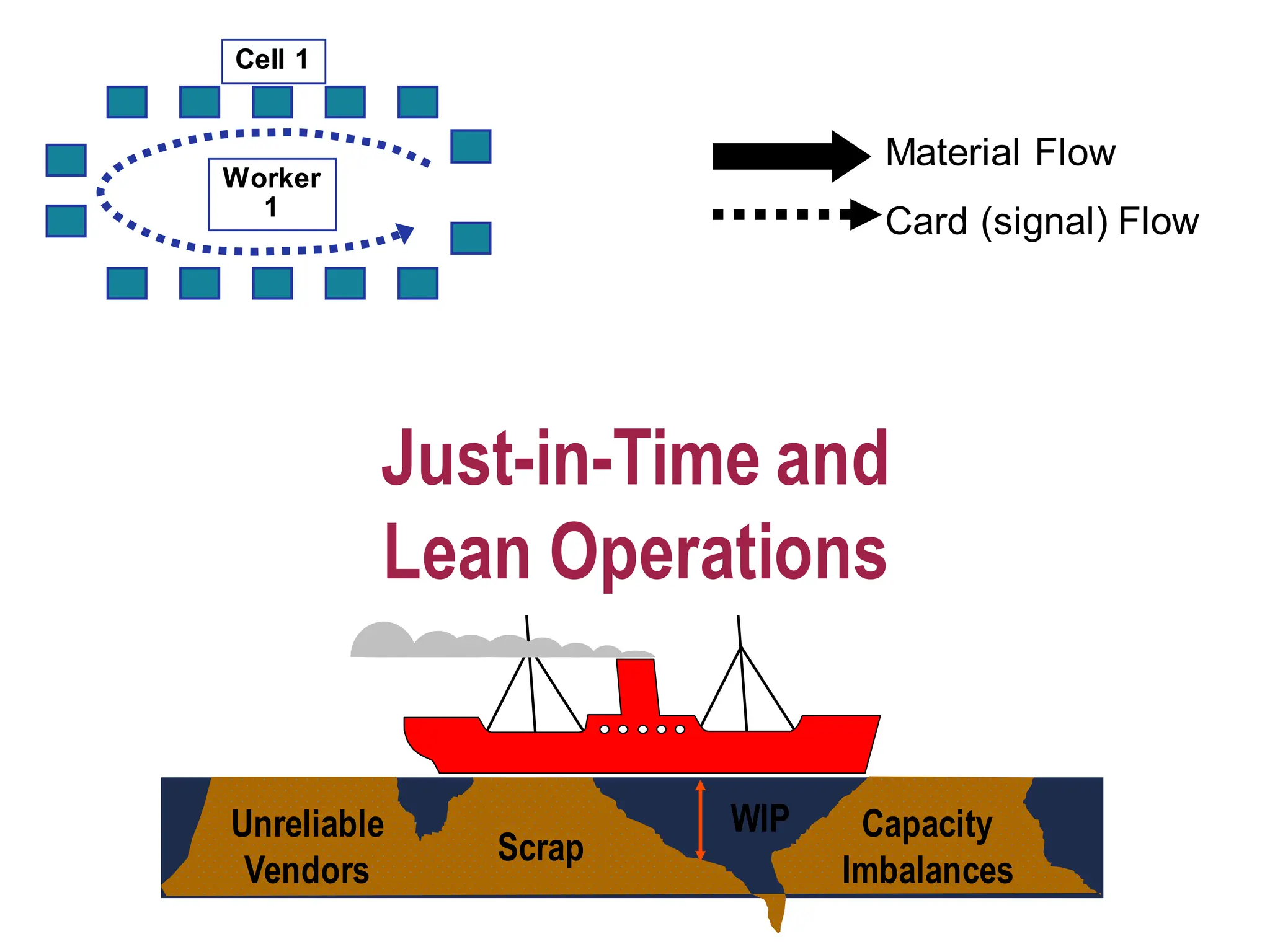
Worker
1
Cell 1
Scrap
Unreliable
Vendors
Capacity
Imbalances
WIP
Material Flow
Card (signal) Flow
✓Producingonly what is needed,when it is needed (not
early, not late; not less, not more)
✓Achieving high volume production using minimal
inventories
✓An integrated but simplified
system
✓JIT’s mandate:
Eliminationof all waste
in productioneffort
What is JIT ?
Just-in-Time
Just-in-time (JIT):A highly coordinatedprocessing
system in which goods move through the system, and
servicesare performed,just as they are needed
➢Suppliesand componentsare ‘pulled’throughthe
system to arrive where they are needed when they
are needed (just-in-time)
➢A managementphilosophy of continuous and forced
problem solving by attacking the root causes
Lean Production
➢JIT  ➔ lean production
➢Lean Production supplies customers with exactly
what the customer wants, when the customer
wants, without waste, through continuous
improvement
➢JIT operates with very little fat
➢Attackswaste (anythingnot adding value to the
product)
➢Achievesstreamlined productionby reducing
inventory
➢Exposesproblems and bottleneckscausedby
variability
What Does Just-in-Time Do?
Goal of JIT
The ultimate goal of JIT is a balancedsystem.
(Achievesa smooth, rapid flow of materials through the
system)
The supportinggoals are:
➢ Eliminatedisruptions
➢ Make the system flexible
➢ Eliminatewaste, especiallyexcess inventory
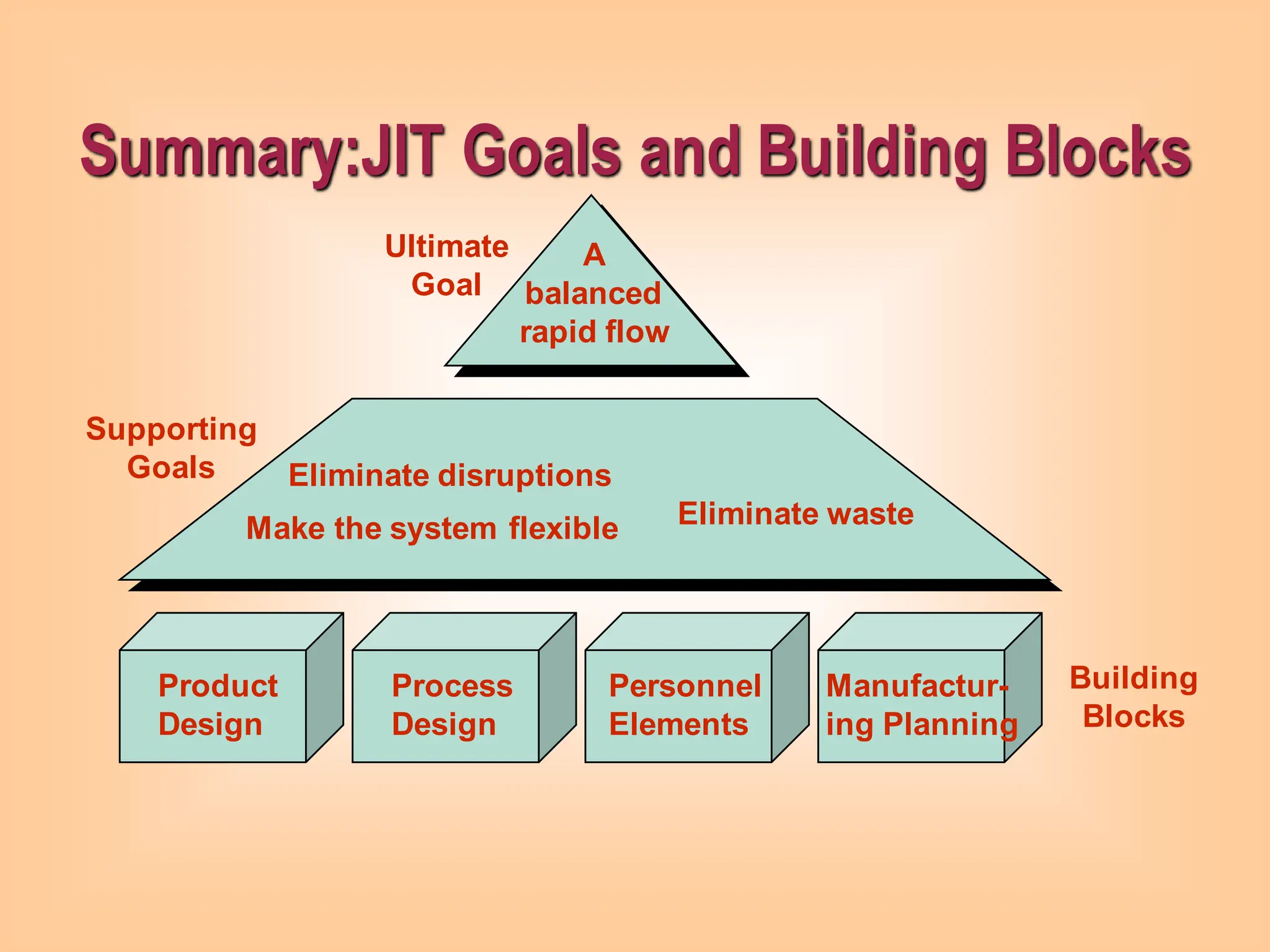
Summary:JIT Goals and Building Blocks
Product
Design
Process
Design
Personnel
Elements
Manufactur-
ing Planning
Eliminate disruptions
Make the system flexible Eliminate waste
A
balanced
rapid flow
Ultimate
Goal
Supporting
Goals
Building
Blocks
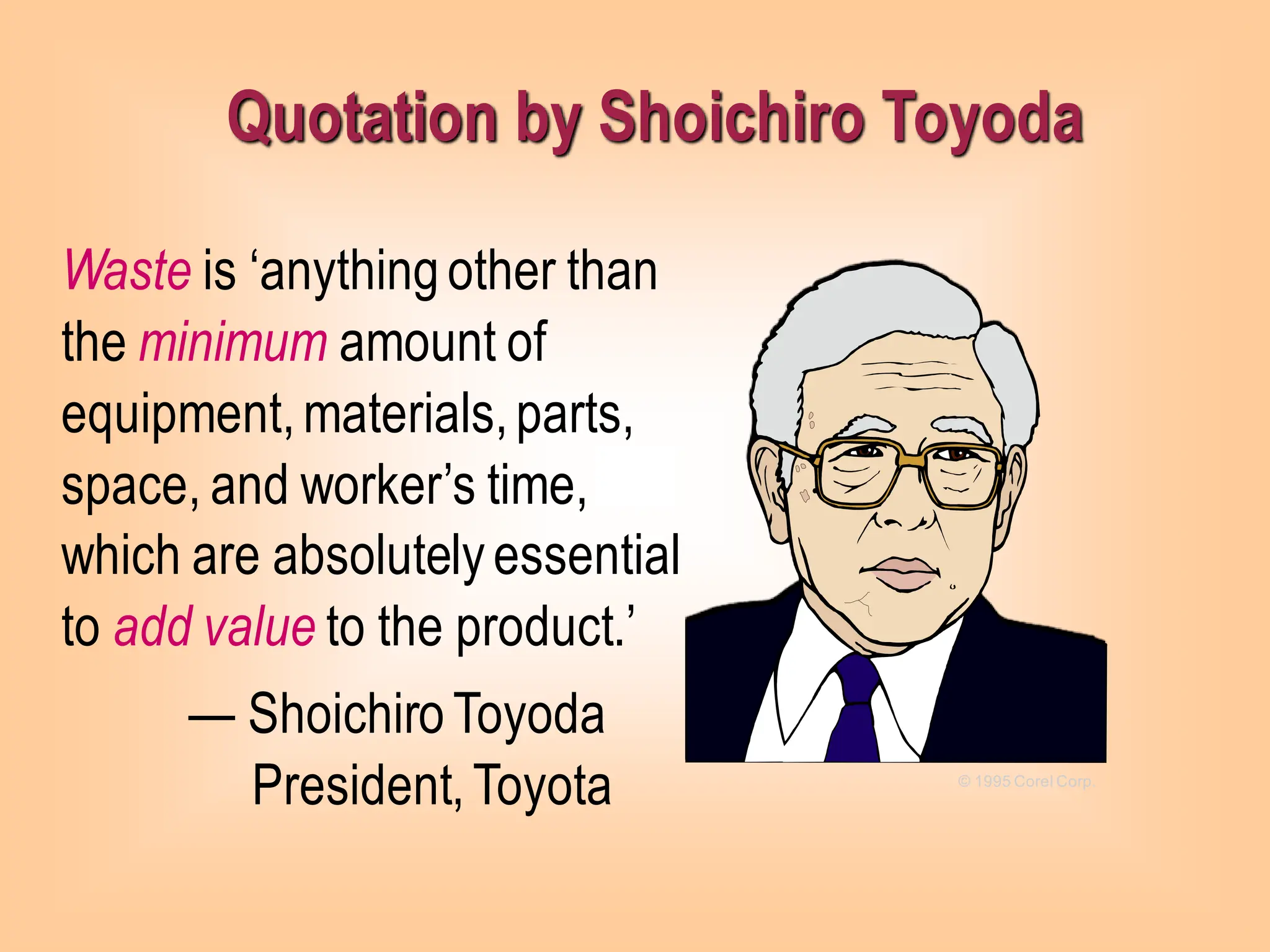
Waste is ‘anythingother than
the minimum amount of
equipment,materials,parts,
space, and worker’s time,
which are absolutelyessential
to add value to the product.’
— ShoichiroToyoda
President,Toyota © 1995 Corel Corp.
Quotation by Shoichiro Toyoda
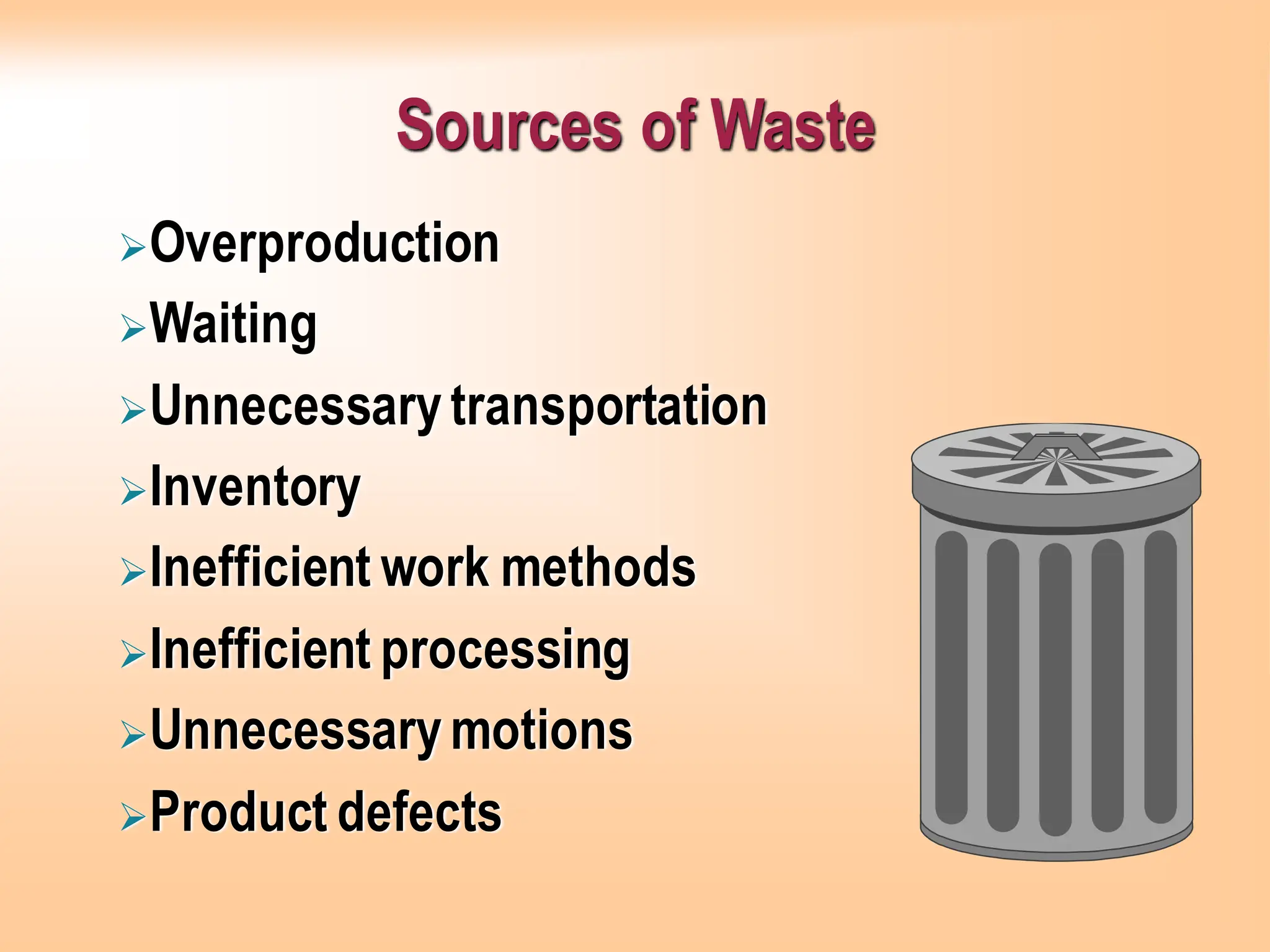
Sources of Waste
➢Overproduction
➢Waiting
➢Unnecessarytransportation
➢Inventory
➢Inefficient work methods
➢Inefficient processing
➢Unnecessarymotions
➢Product defects
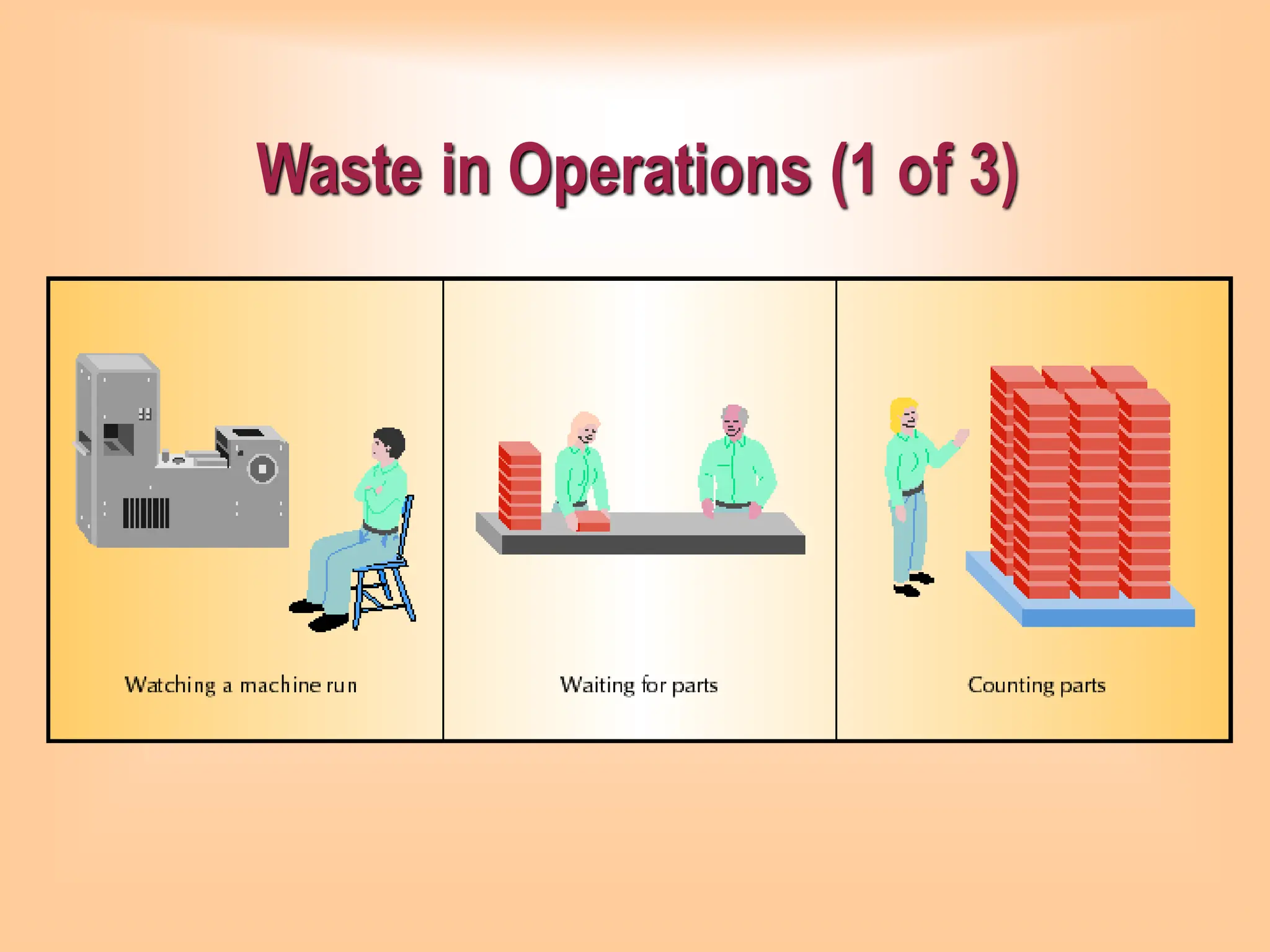
Waste in Operations (1 of 3)
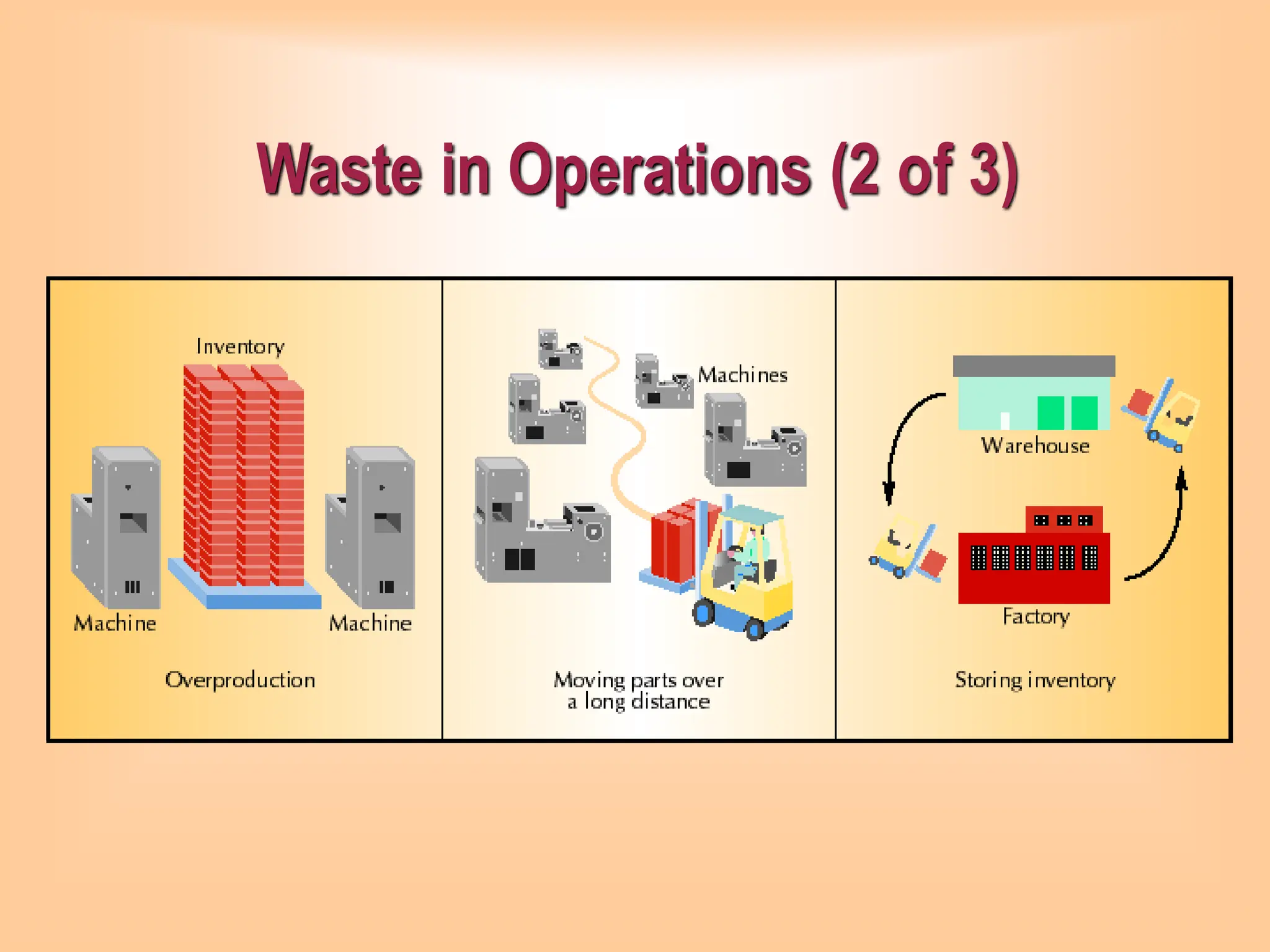
Waste in Operations (2 of 3)
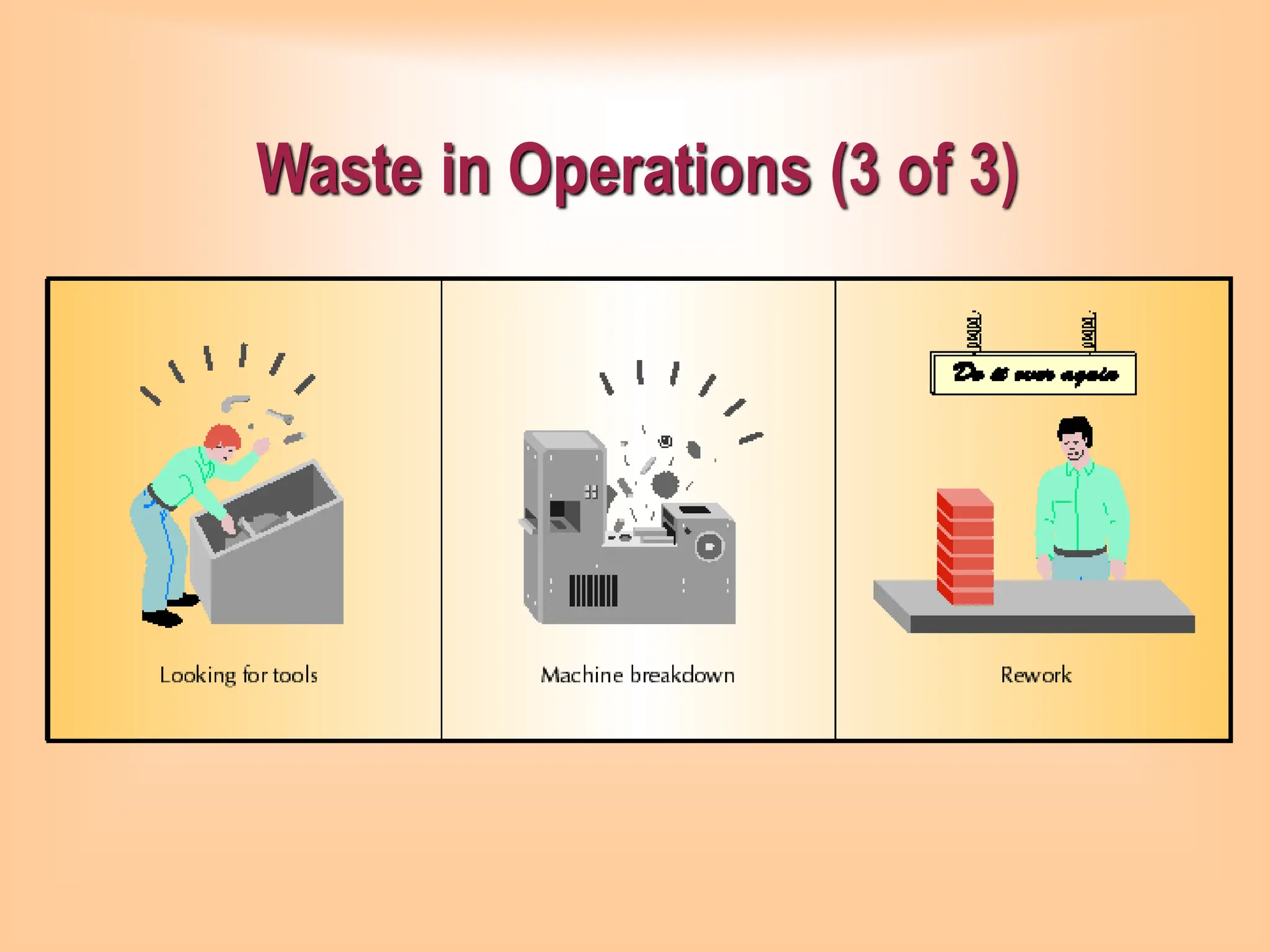
Waste in Operations (3 of 3)
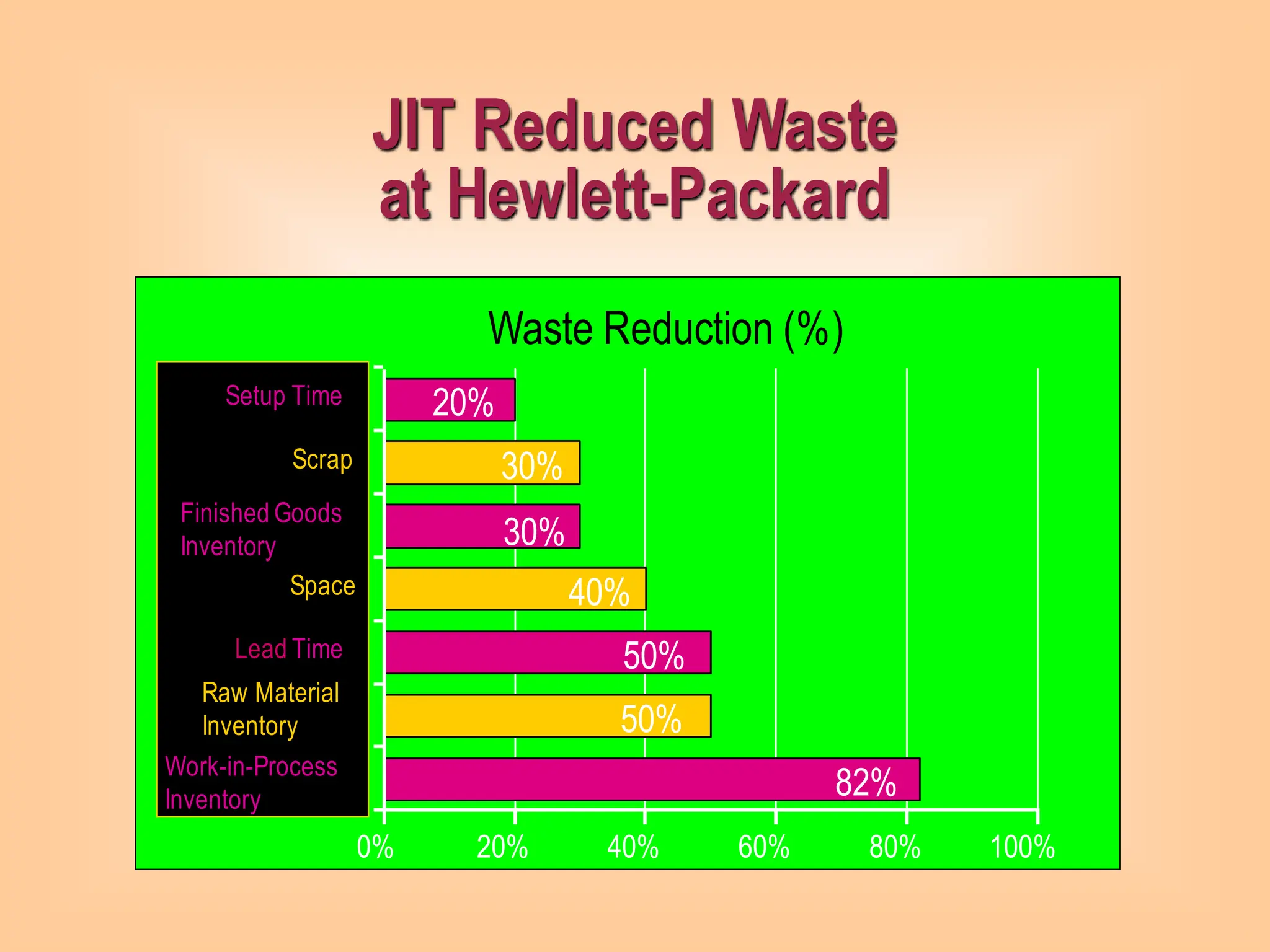
Waste Reduction (%)
82%
50%
50%
30%
30%
20%
40%
0% 20% 40% 60% 80% 100%
Work-in-Process
Inventory
Raw Material
Inventory
Lead Time
Space
Finished Goods
Inventory
Scrap
Setup Time
JIT Reduced Waste
at Hewlett-Packard
Kaizen Philosophy (1 of 3)
✓Continuousimprovement
✓Requires total employeeinvolvement
✓Essenceof JIT is willingness of workers to
✓Spot quality problems
✓Halt productionwhen necessary
✓Generate ideas for improvement
✓Analyzeproblems
✓Perform different functions
Kaizen Philosophy (2 of 3)
➢Waste is the enemy
➢Improvement should be done gradually and
continuously
➢Everyone should be involved
➢Built on a cheap strategy
➢Can be applied anywhere
Kaizen Philosophy (3 of 3)
➢Supported by a visual system
➢Focuses attention where value is created
➢Process oriented
➢Stresses main effort of improvement should come
from new thinking and work style
➢The essence of organizational learning is to learn
while doing
➢Big JIT – broad focus
➢Vendor relations
➢Human relations
➢Technology management
➢Materials and inventory management
➢Little JIT – narrow focus
➢Scheduling materials
➢Scheduling services for production
Big vs. Little JIT
JIT Building Blocks
In order to achieve competitiveadvantagethrough
JIT, the necessary buildingblocks should be installed
The building blocks can also be regardedas JIT
successfactors or the basic elements of JIT
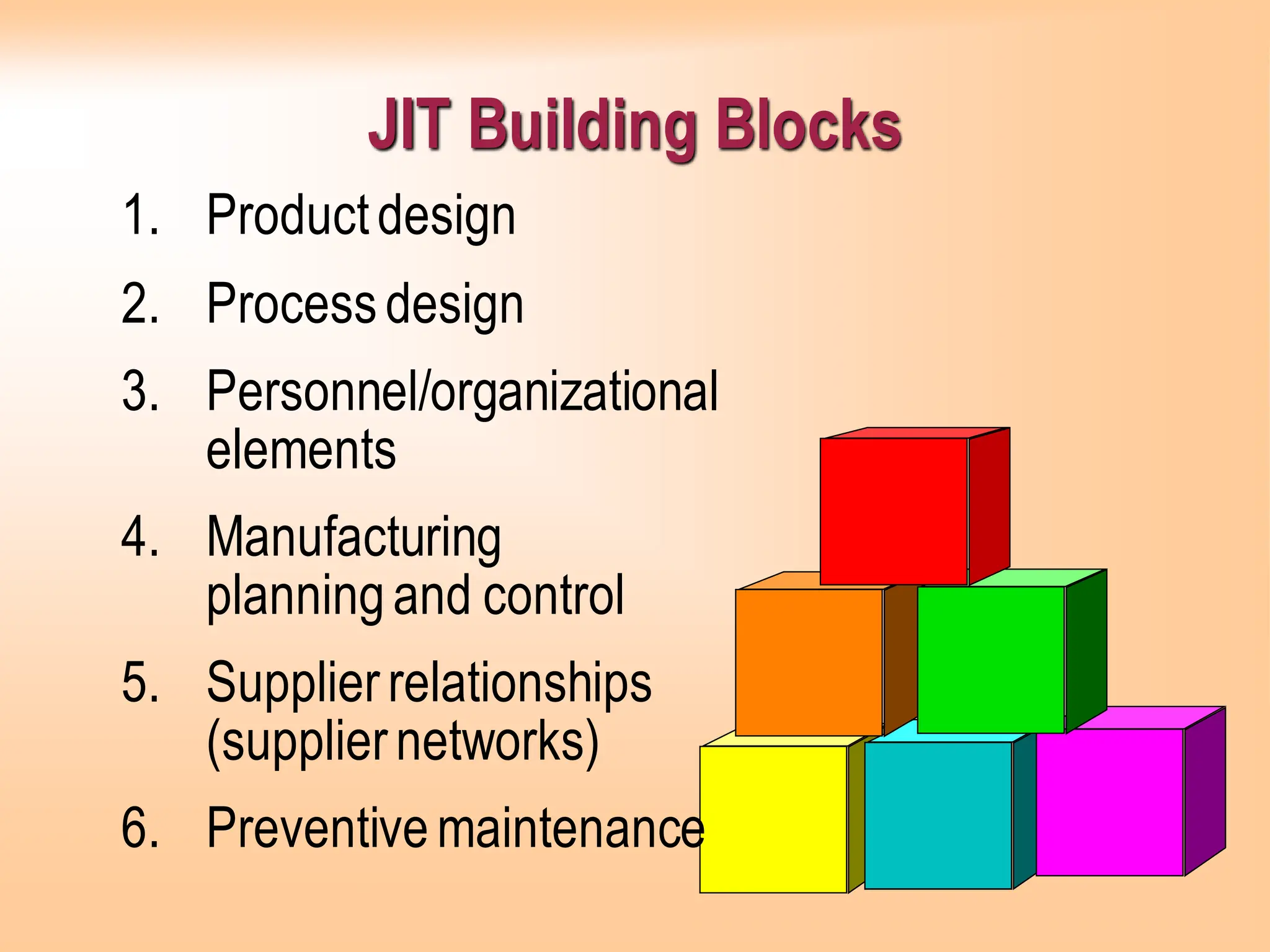
JIT Building Blocks
1. Productdesign
2. Processdesign
3. Personnel/organizational
elements
4. Manufacturing
planningand control
5. Supplierrelationships
(suppliernetworks)
6. Preventivemaintenance
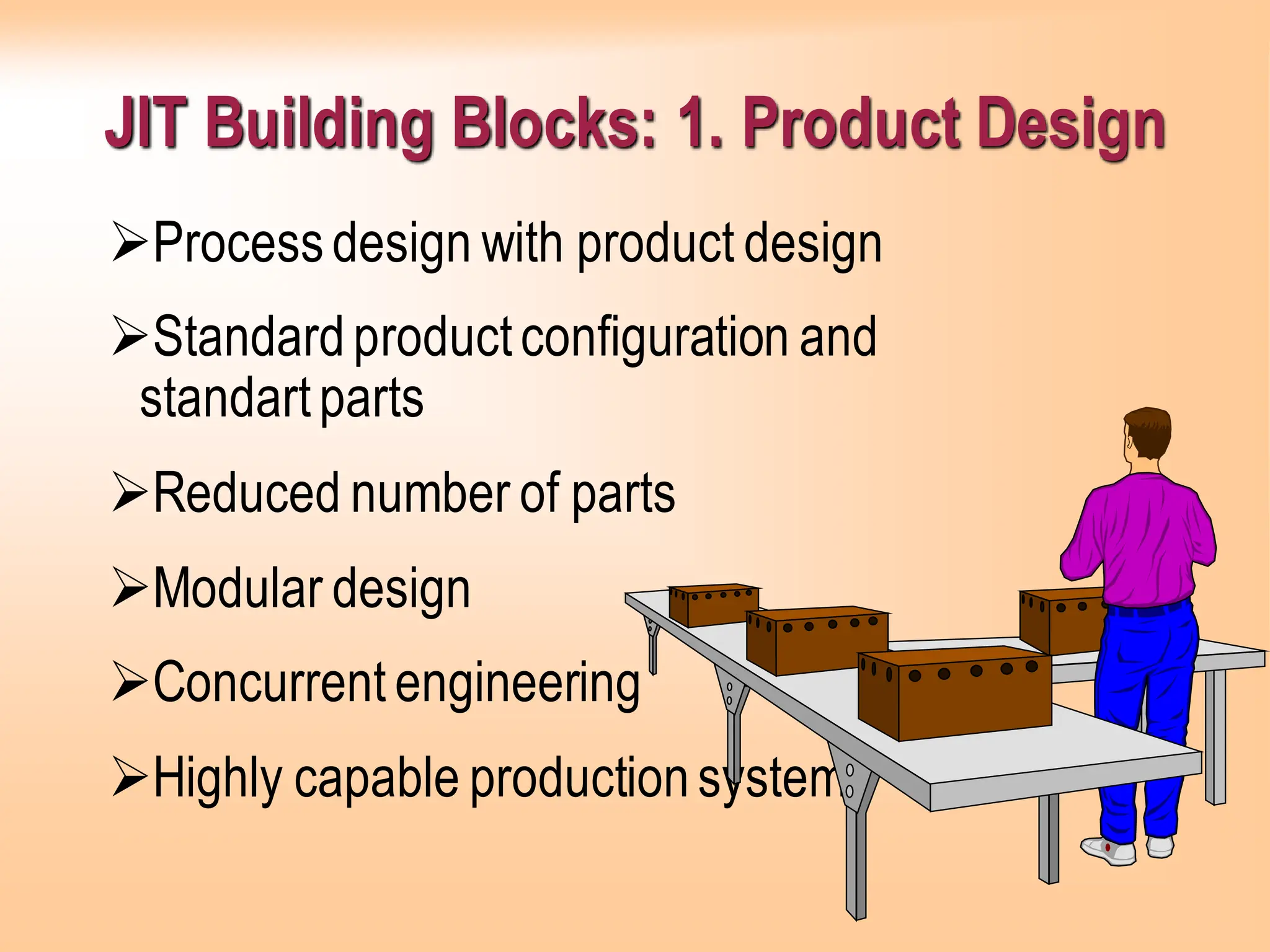
JIT Building Blocks: 1. Product Design
➢Processdesign with product design
➢Standardproductconfiguration and
standartparts
➢Reduced number of parts
➢Modular design
➢Concurrent engineering
➢Highly capable productionsystems
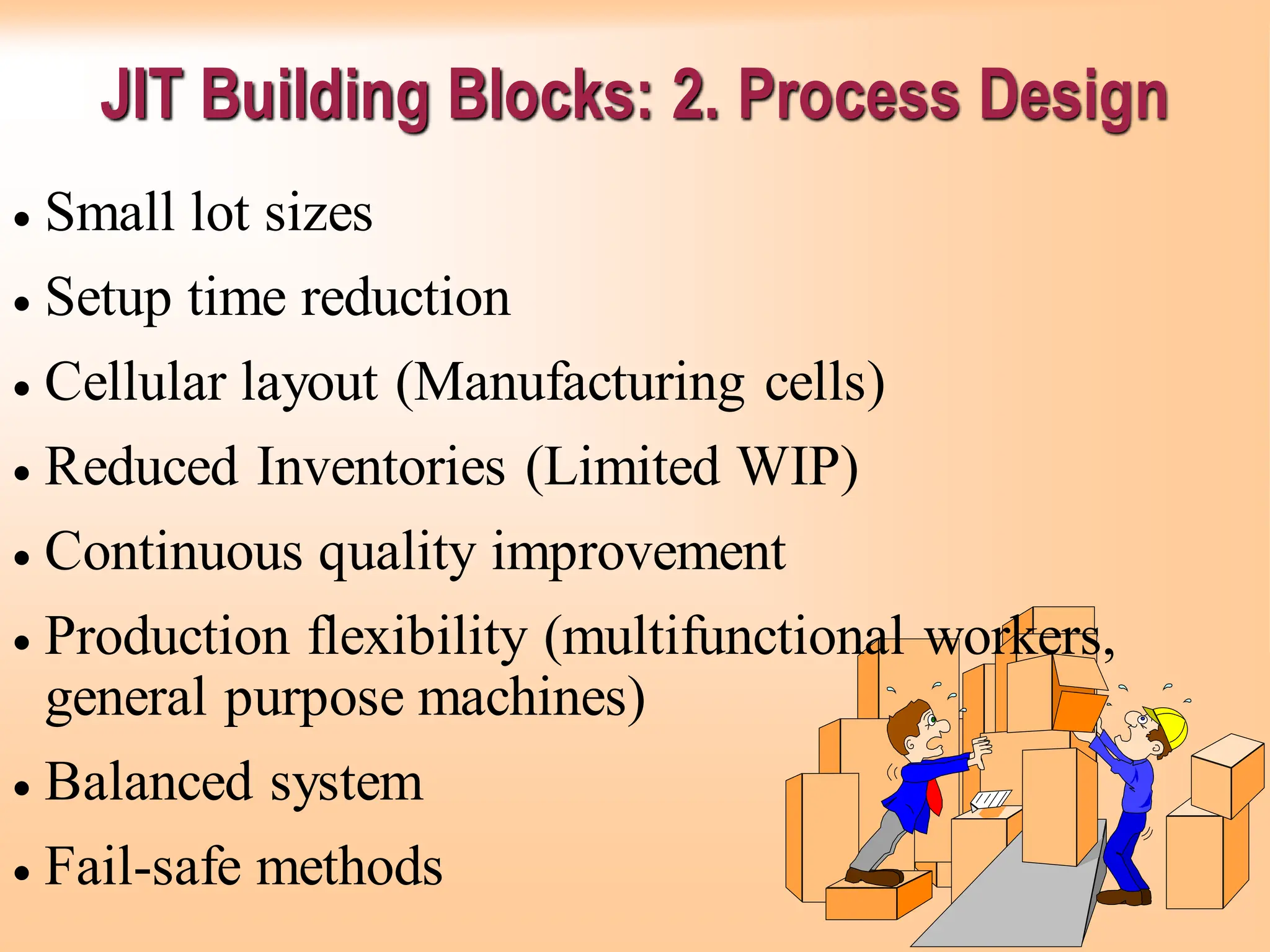
JIT Building Blocks: 2. Process Design
• Small lot sizes
• Setup time reduction
• Cellular layout (Manufacturing cells)
• Reduced Inventories (Limited WIP)
• Continuous quality improvement
• Production flexibility (multifunctional workers,
general purpose machines)
• Balanced system
• Fail-safe methods
Small-Lot Production
✓Requires less space & capital investment
✓Moves processes closer together
✓Makes quality problems easier to detect
✓Makes processes more dependent on each other
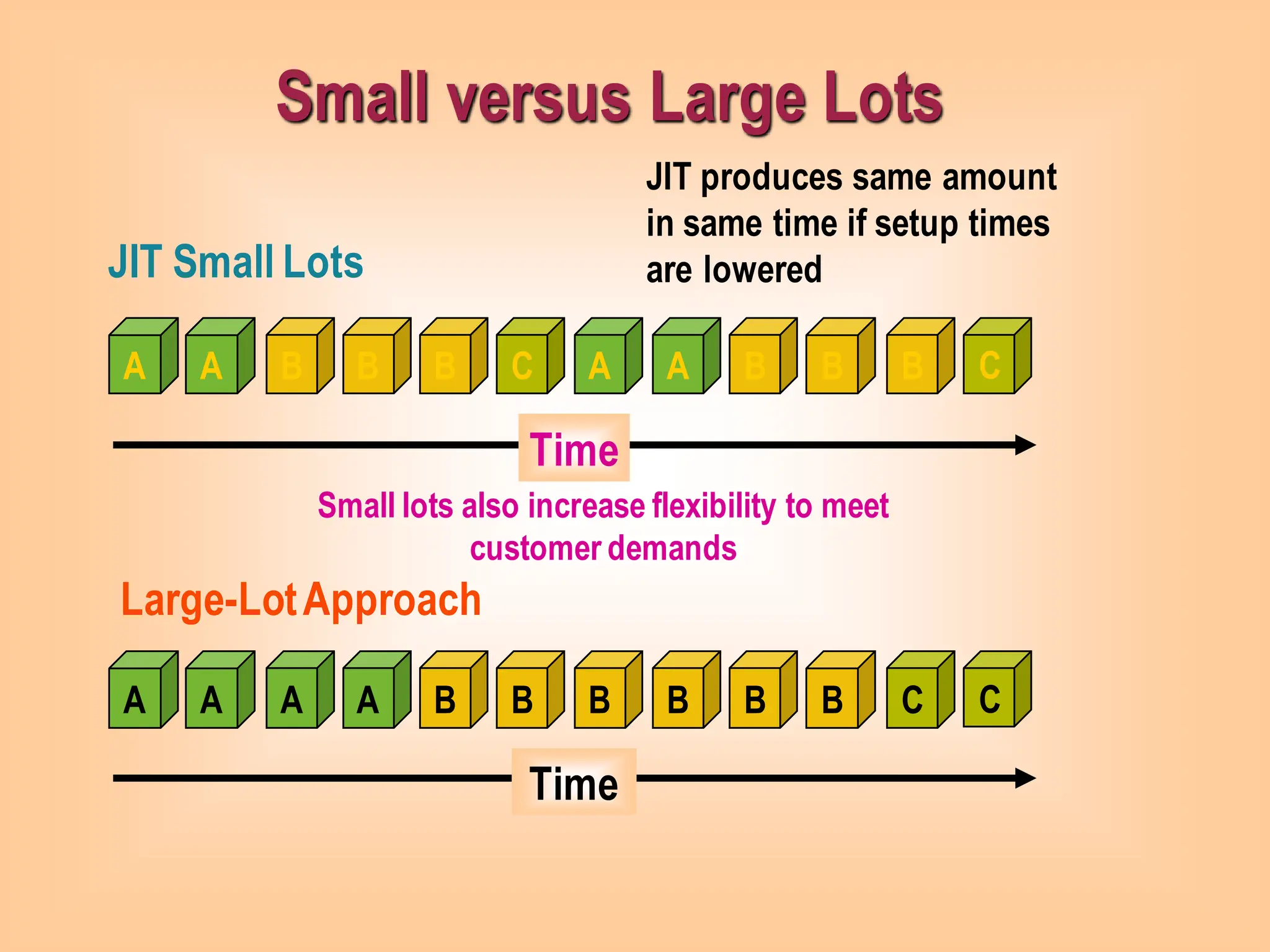
A
A A B B B C
JIT Small Lots
Large-LotApproach
Time
Time
A A B B B C
A A A B B B B B B C C
JIT produces same amount
in same time if setup times
are lowered
Small versus Large Lots
Small lots also increase flexibility to meet
customer demands
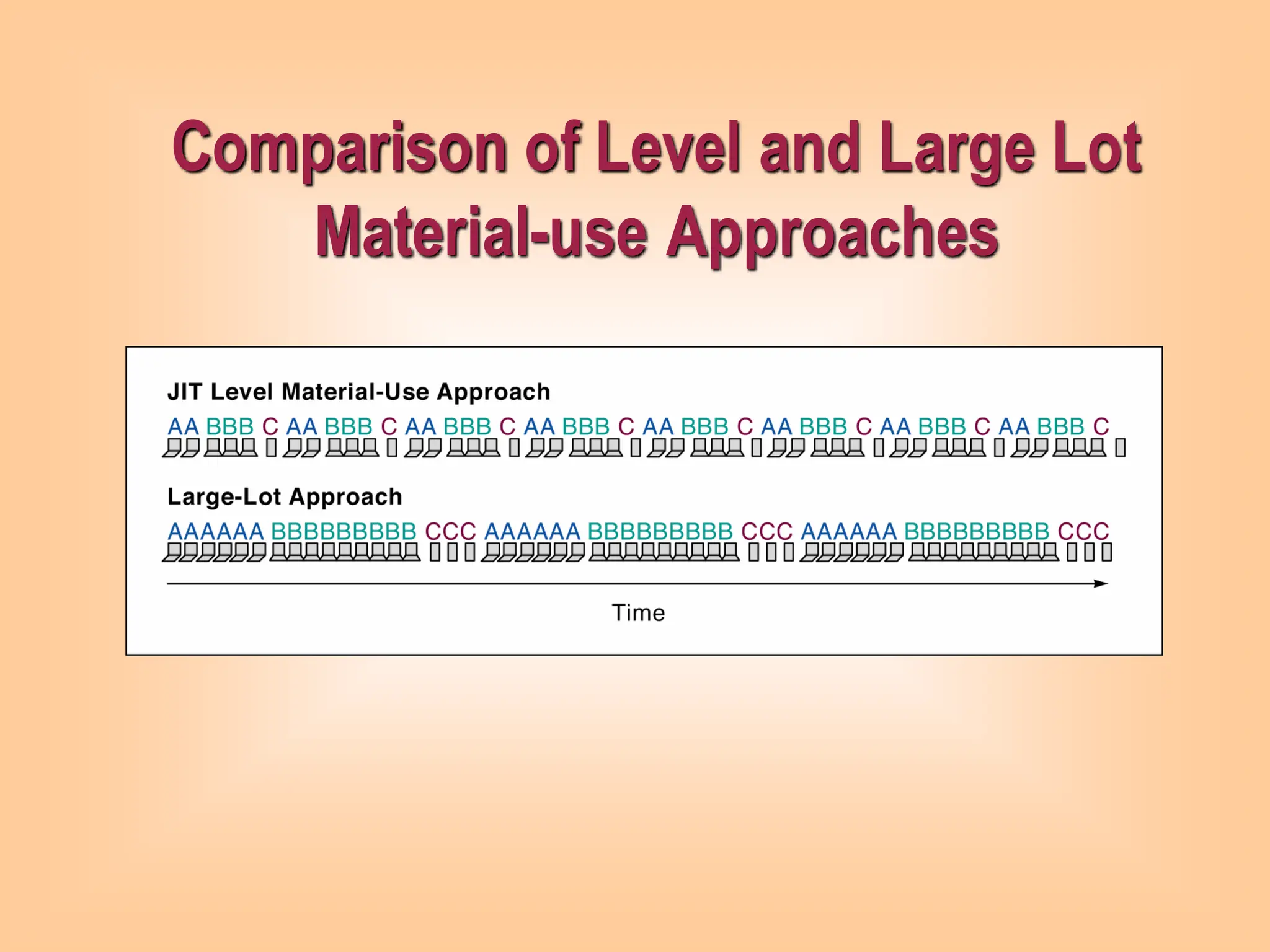
Comparison of Level and Large Lot
Material-use Approaches
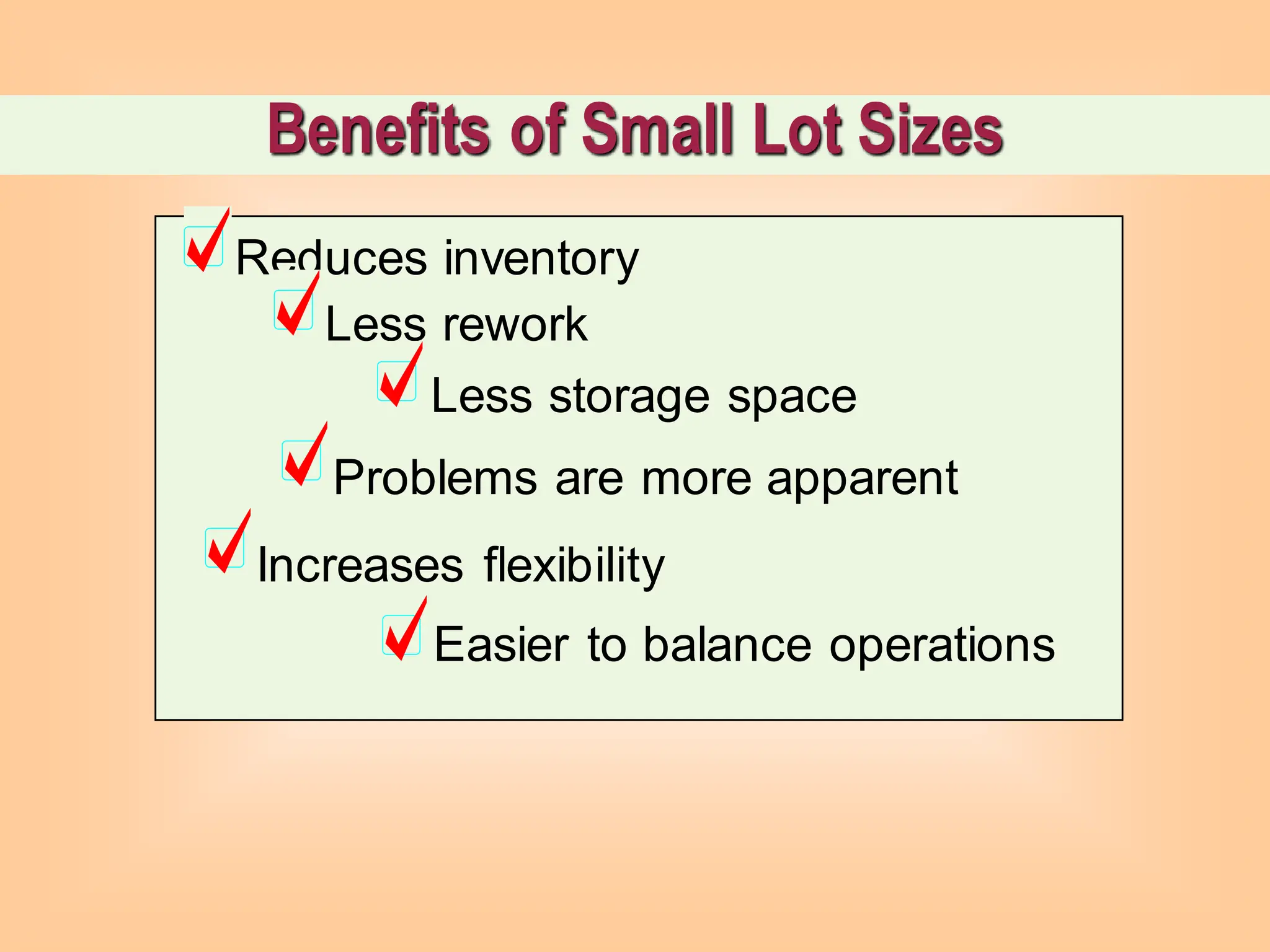
Benefits of Small Lot Sizes
Reduces inventory
Less storage space
Less rework
Problems are more apparent
Increases flexibility
Easier to balance operations
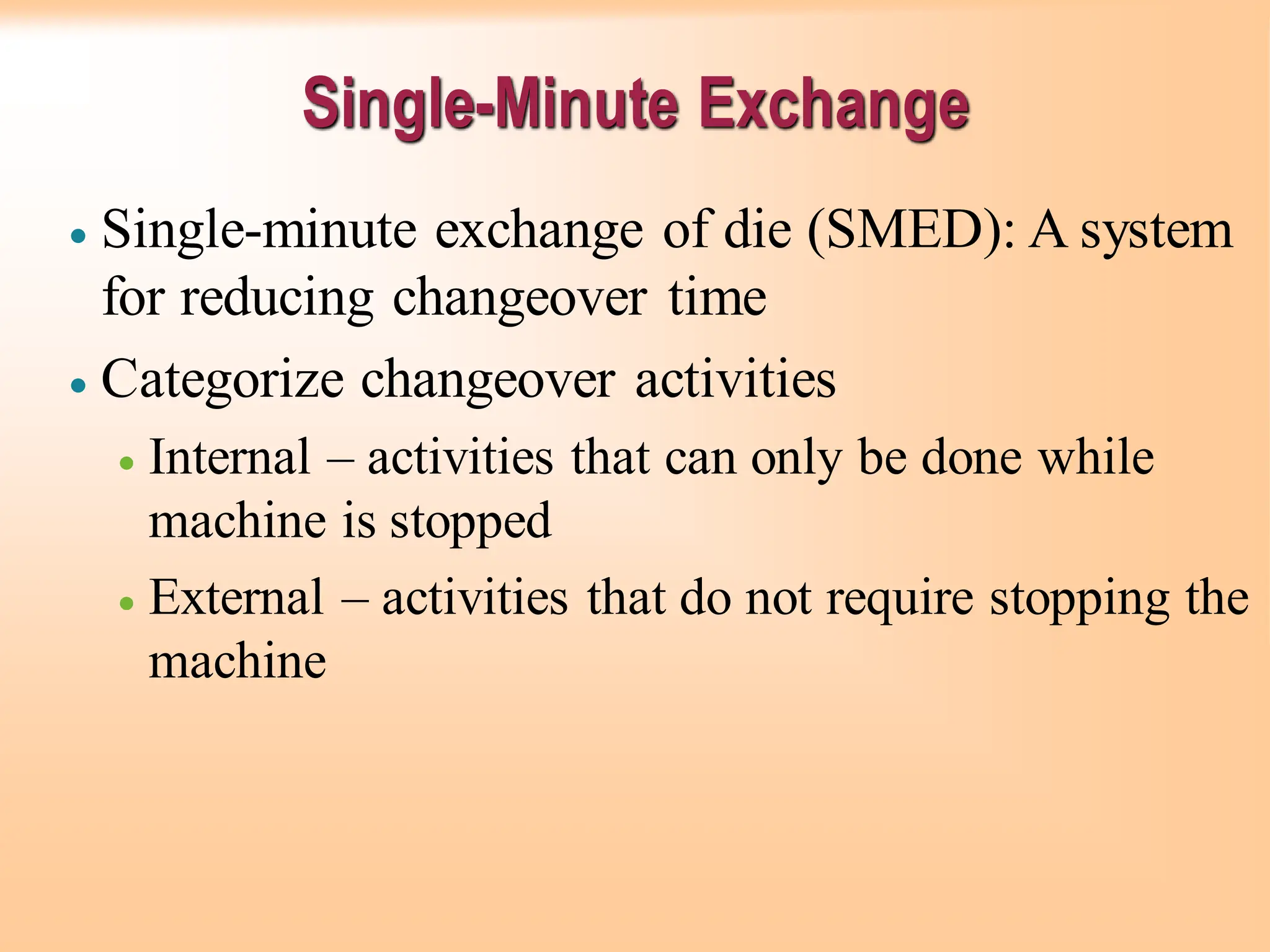
Single-Minute Exchange
• Single-minute exchange of die (SMED): A system
for reducing changeover time
• Categorize changeover activities
• Internal – activities that can only be done while
machine is stopped
• External – activities that do not require stopping the
machine
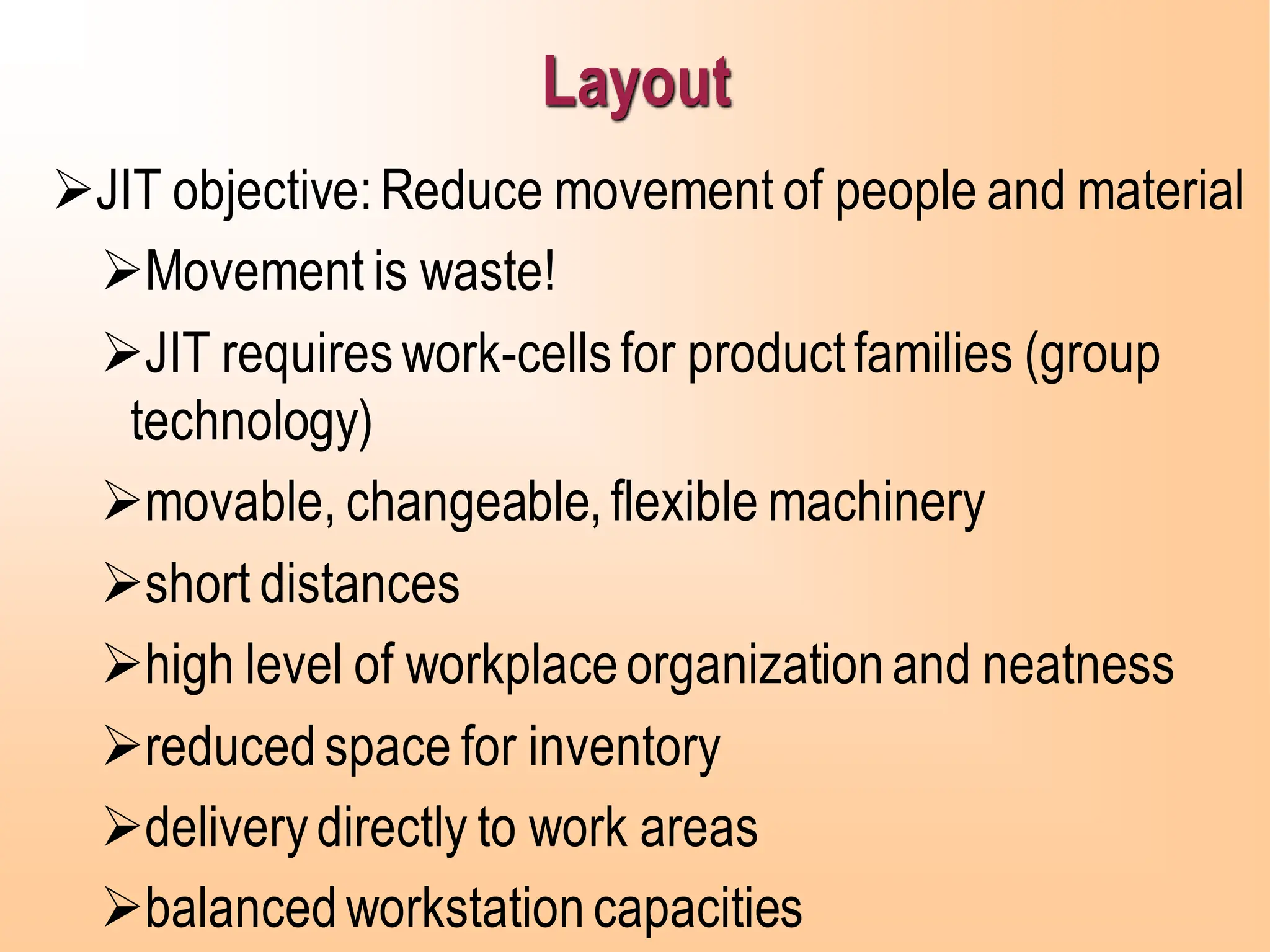
Layout
➢JIT objective:Reduce movement of people and material
➢Movement is waste!
➢JIT requireswork-cellsfor productfamilies (group
technology)
➢movable, changeable,flexible machinery
➢short distances
➢high level of workplaceorganizationand neatness
➢reducedspace for inventory
➢deliverydirectly to work areas
➢balancedworkstationcapacities
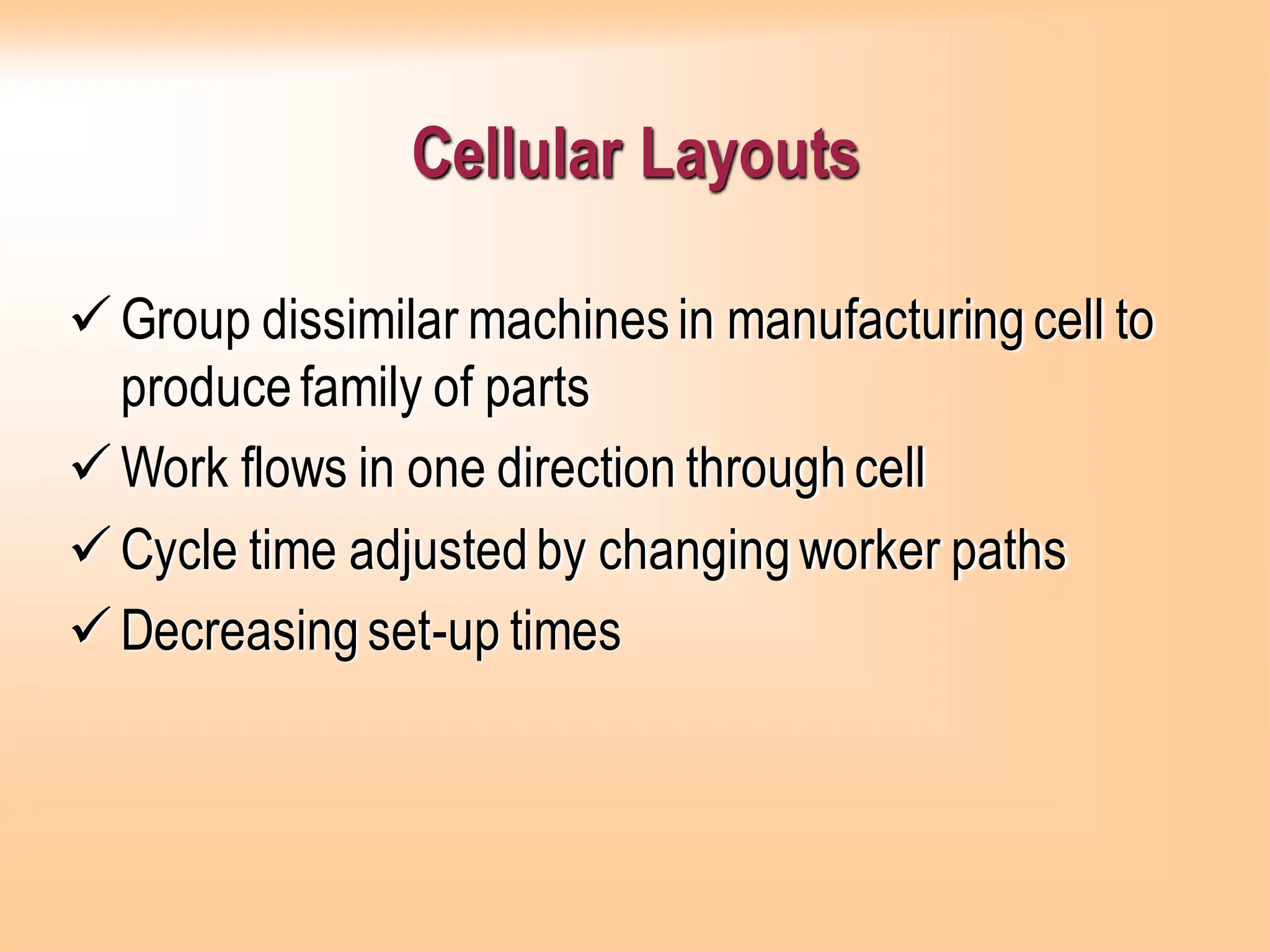
Cellular Layouts
✓Group dissimilar machinesin manufacturingcell to
producefamily of parts
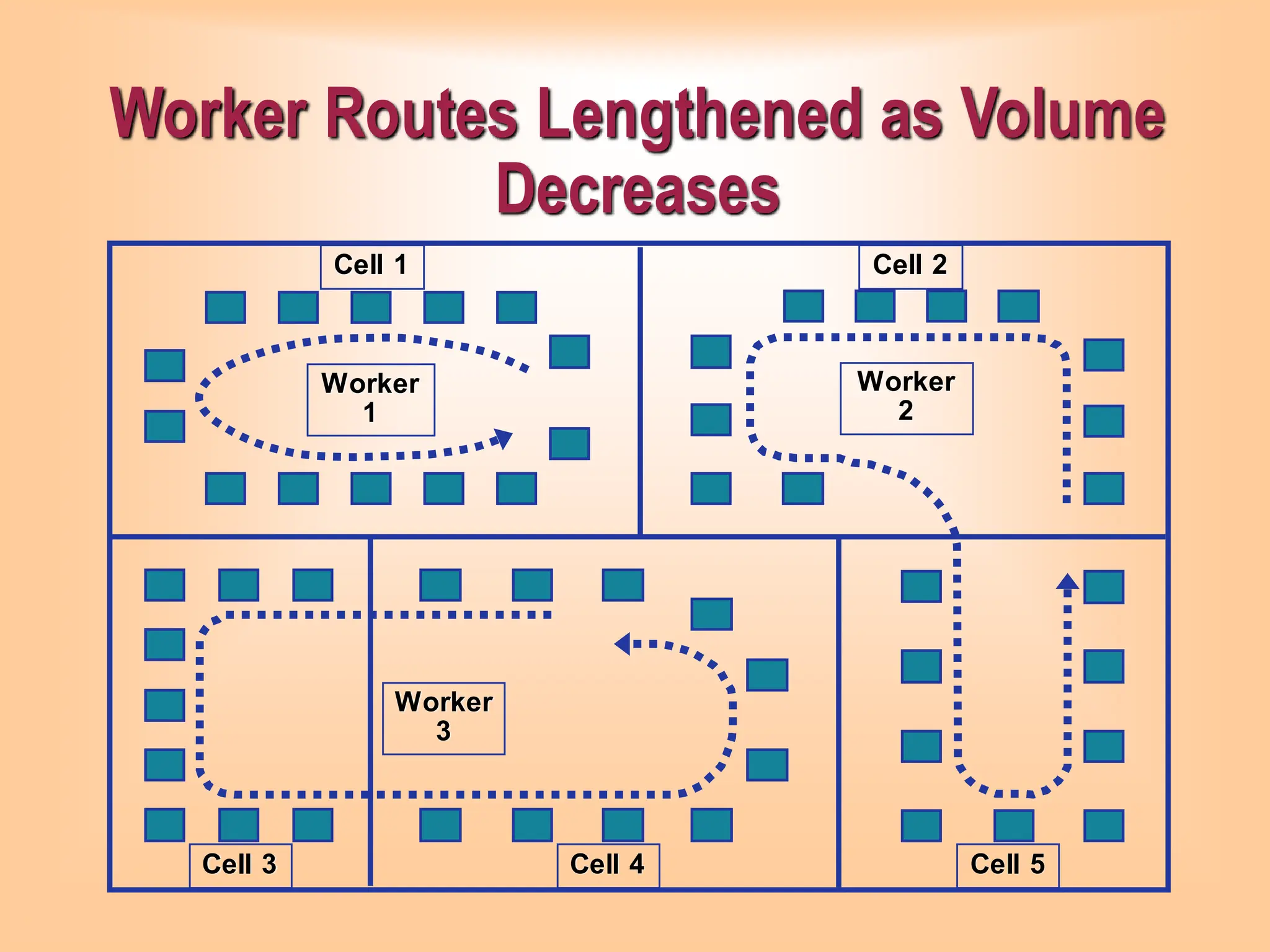
✓Work flows in one direction throughcell
✓Cycle time adjustedby changingworker paths
✓Decreasingset-up times
Worker Routes Lengthened as Volume
Decreases
Cell 5
Worker
2
Cell 2
Worker
1
Cell 1
Worker
3
Cell 3 Cell 4
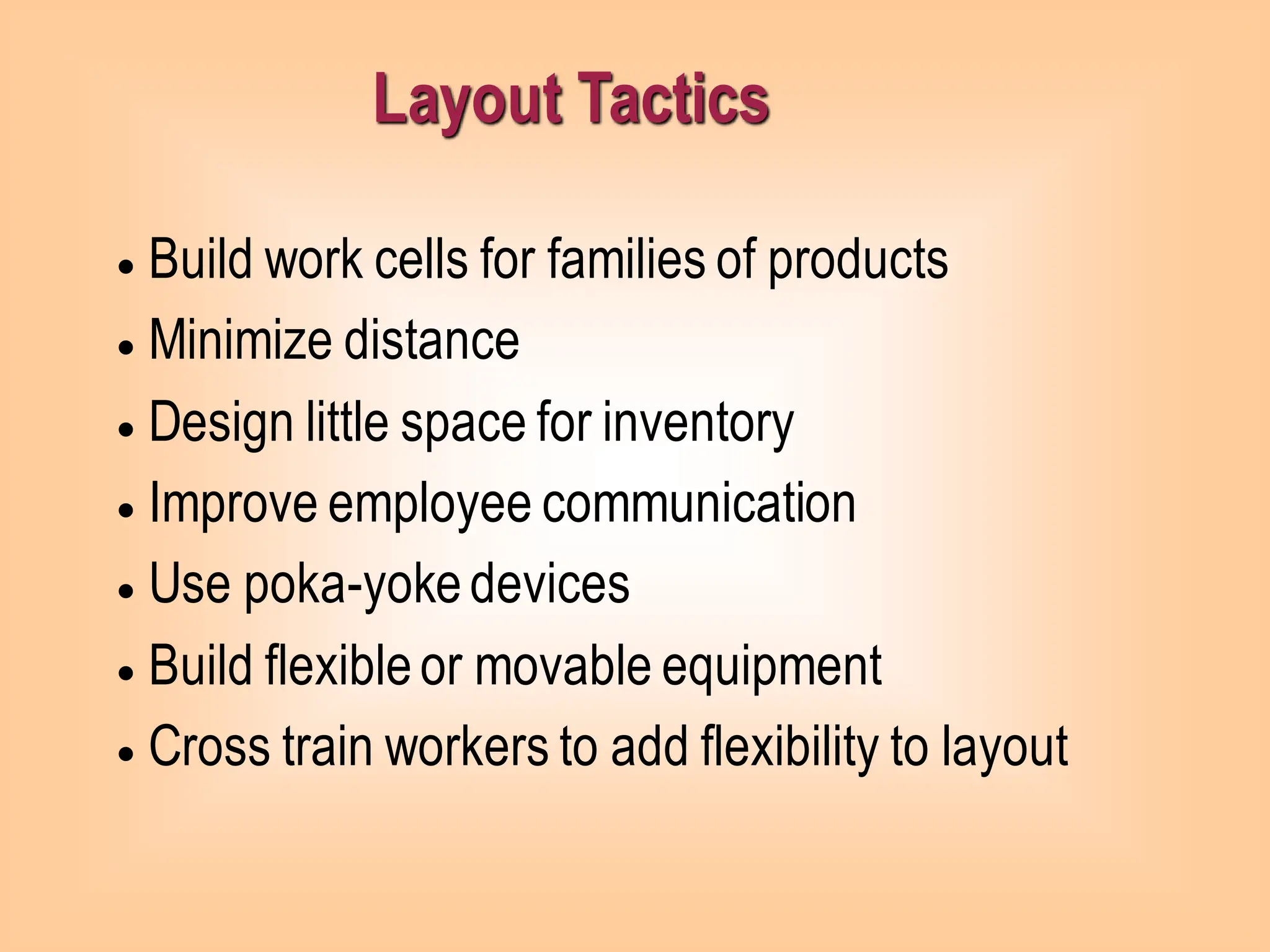
Layout Tactics
• Build work cells for families of products
• Minimize distance
• Design little space for inventory
• Improve employee communication
• Use poka-yokedevices
• Build flexibleor movable equipment
• Cross train workers to add flexibility to layout
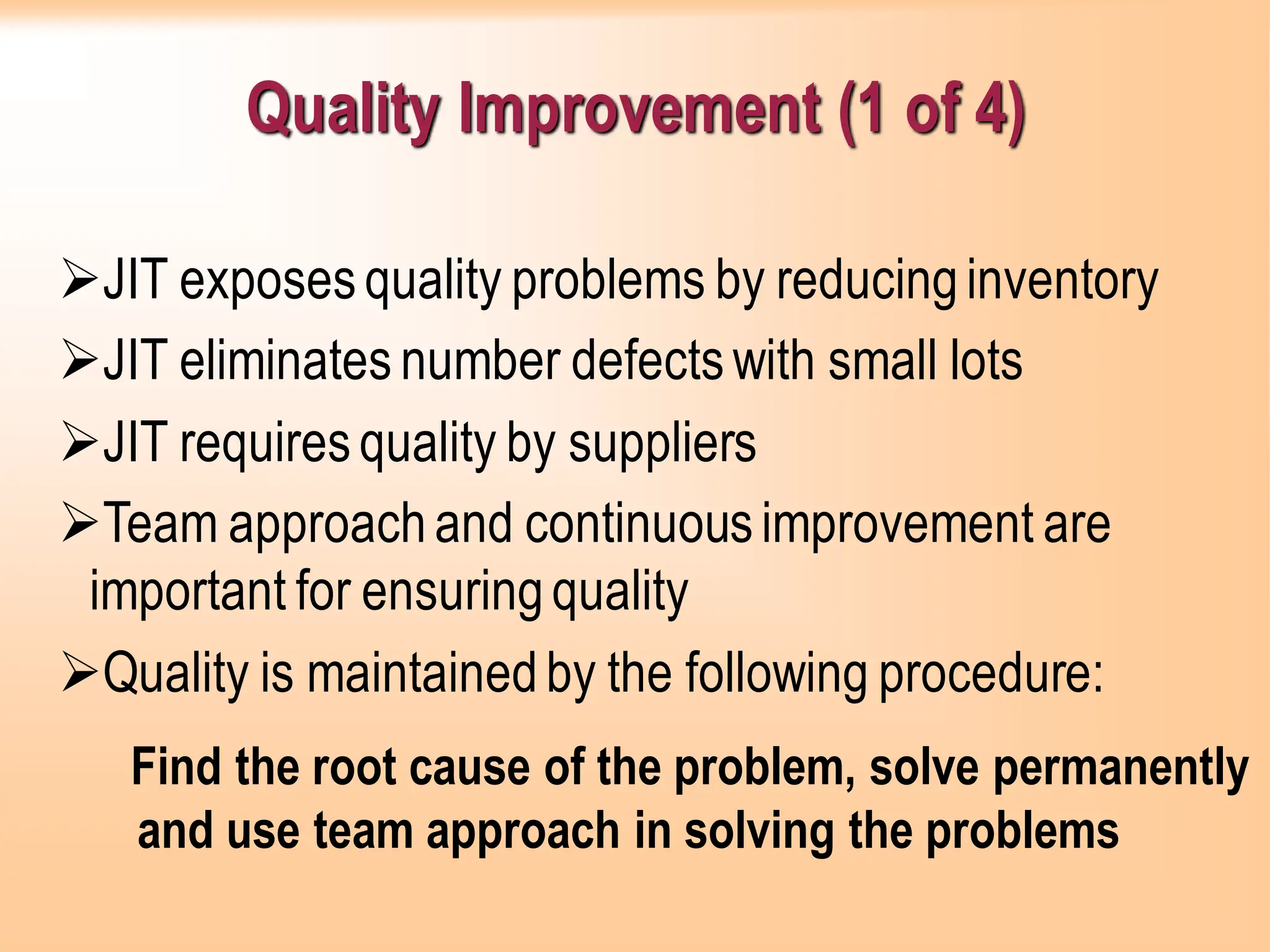
Quality Improvement (1 of 4)
➢JIT exposesquality problems by reducinginventory
➢JIT eliminates number defectswith small lots
➢JIT requiresquality by suppliers
➢Team approachand continuousimprovement are
important for ensuringquality
➢Quality is maintainedby the following procedure:
Find the root cause of the problem, solve permanently
and use team approach in solving the problems
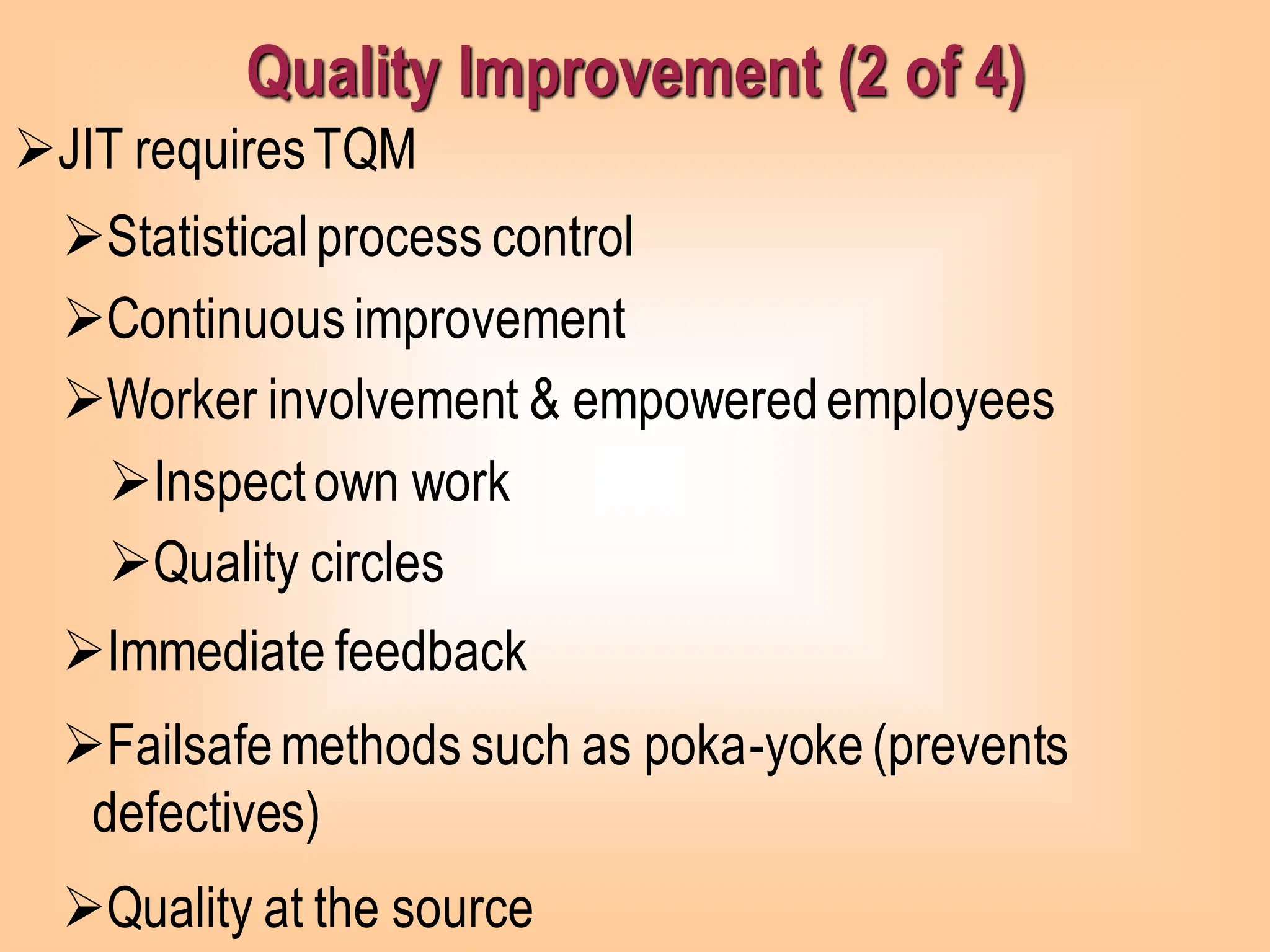
Quality Improvement (2 of 4)
➢JIT requiresTQM
➢Statisticalprocess control
➢Continuousimprovement
➢Worker involvement & empoweredemployees
➢Inspectown work
➢Quality circles
➢Immediate feedback
➢Failsafemethods such as poka-yoke(prevents
defectives)
➢Quality at the source
Quality Improvement (3 of 4)
JIT requires
1) Quality within the firm
• Autonomation (jidoka): automatic detection of
defects during production
2) Quality by suppliers
Quality Improvement (4 of 4)
✓Jidoka assuresquality at the source
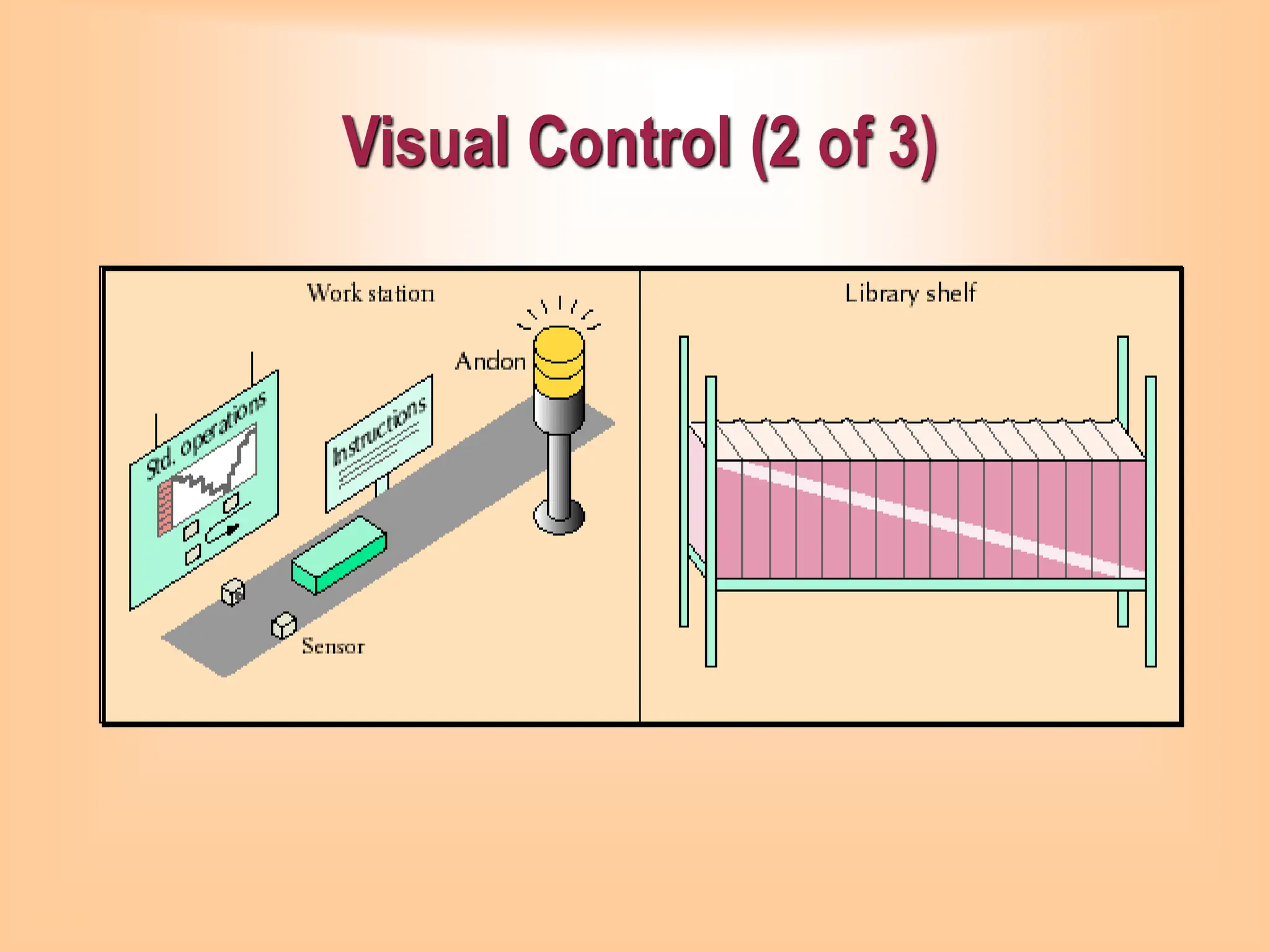
✓Andon lights signal quality problems
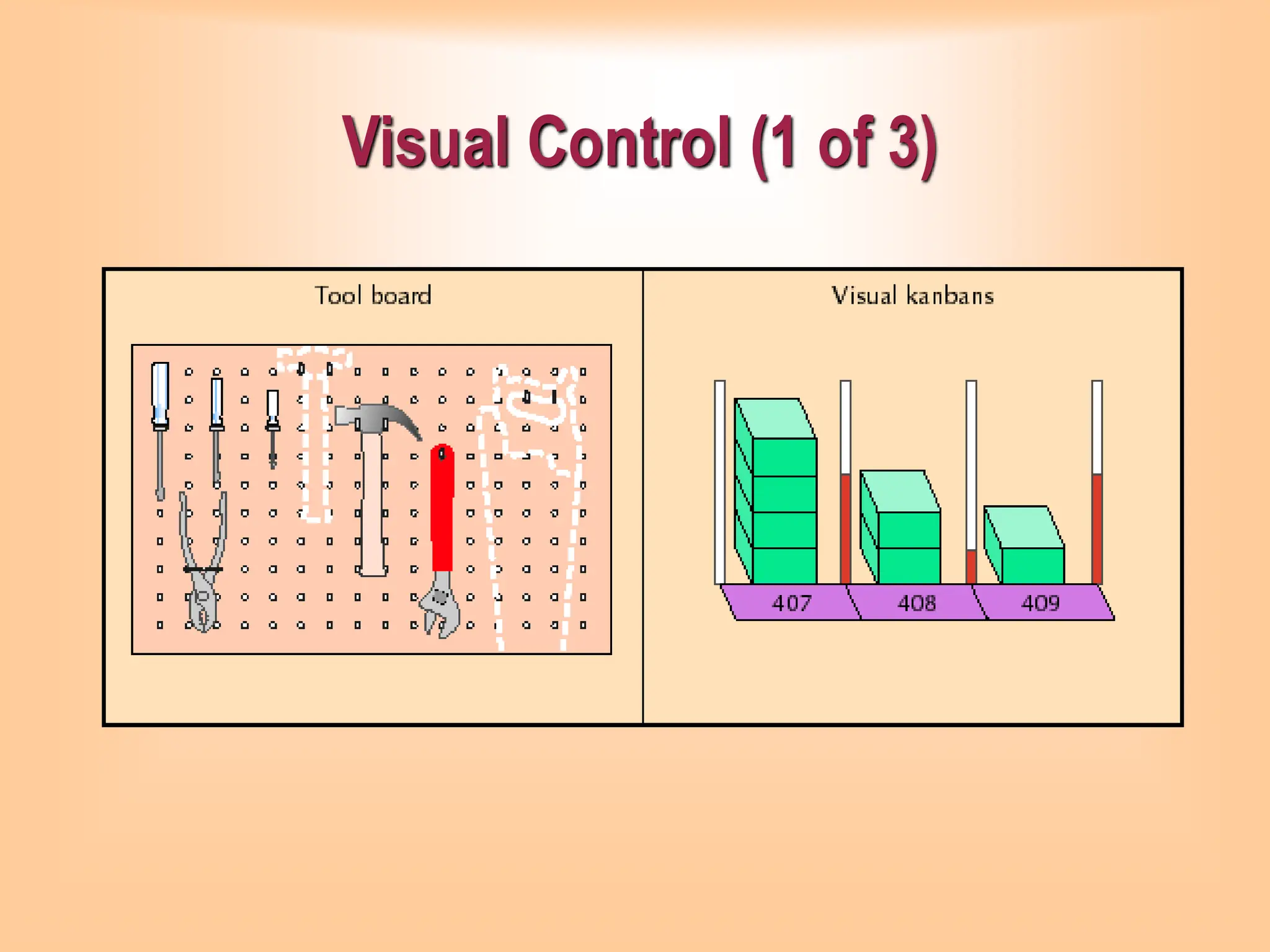
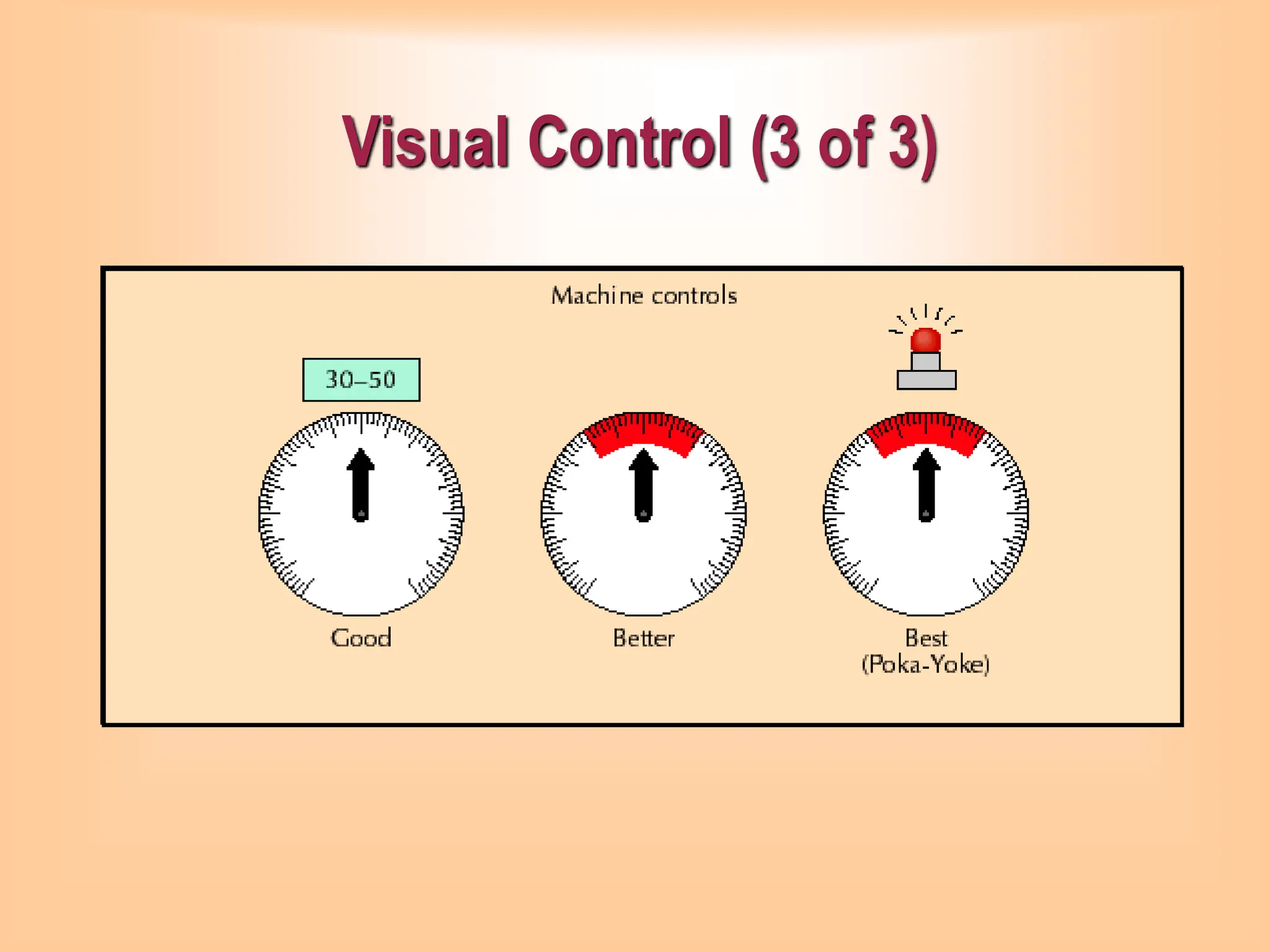
✓Visual controlmakes problems visible
Visual Control (1 of 3)
Visual Control (2 of 3)
Visual Control (3 of 3)
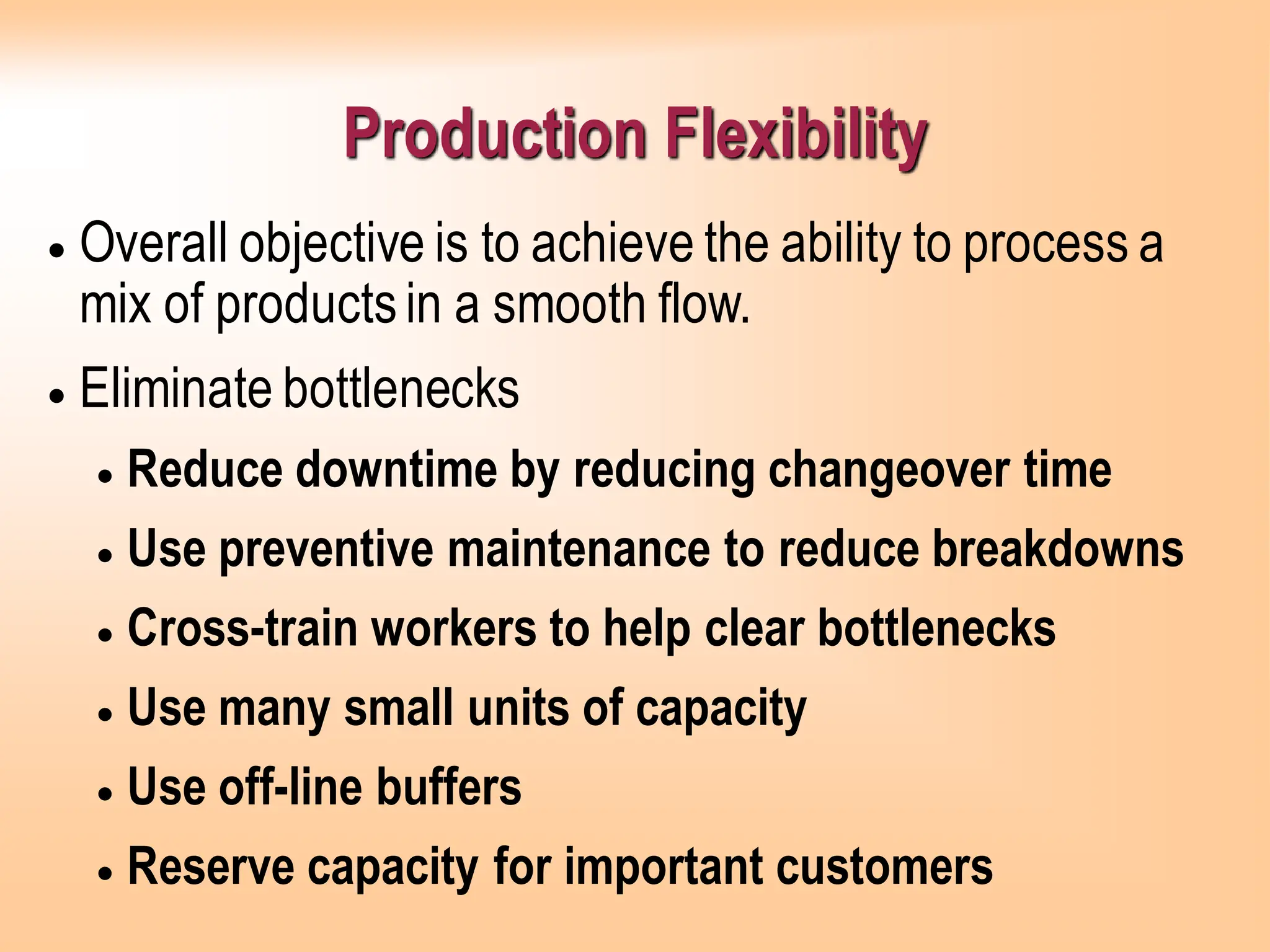
Production Flexibility
• Overall objective is to achieve the ability to process a
mix of productsin a smooth flow.
• Eliminate bottlenecks
• Reduce downtime by reducing changeover time
• Use preventive maintenance to reduce breakdowns
• Cross-train workers to help clear bottlenecks
• Use many small units of capacity
• Use off-line buffers
• Reserve capacity for important customers
A Balanced System
• Balancedsystem: Distributingthe workload evenly
among work stations
• Work assignedto each work station must be less than
or equal to the cycle time
• Cycle time is set equal to the takt time
• Takt time is the cycle time needed to match the pace of
productionto customer demand for final product
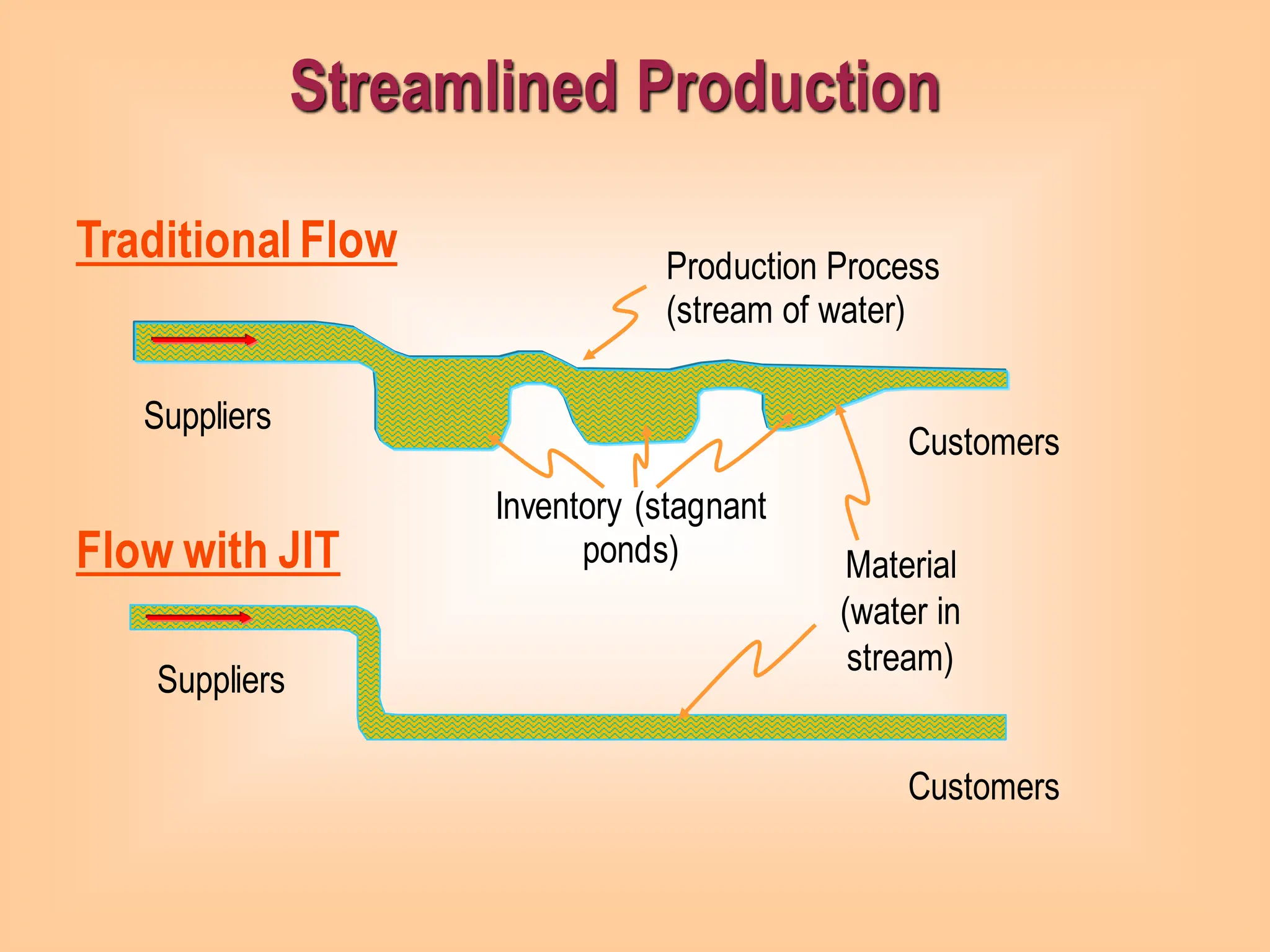
Streamlined Production
Flow with JIT
Traditional Flow
Customers
Suppliers
Customers
Suppliers
Production Process
(stream of water)
Inventory (stagnant
ponds) Material
(water in
stream)
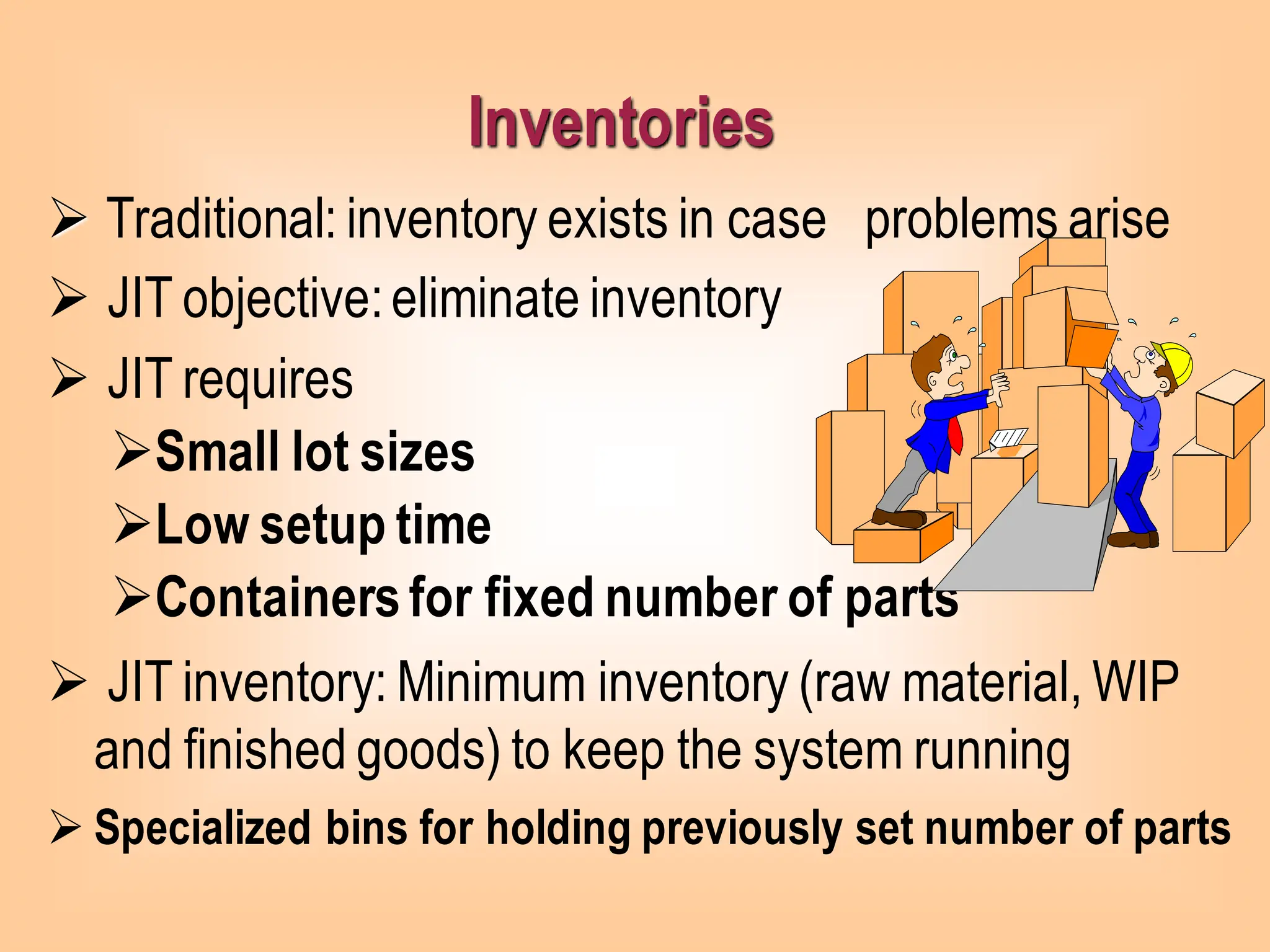
➢ Traditional: inventory exists in case problems arise
➢ JIT objective:eliminate inventory
➢ JIT requires
➢Small lot sizes
➢Low setup time
➢Containersfor fixed number of parts
➢ JIT inventory: Minimum inventory (raw material, WIP
and finished goods) to keep the system running
➢ Specialized bins for holding previously set number of parts
Inventories
JIT Inventory Tactics
➢Use a pull system to move inventory
➢Reduce lot size
➢Reduce setup time
➢Develop Just-in-Time deliverysystems with suppliers
➢Deliver directlyto point of use
➢Perform-to-schedule
➢Use group technology
Limited Work in Process
• Benefits
• Lower carrying costs
• Less space
• Increased flexibility
• Aids scheduling
• Saves cost of rework and scrap
• Two general approaches
• Kanban – focuses on individual work stations
• Constant work in process (CONWIP) – focuses on
the system as a whole
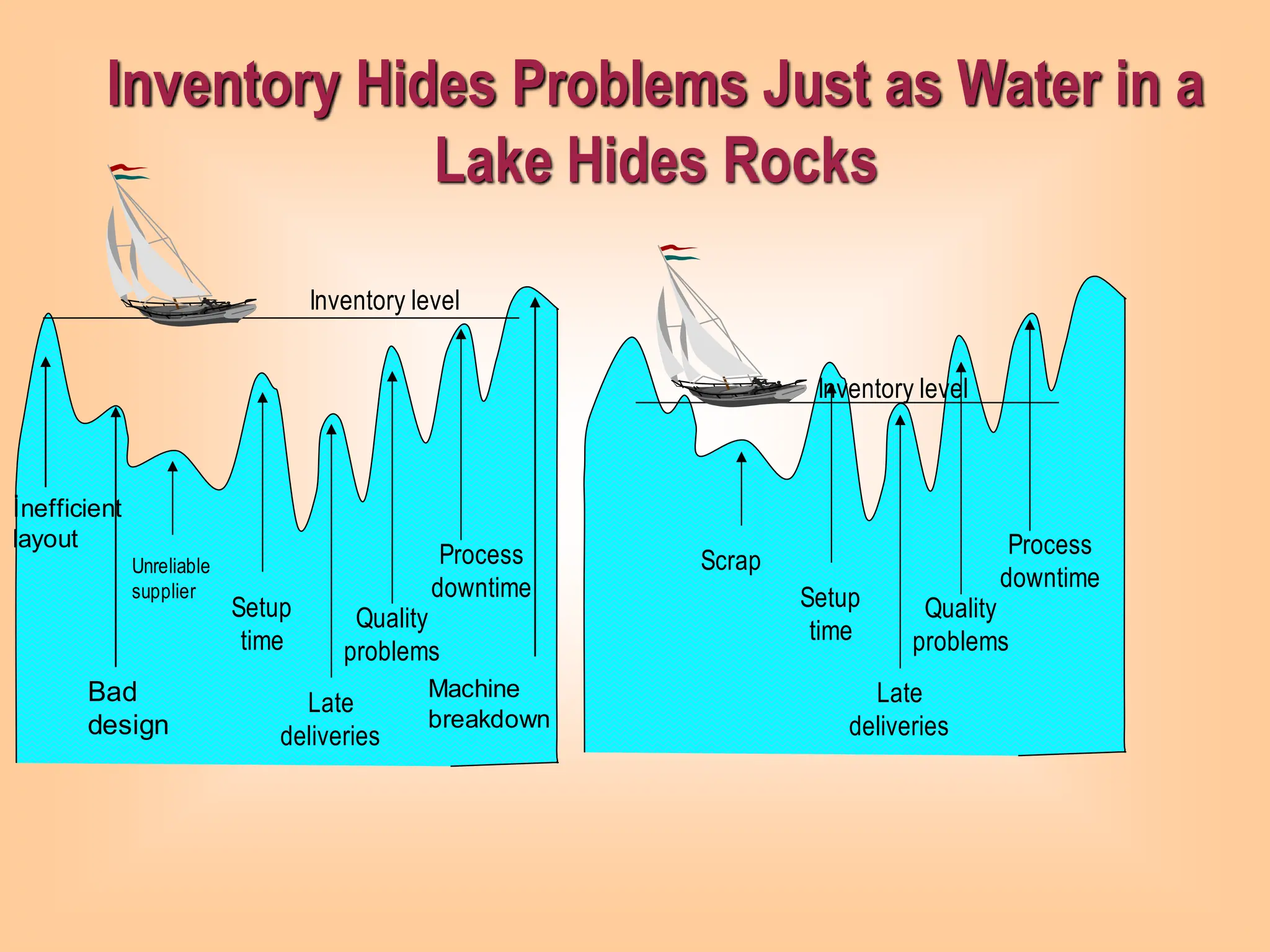
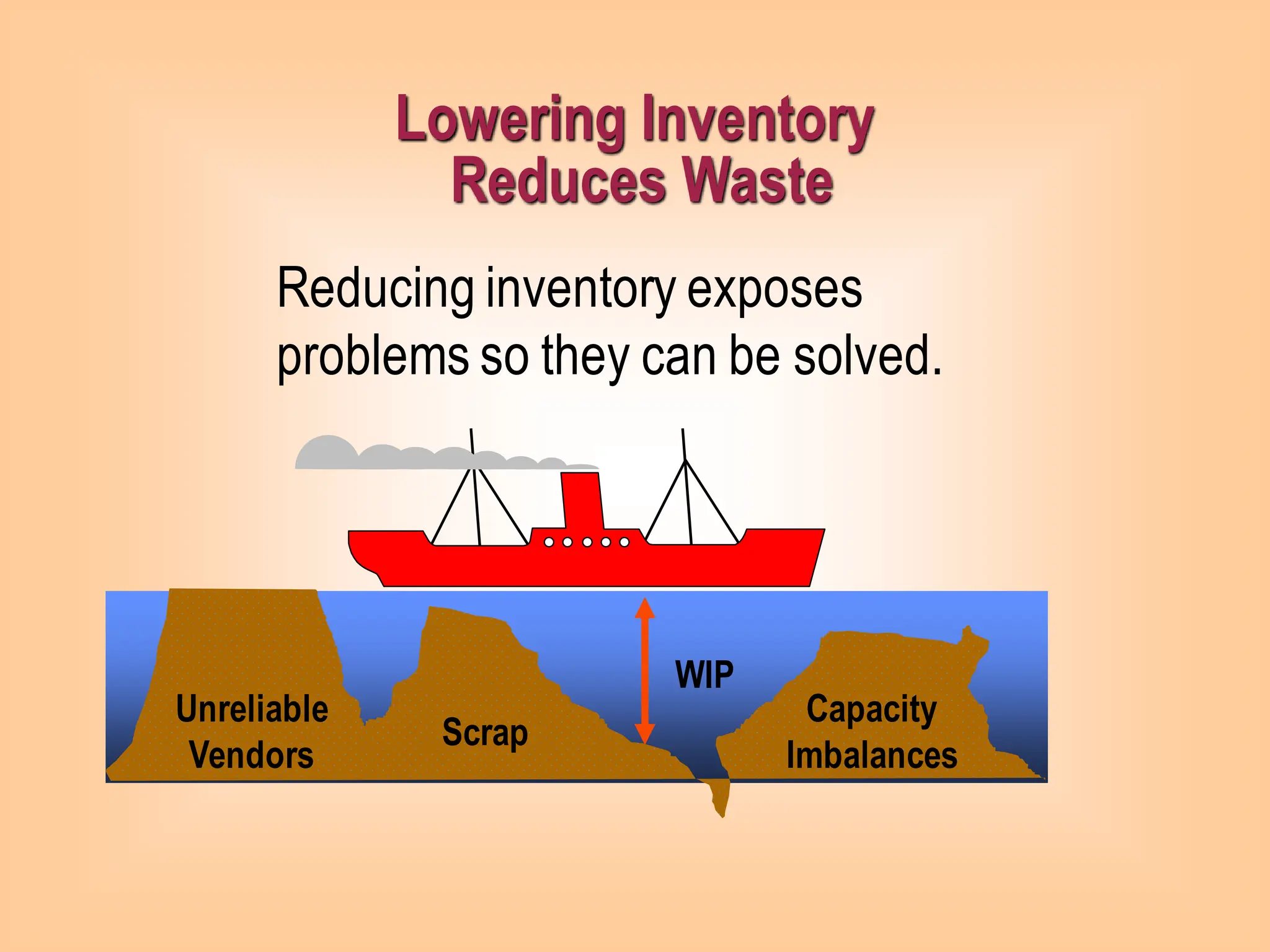
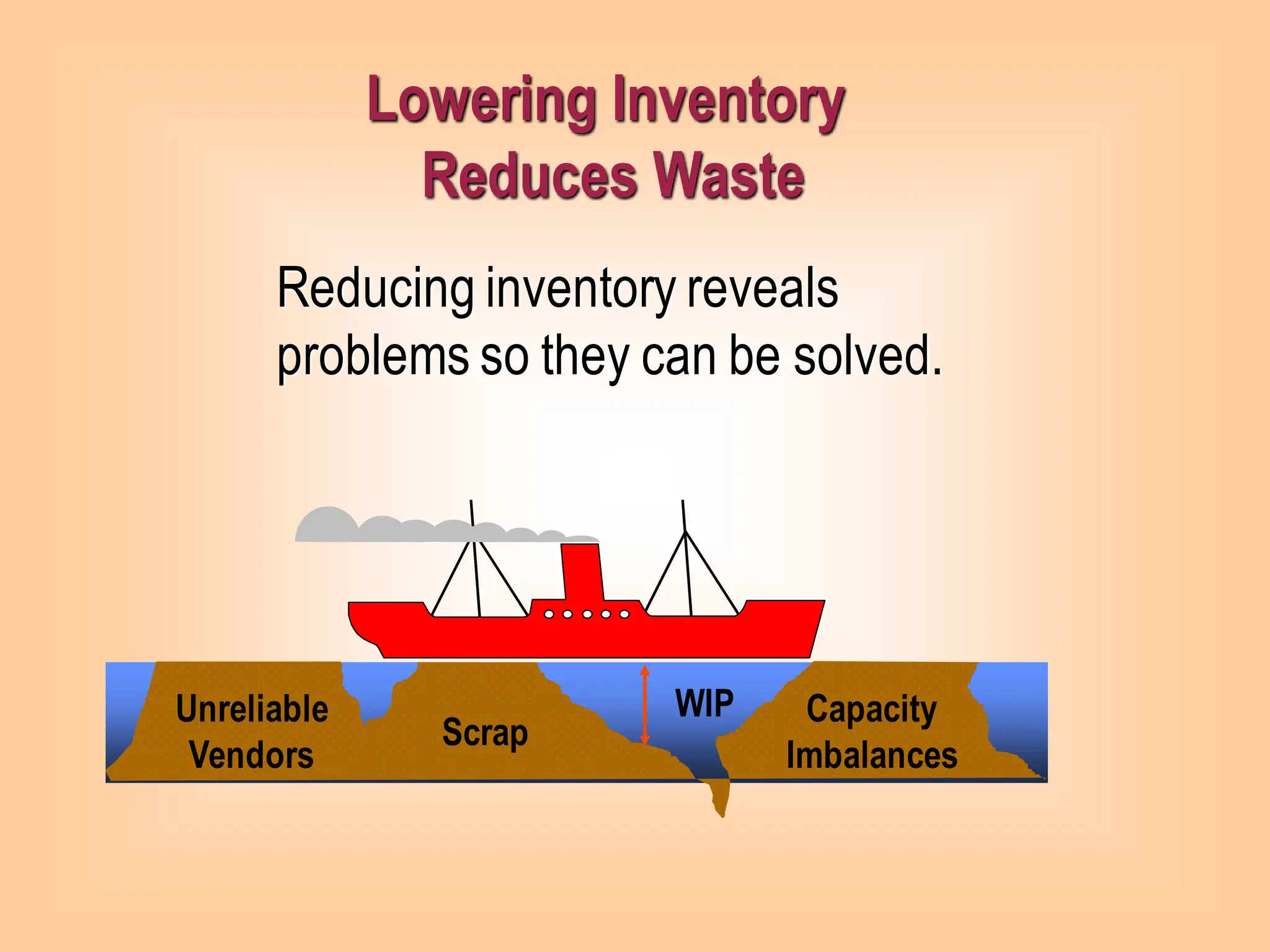
Inventory Hides Problems Just as Water in a
Lake Hides Rocks
Unreliable
supplier
Setup
time
Late
deliveries
Quality
problems
Process
downtime
Scrap
Setup
time
Late
deliveries
Quality
problems
Process
downtime
Inventory level
Inventory level
İnefficient
layout
Bad
design
Machine
breakdown
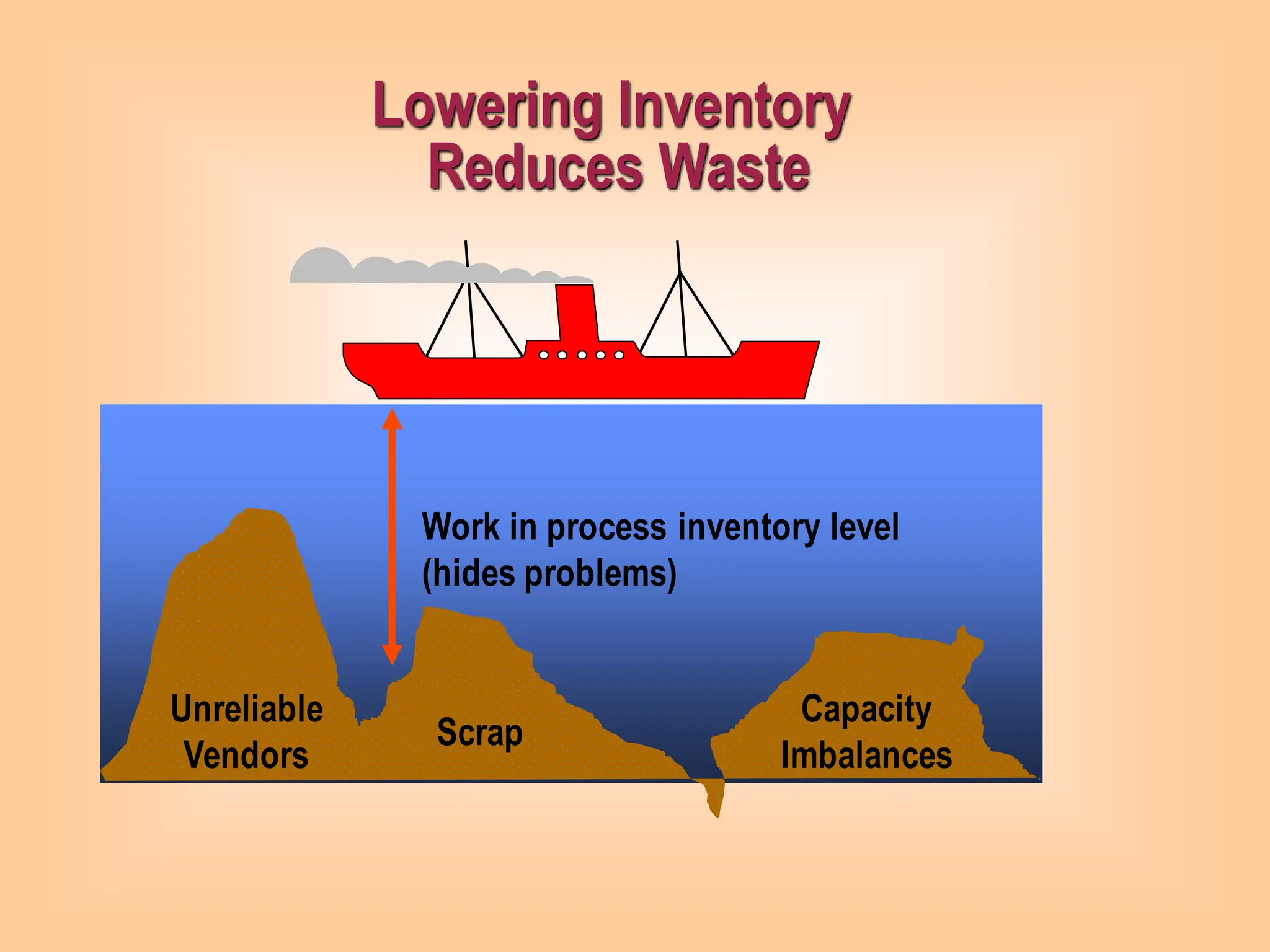
Scrap
Work in process inventory level
(hides problems)
Unreliable
Vendors
Capacity
Imbalances
Lowering Inventory
Reduces Waste
Scrap
Reducing inventory exposes
problems so they can be solved.
Unreliable
Vendors
Capacity
Imbalances
WIP
Lowering Inventory
Reduces Waste
Scrap
Reducing inventory reveals
problems so they can be solved.
Unreliable
Vendors
Capacity
Imbalances
WIP
Lowering Inventory
Reduces Waste
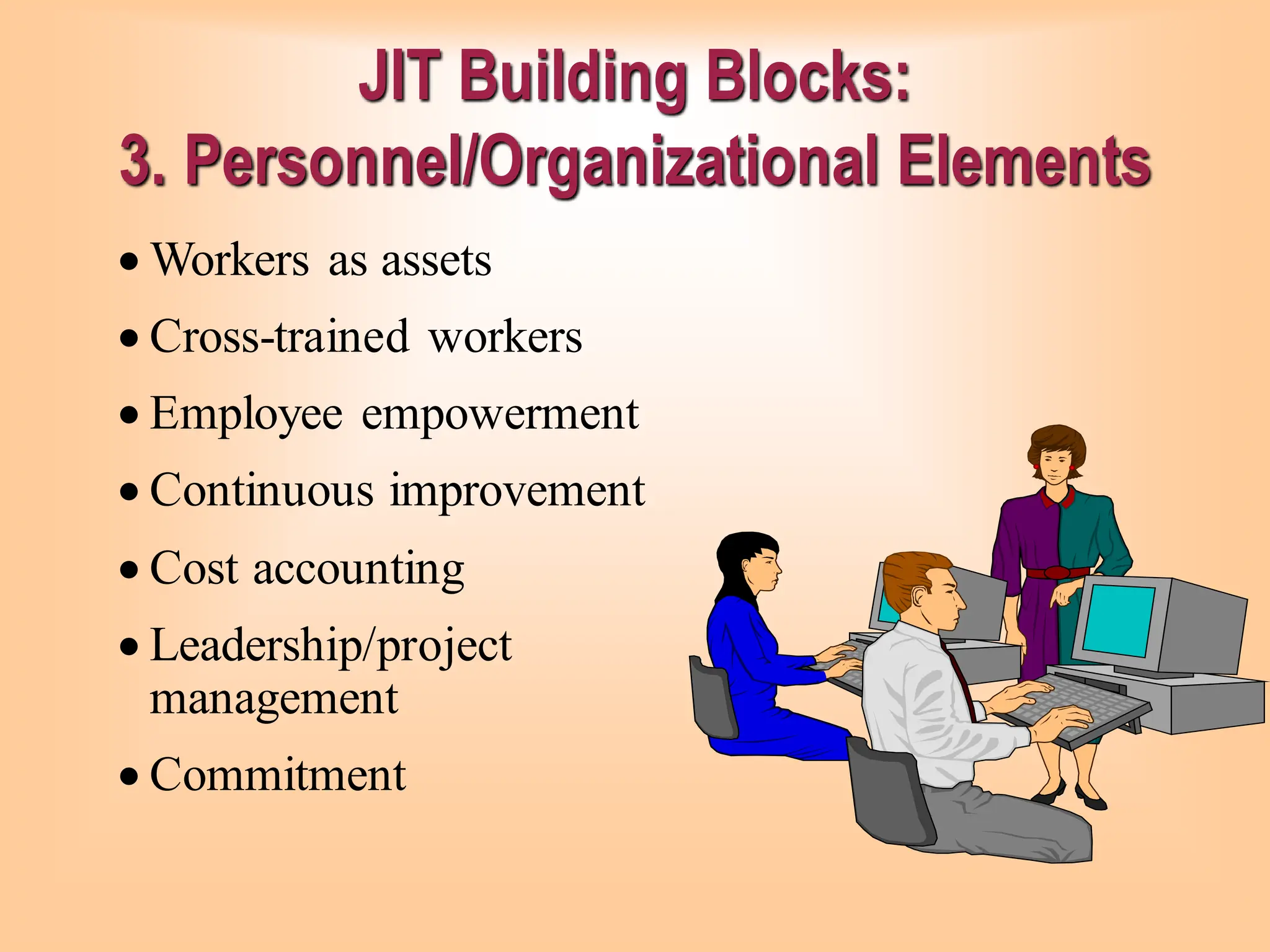
JIT Building Blocks:
3. Personnel/Organizational Elements
• Workers as assets
• Cross-trained workers
• Employee empowerment
• Continuous improvement
• Cost accounting
• Leadership/project
management
• Commitment
Employee Empowerment
Employeeempowerment
• Empowered and cross-trainedemployees(to help clear
bottlenecks)
• Get employeesinvolvedin product & process
(employeesknow the job best!)
• Few job classificationsto ensure flexibilityof employees
• Trainingsupport
Bottom-round Management Style &
Commitment
Commitment
• Supportof management,employeesand suppliers
Any improvementmust be made in accordancewith the
scientificmethod, under the quidanceof a teacher,at the
lowest possiblelevel in the organization(Toyota
ProductionSystem’s work rule)
JIT Building Blocks:
4. Manufacturing Planning and Control
• Uniform production levels
• Level loading (level schedules)
• Pull systems
• Visual systems
• Reduced transaction
processing
Uniform Production
✓Results from smoothingproductionrequirements
✓Kanbansystems can handle +/- 10% demand
changes
✓Smooths demand across planninghorizon
✓Mixed-modelassembly steadiescomponent
production
• Reduce ripple effect of small variations in
schedules(e.g., final assembly)
• Productionquantitiesevenly distributedover
time (e.g., 7/day)
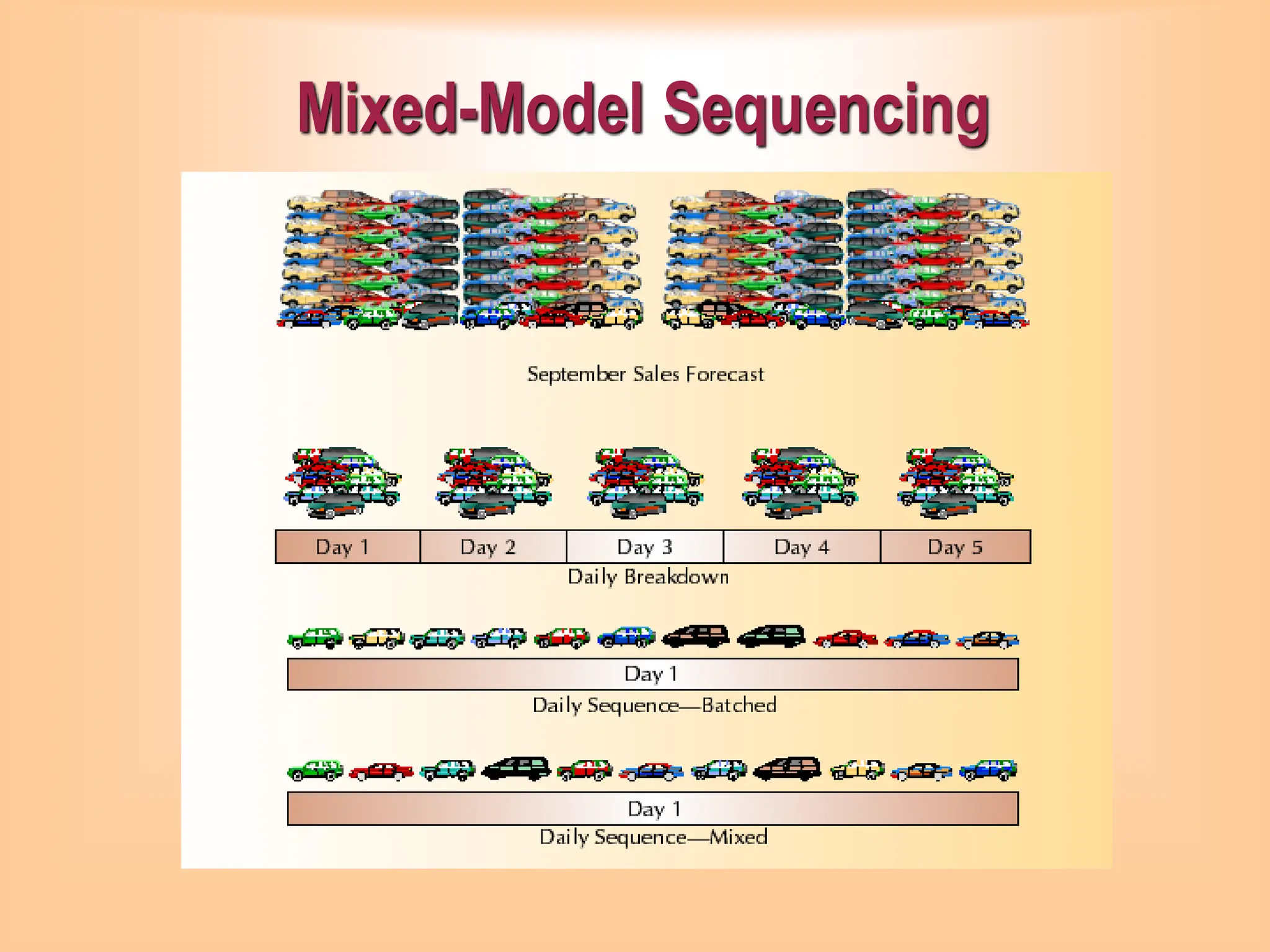
• Build same mix of products every day
• Results in many small lots
• Item Monthly Quantity Daily Quantity
A 40 2
B 60 3
Level Schedules
Mixed-Model Sequencing
JIT Scheduling Tactics
Involvestiming of operations
Schedulingin JIT requires
• Level loading (level schedules)
• Zero deviation from schedules(performing to schedules)
• Suppliersinformed about schedules
• Small lots (seeking one-piece-make and one-piece
move)
• Making each operationproducea perfectpart
• Kanbantechniques
Pull/Push Systems
➢Pull system: System for moving work where a
workstationpulls output from the precedingstation just
as it is needed.(e.g. Kanban)
vs.
➢Push system: System for moving work where output is
pushed to the next stationas it is completed
The Pull System
✓Material is pulled throughthe system when
needed
✓Reversal of traditionalpush system where
material is pushed according to a schedule
✓Forces cooperation
✓Preventover and underproduction
Kanban Production Control System (1 of 2)
✓Kanban:Card or other device that communicates demand
for work or materials from the precedingstation
✓Japanese word meaning “signal” or “visible record”may
be a card, or may be a flag, ball etc.
✓Paperlessproductioncontrol system
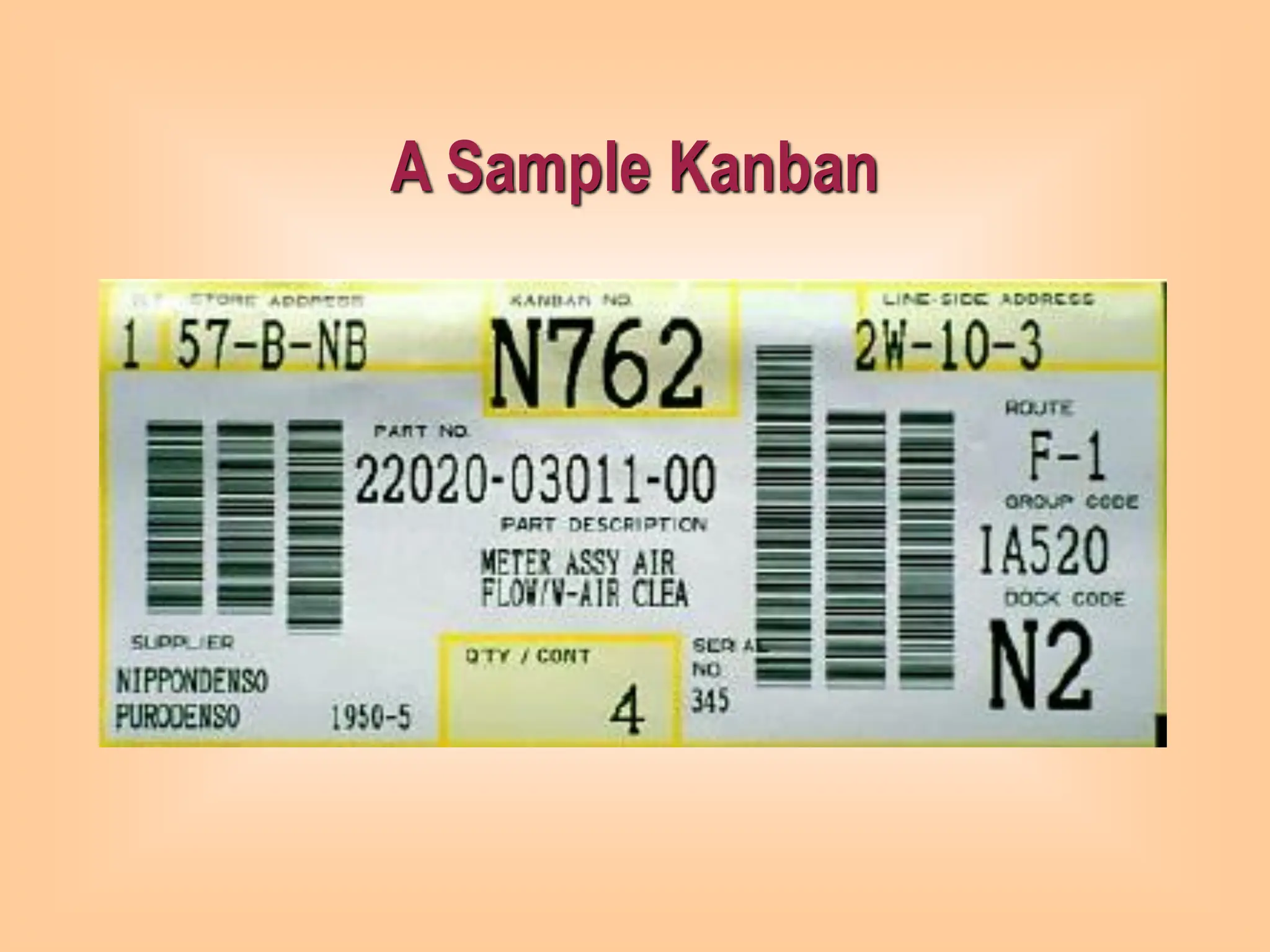
✓Kanbancard indicatesstandardquantity of production
✓Used often with fixed sized container
Kanban Production Control System (2 of 2)
✓ The kanban cards provide direct control (limit) on the amount
of work-in-process between cells.
✓ Derived from two-bin inventory system
✓ Maintains discipline of pull production
✓ Signifies an authority to pull or produce which comes from a
downstream process
✓ Production kanban authorizes production
✓ Withdrawal kanban authorizes movement of goods
A Sample Kanban
Determination of the Number of Kanbans
Needed
➢Setting up a kanban system requiresdeterminingthe
number of kanbans(or containers)needed.
➢Each containerrepresentsthe minimum productionlot
size
➢An accurateestimate of lead time requiredto produce a
container is key to determining how many kanbansare
required
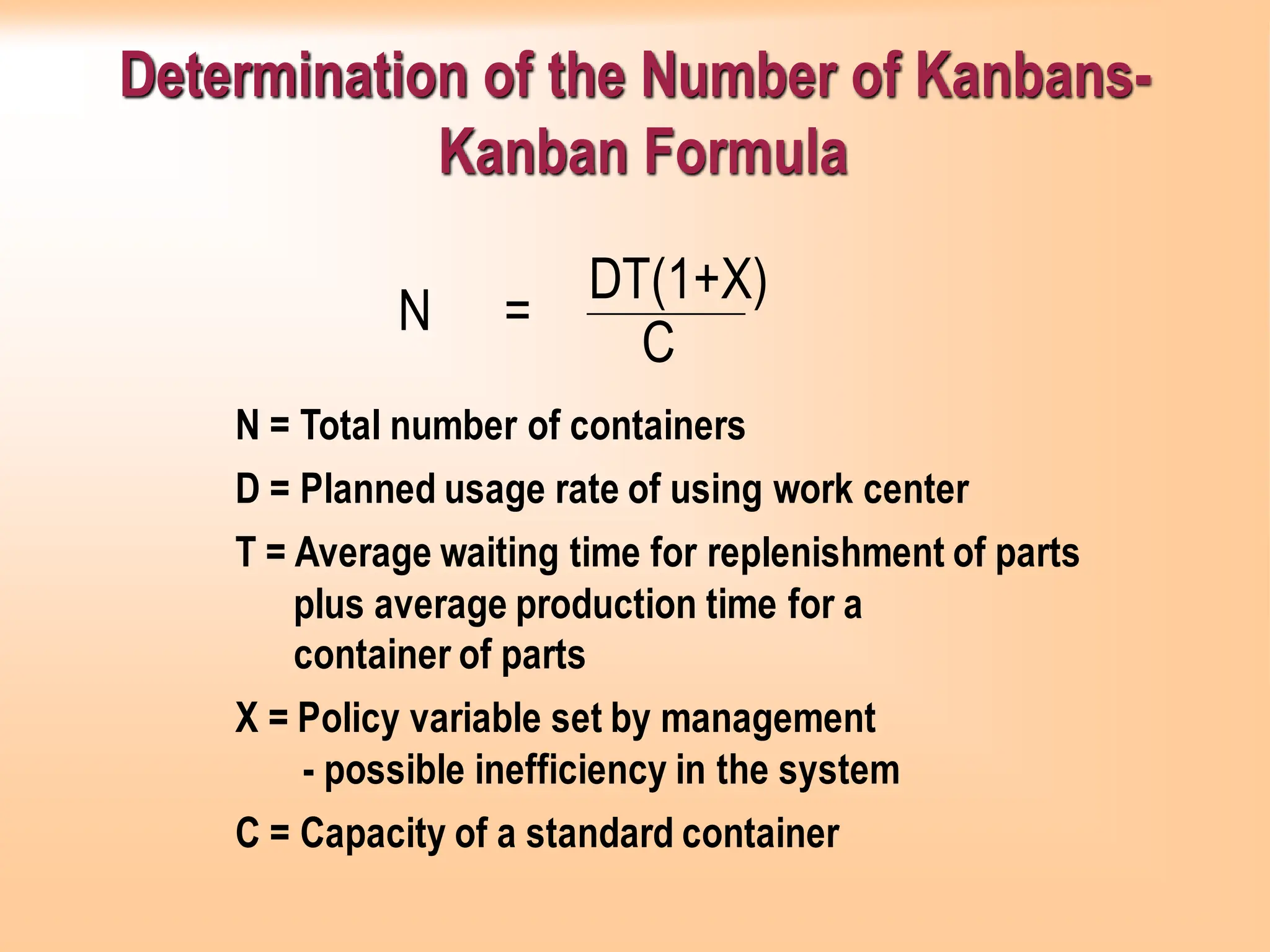
Determination of the Number of Kanbans-
Kanban Formula
N =
DT(1+X)
C
N = Total number of containers
D = Planned usage rate of using work center
T = Average waiting time for replenishment of parts
plus average production time for a
container of parts
X = Policy variable set by management
- possible inefficiency in the system
C = Capacity of a standard container
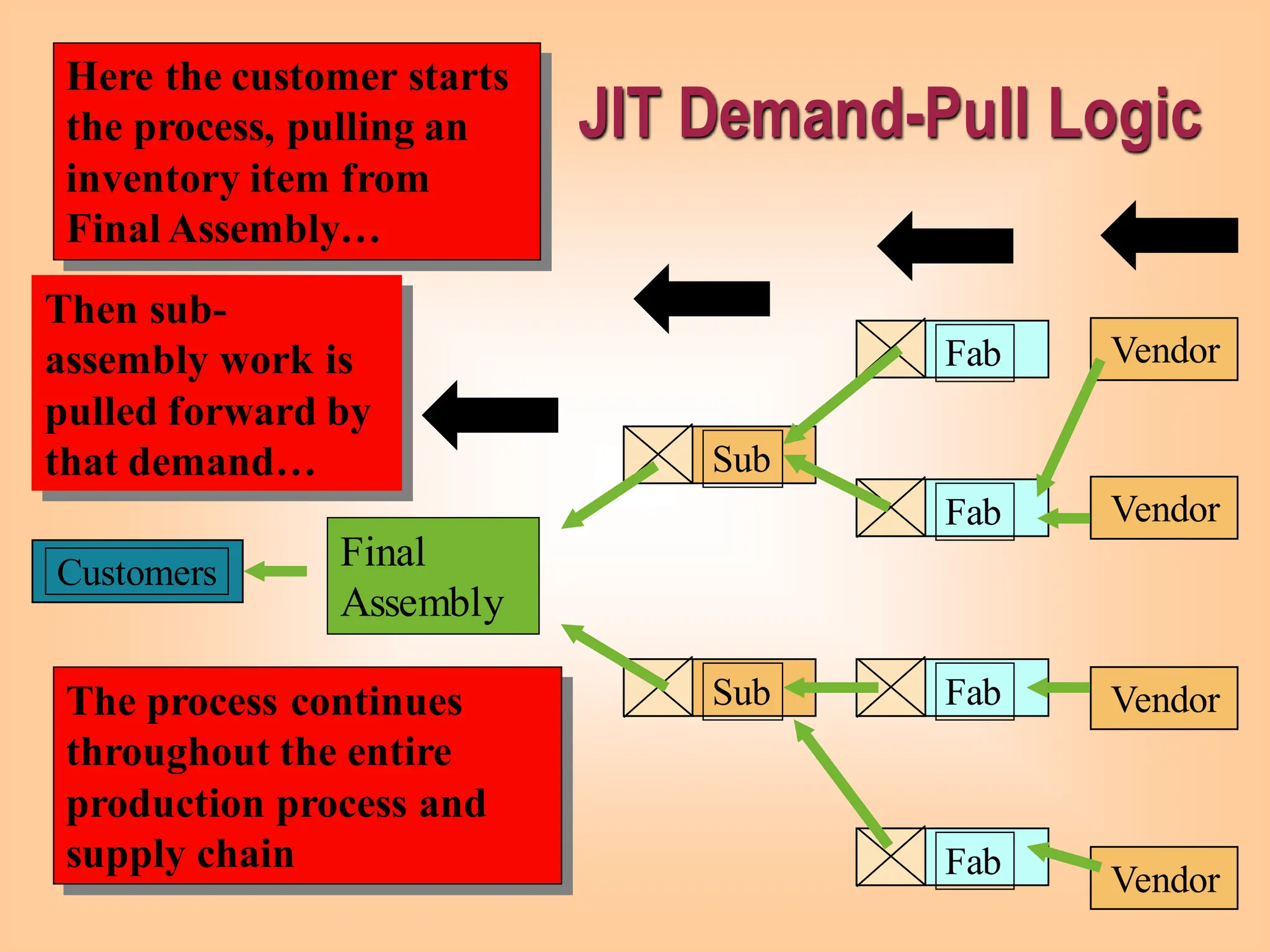
JIT Demand-Pull Logic
Customers
Sub
Sub
Fab
Fab
Fab
Fab
Vendor
Vendor
Vendor
Vendor
Final
Assembly
Here the customer starts
the process, pulling an
inventory item from
Final Assembly…
Then sub-
assembly work is
pulled forward by
that demand…
The process continues
throughout the entire
production process and
supply chain
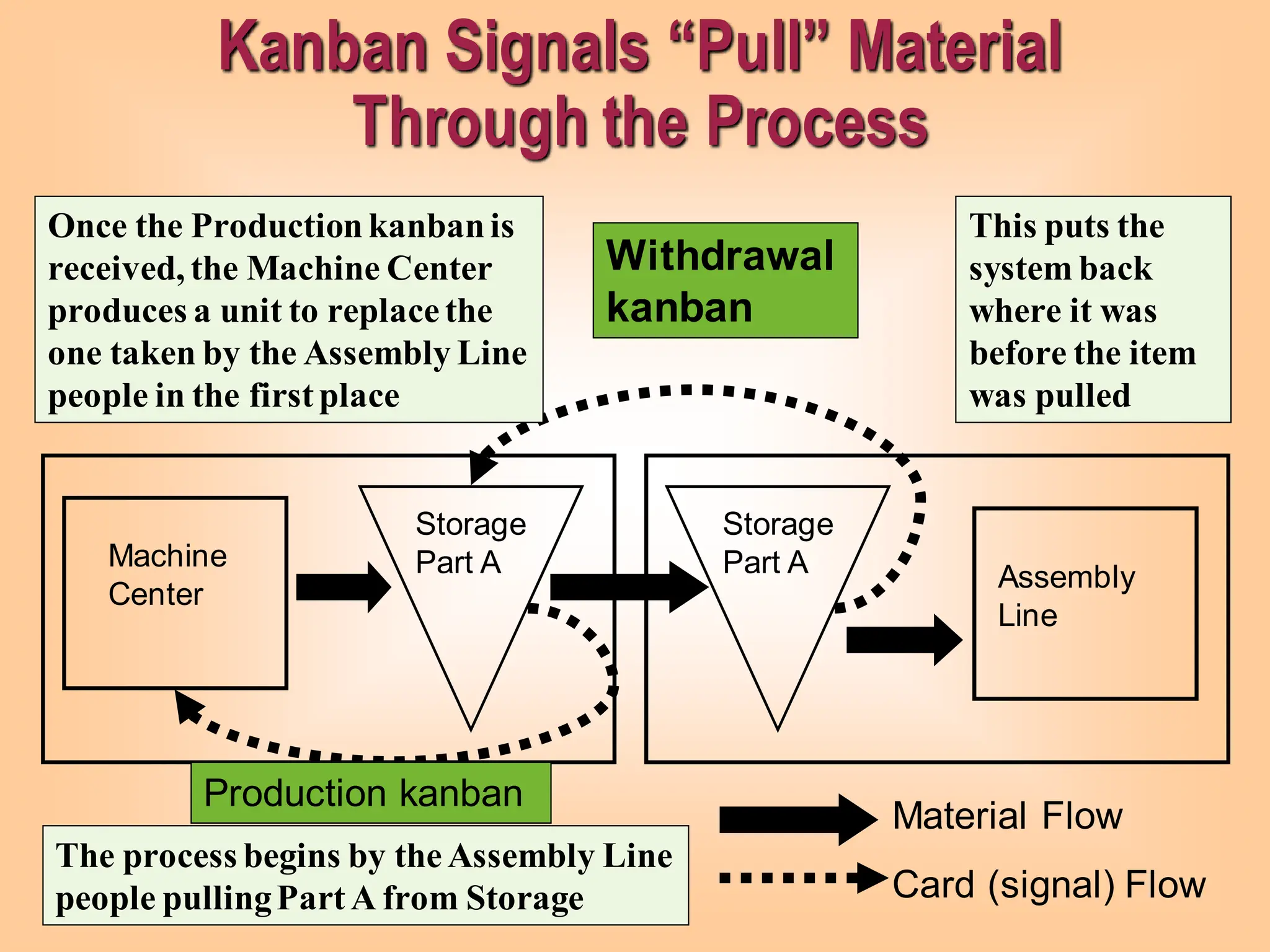
Kanban Signals “Pull” Material
Through the Process
Storage
Part A
Storage
Part A
Machine
Center
Assembly
Line
Material Flow
Card (signal) Flow
Withdrawal
kanban
Once the Productionkanbanis
received, the Machine Center
produces a unit to replacethe
one taken by the Assembly Line
people in the firstplace
This puts the
system back
where it was
before the item
was pulled
The process begins by theAssembly Line
people pullingPartA from Storage
Production kanban
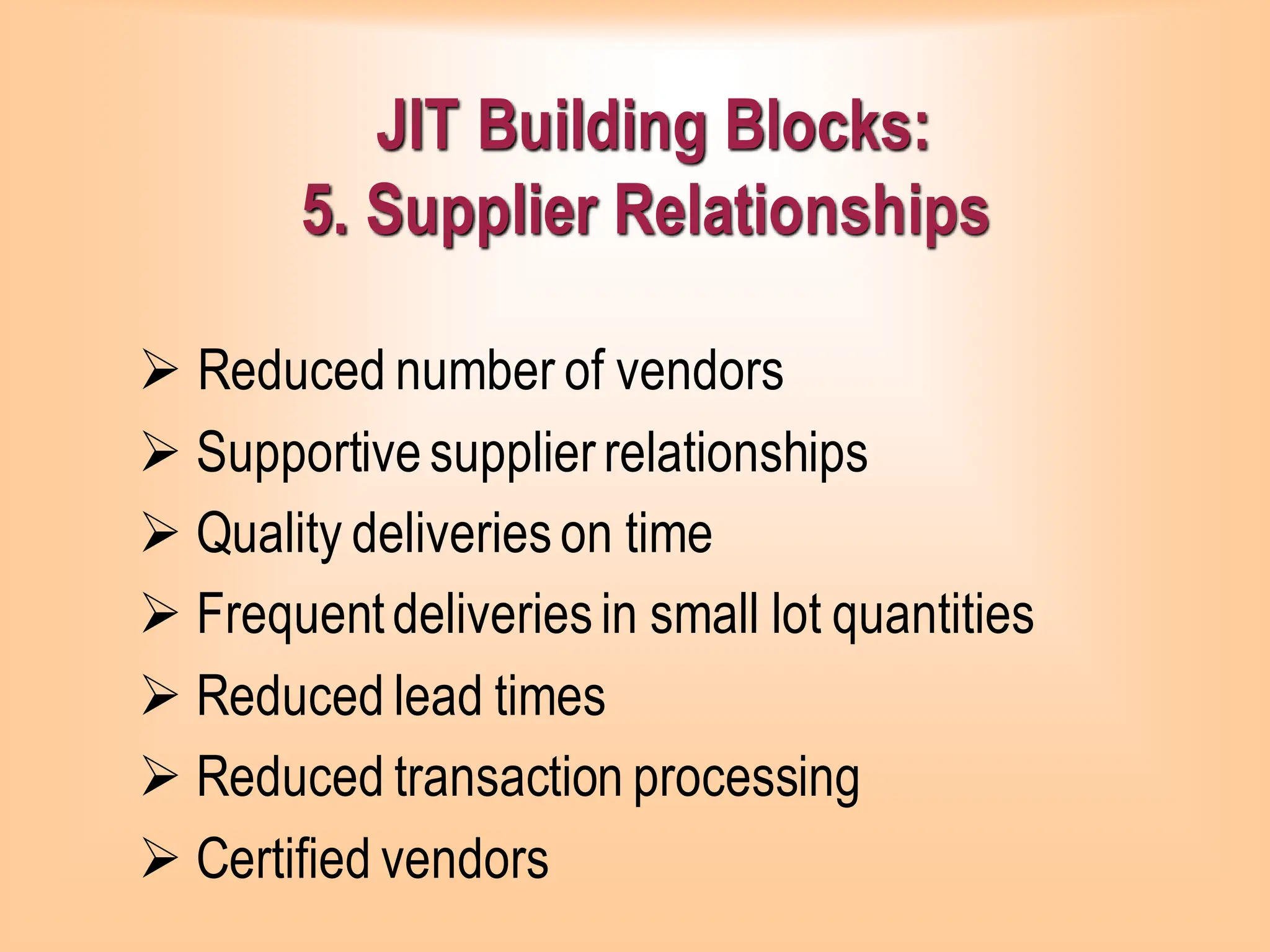
JIT Building Blocks:
5. Supplier Relationships
➢ Reduced number of vendors
➢ Supportivesupplierrelationships
➢ Quality deliverieson time
➢ Frequentdeliveriesin small lot quantities
➢ Reduced lead times
➢ Reduced transaction processing
➢ Certified vendors
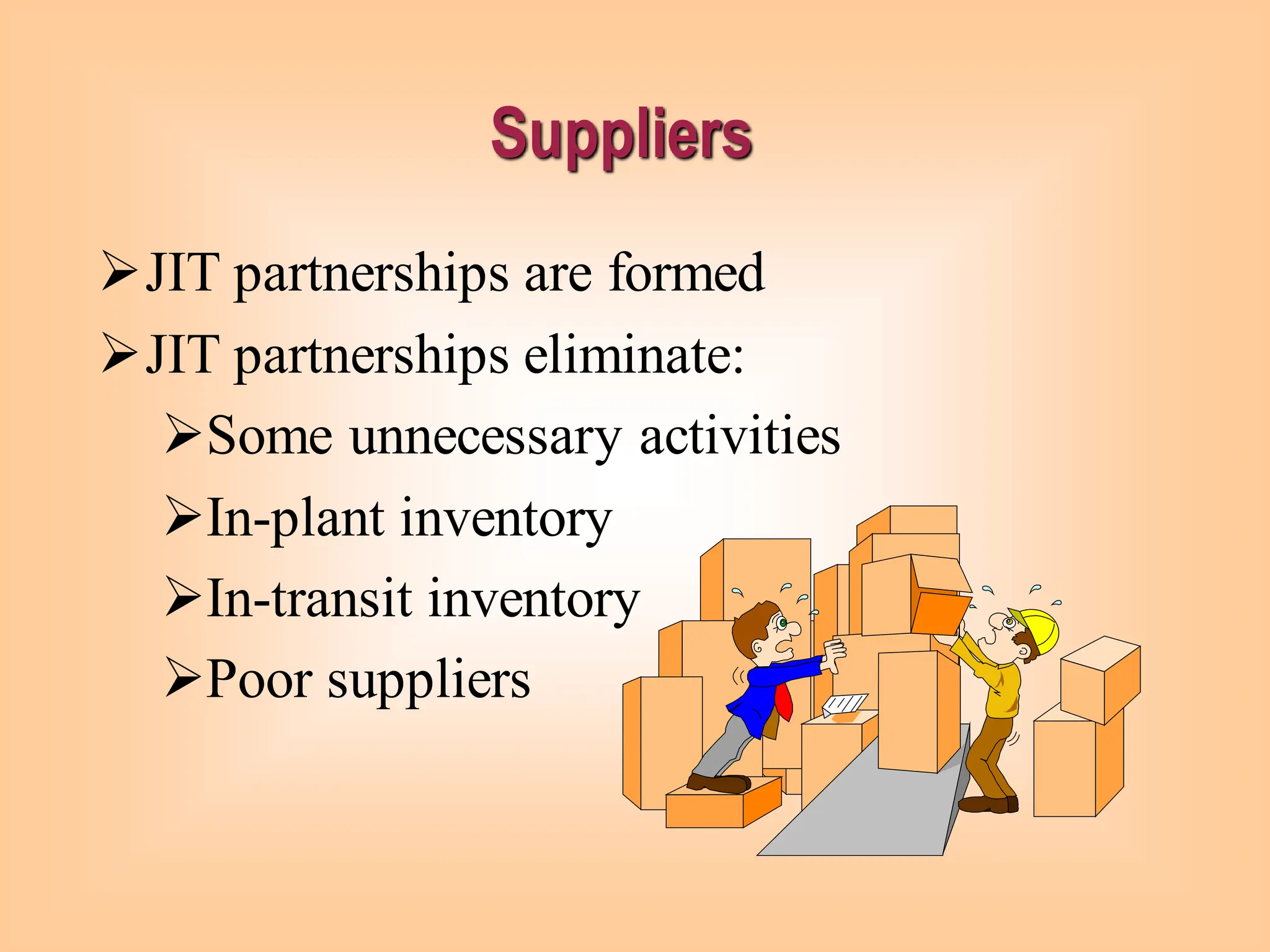
➢JIT partnerships are formed
➢JIT partnerships eliminate:
➢Some unnecessary activities
➢In-plant inventory
➢In-transit inventory
➢Poor suppliers
Suppliers
➢Few
➢Nearby
➢Long-term relationships
➢Analysisand support to enable desirable suppliers to
become or stay price competitive
➢Buyer resists vertical integrationand subsequent
wipeout of supplier business
➢Suppliersencouraged to extend JIT to their suppliers
(2nd and 3rd tier suppliers)
Characteristics of JIT Partnerships
Suppliers
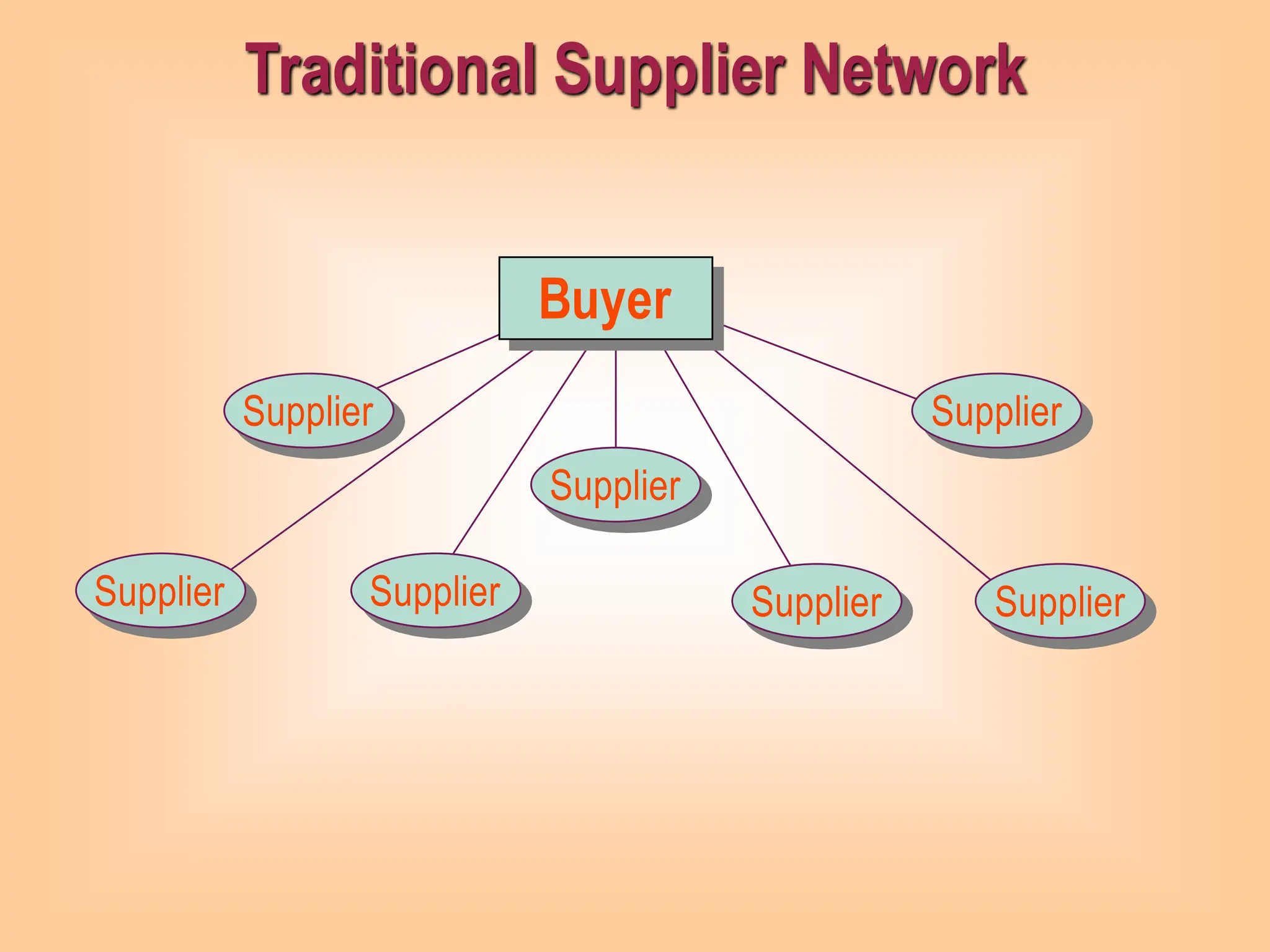
Traditional Supplier Network
Buyer
Supplier
Supplier Supplier Supplier
Supplier
Supplier
Supplier
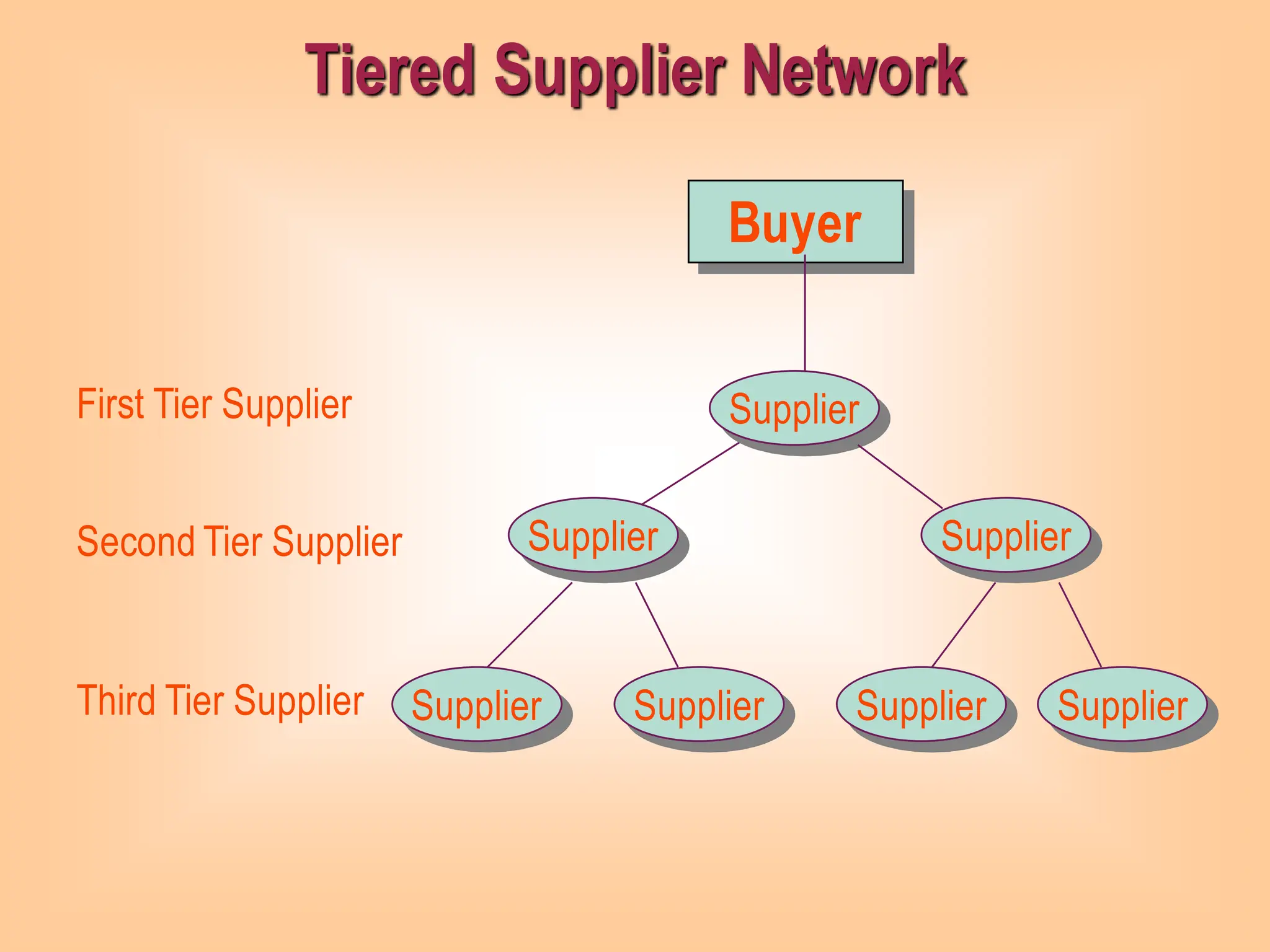
Tiered Supplier Network
Supplier
Supplier
Supplier
Supplier
Supplier Supplier
Buyer
Supplier
First Tier Supplier
Second Tier Supplier
Third Tier Supplier
JIT Building Blocks:
6. Preventive Maintenance
➢All activities involved in keeping equipment in working
order
➢Maintaining equipment in good condition and replacing
parts that have a tendency to fail before they actually fail
➢Done to prevent failure
➢JIT requires
➢Scheduled & daily PM
➢Operator involvement in PM
➢Knows machines
➢Responsible for product quality
Total Productive Maintenance (TPM)
✓Breakdown maintenance
✓Repairs to make failed machine operational
✓Preventivemaintenance
✓System of periodic inspection& maintenance
to keep machines operating
✓TPM combines preventivemaintenance& total
quality concepts
TPM Requires Management to:
✓Design productsthat can be easily producedon existing
machines
✓Design machinesfor easier operation, changeover,
maintenance
✓Train & retrain workers to operate machines
✓Purchase machinesthat maximize productivepotential
✓Design preventivemaintenanceplan spanninglife of
machine
Housekeeping
Housekeeping: Maintaining a workplace that is
clean and free of unnecessary materials.
Housekeeping 5 S’s
▪ Sort
▪ Straighten
▪ Sweep
▪ Standardize
▪ Self-discipline
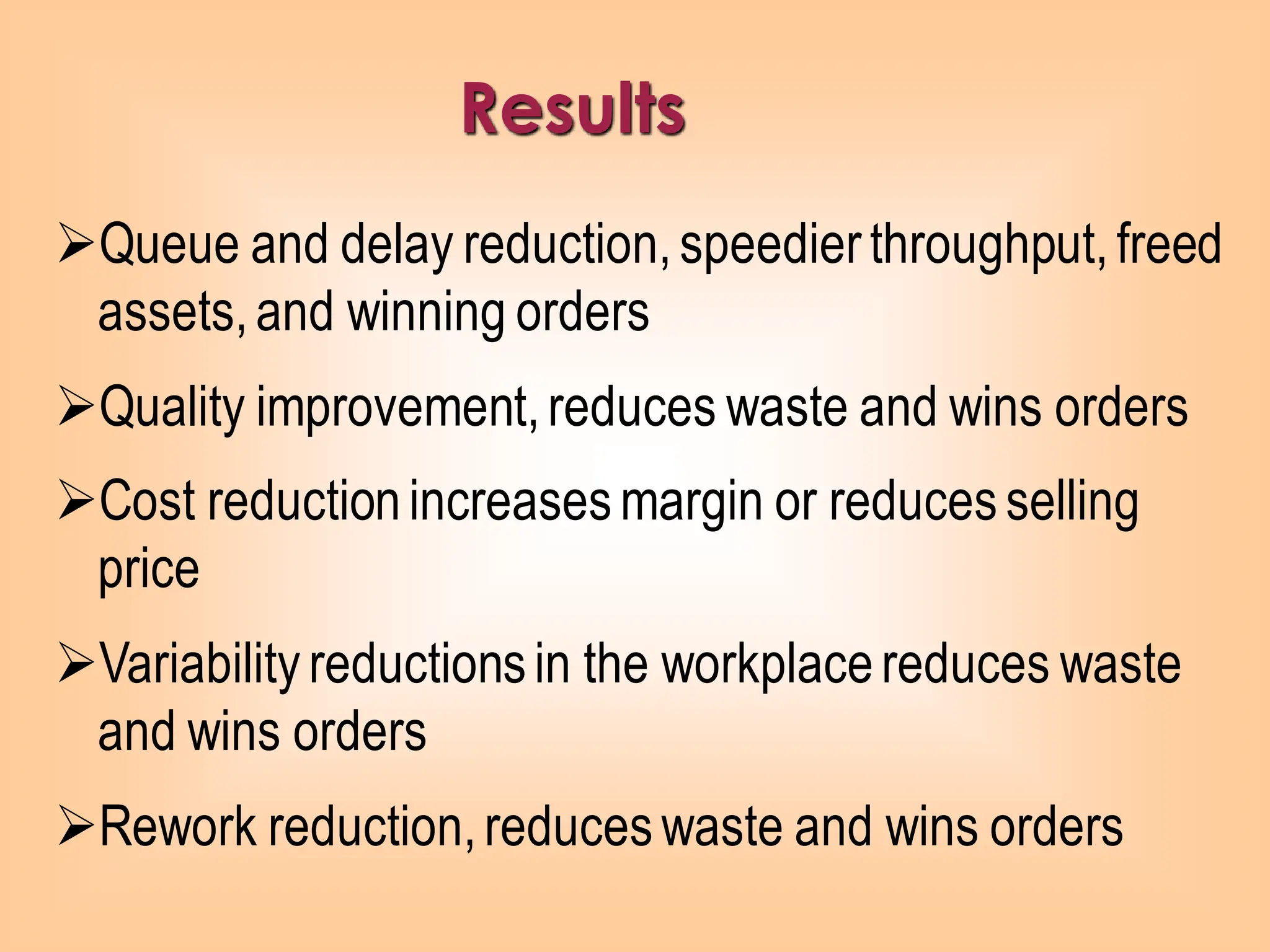
Results
➢Queue and delay reduction,speedierthroughput,freed
assets,and winning orders
➢Quality improvement,reduces waste and wins orders
➢Cost reductionincreasesmargin or reducesselling
price
➢Variabilityreductionsin the workplacereduces waste
and wins orders
➢Rework reduction,reduceswaste and wins orders
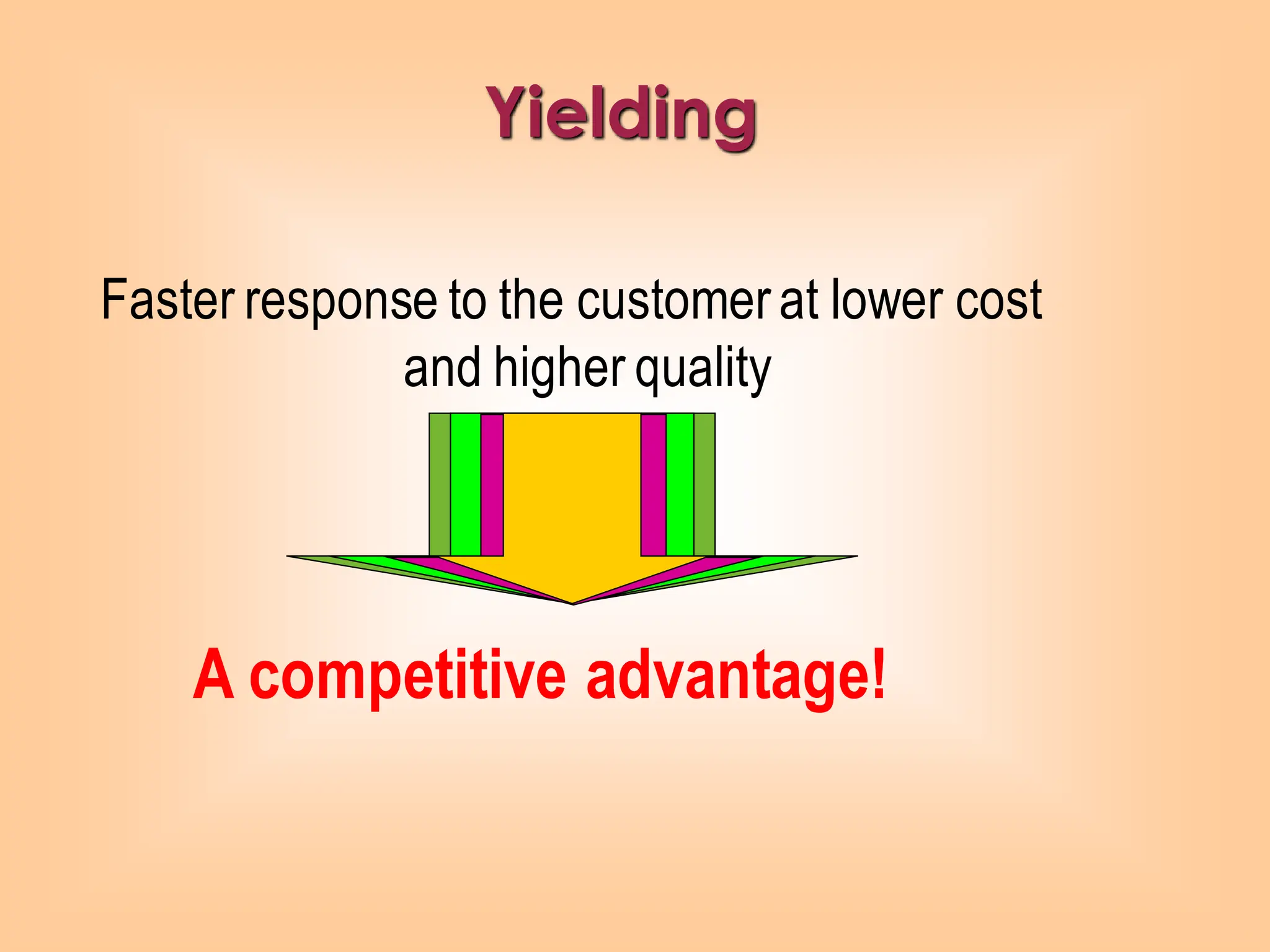
Yielding
Faster response to the customerat lower cost
and higher quality
A competitive advantage!
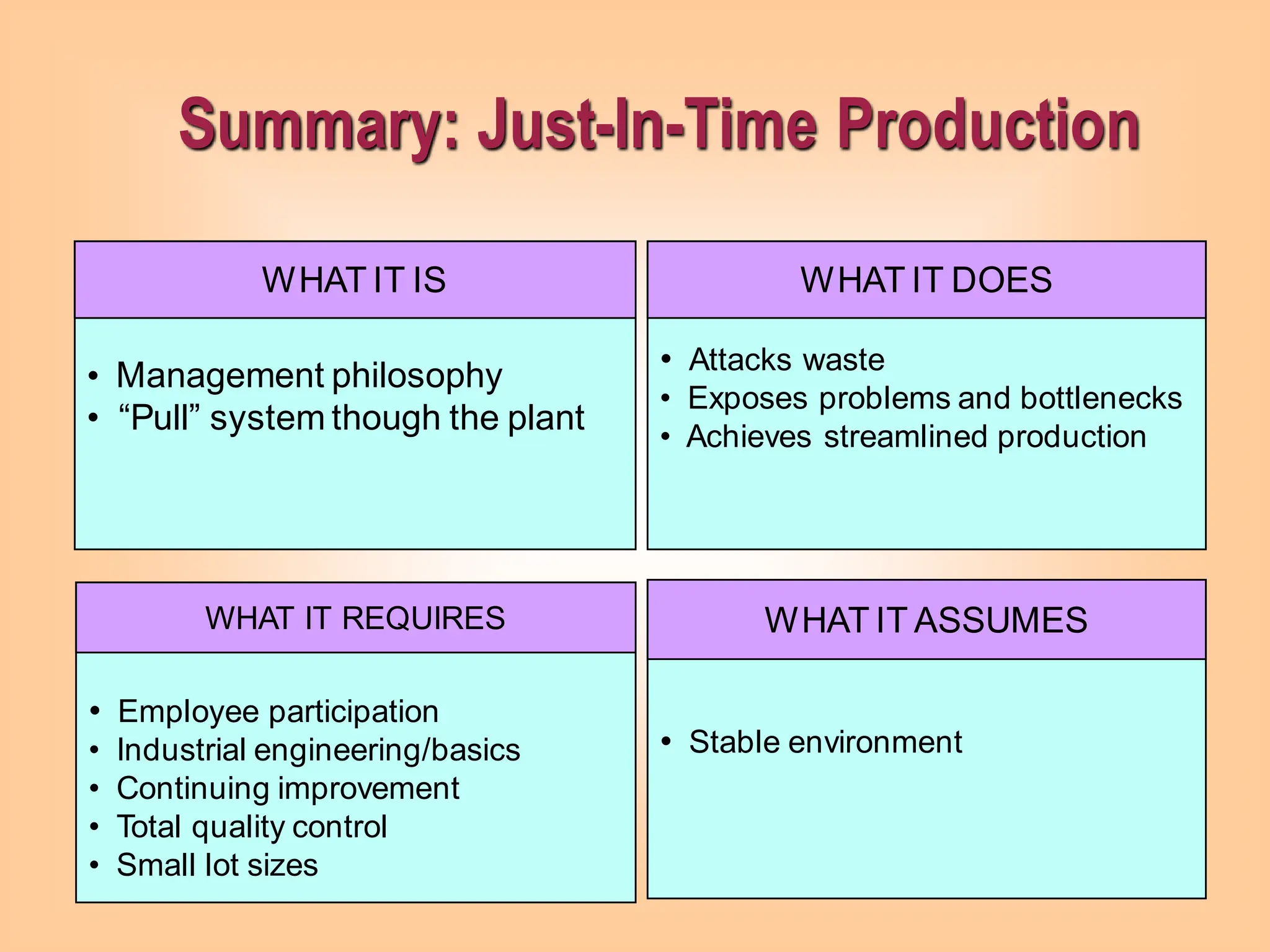
Summary: Just-In-Time Production
• Management philosophy
• “Pull” system though the plant
WHAT IT IS
• Employee participation
• Industrial engineering/basics
• Continuing improvement
• Total quality control
• Small lot sizes
WHAT IT REQUIRES
• Attacks waste
• Exposes problems and bottlenecks
• Achieves streamlined production
WHAT IT DOES
• Stable environment
WHAT IT ASSUMES
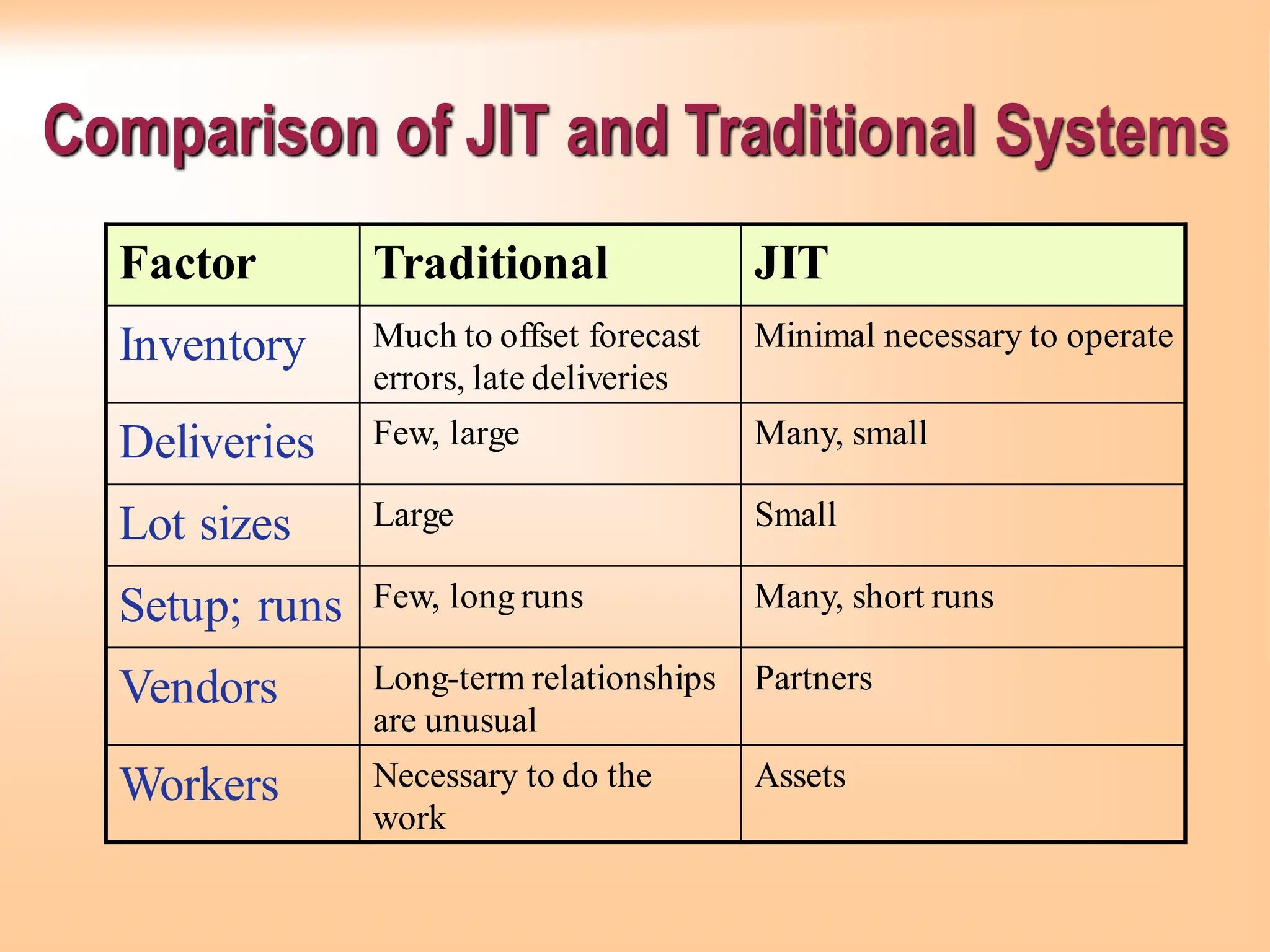
Comparison of JIT and Traditional Systems
Factor Traditional JIT
Inventory Much to offset forecast
errors, late deliveries
Minimal necessary to operate
Deliveries Few, large Many, small
Lot sizes Large Small
Setup; runs Few, long runs Many, short runs
Vendors Long-term relationships
are unusual
Partners
Workers Necessary to do the
work
Assets
Transitioning to a JIT System
➢Get top managementcommitment
➢Decide which parts need most effort
➢Obtain supportof workers
➢Start by trying to reduce setup times
➢Gradually convertoperations
➢Convert suppliersto JIT
➢Preparefor obstacles
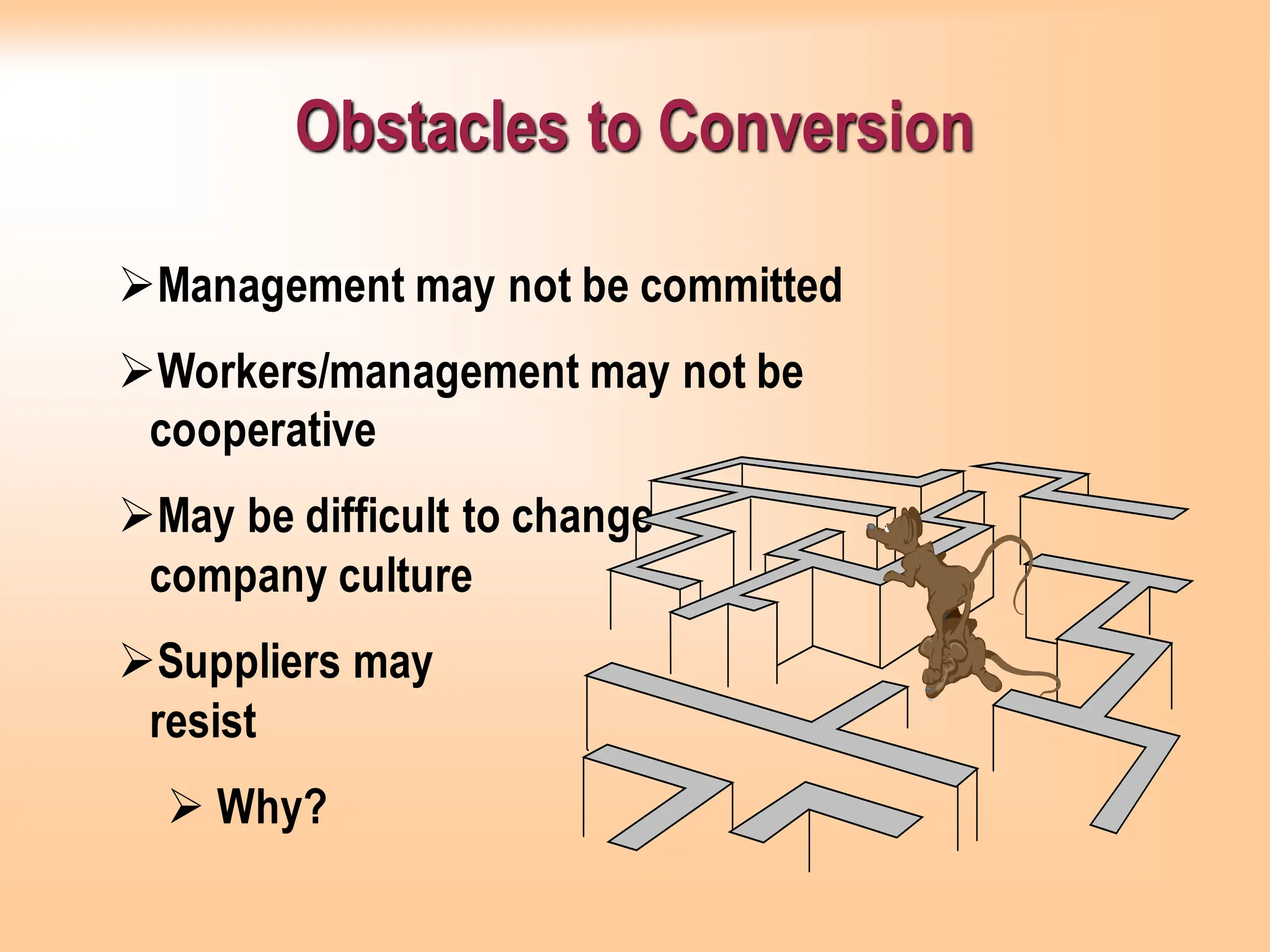
Obstacles to Conversion
➢Management may not be committed
➢Workers/management may not be
cooperative
➢May be difficult to change
company culture
➢Suppliers may
resist
➢ Why?
Suppliers May Resist JIT
➢Unwilling to commit resources
➢Uneasy about long-term commitments
➢Frequent, small deliveries may be difficult
➢Burden of quality control shifts to supplier
➢Frequent engineering changes may cause JIT
changes
Benefits of JIT
1. Reduced inventory
2. Improved quality
3. Lower costs
4. Reduced space
requirements
5. Reduced lead times
6. Increased
productivity
7. Greater flexibility
8. Reduced scrap and
rework
8. Better relations with
suppliers
9. Simplified scheduling
and control activities
10. Increased capacity
11. Increased equipment
utilization
12. Better use of human
resources
13. More product variety
14. Reduced need for
indirect labor
JIT in Services (1 of 3)
The basic goal of the demand flow technologyin the
service organizationis to provide optimum response to the
customer with the highest quality service and lowest
possible cost.
JIT in Services (2 of 3)
All the techniques used in manufacturingare used in
services
➢Level the facility load & eliminate disruptionsand
unnecessaryactivities
➢Reorganizephysicalconfiguration
➢Introduce demand-pullscheduling
➢Develop supplier networks
➢Minimize WIP
JIT in Services (3 of 3)
All the techniquesused in manufacturing are used in
services
➢Make the system flexible
➢Reduce setup and lead times
➢Eliminate waste
➢Simplify the process
➢Organize problem solving groups
➢Upgrade quality
JIT II: a supplier representative works right in the
company’s plant, making sure there is an
appropriatesupply on hand.
JIT II
✓Use JIT to finely tune an operatingsystem
✓Somewhat different in
USA than Japan
✓JIT is still evolving
✓JIT isn’t for everyone
JIT Implementation
➢Smooth flow of work (the ultimate goal)
➢Elimination of waste
➢Continuous improvement
➢Eliminating anything that does not add
value
➢Simple systems that are easy to manage
➢Use of product layouts to minimize moving
materials and parts
➢Quality at the source
Elements of JIT (1 of 2)
➢Poka-yoke – fail safe tools and methods
➢Preventative maintenance
➢Good housekeeping
➢Set-up time reduction
➢Cross-trained employees
➢A pull system
Elements of JIT (2 of 2)
Attributes of Lean Producers - They
➢use JIT to eliminate virtually all
inventory
➢build systems to help employees produce
a perfect part every time
➢reduce space requirements
➢develop close relationships with suppliers
➢educate suppliers
Attributes of Lean Producers - They
➢eliminate all but value-added activities
➢develop the workforce
➢make jobs more challenging
➢reduce the number of job classes and
build worker flexibility

Introduction to JIT & Lean Operations.pdf

  • 1.
    Just-in-Time and Lean Operations Worker 1 Cell1 Scrap Unreliable Vendors Capacity Imbalances WIP Material Flow Card (signal) Flow
  • 2.
    ✓Producingonly what isneeded,when it is needed (not early, not late; not less, not more) ✓Achieving high volume production using minimal inventories ✓An integrated but simplified system ✓JIT’s mandate: Eliminationof all waste in productioneffort What is JIT ?
  • 3.
    Just-in-Time Just-in-time (JIT):A highlycoordinatedprocessing system in which goods move through the system, and servicesare performed,just as they are needed ➢Suppliesand componentsare ‘pulled’throughthe system to arrive where they are needed when they are needed (just-in-time) ➢A managementphilosophy of continuous and forced problem solving by attacking the root causes
  • 4.
    Lean Production ➢JIT ➔ lean production ➢Lean Production supplies customers with exactly what the customer wants, when the customer wants, without waste, through continuous improvement ➢JIT operates with very little fat
  • 5.
    ➢Attackswaste (anythingnot addingvalue to the product) ➢Achievesstreamlined productionby reducing inventory ➢Exposesproblems and bottleneckscausedby variability What Does Just-in-Time Do?
  • 6.
    Goal of JIT Theultimate goal of JIT is a balancedsystem. (Achievesa smooth, rapid flow of materials through the system) The supportinggoals are: ➢ Eliminatedisruptions ➢ Make the system flexible ➢ Eliminatewaste, especiallyexcess inventory
  • 7.
    Summary:JIT Goals andBuilding Blocks Product Design Process Design Personnel Elements Manufactur- ing Planning Eliminate disruptions Make the system flexible Eliminate waste A balanced rapid flow Ultimate Goal Supporting Goals Building Blocks
  • 8.
    Waste is ‘anythingotherthan the minimum amount of equipment,materials,parts, space, and worker’s time, which are absolutelyessential to add value to the product.’ — ShoichiroToyoda President,Toyota © 1995 Corel Corp. Quotation by Shoichiro Toyoda
  • 9.
    Sources of Waste ➢Overproduction ➢Waiting ➢Unnecessarytransportation ➢Inventory ➢Inefficientwork methods ➢Inefficient processing ➢Unnecessarymotions ➢Product defects
  • 10.
  • 11.
  • 12.
  • 13.
    Waste Reduction (%) 82% 50% 50% 30% 30% 20% 40% 0%20% 40% 60% 80% 100% Work-in-Process Inventory Raw Material Inventory Lead Time Space Finished Goods Inventory Scrap Setup Time JIT Reduced Waste at Hewlett-Packard
  • 14.
    Kaizen Philosophy (1of 3) ✓Continuousimprovement ✓Requires total employeeinvolvement ✓Essenceof JIT is willingness of workers to ✓Spot quality problems ✓Halt productionwhen necessary ✓Generate ideas for improvement ✓Analyzeproblems ✓Perform different functions
  • 15.
    Kaizen Philosophy (2of 3) ➢Waste is the enemy ➢Improvement should be done gradually and continuously ➢Everyone should be involved ➢Built on a cheap strategy ➢Can be applied anywhere
  • 16.
    Kaizen Philosophy (3of 3) ➢Supported by a visual system ➢Focuses attention where value is created ➢Process oriented ➢Stresses main effort of improvement should come from new thinking and work style ➢The essence of organizational learning is to learn while doing
  • 17.
    ➢Big JIT –broad focus ➢Vendor relations ➢Human relations ➢Technology management ➢Materials and inventory management ➢Little JIT – narrow focus ➢Scheduling materials ➢Scheduling services for production Big vs. Little JIT
  • 18.
    JIT Building Blocks Inorder to achieve competitiveadvantagethrough JIT, the necessary buildingblocks should be installed The building blocks can also be regardedas JIT successfactors or the basic elements of JIT
  • 19.
    JIT Building Blocks 1.Productdesign 2. Processdesign 3. Personnel/organizational elements 4. Manufacturing planningand control 5. Supplierrelationships (suppliernetworks) 6. Preventivemaintenance
  • 20.
    JIT Building Blocks:1. Product Design ➢Processdesign with product design ➢Standardproductconfiguration and standartparts ➢Reduced number of parts ➢Modular design ➢Concurrent engineering ➢Highly capable productionsystems
  • 21.
    JIT Building Blocks:2. Process Design • Small lot sizes • Setup time reduction • Cellular layout (Manufacturing cells) • Reduced Inventories (Limited WIP) • Continuous quality improvement • Production flexibility (multifunctional workers, general purpose machines) • Balanced system • Fail-safe methods
  • 22.
    Small-Lot Production ✓Requires lessspace & capital investment ✓Moves processes closer together ✓Makes quality problems easier to detect ✓Makes processes more dependent on each other
  • 23.
    A A A BB B C JIT Small Lots Large-LotApproach Time Time A A B B B C A A A B B B B B B C C JIT produces same amount in same time if setup times are lowered Small versus Large Lots Small lots also increase flexibility to meet customer demands
  • 24.
    Comparison of Leveland Large Lot Material-use Approaches
  • 25.
    Benefits of SmallLot Sizes Reduces inventory Less storage space Less rework Problems are more apparent Increases flexibility Easier to balance operations
  • 26.
    Single-Minute Exchange • Single-minuteexchange of die (SMED): A system for reducing changeover time • Categorize changeover activities • Internal – activities that can only be done while machine is stopped • External – activities that do not require stopping the machine
  • 27.
    Layout ➢JIT objective:Reduce movementof people and material ➢Movement is waste! ➢JIT requireswork-cellsfor productfamilies (group technology) ➢movable, changeable,flexible machinery ➢short distances ➢high level of workplaceorganizationand neatness ➢reducedspace for inventory ➢deliverydirectly to work areas ➢balancedworkstationcapacities
  • 28.
    Cellular Layouts ✓Group dissimilarmachinesin manufacturingcell to producefamily of parts ✓Work flows in one direction throughcell ✓Cycle time adjustedby changingworker paths ✓Decreasingset-up times
  • 29.
    Worker Routes Lengthenedas Volume Decreases Cell 5 Worker 2 Cell 2 Worker 1 Cell 1 Worker 3 Cell 3 Cell 4
  • 30.
    Layout Tactics • Buildwork cells for families of products • Minimize distance • Design little space for inventory • Improve employee communication • Use poka-yokedevices • Build flexibleor movable equipment • Cross train workers to add flexibility to layout
  • 31.
    Quality Improvement (1of 4) ➢JIT exposesquality problems by reducinginventory ➢JIT eliminates number defectswith small lots ➢JIT requiresquality by suppliers ➢Team approachand continuousimprovement are important for ensuringquality ➢Quality is maintainedby the following procedure: Find the root cause of the problem, solve permanently and use team approach in solving the problems
  • 32.
    Quality Improvement (2of 4) ➢JIT requiresTQM ➢Statisticalprocess control ➢Continuousimprovement ➢Worker involvement & empoweredemployees ➢Inspectown work ➢Quality circles ➢Immediate feedback ➢Failsafemethods such as poka-yoke(prevents defectives) ➢Quality at the source
  • 33.
    Quality Improvement (3of 4) JIT requires 1) Quality within the firm • Autonomation (jidoka): automatic detection of defects during production 2) Quality by suppliers
  • 34.
    Quality Improvement (4of 4) ✓Jidoka assuresquality at the source ✓Andon lights signal quality problems ✓Visual controlmakes problems visible
  • 35.
  • 36.
  • 37.
  • 38.
    Production Flexibility • Overallobjective is to achieve the ability to process a mix of productsin a smooth flow. • Eliminate bottlenecks • Reduce downtime by reducing changeover time • Use preventive maintenance to reduce breakdowns • Cross-train workers to help clear bottlenecks • Use many small units of capacity • Use off-line buffers • Reserve capacity for important customers
  • 39.
    A Balanced System •Balancedsystem: Distributingthe workload evenly among work stations • Work assignedto each work station must be less than or equal to the cycle time • Cycle time is set equal to the takt time • Takt time is the cycle time needed to match the pace of productionto customer demand for final product
  • 40.
    Streamlined Production Flow withJIT Traditional Flow Customers Suppliers Customers Suppliers Production Process (stream of water) Inventory (stagnant ponds) Material (water in stream)
  • 41.
    ➢ Traditional: inventoryexists in case problems arise ➢ JIT objective:eliminate inventory ➢ JIT requires ➢Small lot sizes ➢Low setup time ➢Containersfor fixed number of parts ➢ JIT inventory: Minimum inventory (raw material, WIP and finished goods) to keep the system running ➢ Specialized bins for holding previously set number of parts Inventories
  • 42.
    JIT Inventory Tactics ➢Usea pull system to move inventory ➢Reduce lot size ➢Reduce setup time ➢Develop Just-in-Time deliverysystems with suppliers ➢Deliver directlyto point of use ➢Perform-to-schedule ➢Use group technology
  • 43.
    Limited Work inProcess • Benefits • Lower carrying costs • Less space • Increased flexibility • Aids scheduling • Saves cost of rework and scrap • Two general approaches • Kanban – focuses on individual work stations • Constant work in process (CONWIP) – focuses on the system as a whole
  • 44.
    Inventory Hides ProblemsJust as Water in a Lake Hides Rocks Unreliable supplier Setup time Late deliveries Quality problems Process downtime Scrap Setup time Late deliveries Quality problems Process downtime Inventory level Inventory level İnefficient layout Bad design Machine breakdown
  • 45.
    Scrap Work in processinventory level (hides problems) Unreliable Vendors Capacity Imbalances Lowering Inventory Reduces Waste
  • 46.
    Scrap Reducing inventory exposes problemsso they can be solved. Unreliable Vendors Capacity Imbalances WIP Lowering Inventory Reduces Waste
  • 47.
    Scrap Reducing inventory reveals problemsso they can be solved. Unreliable Vendors Capacity Imbalances WIP Lowering Inventory Reduces Waste
  • 48.
    JIT Building Blocks: 3.Personnel/Organizational Elements • Workers as assets • Cross-trained workers • Employee empowerment • Continuous improvement • Cost accounting • Leadership/project management • Commitment
  • 49.
    Employee Empowerment Employeeempowerment • Empoweredand cross-trainedemployees(to help clear bottlenecks) • Get employeesinvolvedin product & process (employeesknow the job best!) • Few job classificationsto ensure flexibilityof employees • Trainingsupport
  • 50.
    Bottom-round Management Style& Commitment Commitment • Supportof management,employeesand suppliers Any improvementmust be made in accordancewith the scientificmethod, under the quidanceof a teacher,at the lowest possiblelevel in the organization(Toyota ProductionSystem’s work rule)
  • 51.
    JIT Building Blocks: 4.Manufacturing Planning and Control • Uniform production levels • Level loading (level schedules) • Pull systems • Visual systems • Reduced transaction processing
  • 52.
    Uniform Production ✓Results fromsmoothingproductionrequirements ✓Kanbansystems can handle +/- 10% demand changes ✓Smooths demand across planninghorizon ✓Mixed-modelassembly steadiescomponent production
  • 53.
    • Reduce rippleeffect of small variations in schedules(e.g., final assembly) • Productionquantitiesevenly distributedover time (e.g., 7/day) • Build same mix of products every day • Results in many small lots • Item Monthly Quantity Daily Quantity A 40 2 B 60 3 Level Schedules
  • 54.
  • 55.
    JIT Scheduling Tactics Involvestimingof operations Schedulingin JIT requires • Level loading (level schedules) • Zero deviation from schedules(performing to schedules) • Suppliersinformed about schedules • Small lots (seeking one-piece-make and one-piece move) • Making each operationproducea perfectpart • Kanbantechniques
  • 56.
    Pull/Push Systems ➢Pull system:System for moving work where a workstationpulls output from the precedingstation just as it is needed.(e.g. Kanban) vs. ➢Push system: System for moving work where output is pushed to the next stationas it is completed
  • 57.
    The Pull System ✓Materialis pulled throughthe system when needed ✓Reversal of traditionalpush system where material is pushed according to a schedule ✓Forces cooperation ✓Preventover and underproduction
  • 58.
    Kanban Production ControlSystem (1 of 2) ✓Kanban:Card or other device that communicates demand for work or materials from the precedingstation ✓Japanese word meaning “signal” or “visible record”may be a card, or may be a flag, ball etc. ✓Paperlessproductioncontrol system ✓Kanbancard indicatesstandardquantity of production ✓Used often with fixed sized container
  • 59.
    Kanban Production ControlSystem (2 of 2) ✓ The kanban cards provide direct control (limit) on the amount of work-in-process between cells. ✓ Derived from two-bin inventory system ✓ Maintains discipline of pull production ✓ Signifies an authority to pull or produce which comes from a downstream process ✓ Production kanban authorizes production ✓ Withdrawal kanban authorizes movement of goods
  • 60.
  • 61.
    Determination of theNumber of Kanbans Needed ➢Setting up a kanban system requiresdeterminingthe number of kanbans(or containers)needed. ➢Each containerrepresentsthe minimum productionlot size ➢An accurateestimate of lead time requiredto produce a container is key to determining how many kanbansare required
  • 62.
    Determination of theNumber of Kanbans- Kanban Formula N = DT(1+X) C N = Total number of containers D = Planned usage rate of using work center T = Average waiting time for replenishment of parts plus average production time for a container of parts X = Policy variable set by management - possible inefficiency in the system C = Capacity of a standard container
  • 63.
    JIT Demand-Pull Logic Customers Sub Sub Fab Fab Fab Fab Vendor Vendor Vendor Vendor Final Assembly Herethe customer starts the process, pulling an inventory item from Final Assembly… Then sub- assembly work is pulled forward by that demand… The process continues throughout the entire production process and supply chain
  • 64.
    Kanban Signals “Pull”Material Through the Process Storage Part A Storage Part A Machine Center Assembly Line Material Flow Card (signal) Flow Withdrawal kanban Once the Productionkanbanis received, the Machine Center produces a unit to replacethe one taken by the Assembly Line people in the firstplace This puts the system back where it was before the item was pulled The process begins by theAssembly Line people pullingPartA from Storage Production kanban
  • 65.
    JIT Building Blocks: 5.Supplier Relationships ➢ Reduced number of vendors ➢ Supportivesupplierrelationships ➢ Quality deliverieson time ➢ Frequentdeliveriesin small lot quantities ➢ Reduced lead times ➢ Reduced transaction processing ➢ Certified vendors
  • 66.
    ➢JIT partnerships areformed ➢JIT partnerships eliminate: ➢Some unnecessary activities ➢In-plant inventory ➢In-transit inventory ➢Poor suppliers Suppliers
  • 67.
    ➢Few ➢Nearby ➢Long-term relationships ➢Analysisand supportto enable desirable suppliers to become or stay price competitive ➢Buyer resists vertical integrationand subsequent wipeout of supplier business ➢Suppliersencouraged to extend JIT to their suppliers (2nd and 3rd tier suppliers) Characteristics of JIT Partnerships Suppliers
  • 68.
    Traditional Supplier Network Buyer Supplier SupplierSupplier Supplier Supplier Supplier Supplier
  • 69.
    Tiered Supplier Network Supplier Supplier Supplier Supplier SupplierSupplier Buyer Supplier First Tier Supplier Second Tier Supplier Third Tier Supplier
  • 70.
    JIT Building Blocks: 6.Preventive Maintenance ➢All activities involved in keeping equipment in working order ➢Maintaining equipment in good condition and replacing parts that have a tendency to fail before they actually fail ➢Done to prevent failure ➢JIT requires ➢Scheduled & daily PM ➢Operator involvement in PM ➢Knows machines ➢Responsible for product quality
  • 71.
    Total Productive Maintenance(TPM) ✓Breakdown maintenance ✓Repairs to make failed machine operational ✓Preventivemaintenance ✓System of periodic inspection& maintenance to keep machines operating ✓TPM combines preventivemaintenance& total quality concepts
  • 72.
    TPM Requires Managementto: ✓Design productsthat can be easily producedon existing machines ✓Design machinesfor easier operation, changeover, maintenance ✓Train & retrain workers to operate machines ✓Purchase machinesthat maximize productivepotential ✓Design preventivemaintenanceplan spanninglife of machine
  • 73.
    Housekeeping Housekeeping: Maintaining aworkplace that is clean and free of unnecessary materials. Housekeeping 5 S’s ▪ Sort ▪ Straighten ▪ Sweep ▪ Standardize ▪ Self-discipline
  • 74.
    Results ➢Queue and delayreduction,speedierthroughput,freed assets,and winning orders ➢Quality improvement,reduces waste and wins orders ➢Cost reductionincreasesmargin or reducesselling price ➢Variabilityreductionsin the workplacereduces waste and wins orders ➢Rework reduction,reduceswaste and wins orders
  • 75.
    Yielding Faster response tothe customerat lower cost and higher quality A competitive advantage!
  • 76.
    Summary: Just-In-Time Production •Management philosophy • “Pull” system though the plant WHAT IT IS • Employee participation • Industrial engineering/basics • Continuing improvement • Total quality control • Small lot sizes WHAT IT REQUIRES • Attacks waste • Exposes problems and bottlenecks • Achieves streamlined production WHAT IT DOES • Stable environment WHAT IT ASSUMES
  • 77.
    Comparison of JITand Traditional Systems Factor Traditional JIT Inventory Much to offset forecast errors, late deliveries Minimal necessary to operate Deliveries Few, large Many, small Lot sizes Large Small Setup; runs Few, long runs Many, short runs Vendors Long-term relationships are unusual Partners Workers Necessary to do the work Assets
  • 78.
    Transitioning to aJIT System ➢Get top managementcommitment ➢Decide which parts need most effort ➢Obtain supportof workers ➢Start by trying to reduce setup times ➢Gradually convertoperations ➢Convert suppliersto JIT ➢Preparefor obstacles
  • 79.
    Obstacles to Conversion ➢Managementmay not be committed ➢Workers/management may not be cooperative ➢May be difficult to change company culture ➢Suppliers may resist ➢ Why?
  • 80.
    Suppliers May ResistJIT ➢Unwilling to commit resources ➢Uneasy about long-term commitments ➢Frequent, small deliveries may be difficult ➢Burden of quality control shifts to supplier ➢Frequent engineering changes may cause JIT changes
  • 81.
    Benefits of JIT 1.Reduced inventory 2. Improved quality 3. Lower costs 4. Reduced space requirements 5. Reduced lead times 6. Increased productivity 7. Greater flexibility 8. Reduced scrap and rework 8. Better relations with suppliers 9. Simplified scheduling and control activities 10. Increased capacity 11. Increased equipment utilization 12. Better use of human resources 13. More product variety 14. Reduced need for indirect labor
  • 82.
    JIT in Services(1 of 3) The basic goal of the demand flow technologyin the service organizationis to provide optimum response to the customer with the highest quality service and lowest possible cost.
  • 83.
    JIT in Services(2 of 3) All the techniques used in manufacturingare used in services ➢Level the facility load & eliminate disruptionsand unnecessaryactivities ➢Reorganizephysicalconfiguration ➢Introduce demand-pullscheduling ➢Develop supplier networks ➢Minimize WIP
  • 84.
    JIT in Services(3 of 3) All the techniquesused in manufacturing are used in services ➢Make the system flexible ➢Reduce setup and lead times ➢Eliminate waste ➢Simplify the process ➢Organize problem solving groups ➢Upgrade quality
  • 85.
    JIT II: asupplier representative works right in the company’s plant, making sure there is an appropriatesupply on hand. JIT II
  • 86.
    ✓Use JIT tofinely tune an operatingsystem ✓Somewhat different in USA than Japan ✓JIT is still evolving ✓JIT isn’t for everyone JIT Implementation
  • 87.
    ➢Smooth flow ofwork (the ultimate goal) ➢Elimination of waste ➢Continuous improvement ➢Eliminating anything that does not add value ➢Simple systems that are easy to manage ➢Use of product layouts to minimize moving materials and parts ➢Quality at the source Elements of JIT (1 of 2)
  • 88.
    ➢Poka-yoke – failsafe tools and methods ➢Preventative maintenance ➢Good housekeeping ➢Set-up time reduction ➢Cross-trained employees ➢A pull system Elements of JIT (2 of 2)
  • 89.
    Attributes of LeanProducers - They ➢use JIT to eliminate virtually all inventory ➢build systems to help employees produce a perfect part every time ➢reduce space requirements ➢develop close relationships with suppliers ➢educate suppliers
  • 90.
    Attributes of LeanProducers - They ➢eliminate all but value-added activities ➢develop the workforce ➢make jobs more challenging ➢reduce the number of job classes and build worker flexibility