This document discusses the history and functions of packaging. It traces the origins of modern packaging back to the late 18th century with the industrial revolution. Packaging helps promote and differentiate products, aids in consumer decision making, and serves important protective and informative functions. The document outlines different types of packaging including consumer, industrial, primary, secondary and tertiary packaging. It also discusses factors that influence packaging design and the relationship between packaging and the product.
In this document
Powered by AI
Overview of packaging as an essential industry, definition, and its role in the marketing mix.
Explores the origins and development of packaging from the 18th century to modern materials.
Explains key functions such as protection, information provision, and promotional aspects.
Describes how packaging serves as a silent salesman, influencing consumer choice and brand identity.
Differentiates packaging types based on their usage: consumer convenience versus industrial logistics.
Details primary, secondary, and tertiary packaging classifications and their respective functions.
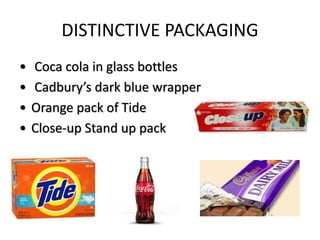
Showcases unique packaging designs that enhance brand recognition, like Coca Cola and Cadbury.
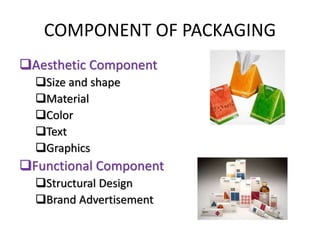
Highlights components such as aesthetics, material, and functional design important for packaging.
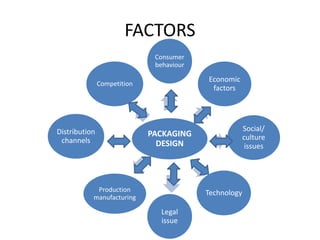
Discusses elements affecting packaging design, including consumer behavior, cost, and environmental factors.
Emphasizes packaging's role in protecting contents, providing information, and ensuring compliance with regulations.
Critiques issues in packaging such as waste from over-packaging and deceptive designs.
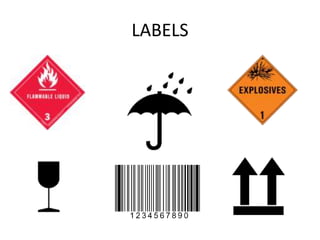
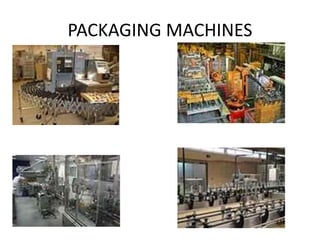
Mentions labeling and machines used in packaging processes, as well as visual material.
Summarizes packaging's benefits including sales increase, quality, and organizational reputation.
Ends with thanks and prompts questions about the importance and implications of packaging.
INTRODUCTION
Packaging is :
thetechnology of enclosing or protecting
products for distribution, storage, sale, and
use.
• An activity of designing & producing the
container for a product.
• Also referred to as the 5th P of marketing mix.
3.
ROOTS OF PACKAGING
•The origin of the modern packaging industry can be traced
back to the late 18th century , when the industrial revolution
heralded widespread changes in manufacturing. Before, then
most manufacturing processes were dependent on manual
labour and small-batch production.
• Mechanization not only accelerated the production of all
types of commodities, but also influenced their packaging.
• The faster production ,the greater need for packaging supply
could now anticipate and even outstrip demand , so
packaging needed to be attractive as well as functional if
products were to survive market competition .
4.
CONT..
• The firstpackages used the natural material like
baskets of reeds, wineskins, wooden boxes,
pottery, vases, ceramic , wooden barrels, etc.
• Then came tinplate, canning with air tight
containers were used for food preservation and
many medical and chemicals .
• Later came cellophane , aluminum and plastic
which is light, less costly, recyclable, high
performance and functionality.
5.
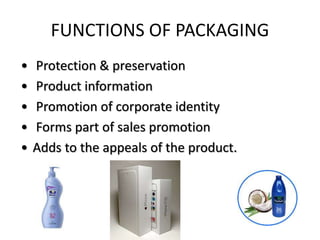
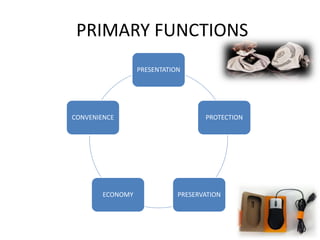
FUNCTIONS OF PACKAGING
•Protection & preservation
• Product information
• Promotion of corporate identity
• Forms part of sales promotion
• Adds to the appeals of the product.
PACKAGING AS A“SILENT SALESMAN”
• Helps to promote product
• Differentiates product from rivals
• Key part of the brand image
• Aids identification & recognition
• Shape, color & size relate to customer motivation
• Key factor in consumer decision making
• Medium for advertising & sales promotion message.
8.
TYPES OF PACKAGING
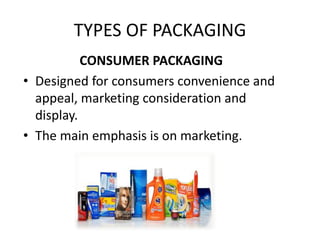
CONSUMERPACKAGING
• Designed for consumers convenience and
appeal, marketing consideration and
display.
• The main emphasis is on marketing.
9.
TYPES OF PACKAGING
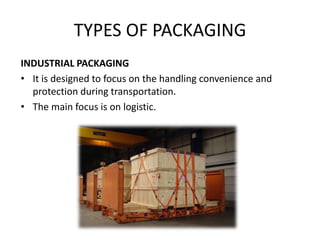
INDUSTRIALPACKAGING
• It is designed to focus on the handling convenience and
protection during transportation.
• The main focus is on logistic.
10.
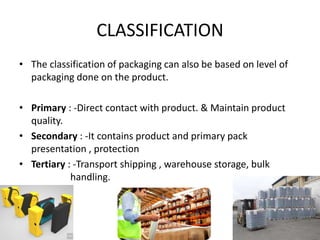
CLASSIFICATION
• The classificationof packaging can also be based on level of
packaging done on the product.
• Primary : -Direct contact with product. & Maintain product
quality.
• Secondary : -It contains product and primary pack
presentation , protection
• Tertiary : -Transport shipping , warehouse storage, bulk
handling.
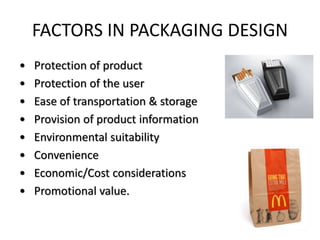
FACTORS IN PACKAGINGDESIGN
• Protection of product
• Protection of the user
• Ease of transportation & storage
• Provision of product information
• Environmental suitability
• Convenience
• Economic/Cost considerations
• Promotional value.
17.
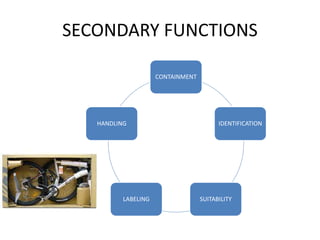
PACKAGE & THEPRODUCT
• Protection of contents from damage,
deterioration & containment
• Provides product information e.g. ingredients
& instructions for use
• Added value through convenience e.g. handy
size, storage features & opening
• Complies with health, hygiene & content
labeling regulations.
18.
CRITISICIMS IN PACKAGING
•Over packaging creates waste
Desirability of using materials which can be recycled
• Deceptive Packaging like
* Over sized packaging with slack packaging
* Copying of packaging style & logo of rivals
* Misleading labels
CONCLUSI0N
• Adds toincreased sales within & outside the
country
• Fetches higher unit values for consumer
goods
• Prevents loss & damage cost
• Improves reputation of product &
organization.
QUESTIONS
• What isthe importance of packaging in todays
world?
• What are the types of packaging?
• What are the advantages and disadvantages
of packaging?
• What are the various functions of packaging?
Explain each in brief.
• How modern packaging is different from
conventional? Explain giving an example.