Presented byGsba students
Just-In-Time is a Japanese manufacturing management method developed in 1970s. It was first adopted by Toyota manufacturing plants by TaiichiOhno. The main concern at that time was to meet consumer demands. Because of the success of JIT management, TaiichiOhno was named the Father of JIT
Just-In-Time JUST IN TIME (JIT) philosophy. JIT is both a philosophy and collection of management methods and techniques used to eliminate waste (particularly inventory) Waste resultsJIT is a long-term approach to process improvement.  It uses timeliness as a lever to lower costs, improve quality and improve responsiveness. However, JIT requires enormous commitment. The focus of JIT is to improve the system of production by eliminating all forms of WASTE.2/22/2009just in time by ravindra3
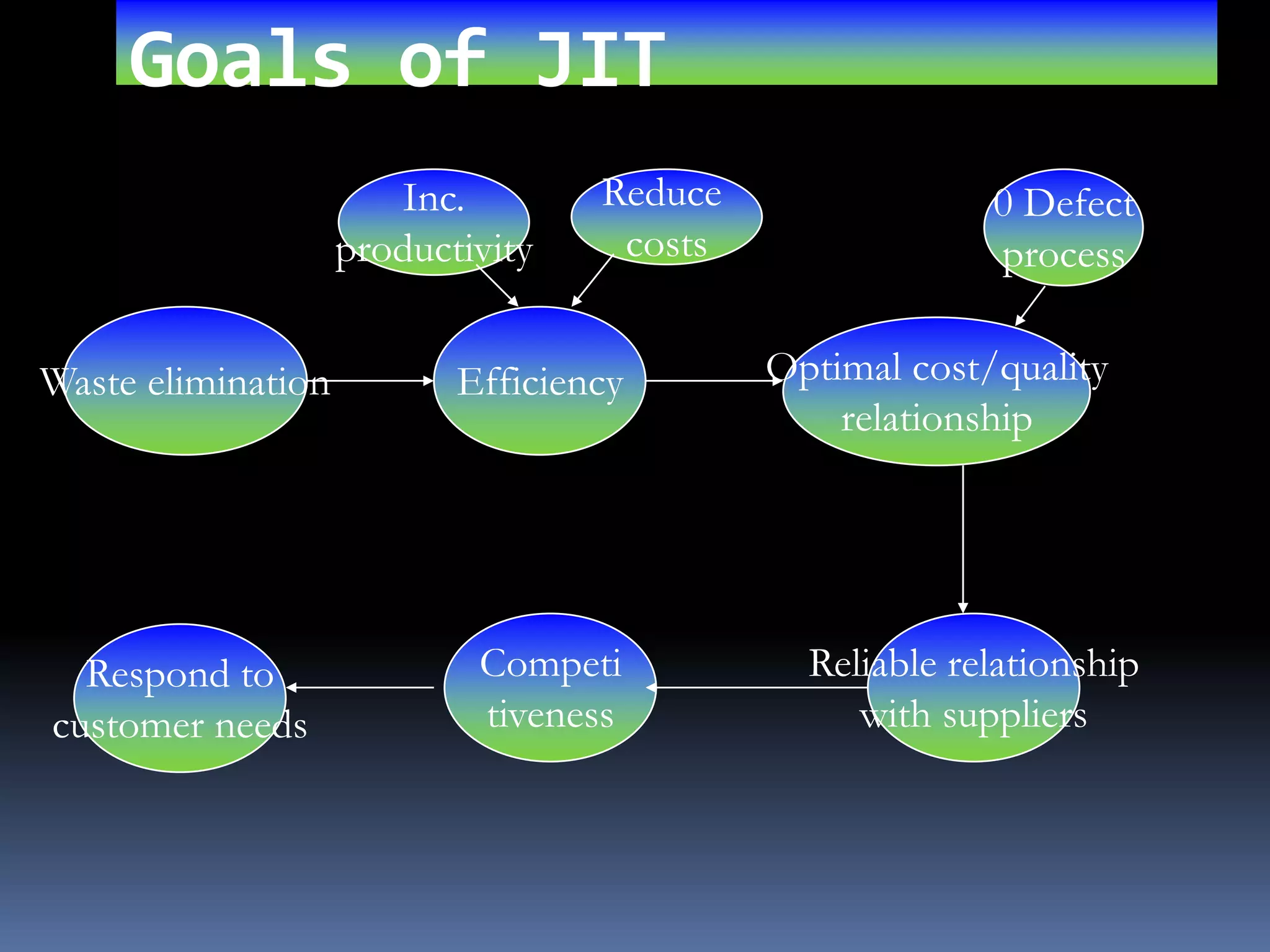
Goals of JITInc.productivityReduce costs0 DefectprocessWaste eliminationEfficiencyOptimal cost/qualityrelationshipCompetitivenessReliable relationshipwith suppliersRespond tocustomer needs
GOALSIncreasing the organization’s ability to compete with others and remain competitive over the long run is very important. Customers’ needs and wants should be the most important focus for business today. This objective will help the firm on what is demanded from customers, and what is required of production.Moreover, the optimal quality and cost relationship is also important. The organization should focus on zero-defect production process. Although it seems to be unrealistic in the long run, it will eliminate a huge amount of resources and effort in inspecting, and reworking defected goods.
Contd….  A good and long-term relationship between an organization and its suppliers helps to manage a more efficient process in inventory management, material management, and delivery system. It will also assure that the supply is stable and available when needed. Moreover, adopt the idea of continuous improvement. If committed to a long-term continuous improvement idea, it will help the organization to remain competitive in the future.
Becoming a Time-Based Competitor Broadly speaking, an organization competes on the basis of quality,  cost, flexibility and time. These factors are complementary, even symbiotic. Today's discriminating customer demands world-class quality at a competitive price. When all the leading companies in an industry  have achieved a  high level of quality, a focus on quality alone cannot keep a company competitive.
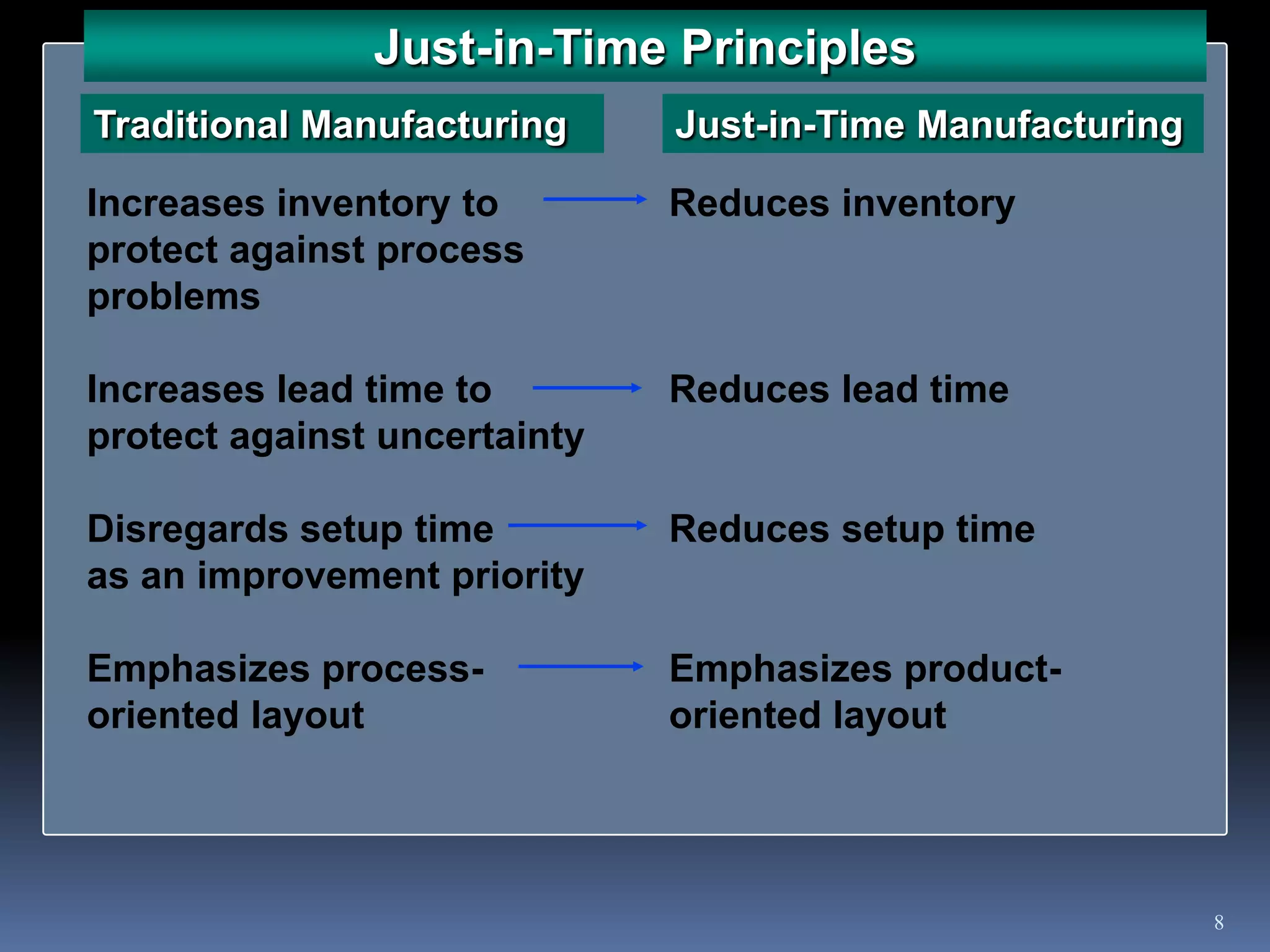
 Quality then becomes a common expected factor, which must be complemented by a faster response time and flexibility. Increasingly, cost and quality are viewed as residuals or outcomes of competing on the basis of time and flexibility.Just-in-Time PrinciplesJust-in-Time ManufacturingTraditional Manufacturing Reduces inventoryReduces lead timeReduces setup timeEmphasizes product-oriented layoutIncreases inventory to protect against process problemsIncreases lead time to protect against uncertaintyDisregards setup timeas an improvement priorityEmphasizes process-oriented layout8
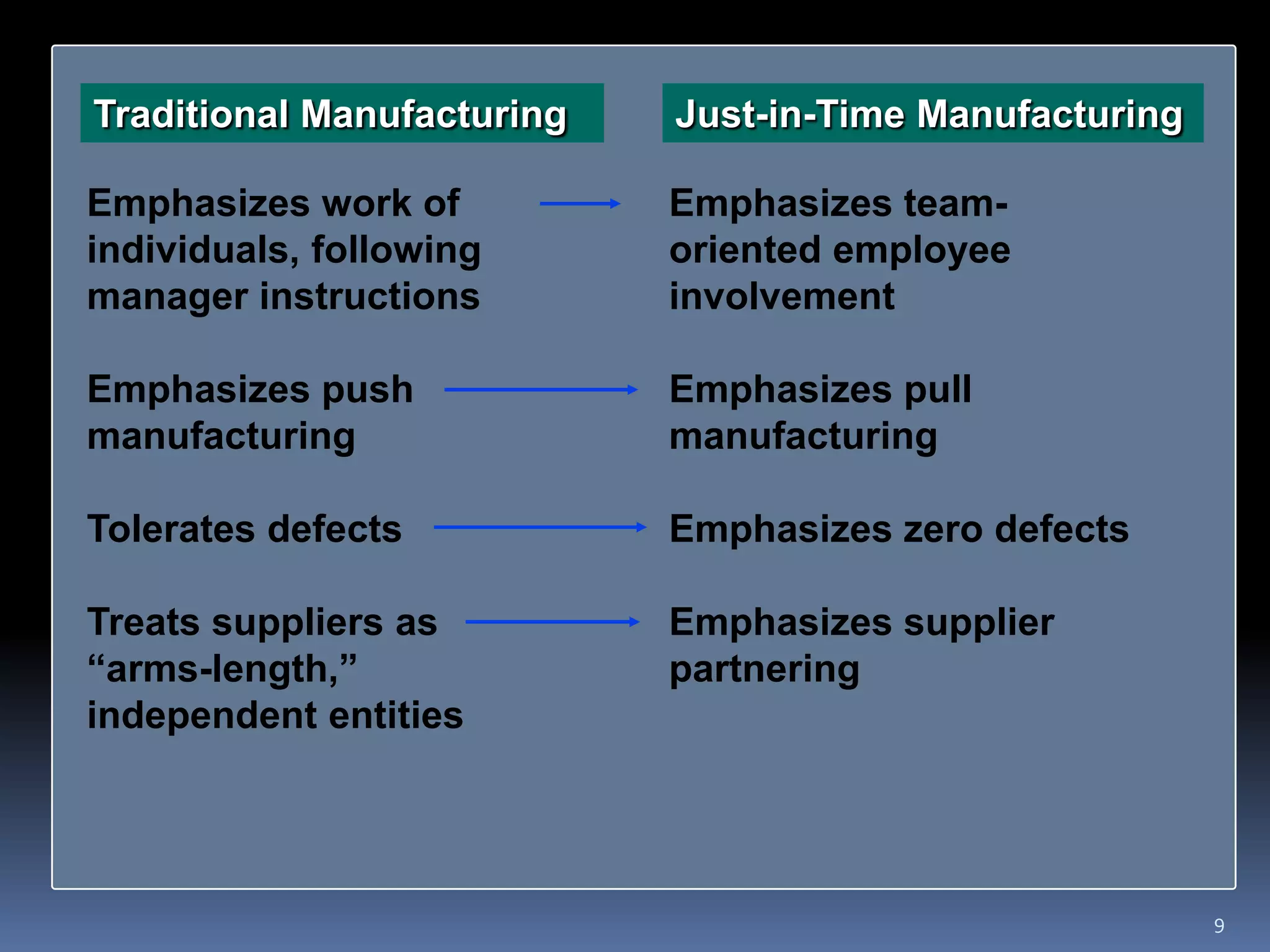
Just-in-Time ManufacturingTraditional Manufacturing Emphasizes team-oriented employee involvementEmphasizes pull manufacturingEmphasizes zero defectsEmphasizes supplier partneringEmphasizes work of individuals, following manager instructionsEmphasizes push manufacturingTolerates defectsTreats suppliers as “arms-length,” independent entities9
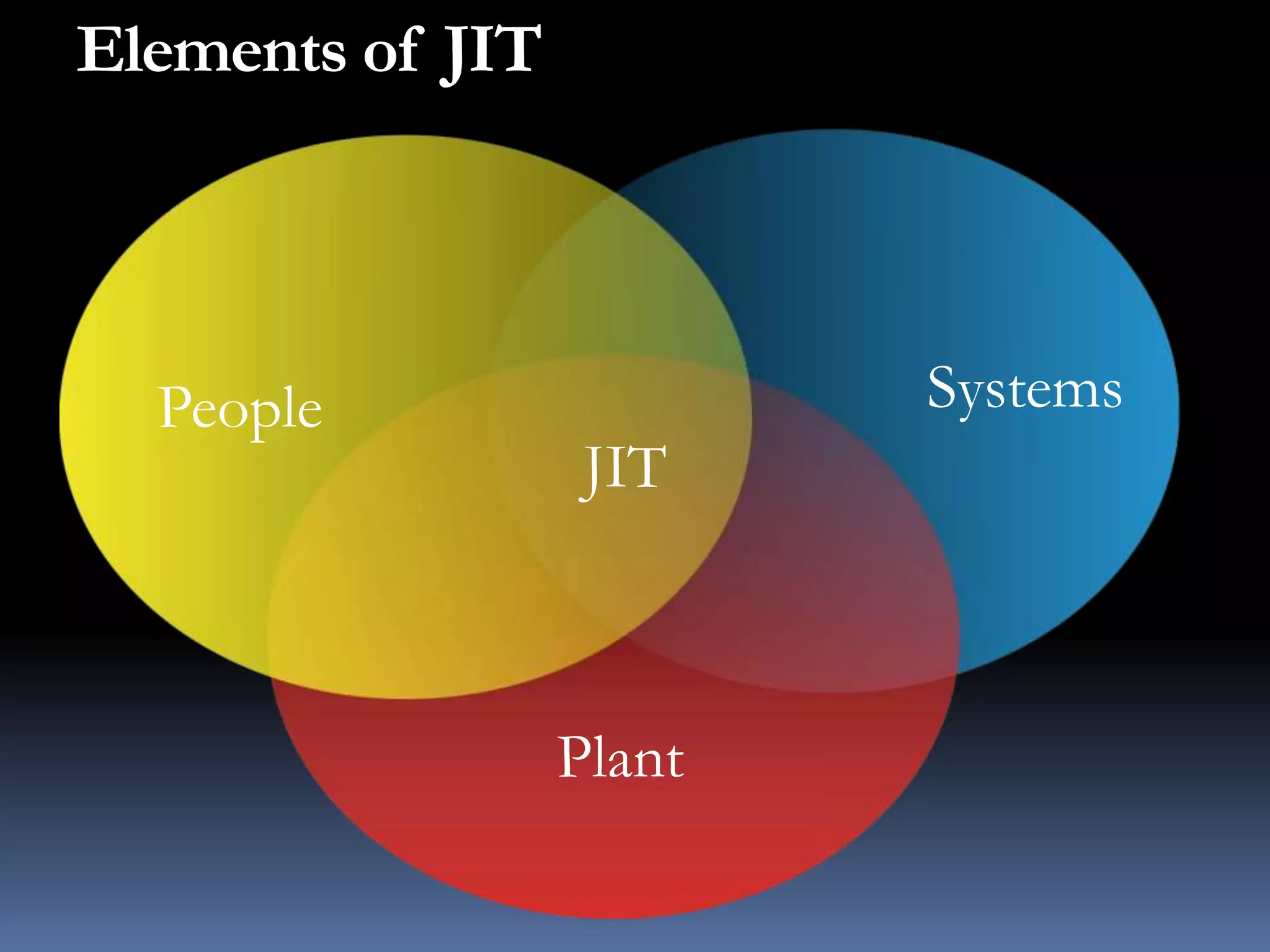
Elements of JITSystemsPeopleJITPlant
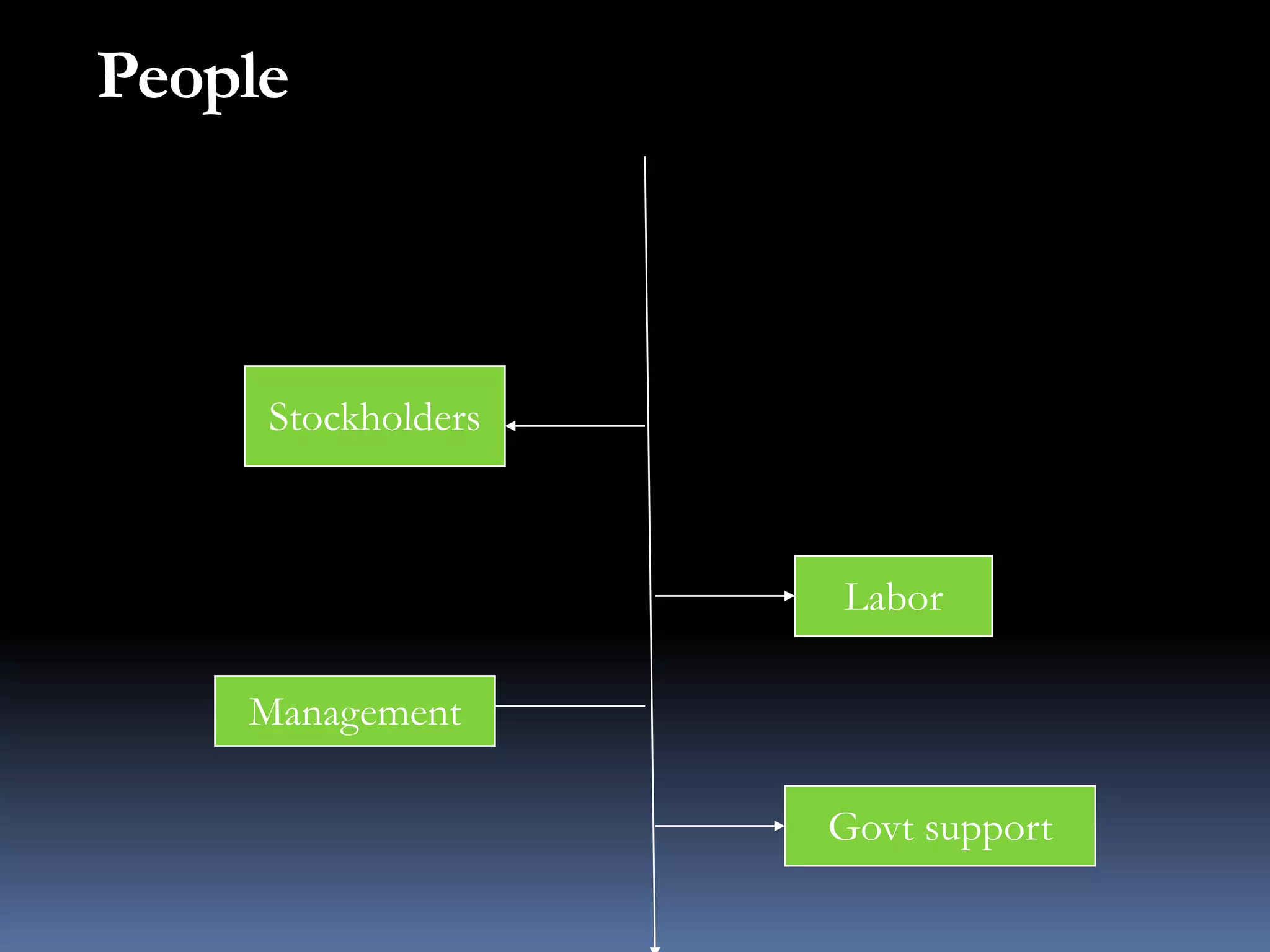
PeopleStockholdersLaborManagementGovt support
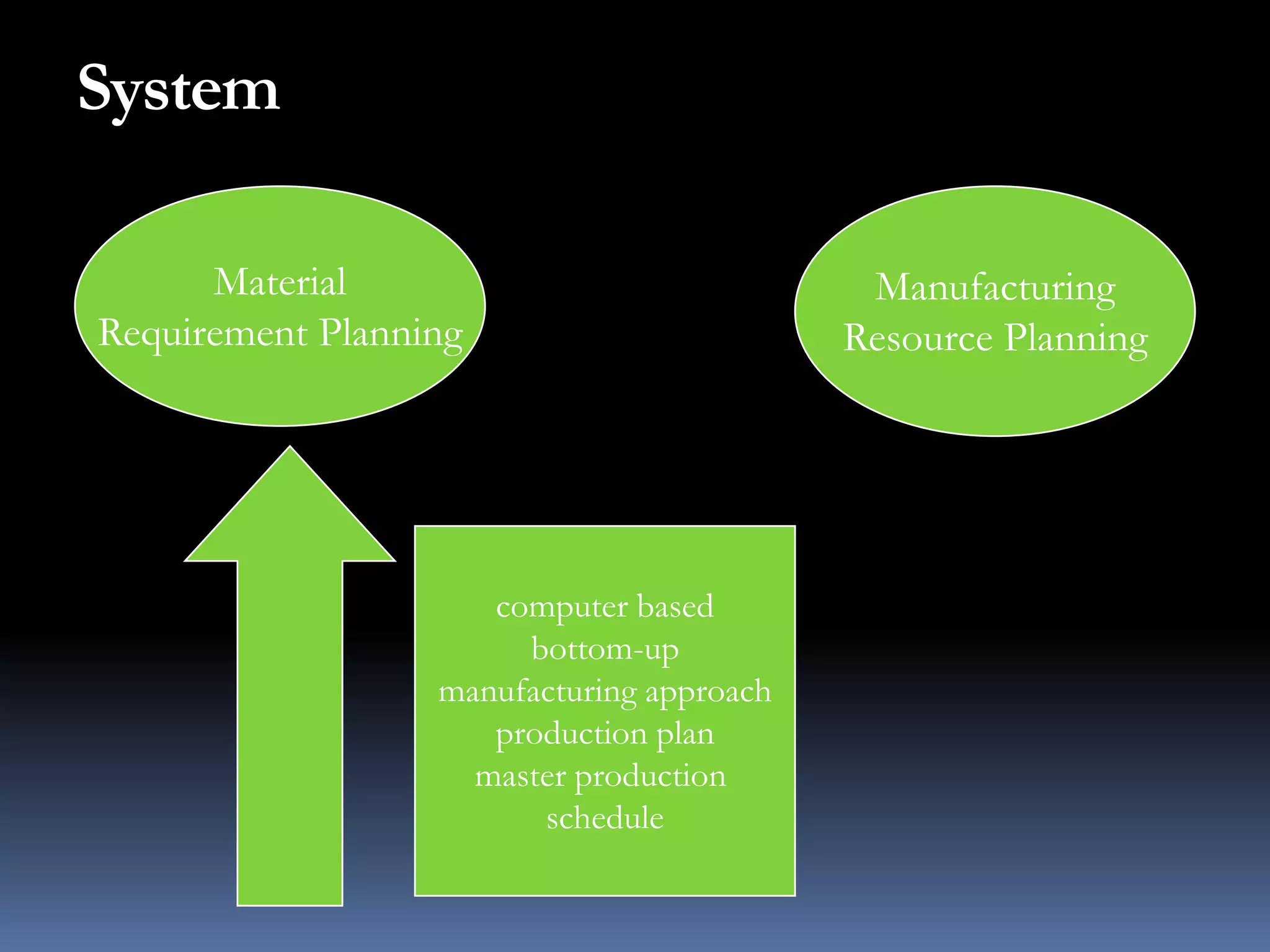
SystemMaterialRequirement PlanningManufacturingResource Planningcomputer basedbottom-upmanufacturing approachproduction planmaster production schedule
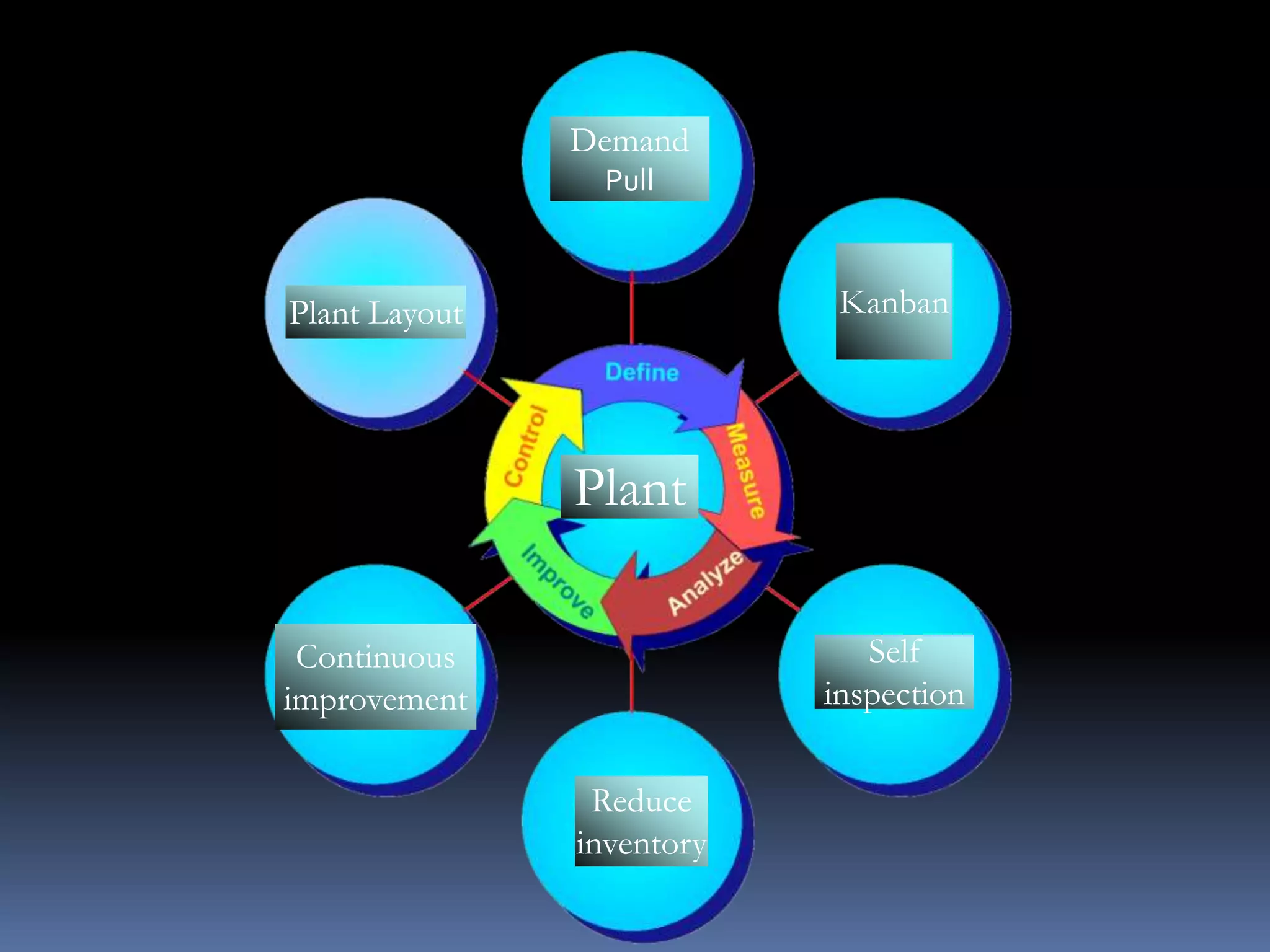
DemandPullKanbanPlant LayoutPlantContinuousimprovementSelfinspectionReduceinventory
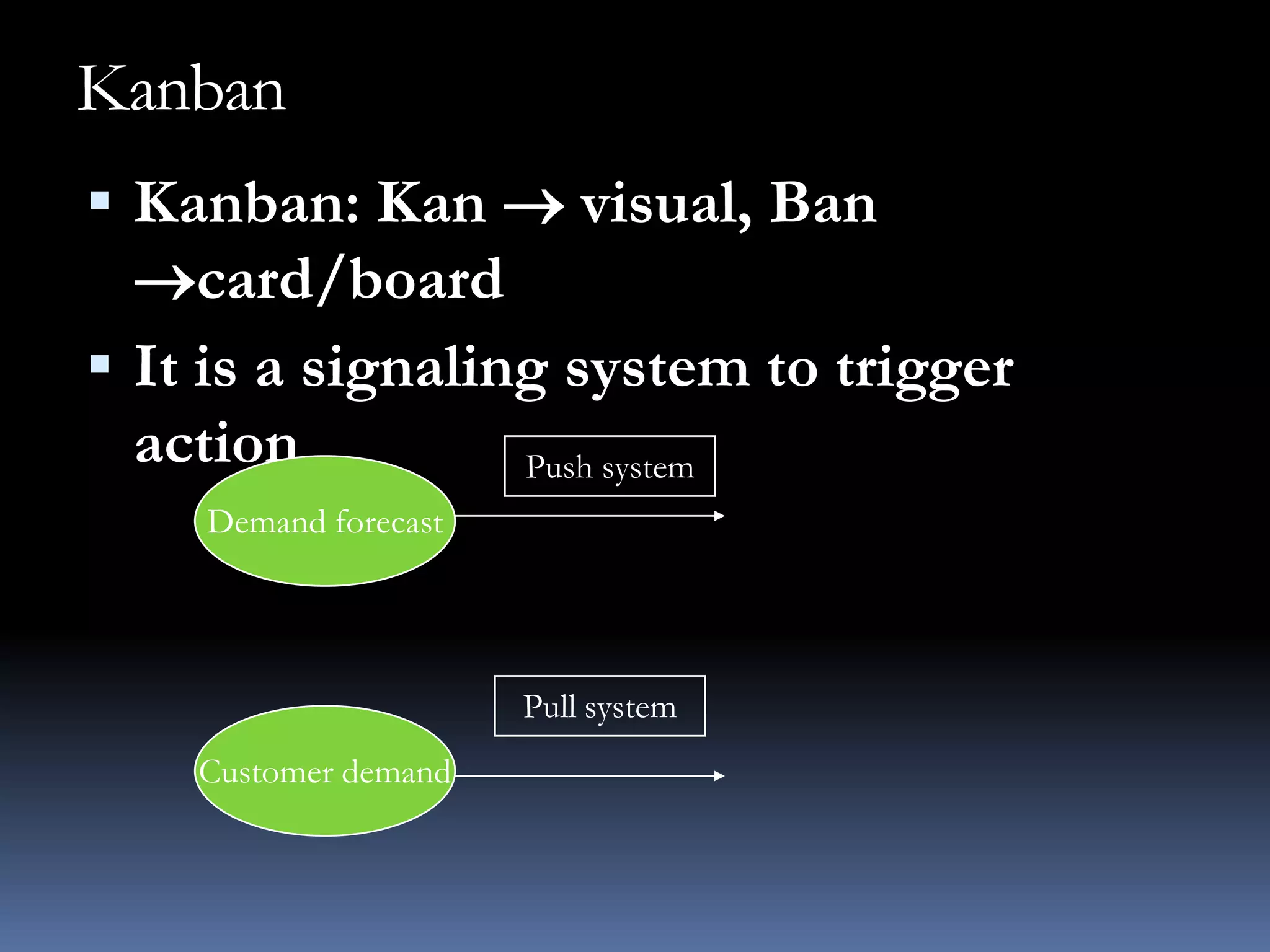
KanbanKanban: Kan  visual, Ban card/board
It is a signaling system to trigger actionPush systemDemand forecastPullsystemCustomer demand
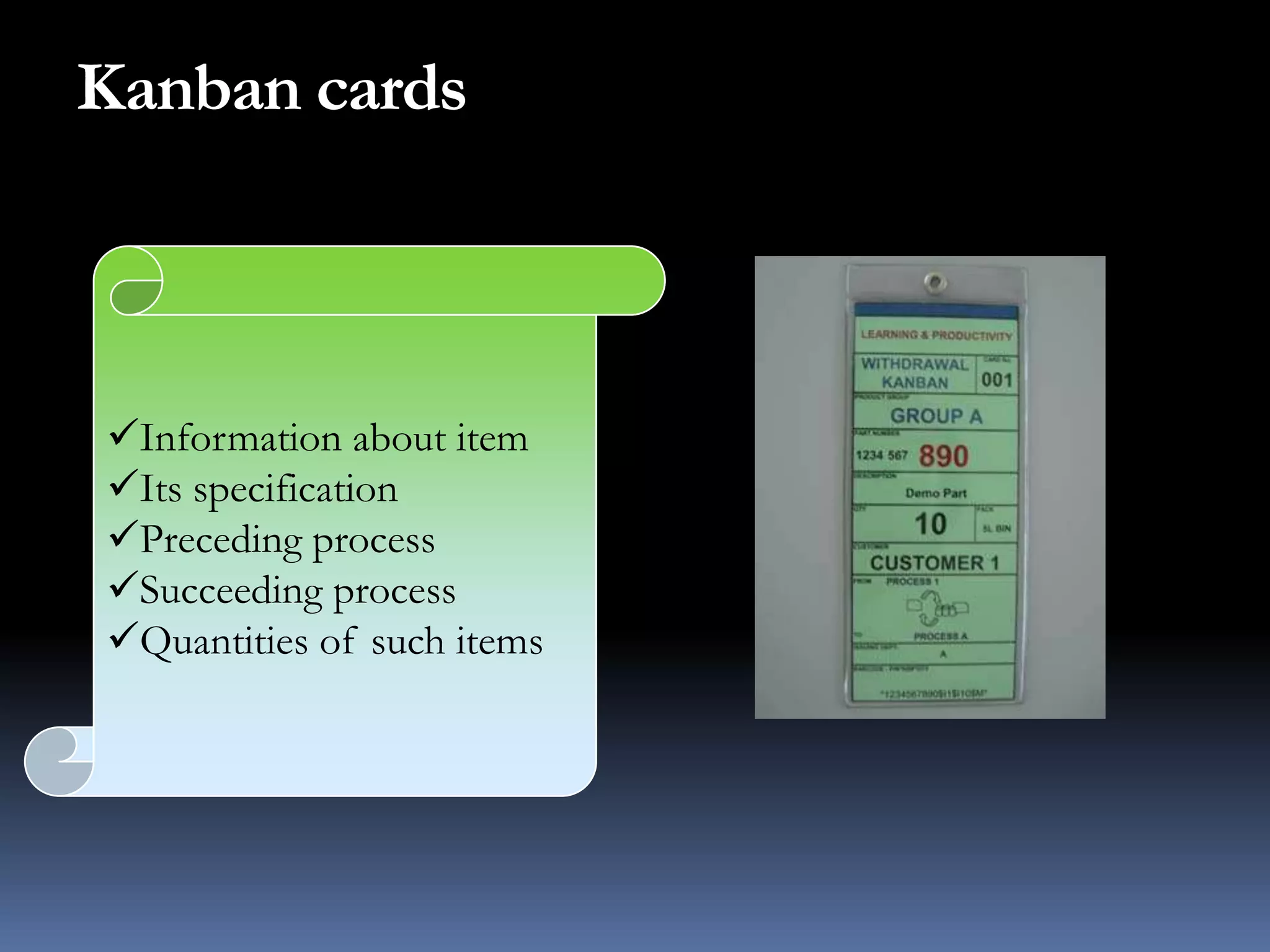
KanbancardsInformation about item
Its specification
Preceding process
Succeeding process
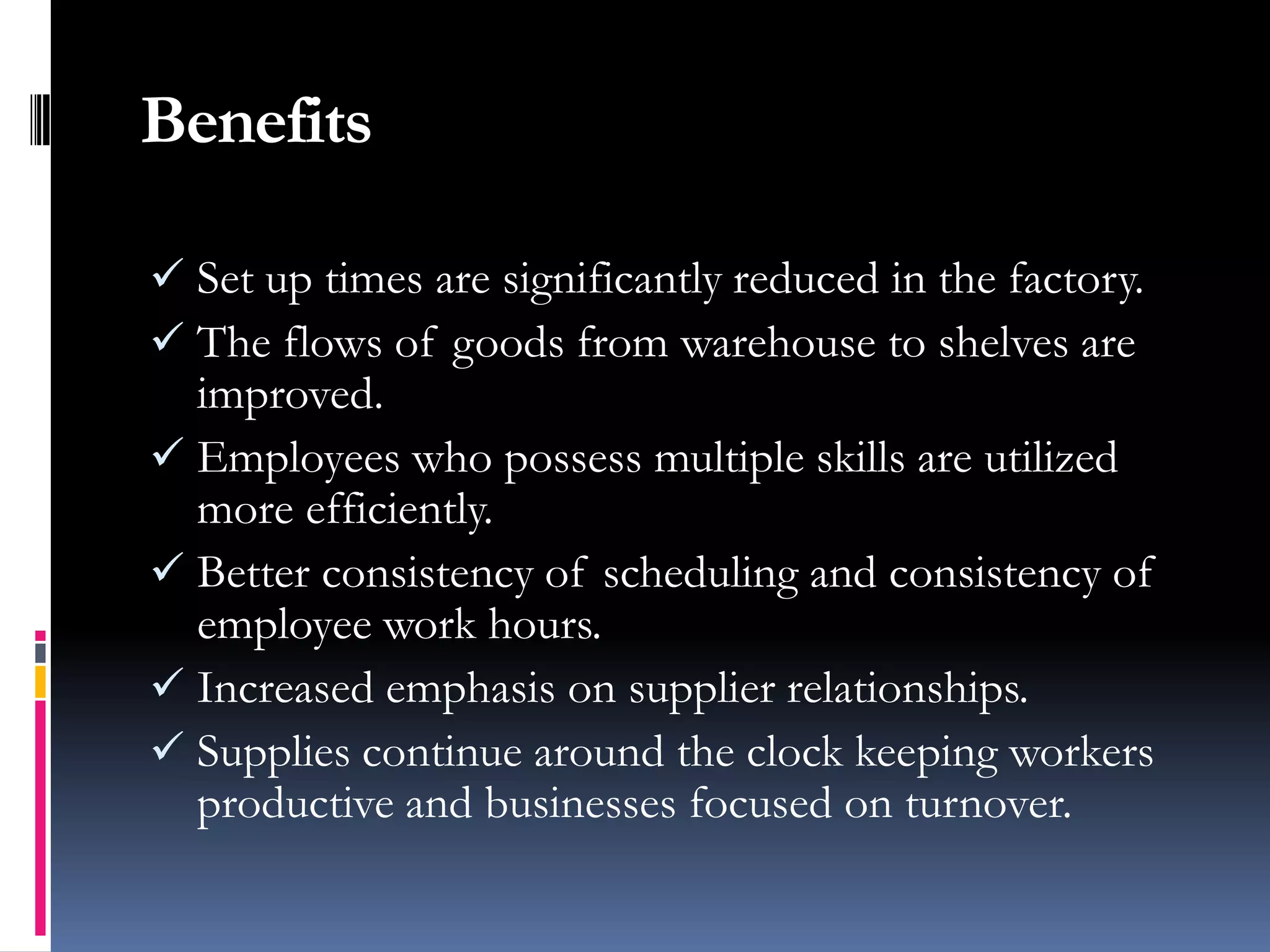
Quantities of such itemsBenefitsSet up times are significantly reduced in the factory.
The flows of goods from warehouse to shelves are improved.
Employees who possess multiple skills are utilized more efficiently.
Better consistency of scheduling and consistency of employee work hours.
Increased emphasis on supplier relationships.
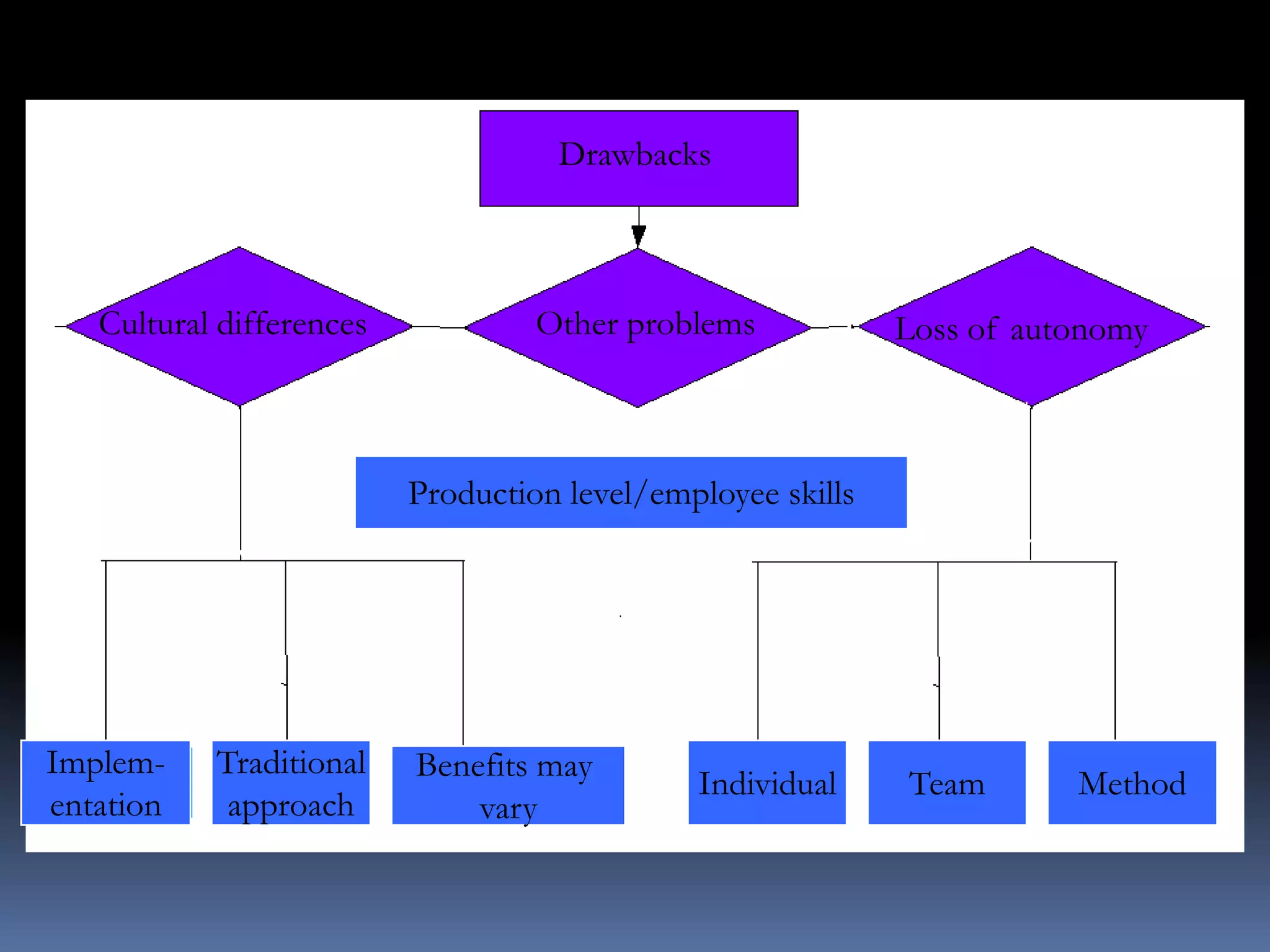
Supplies continue around the clock keeping workers productive and businesses focused on turnover.Drawbacks of JITDrawbacksLoss of autonomyCultural differencesOther problemsProduction level/employee skillsImplem-entationIndividualTeamMethodTraditionalapproachBenefits may vary
Companies That  Have Implemented JIT
JIT in Production SystemsThere are major differences between the production systems. First, each production system is designed to produce different numbers of products in different volumes. Second, each system arranges its equipment in a different layout. The material flow is different because of that layout.
Contd….Third and most important, each provides different levels of output viz:CostQuality PerformanceDeliveryFlexibilityInnovativeness Output.The JIT production system can make improvements in all the 6 outputs  mentioned above.
Seven prominent types of waste to be eliminated:Waste from Overproduction Transportation Waste Processing Waste Waste from Product Defects Waste of waiting/idle time Inventory Waste Waste of Motion
Implementation of JIT JIT is to eliminate waste in all its forms.
The assumption of JIT is that we cannot sell everything we make.  Thus, we must produce salable goods  (low cost, high quality, etc...) quickly.
Operation = Motion (Waste) + Work (Added Value)

Just In Time

  • 1.
  • 2.
    Just-In-Time is aJapanese manufacturing management method developed in 1970s. It was first adopted by Toyota manufacturing plants by TaiichiOhno. The main concern at that time was to meet consumer demands. Because of the success of JIT management, TaiichiOhno was named the Father of JIT
  • 3.
    Just-In-Time JUST INTIME (JIT) philosophy. JIT is both a philosophy and collection of management methods and techniques used to eliminate waste (particularly inventory) Waste resultsJIT is a long-term approach to process improvement. It uses timeliness as a lever to lower costs, improve quality and improve responsiveness. However, JIT requires enormous commitment. The focus of JIT is to improve the system of production by eliminating all forms of WASTE.2/22/2009just in time by ravindra3
  • 4.
    Goals of JITInc.productivityReducecosts0 DefectprocessWaste eliminationEfficiencyOptimal cost/qualityrelationshipCompetitivenessReliable relationshipwith suppliersRespond tocustomer needs
  • 5.
    GOALSIncreasing the organization’sability to compete with others and remain competitive over the long run is very important. Customers’ needs and wants should be the most important focus for business today. This objective will help the firm on what is demanded from customers, and what is required of production.Moreover, the optimal quality and cost relationship is also important. The organization should focus on zero-defect production process. Although it seems to be unrealistic in the long run, it will eliminate a huge amount of resources and effort in inspecting, and reworking defected goods.
  • 6.
    Contd…. Agood and long-term relationship between an organization and its suppliers helps to manage a more efficient process in inventory management, material management, and delivery system. It will also assure that the supply is stable and available when needed. Moreover, adopt the idea of continuous improvement. If committed to a long-term continuous improvement idea, it will help the organization to remain competitive in the future.
  • 7.
    Becoming a Time-BasedCompetitor Broadly speaking, an organization competes on the basis of quality, cost, flexibility and time. These factors are complementary, even symbiotic. Today's discriminating customer demands world-class quality at a competitive price. When all the leading companies in an industry have achieved a high level of quality, a focus on quality alone cannot keep a company competitive.
  • 8.
    Quality thenbecomes a common expected factor, which must be complemented by a faster response time and flexibility. Increasingly, cost and quality are viewed as residuals or outcomes of competing on the basis of time and flexibility.Just-in-Time PrinciplesJust-in-Time ManufacturingTraditional Manufacturing Reduces inventoryReduces lead timeReduces setup timeEmphasizes product-oriented layoutIncreases inventory to protect against process problemsIncreases lead time to protect against uncertaintyDisregards setup timeas an improvement priorityEmphasizes process-oriented layout8
  • 9.
    Just-in-Time ManufacturingTraditional ManufacturingEmphasizes team-oriented employee involvementEmphasizes pull manufacturingEmphasizes zero defectsEmphasizes supplier partneringEmphasizes work of individuals, following manager instructionsEmphasizes push manufacturingTolerates defectsTreats suppliers as “arms-length,” independent entities9
  • 10.
  • 11.
  • 12.
    SystemMaterialRequirement PlanningManufacturingResource Planningcomputerbasedbottom-upmanufacturing approachproduction planmaster production schedule
  • 13.
  • 14.
    KanbanKanban: Kan visual, Ban card/board
  • 15.
    It is asignaling system to trigger actionPush systemDemand forecastPullsystemCustomer demand
  • 16.
  • 17.
  • 18.
  • 19.
  • 20.
    Quantities of suchitemsBenefitsSet up times are significantly reduced in the factory.
  • 21.
    The flows ofgoods from warehouse to shelves are improved.
  • 22.
    Employees who possessmultiple skills are utilized more efficiently.
  • 23.
    Better consistency ofscheduling and consistency of employee work hours.
  • 24.
    Increased emphasis onsupplier relationships.
  • 25.
    Supplies continue aroundthe clock keeping workers productive and businesses focused on turnover.Drawbacks of JITDrawbacksLoss of autonomyCultural differencesOther problemsProduction level/employee skillsImplem-entationIndividualTeamMethodTraditionalapproachBenefits may vary
  • 26.
    Companies That Have Implemented JIT
  • 27.
    JIT in ProductionSystemsThere are major differences between the production systems. First, each production system is designed to produce different numbers of products in different volumes. Second, each system arranges its equipment in a different layout. The material flow is different because of that layout.
  • 28.
    Contd….Third and mostimportant, each provides different levels of output viz:CostQuality PerformanceDeliveryFlexibilityInnovativeness Output.The JIT production system can make improvements in all the 6 outputs mentioned above.
  • 29.
    Seven prominent typesof waste to be eliminated:Waste from Overproduction Transportation Waste Processing Waste Waste from Product Defects Waste of waiting/idle time Inventory Waste Waste of Motion
  • 30.
    Implementation of JITJIT is to eliminate waste in all its forms.
  • 31.
    The assumption ofJIT is that we cannot sell everything we make. Thus, we must produce salable goods (low cost, high quality, etc...) quickly.
  • 32.
    Operation = Motion(Waste) + Work (Added Value)
  • 33.
    Motion alone isa waste that adds cost (counting things, moving boxes, transporting goods, preparation time, waiting, producing defects, over production, handling materials, switching things on)
  • 34.
    Inventory decouples individualoperations and thereby creates waste (non-value-added motion) to buffer the operations against the effect of a different form of waste (long setups, poor material handling procedures, production of defects, etc.)
  • 35.
    For real improvement,we must ask "why" when we encounter any form of waste.Implementation of JITProper arrangement (sort through and sort out, identify what you need, discard what you do not need )
  • 36.
    Orderliness (assign aseparate location for all essential items)
  • 37.
    Cleanliness (keep theworkplace spotless at all times)
  • 38.
  • 39.
    Discipline (stick tothe rules scrupulously)Implementation of JITPlace the machines in process sequenceDesign a cellular (U-shaped) layoutMake one piece at a time in the cellCrosstrain workers to handle multiple processesProduce according to the cycle time Have the operators work standing up and walking Use slower, dedicated machines that are smaller and less expensive
  • 40.
  • 41.
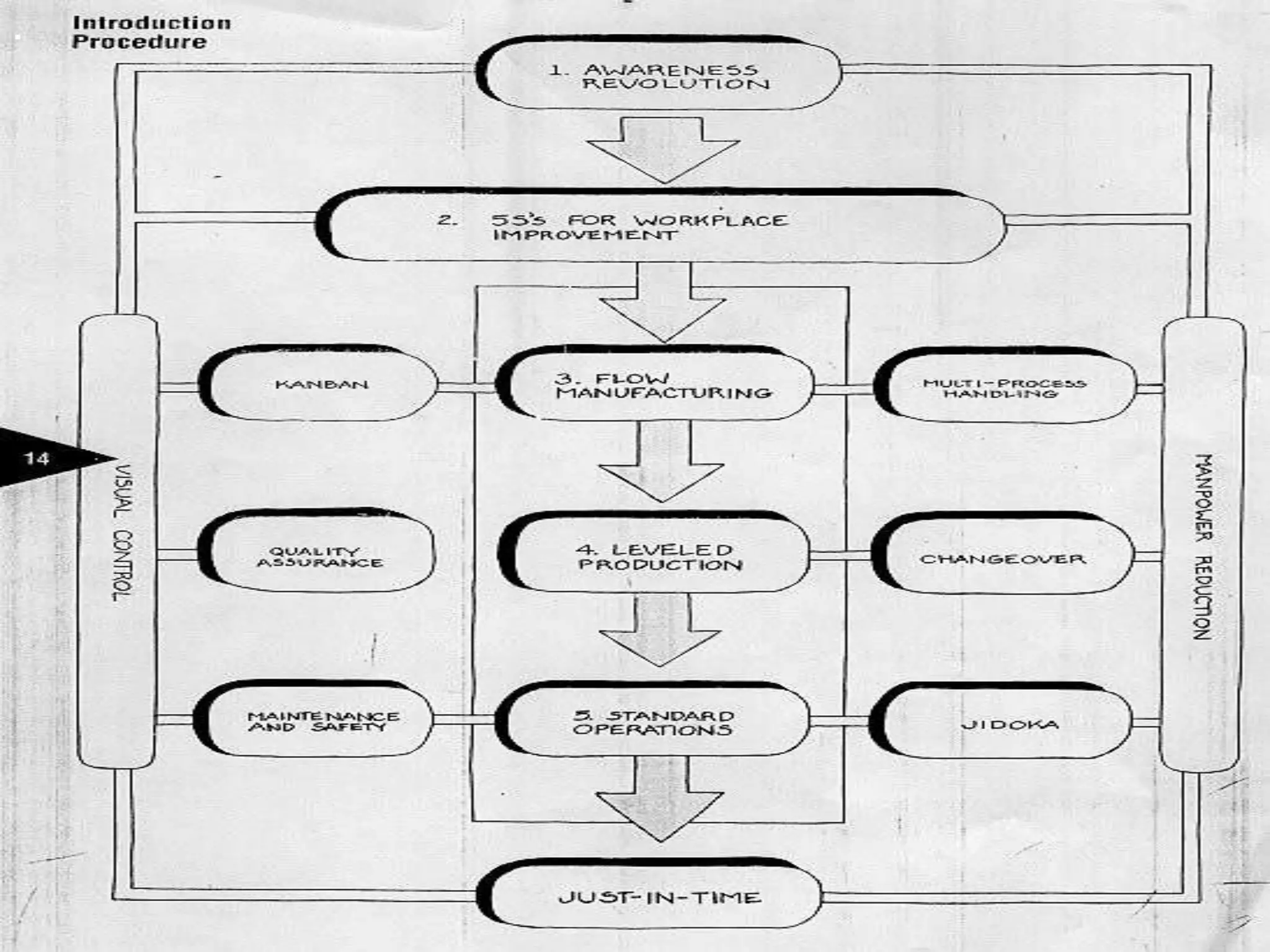
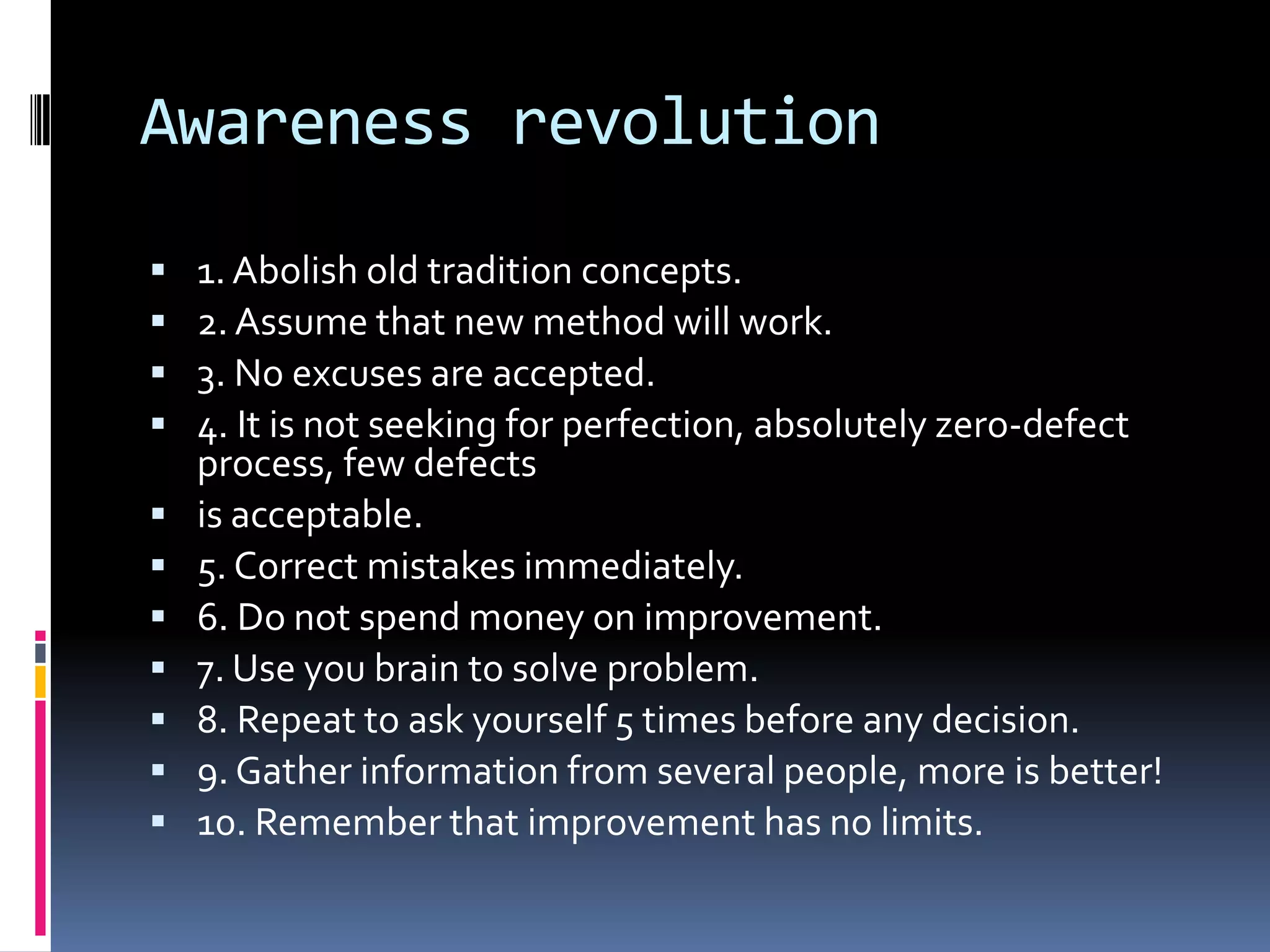
    Awareness revolution1. Abolishold tradition concepts.2. Assume that new method will work.3. No excuses are accepted.4. It is not seeking for perfection, absolutely zero-defect process, few defectsis acceptable.5. Correct mistakes immediately.6. Do not spend money on improvement.7. Use you brain to solve problem.8. Repeat to ask yourself 5 times before any decision.9. Gather information from several people, more is better!10. Remember that improvement has no limits.
  • 42.
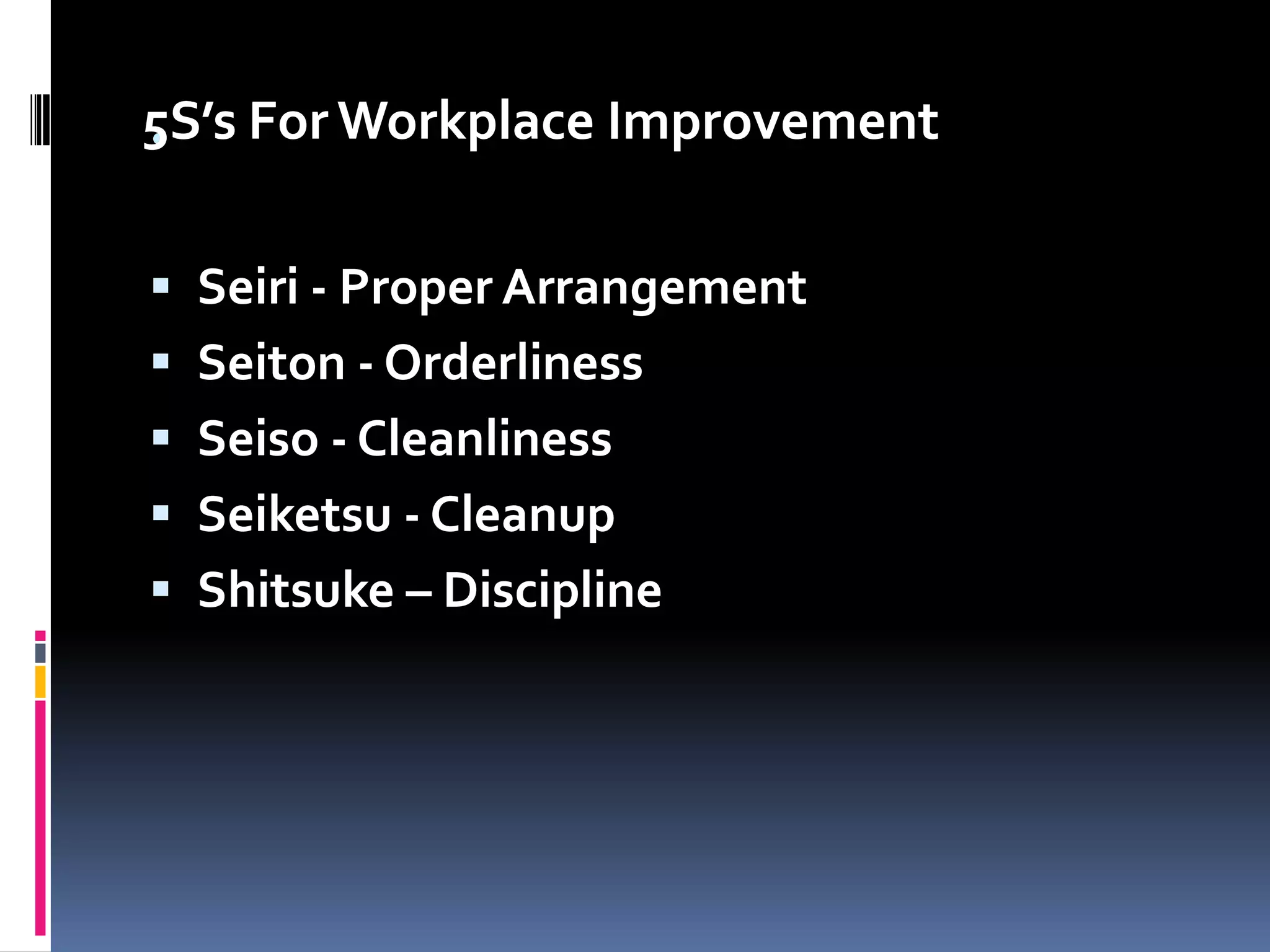
    .Seiri - ProperArrangementSeiton - OrderlinessSeiso - CleanlinessSeiketsu - CleanupShitsuke – Discipline5S’s For Workplace Improvement
  • 43.
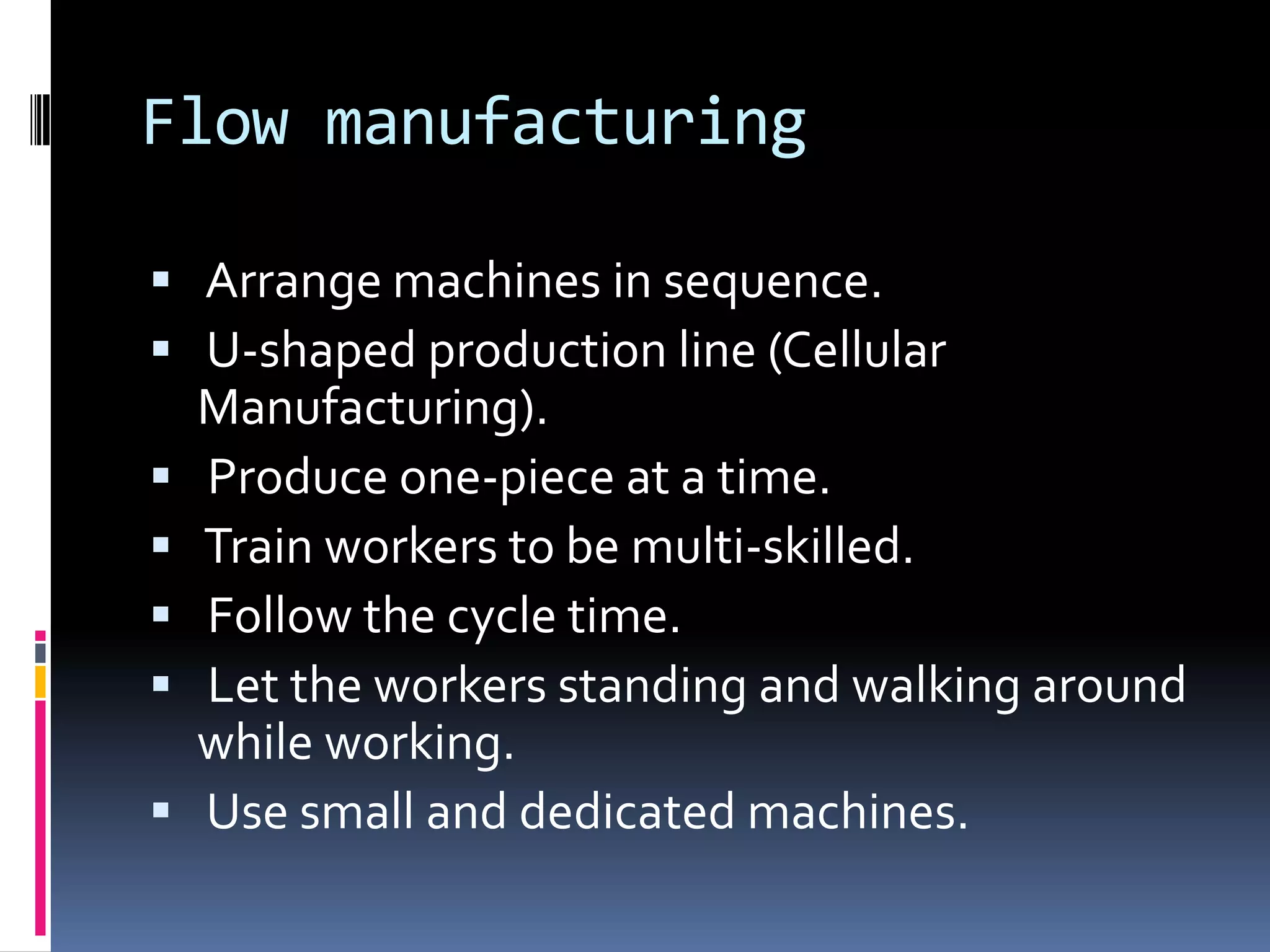
    Flow manufacturing Arrangemachines in sequence. U-shaped production line (Cellular Manufacturing). Produce one-piece at a time. Train workers to be multi-skilled. Follow the cycle time. Let the workers standing and walking around while working. Use small and dedicated machines.
  • 44.
    Standard OperationCycle timeWorksequenceStandard stock-on-handUse operation charts
  • 45.
    Multi-process handlingMulti-process handling- a worker should handle several different processes at once, this is also called "vertical handling" and this is the basis for JIT production.
  • 46.
    Requirements for aproper JIT management STANDARDIZATION: Where the supplies are standardized and the suppliers are trustable and close to the plant. As there is little buffer inventory between the workstations, so the quality must be high and efforts are made to prevent machine breakdowns.SOFTWARE:For JIT to work efficiently Supply Chain Planning software, companies have in the mean time extended Just-in-time manufacturing externally, by demanding from their suppliers to deliver inventory to the factory only when it's needed MULTI-FUNCTIONALITY In JIT workers are multifunctional and are required to perform different tasks. Machines are also multifunction and are arranged in small U-shaped work cells
  • 47.
    Contd… .CLEANLINESS Environmentis kept clean and free of waste so that any unusual occurrence are visibleSCHEDULES: Schedules are prepared only for the final assembly line, in which several different models are assembled at the same line. Requirements for the component parts and subassemblies are then pulled through the system..QUALITY: Quality within JIT manufacturing is necessary, because without a quality program in JIT, the JIT will fail. Here we think about quality at the source and the Plan, Do, Check, Action with its statistical process control. Furthermore, techniques are also very important.