DEVELOPING OF
JUST-IN-TIME
PRODUCTION
PROCESS BY,
WHAT IS JIT?
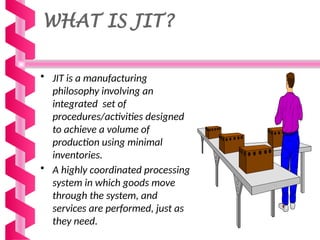
• JIT is a manufacturing
philosophy involving an
integrated set of
procedures/activities designed
to achieve a volume of
production using minimal
inventories.
• A highly coordinated processing
system in which goods move
through the system, and
services are performed, just as
they need.
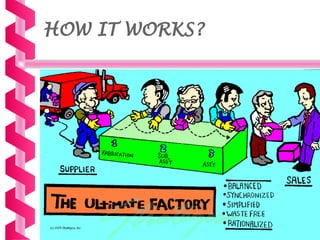
HOW IT WORKS?
HISTORY
• Evolved in Japan after World War II, as a result of their
diminishing market share in the auto industry.
• Founded by Taiichi Ohno, a vice president of Toyota.
• Basically implemented in Toyota plant 1950, well
established after 1970.
FOLLOWERS
• Adopted by General Electrical in the USA in the 1980.
• Some companies referred JIT with different names:
i. TOYOTA – ‘Toyota System’
ii. IBM – ‘Continuous flow manufacturing’
iii. GE- ‘Management by sight’
iv. HEWLETT- PACKARD- ‘stockless production & repetitive
manufacturing system’
7 WASTES
1) Waste of over production
2) Waste of waiting
3) Waste of transportation
4) Waste of Underutilization
of Employees
5) Waste of Inventory
6) Waste of motion
7) Waste of making defective
products
PRINCIPLES OF JIT
PRODUCTION
TOTAL QUALITY
MANAGEMENT
• Seek long-term
commitment
• Quality must be a
higher priority than cost
• Minimize Waste
PRODUCTION MANAGEMENT
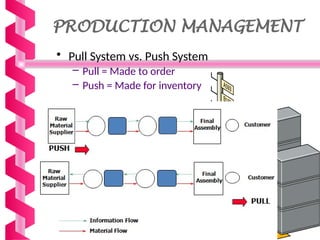
• Pull System vs. Push System
– Pull = Made to order
– Push = Made for inventory
• Communication Techniques
– Completion of task-Kanban
– Problem- Andon or siren/light
• Flexibility of the system
• Design For Testability
– Poka-Yoke= Mistake-proofing
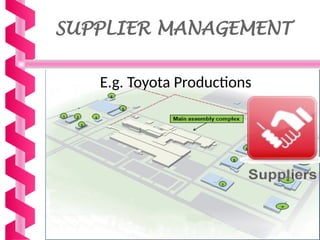
SUPPLIER MANAGEMENT
• Establish Long Term Relationships with few
suppliers.
• Delivery of Parts = 100% Defect Free
– Where they are needed
– When they are needed
– The exact quantity
• Work Together
• Elimination of inspection of parts
E.g. Toyota Productions
Material
quality
problems
Long
setups
Poor
training Break
downs
Material
handling
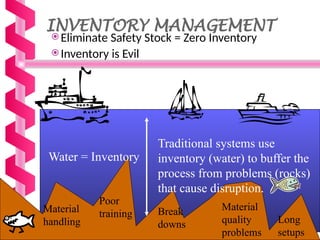
Traditional systems use
inventory (water) to buffer the
process from problems (rocks)
that cause disruption.
Water = Inventory
INVENTORY MANAGEMENT
 Eliminate Safety Stock = Zero Inventory
 Inventory is Evil
Material
quality
problems
Long
setups
Poor
training
Break
downs
Material
handling
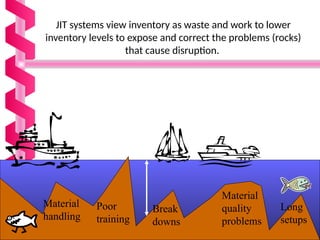
JIT systems view inventory as waste and work to lower
inventory levels to expose and correct the problems (rocks)
that cause disruption.
Material
quality
problems
Long
setups
Poor
training
Break downs
Material
handling
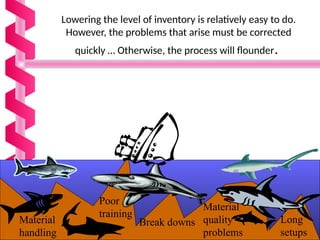
Lowering the level of inventory is relatively easy to do.
However, the problems that arise must be corrected
quickly … Otherwise, the process will flounder.
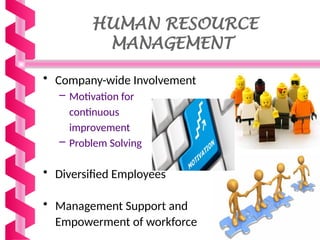
HUMAN RESOURCE
MANAGEMENT
• Company-wide Involvement
– Motivation for
continuous
improvement
– Problem Solving
• Diversified Employees
• Management Support and
Empowerment of workforce
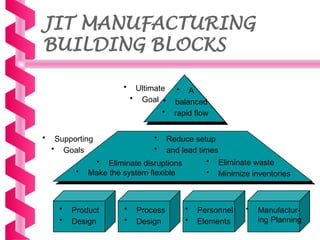
JIT MANUFACTURING
BUILDING BLOCKS
• Product
• Design
• Process
• Design
• Personnel
• Elements
• Manufactur-
ing Planning
• Eliminate disruptions
• Make the system flexible
• Reduce setup
• and lead times
• Eliminate waste
• Minimize inventories
• A
• balanced
• rapid flow
• Ultimate
• Goal
• Supporting
• Goals
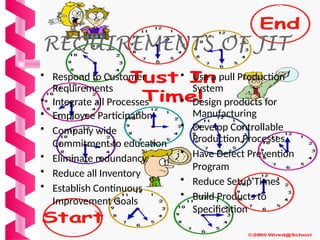
REQUIREMENTS OF JIT
• Respond to Customer
Requirements
• Integrate all Processes
• Employee Participation
• Company wide
Commitment to education
• Eliminate redundancy
• Reduce all Inventory
• Establish Continuous
Improvement Goals
• Use a pull Production
System
• Design products for
Manufacturing
• Develop Controllable
Production Processes
• Have Defect Prevention
Program
• Reduce Setup Times
• Build Products to
Specification
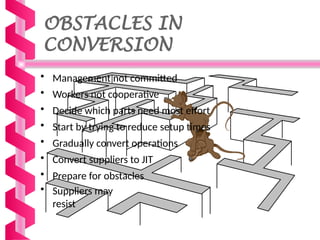
OBSTACLES IN
CONVERSION
• Management not committed
• Workers not cooperative
• Decide which parts need most effort
• Start by trying to reduce setup times
• Gradually convert operations
• Convert suppliers to JIT
• Prepare for obstacles
• Suppliers may
resist
ADVANTAGES OF JIT
• High quality
• Flexibility
• Reduced setup times
• Reduced need for indirect labor
• Less waste
• Low warehouse cost
• Synchronization between production scheduling and work
hour
DISADVANTAGES OF JIT
• Time consuming
• No spare product to meet un expected order
• Supply Shock : If products do not reach on
time
• High risk factor
JIT IN GOODS :
• Leveraged JIT principles to make its manufacturing process
a success
• Leverage their suppliers to achieve the JIT goal
• Provide exceptionally short set up times to their customers
• Suppliers carry inventory instead of carrying it themselves.
• Has dependable suppliers with the ability to meet its
demanding lead time requirements.
• Seamless system that allows it to transmit its component
on requirements
• Willingness of suppliers to keep inventory on hand.
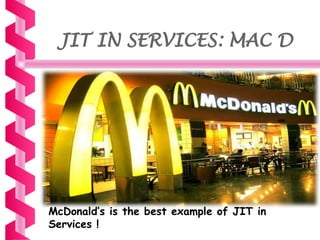
JIT IN SERVICES: MAC D
McDonald’s is the best example of JIT in
Services !
• McDonald's doesn't begin to cook until a
customer has placed a specific order.
• The major benefits are better food at a lower
cost.
• Wastage is reduced along with an improvised
taste that makes you want to scream out I’m
Lovin’ It !
THANK YOU!!

Developing the Justin-in-Time Production Process

  • 1.
  • 2.
    WHAT IS JIT? •JIT is a manufacturing philosophy involving an integrated set of procedures/activities designed to achieve a volume of production using minimal inventories. • A highly coordinated processing system in which goods move through the system, and services are performed, just as they need.
  • 3.
  • 4.
    HISTORY • Evolved inJapan after World War II, as a result of their diminishing market share in the auto industry. • Founded by Taiichi Ohno, a vice president of Toyota. • Basically implemented in Toyota plant 1950, well established after 1970.
  • 5.
    FOLLOWERS • Adopted byGeneral Electrical in the USA in the 1980. • Some companies referred JIT with different names: i. TOYOTA – ‘Toyota System’ ii. IBM – ‘Continuous flow manufacturing’ iii. GE- ‘Management by sight’ iv. HEWLETT- PACKARD- ‘stockless production & repetitive manufacturing system’
  • 6.
    7 WASTES 1) Wasteof over production 2) Waste of waiting 3) Waste of transportation 4) Waste of Underutilization of Employees 5) Waste of Inventory 6) Waste of motion 7) Waste of making defective products
  • 7.
  • 8.
    TOTAL QUALITY MANAGEMENT • Seeklong-term commitment • Quality must be a higher priority than cost • Minimize Waste
  • 9.
    PRODUCTION MANAGEMENT • PullSystem vs. Push System – Pull = Made to order – Push = Made for inventory • Communication Techniques – Completion of task-Kanban – Problem- Andon or siren/light • Flexibility of the system • Design For Testability – Poka-Yoke= Mistake-proofing
  • 10.
    SUPPLIER MANAGEMENT • EstablishLong Term Relationships with few suppliers. • Delivery of Parts = 100% Defect Free – Where they are needed – When they are needed – The exact quantity • Work Together • Elimination of inspection of parts E.g. Toyota Productions
  • 11.
    Material quality problems Long setups Poor training Break downs Material handling Traditional systemsuse inventory (water) to buffer the process from problems (rocks) that cause disruption. Water = Inventory INVENTORY MANAGEMENT  Eliminate Safety Stock = Zero Inventory  Inventory is Evil
  • 12.
    Material quality problems Long setups Poor training Break downs Material handling JIT systems viewinventory as waste and work to lower inventory levels to expose and correct the problems (rocks) that cause disruption.
  • 13.
    Material quality problems Long setups Poor training Break downs Material handling Lowering thelevel of inventory is relatively easy to do. However, the problems that arise must be corrected quickly … Otherwise, the process will flounder.
  • 14.
    HUMAN RESOURCE MANAGEMENT • Company-wideInvolvement – Motivation for continuous improvement – Problem Solving • Diversified Employees • Management Support and Empowerment of workforce
  • 15.
    JIT MANUFACTURING BUILDING BLOCKS •Product • Design • Process • Design • Personnel • Elements • Manufactur- ing Planning • Eliminate disruptions • Make the system flexible • Reduce setup • and lead times • Eliminate waste • Minimize inventories • A • balanced • rapid flow • Ultimate • Goal • Supporting • Goals
  • 16.
    REQUIREMENTS OF JIT •Respond to Customer Requirements • Integrate all Processes • Employee Participation • Company wide Commitment to education • Eliminate redundancy • Reduce all Inventory • Establish Continuous Improvement Goals • Use a pull Production System • Design products for Manufacturing • Develop Controllable Production Processes • Have Defect Prevention Program • Reduce Setup Times • Build Products to Specification
  • 17.
    OBSTACLES IN CONVERSION • Managementnot committed • Workers not cooperative • Decide which parts need most effort • Start by trying to reduce setup times • Gradually convert operations • Convert suppliers to JIT • Prepare for obstacles • Suppliers may resist
  • 18.
    ADVANTAGES OF JIT •High quality • Flexibility • Reduced setup times • Reduced need for indirect labor • Less waste • Low warehouse cost • Synchronization between production scheduling and work hour
  • 19.
    DISADVANTAGES OF JIT •Time consuming • No spare product to meet un expected order • Supply Shock : If products do not reach on time • High risk factor
  • 20.
    JIT IN GOODS: • Leveraged JIT principles to make its manufacturing process a success • Leverage their suppliers to achieve the JIT goal • Provide exceptionally short set up times to their customers • Suppliers carry inventory instead of carrying it themselves. • Has dependable suppliers with the ability to meet its demanding lead time requirements.
  • 21.
    • Seamless systemthat allows it to transmit its component on requirements • Willingness of suppliers to keep inventory on hand.
  • 22.
    JIT IN SERVICES:MAC D McDonald’s is the best example of JIT in Services !
  • 23.
    • McDonald's doesn'tbegin to cook until a customer has placed a specific order. • The major benefits are better food at a lower cost. • Wastage is reduced along with an improvised taste that makes you want to scream out I’m Lovin’ It !
  • 24.

Editor's Notes

  • #1 This PowerPoint presentation focuses on Just-in time manufacturing and its use and implementation in the manufacturing world.