





Welcome to our
Presentation
Presentation on
Presented by
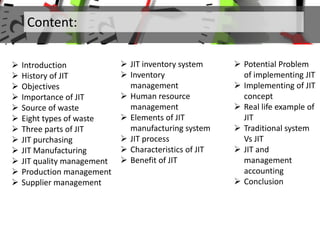
Content:
 Introduction
 History of JIT
 Objectives
 Importance of JIT
 Source of waste
 Eight types of waste
 Three parts of JIT
 JIT purchasing
 JIT Manufacturing
 JIT quality management
 Production management
 Supplier management
 JIT inventory system
 Inventory
management
 Human resource
management
 Elements of JIT
manufacturing system
 JIT process
 Characteristics of JIT
 Benefit of JIT
 Potential Problem
of implementing JIT
 Implementing of JIT
concept
 Real life example of
JIT
 Traditional system
Vs JIT
 JIT and
management
accounting
 Conclusion
Introduction
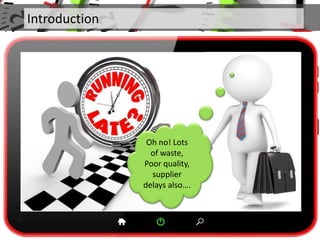
Oh no! Lots
of waste,
Poor quality,
supplier
delays also….
Introduction
Introduction
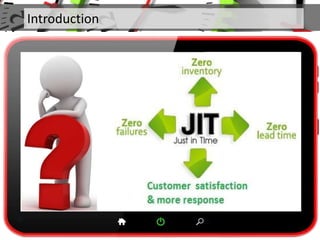
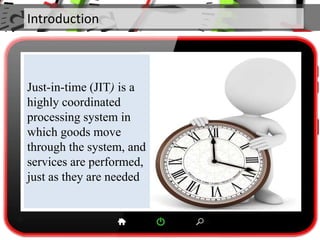
Just-in-time (JIT) is a
highly coordinated
processing system in
which goods move
through the system, and
services are performed,
just as they are needed
History of JIT
• Evolved in Japan after World War II,
as a result of their diminishing market
share in the auto industry.
• Toyota Motor Company- first to
implement fully functioning and
successful JIT system, in 1970’s.
• Japanese Manufacturers looked for a
way to gain the most efficient use of
limited resources. They worked on
"optimal cost/quality relationship.
Objectives
 Produce only the products the customer wants.
 Produce products only at the rate that the customer
wants them.
 Produce with perfect quality
 Produce with minimum lead time.
 Produce products with only those features the
customer wants.
 Produce with no waste of labor, material or equipment
-- every movement must have a purpose so that there
is zero idle inventory.
Why JIT System is necessary for organization
Eliminates waste .
Achieves streamlined production
Eliminate disruptions in production … caused by poor
quality, schedule changes, late deliveries.
Makes the manufacturing delivery system flexible by
allowing it to handle a variety of products and changes
in the level of output.
Reduces setup and delivery times .
Sources of Waste
Overproduction
Waiting time
Unnecessary transportation
Processing waste
Inefficient work methods
Product defects
THE EIGHT TYPES OF WASTE
Waste Definition
1.Overproduction Manufacturing an item before it is
needed.
2.Inappropriate
Processing
Using expensive high precision
equipment when simpler machines
would suffice.
3.Waiting Wasteful time incurred when product is
not being moved or processed.
4.Transportation Excessive movement and material
handling of product between processes.
5.Motion Unnecessary effort related to the
ergonomics of bending, stretching,
reaching, lifting, and walking.
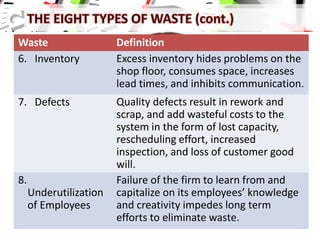
Know?Waste Definition
6. Inventory Excess inventory hides problems on the
shop floor, consumes space, increases
lead times, and inhibits communication.
7. Defects Quality defects result in rework and
scrap, and add wasteful costs to the
system in the form of lost capacity,
rescheduling effort, increased
inspection, and loss of customer good
will.
8.
Underutilization
of Employees
Failure of the firm to learn from and
capitalize on its employees’ knowledge
and creativity impedes long term
efforts to eliminate waste.
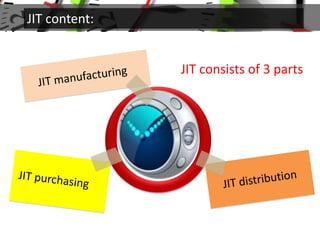
JIT content:
JIT consists of 3 parts
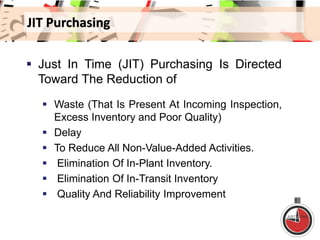
JIT Purchasing
 Just In Time (JIT) Purchasing Is Directed
Toward The Reduction of
 Waste (That Is Present At Incoming Inspection,
Excess Inventory and Poor Quality)
 Delay
 To Reduce All Non-Value-Added Activities.
 Elimination Of In-Plant Inventory.
 Elimination Of In-Transit Inventory
 Quality And Reliability Improvement
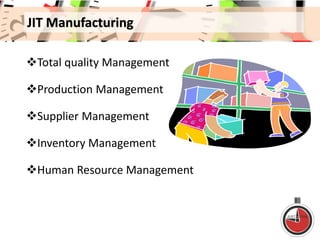
JIT Manufacturing
Total quality Management
Production Management
Supplier Management
Inventory Management
Human Resource Management
Total Quality Management
• Seek long-term commitment to quality efforts with
continuous improvement
• Quality must be a higher priority than cost
• Minimizing waste
• Eliminate Quality Inspectors
• Quality is everyone’s responsibility
• Do it right the first time
Production Management
• The principle of Production Management is important to
sustain quality in the process.
• Pull System vs. Push System
Pull = Made to order
Push = Made for inventory
JIT system uses Pull System in stead of Push System. This
allows for demand to set the tone for production.
• Flexibility of the system
It is also important for the system to be flexible. This means
that production levels must have the ability to change from
day to day, working with the aspect of made to order.
Production Management
• Design For Testability – In the process
Mistake proofing device used throughout entire process
This device will prevent mistakes from happening. It is also
important to test throughout the entire process to ensure
Zero defects.
• Reduced lot sizes
This will shorten the cycle times, and as a result this reduction
will free up capital that was otherwise tied up in Inventory.
• Eliminate disruptions in the process
JIT should eliminate any disruptions in the process, to
maximize productivity, while eliminating any bottlenecks.
Production Management
• Standardized Parts/ Simplicity
Standardized parts should be used to increase simplicity in a
process, and as a result defective products will be reduced and
eventually eliminated.
• Communication Techniques
Completion of task-Kanban
Kanban is Japanese for the word Card. Kanban is used to
control the flow of inventory throughout the process in a
pull system utilizing a card to signal demand.
Problem- Andon or siren/light
An Andon is a light or signal in the process throughout the
work stations that will alarm the workers that there is a
problem in the process, and there is a collaborative effort to
correct and prevent the problem from happening again.
Production Management
• Stopping the process if something goes wrong
• Preventive Maintenance
Preventive maintenance is necessary to eliminate any down
time for machinery failure in a process.
Toyota uses a Kanban pull system throughout the
production process.
Supplier Management
• Elimination inspection of parts
• Information Systems
• Eliminating barriers to information
• Communicate problems to suppliers in a positive
manner.
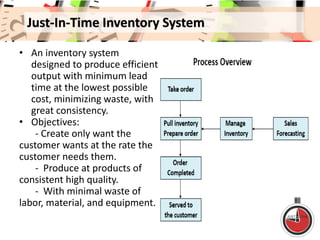
Just-In-Time Inventory System
• An inventory system
designed to produce efficient
output with minimum lead
time at the lowest possible
cost, minimizing waste, with
great consistency.
• Objectives:
- Create only want the
customer wants at the rate the
customer needs them.
- Produce at products of
consistent high quality.
- With minimal waste of
labor, material, and equipment.
Inventory Management
• Eliminate Safety Stock
= Zero Inventory
• Reduce WIP
• JIT is not an inventory
control system
• Reduction in
inventory opens up
space
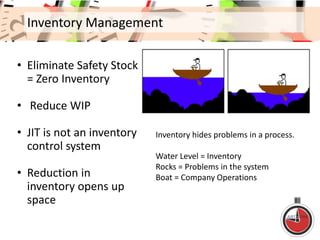
Inventory hides problems in a process.
Water Level = Inventory
Rocks = Problems in the system
Boat = Company Operations
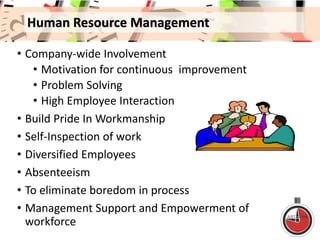
Human Resource Management
• Company-wide Involvement
• Motivation for continuous improvement
• Problem Solving
• High Employee Interaction
• Build Pride In Workmanship
• Self-Inspection of work
• Diversified Employees
• Absenteeism
• To eliminate boredom in process
• Management Support and Empowerment of
workforce
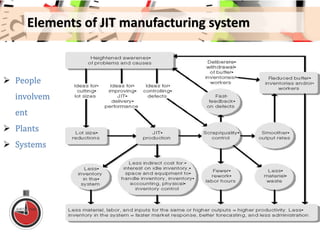
Elements of JIT manufacturing system
 People
involvem
ent
 Plants
 Systems
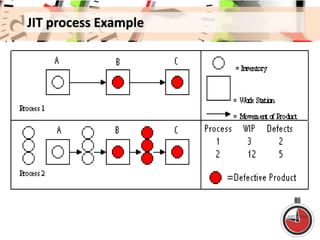
JIT process Example
Characteristics of Just-in-Time
Pull method of materials flow
Consistently high quality
Small lot sizes
Uniform workstation loads
Standardized components and work methods
Close supplier ties
Flexible workforce
Line flows
Automated production
Preventive maintenance
Benefits of JIT
 Reduction in inventories
 Improved quality
 Reduced space requirements
 Shorter lead times
 Lower production costs
 Increased productivity
 Increased machine utilization
 Greater flexibility
Potential Problems Implementing JIT
 Applicable primarily to repetitive
operations
 Requires discipline
 Based on cooperation and trust
 Requires change of philosophy
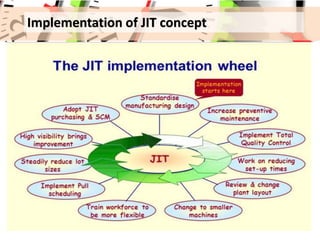
Implementation of JIT concept
Real-Life Examples of Successful JIT Systems
Traditional Systems
Compared to JIT
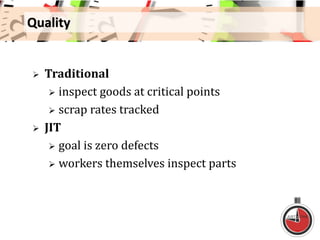
Quality
 Traditional
 inspect goods at critical points
 scrap rates tracked
 JIT
 goal is zero defects
 workers themselves inspect parts
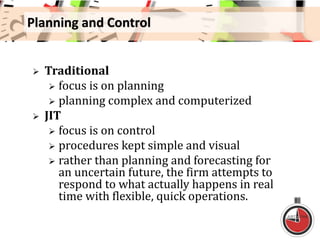
Planning and Control
 Traditional
 focus is on planning
 planning complex and computerized
 JIT
 focus is on control
 procedures kept simple and visual
 rather than planning and forecasting for
an uncertain future, the firm attempts to
respond to what actually happens in real
time with flexible, quick operations.
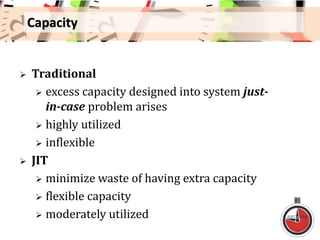
Capacity
 Traditional
 excess capacity designed into system just-
in-case problem arises
 highly utilized
 inflexible
 JIT
 minimize waste of having extra capacity
 flexible capacity
 moderately utilized
Inventories
 Traditional
 used to buffer operations
 large WIP buffers
 JIT
 inventory is seen as an evil
 small WIP buffers
Workforce
 Traditional
 competitive attitude between workers and managers
 status symbols and privileges
 much of the employees’ time is nonworking time:
looking for parts, moving materials, setting up
machines, getting instructions, and so on. When actually
working, they tend to work fast.
 JIT
 broadly skilled flexible workers who can uncover and
solve problems
 Work as a team
 cooperative attitudes
Suppliers
 Traditional
 suppliers treated as adversaries
 multiple sourcing
 JIT
 supplier considered part of team
 single-sourcing agreements
 supplier certification programs
JIT and management accounting
• Management accountants in many organizations have been strongly criticized because of
their failure to alter the management accounting system to reflect the move from a traditional
manufacturing to a just-in-time manufacturing system. Conventional management accounting
system can encourage behavior that is inconsistent with a just-in-time manufacturing
philosophy. Management accounting must support just–in–time manufacturing by monitoring,
identifying and communicating to decision to-makers any delay, error and waste in the system.
modern management accounting system are now placing greater emphasis on providing
information on supplier reliability, set-up times throughput cycle times, percentage of
deliveries that are time and defect rates. JIT manufacturing systems result in the establishment
of production cells that are dedicated to the manufacturing of a single product or a family of
similar products many of the support activities can be directly traced dedicated cells. Thus, a
high proportion of costs can be directly assigned to products. Therefore, the benefits from
implementing ABC product will be lower in JIT organization.
Conclusion
After all, I think that if the company wants to have a JIT
concept it does not mean that everything must be done very
fast. The most important thing for the company is to have
good organized resource allocation. Also, the management
and employees must have on their mind that this concept can
help the organization to solve many problems in logistics.
It is true that implementation and development of JIT is a
long-lasting and expensive process, but if the company can
manage with these difficulties it is possible to achieve high
levels of workflow.
For your valuable time….
Any question?

Presentation on Just in Time

  • 1.
  • 2.
  • 3.
  • 4.
    Content:  Introduction  Historyof JIT  Objectives  Importance of JIT  Source of waste  Eight types of waste  Three parts of JIT  JIT purchasing  JIT Manufacturing  JIT quality management  Production management  Supplier management  JIT inventory system  Inventory management  Human resource management  Elements of JIT manufacturing system  JIT process  Characteristics of JIT  Benefit of JIT  Potential Problem of implementing JIT  Implementing of JIT concept  Real life example of JIT  Traditional system Vs JIT  JIT and management accounting  Conclusion
  • 5.
    Introduction Oh no! Lots ofwaste, Poor quality, supplier delays also….
  • 6.
  • 7.
    Introduction Just-in-time (JIT) isa highly coordinated processing system in which goods move through the system, and services are performed, just as they are needed
  • 8.
    History of JIT •Evolved in Japan after World War II, as a result of their diminishing market share in the auto industry. • Toyota Motor Company- first to implement fully functioning and successful JIT system, in 1970’s. • Japanese Manufacturers looked for a way to gain the most efficient use of limited resources. They worked on "optimal cost/quality relationship.
  • 9.
    Objectives  Produce onlythe products the customer wants.  Produce products only at the rate that the customer wants them.  Produce with perfect quality  Produce with minimum lead time.  Produce products with only those features the customer wants.  Produce with no waste of labor, material or equipment -- every movement must have a purpose so that there is zero idle inventory.
  • 10.
    Why JIT Systemis necessary for organization Eliminates waste . Achieves streamlined production Eliminate disruptions in production … caused by poor quality, schedule changes, late deliveries. Makes the manufacturing delivery system flexible by allowing it to handle a variety of products and changes in the level of output. Reduces setup and delivery times .
  • 11.
    Sources of Waste Overproduction Waitingtime Unnecessary transportation Processing waste Inefficient work methods Product defects
  • 12.
    THE EIGHT TYPESOF WASTE Waste Definition 1.Overproduction Manufacturing an item before it is needed. 2.Inappropriate Processing Using expensive high precision equipment when simpler machines would suffice. 3.Waiting Wasteful time incurred when product is not being moved or processed. 4.Transportation Excessive movement and material handling of product between processes. 5.Motion Unnecessary effort related to the ergonomics of bending, stretching, reaching, lifting, and walking.
  • 13.
    Know?Waste Definition 6. InventoryExcess inventory hides problems on the shop floor, consumes space, increases lead times, and inhibits communication. 7. Defects Quality defects result in rework and scrap, and add wasteful costs to the system in the form of lost capacity, rescheduling effort, increased inspection, and loss of customer good will. 8. Underutilization of Employees Failure of the firm to learn from and capitalize on its employees’ knowledge and creativity impedes long term efforts to eliminate waste.
  • 14.
  • 15.
    JIT Purchasing  JustIn Time (JIT) Purchasing Is Directed Toward The Reduction of  Waste (That Is Present At Incoming Inspection, Excess Inventory and Poor Quality)  Delay  To Reduce All Non-Value-Added Activities.  Elimination Of In-Plant Inventory.  Elimination Of In-Transit Inventory  Quality And Reliability Improvement
  • 16.
    JIT Manufacturing Total qualityManagement Production Management Supplier Management Inventory Management Human Resource Management
  • 17.
    Total Quality Management •Seek long-term commitment to quality efforts with continuous improvement • Quality must be a higher priority than cost • Minimizing waste • Eliminate Quality Inspectors • Quality is everyone’s responsibility • Do it right the first time
  • 18.
    Production Management • Theprinciple of Production Management is important to sustain quality in the process. • Pull System vs. Push System Pull = Made to order Push = Made for inventory JIT system uses Pull System in stead of Push System. This allows for demand to set the tone for production. • Flexibility of the system It is also important for the system to be flexible. This means that production levels must have the ability to change from day to day, working with the aspect of made to order.
  • 19.
    Production Management • DesignFor Testability – In the process Mistake proofing device used throughout entire process This device will prevent mistakes from happening. It is also important to test throughout the entire process to ensure Zero defects. • Reduced lot sizes This will shorten the cycle times, and as a result this reduction will free up capital that was otherwise tied up in Inventory. • Eliminate disruptions in the process JIT should eliminate any disruptions in the process, to maximize productivity, while eliminating any bottlenecks.
  • 20.
    Production Management • StandardizedParts/ Simplicity Standardized parts should be used to increase simplicity in a process, and as a result defective products will be reduced and eventually eliminated. • Communication Techniques Completion of task-Kanban Kanban is Japanese for the word Card. Kanban is used to control the flow of inventory throughout the process in a pull system utilizing a card to signal demand. Problem- Andon or siren/light An Andon is a light or signal in the process throughout the work stations that will alarm the workers that there is a problem in the process, and there is a collaborative effort to correct and prevent the problem from happening again.
  • 21.
    Production Management • Stoppingthe process if something goes wrong • Preventive Maintenance Preventive maintenance is necessary to eliminate any down time for machinery failure in a process. Toyota uses a Kanban pull system throughout the production process.
  • 22.
    Supplier Management • Eliminationinspection of parts • Information Systems • Eliminating barriers to information • Communicate problems to suppliers in a positive manner.
  • 23.
    Just-In-Time Inventory System •An inventory system designed to produce efficient output with minimum lead time at the lowest possible cost, minimizing waste, with great consistency. • Objectives: - Create only want the customer wants at the rate the customer needs them. - Produce at products of consistent high quality. - With minimal waste of labor, material, and equipment.
  • 24.
    Inventory Management • EliminateSafety Stock = Zero Inventory • Reduce WIP • JIT is not an inventory control system • Reduction in inventory opens up space Inventory hides problems in a process. Water Level = Inventory Rocks = Problems in the system Boat = Company Operations
  • 25.
    Human Resource Management •Company-wide Involvement • Motivation for continuous improvement • Problem Solving • High Employee Interaction • Build Pride In Workmanship • Self-Inspection of work • Diversified Employees • Absenteeism • To eliminate boredom in process • Management Support and Empowerment of workforce
  • 26.
    Elements of JITmanufacturing system  People involvem ent  Plants  Systems
  • 27.
  • 28.
    Characteristics of Just-in-Time Pullmethod of materials flow Consistently high quality Small lot sizes Uniform workstation loads Standardized components and work methods Close supplier ties Flexible workforce Line flows Automated production Preventive maintenance
  • 29.
    Benefits of JIT Reduction in inventories  Improved quality  Reduced space requirements  Shorter lead times  Lower production costs  Increased productivity  Increased machine utilization  Greater flexibility
  • 30.
    Potential Problems ImplementingJIT  Applicable primarily to repetitive operations  Requires discipline  Based on cooperation and trust  Requires change of philosophy
  • 31.
  • 32.
    Real-Life Examples ofSuccessful JIT Systems
  • 33.
  • 34.
    Quality  Traditional  inspectgoods at critical points  scrap rates tracked  JIT  goal is zero defects  workers themselves inspect parts
  • 35.
    Planning and Control Traditional  focus is on planning  planning complex and computerized  JIT  focus is on control  procedures kept simple and visual  rather than planning and forecasting for an uncertain future, the firm attempts to respond to what actually happens in real time with flexible, quick operations.
  • 36.
    Capacity  Traditional  excesscapacity designed into system just- in-case problem arises  highly utilized  inflexible  JIT  minimize waste of having extra capacity  flexible capacity  moderately utilized
  • 37.
    Inventories  Traditional  usedto buffer operations  large WIP buffers  JIT  inventory is seen as an evil  small WIP buffers
  • 38.
    Workforce  Traditional  competitiveattitude between workers and managers  status symbols and privileges  much of the employees’ time is nonworking time: looking for parts, moving materials, setting up machines, getting instructions, and so on. When actually working, they tend to work fast.  JIT  broadly skilled flexible workers who can uncover and solve problems  Work as a team  cooperative attitudes
  • 39.
    Suppliers  Traditional  supplierstreated as adversaries  multiple sourcing  JIT  supplier considered part of team  single-sourcing agreements  supplier certification programs
  • 40.
    JIT and managementaccounting • Management accountants in many organizations have been strongly criticized because of their failure to alter the management accounting system to reflect the move from a traditional manufacturing to a just-in-time manufacturing system. Conventional management accounting system can encourage behavior that is inconsistent with a just-in-time manufacturing philosophy. Management accounting must support just–in–time manufacturing by monitoring, identifying and communicating to decision to-makers any delay, error and waste in the system. modern management accounting system are now placing greater emphasis on providing information on supplier reliability, set-up times throughput cycle times, percentage of deliveries that are time and defect rates. JIT manufacturing systems result in the establishment of production cells that are dedicated to the manufacturing of a single product or a family of similar products many of the support activities can be directly traced dedicated cells. Thus, a high proportion of costs can be directly assigned to products. Therefore, the benefits from implementing ABC product will be lower in JIT organization.
  • 41.
    Conclusion After all, Ithink that if the company wants to have a JIT concept it does not mean that everything must be done very fast. The most important thing for the company is to have good organized resource allocation. Also, the management and employees must have on their mind that this concept can help the organization to solve many problems in logistics. It is true that implementation and development of JIT is a long-lasting and expensive process, but if the company can manage with these difficulties it is possible to achieve high levels of workflow.
  • 42.
  • 43.