
Logisticsby Roadways& Railways
Tikeswar Naik
MT14IND024
Industrial engineering
Visvesvaraya national institute technology , Nagpur
What is Logistics??
• Logistics is the management of the flow of goods between the
point of origin and the point of consumption in order to meet
some requirements, of customers or corporations.
• logistics can include physical items, such as food, materials,
animals, equipment and liquids, as well as abstract items,
such as time, information, particles, and energy.
• The logistics of physical items usually involves the
integration of information flow, material
handling, production, packaging, inventory, transportation,
warehousing, and often security.
Logistic by Roadways
• Means by which a shipment is moved from point “A” to point “B” by
road
• Cargo can’t be handled in every part of the country through railway.
• Roadways play major role in handling cargo even in small town.
• Roadways transportation is done through truck/lorries.
• There are no. of lorries having different capacities.
Introduction- Indian road logistics
• Some Facts…….
 India is having second largest road network in world.(3.38 million KM)
 Road network carry nearly 65% of freight and 85% of passenger traffic
 Average speed on Indian highways is 30 km per hour, which is three times
lower than the average speed on highways in developed countries.
 Roads in India are divided into the following five categories:
 National Highways (NH)
 State Highways (SH)
 Major District Roads (MDR)
 Other District Roads (ODR)
 Village Roads (VR)
 National highways form only 2% of the total roads by length and carry about
40% of the traffic
 Out of total length of national highways:
 27 % - single lane/intermediate lane
 59 % - double-lane standard
 14 % - four-lane/ six-lane/ eight lane standard
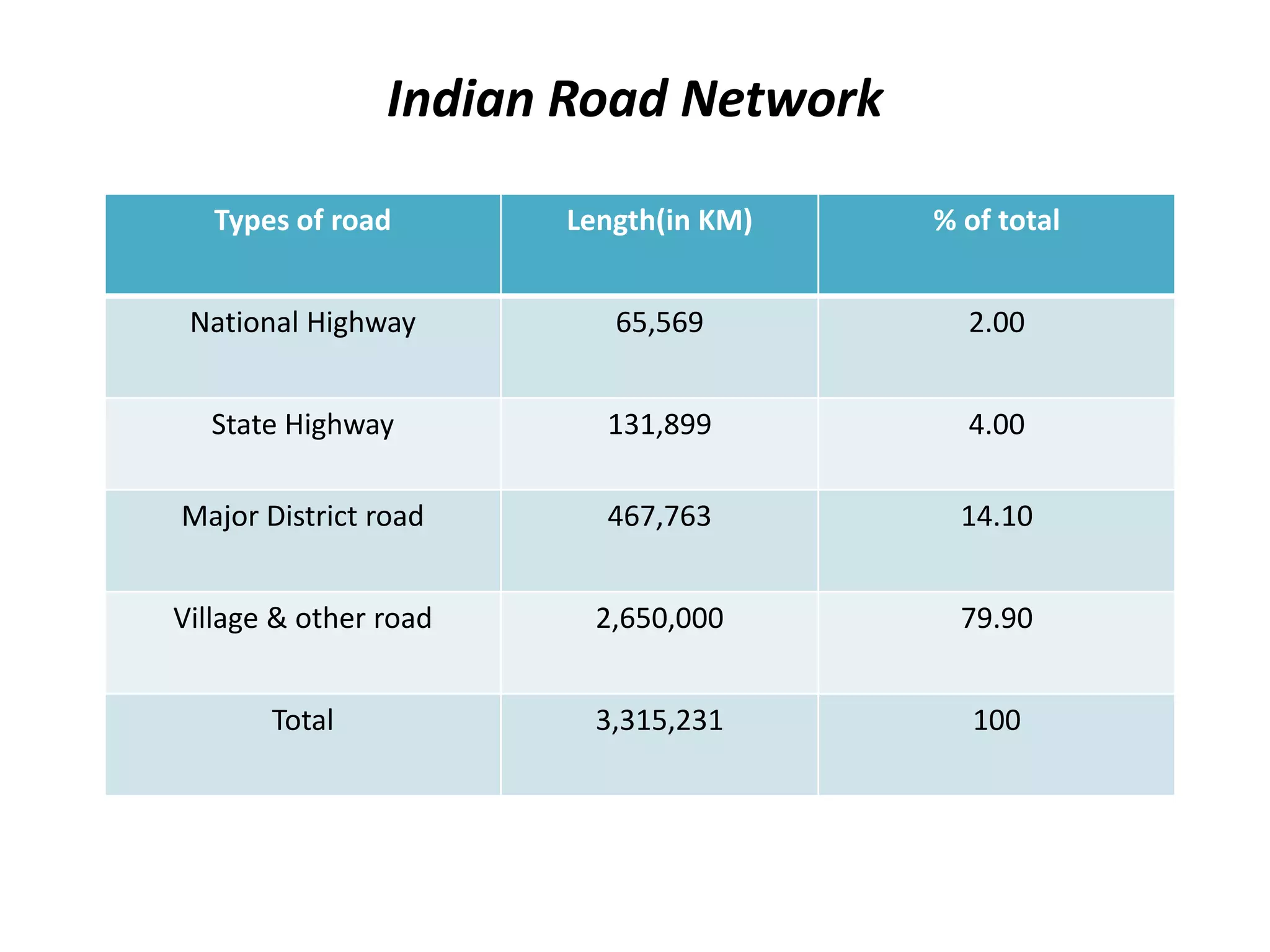
Indian Road Network
Types of road Length(in KM) % of total
National Highway 65,569 2.00
State Highway 131,899 4.00
Major District road 467,763 14.10
Village & other road 2,650,000 79.90
Total 3,315,231 100
Major Road Projects
NHDP & Other NHAI Projects
Total
Length
(Km.)
Already
4/6Laned
(Km.)
Under
Implementat
ion (Km.)
Contracts
Under
Implementa
tion (No.)
Balance
length for
award
(Km.)
GQ 5,846
5,846
(100.00%)
0 0 -
NS - EW
Ph. I & II
7,142 6,360 365 42 417
Port
Connectivity
380 379 1 1 0
NHDP Phase III 12,109 6,393 4,373 89 1,343
NHDP Phase IV 14,799 942 5,904 55 7,953
NHDP Phase V 6,500 2,001 2,080 27 2,419
NHDP Phase VI 1,000 - - - 1,000
NHDP Phase VII 700 22 19 1 659
NHDP Total 48,476 21,943 12,742 215 13,791
NHDP
Others (Ph.-I, Ph.-II & Misc.) 1754 1428 326 10 -
SARDP -NE 388 99 12 1 277
Total by NHAI 50,618 23,470 13,080 226 14,068
Share of different mode of Transport in India’s
GDP
Sector 2008-09 2009-10 2010-11 2011-12 2012-13 2013-14
Transport of
which:
5.7 5.8 5.9 6.2 6.2 6.4
Road Transport 3.8 3.9 3.9 4.1 4.3 4.5
Railways 1.1 1.1 1.1 1.1 1.2 1.2
Water transport 0.2 0.2 0.3 0.3 0.2 0.2
Air transport 0.2 0.2 0.2 0.3 0.3 0.2
services 0.4 0.4 0.4 0.4 0.3 0.3
Indian Road Logistics-Comparison
Road logistic in India
 Golden Quadrilateral
• The Golden Quadrilateral is a highway
network connecting India's four largest
metros : Delhi, Mumbai, Chennai, Kolkata
• First phase of the National Highways
Development Project .
• The second phase involves the
development of the North-South and East-
West links, which runs from Srinagar to
Kanyakumari and from Porbunder to
Silchar
• The project aims of building 5,846 km
(3,633 mi) of four/six lane express
highways at a cost US$12.2 billion
Road logistic in India
Advantage & Disadvantage
A very popular mode of transport used by supplier and business to deliver orders.
Many transport companies provide scheduled delivery days and next day delivery
services, depending upon the needs. Goods can be packed/grouped in box vans or
in containers which are also used for sea transportation.
 Cost effective
 Fast delivery
 Ideal for short distance
 Ideal for transporting perishable
(fruits & vegetable)
 Easy monitor location of goods
 Easy to communicate with driver
 Transport subject to traffic delays
 Transport subject to break down
 Goods susceptible to damage
through careless driving
 Bad weather
 Driving regulation can cause delay
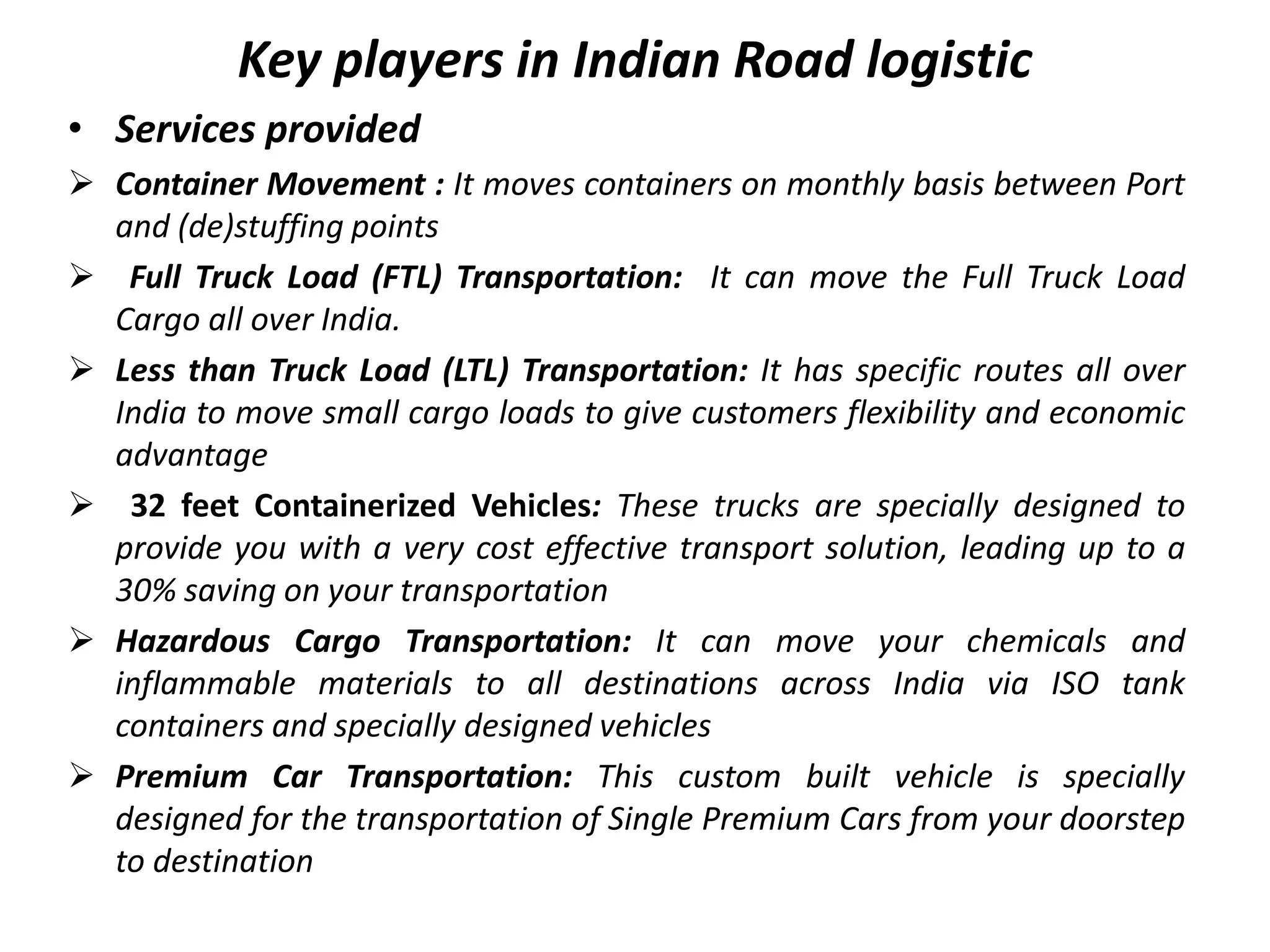
Key players in Indian Road logistic
• Services provided
 Container Movement : It moves containers on monthly basis between Port
and (de)stuffing points
 Full Truck Load (FTL) Transportation: It can move the Full Truck Load
Cargo all over India.
 Less than Truck Load (LTL) Transportation: It has specific routes all over
India to move small cargo loads to give customers flexibility and economic
advantage
 32 feet Containerized Vehicles: These trucks are specially designed to
provide you with a very cost effective transport solution, leading up to a
30% saving on your transportation
 Hazardous Cargo Transportation: It can move your chemicals and
inflammable materials to all destinations across India via ISO tank
containers and specially designed vehicles
 Premium Car Transportation: This custom built vehicle is specially
designed for the transportation of Single Premium Cars from your doorstep
to destination
Key players in Indian Road logistic
Long Haul truck Mining truck Distribution truck
Steel
container
Refrigerated
container Ambulance Aluminium FSD
Key players in Indian Road logistic
• Defense
Key issue in indian Road logistics
• Road capacity in India is very low with most national
highways having two lanes or less.
• Congestion of roads is a major problem with a quarter of all of
India's highways being congested.
• The average productivity of a truck in India is an abysmal 200
kms a day which could be increased to 350 - 400 kms just by
reduction in congestion
• Transportation of goods by road is too much time consuming.
• Lack participation of private sector
• Maintainance
Key issue in indian Road logistics
Logistic by railways
Railways
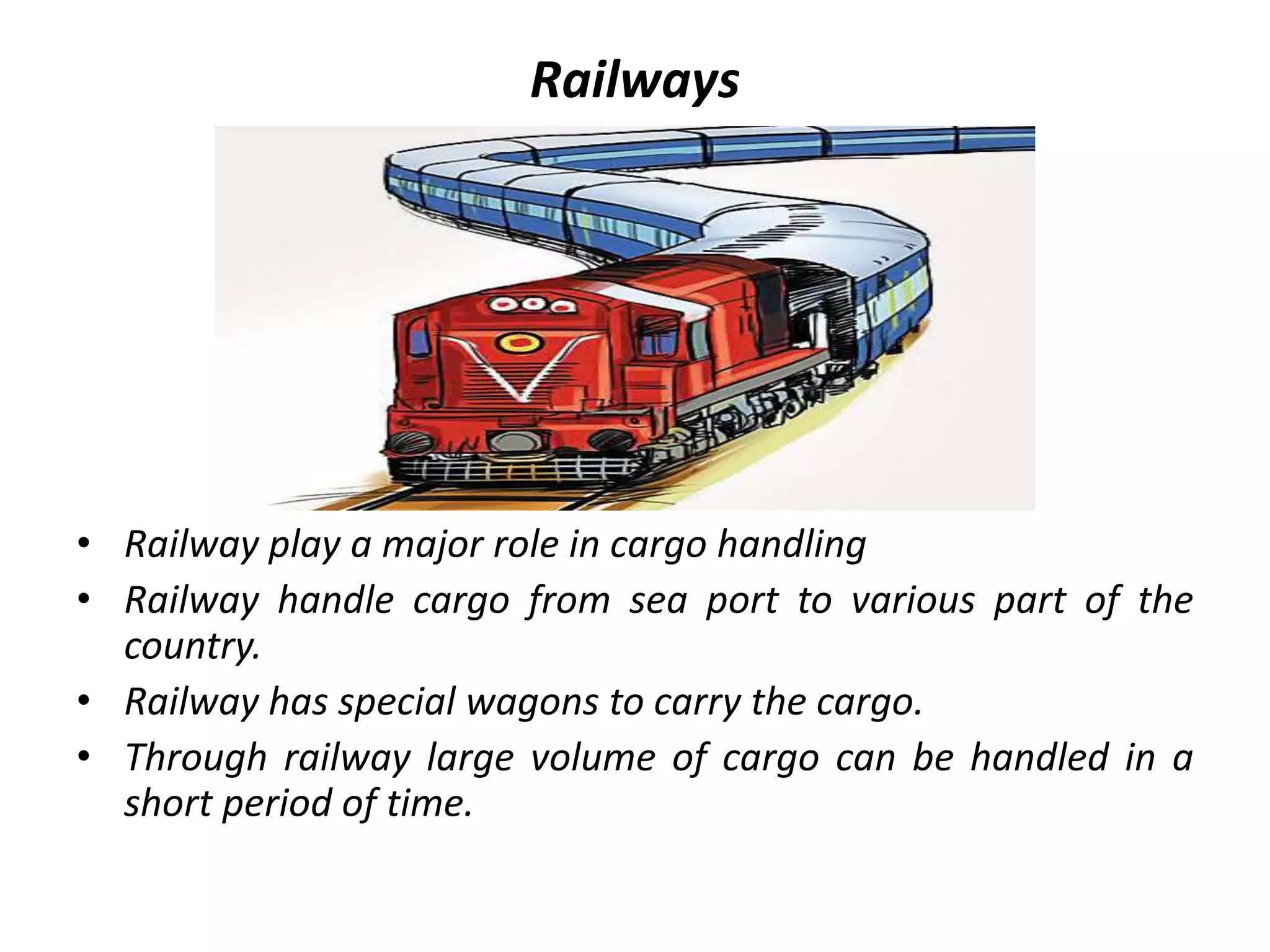
• Railway play a major role in cargo handling
• Railway handle cargo from sea port to various part of the
country.
• Railway has special wagons to carry the cargo.
• Through railway large volume of cargo can be handled in a
short period of time.
Logistic by railways
World’s fourth-largest rail network:
• Indian Railways had 12,335 passenger trains carrying over 30
million passengers daily. On the commercial front, 1,119 million
tonnes of freight was transported via trains
• It has a total route network of about 64,600 kilometres (of which
29.98 per cent is double/multi-track) spread across 7,146 stations.
• Operates more than 19,000 trains every day
• It has 239,321 wagons, 61,899 coaches, and 9,549 locomotives
Indian railway-Zones
1. Central railway
2. Eastern railway
3. East central railway
4. East coast railway
5. Northern railway
6. North Central Railway
7. North Eastern Railway
8. North Frontier Railway
9. North Western Railway
10. Southern Railway
11. South Central Railway
12. South Eastern Railway
13. South East Central Railway
14. South Western Railway
15. Western Railway
16. West Central Railway
• Railways has two major segments
Passenger :-
 About 12,335 passenger trains were in operation in FY14
 Over 30 million passengers travel by trains on a daily basis in
India
Freight :-
 Around 1,119 million tonnes of freight was transported via
trains in FY14
 These include a huge variety of goods like mineral ores, iron
and steel, fertilizers, petrochemicals, and agricultural produce
Railway freight structure
 Ability to pay principle
 Speed
 Distance
 Liability of risk (Railways’s risk & Owner’s risk)
 Types of Wagon(closed, open , refrigerated)
 Liability to damage- (premium attached)
 Nature of commodity-Liability to inflammation/explosion
 Nature of commodity- size and packing of commodity
Indian railways-Service provided
• Freight
• Freight remains the major
revenue earning segment for
the railways, accounting for
67 per cent of total revenues
in FY14 .
• Last 2 decades, shifted to
large container movement.
• Majority of earnings comes
from carrying bulk goods like
iron ore , coal, crude oil.
Strong growth in freight traffic
745
804 837
892 926 975
1,038
1,119
1,206
1,300
1,405
FY 7 FY8 FY 9 FY 10 FY 11 FY 12 FY 13 FY 14 FY 15 FY 16 FY 17
FREIGHT TRAFFIC(million tonnes)
Types of goods wagon or freight car
BOXNHL
for the transportation of bulk goods
that are not moisture-retentive and
can usually be tipped, dumped or
shovelled
BOBYN
used to transport loose bulk
commodities such as coal, ore, grain,
and track ballast
Types of goods wagon or freight car
BCNHL
FLAT WAGON
generally used to carry general freight
Flat wagons are used for loads that are
too large or cumbersome to load in
enclosed cars such as covered wagon
Dedicated freight corridor
DFCCIL, a special purpose vehicle, was set up for implementing
the DFC project under the administrative control of the Ministry
of Railways
The plan is to construct dedicated freight lines along the Eastern
and Western parts of India
Total length: 3,300 kilometres; total estimated cost: USD16.7
billion; project scheduled for completion in FY17
Objectives…DFCCIL
 Increase rail freight share through customised logistic
services
 Segregate freight and passenger lines for focused
approach
 Create additional freight capacity to meet demand
 Introduce time-tabled freight services to ensure better
services
 Adopt high-end technology for real-time data analysis
 Reduce unit cost of transportation and increase
productivity
Inherent advantages of the
rail container transport
Lower transportation cost
Higher reliability
Relatively safer and secure
Very environmentally friendly
Reduced accidents.
Key player in railways logistic
 Navratna PSU under the Indian Ministry of Railways
 CONCOR operates three core businesses: cargo carrier
, terminal operator, and warehouse operator
Logistics Sectors
• Oil & Gas sector
Transportation of drilling rigs, equipment for oil processing
plants, equipment for gas supply, dehydrators, oxygen plants,
compressors, rectification columns and tanks
Logistics Sectors
• Energy sector
Transportation of transformers, columns, gas and steam
turbines, power cables
Logistics Sectors
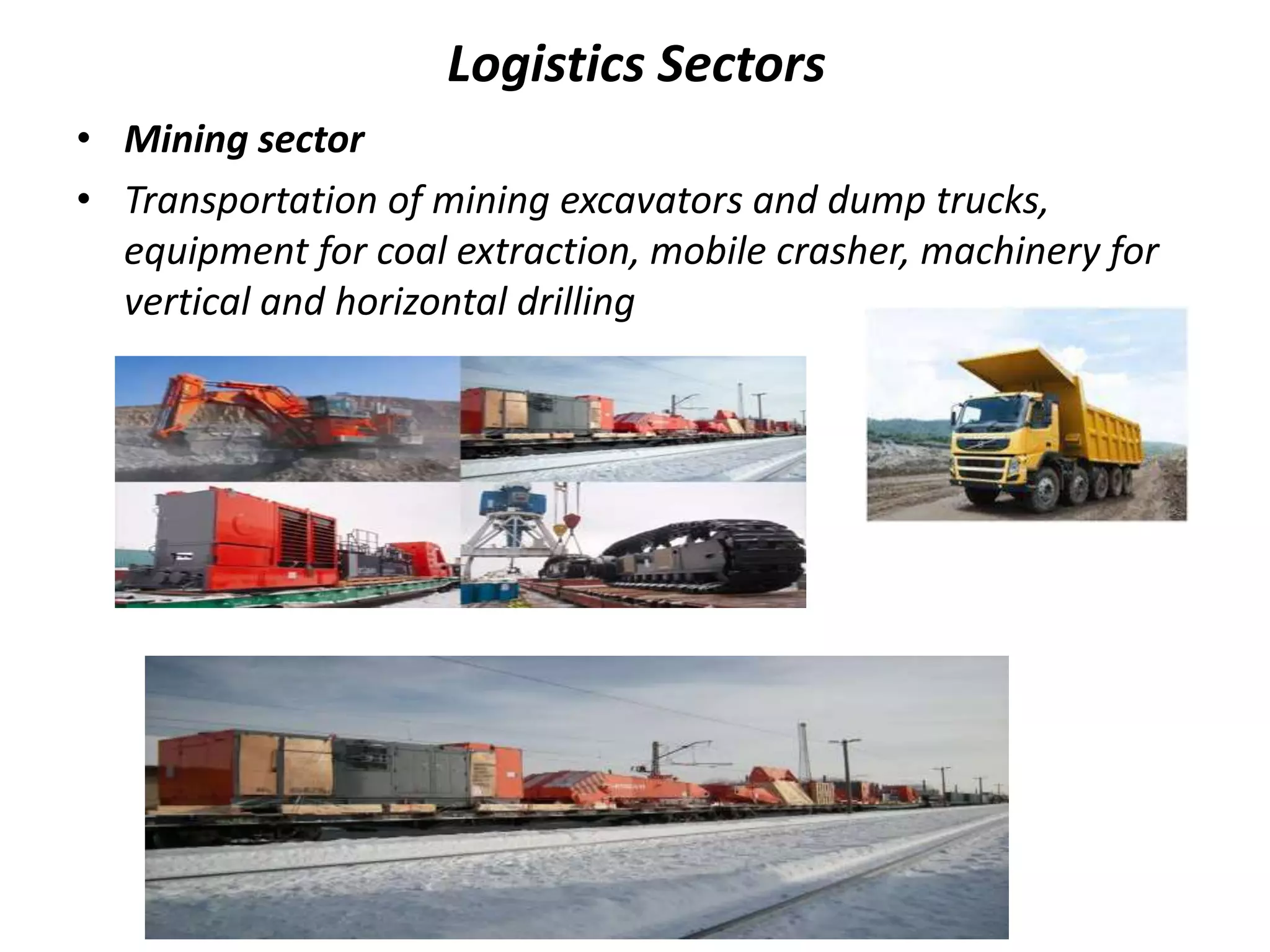
• Mining sector
• Transportation of mining excavators and dump trucks,
equipment for coal extraction, mobile crasher, machinery for
vertical and horizontal drilling
Logistics Sectors
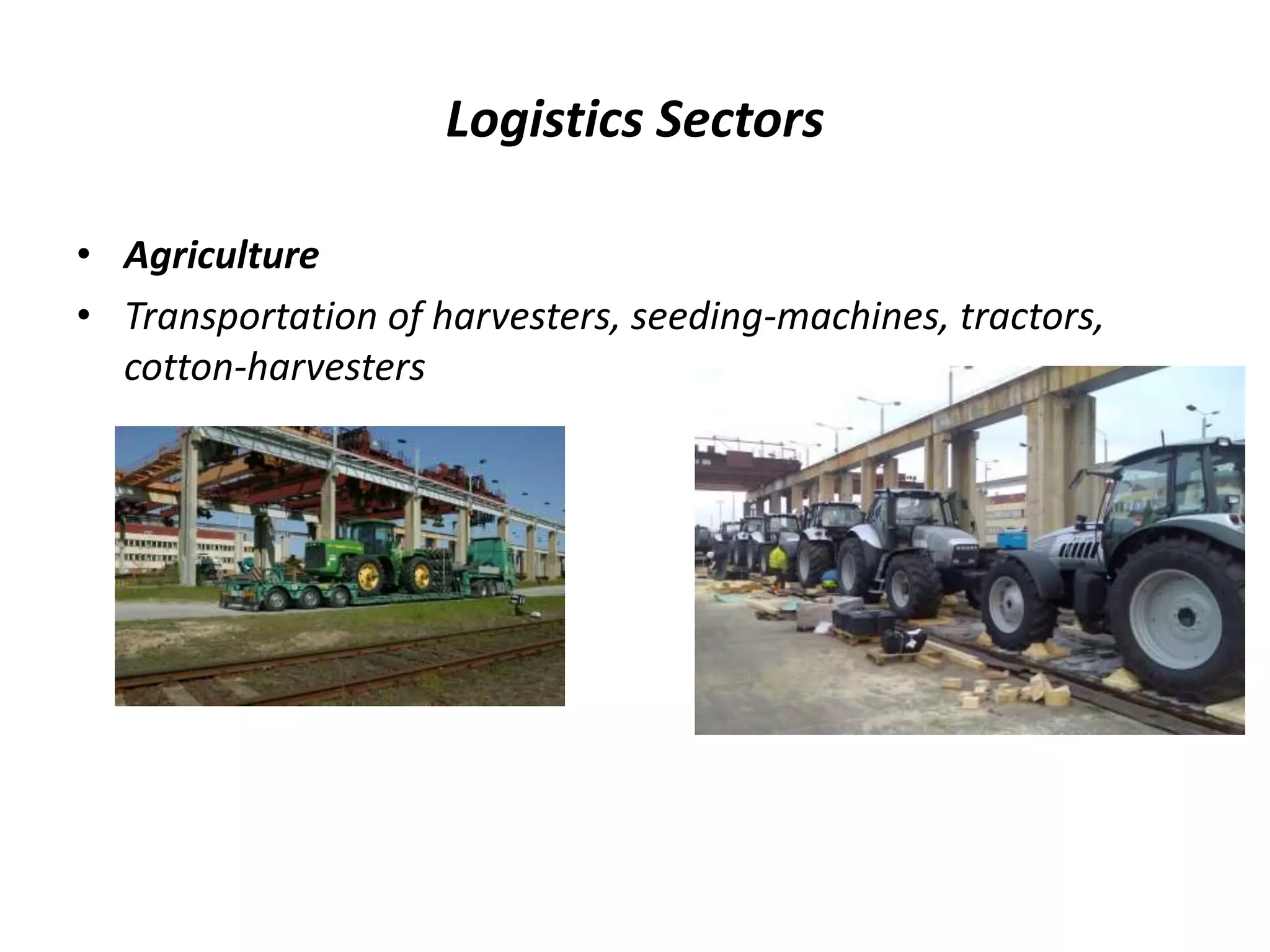
• Agriculture
• Transportation of harvesters, seeding-machines, tractors,
cotton-harvesters
Logistics Sectors
• Construction
• Transportation of gantry and lattice-jib cranes, excavators,
bulldozers, pipelayers.
reference
• https://www.kpmg.com/DE/de/Documents/Logistics_Game_Changers_Tr
ansforming_India_logistics_industry_2013.pdf
• www.ibef.org
• www.wikipedia.com
Thank you
1) what is logistics? What are the different types
of logistics?
2) What are the advantage and disadvantage of
road logistics?
3) What are the key issue of indian road
logistics?
4) What are the different type of rail freight
structure?
5) What is the advantages of rail container
transport?

logistics

  • 1.
    Logisticsby Roadways& Railways TikeswarNaik MT14IND024 Industrial engineering Visvesvaraya national institute technology , Nagpur
  • 2.
    What is Logistics?? •Logistics is the management of the flow of goods between the point of origin and the point of consumption in order to meet some requirements, of customers or corporations. • logistics can include physical items, such as food, materials, animals, equipment and liquids, as well as abstract items, such as time, information, particles, and energy. • The logistics of physical items usually involves the integration of information flow, material handling, production, packaging, inventory, transportation, warehousing, and often security.
  • 3.
    Logistic by Roadways •Means by which a shipment is moved from point “A” to point “B” by road • Cargo can’t be handled in every part of the country through railway. • Roadways play major role in handling cargo even in small town. • Roadways transportation is done through truck/lorries. • There are no. of lorries having different capacities.
  • 4.
    Introduction- Indian roadlogistics • Some Facts…….  India is having second largest road network in world.(3.38 million KM)  Road network carry nearly 65% of freight and 85% of passenger traffic  Average speed on Indian highways is 30 km per hour, which is three times lower than the average speed on highways in developed countries.  Roads in India are divided into the following five categories:  National Highways (NH)  State Highways (SH)  Major District Roads (MDR)  Other District Roads (ODR)  Village Roads (VR)  National highways form only 2% of the total roads by length and carry about 40% of the traffic  Out of total length of national highways:  27 % - single lane/intermediate lane  59 % - double-lane standard  14 % - four-lane/ six-lane/ eight lane standard
  • 5.
    Indian Road Network Typesof road Length(in KM) % of total National Highway 65,569 2.00 State Highway 131,899 4.00 Major District road 467,763 14.10 Village & other road 2,650,000 79.90 Total 3,315,231 100
  • 6.
    Major Road Projects NHDP& Other NHAI Projects Total Length (Km.) Already 4/6Laned (Km.) Under Implementat ion (Km.) Contracts Under Implementa tion (No.) Balance length for award (Km.) GQ 5,846 5,846 (100.00%) 0 0 - NS - EW Ph. I & II 7,142 6,360 365 42 417 Port Connectivity 380 379 1 1 0 NHDP Phase III 12,109 6,393 4,373 89 1,343 NHDP Phase IV 14,799 942 5,904 55 7,953 NHDP Phase V 6,500 2,001 2,080 27 2,419 NHDP Phase VI 1,000 - - - 1,000 NHDP Phase VII 700 22 19 1 659 NHDP Total 48,476 21,943 12,742 215 13,791 NHDP Others (Ph.-I, Ph.-II & Misc.) 1754 1428 326 10 - SARDP -NE 388 99 12 1 277 Total by NHAI 50,618 23,470 13,080 226 14,068
  • 7.
    Share of differentmode of Transport in India’s GDP Sector 2008-09 2009-10 2010-11 2011-12 2012-13 2013-14 Transport of which: 5.7 5.8 5.9 6.2 6.2 6.4 Road Transport 3.8 3.9 3.9 4.1 4.3 4.5 Railways 1.1 1.1 1.1 1.1 1.2 1.2 Water transport 0.2 0.2 0.3 0.3 0.2 0.2 Air transport 0.2 0.2 0.2 0.3 0.3 0.2 services 0.4 0.4 0.4 0.4 0.3 0.3
  • 8.
  • 9.
    Road logistic inIndia  Golden Quadrilateral • The Golden Quadrilateral is a highway network connecting India's four largest metros : Delhi, Mumbai, Chennai, Kolkata • First phase of the National Highways Development Project . • The second phase involves the development of the North-South and East- West links, which runs from Srinagar to Kanyakumari and from Porbunder to Silchar • The project aims of building 5,846 km (3,633 mi) of four/six lane express highways at a cost US$12.2 billion
  • 10.
    Road logistic inIndia Advantage & Disadvantage A very popular mode of transport used by supplier and business to deliver orders. Many transport companies provide scheduled delivery days and next day delivery services, depending upon the needs. Goods can be packed/grouped in box vans or in containers which are also used for sea transportation.  Cost effective  Fast delivery  Ideal for short distance  Ideal for transporting perishable (fruits & vegetable)  Easy monitor location of goods  Easy to communicate with driver  Transport subject to traffic delays  Transport subject to break down  Goods susceptible to damage through careless driving  Bad weather  Driving regulation can cause delay
  • 11.
    Key players inIndian Road logistic
  • 12.
    Key players inIndian Road logistic • Services provided  Container Movement : It moves containers on monthly basis between Port and (de)stuffing points  Full Truck Load (FTL) Transportation: It can move the Full Truck Load Cargo all over India.  Less than Truck Load (LTL) Transportation: It has specific routes all over India to move small cargo loads to give customers flexibility and economic advantage  32 feet Containerized Vehicles: These trucks are specially designed to provide you with a very cost effective transport solution, leading up to a 30% saving on your transportation  Hazardous Cargo Transportation: It can move your chemicals and inflammable materials to all destinations across India via ISO tank containers and specially designed vehicles  Premium Car Transportation: This custom built vehicle is specially designed for the transportation of Single Premium Cars from your doorstep to destination
  • 13.
    Key players inIndian Road logistic Long Haul truck Mining truck Distribution truck Steel container Refrigerated container Ambulance Aluminium FSD
  • 14.
    Key players inIndian Road logistic • Defense
  • 15.
    Key issue inindian Road logistics • Road capacity in India is very low with most national highways having two lanes or less. • Congestion of roads is a major problem with a quarter of all of India's highways being congested. • The average productivity of a truck in India is an abysmal 200 kms a day which could be increased to 350 - 400 kms just by reduction in congestion • Transportation of goods by road is too much time consuming. • Lack participation of private sector • Maintainance
  • 16.
    Key issue inindian Road logistics
  • 17.
  • 18.
    Railways • Railway playa major role in cargo handling • Railway handle cargo from sea port to various part of the country. • Railway has special wagons to carry the cargo. • Through railway large volume of cargo can be handled in a short period of time.
  • 19.
    Logistic by railways World’sfourth-largest rail network: • Indian Railways had 12,335 passenger trains carrying over 30 million passengers daily. On the commercial front, 1,119 million tonnes of freight was transported via trains • It has a total route network of about 64,600 kilometres (of which 29.98 per cent is double/multi-track) spread across 7,146 stations. • Operates more than 19,000 trains every day • It has 239,321 wagons, 61,899 coaches, and 9,549 locomotives
  • 20.
    Indian railway-Zones 1. Centralrailway 2. Eastern railway 3. East central railway 4. East coast railway 5. Northern railway 6. North Central Railway 7. North Eastern Railway 8. North Frontier Railway 9. North Western Railway 10. Southern Railway 11. South Central Railway 12. South Eastern Railway 13. South East Central Railway 14. South Western Railway 15. Western Railway 16. West Central Railway
  • 21.
    • Railways hastwo major segments Passenger :-  About 12,335 passenger trains were in operation in FY14  Over 30 million passengers travel by trains on a daily basis in India Freight :-  Around 1,119 million tonnes of freight was transported via trains in FY14  These include a huge variety of goods like mineral ores, iron and steel, fertilizers, petrochemicals, and agricultural produce
  • 22.
    Railway freight structure Ability to pay principle  Speed  Distance  Liability of risk (Railways’s risk & Owner’s risk)  Types of Wagon(closed, open , refrigerated)  Liability to damage- (premium attached)  Nature of commodity-Liability to inflammation/explosion  Nature of commodity- size and packing of commodity
  • 23.
    Indian railways-Service provided •Freight • Freight remains the major revenue earning segment for the railways, accounting for 67 per cent of total revenues in FY14 . • Last 2 decades, shifted to large container movement. • Majority of earnings comes from carrying bulk goods like iron ore , coal, crude oil.
  • 24.
    Strong growth infreight traffic 745 804 837 892 926 975 1,038 1,119 1,206 1,300 1,405 FY 7 FY8 FY 9 FY 10 FY 11 FY 12 FY 13 FY 14 FY 15 FY 16 FY 17 FREIGHT TRAFFIC(million tonnes)
  • 25.
    Types of goodswagon or freight car BOXNHL for the transportation of bulk goods that are not moisture-retentive and can usually be tipped, dumped or shovelled BOBYN used to transport loose bulk commodities such as coal, ore, grain, and track ballast
  • 26.
    Types of goodswagon or freight car BCNHL FLAT WAGON generally used to carry general freight Flat wagons are used for loads that are too large or cumbersome to load in enclosed cars such as covered wagon
  • 27.
    Dedicated freight corridor DFCCIL,a special purpose vehicle, was set up for implementing the DFC project under the administrative control of the Ministry of Railways The plan is to construct dedicated freight lines along the Eastern and Western parts of India Total length: 3,300 kilometres; total estimated cost: USD16.7 billion; project scheduled for completion in FY17
  • 28.
    Objectives…DFCCIL  Increase railfreight share through customised logistic services  Segregate freight and passenger lines for focused approach  Create additional freight capacity to meet demand  Introduce time-tabled freight services to ensure better services  Adopt high-end technology for real-time data analysis  Reduce unit cost of transportation and increase productivity
  • 29.
    Inherent advantages ofthe rail container transport Lower transportation cost Higher reliability Relatively safer and secure Very environmentally friendly Reduced accidents.
  • 30.
    Key player inrailways logistic  Navratna PSU under the Indian Ministry of Railways  CONCOR operates three core businesses: cargo carrier , terminal operator, and warehouse operator
  • 31.
    Logistics Sectors • Oil& Gas sector Transportation of drilling rigs, equipment for oil processing plants, equipment for gas supply, dehydrators, oxygen plants, compressors, rectification columns and tanks
  • 32.
    Logistics Sectors • Energysector Transportation of transformers, columns, gas and steam turbines, power cables
  • 33.
    Logistics Sectors • Miningsector • Transportation of mining excavators and dump trucks, equipment for coal extraction, mobile crasher, machinery for vertical and horizontal drilling
  • 34.
    Logistics Sectors • Agriculture •Transportation of harvesters, seeding-machines, tractors, cotton-harvesters
  • 35.
    Logistics Sectors • Construction •Transportation of gantry and lattice-jib cranes, excavators, bulldozers, pipelayers.
  • 36.
  • 37.
  • 38.
    1) what islogistics? What are the different types of logistics? 2) What are the advantage and disadvantage of road logistics? 3) What are the key issue of indian road logistics? 4) What are the different type of rail freight structure? 5) What is the advantages of rail container transport?