TOYOTA MOTOR MANUFACTURING INC.
U.S.A
Prepared By –
Ashwin Mehta – 313
Pratik Mehta – 314
Ishaan Parekh – 315
Ankit shah – 317
Dishank Shah – 318
Fenil Shah - 319
Agenda
 Current Scenario
 Problems Faced
 Analysis
 Suggestions and recommendations
 Risks and contingencies
Current Scenario
• Toyota Motors Manufacturing (TMM) faces increasing
problems with its seat supply.
• Kentucky Framed Seat (KFS), is a single seat supplier
for TMM.
• KFS is responsible for the material flaws and missing
parts as the major encountered defects.
• These problems are increasingly occurring with an
increase in varieties and demand for the seats.
Problems Faced
• Product proliferation problems with defective seats.
• Company’s deviation from its normal production plan and lack of
a recovery system.
• Run ratio dropped from 95% to 85%.
• This means 45 less cars were being produced per shift.
• This translated in overtime of workers.
• Too many cars needed off-line operations of one type or the
another before they could go on shipping.
Questions Raised
• Will the sales company get cars on time as promised?
• What does it mean to implement JIT and Jidoka
principles to this situation?
• Is TMM handling seat defects correctly on the line?
• Is the current routine for handling seat-defect cars
really a legitimate exception to TPS, or could it be a
dangerous deviation from TPS?
• Is there a way to kaizen TMM’s off-line routine?
Analysis
The Problem
 Rise in number of Camry’s with defective seats,
leading to a reduced run ratio at the TMM
Georgetown Plant.
 On April 27th the run ratio was down from 95% to a
damaging 85%.
 Decrease in per-shift production is close to 50 cars.
 Producing the missing cars via overtime capacity
will cost TMM in excess of $16,000 per shift.
 This translates to around $8.4 Million per year
considering two shifts and a 5-day workweek.
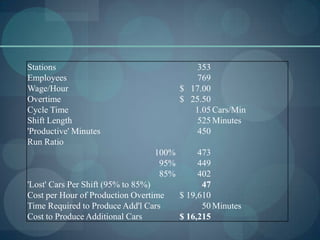
Stations 353
Employees 769
Wage/Hour $ 17.00
Overtime $ 25.50
Cycle Time 1.05 Cars/Min
Shift Length 525 Minutes
'Productive' Minutes 450
Run Ratio
100% 473
95% 449
85% 402
'Lost' Cars Per Shift (95% to 85%) 47
Cost per Hour of Production Overtime $ 19,610
Time Required to Produce Add'l Cars 50 Minutes
Cost to Produce Additional Cars $ 16,215
The Reason
 Product proliferation
 From 3 styles x 4 colors, to 36 different seat styles.
 Seats need to match each particular car, therefore stock
parts cannot be used.
 Sequential pull with a 57 sec line cycle time means
response time for KFS to come up with the next seat is
minimal
 Greater variety of styles and heijunka concept means more
frequent changes in seat line setup
 Suppliers operate under JIT
The Root Cause
 TMM did not internalize the TPS philosophy. It only
emulated the systems from Toyota, Japan.
 KFS balanced capacity to meet TMM Production. It
did not have the TPS implementation to respond to
the product proliferation.
 It only learnt system from the Japanese seat suppliers,
not the underlying philosophy.
 Not allowing the seat problem to be solved in real time
but just tagging it for storage in the rework area is a
gross violation of the jidoka concept.
The Snowballing Mistakes
 Thinking that it is too expensive to stop the line. Andon pulls
don’t stop the line at once. 353 workstations would slow down to
a halt depending upon time taken for rectification.
 Illegible re-order form instead of a proper kanban system might
be leading to slower turnaround from KFS
 Additional time pressure on KFS would further interrupt their
production line, deteriorating quality further
 KFS is blamed for the seat defects without going for the Five
Why’s to determine the root cause of the problem
 KFS being treated as a supplier as opposed to the partnership
model JIT actually professes
Suggestions
• Given that 88% of seat defects is from KFS, TMM needs to participate
in KFS’s QC Process, perhaps by placing its own personnel
• Defective items need to be fixed on assembly line and not postponed
• Design review needs to be done to see if so many different seat styles
are actually necessary
• Heijunka system may be avoided given the wide variety. This would
ensure that a replacement is at hand within 1 minute
• A drum-buffer-rope model of intimating KFS of replacement stock as
soon as it is discovered needs to be installed. A contingency kanban
may be designed.
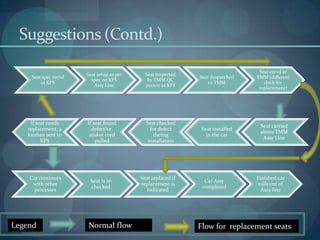
Suggestions (Contd.)
Seat spec recvd
at KFS
Seat setup as per
spec on KFS
Assy Line
Seat inspected
by TMM QC
person at KFS
Seat despatched
to TMM
Seat recvd at
TMM (different
dock for
replacement)
Seat carried
above TMM
Assy Line
Seat installed
in the car
Seat checked
for defect
during
installation
If seat found
defective,
andon cord
pulled
If seat needs
replacement, a
kanban sent to
KFS
Car continues
with other
processes
Seat is re-
checked.
Seat replaced if
replacement is
indicated
Car Assy
completed
Finished car
rolls out of
Assy line
Legend Normal flow Flow for replacement seats
Implementation
TMM should immediately implement the following measures:
 Assign an employee to manage seat correction and replacement
and implement a one-shift requirement.
 Designated area should be available for the vehicles with the seat
problems.
 Problems should be resolved by notifying the suppliers of
defective seats.
 Actions should be introduced to revise current procedures in
response to problems.
Recommendations
 TMM should consider the following long-term solutions:-
 Close relationship should be maintained between KFS,
TMM and TMC to over come barriers.
 TPS integration will benefit the Toyotas supplier network.
 TMM should recommend a reduction in the variety of
seats with TMC.
Risks and Contingencies
• TMC might not feel that the variety of seats could be
reduced.
• KFS might not be able to react to the increased
demand
• KFS could refuse to adopt TMM and TPS procedures

Toyota Motor Manufacturing Inc - Case Study

  • 1.
    TOYOTA MOTOR MANUFACTURINGINC. U.S.A Prepared By – Ashwin Mehta – 313 Pratik Mehta – 314 Ishaan Parekh – 315 Ankit shah – 317 Dishank Shah – 318 Fenil Shah - 319
  • 2.
    Agenda  Current Scenario Problems Faced  Analysis  Suggestions and recommendations  Risks and contingencies
  • 3.
    Current Scenario • ToyotaMotors Manufacturing (TMM) faces increasing problems with its seat supply. • Kentucky Framed Seat (KFS), is a single seat supplier for TMM. • KFS is responsible for the material flaws and missing parts as the major encountered defects. • These problems are increasingly occurring with an increase in varieties and demand for the seats.
  • 4.
    Problems Faced • Productproliferation problems with defective seats. • Company’s deviation from its normal production plan and lack of a recovery system. • Run ratio dropped from 95% to 85%. • This means 45 less cars were being produced per shift. • This translated in overtime of workers. • Too many cars needed off-line operations of one type or the another before they could go on shipping.
  • 5.
    Questions Raised • Willthe sales company get cars on time as promised? • What does it mean to implement JIT and Jidoka principles to this situation? • Is TMM handling seat defects correctly on the line? • Is the current routine for handling seat-defect cars really a legitimate exception to TPS, or could it be a dangerous deviation from TPS? • Is there a way to kaizen TMM’s off-line routine?
  • 6.
  • 7.
    The Problem  Risein number of Camry’s with defective seats, leading to a reduced run ratio at the TMM Georgetown Plant.
  • 8.
     On April27th the run ratio was down from 95% to a damaging 85%.  Decrease in per-shift production is close to 50 cars.  Producing the missing cars via overtime capacity will cost TMM in excess of $16,000 per shift.  This translates to around $8.4 Million per year considering two shifts and a 5-day workweek.
  • 9.
    Stations 353 Employees 769 Wage/Hour$ 17.00 Overtime $ 25.50 Cycle Time 1.05 Cars/Min Shift Length 525 Minutes 'Productive' Minutes 450 Run Ratio 100% 473 95% 449 85% 402 'Lost' Cars Per Shift (95% to 85%) 47 Cost per Hour of Production Overtime $ 19,610 Time Required to Produce Add'l Cars 50 Minutes Cost to Produce Additional Cars $ 16,215
  • 10.
    The Reason  Productproliferation  From 3 styles x 4 colors, to 36 different seat styles.  Seats need to match each particular car, therefore stock parts cannot be used.  Sequential pull with a 57 sec line cycle time means response time for KFS to come up with the next seat is minimal  Greater variety of styles and heijunka concept means more frequent changes in seat line setup  Suppliers operate under JIT
  • 11.
    The Root Cause TMM did not internalize the TPS philosophy. It only emulated the systems from Toyota, Japan.  KFS balanced capacity to meet TMM Production. It did not have the TPS implementation to respond to the product proliferation.  It only learnt system from the Japanese seat suppliers, not the underlying philosophy.  Not allowing the seat problem to be solved in real time but just tagging it for storage in the rework area is a gross violation of the jidoka concept.
  • 12.
    The Snowballing Mistakes Thinking that it is too expensive to stop the line. Andon pulls don’t stop the line at once. 353 workstations would slow down to a halt depending upon time taken for rectification.  Illegible re-order form instead of a proper kanban system might be leading to slower turnaround from KFS  Additional time pressure on KFS would further interrupt their production line, deteriorating quality further  KFS is blamed for the seat defects without going for the Five Why’s to determine the root cause of the problem  KFS being treated as a supplier as opposed to the partnership model JIT actually professes
  • 13.
    Suggestions • Given that88% of seat defects is from KFS, TMM needs to participate in KFS’s QC Process, perhaps by placing its own personnel • Defective items need to be fixed on assembly line and not postponed • Design review needs to be done to see if so many different seat styles are actually necessary • Heijunka system may be avoided given the wide variety. This would ensure that a replacement is at hand within 1 minute • A drum-buffer-rope model of intimating KFS of replacement stock as soon as it is discovered needs to be installed. A contingency kanban may be designed.
  • 14.
    Suggestions (Contd.) Seat specrecvd at KFS Seat setup as per spec on KFS Assy Line Seat inspected by TMM QC person at KFS Seat despatched to TMM Seat recvd at TMM (different dock for replacement) Seat carried above TMM Assy Line Seat installed in the car Seat checked for defect during installation If seat found defective, andon cord pulled If seat needs replacement, a kanban sent to KFS Car continues with other processes Seat is re- checked. Seat replaced if replacement is indicated Car Assy completed Finished car rolls out of Assy line Legend Normal flow Flow for replacement seats
  • 15.
    Implementation TMM should immediatelyimplement the following measures:  Assign an employee to manage seat correction and replacement and implement a one-shift requirement.  Designated area should be available for the vehicles with the seat problems.  Problems should be resolved by notifying the suppliers of defective seats.  Actions should be introduced to revise current procedures in response to problems.
  • 16.
    Recommendations  TMM shouldconsider the following long-term solutions:-  Close relationship should be maintained between KFS, TMM and TMC to over come barriers.  TPS integration will benefit the Toyotas supplier network.  TMM should recommend a reduction in the variety of seats with TMC.
  • 17.
    Risks and Contingencies •TMC might not feel that the variety of seats could be reduced. • KFS might not be able to react to the increased demand • KFS could refuse to adopt TMM and TPS procedures