

Just in time technology (JIT)
Presented by
Akash Dutta
Department of Mechanical Engineering
Indian Institute of Technology Guwahati
History of JIT
• First developed by Toyota
• Toyota not only applied JIT to its own production but also to its
supplier delivery operations
• Before JIT
o “just in case” production
o Large in-progress inventories to cope with production problems
• Other concepts related to JIT-
o Continuous flow manufacturing…IBM corporation
o Zero inventory production system…General Electric Company
o Zero inventory…American Production and Inventory Control
Society
9/21/2015
1
What is JIT?
• Supplying "what is needed, when it is needed, and in the amount
needed“
• Making "only what is needed, when it is needed, and in the amount
needed.“
The philosophy of JIT:
“the storage of unused inventory is a waste of resources”
Aim:
“the right material, at the right time, at the right place, and in the exact
amount”, without the safety net of inventory
9/21/2015
2
Features of JIT
• Reduction of wastage
• Pull system of production
• Use of kanbans
• Streamlined production
• Flexibility in production
• Low inventories
• Balanced system: Distribution of the workload evenly among
work stations
9/21/2015
3
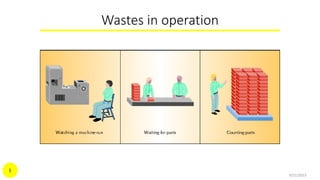
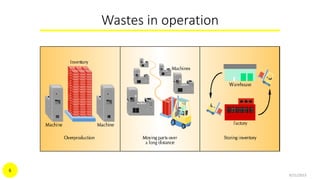
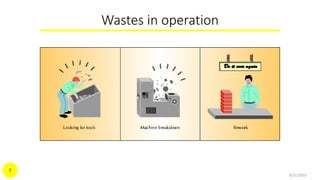
Reduction of wastes
“Waste is anything other than the minimum amount of equipment, materials,
parts, space, and worker’s time, which are absolutely essential to add value to
the product”
Shoichiro Toyoda
Sources of wastes:
• Overproduction
• Waiting
• Unnecessary transportation
• Inventory
• Inefficient work methods
• Inefficient processing
• Unnecessary motions
• Product defects
9/21/2015
4
Wastes in operation
9/21/2015
5
Wastes in operation
9/21/2015
6
Wastes in operation
9/21/2015
7
Push system of production
• Parts at each workstation are produced irrespective of the need for
them in the downstream workstation
• Pushes the parts through the plant
• More parts get produced than the system can handle
• Large work-in-progress inventory
• Overloaded factory
• Example: material requirement planning (MRP)
9/21/2015
8
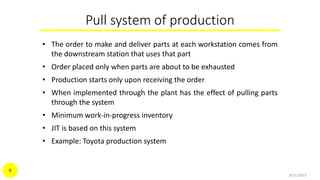
Pull system of production
• The order to make and deliver parts at each workstation comes from
the downstream station that uses that part
• Order placed only when parts are about to be exhausted
• Production starts only upon receiving the order
• When implemented through the plant has the effect of pulling parts
through the system
• Minimum work-in-progress inventory
• JIT is based on this system
• Example: Toyota production system
9/21/2015
9
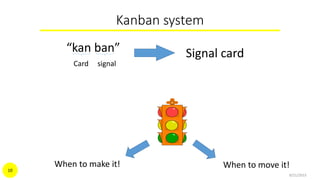
Kanban system
“kan ban”
Card signal
9/21/2015
10
Signal card
When to make it! When to move it!
Two types of kanban signal
1. Production kanban
o authorizes the upstream station to produce a batch of parts
o the parts produced are placed in containers so that the batch
quantity is just sufficient to fill It
o production more than this quantity is not allowed
2. Transportation kanban
o authorizes the movement of a batch of parts to the next
downstream station
9/21/2015
11
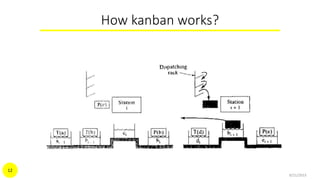
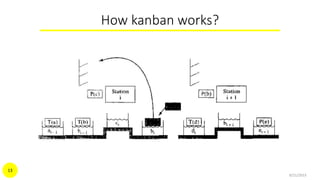
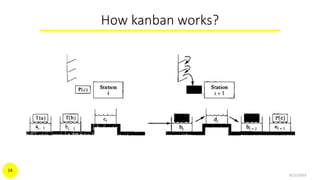
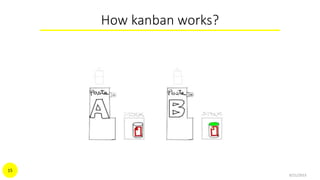
How kanban works?
9/21/2015
12
How kanban works?
9/21/2015
13
How kanban works?
9/21/2015
14
How kanban works?
9/21/2015
15
The production kanban signal
It tells us:
 when to make
 what to make
 how much to make
Types:
1. Production card
 Instructs us to make One Container
2. Signal (Triangle)
 Instructs us to produce One Lot
 Used when a work unit does not have the changeover capability
to produce one container for one production card
9/21/2015
16
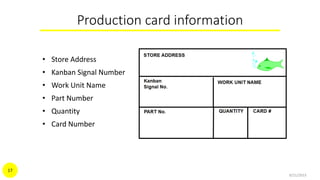
Production card information
• Store Address
• Kanban Signal Number
• Work Unit Name
• Part Number
• Quantity
• Card Number
9/21/2015
17
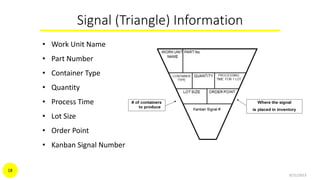
Signal (Triangle) Information
• Work Unit Name
• Part Number
• Container Type
• Quantity
• Process Time
• Lot Size
• Order Point
• Kanban Signal Number
9/21/2015
18
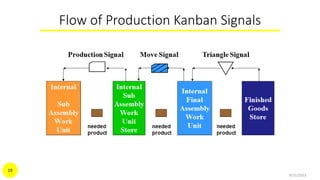
Flow of Production Kanban Signals
9/21/2015
19
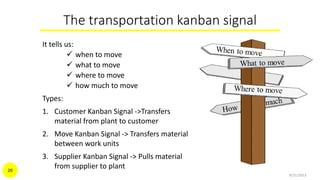
The transportation kanban signal
It tells us:
 when to move
 what to move
 where to move
 how much to move
Types:
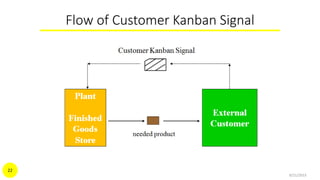
1. Customer Kanban Signal ->Transfers
material from plant to customer
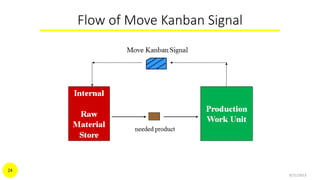
2. Move Kanban Signal -> Transfers material
between work units
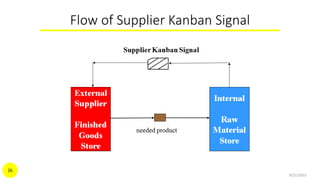
3. Supplier Kanban Signal -> Pulls material
from supplier to plant
9/21/2015
20
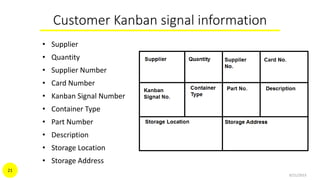
Customer Kanban signal information
• Supplier
• Quantity
• Supplier Number
• Card Number
• Kanban Signal Number
• Container Type
• Part Number
• Description
• Storage Location
• Storage Address
9/21/2015
21
Flow of Customer Kanban Signal
9/21/2015
22
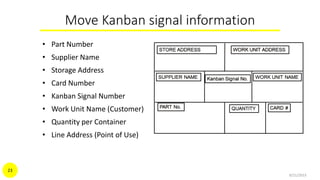
Move Kanban signal information
• Part Number
• Supplier Name
• Storage Address
• Card Number
• Kanban Signal Number
• Work Unit Name (Customer)
• Quantity per Container
• Line Address (Point of Use)
9/21/2015
23
Flow of Move Kanban Signal
9/21/2015
24
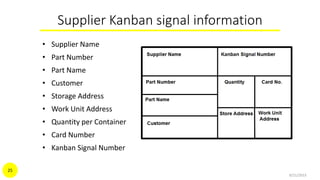
Supplier Kanban signal information
• Supplier Name
• Part Number
• Part Name
• Customer
• Storage Address
• Work Unit Address
• Quantity per Container
• Card Number
• Kanban Signal Number
9/21/2015
25
Flow of Supplier Kanban Signal
9/21/2015
26
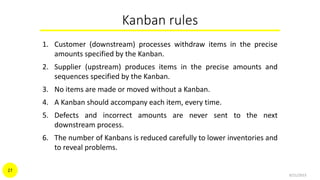
Kanban rules
1. Customer (downstream) processes withdraw items in the precise
amounts specified by the Kanban.
2. Supplier (upstream) produces items in the precise amounts and
sequences specified by the Kanban.
3. No items are made or moved without a Kanban.
4. A Kanban should accompany each item, every time.
5. Defects and incorrect amounts are never sent to the next
downstream process.
6. The number of Kanbans is reduced carefully to lower inventories and
to reveal problems.
9/21/2015
27
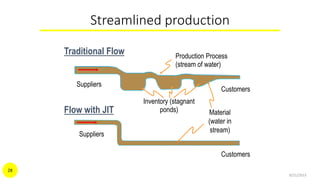
Streamlined production
9/21/2015
28
Flow with JIT
Traditional Flow
Customers
Suppliers
Customers
Suppliers
Production Process
(stream of water)
Inventory (stagnant
ponds) Material
(water in
stream)
Inventories
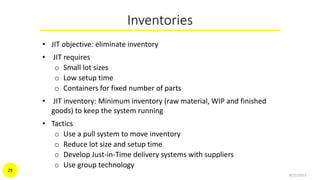
• JIT objective: eliminate inventory
• JIT requires
o Small lot sizes
o Low setup time
o Containers for fixed number of parts
• JIT inventory: Minimum inventory (raw material, WIP and finished
goods) to keep the system running
• Tactics
o Use a pull system to move inventory
o Reduce lot size and setup time
o Develop Just-in-Time delivery systems with suppliers
o Use group technology
9/21/2015
29
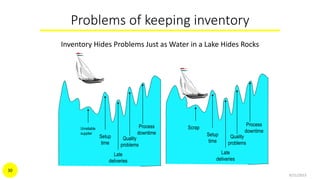
Problems of keeping inventory
Inventory Hides Problems Just as Water in a Lake Hides Rocks
9/21/2015
30
Unreliable
supplier
Setup
time
Late
deliveries
Quality
problems
Process
downtime
Scrap
Setup
time
Late
deliveries
Quality
problems
Process
downtime
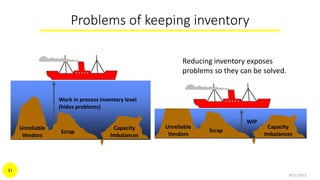
Problems of keeping inventory
9/21/2015
31
Scrap
Work in process inventory level
(hides problems)
Unreliable
Vendors
Capacity
Imbalances
Scrap
Reducing inventory exposes
problems so they can be solved.
Unreliable
Vendors
Capacity
Imbalances
WIP
Quality improvement
• JIT exposes quality problems by reducing inventory
• JIT eliminates number defects with small lots
• JIT requires quality by suppliers
• Team approach and continuous improvement are important for
ensuring quality
• Quality is maintained by the following procedure:
• Find the root cause of the problem, solve permanently and use team
approach in solving the problems
9/21/2015
32
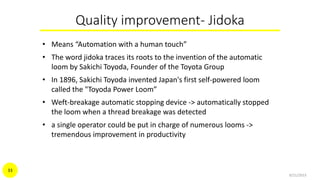
Quality improvement- Jidoka
• Means “Automation with a human touch”
• The word jidoka traces its roots to the invention of the automatic
loom by Sakichi Toyoda, Founder of the Toyota Group
• In 1896, Sakichi Toyoda invented Japan's first self-powered loom
called the "Toyoda Power Loom”
• Weft-breakage automatic stopping device -> automatically stopped
the loom when a thread breakage was detected
• a single operator could be put in charge of numerous looms ->
tremendous improvement in productivity
9/21/2015
33
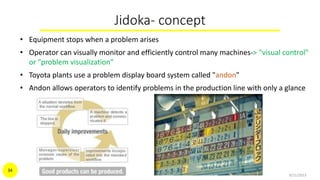
Jidoka- concept
• Equipment stops when a problem arises
• Operator can visually monitor and efficiently control many machines-> "visual control"
or "problem visualization“
• Toyota plants use a problem display board system called "andon"
• Andon allows operators to identify problems in the production line with only a glance
9/21/2015
34
Requirements for JIT
1. Stable production schedule
2. Small batch sizes and short set-up times
3. On time delivery
4. Defect free components and materials
5. Reliable production equipment
6. Pull system of production control
7. Capable, committed and co-operative work force
8. Dependable supplier base
9/21/2015
35
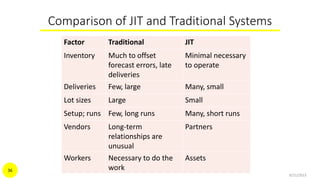
Comparison of JIT and Traditional Systems
9/21/2015
36
Factor Traditional JIT
Inventory Much to offset
forecast errors, late
deliveries
Minimal necessary
to operate
Deliveries Few, large Many, small
Lot sizes Large Small
Setup; runs Few, long runs Many, short runs
Vendors Long-term
relationships are
unusual
Partners
Workers Necessary to do the
work
Assets
References
1. M. P. Groover, Automation, Production Systems, and Computer-
integrated Manufacturing, 2009, 769-777
2. http://www.toyota.com.au/toyota/company/operations/toyota-
production-system
9/21/2015
37
THANKS

Just in time technology (JIT)

  • 1.
    Just in timetechnology (JIT) Presented by Akash Dutta Department of Mechanical Engineering Indian Institute of Technology Guwahati
  • 2.
    History of JIT •First developed by Toyota • Toyota not only applied JIT to its own production but also to its supplier delivery operations • Before JIT o “just in case” production o Large in-progress inventories to cope with production problems • Other concepts related to JIT- o Continuous flow manufacturing…IBM corporation o Zero inventory production system…General Electric Company o Zero inventory…American Production and Inventory Control Society 9/21/2015 1
  • 3.
    What is JIT? •Supplying "what is needed, when it is needed, and in the amount needed“ • Making "only what is needed, when it is needed, and in the amount needed.“ The philosophy of JIT: “the storage of unused inventory is a waste of resources” Aim: “the right material, at the right time, at the right place, and in the exact amount”, without the safety net of inventory 9/21/2015 2
  • 4.
    Features of JIT •Reduction of wastage • Pull system of production • Use of kanbans • Streamlined production • Flexibility in production • Low inventories • Balanced system: Distribution of the workload evenly among work stations 9/21/2015 3
  • 5.
    Reduction of wastes “Wasteis anything other than the minimum amount of equipment, materials, parts, space, and worker’s time, which are absolutely essential to add value to the product” Shoichiro Toyoda Sources of wastes: • Overproduction • Waiting • Unnecessary transportation • Inventory • Inefficient work methods • Inefficient processing • Unnecessary motions • Product defects 9/21/2015 4
  • 6.
  • 7.
  • 8.
  • 9.
    Push system ofproduction • Parts at each workstation are produced irrespective of the need for them in the downstream workstation • Pushes the parts through the plant • More parts get produced than the system can handle • Large work-in-progress inventory • Overloaded factory • Example: material requirement planning (MRP) 9/21/2015 8
  • 10.
    Pull system ofproduction • The order to make and deliver parts at each workstation comes from the downstream station that uses that part • Order placed only when parts are about to be exhausted • Production starts only upon receiving the order • When implemented through the plant has the effect of pulling parts through the system • Minimum work-in-progress inventory • JIT is based on this system • Example: Toyota production system 9/21/2015 9
  • 11.
    Kanban system “kan ban” Cardsignal 9/21/2015 10 Signal card When to make it! When to move it!
  • 12.
    Two types ofkanban signal 1. Production kanban o authorizes the upstream station to produce a batch of parts o the parts produced are placed in containers so that the batch quantity is just sufficient to fill It o production more than this quantity is not allowed 2. Transportation kanban o authorizes the movement of a batch of parts to the next downstream station 9/21/2015 11
  • 13.
  • 14.
  • 15.
  • 16.
  • 17.
    The production kanbansignal It tells us:  when to make  what to make  how much to make Types: 1. Production card  Instructs us to make One Container 2. Signal (Triangle)  Instructs us to produce One Lot  Used when a work unit does not have the changeover capability to produce one container for one production card 9/21/2015 16
  • 18.
    Production card information •Store Address • Kanban Signal Number • Work Unit Name • Part Number • Quantity • Card Number 9/21/2015 17
  • 19.
    Signal (Triangle) Information •Work Unit Name • Part Number • Container Type • Quantity • Process Time • Lot Size • Order Point • Kanban Signal Number 9/21/2015 18
  • 20.
    Flow of ProductionKanban Signals 9/21/2015 19
  • 21.
    The transportation kanbansignal It tells us:  when to move  what to move  where to move  how much to move Types: 1. Customer Kanban Signal ->Transfers material from plant to customer 2. Move Kanban Signal -> Transfers material between work units 3. Supplier Kanban Signal -> Pulls material from supplier to plant 9/21/2015 20
  • 22.
    Customer Kanban signalinformation • Supplier • Quantity • Supplier Number • Card Number • Kanban Signal Number • Container Type • Part Number • Description • Storage Location • Storage Address 9/21/2015 21
  • 23.
    Flow of CustomerKanban Signal 9/21/2015 22
  • 24.
    Move Kanban signalinformation • Part Number • Supplier Name • Storage Address • Card Number • Kanban Signal Number • Work Unit Name (Customer) • Quantity per Container • Line Address (Point of Use) 9/21/2015 23
  • 25.
    Flow of MoveKanban Signal 9/21/2015 24
  • 26.
    Supplier Kanban signalinformation • Supplier Name • Part Number • Part Name • Customer • Storage Address • Work Unit Address • Quantity per Container • Card Number • Kanban Signal Number 9/21/2015 25
  • 27.
    Flow of SupplierKanban Signal 9/21/2015 26
  • 28.
    Kanban rules 1. Customer(downstream) processes withdraw items in the precise amounts specified by the Kanban. 2. Supplier (upstream) produces items in the precise amounts and sequences specified by the Kanban. 3. No items are made or moved without a Kanban. 4. A Kanban should accompany each item, every time. 5. Defects and incorrect amounts are never sent to the next downstream process. 6. The number of Kanbans is reduced carefully to lower inventories and to reveal problems. 9/21/2015 27
  • 29.
    Streamlined production 9/21/2015 28 Flow withJIT Traditional Flow Customers Suppliers Customers Suppliers Production Process (stream of water) Inventory (stagnant ponds) Material (water in stream)
  • 30.
    Inventories • JIT objective:eliminate inventory • JIT requires o Small lot sizes o Low setup time o Containers for fixed number of parts • JIT inventory: Minimum inventory (raw material, WIP and finished goods) to keep the system running • Tactics o Use a pull system to move inventory o Reduce lot size and setup time o Develop Just-in-Time delivery systems with suppliers o Use group technology 9/21/2015 29
  • 31.
    Problems of keepinginventory Inventory Hides Problems Just as Water in a Lake Hides Rocks 9/21/2015 30 Unreliable supplier Setup time Late deliveries Quality problems Process downtime Scrap Setup time Late deliveries Quality problems Process downtime
  • 32.
    Problems of keepinginventory 9/21/2015 31 Scrap Work in process inventory level (hides problems) Unreliable Vendors Capacity Imbalances Scrap Reducing inventory exposes problems so they can be solved. Unreliable Vendors Capacity Imbalances WIP
  • 33.
    Quality improvement • JITexposes quality problems by reducing inventory • JIT eliminates number defects with small lots • JIT requires quality by suppliers • Team approach and continuous improvement are important for ensuring quality • Quality is maintained by the following procedure: • Find the root cause of the problem, solve permanently and use team approach in solving the problems 9/21/2015 32
  • 34.
    Quality improvement- Jidoka •Means “Automation with a human touch” • The word jidoka traces its roots to the invention of the automatic loom by Sakichi Toyoda, Founder of the Toyota Group • In 1896, Sakichi Toyoda invented Japan's first self-powered loom called the "Toyoda Power Loom” • Weft-breakage automatic stopping device -> automatically stopped the loom when a thread breakage was detected • a single operator could be put in charge of numerous looms -> tremendous improvement in productivity 9/21/2015 33
  • 35.
    Jidoka- concept • Equipmentstops when a problem arises • Operator can visually monitor and efficiently control many machines-> "visual control" or "problem visualization“ • Toyota plants use a problem display board system called "andon" • Andon allows operators to identify problems in the production line with only a glance 9/21/2015 34
  • 36.
    Requirements for JIT 1.Stable production schedule 2. Small batch sizes and short set-up times 3. On time delivery 4. Defect free components and materials 5. Reliable production equipment 6. Pull system of production control 7. Capable, committed and co-operative work force 8. Dependable supplier base 9/21/2015 35
  • 37.
    Comparison of JITand Traditional Systems 9/21/2015 36 Factor Traditional JIT Inventory Much to offset forecast errors, late deliveries Minimal necessary to operate Deliveries Few, large Many, small Lot sizes Large Small Setup; runs Few, long runs Many, short runs Vendors Long-term relationships are unusual Partners Workers Necessary to do the work Assets
  • 38.
    References 1. M. P.Groover, Automation, Production Systems, and Computer- integrated Manufacturing, 2009, 769-777 2. http://www.toyota.com.au/toyota/company/operations/toyota- production-system 9/21/2015 37
  • 39.

Editor's Notes

  • #3 Continuous flow manufacturing suggests a method in which work parts are processed and transported directly to the next work station one at a time. Each process is completed just before the next process in the sequence begins. This is jit with a batch size of unity. Production problems like late deliveries of componenrs, machine breakdowns, defective components
  • #4 For example, to efficiently produce a large number of automobiles, which can consist of around 30,000 parts, it is necessary to create a detailed production plan that includes parts procurement. Write about the Toyota parts procurement and manufacturing Eliminates waste, inconsistencies, and unreasonable requirements, resulting in improved productivity. Inventory is a necessary evil