MRP-II
&
ENTERPRISE RESOURCE
PLANNING (ERP)
Compiled by
Somashekar S M
Contents
• Introduction to MRP-II
• MRP-II
• Basic terminologies associated with MRP-II
• Flow structure for MRP-II
• Working of MRP-II
• Introduction to ERP
• ERP
• ERP functioning
• Scope for ERP
• Benefits of ERP
Introduction
• In a manufacturing organization, MRP system takes care of
planning and scheduling time-phased (Time schedule to
receipt amount of material at right interval) material
requirements.
• However total focus towards this system may impede
functions of other production related departments such as
sales, finance, design, purchasing etc.,
• Nevertheless, duties such as providing input data required for
processing of MRP as will as monitoring outputs of MRP can
be carried in liaise with other departments.
• So, there is a need for a comprehensive approach for the
whole organization rather than looking only at raw material
requirement of production department.
Manufacturing Resources Planning (MRP-II)
• MRP-II, is an integrated information system that synchronizes
all aspects (not just manufacturing) of the business.
• In other words, MRP-II coordinates the activities of sales,
Purchasing, Design, Manufacturing, Finance and Engineering
departments by adopting a total production plan by using
unified database.
• MRP-I is concerned primarily with manufacturing materials
while MRPII is concerned with the coordination of the entire
manufacturing production, including materials, finance, and
human relations.
Basic terminologies associated with MRP-II
• Shop floor: The shop floor is the floor of a factory (machine
shop) where people work on machines.
• Shop floor control: It includes the principles and techniques
that are necessary to schedule, control and evaluate the
effectiveness of production operations.
• * It includes the procedures used to evaluate current resource
status, labour, machine usage, and other information
required to support the overall planning, scheduling, and
costing systems related to shop floor operation.
• Capacity planning: is the process of determining the
production capacity needed by an organization to meet
changing demands for its products.
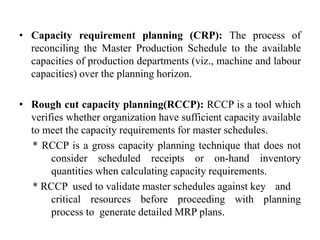
• Capacity requirement planning (CRP): The process of
reconciling the Master Production Schedule to the available
capacities of production departments (viz., machine and labour
capacities) over the planning horizon.
• Rough cut capacity planning(RCCP): RCCP is a tool which
verifies whether organization have sufficient capacity available
to meet the capacity requirements for master schedules.
* RCCP is a gross capacity planning technique that does not
consider scheduled receipts or on-hand inventory
quantities when calculating capacity requirements.
* RCCP used to validate master schedules against key and
critical resources before proceeding with planning
process to generate detailed MRP plans.
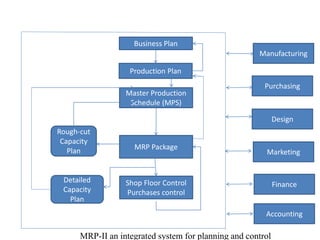
MRP-II an integrated system for planning and control
Business Plan
Production Plan
Master Production
Schedule (MPS)
MRP Package
Rough-cut
Capacity
Plan
Shop Floor Control
Purchases control
Detailed
Capacity
Plan
Manufacturing
Purchasing
Design
Marketing
Finance
Accounting
Working of MRP-II
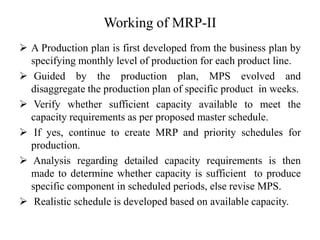
 A Production plan is first developed from the business plan by
specifying monthly level of production for each product line.
 Guided by the production plan, MPS evolved and
disaggregate the production plan of specific product in weeks.
 Verify whether sufficient capacity available to meet the
capacity requirements as per proposed master schedule.
 If yes, continue to create MRP and priority schedules for
production.
 Analysis regarding detailed capacity requirements is then
made to determine whether capacity is sufficient to produce
specific component in scheduled periods, else revise MPS.
 Realistic schedule is developed based on available capacity.
• Now execute plans by generating purchase schedules and shop
schedules.
• Through MRP interaction with various functional departments
established.
Introduction to ERP
• Enterprise resource planning, popularly known as ERP, is
today’s buzz-word in the corporate world.
• Companies world-wide use ERP to integrate business
processes and thereby reduce costs and increase productivity.
• Traditionally companies develop isolated computer
applications to suit and satisfy each of their functional
segments such as sales, purchase, production, inventory,
personnel and accounts.
• MRP and MRP-II were developed basically to address the
requirements of the manufacturing set-up.
• But the information available in various functional segments
was so scattered that it was almost impossible to consolidate
the information and provide the same to top management to
enable them to take vital business decisions.
Enterprise Resource Planning (ERP)
• ERP is a software package developed for optimum use of
resources of an enterprise in a planned manner.
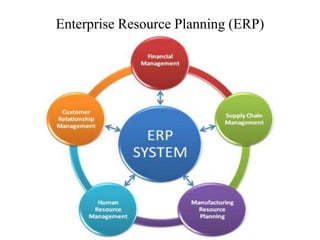
• ERP integrates the entire enterprise starting from the supplier
to the customer, covering logistics, financial and human
resources.
• This will enable the enterprise to increase productivity by
reducing costs.
• ERP is a package of cost saving.
• Once the ERP is implemented, a single solution addresses the
information needs the whole organization.
Enterprise Resource Planning (ERP)
ERP Functioning
• Following example gives simple understanding of how ERP
functions,
 Suppose, an order is placed by the dealer, then the ERP,
 checks for stock
 reserves the inventory for dispatch
 opens the dealer account to verify the credit limit of the
dealer and processes the order.
 If credit limit exceeds, then it holds the order.
 All these functions are carried out instantaneously, as ERP
integrates production, logistics, distribution, marketing,
finance and human resource and development.
Scope for ERP
• The various areas normally covered by ERP are;
 Financials: Financial accounting, treasury management,
asset management and enterprise control.
 Logistics: Production planning, materials management,
plant maintenance, quality management, project
management, sales and distribution management.
 Human resources: Personnel management, training and
skills development.
 Work flow: Integrates the entire organization with flexible
assignment of tasks and responsibilities to locations,
positions, jobs, groups or individuals.
Benefits of ERP
• Reduction of lead time.
• On-time shipments.
• Doubled business.
• Increase of turnover.
• Reduction of cycle time.
• Better customer satisfaction.
• Improved vendor performance.
• Reduced quality costs.
• Improved resource utilization.
• Improved information accuracy.
• Improved decision making capability

MRP-II

  • 1.
  • 2.
    Contents • Introduction toMRP-II • MRP-II • Basic terminologies associated with MRP-II • Flow structure for MRP-II • Working of MRP-II • Introduction to ERP • ERP • ERP functioning • Scope for ERP • Benefits of ERP
  • 3.
    Introduction • In amanufacturing organization, MRP system takes care of planning and scheduling time-phased (Time schedule to receipt amount of material at right interval) material requirements. • However total focus towards this system may impede functions of other production related departments such as sales, finance, design, purchasing etc., • Nevertheless, duties such as providing input data required for processing of MRP as will as monitoring outputs of MRP can be carried in liaise with other departments. • So, there is a need for a comprehensive approach for the whole organization rather than looking only at raw material requirement of production department.
  • 4.
    Manufacturing Resources Planning(MRP-II) • MRP-II, is an integrated information system that synchronizes all aspects (not just manufacturing) of the business. • In other words, MRP-II coordinates the activities of sales, Purchasing, Design, Manufacturing, Finance and Engineering departments by adopting a total production plan by using unified database. • MRP-I is concerned primarily with manufacturing materials while MRPII is concerned with the coordination of the entire manufacturing production, including materials, finance, and human relations.
  • 5.
    Basic terminologies associatedwith MRP-II • Shop floor: The shop floor is the floor of a factory (machine shop) where people work on machines. • Shop floor control: It includes the principles and techniques that are necessary to schedule, control and evaluate the effectiveness of production operations. • * It includes the procedures used to evaluate current resource status, labour, machine usage, and other information required to support the overall planning, scheduling, and costing systems related to shop floor operation. • Capacity planning: is the process of determining the production capacity needed by an organization to meet changing demands for its products.
  • 6.
    • Capacity requirementplanning (CRP): The process of reconciling the Master Production Schedule to the available capacities of production departments (viz., machine and labour capacities) over the planning horizon. • Rough cut capacity planning(RCCP): RCCP is a tool which verifies whether organization have sufficient capacity available to meet the capacity requirements for master schedules. * RCCP is a gross capacity planning technique that does not consider scheduled receipts or on-hand inventory quantities when calculating capacity requirements. * RCCP used to validate master schedules against key and critical resources before proceeding with planning process to generate detailed MRP plans.
  • 7.
    MRP-II an integratedsystem for planning and control Business Plan Production Plan Master Production Schedule (MPS) MRP Package Rough-cut Capacity Plan Shop Floor Control Purchases control Detailed Capacity Plan Manufacturing Purchasing Design Marketing Finance Accounting
  • 8.
    Working of MRP-II A Production plan is first developed from the business plan by specifying monthly level of production for each product line.  Guided by the production plan, MPS evolved and disaggregate the production plan of specific product in weeks.  Verify whether sufficient capacity available to meet the capacity requirements as per proposed master schedule.  If yes, continue to create MRP and priority schedules for production.  Analysis regarding detailed capacity requirements is then made to determine whether capacity is sufficient to produce specific component in scheduled periods, else revise MPS.  Realistic schedule is developed based on available capacity.
  • 9.
    • Now executeplans by generating purchase schedules and shop schedules. • Through MRP interaction with various functional departments established.
  • 10.
    Introduction to ERP •Enterprise resource planning, popularly known as ERP, is today’s buzz-word in the corporate world. • Companies world-wide use ERP to integrate business processes and thereby reduce costs and increase productivity. • Traditionally companies develop isolated computer applications to suit and satisfy each of their functional segments such as sales, purchase, production, inventory, personnel and accounts. • MRP and MRP-II were developed basically to address the requirements of the manufacturing set-up. • But the information available in various functional segments was so scattered that it was almost impossible to consolidate the information and provide the same to top management to enable them to take vital business decisions.
  • 11.
    Enterprise Resource Planning(ERP) • ERP is a software package developed for optimum use of resources of an enterprise in a planned manner. • ERP integrates the entire enterprise starting from the supplier to the customer, covering logistics, financial and human resources. • This will enable the enterprise to increase productivity by reducing costs. • ERP is a package of cost saving. • Once the ERP is implemented, a single solution addresses the information needs the whole organization.
  • 12.
  • 13.
    ERP Functioning • Followingexample gives simple understanding of how ERP functions,  Suppose, an order is placed by the dealer, then the ERP,  checks for stock  reserves the inventory for dispatch  opens the dealer account to verify the credit limit of the dealer and processes the order.  If credit limit exceeds, then it holds the order.  All these functions are carried out instantaneously, as ERP integrates production, logistics, distribution, marketing, finance and human resource and development.
  • 14.
    Scope for ERP •The various areas normally covered by ERP are;  Financials: Financial accounting, treasury management, asset management and enterprise control.  Logistics: Production planning, materials management, plant maintenance, quality management, project management, sales and distribution management.  Human resources: Personnel management, training and skills development.  Work flow: Integrates the entire organization with flexible assignment of tasks and responsibilities to locations, positions, jobs, groups or individuals.
  • 15.
    Benefits of ERP •Reduction of lead time. • On-time shipments. • Doubled business. • Increase of turnover. • Reduction of cycle time. • Better customer satisfaction. • Improved vendor performance. • Reduced quality costs. • Improved resource utilization. • Improved information accuracy. • Improved decision making capability