Yashpal Ghate   (M-11-16)
Just in time………….

 Keeping work flows moving
 Eliminating inventories
 Reducing travel distances
 Eliminating defects and scrap
 Maximizing usage of space
• Just-In-Time is a Japanese manufacturing management
  method that was developed in the 1970‟s.

• It was first adopted by Toyota manufacturing plants by
  Taiichi Ohno.

• Producing only what is needed, when it is needed (not
  early, not late; not less, not more)
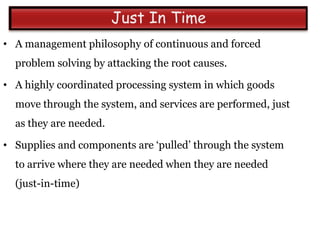
• A management philosophy of continuous and forced
  problem solving by attacking the root causes.

• A highly coordinated processing system in which goods
  move through the system, and services are performed, just
  as they are needed.

• Supplies and components are „pulled‟ through the system
  to arrive where they are needed when they are needed
  (just-in-time)
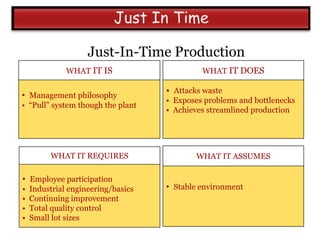
Just-In-Time Production
              WHAT IT IS                     WHAT IT DOES

                                    • Attacks waste
• Management philosophy
                                    • Exposes problems and bottlenecks
• “Pull” system though the plant
                                    • Achieves streamlined production


         WHAT IT REQUIRES                   WHAT IT ASSUMES

• Employee participation
•   Industrial engineering/basics   • Stable environment
•   Continuing improvement
•   Total quality control
•   Small lot sizes
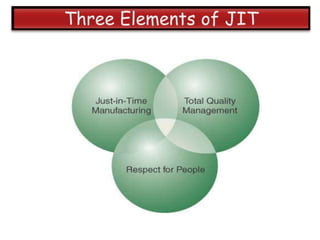
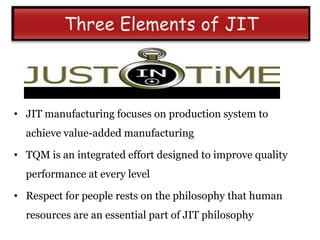
• JIT manufacturing focuses on production system to
  achieve value-added manufacturing

• TQM is an integrated effort designed to improve quality
  performance at every level

• Respect for people rests on the philosophy that human
  resources are an essential part of JIT philosophy
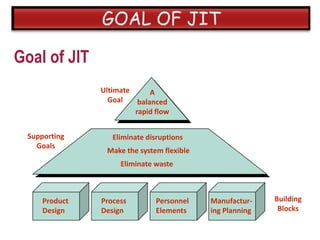
Goal of JIT
               Ultimate      A
                 Goal    balanced
                        rapid flow


 Supporting       Eliminate disruptions
   Goals
                Make the system flexible
                    Eliminate waste


     Product   Process        Personnel    Manufactur-    Building
     Design    Design         Elements     ing Planning    Blocks
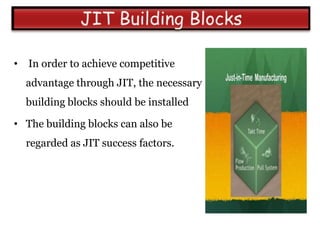
•   In order to achieve competitive
    advantage through JIT, the necessary
    building blocks should be installed

• The building blocks can also be
    regarded as JIT success factors.
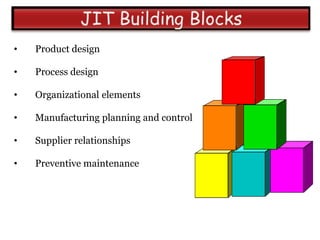
•   Product design

•   Process design

•   Organizational elements

•   Manufacturing planning and control

•   Supplier relationships

•   Preventive maintenance
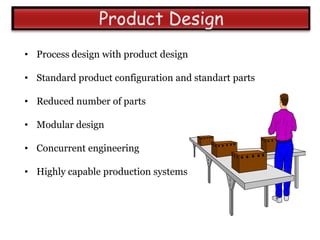
• Process design with product design

• Standard product configuration and standart parts

• Reduced number of parts

• Modular design

• Concurrent engineering

• Highly capable production systems
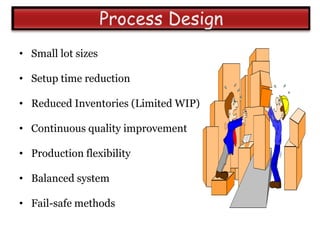
• Small lot sizes

• Setup time reduction

• Reduced Inventories (Limited WIP)

• Continuous quality improvement

• Production flexibility

• Balanced system

• Fail-safe methods
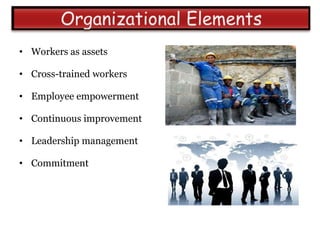
• Workers as assets

• Cross-trained workers

• Employee empowerment

• Continuous improvement

• Leadership management

• Commitment
• Uniform production levels

•   Level loading (level schedules)

•   Pull systems

•   Visual systems

•   Reduced transaction processing
• Reduced number of vendors

•   Supportive supplier relationships

•   Quality deliveries on time

•   Frequent deliveries in small lot quantities

•   Reduced lead times

•   Reduced transaction processing

•   Certified vendors
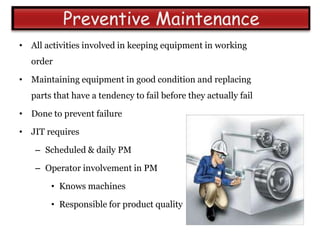
• All activities involved in keeping equipment in working
   order

• Maintaining equipment in good condition and replacing
   parts that have a tendency to fail before they actually fail

• Done to prevent failure

• JIT requires

    – Scheduled & daily PM

    – Operator involvement in PM

        • Knows machines

        • Responsible for product quality
Preconditions to JIT

• Recognition of Processes

• Quality at the source

• Agreement over value and waste

• Trust must be present

  - labor/management

  - suppliers/consumers
• Management may not be committed

• Workers/management may not be cooperative

• May be difficult to change company culture

• Suppliers may resist
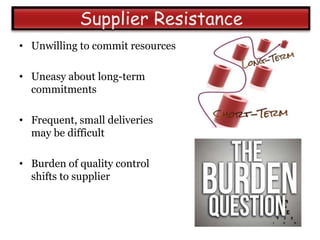
• Unwilling to commit resources

• Uneasy about long-term
  commitments

• Frequent, small deliveries
  may be difficult

• Burden of quality control
  shifts to supplier
• Use single-source suppliers when possible

• Build long-term relationships
        .
• Work together to certify processes

• Co-locate facilities to reduce transport
  if possible

• Stabilize delivery schedules

• Share cost & other information
•   Reduced inventory

•   Improved quality

•   Lower costs

•   Reduced space requirements

•   Reduced lead times

•   Increased productivity

•   Reduced scrap and rework
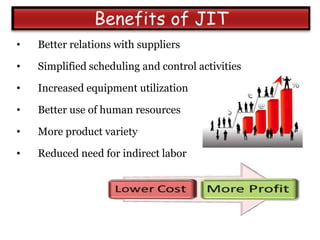
•   Better relations with suppliers

•   Simplified scheduling and control activities

•   Increased equipment utilization

•   Better use of human resources

•   More product variety

•   Reduced need for indirect labor
Just in time

Just in time

  • 1.
    Yashpal Ghate (M-11-16)
  • 2.
    Just in time…………. Keeping work flows moving Eliminating inventories Reducing travel distances Eliminating defects and scrap Maximizing usage of space
  • 3.
    • Just-In-Time isa Japanese manufacturing management method that was developed in the 1970‟s. • It was first adopted by Toyota manufacturing plants by Taiichi Ohno. • Producing only what is needed, when it is needed (not early, not late; not less, not more)
  • 4.
    • A managementphilosophy of continuous and forced problem solving by attacking the root causes. • A highly coordinated processing system in which goods move through the system, and services are performed, just as they are needed. • Supplies and components are „pulled‟ through the system to arrive where they are needed when they are needed (just-in-time)
  • 5.
    Just-In-Time Production WHAT IT IS WHAT IT DOES • Attacks waste • Management philosophy • Exposes problems and bottlenecks • “Pull” system though the plant • Achieves streamlined production WHAT IT REQUIRES WHAT IT ASSUMES • Employee participation • Industrial engineering/basics • Stable environment • Continuing improvement • Total quality control • Small lot sizes
  • 7.
    • JIT manufacturingfocuses on production system to achieve value-added manufacturing • TQM is an integrated effort designed to improve quality performance at every level • Respect for people rests on the philosophy that human resources are an essential part of JIT philosophy
  • 8.
    Goal of JIT Ultimate A Goal balanced rapid flow Supporting Eliminate disruptions Goals Make the system flexible Eliminate waste Product Process Personnel Manufactur- Building Design Design Elements ing Planning Blocks
  • 9.
    In order to achieve competitive advantage through JIT, the necessary building blocks should be installed • The building blocks can also be regarded as JIT success factors.
  • 10.
    Product design • Process design • Organizational elements • Manufacturing planning and control • Supplier relationships • Preventive maintenance
  • 11.
    • Process designwith product design • Standard product configuration and standart parts • Reduced number of parts • Modular design • Concurrent engineering • Highly capable production systems
  • 12.
    • Small lotsizes • Setup time reduction • Reduced Inventories (Limited WIP) • Continuous quality improvement • Production flexibility • Balanced system • Fail-safe methods
  • 13.
    • Workers asassets • Cross-trained workers • Employee empowerment • Continuous improvement • Leadership management • Commitment
  • 14.
    • Uniform productionlevels • Level loading (level schedules) • Pull systems • Visual systems • Reduced transaction processing
  • 15.
    • Reduced numberof vendors • Supportive supplier relationships • Quality deliveries on time • Frequent deliveries in small lot quantities • Reduced lead times • Reduced transaction processing • Certified vendors
  • 16.
    • All activitiesinvolved in keeping equipment in working order • Maintaining equipment in good condition and replacing parts that have a tendency to fail before they actually fail • Done to prevent failure • JIT requires – Scheduled & daily PM – Operator involvement in PM • Knows machines • Responsible for product quality
  • 17.
    Preconditions to JIT •Recognition of Processes • Quality at the source • Agreement over value and waste • Trust must be present - labor/management - suppliers/consumers
  • 18.
    • Management maynot be committed • Workers/management may not be cooperative • May be difficult to change company culture • Suppliers may resist
  • 19.
    • Unwilling tocommit resources • Uneasy about long-term commitments • Frequent, small deliveries may be difficult • Burden of quality control shifts to supplier
  • 20.
    • Use single-sourcesuppliers when possible • Build long-term relationships . • Work together to certify processes • Co-locate facilities to reduce transport if possible • Stabilize delivery schedules • Share cost & other information
  • 21.
    Reduced inventory • Improved quality • Lower costs • Reduced space requirements • Reduced lead times • Increased productivity • Reduced scrap and rework
  • 22.
    Better relations with suppliers • Simplified scheduling and control activities • Increased equipment utilization • Better use of human resources • More product variety • Reduced need for indirect labor