LOGISTICS BY WATERWAYS
By:
Pankaj Kumar Taywade
MT14IND014
M. Tech.(Industrial Engineering)
2014-15
Mechanical Engineering
VNIT, Nagpur
What is waterways?
• A river, canal, or other body of water serving
as a route or way of travel or transport is
known as waterways.
Classification of waterways
Inland water transport
• A stretch of water, not part of the sea, over which craft of a carrying
capacity not less than 50 tonnes can navigate when normally loaded.
• This term covers both navigable rivers and lakes (natural water courses,
whether or not they have been improved for navigation purposes) and
canals (water ways constructed primarily for the purpose of navigation)
• Inland waterways of India is designated as National waterways by the
government.
States/ UTs Total length of rivers/lakes in state(km) Navigable
length(km)
1 Andhra Pradesh 2501 791
2 Assam 3700 2584
3 Bihar 3763 1391
4 Goa 260 202
5 Gujrat 801.5 129
6 Jammu & Kashmir ….. …..
7 Karnataka 2465 425
8 Kerla 3092 845.2
Table : State wise Total and Navigable Length of Waterways as on 31st March, 2007
S.No
.
States/UTs Total length of river/lake in state(km) Total
Navigable
length(km)
9 Maharashtra 611 453
10 Orissa 1840 1650
11 Nagaland 937 375
12 Mizoram 559 293
13 Tamilnadu 170.1 …..
14 Uttarpradesh ….. …..
15 West Bengal 4741 4593
16 A & N Island ….. …..
TOTAL 25440.6 13731.2
….. Not Available
Source : Statistics of Inland Water Transport , M/O Shipping
National Waterways
• National waterway 1 :
The Ganga – Bhagirathi – Hooghly river from Haldia to Allahabad - 1620
km. Declared as National waterway in 1986
• National waterway 2 :
The Bramhaputra from Dhubri to Sadiya – 891km ,declared as National
waterways in 1988
• National waterway 3 :
Kottapuram – Kollam sector of West Coast canal with Champakara &
Udyogmandal canals – 205 km, declared as national waterway in 1993.
Proposed waterways
• Proposed National Water Ways 1 :
Kakinada – Puducherry Canals integrated with rivers Godavari and Krishna,
Length – 1095 km
• Proposed National Water Ways 2 :
East Coast Canal with Brahmani river & Mahanadidelta, Length – 623 km
• Proposed National Water Ways 3 :
River Barak, Length -121 km.
Advantages of IWT
• Additional Employment generation of 27,047 is expected by 2020.
• IWT will develop as an alternative mode of transport, the development
will make the river way worthy for safe and smooth operation of cargo
movement.
• Helps in reducing the level of congestion on road and rail tracks.
• As it is environment friendly, it creates less noise pollution and reduces
pollutants levels in the air .
Disadvantages of IWT
• Low availability of inland waterways - As mentioned above, there are
numerous criteria for a water body to be navigable. Out of the total inland
water body available in the world, only a very low percentage of it is
potentially navigable.
• Low speed - Water transport as a whole is much slower than its road, rail,
or air competitors.
Shipping ( Sea or ocean )
• The process of transporting or travelling by means of sea is called as
shipping.
• It is classified into two categories:
a) Coastal shipping : Coastal shipping (short sea shipping) refers to the
movement of cargo over water without crossing a major ocean.
b) Overseas shipping : It refers to the movement of cargo over water
crossing a major ocean.
Types of ship freight
Sea freight containerized
• Consists of metallic body
• Has double door at one end
• Cargo can safely loaded and
transported
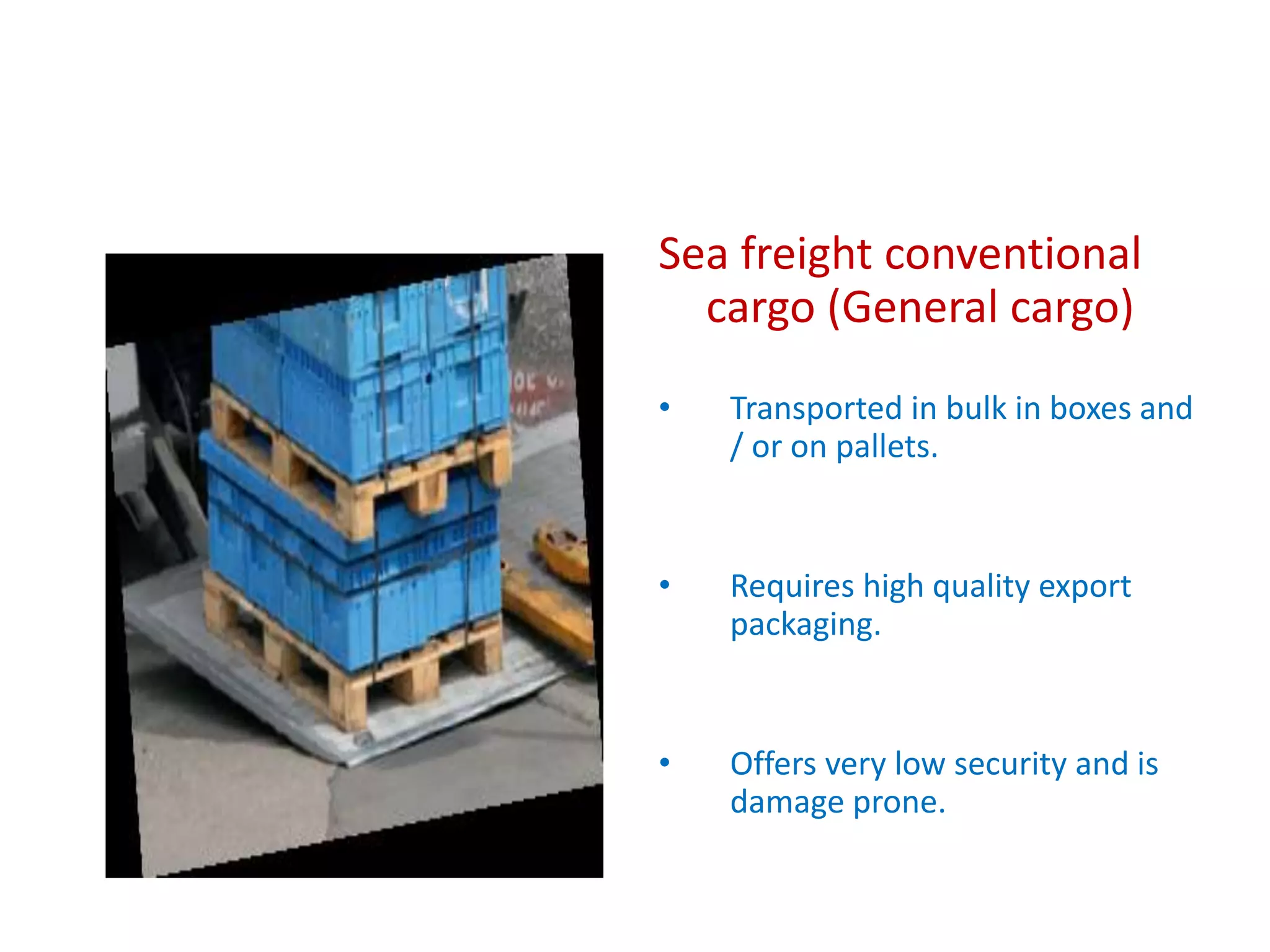
Sea freight conventional
cargo (General cargo)
• Transported in bulk in boxes and
/ or on pallets.
• Requires high quality export
packaging.
• Offers very low security and is
damage prone.
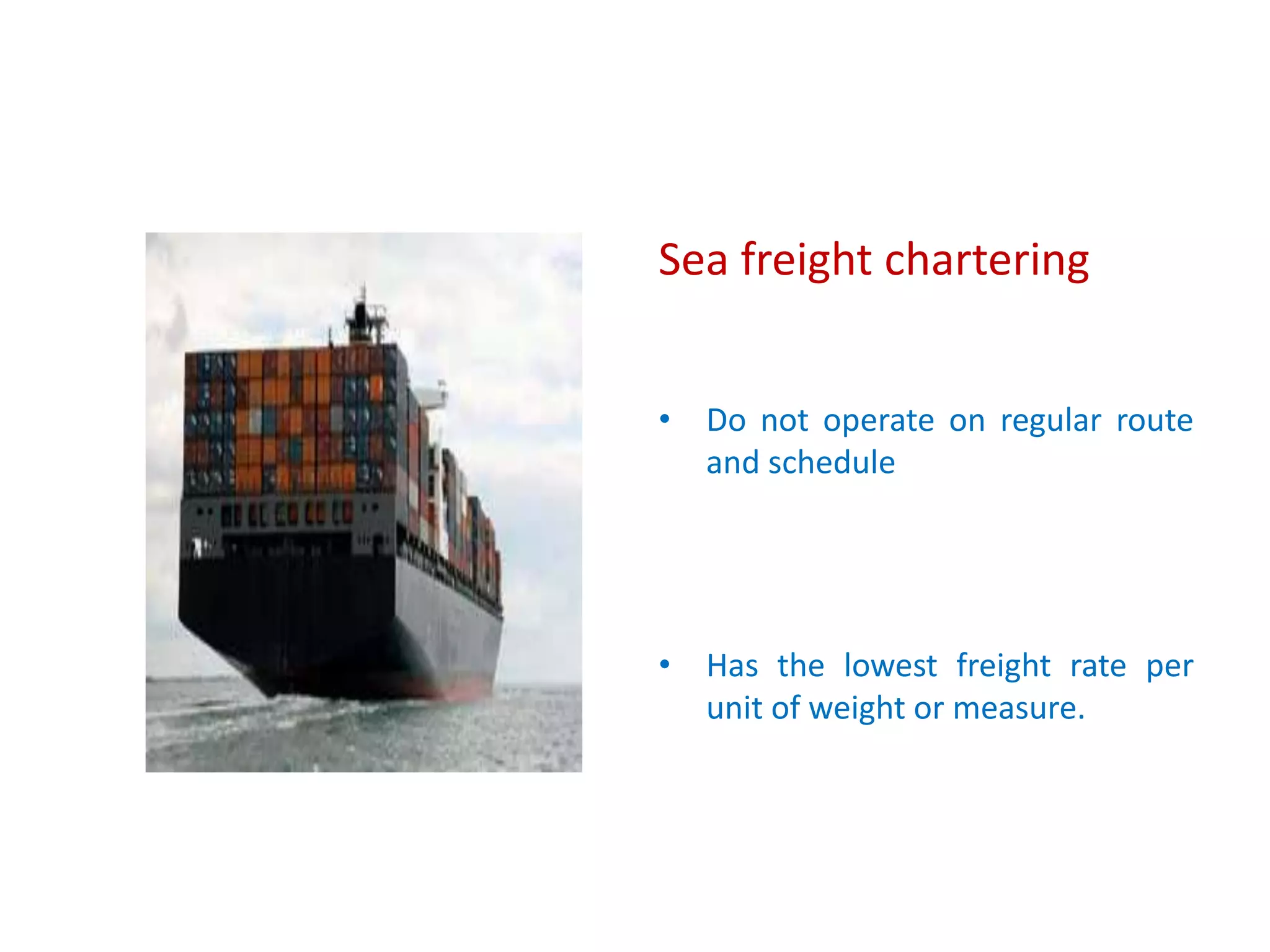
Sea freight chartering
• Do not operate on regular route
and schedule
• Has the lowest freight rate per
unit of weight or measure.
Sea freight Roll On/ Roll
Off(RO/ RO)
• Equipped with the ramps that
makes loading and unloading
from side and / or bow (front of
vessel) and / or stern (rear of
vessel) possible
• It provides fast loading and
unloading.
Sea freight LASH(Lighter
Aboard Ship)
• It is a system of water transport.
• Lash vessel carries about 82 LASH
barges of standard size with cargo
capacity of 385 tons.
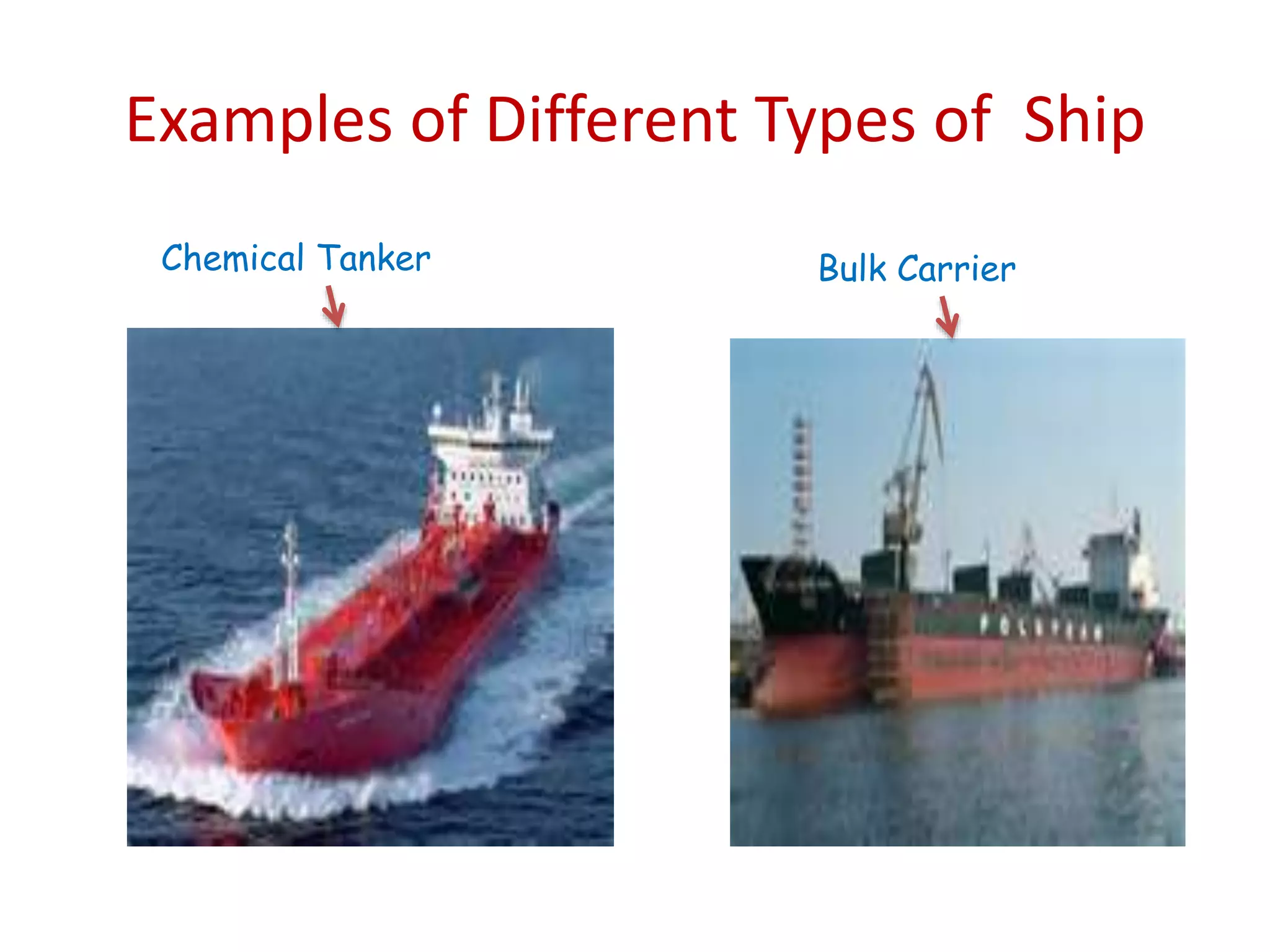
Examples of Different Types of Ship
Chemical Tanker Bulk Carrier
Ro-Ro ship Gas Tanker
Advantages of water transport
• Carry more and heavier cargo than truck or train
• Lower transportation cost than air transport
• Most suitable form of transport for carrying heavy and large items.
Disadvantages of water transport
• Relatively slow form of transport and is unsuitable for urgent goods.
• It can not deliver the goods directly to inland destination.
• Goods can be easily lost or damaged.
• Bad weather can cause the delays and losses goods at sea.
Conclusion
References
• http://www.slideshare.net/shikhs03/inland-water-transport-is-the-future-logistics-
dimension
• http://www.tsmg.com/download/article/Coastal%20Shipping.pdf
• http://www.ciilogistics.com/coastal_shipping.pdf
• http://www.worldshipping.org/pdf/industry_guidance_shippers_container_stuffers.p
df
• http://www.undp.org/content/dam/undp/documents/procurement/documents/UN
DP-Shipping-Guide.pdf
• http://www.seinemaritime.net/suports/uploads/files/Glossary%20of%20Port%20and
%20Shipping%20Terms.pdf
• http://www.ccr-
zkr.org/files/documents/workshops/wwf130312/pres_Nair_Prasanth_en.pdf
Thank you
Questions
1. What is waterway? What are the different
types of waterways transport?
2. Describe Inland waterway transport.
3. What are the advantages and limitations of
Inland water transport?
4. What are the merits and demerits of water
transportation?
5. Classify the waterways transportation ands
describe it brief.

logistics by waterways

  • 1.
    LOGISTICS BY WATERWAYS By: PankajKumar Taywade MT14IND014 M. Tech.(Industrial Engineering) 2014-15 Mechanical Engineering VNIT, Nagpur
  • 2.
    What is waterways? •A river, canal, or other body of water serving as a route or way of travel or transport is known as waterways.
  • 3.
  • 4.
    Inland water transport •A stretch of water, not part of the sea, over which craft of a carrying capacity not less than 50 tonnes can navigate when normally loaded. • This term covers both navigable rivers and lakes (natural water courses, whether or not they have been improved for navigation purposes) and canals (water ways constructed primarily for the purpose of navigation) • Inland waterways of India is designated as National waterways by the government.
  • 5.
    States/ UTs Totallength of rivers/lakes in state(km) Navigable length(km) 1 Andhra Pradesh 2501 791 2 Assam 3700 2584 3 Bihar 3763 1391 4 Goa 260 202 5 Gujrat 801.5 129 6 Jammu & Kashmir ….. ….. 7 Karnataka 2465 425 8 Kerla 3092 845.2 Table : State wise Total and Navigable Length of Waterways as on 31st March, 2007
  • 6.
    S.No . States/UTs Total lengthof river/lake in state(km) Total Navigable length(km) 9 Maharashtra 611 453 10 Orissa 1840 1650 11 Nagaland 937 375 12 Mizoram 559 293 13 Tamilnadu 170.1 ….. 14 Uttarpradesh ….. ….. 15 West Bengal 4741 4593 16 A & N Island ….. ….. TOTAL 25440.6 13731.2 ….. Not Available Source : Statistics of Inland Water Transport , M/O Shipping
  • 7.
    National Waterways • Nationalwaterway 1 : The Ganga – Bhagirathi – Hooghly river from Haldia to Allahabad - 1620 km. Declared as National waterway in 1986 • National waterway 2 : The Bramhaputra from Dhubri to Sadiya – 891km ,declared as National waterways in 1988 • National waterway 3 : Kottapuram – Kollam sector of West Coast canal with Champakara & Udyogmandal canals – 205 km, declared as national waterway in 1993.
  • 8.
    Proposed waterways • ProposedNational Water Ways 1 : Kakinada – Puducherry Canals integrated with rivers Godavari and Krishna, Length – 1095 km • Proposed National Water Ways 2 : East Coast Canal with Brahmani river & Mahanadidelta, Length – 623 km • Proposed National Water Ways 3 : River Barak, Length -121 km.
  • 9.
    Advantages of IWT •Additional Employment generation of 27,047 is expected by 2020. • IWT will develop as an alternative mode of transport, the development will make the river way worthy for safe and smooth operation of cargo movement. • Helps in reducing the level of congestion on road and rail tracks. • As it is environment friendly, it creates less noise pollution and reduces pollutants levels in the air .
  • 10.
    Disadvantages of IWT •Low availability of inland waterways - As mentioned above, there are numerous criteria for a water body to be navigable. Out of the total inland water body available in the world, only a very low percentage of it is potentially navigable. • Low speed - Water transport as a whole is much slower than its road, rail, or air competitors.
  • 11.
    Shipping ( Seaor ocean ) • The process of transporting or travelling by means of sea is called as shipping. • It is classified into two categories: a) Coastal shipping : Coastal shipping (short sea shipping) refers to the movement of cargo over water without crossing a major ocean. b) Overseas shipping : It refers to the movement of cargo over water crossing a major ocean.
  • 12.
    Types of shipfreight Sea freight containerized • Consists of metallic body • Has double door at one end • Cargo can safely loaded and transported
  • 13.
    Sea freight conventional cargo(General cargo) • Transported in bulk in boxes and / or on pallets. • Requires high quality export packaging. • Offers very low security and is damage prone.
  • 14.
    Sea freight chartering •Do not operate on regular route and schedule • Has the lowest freight rate per unit of weight or measure.
  • 15.
    Sea freight RollOn/ Roll Off(RO/ RO) • Equipped with the ramps that makes loading and unloading from side and / or bow (front of vessel) and / or stern (rear of vessel) possible • It provides fast loading and unloading.
  • 16.
    Sea freight LASH(Lighter AboardShip) • It is a system of water transport. • Lash vessel carries about 82 LASH barges of standard size with cargo capacity of 385 tons.
  • 17.
    Examples of DifferentTypes of Ship Chemical Tanker Bulk Carrier
  • 18.
  • 19.
    Advantages of watertransport • Carry more and heavier cargo than truck or train • Lower transportation cost than air transport • Most suitable form of transport for carrying heavy and large items.
  • 20.
    Disadvantages of watertransport • Relatively slow form of transport and is unsuitable for urgent goods. • It can not deliver the goods directly to inland destination. • Goods can be easily lost or damaged. • Bad weather can cause the delays and losses goods at sea.
  • 21.
  • 22.
    References • http://www.slideshare.net/shikhs03/inland-water-transport-is-the-future-logistics- dimension • http://www.tsmg.com/download/article/Coastal%20Shipping.pdf •http://www.ciilogistics.com/coastal_shipping.pdf • http://www.worldshipping.org/pdf/industry_guidance_shippers_container_stuffers.p df • http://www.undp.org/content/dam/undp/documents/procurement/documents/UN DP-Shipping-Guide.pdf • http://www.seinemaritime.net/suports/uploads/files/Glossary%20of%20Port%20and %20Shipping%20Terms.pdf • http://www.ccr- zkr.org/files/documents/workshops/wwf130312/pres_Nair_Prasanth_en.pdf
  • 23.
  • 24.
    Questions 1. What iswaterway? What are the different types of waterways transport? 2. Describe Inland waterway transport. 3. What are the advantages and limitations of Inland water transport? 4. What are the merits and demerits of water transportation? 5. Classify the waterways transportation ands describe it brief.