Quality Function
Deployment
(Q F D)
What is QFD?
• QFD is Quality Function Deployment
• A method of transferring customer needs and
requirements into technical specifications for
new product and service development.
Brief History
• Dr. Yoji Akao and Shigeru Mizuno
• First implemented at Mitsubishi Heavy Industries, Kobe
Shipyard in 1972
• Toyota strongly influenced adoption of QFD in North
America
• Adopted By Ford and GM in 1980s
– Between 1977-1984 achieved a 61% reduction in product
development cost, a 33% reduction in product development cycle,
and virtual elimination of rust related warranty problems.
Quality Function Deployment
• Identify customer wants
• Identify how the good/service will satisfy
customer wants
• Relate customer wants to product hows
• Identify relationships between the firm’s
hows
• Develop importance ratings
• Evaluate competing products
QFD House of Quality
Idea Generation Stage
• Provides basis for entry into market
• Sources of ideas
– Market need (60-80%); engineering & operations
(20%); technology; competitors; inventions;
employees
• Follows from marketing strategy
– Identifies, defines, & selects best market
opportunities
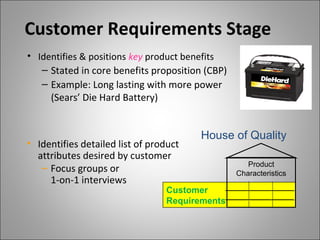
Customer Requirements Stage
• Identifies & positions key product benefits
– Stated in core benefits proposition (CBP)
– Example: Long lasting with more power
(Sears’ Die Hard Battery)
• Identifies detailed list of product
attributes desired by customer
– Focus groups or
1-on-1 interviews
House of Quality
Customer
Requirements
Product
Characteristics
Functional Specification Stage
• Defines product in terms of how the
product would meet desired
attributes
• Identifies product’s engineering
characteristics
– Example: printer noise (dB)
• Prioritizes engineering characteristics
• May rate product compared
to competitors’
House of QualityHouse of Quality
Customer
Requirements
Product
Characteristics
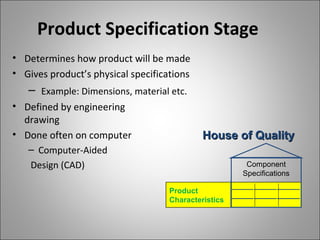
Product Specification Stage
• Determines how product will be made
• Gives product’s physical specifications
– Example: Dimensions, material etc.
• Defined by engineering
drawing
• Done often on computer
– Computer-Aided
Design (CAD)
House of QualityHouse of Quality
Product
Characteristics
Component
Specifications
Quality Function Deployment
• Product design process using
cross-functional teams
– Marketing, engineering, manufacturing
• Translates customer preferences into specific
product characteristics
• Involves creating 4 tabular ‘Matrices’ or
‘Houses’
– Breakdown product design into increasing levels of
detail
Benefits Of Adopting QFD
• Reduced time to market
• Reduction in design changes
• Decreased design and manufacturing costs
• Improved quality
• Increased customer satisfaction
Application Of QFD
Some of the application of QFD are:
• Production/Manufacturing
• Maintenance
• Design courses and curriculum
• Design of performance measures
• Aerospace
• Military needs
QFD SummaryQFD Summary
• Orderly Way Of Obtaining Information & Presenting It
• Shorter Product Development Cycle
• Considerably Reduced Start-Up Costs
• Fewer Engineering Changes
• Reduced Chance Of Oversights During Design Process
• Environment Of Teamwork
• Consensus Decisions
• Preserves Everything In Writing
Quality Function Development

Quality Function Development

  • 1.
  • 2.
    What is QFD? •QFD is Quality Function Deployment • A method of transferring customer needs and requirements into technical specifications for new product and service development.
  • 3.
    Brief History • Dr.Yoji Akao and Shigeru Mizuno • First implemented at Mitsubishi Heavy Industries, Kobe Shipyard in 1972 • Toyota strongly influenced adoption of QFD in North America • Adopted By Ford and GM in 1980s – Between 1977-1984 achieved a 61% reduction in product development cost, a 33% reduction in product development cycle, and virtual elimination of rust related warranty problems.
  • 4.
    Quality Function Deployment •Identify customer wants • Identify how the good/service will satisfy customer wants • Relate customer wants to product hows • Identify relationships between the firm’s hows • Develop importance ratings • Evaluate competing products
  • 5.
    QFD House ofQuality
  • 6.
    Idea Generation Stage •Provides basis for entry into market • Sources of ideas – Market need (60-80%); engineering & operations (20%); technology; competitors; inventions; employees • Follows from marketing strategy – Identifies, defines, & selects best market opportunities
  • 7.
    Customer Requirements Stage •Identifies & positions key product benefits – Stated in core benefits proposition (CBP) – Example: Long lasting with more power (Sears’ Die Hard Battery) • Identifies detailed list of product attributes desired by customer – Focus groups or 1-on-1 interviews House of Quality Customer Requirements Product Characteristics
  • 8.
    Functional Specification Stage •Defines product in terms of how the product would meet desired attributes • Identifies product’s engineering characteristics – Example: printer noise (dB) • Prioritizes engineering characteristics • May rate product compared to competitors’ House of QualityHouse of Quality Customer Requirements Product Characteristics
  • 9.
    Product Specification Stage •Determines how product will be made • Gives product’s physical specifications – Example: Dimensions, material etc. • Defined by engineering drawing • Done often on computer – Computer-Aided Design (CAD) House of QualityHouse of Quality Product Characteristics Component Specifications
  • 10.
    Quality Function Deployment •Product design process using cross-functional teams – Marketing, engineering, manufacturing • Translates customer preferences into specific product characteristics • Involves creating 4 tabular ‘Matrices’ or ‘Houses’ – Breakdown product design into increasing levels of detail
  • 11.
    Benefits Of AdoptingQFD • Reduced time to market • Reduction in design changes • Decreased design and manufacturing costs • Improved quality • Increased customer satisfaction
  • 12.
    Application Of QFD Someof the application of QFD are: • Production/Manufacturing • Maintenance • Design courses and curriculum • Design of performance measures • Aerospace • Military needs
  • 13.
    QFD SummaryQFD Summary •Orderly Way Of Obtaining Information & Presenting It • Shorter Product Development Cycle • Considerably Reduced Start-Up Costs • Fewer Engineering Changes • Reduced Chance Of Oversights During Design Process • Environment Of Teamwork • Consensus Decisions • Preserves Everything In Writing

Editor's Notes

  • #7 One notion which might be discussed at this stage is the attempts by manufacturers to add information to an existing good rather than develop a new good.
  • #8 Here begins the attempt to link the product directly with the customer. You might specify a product and ask students to identify first the attributes of interest to the customer, and second the “benefits” to the customer.
  • #9 At this point we have to start adding precision to our specifications. If we want a product to be “easy to use,” what exactly does that mean? To use by whom? With what level of preparation? Etc.
  • #10 At this point, we have to develop the information necessary to actually produce the product - and, to know that it has been produced appropriately.