By: Arushi Gupta
AGGREGATE PRODUCTION
PLANNING
AGGREGATE PRODUCTION
PLANNING: MEANING, NATURE,
SCOPE, NEED FOR APP
AND APP PROCESS
AGGREGATE PRODUCTION
PLANNING
Aggregate planning is an operational activity that does an aggregate
plan for the production process, in advance of 6 to 18 months, to
give an idea to management as to what quantity of materials and
other resources are to be procured and when, so that the total cost of
operations of the organization is kept to the minimum over that
period.
The quantity of outsourcing, subcontracting of items, overtime of
labour, numbers to be hired and fired in each period and the amount
of inventory to be held in stock and to be backlogged for each period
are decided. All of these activities are done within the framework of
the company ethics, policies, and long term commitment to the
society, community and the country of operation.
NATURE
Aggregate Planning is concerned with matching supply and demand
of output over the medium time range, up to approximately 12
months into the future. The term aggregate implies that the planning
is done for a single overall measure of output or, at the most, a few
aggregated product categories. The aim of aggregate planning is to
set overall output levels in the near to medium future in the face of
fluctuating or uncertain demands. Aggregate planning might seek to
influence demand as well as supply.
NEED FOR APP
1) Demand fluctuation
2) Capacity fluctuation
3) Difficulty level in altering operation rate
4) Benefits of multi-period plans
Long-range plans
(over one year)
Research and Development
New product plans
Capital investments
Facility location/expansion
Intermediate-range plans
(3 to 18 months)
Sales planning
Production planning and budgeting
Setting employment, inventory,
subcontracting levels
Analyzing operating plans
Short-range plans
(up to 3 months)
Job assignments
Ordering
Job scheduling
Dispatching
Overtime
Part-time help
Top
executives
Operations
managers
Operations
managers,
supervisors,
foremen
Responsibility Planning tasks and horizon
ThePlanning
Process
AGGREGATE PLANNING
ENVIRONMENT, INPUT AND
OUTPUT OF APP AND
BALANCE BETWEEN DEMAND
AGGREGATE
PLANNING
ENVIRONMENT
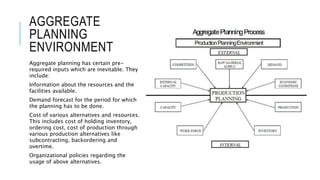
Aggregate planning has certain pre-
required inputs which are inevitable. They
include:
Information about the resources and the
facilities available.
Demand forecast for the period for which
the planning has to be done.
Cost of various alternatives and resources.
This includes cost of holding inventory,
ordering cost, cost of production through
various production alternatives like
subcontracting, backordering and
overtime.
Organizational policies regarding the
usage of above alternatives.
INPUTS AND OUTPUTS OF
AGGREGATE PLANNING
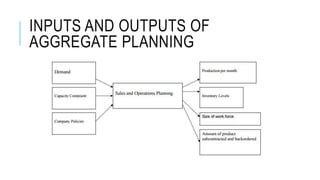
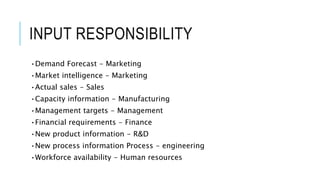
INPUT RESPONSIBILITY
•Demand Forecast - Marketing
•Market intelligence - Marketing
•Actual sales - Sales
•Capacity information - Manufacturing
•Management targets - Management
•Financial requirements - Finance
•New product information - R&D
•New process information Process - engineering
•Workforce availability - Human resources
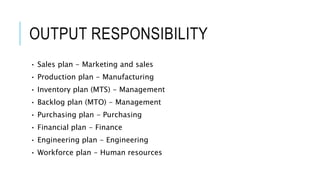
OUTPUT RESPONSIBILITY
• Sales plan - Marketing and sales
• Production plan - Manufacturing
• Inventory plan (MTS) - Management
• Backlog plan (MTO) - Management
• Purchasing plan - Purchasing
• Financial plan - Finance
• Engineering plan - Engineering
• Workforce plan - Human resources
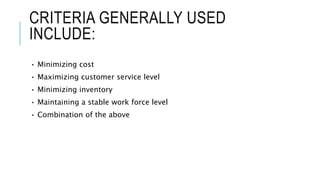
CRITERIA GENERALLY USED
INCLUDE:
• Minimizing cost
• Maximizing customer service level
• Minimizing inventory
• Maintaining a stable work force level
• Combination of the above
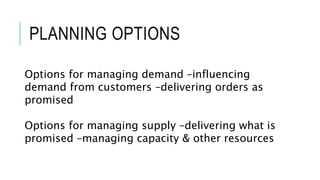
Options for managing demand –influencing
demand from customers –delivering orders as
promised
Options for managing supply –delivering what is
promised –managing capacity & other resources
PLANNING OPTIONS
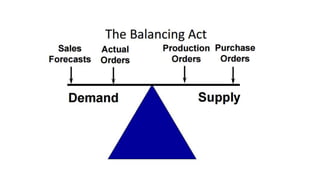
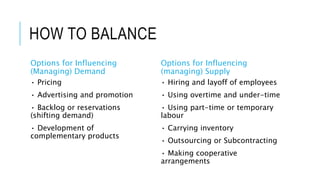
HOW TO BALANCE
Options for Influencing
(Managing) Demand
• Pricing
• Advertising and promotion
• Backlog or reservations
(shifting demand)
• Development of
complementary products
Options for Influencing
(managing) Supply
• Hiring and layoff of employees
• Using overtime and under-time
• Using part-time or temporary
labour
• Carrying inventory
• Outsourcing or Subcontracting
• Making cooperative
arrangements
DEMAND AND SUPPLY SIDE
PRODUCTION PLANNING
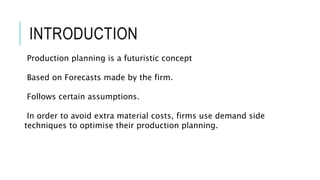
INTRODUCTION
Production planning is a futuristic concept
Based on Forecasts made by the firm.
Follows certain assumptions.
In order to avoid extra material costs, firms use demand side
techniques to optimise their production planning.
TECHNIQUES
1. Chase Strategy
2. Level Strategy
3. Varying Work Hours
4. Mixed Strategy
*Subcontracting is another strategy, generally, used as to chase demand, however
sentimentally different.
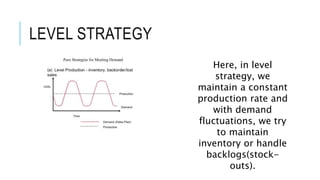
LEVEL STRATEGY
Here, in level
strategy, we
maintain a constant
production rate and
with demand
fluctuations, we try
to maintain
inventory or handle
backlogs(stock-
outs).
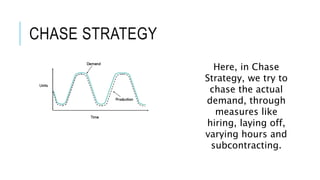
CHASE STRATEGY
Here, in Chase
Strategy, we try to
chase the actual
demand, through
measures like
hiring, laying off,
varying hours and
subcontracting.
TRANSPORTATION
MODEL
A transportation model is used to determine
how to distribute supplies to various
destinations while minimizing total shipping
cost. In this case, a shipping plan is produced
and is not changed unless factors such as
supply, demand, or unit shipping costs change.
ASSUMPTIONS
1. Items are homogeneous.
2. Shipping cost is same.
3.Only one route is used from one place to another.
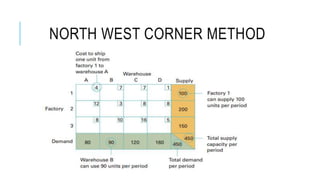
NORTH WEST CORNER METHOD

Aggregate production planning

  • 1.
    By: Arushi Gupta AGGREGATEPRODUCTION PLANNING
  • 2.
    AGGREGATE PRODUCTION PLANNING: MEANING,NATURE, SCOPE, NEED FOR APP AND APP PROCESS
  • 3.
    AGGREGATE PRODUCTION PLANNING Aggregate planningis an operational activity that does an aggregate plan for the production process, in advance of 6 to 18 months, to give an idea to management as to what quantity of materials and other resources are to be procured and when, so that the total cost of operations of the organization is kept to the minimum over that period. The quantity of outsourcing, subcontracting of items, overtime of labour, numbers to be hired and fired in each period and the amount of inventory to be held in stock and to be backlogged for each period are decided. All of these activities are done within the framework of the company ethics, policies, and long term commitment to the society, community and the country of operation.
  • 4.
    NATURE Aggregate Planning isconcerned with matching supply and demand of output over the medium time range, up to approximately 12 months into the future. The term aggregate implies that the planning is done for a single overall measure of output or, at the most, a few aggregated product categories. The aim of aggregate planning is to set overall output levels in the near to medium future in the face of fluctuating or uncertain demands. Aggregate planning might seek to influence demand as well as supply.
  • 5.
    NEED FOR APP 1)Demand fluctuation 2) Capacity fluctuation 3) Difficulty level in altering operation rate 4) Benefits of multi-period plans
  • 6.
    Long-range plans (over oneyear) Research and Development New product plans Capital investments Facility location/expansion Intermediate-range plans (3 to 18 months) Sales planning Production planning and budgeting Setting employment, inventory, subcontracting levels Analyzing operating plans Short-range plans (up to 3 months) Job assignments Ordering Job scheduling Dispatching Overtime Part-time help Top executives Operations managers Operations managers, supervisors, foremen Responsibility Planning tasks and horizon ThePlanning Process
  • 8.
    AGGREGATE PLANNING ENVIRONMENT, INPUTAND OUTPUT OF APP AND BALANCE BETWEEN DEMAND
  • 9.
    AGGREGATE PLANNING ENVIRONMENT Aggregate planning hascertain pre- required inputs which are inevitable. They include: Information about the resources and the facilities available. Demand forecast for the period for which the planning has to be done. Cost of various alternatives and resources. This includes cost of holding inventory, ordering cost, cost of production through various production alternatives like subcontracting, backordering and overtime. Organizational policies regarding the usage of above alternatives.
  • 10.
    INPUTS AND OUTPUTSOF AGGREGATE PLANNING
  • 11.
    INPUT RESPONSIBILITY •Demand Forecast- Marketing •Market intelligence - Marketing •Actual sales - Sales •Capacity information - Manufacturing •Management targets - Management •Financial requirements - Finance •New product information - R&D •New process information Process - engineering •Workforce availability - Human resources
  • 12.
    OUTPUT RESPONSIBILITY • Salesplan - Marketing and sales • Production plan - Manufacturing • Inventory plan (MTS) - Management • Backlog plan (MTO) - Management • Purchasing plan - Purchasing • Financial plan - Finance • Engineering plan - Engineering • Workforce plan - Human resources
  • 14.
    CRITERIA GENERALLY USED INCLUDE: •Minimizing cost • Maximizing customer service level • Minimizing inventory • Maintaining a stable work force level • Combination of the above
  • 15.
    Options for managingdemand –influencing demand from customers –delivering orders as promised Options for managing supply –delivering what is promised –managing capacity & other resources PLANNING OPTIONS
  • 16.
    HOW TO BALANCE Optionsfor Influencing (Managing) Demand • Pricing • Advertising and promotion • Backlog or reservations (shifting demand) • Development of complementary products Options for Influencing (managing) Supply • Hiring and layoff of employees • Using overtime and under-time • Using part-time or temporary labour • Carrying inventory • Outsourcing or Subcontracting • Making cooperative arrangements
  • 17.
    DEMAND AND SUPPLYSIDE PRODUCTION PLANNING
  • 18.
    INTRODUCTION Production planning isa futuristic concept Based on Forecasts made by the firm. Follows certain assumptions. In order to avoid extra material costs, firms use demand side techniques to optimise their production planning.
  • 19.
    TECHNIQUES 1. Chase Strategy 2.Level Strategy 3. Varying Work Hours 4. Mixed Strategy *Subcontracting is another strategy, generally, used as to chase demand, however sentimentally different.
  • 20.
    LEVEL STRATEGY Here, inlevel strategy, we maintain a constant production rate and with demand fluctuations, we try to maintain inventory or handle backlogs(stock- outs).
  • 21.
    CHASE STRATEGY Here, inChase Strategy, we try to chase the actual demand, through measures like hiring, laying off, varying hours and subcontracting.
  • 22.
  • 23.
    A transportation modelis used to determine how to distribute supplies to various destinations while minimizing total shipping cost. In this case, a shipping plan is produced and is not changed unless factors such as supply, demand, or unit shipping costs change.
  • 24.
    ASSUMPTIONS 1. Items arehomogeneous. 2. Shipping cost is same. 3.Only one route is used from one place to another.
  • 25.