Group Members
Niaz Hussain(09-IME-71)
Salman Razaq (09-IME-72)
Muhammad Usman (09-IME-73)
Muhammad Waleed (09-IME-74)
3.
What Is JIT
Managementphilosophy (produce
only what is needed when it is
needed)
A highly coordinated processing
system in which goods move through
the system, and services are
performed, just as they are needed
Represents Pull type system
4.
History of JITManufacturing
Evolved in Japan after World War II, as a
result of their diminishing market share in
the auto industry.
Toyota Motor Company- Birthplace of the
JIT Philosophy Under Taiichi Ohno.
JIT is now on the rise in American
Industries.
5.
Definition
JIT is amanufacturing philosophy
involving an integrated set of
procedures/activities designed to
achieve a high volume of production
using minimal inventories
6.
More Introduction
Raw materials,parts & sub
assemblies are pulled through the
manufacturing process when they
are needed.
Simply put, JIT is a philosophy of
“make what is needed … when it is
needed”.
7.
Goal of JIT
The ultimate goal of JIT is a
balanced system.
Achieves a smooth, rapid flow of
materials through the system
Eliminate disruptions
Make system flexible
Eliminate waste, especially excess
inventory
8.
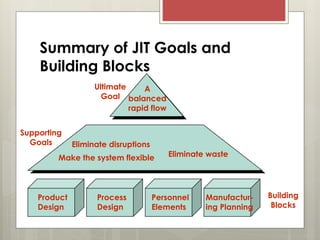
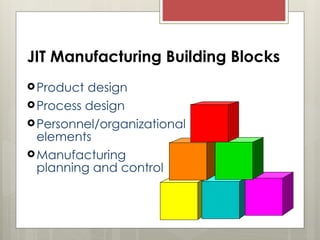
Summary of JITGoals and
Building Blocks
Product
Design
Process
Design
Personnel
Elements
Manufactur-
ing Planning
Eliminate disruptions
Make the system flexible Eliminate waste
A
balanced
rapid flow
Ultimate
Goal
Supporting
Goals
Building
Blocks
9.
Big JIT –broad focus
Vendor relations
Human relations
Technology management
Materials and inventory management
Little JIT – narrow focus
Scheduling materials
Scheduling services of production
Big vs. Little JIT
10.
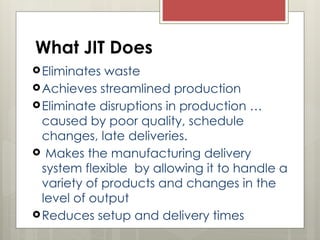
What JIT Does
Eliminateswaste
Achieves streamlined production
Eliminate disruptions in production …
caused by poor quality, schedule
changes, late deliveries.
Makes the manufacturing delivery
system flexible by allowing it to handle a
variety of products and changes in the
level of output
Reduces setup and delivery times
11.
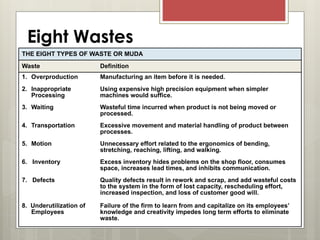
Eight Wastes
THE EIGHTTYPES OF WASTE OR MUDA
Waste Definition
1. Overproduction Manufacturing an item before it is needed.
2. Inappropriate
Processing
Using expensive high precision equipment when simpler
machines would suffice.
3. Waiting Wasteful time incurred when product is not being moved or
processed.
4. Transportation Excessive movement and material handling of product between
processes.
5. Motion Unnecessary effort related to the ergonomics of bending,
stretching, reaching, lifting, and walking.
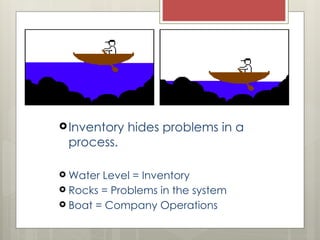
6. Inventory Excess inventory hides problems on the shop floor, consumes
space, increases lead times, and inhibits communication.
7. Defects Quality defects result in rework and scrap, and add wasteful costs
to the system in the form of lost capacity, rescheduling effort,
increased inspection, and loss of customer good will.
8. Underutilization of
Employees
Failure of the firm to learn from and capitalize on its employees’
knowledge and creativity impedes long term efforts to eliminate
waste.
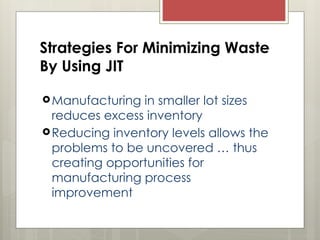
Strategies For MinimizingWaste
By Using JIT
Manufacturing in smaller lot sizes
reduces excess inventory
Reducing inventory levels allows the
problems to be uncovered … thus
creating opportunities for
manufacturing process
improvement
Total Quality Management
Seeklong-term commitment to
quality efforts with continuous
improvement
Quality must be a higher priority than
cost
Minimizing waste
Production Management
Pull Systemvs. Push System
Pull = Made to order
Push = Made for inventory
Flexibility of the system
Design For Testability – In the process
Poka-Yoke= Mistake-proofing
Throughout entire process
Production Management
CommunicationTechniques
Completion of task-Kanban
Problem- Siren/light
Stopping the process if something
goes wrong =Jidoka
Preventive Maintenance
Supplier Management
EstablishLong Term Relationships
with few suppliers.
Delivery of Parts = 100% Defect Free
Where they are needed
When they are needed
The exact quantity
Work Together
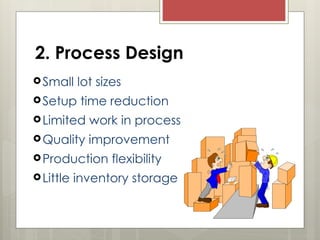
2. Process Design
Smalllot sizes
Setup time reduction
Limited work in process
Quality improvement
Production flexibility
Little inventory storage
35.
Benefits of SmallLot Sizes
Reduces inventory
Less storage space
Less rework
Problems are more apparent
Increases product flexibility
Easier to balance operations
Production Flexibility
Reduce downtimeby reducing
changeover time
Use preventive maintenance to
reduce breakdowns
Cross-train workers to help clear
bottlenecks
Use many small units of capacity
Reserve capacity for important
customers
4. Manufacturing Planning
andControl
Pull systems
Visual systems (kanban)
Close vendor relationships
Reduced transaction
processing (delays in
delievery)
Preventive maintenance
40.
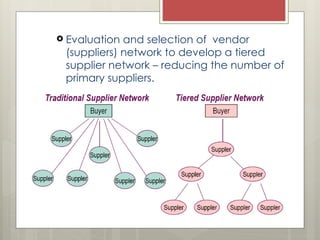
Evaluation andselection of vendor
(suppliers) network to develop a tiered
supplier network – reducing the number of
primary suppliers.
41.
Transitioning to aSuccessful JIT
System
Get top management commitment
Decide which parts need most effort
Obtain support of workers
Start by trying to reduce setup times
Gradually convert operations
Convert suppliers to JIT
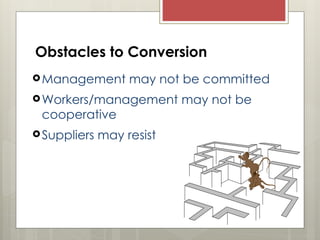
Prepare for obstacles
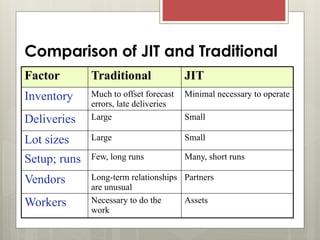
Comparison of JITand Traditional
Factor Traditional JIT
Inventory Much to offset forecast
errors, late deliveries
Minimal necessary to operate
Deliveries Large Small
Lot sizes Large Small
Setup; runs Few, long runs Many, short runs
Vendors Long-term relationships
are unusual
Partners
Workers Necessary to do the
work
Assets
44.
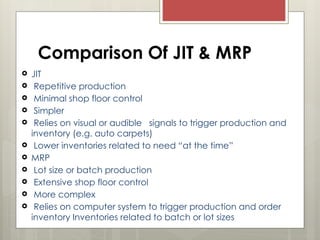
Comparison Of JIT& MRP
JIT
Repetitive production
Minimal shop floor control
Simpler
Relies on visual or audible signals to trigger production and
inventory (e.g. auto carpets)
Lower inventories related to need “at the time”
MRP
Lot size or batch production
Extensive shop floor control
More complex
Relies on computer system to trigger production and order
inventory Inventories related to batch or lot sizes
45.
JIT in Services
Thebasic goal of the demand flow
technology in the service organization is
to provide optimum response to the
customer with the highest quality
service and lowest possible cost.
JIT Benefits (contd.)
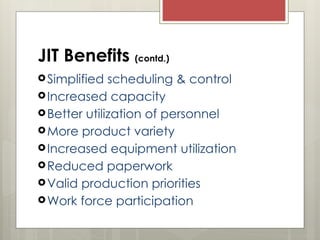
Simplifiedscheduling & control
Increased capacity
Better utilization of personnel
More product variety
Increased equipment utilization
Reduced paperwork
Valid production priorities
Work force participation
48.
JIT … NotFor Everyone
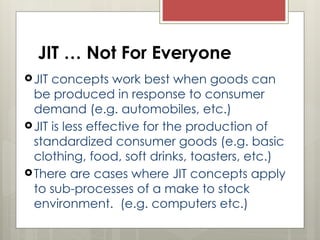
JIT concepts work best when goods can
be produced in response to consumer
demand (e.g. automobiles, etc.)
JIT is less effective for the production of
standardized consumer goods (e.g. basic
clothing, food, soft drinks, toasters, etc.)
There are cases where JIT concepts apply
to sub-processes of a make to stock
environment. (e.g. computers etc.)
49.
References
Cammaranano, J.Lessons to be Learned: JIT. Atlanta, Georgia: Engineering
and Management Press, 1997.
Dear, A. Working toward JIT: Management Technology. London: Derek Doyle
and Associates, 1988.
Fisher, D. The JIT Self Test: Success Through Assesment and Implementation.
Chicago, IL: Irwin Inc., 1995.
Hernandez, A. JIT Quality: A Practical Approach. Englewood Cliffs, NJ:
Prentice-Hall, 1993.
Hutchins, D. Just-In-Time: Inventory Control. Brookfield, VT: Gower Publishing,
1988.
O’Grady, P.J. Putting the JIT Philosophy Into Practice. New York, NY: Nichols
Publishing, 1988.
Reinfeld, N.V. Handbook of Production and Inventory Control. Englewood
Cliffs, NJ: Prentice-Hall, 1987.
Schneiderjans, M.J. Advanced Topics In JIT Management: JIT Systems.
Westport, CT: Greenwood Publishing Group, 1999.
Taver, R.W. Manufacturing Solutions for Consistent Quality and Reliability: The 9
Step Problem Solving Process. New York, NY: AMACON, 1995.
Wesner, J.W., Hiatt, J.M., and Trimble, D.C. Winning with Quality: Applying
Quality Principles in Product Development. Reading, MASS: Addison-Wesley
Publishing Co., 1995.