1

Just-in-Time
and
Lean Systems
2

OBJECTIVES


Lean Production Defined



The Toyota Production System



Lean Implementation Requirements



Lean Services
3

Lean Production


Lean Production can be defined as an
integrated set of activities designed to
achieve high-volume production using
minimal inventories (raw materials, work in
process, and finished goods)



Lean Production also involves the
elimination of waste in production effort



Lean Production also involves the timing of
production resources (i.e., parts arrive at the
next workstation “just in time”)
4

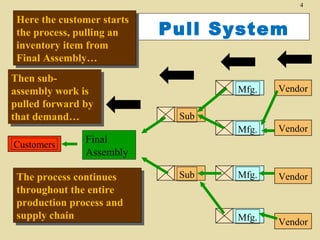
Here the customer starts
the process, pulling an
inventory item from
inventory item from
Final Assembly…
Final Assembly…
Then subThen subassembly work is
assembly work is
pulled forward by
pulled forward by
that demand…
that demand…
Customers

Pull System
Mfg.

Mfg.

Vendor

Mfg.

Vendor

Mfg.

Vendor

Sub

Final
Assembly

The process continues
throughout the entire
production process and
supply chain
supply chain

Vendor

Sub
The Toyota Production
System


Based on two philosophies:
1. Elimination of waste
2. Respect for people

5
6

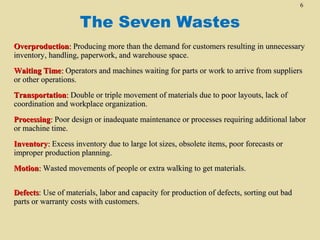
The Seven Wastes
Overproduction: Producing more than the demand for customers resulting in unnecessary
inventory, handling, paperwork, and warehouse space.
Waiting Time: Operators and machines waiting for parts or work to arrive from suppliers
or other operations.
Transportation: Double or triple movement of materials due to poor layouts, lack of
coordination and workplace organization.
Processing: Poor design or inadequate maintenance or processes requiring additional labor
or machine time.
Inventory: Excess inventory due to large lot sizes, obsolete items, poor forecasts or
improper production planning.
Motion: Wasted movements of people or extra walking to get materials.
Defects: Use of materials, labor and capacity for production of defects, sorting out bad
parts or warranty costs with customers.
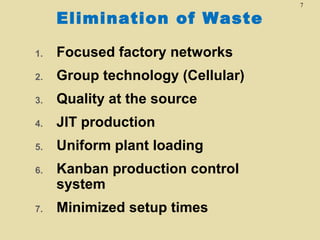
Elimination of Waste
1.

Focused factory networks

2.

Group technology (Cellular)

3.

Quality at the source

4.

JIT production

5.

Uniform plant loading

6.

Kanban production control
system

7.

Minimized setup times

7
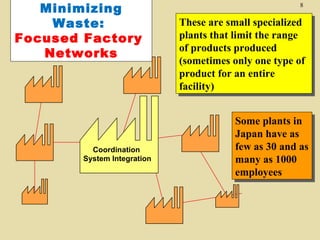
Minimizing
Waste:
Focused Factory
Networks

Coordination
System Integration

8

These are small specialized
plants that limit the range
of products produced
(sometimes only one type of
product for an entire
facility)
facility)
Some plants in
Some plants in
Japan have as
Japan have as
few as 30 and as
few as 30 and as
many as 1000
many as 1000
employees
employees
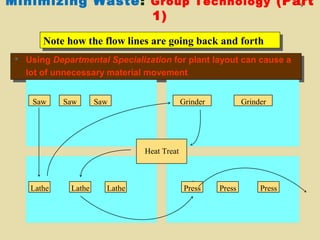
Minimizing Waste: Group Technology (Part
9
1)
Note how the flow lines are going back and forth



Using Departmental Specialization for plant layout can cause a
lot of unnecessary material movement
Saw

Saw

Saw

Grinder

Grinder

Heat Treat

Lathe

Lathe

Lathe

Press

Press

Press
10

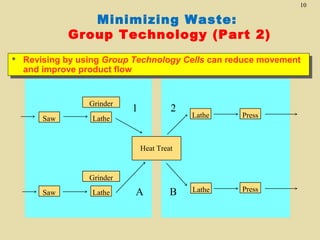
Minimizing Waste:
Group Technology (Part 2)



Revising by using Group Technology Cells can reduce movement
and improve product flow

Grinder
Saw

1

2

Lathe

Lathe

Press

Lathe

Press

Heat Treat

Grinder
Saw

Lathe

A

B
11

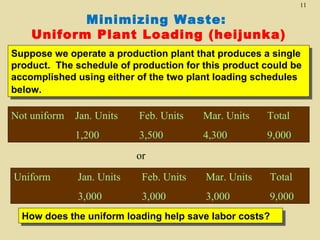
Minimizing Waste:
Uniform Plant Loading (heijunka)
Suppose we operate a production plant that produces a single
product. The schedule of production for this product could be
accomplished using either of the two plant loading schedules
below.
below.

Not uniform

Jan. Units

Feb. Units

Mar. Units

Total

1,200

3,500

4,300

9,000

or
Uniform

Jan. Units

Feb. Units

Mar. Units

Total

3,000

3,000

3,000

9,000

How does the uniform loading help save labor costs?
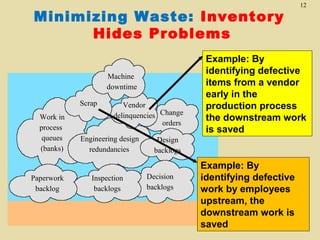
Minimizing Waste: Inventory
Hides Problems
Machine
downtime
Scrap
Work in
process
queues
(banks)

Paperwork
backlog

Vendor
delinquencies Change
orders

Engineering design
redundancies

Inspection
backlogs

Example: By
identifying defective
items from a vendor
early in the
production process
the downstream work
is saved

Design
backlogs
Decision
backlogs

12

Example: By
identifying defective
work by employees
upstream, the
downstream work is
saved
13

Minimizing Waste: Kanban
Production Control Systems
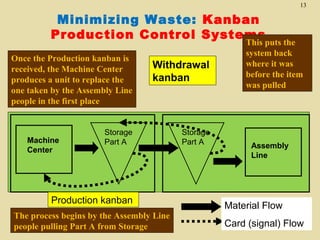
Once the Production kanban is
received, the Machine Center
produces a unit to replace the
one taken by the Assembly Line
people in the first place

Machine
Center

Withdrawal
kanban

Storage
Part A

Production kanban
The process begins by the Assembly Line
people pulling Part A from Storage

Storage
Part A

This puts the
system back
where it was
before the item
was pulled

Assembly
Line

Material Flow
Card (signal) Flow
14

Respect for People

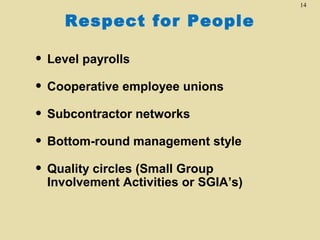
• Level payrolls
• Cooperative employee unions
• Subcontractor networks
• Bottom-round management style
• Quality circles (Small Group

Involvement Activities or SGIA’s)
Toyota Production System’s
Four Rules
1.

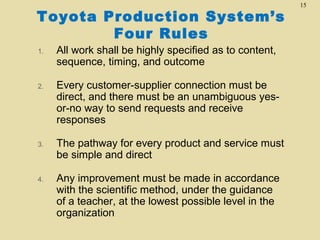
All work shall be highly specified as to content,
sequence, timing, and outcome

2.

Every customer-supplier connection must be
direct, and there must be an unambiguous yesor-no way to send requests and receive
responses

3.

The pathway for every product and service must
be simple and direct

4.

Any improvement must be made in accordance
with the scientific method, under the guidance
of a teacher, at the lowest possible level in the
organization

15
Lean Implementation
Requirements: Design Flow
Process

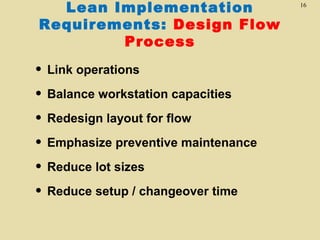
• Link operations
• Balance workstation capacities
• Redesign layout for flow
• Emphasize preventive maintenance
• Reduce lot sizes
• Reduce setup / changeover time

16
Lean Implementation
Requirements: Total Quality
Control

• Worker responsibility
• Measure SQC
• Enforce compliance
• Fail-safe methods
• Automatic inspection

17
Lean Implementation
Requirements: Stabilize
Schedule

• Level schedule
• Underutilize capacity
• Establish freeze windows

18
19

Lean Implementation
Requirements: Kanban-Pull

• Demand pull
• Backflush
• Reduce lot sizes
Lean Implementation
Requirements: Work with
Vendors

• Reduce lead times
• Frequent deliveries
• Project usage requirements
• Quality expectations

20
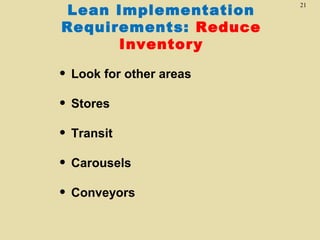
Lean Implementation
Requirements: Reduce
Inventory

• Look for other areas
• Stores
• Transit
• Carousels
• Conveyors

21
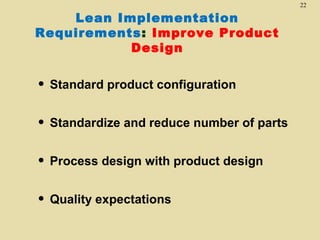
Lean Implementation
Requirements: Improve Product
Design

• Standard product configuration
• Standardize and reduce number of parts
• Process design with product design
• Quality expectations

22
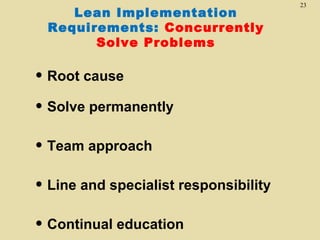
Lean Implementation
Requirements: Concurrently
Solve Problems

• Root cause
• Solve permanently
• Team approach
• Line and specialist responsibility
• Continual education

23
24

Lean Implementation
Requirements: Measure
Performance

• Emphasize improvement
• Track trends
25

Value Stream Mapping

• A method of visually mapping a product's

production path (materials and information) from
"door to door".

• Value stream is all the actions (both value added
and non-value added) currently required to bring
a product through the main flows essential to
every product:
26

Value Stream
Mapping( Contd)

Value Stream Mapping;

• helps to visualize more than just the single-process level
more than waste
• helps seeyour value stream - it helps see the sources of
waste in

• provides a common language for talking about
manufacturing processes
27

Value Stream Mapping
(contd.)

• ties together lean concepts and techniques
• forms the basis of an implementation plan
• shows the linkage between the information flow
and the material flow

• is much more useful than quantitative tools and

layout diagrams that produce a tally of non-value
added steps, lead time, distance traveled, the
amount of inventory, and so on.
Lean in Services
(Examples)

• Organize Problem-Solving Groups
• Upgrade Housekeeping
• Upgrade Quality
• Clarify Process Flows
• Revise Equipment and Process
Technologies

28
Lean in Services
(Examples)

• Level the Facility Load
• Eliminate Unnecessary Activities
• Reorganize Physical Configuration
• Introduce Demand-Pull Scheduling
• Develop Supplier Networks

29
30

Question Bowl
Lean Production seeks to achieve high volume
production using which of the following?
a.

Minimal inventory of raw materials

b.

Minimal inventory of work-in-process

c.

Minimal inventory of finished goods

d.

All of the above

e.

None of the above

Answer: d. All of the above
31

Question Bowl
In the Toyota Production System, the
“elimination of waste” involves which of the following?
a.

Overproduction

b.

Waiting time

c.

Transportation

d.

All of the above

e.

None of the above

Answer: d. All of the above
32

Question Bowl
In the Pull System the partner that begins the
process of “pulling” is which of the following?
a.

Customers

b.

Vendors

c.

Fabrication personnel

d.

CEO

e.

All of the above

Answer: a. Customer
33

Question Bowl
A Lean Production program requires which of
the following?
a.

Employee participation

b.

Total quality control

c.

Small lot sizes

d.

Continuing improvement

e.

All of the above

Answer: e. All of the above (Also included in Industrial
engineering/basics)
34

Question Bowl
Inventory has been known to hide which of the
following production problems?
a.

Scrap

b.

Vendor delinquencies

c.

Decision backlogs

d.

All of the above

e.

None of the above

Answer: d. All of the above
35

Question Bowl
You want to determine how many kanban card sets you need for an
operation. You find that average number of units demanded is
1,000 per hour, the lead time to replenish the order for this item is
10 hours, the container size is 10 units, and the safety stock is
estimated to be 5% of the expected demand. Which of the
following is the desired number of kanban card sets?
a.

1050

b.

1000

c.

605

d.

500

e.

None of the above

Answer: a. 1050 ([1000x10](1+0.05)/10=1050)
36

Question Bowl
When trying to implement Lean system a
“stabilized schedule” includes which of the
following?
a.

Demand pull

b.

Backflush

c.

Fail-safe methods

d.

All of the above

e.

None of the above

Answer: e. None of
the above (These
include: level
schedule,
underutilization
capacity, and
establish freeze
windows.)

Ch12 jit+&+lean+systems

  • 1.
  • 2.
    2 OBJECTIVES  Lean Production Defined  TheToyota Production System  Lean Implementation Requirements  Lean Services
  • 3.
    3 Lean Production  Lean Productioncan be defined as an integrated set of activities designed to achieve high-volume production using minimal inventories (raw materials, work in process, and finished goods)  Lean Production also involves the elimination of waste in production effort  Lean Production also involves the timing of production resources (i.e., parts arrive at the next workstation “just in time”)
  • 4.
    4 Here the customerstarts Here the customer starts the process, pulling an the process, pulling an inventory item from inventory item from Final Assembly… Final Assembly… Then subThen subassembly work is assembly work is pulled forward by pulled forward by that demand… that demand… Customers Pull System Mfg. Mfg. Vendor Mfg. Vendor Mfg. Vendor Sub Final Assembly The process continues The process continues throughout the entire throughout the entire production process and production process and supply chain supply chain Vendor Sub
  • 5.
    The Toyota Production System  Basedon two philosophies: 1. Elimination of waste 2. Respect for people 5
  • 6.
    6 The Seven Wastes Overproduction:Producing more than the demand for customers resulting in unnecessary inventory, handling, paperwork, and warehouse space. Waiting Time: Operators and machines waiting for parts or work to arrive from suppliers or other operations. Transportation: Double or triple movement of materials due to poor layouts, lack of coordination and workplace organization. Processing: Poor design or inadequate maintenance or processes requiring additional labor or machine time. Inventory: Excess inventory due to large lot sizes, obsolete items, poor forecasts or improper production planning. Motion: Wasted movements of people or extra walking to get materials. Defects: Use of materials, labor and capacity for production of defects, sorting out bad parts or warranty costs with customers.
  • 7.
    Elimination of Waste 1. Focusedfactory networks 2. Group technology (Cellular) 3. Quality at the source 4. JIT production 5. Uniform plant loading 6. Kanban production control system 7. Minimized setup times 7
  • 8.
    Minimizing Waste: Focused Factory Networks Coordination System Integration 8 Theseare small specialized These are small specialized plants that limit the range plants that limit the range of products produced of products produced (sometimes only one type of (sometimes only one type of product for an entire product for an entire facility) facility) Some plants in Some plants in Japan have as Japan have as few as 30 and as few as 30 and as many as 1000 many as 1000 employees employees
  • 9.
    Minimizing Waste: GroupTechnology (Part 9 1) Note how the flow lines are going back and forth Note how the flow lines are going back and forth   Using Departmental Specialization for plant layout can cause a Using Departmental Specialization for plant layout can cause a lot of unnecessary material movement lot of unnecessary material movement Saw Saw Saw Grinder Grinder Heat Treat Lathe Lathe Lathe Press Press Press
  • 10.
    10 Minimizing Waste: Group Technology(Part 2)   Revising by using Group Technology Cells can reduce movement Revising by using Group Technology Cells can reduce movement and improve product flow and improve product flow Grinder Saw 1 2 Lathe Lathe Press Lathe Press Heat Treat Grinder Saw Lathe A B
  • 11.
    11 Minimizing Waste: Uniform PlantLoading (heijunka) Suppose we operate a production plant that produces a single Suppose we operate a production plant that produces a single product. The schedule of production for this product could be product. The schedule of production for this product could be accomplished using either of the two plant loading schedules accomplished using either of the two plant loading schedules below. below. Not uniform Jan. Units Feb. Units Mar. Units Total 1,200 3,500 4,300 9,000 or Uniform Jan. Units Feb. Units Mar. Units Total 3,000 3,000 3,000 9,000 How does the uniform loading help save labor costs? How does the uniform loading help save labor costs?
  • 12.
    Minimizing Waste: Inventory HidesProblems Machine downtime Scrap Work in process queues (banks) Paperwork backlog Vendor delinquencies Change orders Engineering design redundancies Inspection backlogs Example: By identifying defective items from a vendor early in the production process the downstream work is saved Design backlogs Decision backlogs 12 Example: By identifying defective work by employees upstream, the downstream work is saved
  • 13.
    13 Minimizing Waste: Kanban ProductionControl Systems Once the Production kanban is received, the Machine Center produces a unit to replace the one taken by the Assembly Line people in the first place Machine Center Withdrawal kanban Storage Part A Production kanban The process begins by the Assembly Line people pulling Part A from Storage Storage Part A This puts the system back where it was before the item was pulled Assembly Line Material Flow Card (signal) Flow
  • 14.
    14 Respect for People •Level payrolls • Cooperative employee unions • Subcontractor networks • Bottom-round management style • Quality circles (Small Group Involvement Activities or SGIA’s)
  • 15.
    Toyota Production System’s FourRules 1. All work shall be highly specified as to content, sequence, timing, and outcome 2. Every customer-supplier connection must be direct, and there must be an unambiguous yesor-no way to send requests and receive responses 3. The pathway for every product and service must be simple and direct 4. Any improvement must be made in accordance with the scientific method, under the guidance of a teacher, at the lowest possible level in the organization 15
  • 16.
    Lean Implementation Requirements: DesignFlow Process • Link operations • Balance workstation capacities • Redesign layout for flow • Emphasize preventive maintenance • Reduce lot sizes • Reduce setup / changeover time 16
  • 17.
    Lean Implementation Requirements: TotalQuality Control • Worker responsibility • Measure SQC • Enforce compliance • Fail-safe methods • Automatic inspection 17
  • 18.
    Lean Implementation Requirements: Stabilize Schedule •Level schedule • Underutilize capacity • Establish freeze windows 18
  • 19.
    19 Lean Implementation Requirements: Kanban-Pull •Demand pull • Backflush • Reduce lot sizes
  • 20.
    Lean Implementation Requirements: Workwith Vendors • Reduce lead times • Frequent deliveries • Project usage requirements • Quality expectations 20
  • 21.
    Lean Implementation Requirements: Reduce Inventory •Look for other areas • Stores • Transit • Carousels • Conveyors 21
  • 22.
    Lean Implementation Requirements: ImproveProduct Design • Standard product configuration • Standardize and reduce number of parts • Process design with product design • Quality expectations 22
  • 23.
    Lean Implementation Requirements: Concurrently SolveProblems • Root cause • Solve permanently • Team approach • Line and specialist responsibility • Continual education 23
  • 24.
  • 25.
    25 Value Stream Mapping •A method of visually mapping a product's production path (materials and information) from "door to door". • Value stream is all the actions (both value added and non-value added) currently required to bring a product through the main flows essential to every product:
  • 26.
    26 Value Stream Mapping( Contd) ValueStream Mapping; • helps to visualize more than just the single-process level more than waste • helps seeyour value stream - it helps see the sources of waste in • provides a common language for talking about manufacturing processes
  • 27.
    27 Value Stream Mapping (contd.) •ties together lean concepts and techniques • forms the basis of an implementation plan • shows the linkage between the information flow and the material flow • is much more useful than quantitative tools and layout diagrams that produce a tally of non-value added steps, lead time, distance traveled, the amount of inventory, and so on.
  • 28.
    Lean in Services (Examples) •Organize Problem-Solving Groups • Upgrade Housekeeping • Upgrade Quality • Clarify Process Flows • Revise Equipment and Process Technologies 28
  • 29.
    Lean in Services (Examples) •Level the Facility Load • Eliminate Unnecessary Activities • Reorganize Physical Configuration • Introduce Demand-Pull Scheduling • Develop Supplier Networks 29
  • 30.
    30 Question Bowl Lean Productionseeks to achieve high volume production using which of the following? a. Minimal inventory of raw materials b. Minimal inventory of work-in-process c. Minimal inventory of finished goods d. All of the above e. None of the above Answer: d. All of the above
  • 31.
    31 Question Bowl In theToyota Production System, the “elimination of waste” involves which of the following? a. Overproduction b. Waiting time c. Transportation d. All of the above e. None of the above Answer: d. All of the above
  • 32.
    32 Question Bowl In thePull System the partner that begins the process of “pulling” is which of the following? a. Customers b. Vendors c. Fabrication personnel d. CEO e. All of the above Answer: a. Customer
  • 33.
    33 Question Bowl A LeanProduction program requires which of the following? a. Employee participation b. Total quality control c. Small lot sizes d. Continuing improvement e. All of the above Answer: e. All of the above (Also included in Industrial engineering/basics)
  • 34.
    34 Question Bowl Inventory hasbeen known to hide which of the following production problems? a. Scrap b. Vendor delinquencies c. Decision backlogs d. All of the above e. None of the above Answer: d. All of the above
  • 35.
    35 Question Bowl You wantto determine how many kanban card sets you need for an operation. You find that average number of units demanded is 1,000 per hour, the lead time to replenish the order for this item is 10 hours, the container size is 10 units, and the safety stock is estimated to be 5% of the expected demand. Which of the following is the desired number of kanban card sets? a. 1050 b. 1000 c. 605 d. 500 e. None of the above Answer: a. 1050 ([1000x10](1+0.05)/10=1050)
  • 36.
    36 Question Bowl When tryingto implement Lean system a “stabilized schedule” includes which of the following? a. Demand pull b. Backflush c. Fail-safe methods d. All of the above e. None of the above Answer: e. None of the above (These include: level schedule, underutilization capacity, and establish freeze windows.)