Lean
An introduction to Lean
principles, methodology, tools
and terminology
Agenda
• Lean overview
• Lean principles
• Eight deadly wastes
• Lean concepts and tools
2
What is Lean?
3
 Learning to see Waste in all activities
 Eliminating Waste by…
“Continuously Improving Everything”
• Way of pursuing value in your business by systematically
eliminating waste from daily process
• Results
• Lower operating cost
• Reduced cycle time
• Reduce defects
• Improved customer satisfaction
• Improved employee morale
• Business Plan Achieved
• Faster, Better & More efficient.
Lean as a Business Philosophy:
History of Lean Manufacturing
1798
Eli Whitney develops
interchangeable parts
1933 - Toyota Motor
Company established
1908 through 1913
Henry Ford develops the
moving assembly line.
1920’s
Sakichi Toyoda
develops mistake
proofing and 5 Whys
August 4, 1937
First supermarket
in the United
States opened
June – August 1950
Deming introduces
lean quality principles
to Japanese engineers
and managers
1950’s - Taiichi Ohno
develops the Toyota
Production System
(TPS)
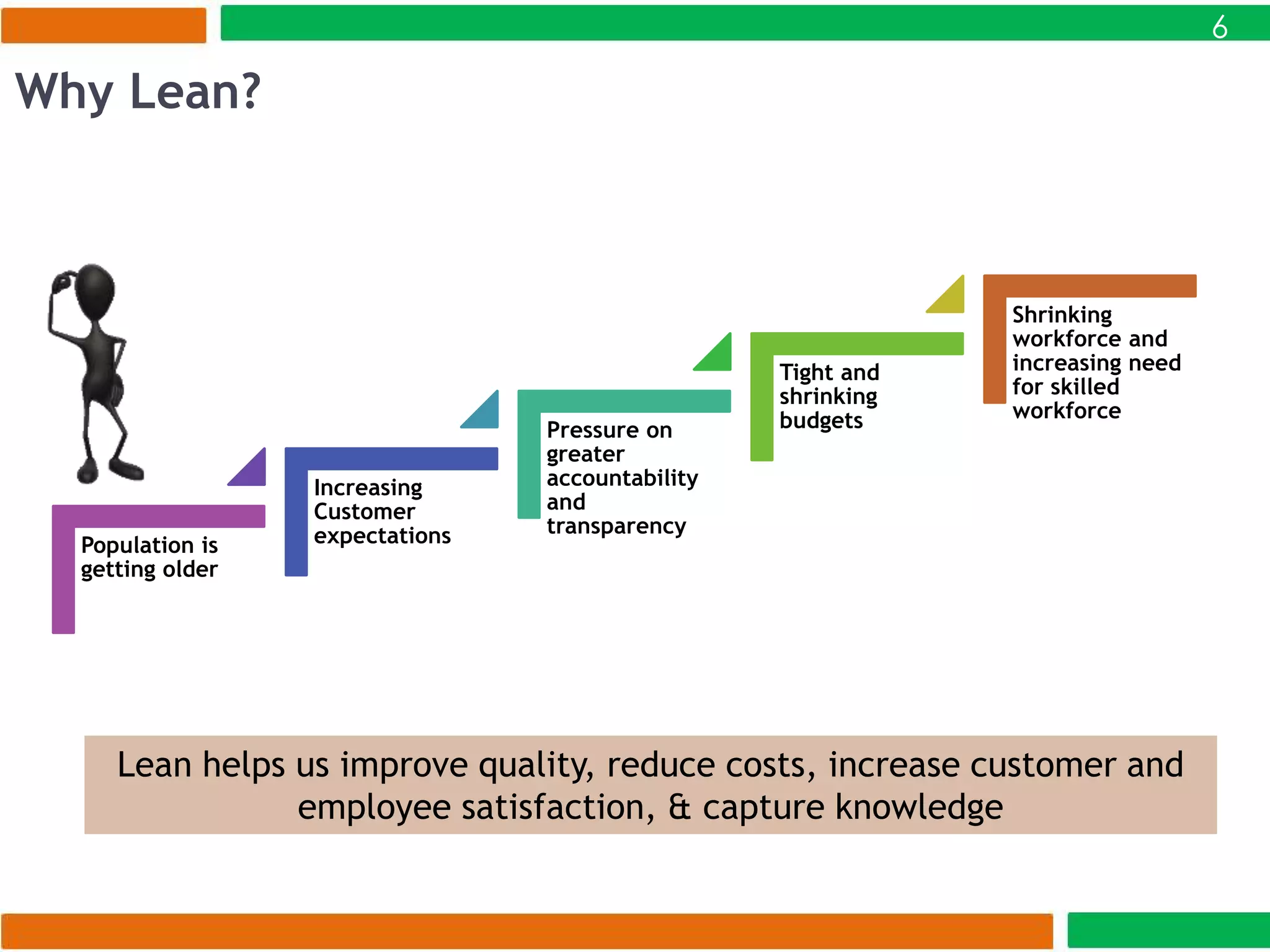
Why Lean?
Population is
getting older
Increasing
Customer
expectations
Pressure on
greater
accountability
and
transparency
Tight and
shrinking
budgets
Shrinking
workforce and
increasing need
for skilled
workforce
6
Lean helps us improve quality, reduce costs, increase customer and
employee satisfaction, & capture knowledge
Customer Work
Problem
solving
Process Oppurtunities
Lean helps us Understand:
7
What adds values
to customer
How work gets
done
How to iden. Root
cause of Problems
How Ideal Process
Look like
How to improve
performance
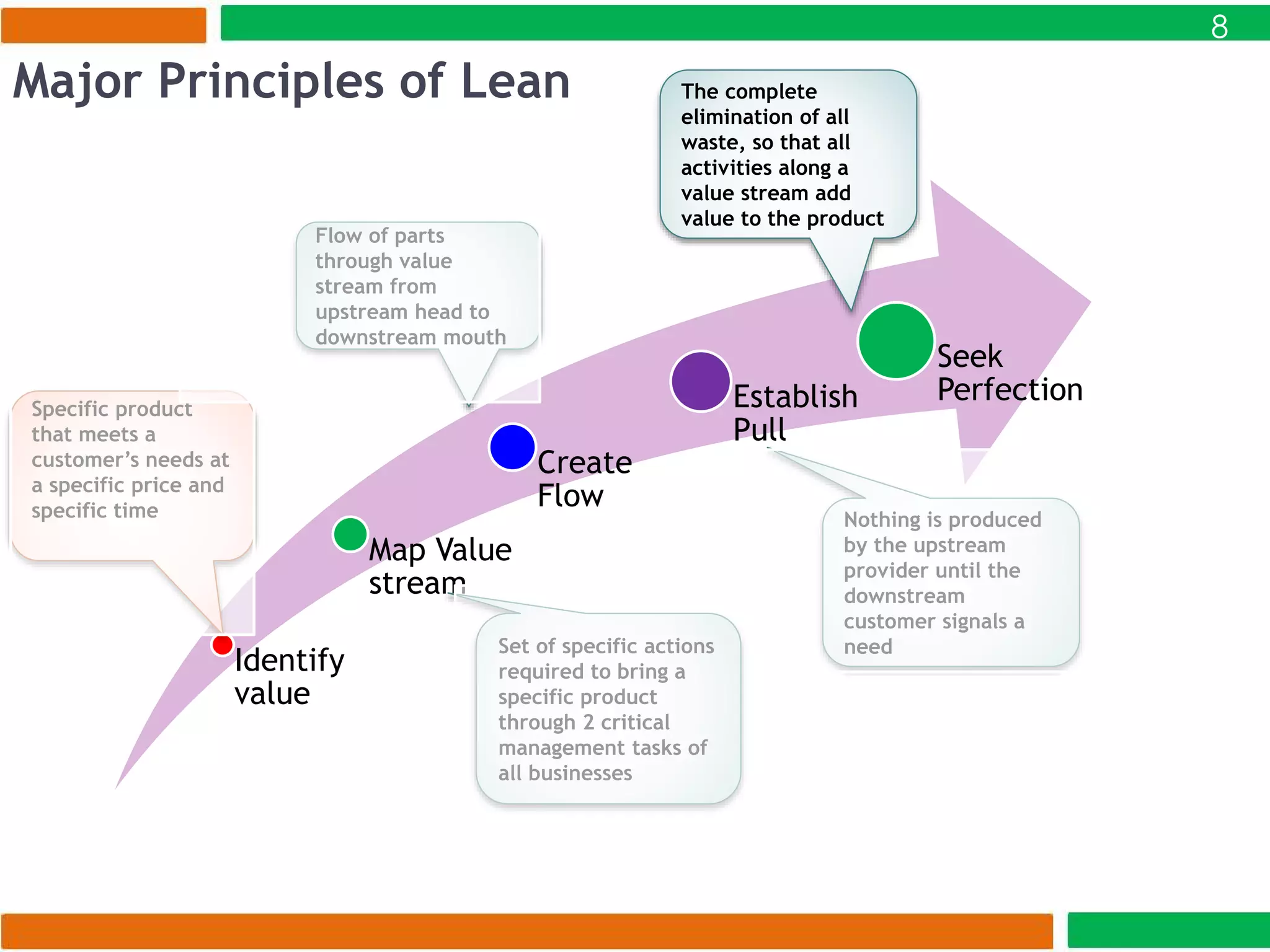
Major Principles of Lean
8
Identify
value
Map Value
stream
Create
Flow
Establish
Pull
Seek
PerfectionSpecific product
that meets a
customer’s needs at
a specific price and
specific time
Set of specific actions
required to bring a
specific product
through 2 critical
management tasks of
all businesses
Flow of parts
through value
stream from
upstream head to
downstream mouth
Nothing is produced
by the upstream
provider until the
downstream
customer signals a
need
The complete
elimination of all
waste, so that all
activities along a
value stream add
value to the product
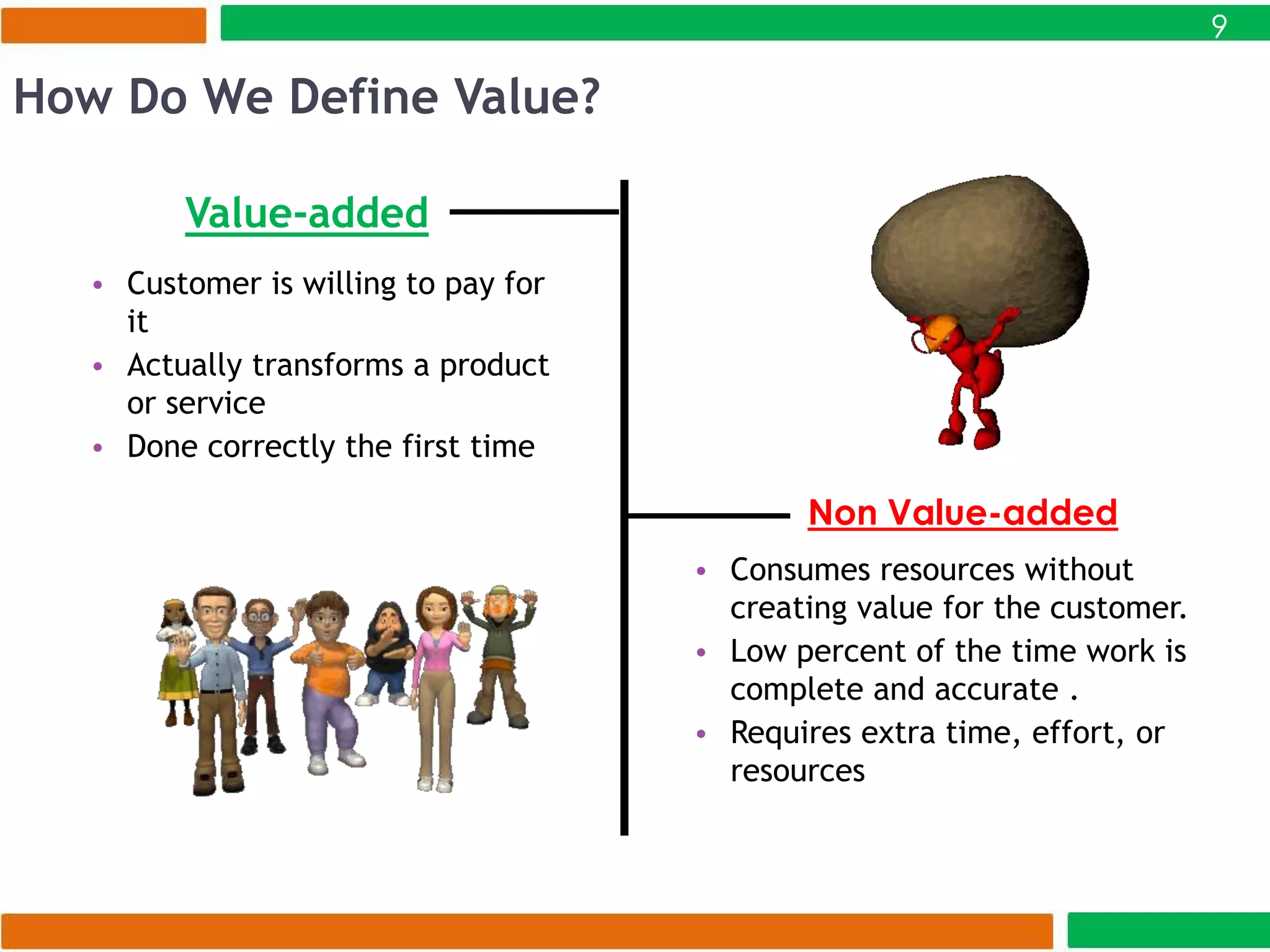
How Do We Define Value?
• Customer is willing to pay for
it
• Actually transforms a product
or service
• Done correctly the first time
• Consumes resources without
creating value for the customer.
• Low percent of the time work is
complete and accurate .
• Requires extra time, effort, or
resources
9
Value-added
Non Value-added
10
• Use Value Stream Analysis as a planning tool
▫ Break down the Value Stream in manageable sections
▫ Communicate the “flow” with maps
 Information
 Material
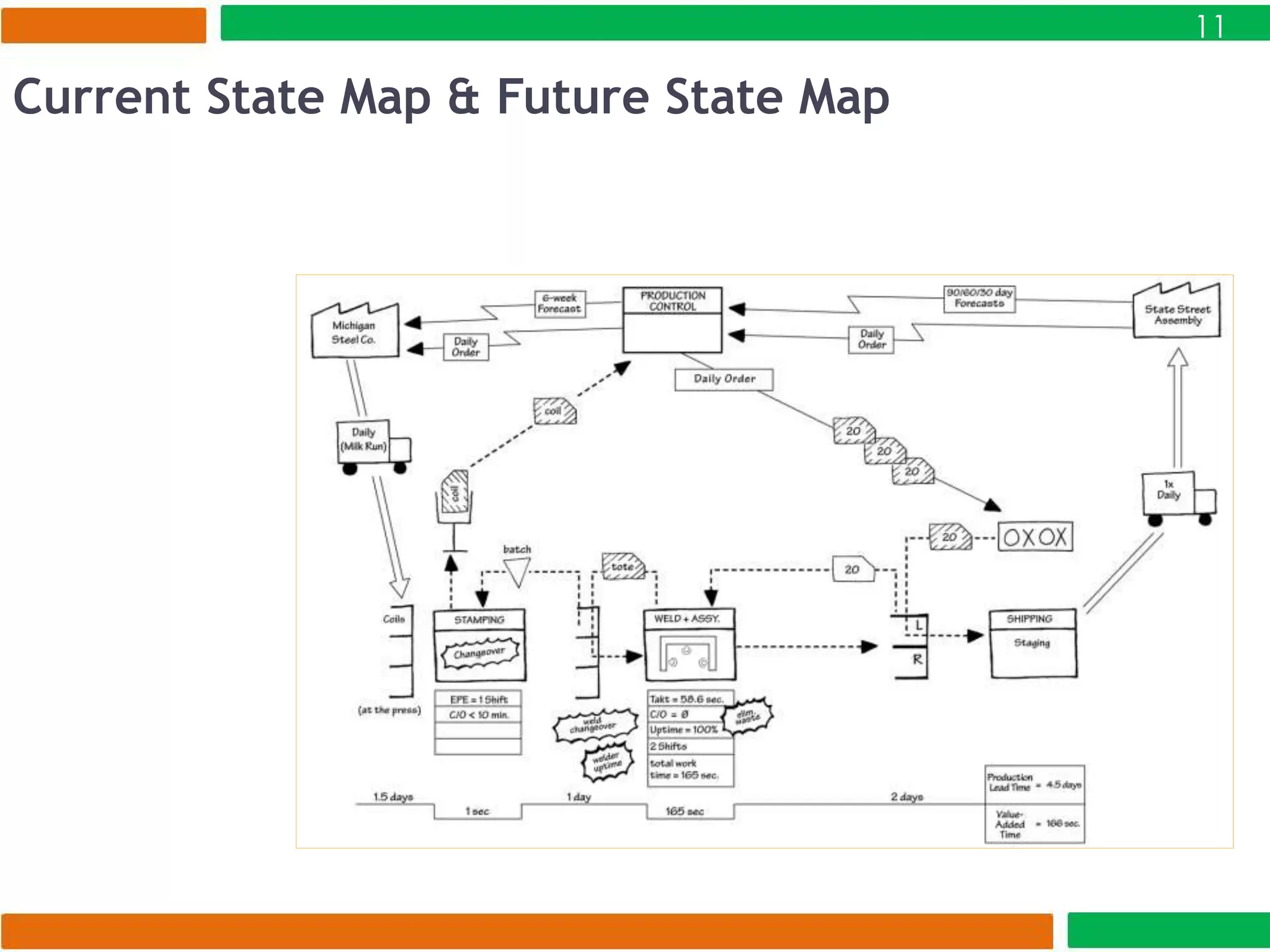
• Use Value Stream Analysis to create 2 maps
▫ Current
▫ Future (near time-within a year)
• Develop action plan from the Future map
Value Stream Analysis
11
Current State Map & Future State Map
12
What is Flow?
• Parts “flow” through a Value Stream
• Upstream is the beginning or “head” of the flow
• Downstream is the “mouth” of the flow, where the part is pulled by
the customer
• Materials and parts are the “parts” in manufacturing
• Customer’s needs are the “parts” in service industry
▫ Same for administration
13
Push and Pull Production
Push Systems: schedule work
releases based on demand.
•inherently due-date driven
•control release rate,
observe WIP level
Pull Systems: authorize work
releases based on system
status.
•inherently rate driven
•control WIP level, observe
throughput
Video
Improvement Strategies
Eliminate non-
value added tasks
Combine tasks or
functions
Concurrent
processing
Co-locate work
Shift roles and
responsibilities
Eliminate or
reduce batching
Automate Solve Problems
Handoffs and batching are common barriers to process
flow
Lean Concepts and Tools
• Eight Wastes
• 5S
• Standard Work
• Visual Management
• Kaizen
• Problem solving
15
16
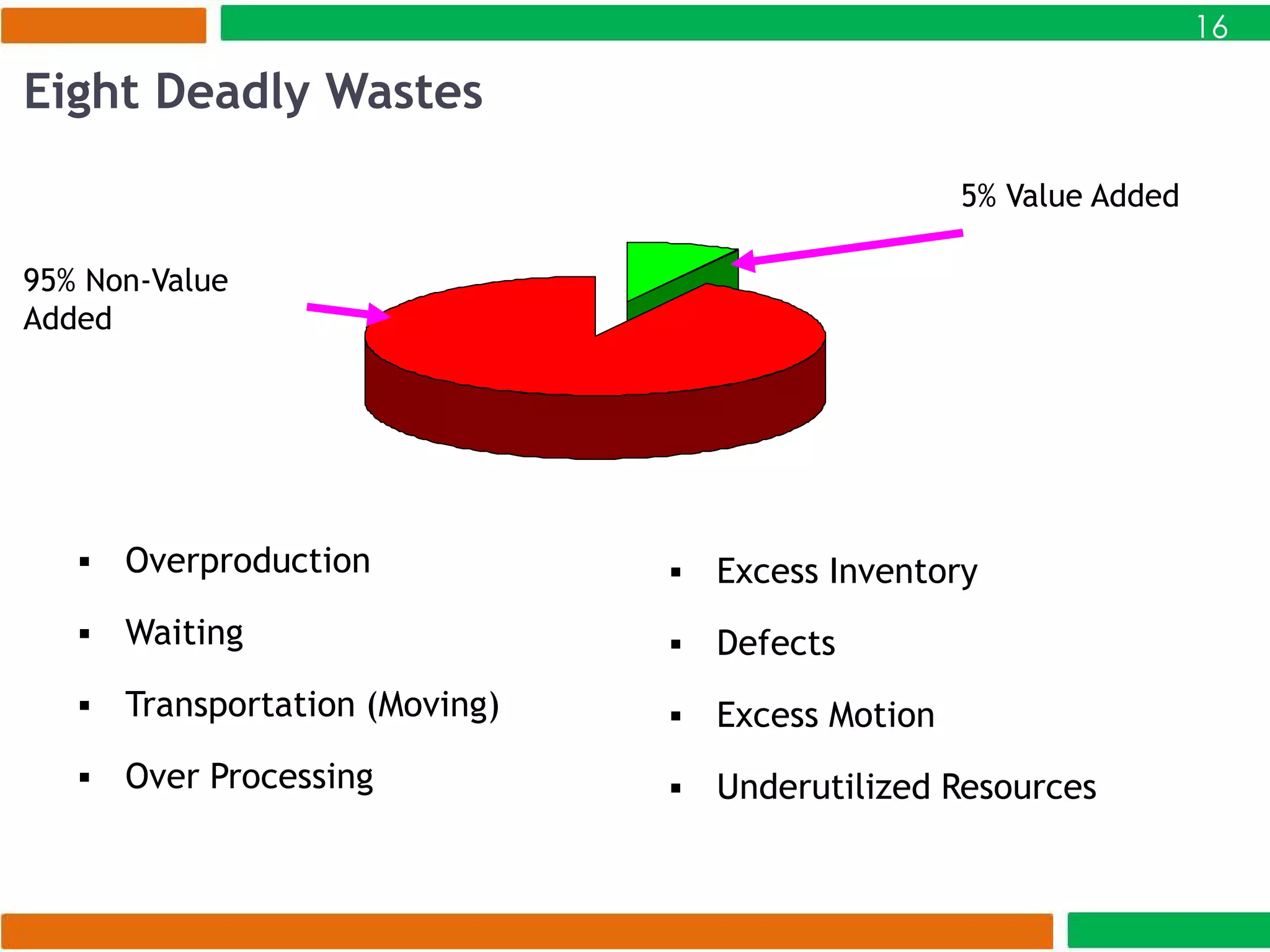
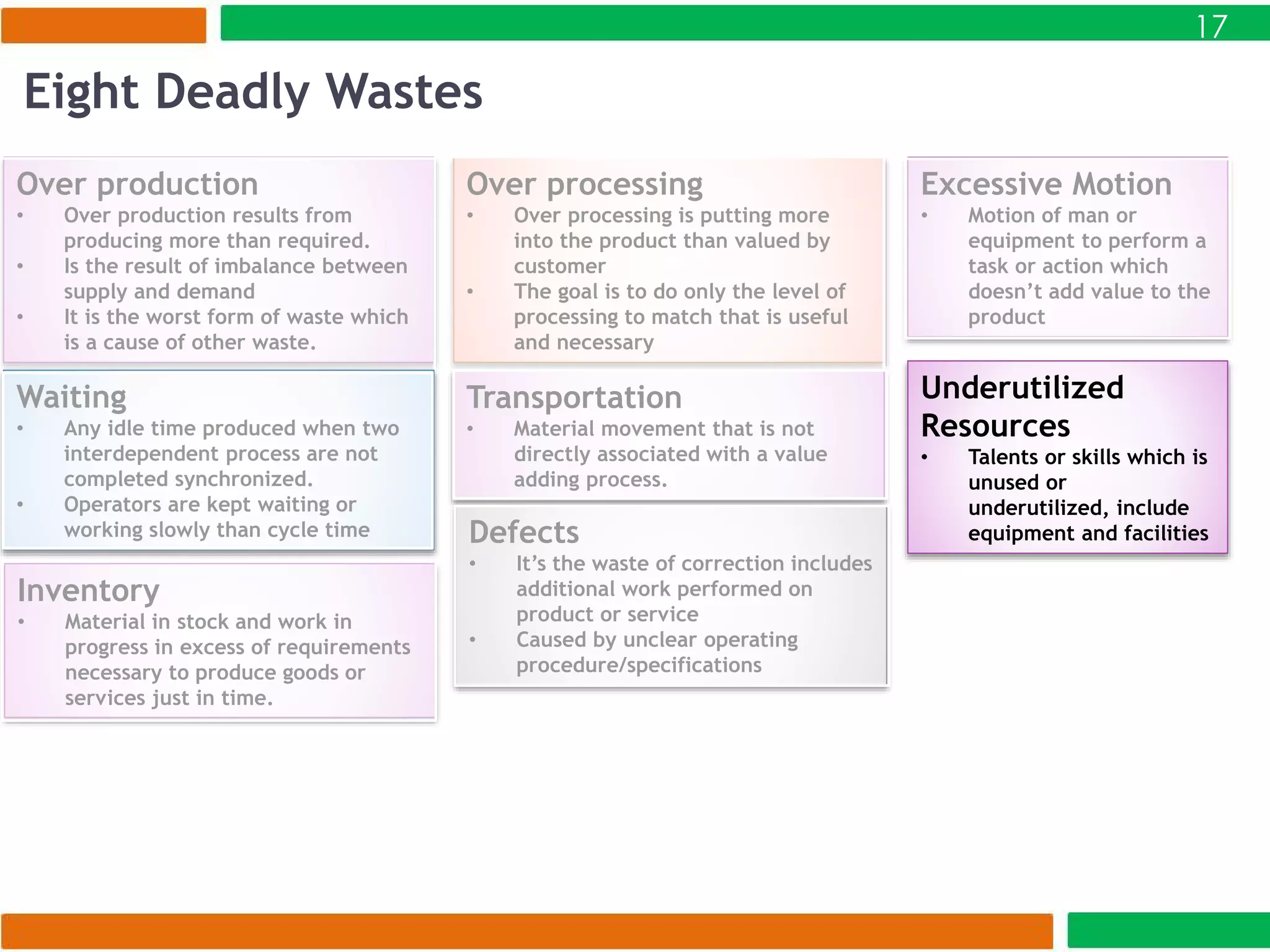
Eight Deadly Wastes
5% Value Added
95% Non-Value
Added
 Overproduction
 Waiting
 Transportation (Moving)
 Over Processing
 Excess Inventory
 Defects
 Excess Motion
 Underutilized Resources
17
Over production
• Over production results from
producing more than required.
• Is the result of imbalance between
supply and demand
• It is the worst form of waste which
is a cause of other waste.
Over processing
• Over processing is putting more
into the product than valued by
customer
• The goal is to do only the level of
processing to match that is useful
and necessary
Waiting
• Any idle time produced when two
interdependent process are not
completed synchronized.
• Operators are kept waiting or
working slowly than cycle time
Transportation
• Material movement that is not
directly associated with a value
adding process.
Inventory
• Material in stock and work in
progress in excess of requirements
necessary to produce goods or
services just in time.
Defects
• It’s the waste of correction includes
additional work performed on
product or service
• Caused by unclear operating
procedure/specifications
Excessive Motion
• Motion of man or
equipment to perform a
task or action which
doesn’t add value to the
product
Underutilized
Resources
• Talents or skills which is
unused or
underutilized, include
equipment and facilities
Eight Deadly Wastes
18
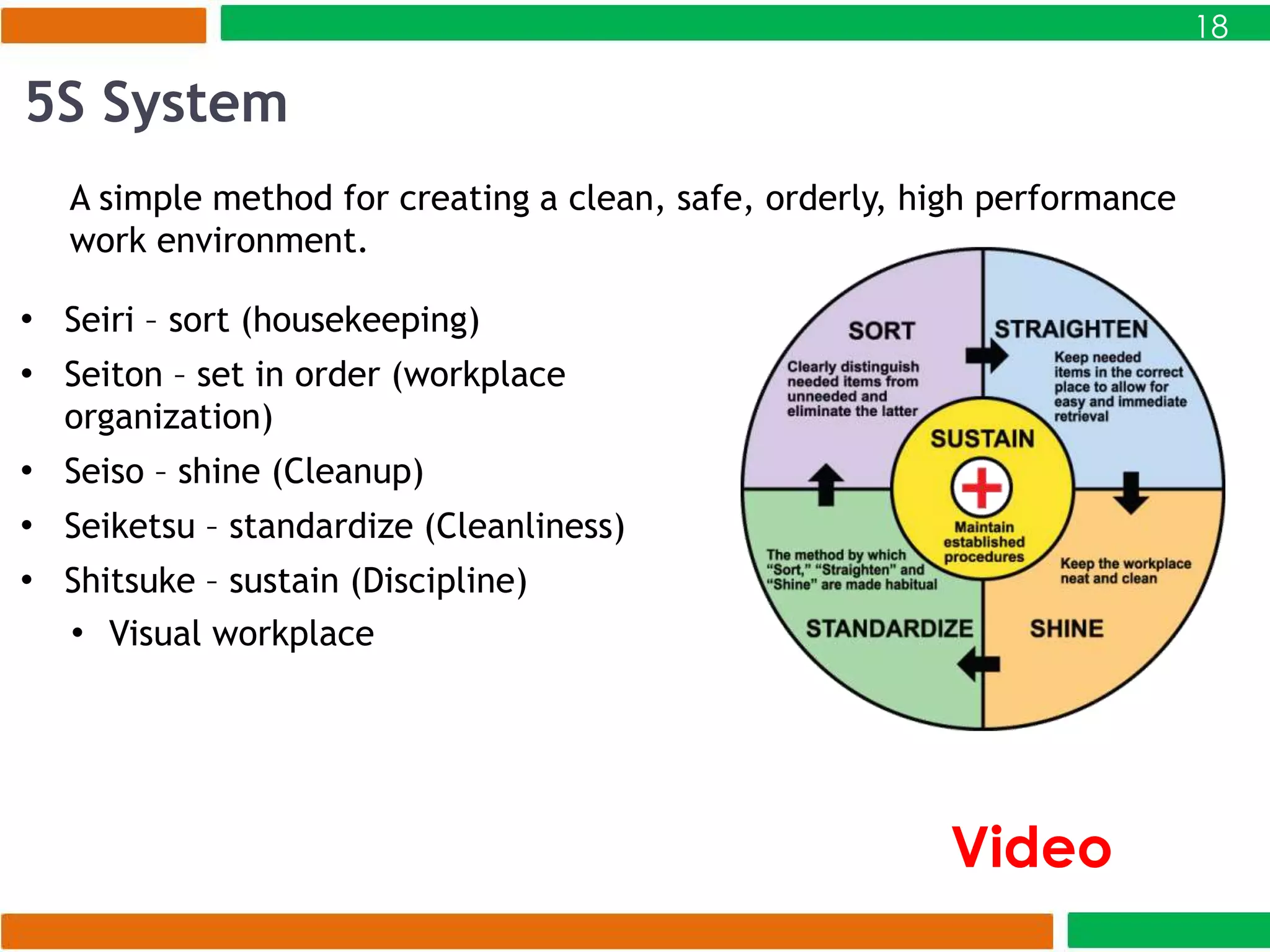
5S System
• Seiri – sort (housekeeping)
• Seiton – set in order (workplace
organization)
• Seiso – shine (Cleanup)
• Seiketsu – standardize (Cleanliness)
• Shitsuke – sustain (Discipline)
• Visual workplace
A simple method for creating a clean, safe, orderly, high performance
work environment.
Video
Visual Management
A communication device that tells, at
a glance, how work should be done.
• Where items belong
• How many items
• Standard procedure
• Work-in-process (WIP)
There is only one place to put each
item.
20
Communication Boards
Visual management tools that can
be understood in 30 seconds or
less
Examples: In/Out, project status,
staffing, wait times, etc.
Can also communicate
accomplishments
Video
KAI - CHANGE ZEN – BETTER/GOOD
• Kaizen is approach of continuous improvement in the work area
involving the everyone from Managers to workers alike
• Kaizen is the combination of two Japanese Words Kai and Zen
Kaizen
22
“Kaizen” Levels
• Restoration
• Renovation
“Kaizen” = Fill difference between present status and goal
- Aim at good condition in the past. -Aim at achieving “what the equipment
and the operation must be” in the future.
Renovating “Kaizen”
Future Level
Difference Present Level
Restorative
Difference
Past Level
Present Level
• First, bring to a condition of the past,
another line or another company
• Copying is also technology
• Develop new ideas by changing conception
• Importance is to train people who can maintain
Kaizen Levels
Poka – Yoke (Mistake Proffing)
Poka-Yoke was developed by Shigeo Shingo from Toyota Motors
as a tool to achieve Zero Defects.
• The process of Zero Defects is also known as
“Mistake Proofing” or “Fail-Safe”.
• By taking over repetitive tasks or actions that depend on vigilance
or memory, Poka-Yoke can free workers’ time and
mind to pursue more value added activities.
24
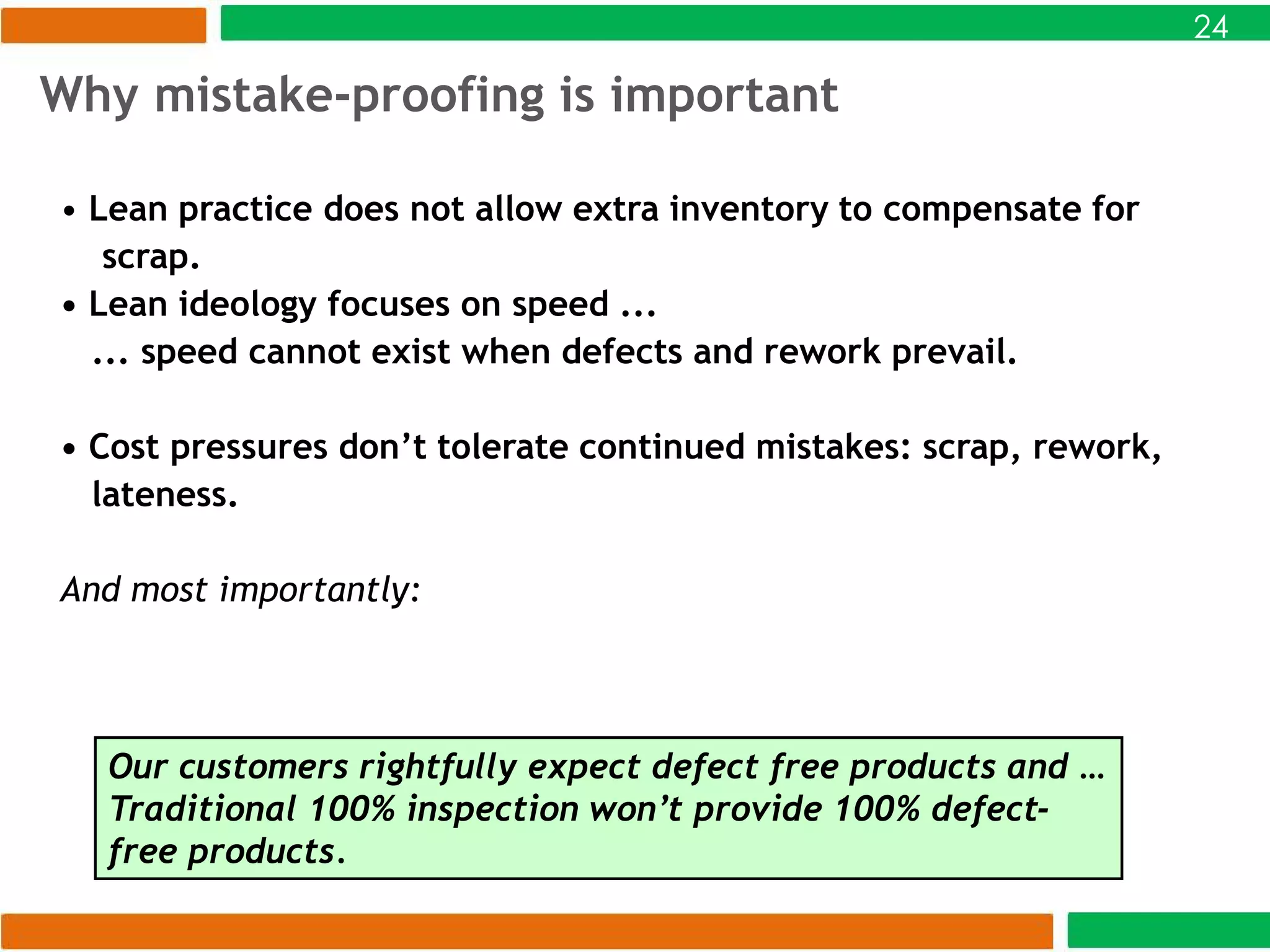
Why mistake-proofing is important
• Lean practice does not allow extra inventory to compensate for
scrap.
• Lean ideology focuses on speed ...
... speed cannot exist when defects and rework prevail.
• Cost pressures don’t tolerate continued mistakes: scrap, rework,
lateness.
And most importantly:
Our customers rightfully expect defect free products and …
Traditional 100% inspection won’t provide 100% defect-
free products.
25
Problem Solving – Root Cause analysis
Defining the “wrong” problem
wastes considerable time
looking in the wrong direction for
solution.
Symptoms:
You see it,
people talk
about it; it is
visible!
Root Cause: The
one to address. It
is often hidden.
You need to find
it!
• 5 Whys is a SIMPLE but POWERFUL
technique for uncovering the root
cause of a problem when you lack
data regarding why the problem is
occurring.
• If we don’t solve problems at the
level of the root cause, we risk the
same problem resurfacing in the
future.
5 Whys?
26
Questions?

Lean Manufacturing

  • 1.
    Lean An introduction toLean principles, methodology, tools and terminology
  • 2.
    Agenda • Lean overview •Lean principles • Eight deadly wastes • Lean concepts and tools 2
  • 3.
    What is Lean? 3 Learning to see Waste in all activities  Eliminating Waste by… “Continuously Improving Everything”
  • 4.
    • Way ofpursuing value in your business by systematically eliminating waste from daily process • Results • Lower operating cost • Reduced cycle time • Reduce defects • Improved customer satisfaction • Improved employee morale • Business Plan Achieved • Faster, Better & More efficient. Lean as a Business Philosophy:
  • 5.
    History of LeanManufacturing 1798 Eli Whitney develops interchangeable parts 1933 - Toyota Motor Company established 1908 through 1913 Henry Ford develops the moving assembly line. 1920’s Sakichi Toyoda develops mistake proofing and 5 Whys August 4, 1937 First supermarket in the United States opened June – August 1950 Deming introduces lean quality principles to Japanese engineers and managers 1950’s - Taiichi Ohno develops the Toyota Production System (TPS)
  • 6.
    Why Lean? Population is gettingolder Increasing Customer expectations Pressure on greater accountability and transparency Tight and shrinking budgets Shrinking workforce and increasing need for skilled workforce 6 Lean helps us improve quality, reduce costs, increase customer and employee satisfaction, & capture knowledge
  • 7.
    Customer Work Problem solving Process Oppurtunities Leanhelps us Understand: 7 What adds values to customer How work gets done How to iden. Root cause of Problems How Ideal Process Look like How to improve performance
  • 8.
    Major Principles ofLean 8 Identify value Map Value stream Create Flow Establish Pull Seek PerfectionSpecific product that meets a customer’s needs at a specific price and specific time Set of specific actions required to bring a specific product through 2 critical management tasks of all businesses Flow of parts through value stream from upstream head to downstream mouth Nothing is produced by the upstream provider until the downstream customer signals a need The complete elimination of all waste, so that all activities along a value stream add value to the product
  • 9.
    How Do WeDefine Value? • Customer is willing to pay for it • Actually transforms a product or service • Done correctly the first time • Consumes resources without creating value for the customer. • Low percent of the time work is complete and accurate . • Requires extra time, effort, or resources 9 Value-added Non Value-added
  • 10.
    10 • Use ValueStream Analysis as a planning tool ▫ Break down the Value Stream in manageable sections ▫ Communicate the “flow” with maps  Information  Material • Use Value Stream Analysis to create 2 maps ▫ Current ▫ Future (near time-within a year) • Develop action plan from the Future map Value Stream Analysis
  • 11.
    11 Current State Map& Future State Map
  • 12.
    12 What is Flow? •Parts “flow” through a Value Stream • Upstream is the beginning or “head” of the flow • Downstream is the “mouth” of the flow, where the part is pulled by the customer • Materials and parts are the “parts” in manufacturing • Customer’s needs are the “parts” in service industry ▫ Same for administration
  • 13.
    13 Push and PullProduction Push Systems: schedule work releases based on demand. •inherently due-date driven •control release rate, observe WIP level Pull Systems: authorize work releases based on system status. •inherently rate driven •control WIP level, observe throughput Video
  • 14.
    Improvement Strategies Eliminate non- valueadded tasks Combine tasks or functions Concurrent processing Co-locate work Shift roles and responsibilities Eliminate or reduce batching Automate Solve Problems Handoffs and batching are common barriers to process flow
  • 15.
    Lean Concepts andTools • Eight Wastes • 5S • Standard Work • Visual Management • Kaizen • Problem solving 15
  • 16.
    16 Eight Deadly Wastes 5%Value Added 95% Non-Value Added  Overproduction  Waiting  Transportation (Moving)  Over Processing  Excess Inventory  Defects  Excess Motion  Underutilized Resources
  • 17.
    17 Over production • Overproduction results from producing more than required. • Is the result of imbalance between supply and demand • It is the worst form of waste which is a cause of other waste. Over processing • Over processing is putting more into the product than valued by customer • The goal is to do only the level of processing to match that is useful and necessary Waiting • Any idle time produced when two interdependent process are not completed synchronized. • Operators are kept waiting or working slowly than cycle time Transportation • Material movement that is not directly associated with a value adding process. Inventory • Material in stock and work in progress in excess of requirements necessary to produce goods or services just in time. Defects • It’s the waste of correction includes additional work performed on product or service • Caused by unclear operating procedure/specifications Excessive Motion • Motion of man or equipment to perform a task or action which doesn’t add value to the product Underutilized Resources • Talents or skills which is unused or underutilized, include equipment and facilities Eight Deadly Wastes
  • 18.
    18 5S System • Seiri– sort (housekeeping) • Seiton – set in order (workplace organization) • Seiso – shine (Cleanup) • Seiketsu – standardize (Cleanliness) • Shitsuke – sustain (Discipline) • Visual workplace A simple method for creating a clean, safe, orderly, high performance work environment. Video
  • 19.
    Visual Management A communicationdevice that tells, at a glance, how work should be done. • Where items belong • How many items • Standard procedure • Work-in-process (WIP) There is only one place to put each item.
  • 20.
    20 Communication Boards Visual managementtools that can be understood in 30 seconds or less Examples: In/Out, project status, staffing, wait times, etc. Can also communicate accomplishments Video
  • 21.
    KAI - CHANGEZEN – BETTER/GOOD • Kaizen is approach of continuous improvement in the work area involving the everyone from Managers to workers alike • Kaizen is the combination of two Japanese Words Kai and Zen Kaizen
  • 22.
    22 “Kaizen” Levels • Restoration •Renovation “Kaizen” = Fill difference between present status and goal - Aim at good condition in the past. -Aim at achieving “what the equipment and the operation must be” in the future. Renovating “Kaizen” Future Level Difference Present Level Restorative Difference Past Level Present Level • First, bring to a condition of the past, another line or another company • Copying is also technology • Develop new ideas by changing conception • Importance is to train people who can maintain Kaizen Levels
  • 23.
    Poka – Yoke(Mistake Proffing) Poka-Yoke was developed by Shigeo Shingo from Toyota Motors as a tool to achieve Zero Defects. • The process of Zero Defects is also known as “Mistake Proofing” or “Fail-Safe”. • By taking over repetitive tasks or actions that depend on vigilance or memory, Poka-Yoke can free workers’ time and mind to pursue more value added activities.
  • 24.
    24 Why mistake-proofing isimportant • Lean practice does not allow extra inventory to compensate for scrap. • Lean ideology focuses on speed ... ... speed cannot exist when defects and rework prevail. • Cost pressures don’t tolerate continued mistakes: scrap, rework, lateness. And most importantly: Our customers rightfully expect defect free products and … Traditional 100% inspection won’t provide 100% defect- free products.
  • 25.
    25 Problem Solving –Root Cause analysis Defining the “wrong” problem wastes considerable time looking in the wrong direction for solution. Symptoms: You see it, people talk about it; it is visible! Root Cause: The one to address. It is often hidden. You need to find it! • 5 Whys is a SIMPLE but POWERFUL technique for uncovering the root cause of a problem when you lack data regarding why the problem is occurring. • If we don’t solve problems at the level of the root cause, we risk the same problem resurfacing in the future. 5 Whys?
  • 26.