Prof. Sohaib Hasnain
Punjab Group of Colleges, Faisalabad
CHEMISTRY
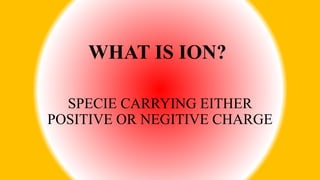
WHAT IS ION?
SPECIE CARRYING EITHER
POSITIVE OR NEGITIVE CHARGE
IONS ARE FORMED BY THE
ADDITION OR REMOVAL OF
ELECTRON
TYPES OF IONS
 POSITIVE ION
 NEGITIVE ION
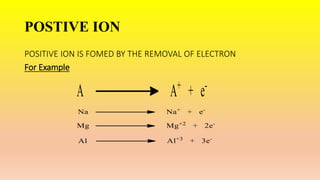
POSTIVE ION
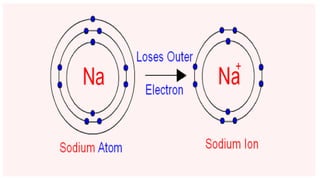
POSITIVE ION IS FOMED BY THE REMOVAL OF ELECTRON
For Example
POSITIVE ION/ CATION
 They are also called cations
 They have positive charge
 They are formed by the removal of electron
 They may carry +1, +2, +3 charge depending upon the number of
electrons lost by the atom
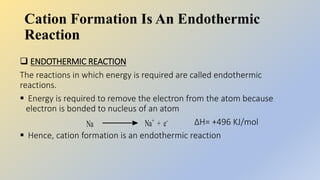
Cation Formation Is An Endothermic
Reaction
 ENDOTHERMIC REACTION
The reactions in which energy is required are called endothermic
reactions.
 Energy is required to remove the electron from the atom because
electron is bonded to nucleus of an atom
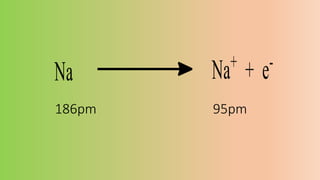
ΔH= +496 KJ/mol
 Hence, cation formation is an endothermic reaction
Cation formation is an
Oxidation Reaction
Oxidation means removal of electron
Hence, it is called oxidation reaction
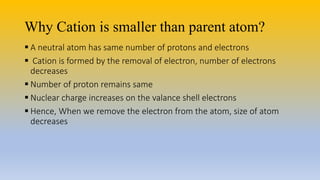
Why Cation is smaller than parent atom?
 A neutral atom has same number of protons and electrons
 Cation is formed by the removal of electron, number of electrons
decreases
 Number of proton remains same
 Nuclear charge increases on the valance shell electrons
 Hence, When we remove the electron from the atom, size of atom
decreases
186pm 95pm
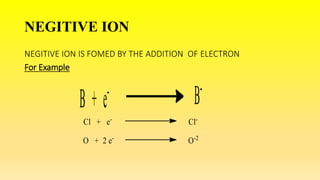
NEGITIVE ION
NEGITIVE ION IS FOMED BY THE ADDITION OF ELECTRON
For Example
NEGITIVE ION/ ANION
 They are also called Anions
 They have negative charge
 They are formed by the addition of electron
 They may carry -1, -2, -3 charge depending upon the number of
electrons gain by the atom
Anion Formation Is An Exothermic
Reaction
 EXOTHERMIC REACTION
The reactions in which energy is released are called exothermic
reactions.
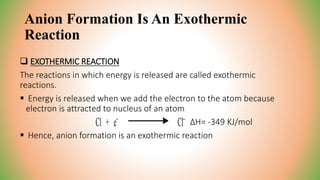
 Energy is released when we add the electron to the atom because
electron is attracted to nucleus of an atom
ΔH= -349 KJ/mol
 Hence, anion formation is an exothermic reaction
Anion formation is an
Reduction Reaction
Redution means addition of electron
Hence, it is called reduction reaction
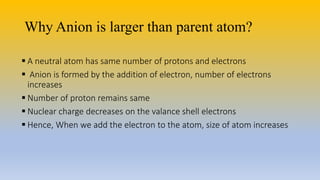
Why Anion is larger than parent atom?
 A neutral atom has same number of protons and electrons
 Anion is formed by the addition of electron, number of electrons
increases
 Number of proton remains same
 Nuclear charge decreases on the valance shell electrons
 Hence, When we add the electron to the atom, size of atom increases
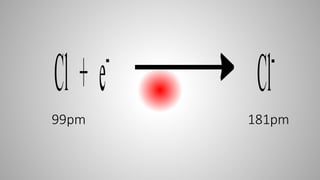
99pm 181pm
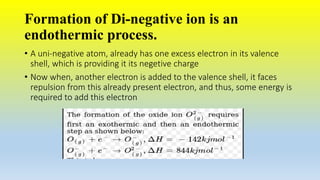
Formation of Di-negative ion is an
endothermic process.
• A uni-negative atom, already has one excess electron in its valence
shell, which is providing it its negetive charge
• Now when, another electron is added to the valence shell, it faces
repulsion from this already present electron, and thus, some energy is
required to add this electron
WHY CATION IS SMALLER
THAN ANION?
OR
WHY ANION IS LARGER
THAN CATION?
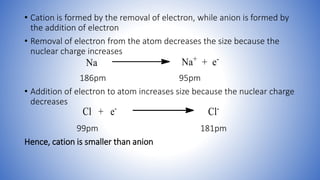
• Cation is formed by the removal of electron, while anion is formed by
the addition of electron
• Removal of electron from the atom decreases the size because the
nuclear charge increases
186pm 95pm
• Addition of electron to atom increases size because the nuclear charge
decreases
99pm 181pm
Hence, cation is smaller than anion
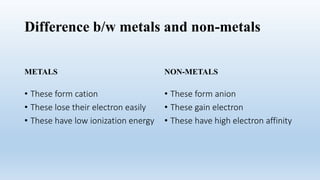
Difference b/w metals and non-metals
METALS
• These form cation
• These lose their electron easily
• These have low ionization energy
NON-METALS
• These form anion
• These gain electron
• These have high electron affinity
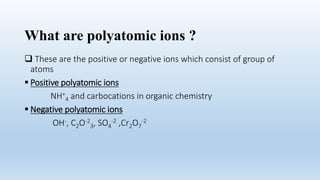
What are polyatomic ions ?
 These are the positive or negative ions which consist of group of
atoms
 Positive polyatomic ions
NH+
4 and carbocations in organic chemistry
 Negative polyatomic ions
OH-, C2O-2
3, SO4
-2 ,Cr2O7
-2

ION AND ITS TYPES

  • 2.
    Prof. Sohaib Hasnain PunjabGroup of Colleges, Faisalabad CHEMISTRY
  • 4.
    WHAT IS ION? SPECIECARRYING EITHER POSITIVE OR NEGITIVE CHARGE
  • 5.
    IONS ARE FORMEDBY THE ADDITION OR REMOVAL OF ELECTRON
  • 6.
    TYPES OF IONS POSITIVE ION  NEGITIVE ION
  • 7.
    POSTIVE ION POSITIVE IONIS FOMED BY THE REMOVAL OF ELECTRON For Example
  • 8.
    POSITIVE ION/ CATION They are also called cations  They have positive charge  They are formed by the removal of electron  They may carry +1, +2, +3 charge depending upon the number of electrons lost by the atom
  • 9.
    Cation Formation IsAn Endothermic Reaction  ENDOTHERMIC REACTION The reactions in which energy is required are called endothermic reactions.  Energy is required to remove the electron from the atom because electron is bonded to nucleus of an atom ΔH= +496 KJ/mol  Hence, cation formation is an endothermic reaction
  • 10.
    Cation formation isan Oxidation Reaction Oxidation means removal of electron Hence, it is called oxidation reaction
  • 12.
    Why Cation issmaller than parent atom?  A neutral atom has same number of protons and electrons  Cation is formed by the removal of electron, number of electrons decreases  Number of proton remains same  Nuclear charge increases on the valance shell electrons  Hence, When we remove the electron from the atom, size of atom decreases
  • 13.
  • 14.
    NEGITIVE ION NEGITIVE IONIS FOMED BY THE ADDITION OF ELECTRON For Example
  • 15.
    NEGITIVE ION/ ANION They are also called Anions  They have negative charge  They are formed by the addition of electron  They may carry -1, -2, -3 charge depending upon the number of electrons gain by the atom
  • 16.
    Anion Formation IsAn Exothermic Reaction  EXOTHERMIC REACTION The reactions in which energy is released are called exothermic reactions.  Energy is released when we add the electron to the atom because electron is attracted to nucleus of an atom ΔH= -349 KJ/mol  Hence, anion formation is an exothermic reaction
  • 17.
    Anion formation isan Reduction Reaction Redution means addition of electron Hence, it is called reduction reaction
  • 18.
    Why Anion islarger than parent atom?  A neutral atom has same number of protons and electrons  Anion is formed by the addition of electron, number of electrons increases  Number of proton remains same  Nuclear charge decreases on the valance shell electrons  Hence, When we add the electron to the atom, size of atom increases
  • 19.
  • 20.
    Formation of Di-negativeion is an endothermic process. • A uni-negative atom, already has one excess electron in its valence shell, which is providing it its negetive charge • Now when, another electron is added to the valence shell, it faces repulsion from this already present electron, and thus, some energy is required to add this electron
  • 21.
    WHY CATION ISSMALLER THAN ANION? OR WHY ANION IS LARGER THAN CATION?
  • 22.
    • Cation isformed by the removal of electron, while anion is formed by the addition of electron • Removal of electron from the atom decreases the size because the nuclear charge increases 186pm 95pm • Addition of electron to atom increases size because the nuclear charge decreases 99pm 181pm Hence, cation is smaller than anion
  • 23.
    Difference b/w metalsand non-metals METALS • These form cation • These lose their electron easily • These have low ionization energy NON-METALS • These form anion • These gain electron • These have high electron affinity
  • 24.
    What are polyatomicions ?  These are the positive or negative ions which consist of group of atoms  Positive polyatomic ions NH+ 4 and carbocations in organic chemistry  Negative polyatomic ions OH-, C2O-2 3, SO4 -2 ,Cr2O7 -2