Chemical Bonding
Comparison of Properties
Ionic Compounds
Covalent Compounds
Metals
Essential Questions
• Why/How do atoms combine with one
another to form the vast array of chemical
substances that exist?
• What is ionic, covalent and metallic bonding
and how do the types of bonding determine
properties of matter?
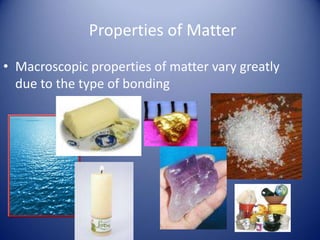
Properties of Matter
• Macroscopic properties of matter vary greatly
due to the type of bonding
What is a chemical bond?
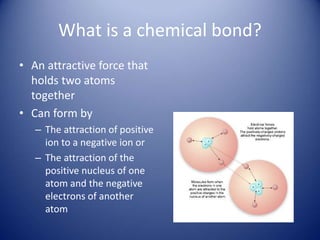
• An attractive force that
holds two atoms
together
• Can form by
– The attraction of positive
ion to a negative ion or
– The attraction of the
positive nucleus of one
atom and the negative
electrons of another
atom
Bond
• the interaction between two or more atoms
that allows them to form a substance different
from the independent atoms.
• involves the outer (valence) electrons of the
atoms.
• These electrons are
– transferred from one atom to another or shared
between them.
Chemical Bond Energy Considerations
• A chemical bond forms when it is energetically
favorable
– when the energy of the bonded atoms is less than
the energies of the separated atoms.
– Al + I2 https://www.youtube.com/watch?v=XBPqSuIN-3E
Bonding
• Chemical compounds are formed by the
joining of two or more atoms.
• A stable compound occurs when the total
energy of the combination has lower energy
than the separated atoms.
• The bound state implies a net attractive force
between the atoms ... a chemical bond.
Energy Changes in Bonding
• When bonds are formed, energy is released.
• Demonstrations:
– Formation of an Ionic Compound: Mg + O2
– Formation of a Molecular Compound: S +O2
Breaking Bonds
• In order to break bonds energy must be
added, usually in the form of heat, light, or
electricity.
• Demonstration: Electrolysis of water
• Demo: Decomposition of Nitrogen Triiodide
• http://www.youtube.com/watch?v=z5vsQ8sPgX4
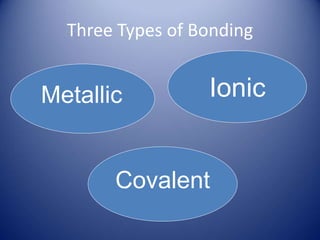
Three Types of Bonding
Metallic
Covalent
Ionic
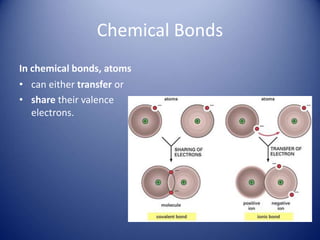
Chemical Bonds
In chemical bonds, atoms
• can either transfer or
• share their valence
electrons.
When atoms transfer electrons
Ionic Bonds
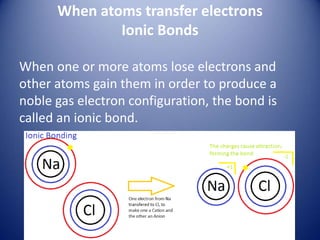
When one or more atoms lose electrons and
other atoms gain them in order to produce a
noble gas electron configuration, the bond is
called an ionic bond.
Ionic Bonding
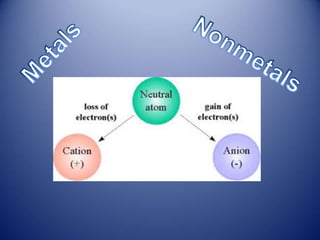
• metallic atoms tend to lose electrons
• When they do so, they become positively charged
ions which are called cations.
• Nonmetallic atoms tend to gain electrons to become
negatively charged ions which are called anions.
• These oppositely charged cations and anions are
attracted to one another because of their opposite
charges.
• That attraction is called an ionic bond. We often
refer to the charge on the ion as the oxidation
state of that element.
Negative Ion (Anion) Formation
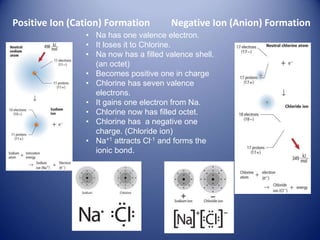
• Na has one valence electron.
• It loses it to Chlorine.
• Na now has a filled valence shell.
(an octet)
• Becomes positive one in charge
• Chlorine has seven valence
electrons.
• It gains one electron from Na.
• Chlorine now has filled octet.
• Chlorine has a negative one
charge. (Chloride ion)
• Na+1 attracts Cl-1 and forms the
ionic bond.
Positive Ion (Cation) Formation
Ionic Bonds
• Part 1
– http://www.youtube.com/watch?v=Qf07-8Jhhpc
• Part 2
– http://www.youtube.com/watch?v=5EwmedLuRmw
• Part 3
– http://www.youtube.com/watch?v=RkZNYuSho0M
Ion Formation
• All of the elements in Group I have one
electron in their outermost energy level.
• All of these elements can lose that one
valence electron.
• These atoms become cations with a positive
one charge.
• Elements in Group II have two electrons in
their outermost energy level.
• So, when these elements lose electrons, they
lose two electrons and take on a positive two
charge.
• The transition metals and the metals to the right of
them generally form more than one ion.
• We call these elements multivalent. The charges on
their ions are not always predictable, although some
patterns do exist.
• A few of the transition elements form only one ion or
oxidation state. For example zinc ion, silver ion and
scandium ion.
• Zn2+ zinc ion
• Ag+ silver ion
• Sc3+ scandium ion
Anions
• Nonmetals tend to gain electrons.
• The halogens - fluorine, chlorine, bromine, and iodine - have a strong
attraction for electrons.
• Their outermost energy levels are almost full. There is only room for one
more electron in the outer energy levels for each of those atoms.
Consequently, the elements fluorine, chlorine, bromine, and iodine will
gain one electron, and become anions with a negative one charge.
• Oxygen, sulfur, and the other elements in that family will gain two
electrons.
• In the next group over, nitrogen, phosphorus and arsenic can take on three
electrons.
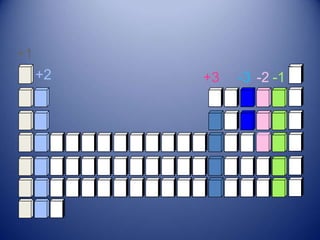
+2
+1
+3 -3 -2 -1
Ionic Nomenclature
• Naming Ionic Compounds
• Video of the Process
– http://www.youtube.com/watch?v=URc75hoKGLY
Ionic Compounds
• Made of cations and anions
• Metals and nonmetals
• The electrons lost by the cation are gained by
the anion
• The cation and anions surround each other
• Smallest ratio of ions in an ionic compound is
a FORMULA UNIT.
K+1
Ca+2 Has lost two electrons
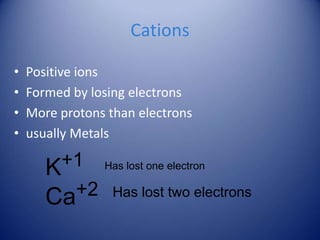
Cations
• Positive ions
• Formed by losing electrons
• More protons than electrons
• usually Metals
Has lost one electron
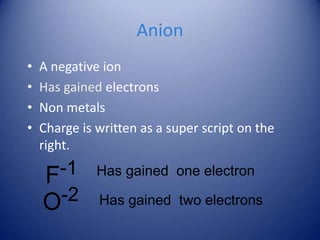
Anion
• A negative ion
• Has gained electrons
• Non metals
• Charge is written as a super script on the
right.
F-1 Has gained one electron
O-2 Has gained two electrons
Formula Unit
• The smallest whole number ratio of atoms in
an ionic compound.
• Ions surround each other so you can’t say
which is hooked to which
Naming Ions
• We will use the systematic way
• Cation- if the charge is always the same just
write the name of the metal
• Transition metals can have more than one
type of charge
• Indicate the charge with a Roman numeral in
parentheses
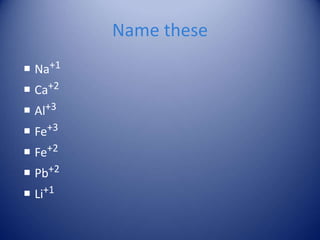
Name these
 Na+1
 Ca+2
 Al+3
 Fe+3
 Fe+2
 Pb+2
 Li+1
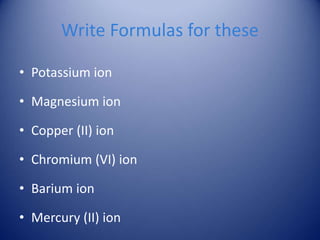
Write Formulas for these
• Potassium ion
• Magnesium ion
• Copper (II) ion
• Chromium (VI) ion
• Barium ion
• Mercury (II) ion
Naming Anions
• Change the element ending to – ide
• F-1 Fluorine
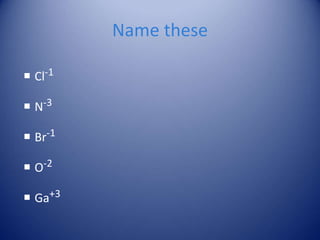
Name these
 Cl-1
 N-3
 Br-1
 O-2
 Ga+3
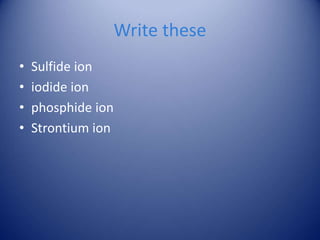
Write these
• Sulfide ion
• iodide ion
• phosphide ion
• Strontium ion
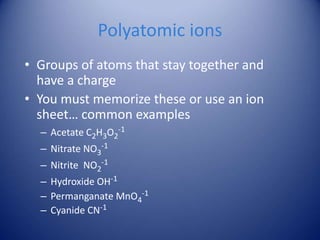
Polyatomic ions
• Groups of atoms that stay together and
have a charge
• You must memorize these or use an ion
sheet… common examples
– Acetate C2H3O2
-1
– Nitrate NO3
-1
– Nitrite NO2
-1
– Hydroxide OH-1
– Permanganate MnO4
-1
– Cyanide CN-1
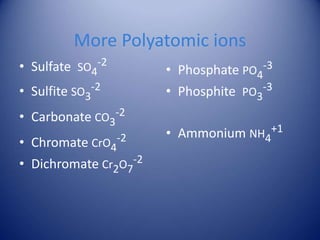
More Polyatomic ions
• Sulfate SO4
-2
• Sulfite SO3
-2
• Carbonate CO3
-2
• Chromate CrO4
-2
• Dichromate Cr2O7
-2
• Phosphate PO4
-3
• Phosphite PO3
-3
• Ammonium NH4
+1
Practice with Ions
• Use the practice worksheet to determine the
ions formed.
• Learn to use your periodic table and pink
sheet to determine charges (oxidation state.)
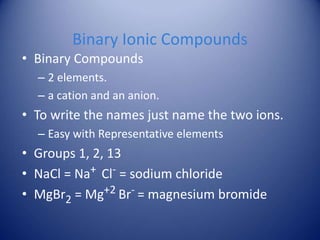
Binary Ionic Compounds
• Binary Compounds
– 2 elements.
– a cation and an anion.
• To write the names just name the two ions.
– Easy with Representative elements
• Groups 1, 2, 13
• NaCl = Na+ Cl- = sodium chloride
• MgBr2 = Mg+2 Br- = magnesium bromide
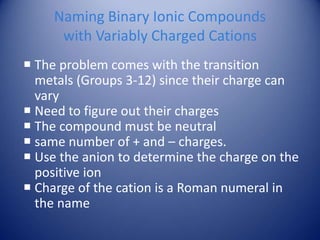
Naming Binary Ionic Compounds
with Variably Charged Cations
 The problem comes with the transition
metals (Groups 3-12) since their charge can
vary
 Need to figure out their charges
 The compound must be neutral
 same number of + and – charges.
 Use the anion to determine the charge on the
positive ion
 Charge of the cation is a Roman numeral in
the name
Example
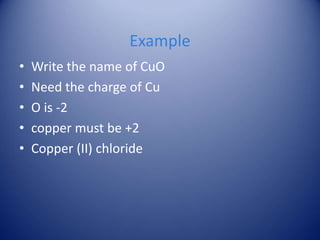
• Write the name of CuO
• Need the charge of Cu
• O is -2
• copper must be +2
• Copper (II) chloride
Example
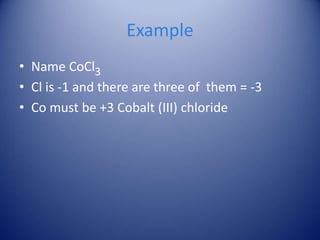
• Name CoCl3
• Cl is -1 and there are three of them = -3
• Co must be +3 Cobalt (III) chloride
Another Example
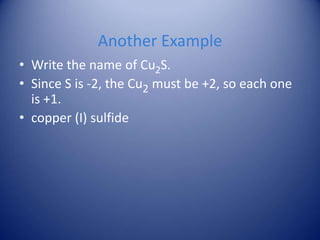
• Write the name of Cu2S.
• Since S is -2, the Cu2 must be +2, so each one
is +1.
• copper (I) sulfide
Last Example
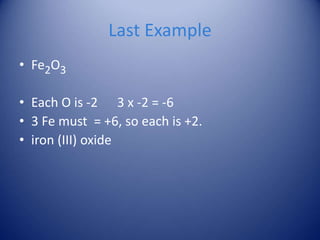
• Fe2O3
• Each O is -2 3 x -2 = -6
• 3 Fe must = +6, so each is +2.
• iron (III) oxide
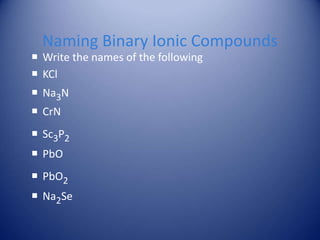
Naming Binary Ionic Compounds
 Write the names of the following
 KCl
 Na3N
 CrN
 Sc3P2
 PbO
 PbO2
 Na2Se
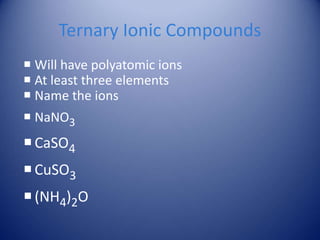
Ternary Ionic Compounds
 Will have polyatomic ions
 At least three elements
 Name the ions
 NaNO3
CaSO4
CuSO3
(NH4)2O
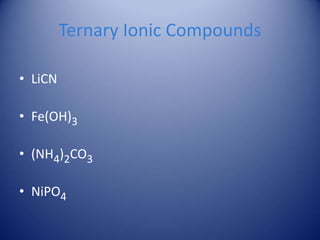
Ternary Ionic Compounds
• LiCN
• Fe(OH)3
• (NH4)2CO3
• NiPO4
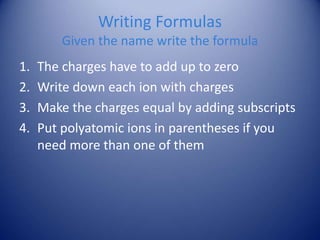
Writing Formulas
Given the name write the formula
1. The charges have to add up to zero
2. Write down each ion with charges
3. Make the charges equal by adding subscripts
4. Put polyatomic ions in parentheses if you
need more than one of them
Writing Formulas Example
• Write the formula for calcium chloride.
Another Example
• Aluminum nitrate
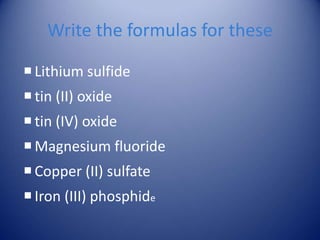
Write the formulas for these
Lithium sulfide
tin (II) oxide
tin (IV) oxide
Magnesium fluoride
Copper (II) sulfate
Iron (III) phosphide
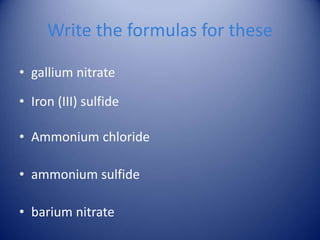
Write the formulas for these
• gallium nitrate
• Iron (III) sulfide
• Ammonium chloride
• ammonium sulfide
• barium nitrate
Things to look for
• If cation has (Roman Numeral), the number is
the charge
• If anions end in -ide they are probably off the
periodic table (Monoatomic)
• If anion ends in -ate or -ite it is polyatomic
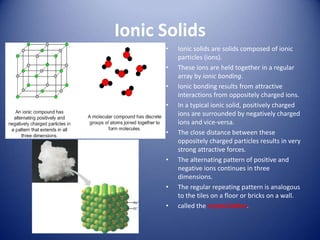
Ionic Solids
• Ionic solids are solids composed of ionic
particles (ions).
• These ions are held together in a regular
array by ionic bonding.
• Ionic bonding results from attractive
interactions from oppositely charged ions.
• In a typical ionic solid, positively charged
ions are surrounded by negatively charged
ions and vice-versa.
• The close distance between these
oppositely charged particles results in very
strong attractive forces.
• The alternating pattern of positive and
negative ions continues in three
dimensions.
• The regular repeating pattern is analogous
to the tiles on a floor or bricks on a wall.
• called the crystal lattice.
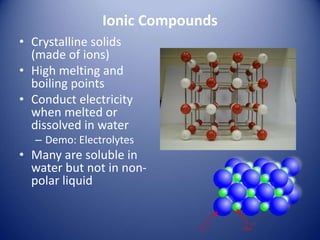
Ionic Compounds
• Crystalline solids
(made of ions)
• High melting and
boiling points
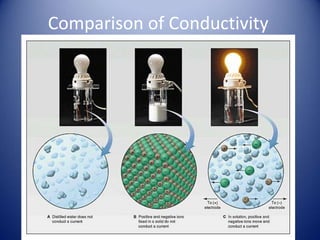
• Conduct electricity
when melted or
dissolved in water
– Demo: Electrolytes
• Many are soluble in
water but not in non-
polar liquid
Comparison of Conductivity
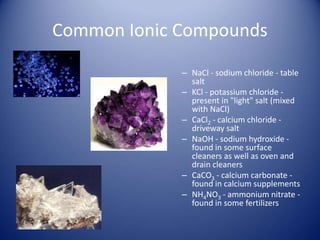
Common Ionic Compounds
– NaCl - sodium chloride - table
salt
– KCl - potassium chloride -
present in "light" salt (mixed
with NaCl)
– CaCl2 - calcium chloride -
driveway salt
– NaOH - sodium hydroxide -
found in some surface
cleaners as well as oven and
drain cleaners
– CaCO3 - calcium carbonate -
found in calcium supplements
– NH4NO3 - ammonium nitrate -
found in some fertilizers
Ionic vs Molecular
• http://www.youtube.com/watch?v=PKA4CZw
bZWU
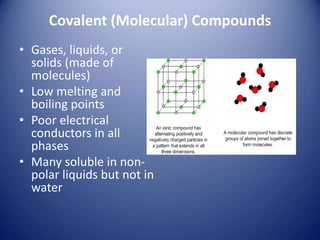
Covalent (Molecular) Compounds
• Gases, liquids, or
solids (made of
molecules)
• Low melting and
boiling points
• Poor electrical
conductors in all
phases
• Many soluble in non-
polar liquids but not in
water
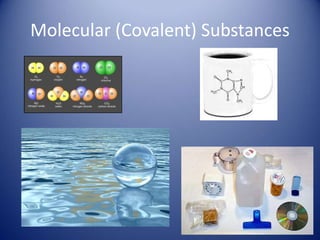
Molecular (Covalent) Substances
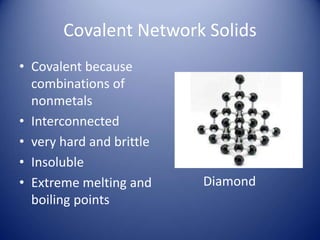
Covalent Network Solids
• Covalent because
combinations of
nonmetals
• Interconnected
• very hard and brittle
• Insoluble
• Extreme melting and
boiling points
Diamond
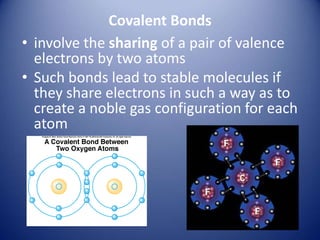
Covalent Bonds
• involve the sharing of a pair of valence
electrons by two atoms
• Such bonds lead to stable molecules if
they share electrons in such a way as to
create a noble gas configuration for each
atom
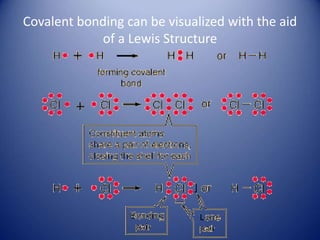
Covalent bonding can be visualized with the aid
of a Lewis Structure
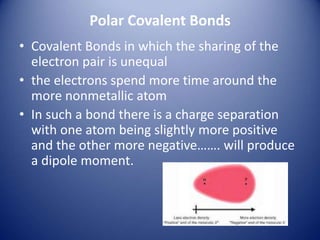
Polar Covalent Bonds
• Covalent Bonds in which the sharing of the
electron pair is unequal
• the electrons spend more time around the
more nonmetallic atom
• In such a bond there is a charge separation
with one atom being slightly more positive
and the other more negative……. will produce
a dipole moment.
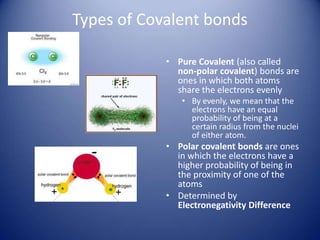
Types of Covalent bonds
• Pure Covalent (also called
non-polar covalent) bonds are
ones in which both atoms
share the electrons evenly
• By evenly, we mean that the
electrons have an equal
probability of being at a
certain radius from the nuclei
of either atom.
• Polar covalent bonds are ones
in which the electrons have a
higher probability of being in
the proximity of one of the
atoms
• Determined by
Electronegativity Difference
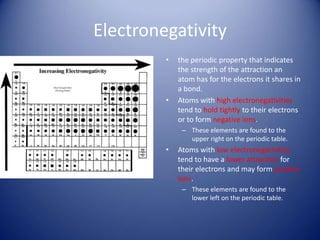
Electronegativity
• the periodic property that indicates
the strength of the attraction an
atom has for the electrons it shares in
a bond.
• Atoms with high electronegativities
tend to hold tightly to their electrons
or to form negative ions.
– These elements are found to the
upper right on the periodic table.
• Atoms with low electronegativities
tend to have a lower attraction for
their electrons and may form positive
ions.
– These elements are found to the
lower left on the periodic table.
Pure covalent or Non-polar
covalent bond
• Electronegativity difference of 0.3 or less in
between the two atoms.
• A pure covalent bond can form between two
atoms of the same element (such as in
diatomic oxygen molecule)
• or atoms of different elements that have
similar electronegativies (such as in the
carbon and hydrogen atom in methane).
Polar Covalent Bond
• A is a pair of electrons shared between two atoms
with significantly different electronegativities (from
0.3 to 1.7 difference).
• These bonds tend to form between highly
electronegative non-metals and other non-metals,
such as the bond between hydrogen and oxygen in
water.
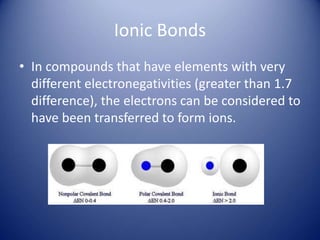
Ionic Bonds
• In compounds that have elements with very
different electronegativities (greater than 1.7
difference), the electrons can be considered to
have been transferred to form ions.
• Many of the properties of a compound, such
as solubility and boiling point, depend, in part,
on the degree of the polarity of its bonds.
Examples to Determine Bond Character
• Using electronegativity in the prediction of the
polarity of a chemical bond.
• sodium bonded to chlorine
– Difference between the electronegativities of Na(0.9) and
Cl(3.0) are so great that they form an ionic bond.
• The hydrogen molecule (2 H atoms bonded to each
other)
• zero electronegativity difference, form a non-polar
covalent bond.
Bond Character
• Nonpolar-Covalent bonds (H2)
– Electrons are equally shared
– Electronegativity difference of 0 to 0.3
• Polar-Covalent bonds (HCl)
– Electrons are unequally shared
– Electronegativity difference between .3 and 1.7
• Ionic Bonds (NaCl)
– Electrons are transferred
– Electronegativity difference of more than 1.7
Diatomic Molecules
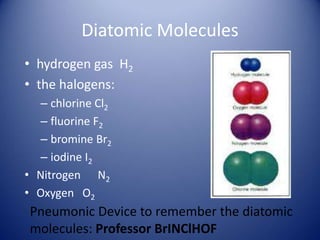
• hydrogen gas H2
• the halogens:
– chlorine Cl2
– fluorine F2
– bromine Br2
– iodine I2
• Nitrogen N2
• Oxygen O2
Pneumonic Device to remember the diatomic
molecules: Professor BrINClHOF
Metals and Metallic Bonding
• Typical Properties of Metals
– Malleable
– Ductile
– Good Conductors of Heat and Electricity
– Generally high melting and boiling points
Metallic Bonds
• The properties of metals suggest that their
atoms possess strong bonds
• yet the ease of conduction of heat and
electricity suggest that electrons can move
freely in all directions in a metal
• The general observations give rise to a picture
of "positive ions in a sea of electrons" to
describe metallic bonding.
Metal Properties
• Malleable and Ductile
• Strong and Durable
• Good conductors of heat and electricity.
• Their strength indicates that the atoms are difficult to
separate… strong bonds
• but malleability and ductility suggest that the atoms are
relatively easy to move in various directions.
• The electrical conductivity suggests that it is easy to move
electrons in any direction in these materials.
• The thermal conductivity also involves the motion of
electrons. All of these properties suggest the nature of the
metallic bonds between atoms. (Electron sea model)
Metallic Bonding
Electron Sea Model
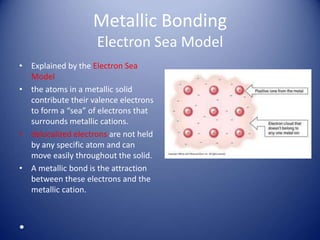
• Explained by the Electron Sea
Model
• the atoms in a metallic solid
contribute their valence electrons
to form a “sea” of electrons that
surrounds metallic cations.
• delocalized electrons are not held
by any specific atom and can
move easily throughout the solid.
• A metallic bond is the attraction
between these electrons and the
metallic cation.
•
Metallic Bonding
the Electron Sea Model
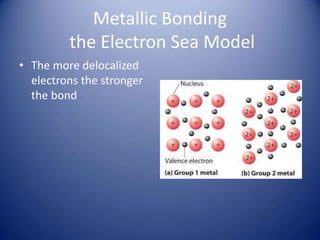
• The more delocalized
electrons the stronger
the bond
• A mixture of elements that has metallic
properties is called an alloy.
• Two types of alloys
– An interstitial alloy is one in which the small holes
in a metallic crystal are filled by other smaller
atoms.
– A substitutional alloy is one in which atoms of the
original metal are replaced by other atoms of
similar size.
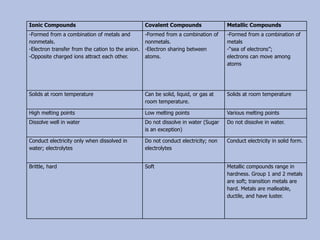
Ionic Compounds Covalent Compounds Metallic Compounds
-Formed from a combination of metals and
nonmetals.
-Electron transfer from the cation to the anion.
-Opposite charged ions attract each other.
-Formed from a combination of
nonmetals.
-Electron sharing between
atoms.
-Formed from a combination of
metals
-“sea of electrons”;
electrons can move among
atoms
Solids at room temperature Can be solid, liquid, or gas at
room temperature.
Solids at room temperature
High melting points Low melting points Various melting points
Dissolve well in water Do not dissolve in water (Sugar
is an exception)
Do not dissolve in water.
Conduct electricity only when dissolved in
water; electrolytes
Do not conduct electricity; non
electrolytes
Conduct electricity in solid form.
Brittle, hard Soft Metallic compounds range in
hardness. Group 1 and 2 metals
are soft; transition metals are
hard. Metals are malleable,
ductile, and have luster.

Comparison-of-Properties-of-Ionic-and-Covalent-Compounds.ppt

  • 1.
    Chemical Bonding Comparison ofProperties Ionic Compounds Covalent Compounds Metals
  • 2.
    Essential Questions • Why/Howdo atoms combine with one another to form the vast array of chemical substances that exist? • What is ionic, covalent and metallic bonding and how do the types of bonding determine properties of matter?
  • 3.
    Properties of Matter •Macroscopic properties of matter vary greatly due to the type of bonding
  • 4.
    What is achemical bond? • An attractive force that holds two atoms together • Can form by – The attraction of positive ion to a negative ion or – The attraction of the positive nucleus of one atom and the negative electrons of another atom
  • 5.
    Bond • the interactionbetween two or more atoms that allows them to form a substance different from the independent atoms. • involves the outer (valence) electrons of the atoms. • These electrons are – transferred from one atom to another or shared between them.
  • 6.
    Chemical Bond EnergyConsiderations • A chemical bond forms when it is energetically favorable – when the energy of the bonded atoms is less than the energies of the separated atoms. – Al + I2 https://www.youtube.com/watch?v=XBPqSuIN-3E
  • 7.
    Bonding • Chemical compoundsare formed by the joining of two or more atoms. • A stable compound occurs when the total energy of the combination has lower energy than the separated atoms. • The bound state implies a net attractive force between the atoms ... a chemical bond.
  • 8.
    Energy Changes inBonding • When bonds are formed, energy is released. • Demonstrations: – Formation of an Ionic Compound: Mg + O2 – Formation of a Molecular Compound: S +O2
  • 9.
    Breaking Bonds • Inorder to break bonds energy must be added, usually in the form of heat, light, or electricity. • Demonstration: Electrolysis of water • Demo: Decomposition of Nitrogen Triiodide • http://www.youtube.com/watch?v=z5vsQ8sPgX4
  • 10.
    Three Types ofBonding Metallic Covalent Ionic
  • 11.
    Chemical Bonds In chemicalbonds, atoms • can either transfer or • share their valence electrons.
  • 12.
    When atoms transferelectrons Ionic Bonds When one or more atoms lose electrons and other atoms gain them in order to produce a noble gas electron configuration, the bond is called an ionic bond.
  • 13.
    Ionic Bonding • metallicatoms tend to lose electrons • When they do so, they become positively charged ions which are called cations. • Nonmetallic atoms tend to gain electrons to become negatively charged ions which are called anions. • These oppositely charged cations and anions are attracted to one another because of their opposite charges. • That attraction is called an ionic bond. We often refer to the charge on the ion as the oxidation state of that element.
  • 14.
    Negative Ion (Anion)Formation • Na has one valence electron. • It loses it to Chlorine. • Na now has a filled valence shell. (an octet) • Becomes positive one in charge • Chlorine has seven valence electrons. • It gains one electron from Na. • Chlorine now has filled octet. • Chlorine has a negative one charge. (Chloride ion) • Na+1 attracts Cl-1 and forms the ionic bond. Positive Ion (Cation) Formation
  • 16.
    Ionic Bonds • Part1 – http://www.youtube.com/watch?v=Qf07-8Jhhpc • Part 2 – http://www.youtube.com/watch?v=5EwmedLuRmw • Part 3 – http://www.youtube.com/watch?v=RkZNYuSho0M
  • 17.
    Ion Formation • Allof the elements in Group I have one electron in their outermost energy level. • All of these elements can lose that one valence electron. • These atoms become cations with a positive one charge.
  • 18.
    • Elements inGroup II have two electrons in their outermost energy level. • So, when these elements lose electrons, they lose two electrons and take on a positive two charge.
  • 19.
    • The transitionmetals and the metals to the right of them generally form more than one ion. • We call these elements multivalent. The charges on their ions are not always predictable, although some patterns do exist. • A few of the transition elements form only one ion or oxidation state. For example zinc ion, silver ion and scandium ion. • Zn2+ zinc ion • Ag+ silver ion • Sc3+ scandium ion
  • 20.
    Anions • Nonmetals tendto gain electrons. • The halogens - fluorine, chlorine, bromine, and iodine - have a strong attraction for electrons. • Their outermost energy levels are almost full. There is only room for one more electron in the outer energy levels for each of those atoms. Consequently, the elements fluorine, chlorine, bromine, and iodine will gain one electron, and become anions with a negative one charge. • Oxygen, sulfur, and the other elements in that family will gain two electrons. • In the next group over, nitrogen, phosphorus and arsenic can take on three electrons.
  • 21.
  • 22.
    Ionic Nomenclature • NamingIonic Compounds • Video of the Process – http://www.youtube.com/watch?v=URc75hoKGLY
  • 23.
    Ionic Compounds • Madeof cations and anions • Metals and nonmetals • The electrons lost by the cation are gained by the anion • The cation and anions surround each other • Smallest ratio of ions in an ionic compound is a FORMULA UNIT.
  • 24.
    K+1 Ca+2 Has losttwo electrons Cations • Positive ions • Formed by losing electrons • More protons than electrons • usually Metals Has lost one electron
  • 25.
    Anion • A negativeion • Has gained electrons • Non metals • Charge is written as a super script on the right. F-1 Has gained one electron O-2 Has gained two electrons
  • 26.
    Formula Unit • Thesmallest whole number ratio of atoms in an ionic compound. • Ions surround each other so you can’t say which is hooked to which
  • 27.
    Naming Ions • Wewill use the systematic way • Cation- if the charge is always the same just write the name of the metal • Transition metals can have more than one type of charge • Indicate the charge with a Roman numeral in parentheses
  • 28.
    Name these  Na+1 Ca+2  Al+3  Fe+3  Fe+2  Pb+2  Li+1
  • 29.
    Write Formulas forthese • Potassium ion • Magnesium ion • Copper (II) ion • Chromium (VI) ion • Barium ion • Mercury (II) ion
  • 30.
    Naming Anions • Changethe element ending to – ide • F-1 Fluorine
  • 31.
    Name these  Cl-1 N-3  Br-1  O-2  Ga+3
  • 32.
    Write these • Sulfideion • iodide ion • phosphide ion • Strontium ion
  • 33.
    Polyatomic ions • Groupsof atoms that stay together and have a charge • You must memorize these or use an ion sheet… common examples – Acetate C2H3O2 -1 – Nitrate NO3 -1 – Nitrite NO2 -1 – Hydroxide OH-1 – Permanganate MnO4 -1 – Cyanide CN-1
  • 34.
    More Polyatomic ions •Sulfate SO4 -2 • Sulfite SO3 -2 • Carbonate CO3 -2 • Chromate CrO4 -2 • Dichromate Cr2O7 -2 • Phosphate PO4 -3 • Phosphite PO3 -3 • Ammonium NH4 +1
  • 35.
    Practice with Ions •Use the practice worksheet to determine the ions formed. • Learn to use your periodic table and pink sheet to determine charges (oxidation state.)
  • 36.
    Binary Ionic Compounds •Binary Compounds – 2 elements. – a cation and an anion. • To write the names just name the two ions. – Easy with Representative elements • Groups 1, 2, 13 • NaCl = Na+ Cl- = sodium chloride • MgBr2 = Mg+2 Br- = magnesium bromide
  • 37.
    Naming Binary IonicCompounds with Variably Charged Cations  The problem comes with the transition metals (Groups 3-12) since their charge can vary  Need to figure out their charges  The compound must be neutral  same number of + and – charges.  Use the anion to determine the charge on the positive ion  Charge of the cation is a Roman numeral in the name
  • 38.
    Example • Write thename of CuO • Need the charge of Cu • O is -2 • copper must be +2 • Copper (II) chloride
  • 39.
    Example • Name CoCl3 •Cl is -1 and there are three of them = -3 • Co must be +3 Cobalt (III) chloride
  • 40.
    Another Example • Writethe name of Cu2S. • Since S is -2, the Cu2 must be +2, so each one is +1. • copper (I) sulfide
  • 41.
    Last Example • Fe2O3 •Each O is -2 3 x -2 = -6 • 3 Fe must = +6, so each is +2. • iron (III) oxide
  • 42.
    Naming Binary IonicCompounds  Write the names of the following  KCl  Na3N  CrN  Sc3P2  PbO  PbO2  Na2Se
  • 43.
    Ternary Ionic Compounds Will have polyatomic ions  At least three elements  Name the ions  NaNO3 CaSO4 CuSO3 (NH4)2O
  • 44.
    Ternary Ionic Compounds •LiCN • Fe(OH)3 • (NH4)2CO3 • NiPO4
  • 45.
    Writing Formulas Given thename write the formula 1. The charges have to add up to zero 2. Write down each ion with charges 3. Make the charges equal by adding subscripts 4. Put polyatomic ions in parentheses if you need more than one of them
  • 46.
    Writing Formulas Example •Write the formula for calcium chloride.
  • 47.
  • 48.
    Write the formulasfor these Lithium sulfide tin (II) oxide tin (IV) oxide Magnesium fluoride Copper (II) sulfate Iron (III) phosphide
  • 49.
    Write the formulasfor these • gallium nitrate • Iron (III) sulfide • Ammonium chloride • ammonium sulfide • barium nitrate
  • 50.
    Things to lookfor • If cation has (Roman Numeral), the number is the charge • If anions end in -ide they are probably off the periodic table (Monoatomic) • If anion ends in -ate or -ite it is polyatomic
  • 51.
    Ionic Solids • Ionicsolids are solids composed of ionic particles (ions). • These ions are held together in a regular array by ionic bonding. • Ionic bonding results from attractive interactions from oppositely charged ions. • In a typical ionic solid, positively charged ions are surrounded by negatively charged ions and vice-versa. • The close distance between these oppositely charged particles results in very strong attractive forces. • The alternating pattern of positive and negative ions continues in three dimensions. • The regular repeating pattern is analogous to the tiles on a floor or bricks on a wall. • called the crystal lattice.
  • 52.
    Ionic Compounds • Crystallinesolids (made of ions) • High melting and boiling points • Conduct electricity when melted or dissolved in water – Demo: Electrolytes • Many are soluble in water but not in non- polar liquid
  • 53.
  • 54.
    Common Ionic Compounds –NaCl - sodium chloride - table salt – KCl - potassium chloride - present in "light" salt (mixed with NaCl) – CaCl2 - calcium chloride - driveway salt – NaOH - sodium hydroxide - found in some surface cleaners as well as oven and drain cleaners – CaCO3 - calcium carbonate - found in calcium supplements – NH4NO3 - ammonium nitrate - found in some fertilizers
  • 55.
    Ionic vs Molecular •http://www.youtube.com/watch?v=PKA4CZw bZWU
  • 56.
    Covalent (Molecular) Compounds •Gases, liquids, or solids (made of molecules) • Low melting and boiling points • Poor electrical conductors in all phases • Many soluble in non- polar liquids but not in water
  • 57.
  • 58.
    Covalent Network Solids •Covalent because combinations of nonmetals • Interconnected • very hard and brittle • Insoluble • Extreme melting and boiling points Diamond
  • 59.
    Covalent Bonds • involvethe sharing of a pair of valence electrons by two atoms • Such bonds lead to stable molecules if they share electrons in such a way as to create a noble gas configuration for each atom
  • 60.
    Covalent bonding canbe visualized with the aid of a Lewis Structure
  • 61.
    Polar Covalent Bonds •Covalent Bonds in which the sharing of the electron pair is unequal • the electrons spend more time around the more nonmetallic atom • In such a bond there is a charge separation with one atom being slightly more positive and the other more negative……. will produce a dipole moment.
  • 62.
    Types of Covalentbonds • Pure Covalent (also called non-polar covalent) bonds are ones in which both atoms share the electrons evenly • By evenly, we mean that the electrons have an equal probability of being at a certain radius from the nuclei of either atom. • Polar covalent bonds are ones in which the electrons have a higher probability of being in the proximity of one of the atoms • Determined by Electronegativity Difference
  • 63.
    Electronegativity • the periodicproperty that indicates the strength of the attraction an atom has for the electrons it shares in a bond. • Atoms with high electronegativities tend to hold tightly to their electrons or to form negative ions. – These elements are found to the upper right on the periodic table. • Atoms with low electronegativities tend to have a lower attraction for their electrons and may form positive ions. – These elements are found to the lower left on the periodic table.
  • 64.
    Pure covalent orNon-polar covalent bond • Electronegativity difference of 0.3 or less in between the two atoms. • A pure covalent bond can form between two atoms of the same element (such as in diatomic oxygen molecule) • or atoms of different elements that have similar electronegativies (such as in the carbon and hydrogen atom in methane).
  • 65.
    Polar Covalent Bond •A is a pair of electrons shared between two atoms with significantly different electronegativities (from 0.3 to 1.7 difference). • These bonds tend to form between highly electronegative non-metals and other non-metals, such as the bond between hydrogen and oxygen in water.
  • 66.
    Ionic Bonds • Incompounds that have elements with very different electronegativities (greater than 1.7 difference), the electrons can be considered to have been transferred to form ions.
  • 67.
    • Many ofthe properties of a compound, such as solubility and boiling point, depend, in part, on the degree of the polarity of its bonds.
  • 68.
    Examples to DetermineBond Character • Using electronegativity in the prediction of the polarity of a chemical bond. • sodium bonded to chlorine – Difference between the electronegativities of Na(0.9) and Cl(3.0) are so great that they form an ionic bond. • The hydrogen molecule (2 H atoms bonded to each other) • zero electronegativity difference, form a non-polar covalent bond.
  • 69.
    Bond Character • Nonpolar-Covalentbonds (H2) – Electrons are equally shared – Electronegativity difference of 0 to 0.3 • Polar-Covalent bonds (HCl) – Electrons are unequally shared – Electronegativity difference between .3 and 1.7 • Ionic Bonds (NaCl) – Electrons are transferred – Electronegativity difference of more than 1.7
  • 70.
    Diatomic Molecules • hydrogengas H2 • the halogens: – chlorine Cl2 – fluorine F2 – bromine Br2 – iodine I2 • Nitrogen N2 • Oxygen O2 Pneumonic Device to remember the diatomic molecules: Professor BrINClHOF
  • 71.
    Metals and MetallicBonding • Typical Properties of Metals – Malleable – Ductile – Good Conductors of Heat and Electricity – Generally high melting and boiling points
  • 72.
    Metallic Bonds • Theproperties of metals suggest that their atoms possess strong bonds • yet the ease of conduction of heat and electricity suggest that electrons can move freely in all directions in a metal • The general observations give rise to a picture of "positive ions in a sea of electrons" to describe metallic bonding.
  • 73.
    Metal Properties • Malleableand Ductile • Strong and Durable • Good conductors of heat and electricity. • Their strength indicates that the atoms are difficult to separate… strong bonds • but malleability and ductility suggest that the atoms are relatively easy to move in various directions. • The electrical conductivity suggests that it is easy to move electrons in any direction in these materials. • The thermal conductivity also involves the motion of electrons. All of these properties suggest the nature of the metallic bonds between atoms. (Electron sea model)
  • 74.
    Metallic Bonding Electron SeaModel • Explained by the Electron Sea Model • the atoms in a metallic solid contribute their valence electrons to form a “sea” of electrons that surrounds metallic cations. • delocalized electrons are not held by any specific atom and can move easily throughout the solid. • A metallic bond is the attraction between these electrons and the metallic cation. •
  • 75.
    Metallic Bonding the ElectronSea Model • The more delocalized electrons the stronger the bond
  • 76.
    • A mixtureof elements that has metallic properties is called an alloy. • Two types of alloys – An interstitial alloy is one in which the small holes in a metallic crystal are filled by other smaller atoms. – A substitutional alloy is one in which atoms of the original metal are replaced by other atoms of similar size.
  • 77.
    Ionic Compounds CovalentCompounds Metallic Compounds -Formed from a combination of metals and nonmetals. -Electron transfer from the cation to the anion. -Opposite charged ions attract each other. -Formed from a combination of nonmetals. -Electron sharing between atoms. -Formed from a combination of metals -“sea of electrons”; electrons can move among atoms Solids at room temperature Can be solid, liquid, or gas at room temperature. Solids at room temperature High melting points Low melting points Various melting points Dissolve well in water Do not dissolve in water (Sugar is an exception) Do not dissolve in water. Conduct electricity only when dissolved in water; electrolytes Do not conduct electricity; non electrolytes Conduct electricity in solid form. Brittle, hard Soft Metallic compounds range in hardness. Group 1 and 2 metals are soft; transition metals are hard. Metals are malleable, ductile, and have luster.