Chemical Bonding
  Vy Bui, Lalein A. Pajarillo
Introduction
Chemical Bond – the type of force that holds two or
    more atoms together. It is the attraction
    between positive nucleus and their negative
    electrons.

There are 3 types of bonds…
  Ionic Bond
  Metallic Bond
  Covalent Bond
Ionic Bonding
This is the reaction between a metal (cation) and non-
metal (anion) where in the cation transfers its valence
electrons to the anion due to electrostatic force in
order to make it stable (octet rule). Strong bonding.

Its properties:
   Hard
   High melting boiling point
   Brittle
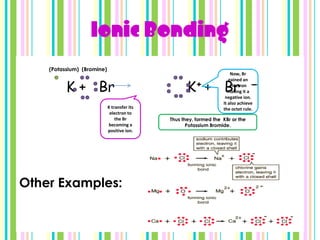
Ionic Bonding
    (Potassium) (Bromine)
                                                                       Now, Br


          K + Br                                    K+ + Br                      -
                                                                      gained an
                                                                       electron
                                                                     making it a
                                                                    negative ion.
                                                                   It also achieve
                            K transfer its                         the octet rule.
                             electron to
                                the Br       Thus they, formed the KBr or the
                            becoming a              Potassium Bromide.
                            positive ion.


Other Examples:
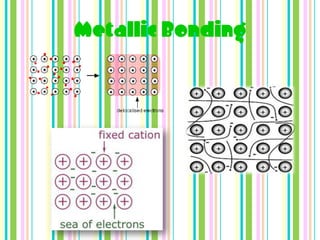
Metallic Bonding
The kind of bonding between metallic elements in which
the valence electrons can move freely from one atom to
another. Since they can move freely they are called
delocalized electrons. They do not share, lose or gain
electrons. Their valence electrons form a "sea” of electrons.
Weak bonding.

Properties:
   High melting and boiling points
   Electrical and heat conductor

Examples of metal elements: Lithium, Magnesium, Sodium
etc.
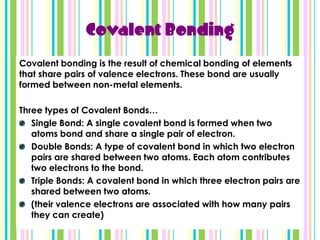
Covalent Bonding
Covalent bonding is the result of chemical bonding of elements
that share pairs of valence electrons. These bond are usually
formed between non-metal elements.

Three types of Covalent Bonds…
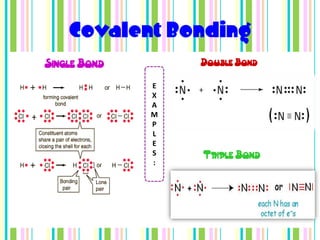
   Single Bond: A single covalent bond is formed when two
   atoms bond and share a single pair of electron.
   Double Bonds: A type of covalent bond in which two electron
   pairs are shared between two atoms. Each atom contributes
   two electrons to the bond.
   Triple Bonds: A covalent bond in which three electron pairs are
   shared between two atoms.
   (their valence electrons are associated with how many pairs
   they can create)
Metallic Bonding
Covalent Bonding
Single Bond       Double Bond

              E
              X
              A
              M
              P
              L
              E
              S   Triple Bond
              :
Sigma                    Vs.                 Pi
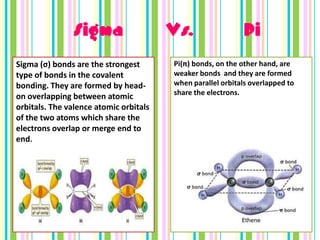
Sigma (σ) bonds are the strongest       Pi(π) bonds, on the other hand, are
type of bonds in the covalent           weaker bonds and they are formed
bonding. They are formed by head-       when parallel orbitals overlapped to
                                        share the electrons.
on overlapping between atomic
orbitals. The valence atomic orbitals
of the two atoms which share the
electrons overlap or merge end to
end.
Conclusion
We therefore conclude that there are three types of
Chemical bond which are Ionic, Metallic and
Covalent. Each type of bonds has its own
applicability. Ionic transfer of electrons between non-
metal and metal. Metallic is the bond between metal
elements in which electrons are delocalized, while
covalent is the sharing of pairs of electrons.

Chemical bonding Powerpoint

  • 1.
    Chemical Bonding Vy Bui, Lalein A. Pajarillo
  • 2.
    Introduction Chemical Bond –the type of force that holds two or more atoms together. It is the attraction between positive nucleus and their negative electrons. There are 3 types of bonds… Ionic Bond Metallic Bond Covalent Bond
  • 3.
    Ionic Bonding This isthe reaction between a metal (cation) and non- metal (anion) where in the cation transfers its valence electrons to the anion due to electrostatic force in order to make it stable (octet rule). Strong bonding. Its properties: Hard High melting boiling point Brittle
  • 4.
    Ionic Bonding (Potassium) (Bromine) Now, Br K + Br K+ + Br - gained an electron making it a negative ion. It also achieve K transfer its the octet rule. electron to the Br Thus they, formed the KBr or the becoming a Potassium Bromide. positive ion. Other Examples:
  • 5.
    Metallic Bonding The kindof bonding between metallic elements in which the valence electrons can move freely from one atom to another. Since they can move freely they are called delocalized electrons. They do not share, lose or gain electrons. Their valence electrons form a "sea” of electrons. Weak bonding. Properties: High melting and boiling points Electrical and heat conductor Examples of metal elements: Lithium, Magnesium, Sodium etc.
  • 6.
    Covalent Bonding Covalent bondingis the result of chemical bonding of elements that share pairs of valence electrons. These bond are usually formed between non-metal elements. Three types of Covalent Bonds… Single Bond: A single covalent bond is formed when two atoms bond and share a single pair of electron. Double Bonds: A type of covalent bond in which two electron pairs are shared between two atoms. Each atom contributes two electrons to the bond. Triple Bonds: A covalent bond in which three electron pairs are shared between two atoms. (their valence electrons are associated with how many pairs they can create)
  • 7.
  • 8.
    Covalent Bonding Single Bond Double Bond E X A M P L E S Triple Bond :
  • 9.
    Sigma Vs. Pi Sigma (σ) bonds are the strongest Pi(π) bonds, on the other hand, are type of bonds in the covalent weaker bonds and they are formed bonding. They are formed by head- when parallel orbitals overlapped to share the electrons. on overlapping between atomic orbitals. The valence atomic orbitals of the two atoms which share the electrons overlap or merge end to end.
  • 10.
    Conclusion We therefore concludethat there are three types of Chemical bond which are Ionic, Metallic and Covalent. Each type of bonds has its own applicability. Ionic transfer of electrons between non- metal and metal. Metallic is the bond between metal elements in which electrons are delocalized, while covalent is the sharing of pairs of electrons.