IONIC COMPOUNDS Chapter 8
Forming Chemical Bonds Section 8.1 The force that holds two atoms together is called a  chemical bond.  Chemical bonds may form by the attraction between a positive nucleus and negative electrons or the attraction between a positive ion and a negative ion
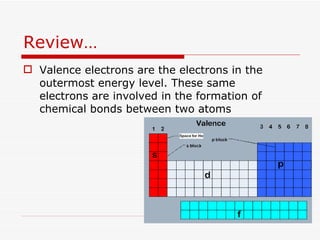
Review… Valence electrons are the electrons in the outermost energy level. These same electrons are involved in the formation of chemical bonds between two atoms
Electron-Dot Structures  Especially useful when illustrating formation of chemical bonds!!
From Chapter 6… Ionization energy refers to how easily an atom loses an electron.  Noble gases, having high ionization energies, show a general lack of chemical reactivity The difference in reactivity is directly related to the valence electrons Elements tend to react to acquire the stable electron structure of a noble gas (V.E. 8)
From Ch 6 Electronegativity – ability to attract e- in a chemical bond.  The greater electronegativity difference as that b/w a metal and a nonmetal = Ionic Bond Ionic Bond – Eneg difference above 1.7  ** Elements farther from each other Refer to table  pg 169 of textbook
Formation of Positive Ions A positive ion forms when an atom loses one or more valence electrons in order to attain a noble gas configuration Positively charged ion is called a  cation
Transition Metals When forming positive ions, transition metals commonly lose their valence electrons, forming 2+ ions.  However, it is also possible for d electrons to be lost A useful rule of thumb for these metals is that they form ions with a 2+ or 3+ charge.
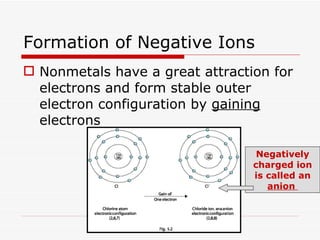
Formation of Negative Ions Nonmetals have a great attraction for electrons and form stable outer electron configuration by  gaining  electrons Negatively charged ion is called an  anion
Checkpoint  Why do ions form? Describe the formation of positive and negative ions. Predict the change that must occur to achieve noble gas stability Nitrogen Sulfur Barium Lithium
Answers  Atoms gain stability by losing or gaining electrons Positive ions form when atoms lose valence electrons Negative ions form when valence electrons are added to an atom Nitrogen- gain 3 electrons (N 3- ) Sulfur- gain 2 electrons (S 2- ) Barium- lose 2 electrons (Ba 2+ ) Lithium- lose 1 electron (Li 1+ )
CW P.214 #1-5 P.236 #47-50, 60-66
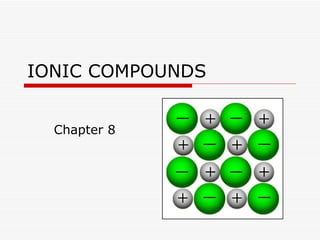
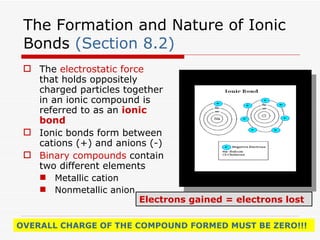
The Formation and Nature of Ionic Bonds  (Section 8.2)   The  electrostatic force  that holds oppositely charged particles together in an ionic compound is referred to as an  ionic bond   Ionic bonds form between cations (+) and anions (-)  Binary compounds  contain two different elements  Metallic cation Nonmetallic anion  Electrons gained = electrons lost  OVERALL CHARGE OF THE COMPOUND FORMED MUST BE ZERO!!!
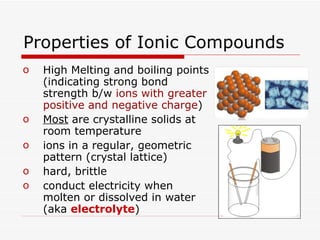
Properties of Ionic Compounds High Melting and boiling points (indicating strong bond strength b/w  ions with greater positive and negative charge ) Most  are crystalline solids at room temperature ions in a regular, geometric pattern (crystal lattice)  hard, brittle conduct electricity when molten or dissolved in water (aka  electrolyte )
Homework P.220 #12-18 P.236 #53,67-73 Lattice structure of various elements and compounds Diamond lattice structure vs Graphite
Names and Formulas for Ionic Compounds  (Very Important!)   Section 8.3 Terms to be familiar with: Formula Unit-  the simplest ratio of the ions represented in an ionic compound Monatomic Ion-  a one-atom ion (Mg 2+  or Br 1- ) Oxidation Number-  the charge of the monatomic ion  Polyatomic Ion-  ions made up of more than one atom (i.e. Nitrate= NO 2 - )
Predicting ionic ratios Based on charge ratios (“formula units” – simplest ratio of the ions) Cations first, anions second For example Na 1+  and Cl 1-  ; therefore, will combine 1:1 NaCl “sodium chloride” Na 1+ and S 2-; therefore, will combine 2:1 Na 2 S “sodium sulfide” Be 2+ and N 3-; therefore, will combine 3:2 Be 3 N 2 “beryllium nitride”
Write the correct formula for the ionic compound composed of the following pairs of ions   Potassium and iodine Magnesium and chlorine Aluminum and bromide Cesium and nitride
Answers 1. Potassium and iodine K +1   and I -1     KI  (1:1 ratio)  2. Magnesium and chlorine   Mg +2   and  Cl -1     MgCl 2  (1:2 ratio) 3. Aluminum and bromide   Al +3   and  Br -1     AlBr 3  (1:3 ratio)   4. Cesium and nitride   Cs +1   and  N -3     Cs 3 N  (3:1 ratio)
Compounds Containing Polyatomic Ions The charge given to a polyatomic ion applies to the  entire group  of atoms The polyatomic ion acts as an individual ion NEVER CHANGE THE SUBSCRIPTS WITHIN THE ION  If more than one polyatomic ion is needed, place parentheses around the ion and write the appropriate subscript outside the parentheses.
Practice Problems Calcium and Nitrate Aluminum and Hydroxide Barium and Sulfate Sodium and Phosphate Potassium and Sulfate
 
 
Naming Ionic Compounds Oxyanion - a polyatomic ion composed of an element, usually a nonmetal, bonded to one or more oxygen atoms An ion with more oxygen atoms is named using the root of the nonmetal plus the suffix  –ate  (ex. NO 3 -     nitr ate ) An ion with fewer oxygen atoms is named using the root of the nonmetal plus the suffix  –ite  (ex. NO 2 -    nitr ite  )
Chlorine’s 4 Oxyanions  ClO 4 -      per chlor ate  (most oxygen's)  ClO 3 -    chlor ate  (one less oxygen) ClO 2 -    chlor ite  (two fewer oxygen's) ClO -     hypo chlor ite  (three fewer oxygen's)
Naming Ionic Compounds Name the cation (+) first and the anion (-) second.  Monatomic cations use the element name. Monatomic anions take their element name plus the suffix  –ide .
4. Transition metals (d-block cations) often have more than one oxidation number.  The oxidation number is written as a Roman numeral in parentheses after the name of the cation  5. If the compound contains a polyatomic ion, simply name the ion.
Practice problems  NaBr CaCl 2 KOH Cu(NO 3 ) 2 Ag 2 CrO 4
Cation  +  Anion  Na Br      sodium  bromide Ca Cl 2     calcium   chloride K OH      potassium  hydroxide Cu ( NO 3 ) 2      copper (II)   nitrate Ag 2 CrO 4      silver   chromate
Writing a Chemical Formula from the Name Step 1: Write the element symbol(s) for name of the ion(s). Step 2: Write the charge of the ion(s). Step 3: If the total charge equals zero, you are done.  If the total charge does not equal zero, you must change the subscripts so that the total charge equals zero (‘drop-n-cross’).
Section Review Anion  Cation   Oxide Chloride Sulfate Phosphate Potassium Barium Aluminum Ammonium
Answers  Anion  Cation   Oxide Chloride Sulfate Phosphate Potassium K 2 O KCl K 2 SO 4 K 3 PO 4 Barium BaO BaCl 2 BaSO 4 Ba 3 (PO 4 ) 2 Aluminum Al 2 O 3 AlCl 3 Al 2 (SO 4 ) 3 AlPO 4 Ammonium (NH 4 ) 2 O NH 4 Cl (NH 4 ) 2 SO 4 (NH 4 ) 3 PO 4
Homework P.227 #35-36,38-39 P.237 #74-79
Metallic Bonds and Properties of Metals  (Section 8.4)   Although metals do not bond ionically, they often form lattices in the solid state. Electron sea model-  all the metal atoms in a metallic solid contribute their valence electrons to form a “sea” of electrons
The electrons present in the outer energy levels of the bonding metallic ions are  not held by any specific atom  and can move easily from one atom to the next.  (Delocalized electrons)  A  metallic bond  is the attraction of a metallic cation for delocalized electrons
Metal Characteristics Moderately high melting points but high boiling points vary greatly but not as extreme as boiling point Soft, malleable, and ductile Shiny Delocalized e- absorb and release photons of light Good conductors of electricity
Metal Alloys A mixture of elements that has  metallic properties Substitutional - atoms of the original metallic solid are replaced by other metal atoms of similar size  Brass, pewter, 10-carat gold, and sterling silver  Interstitial-  formed when small holes in a metallic crystal are filled with smaller atoms  Carbon steel
Alloys Brass: zinc + copper Pewter: 90% Tin + Bi, Sb, Cu, Pb 10 carat gold:  10 part gold + 14 part alloy of copper & Ag Sterling silver: silver + copper (Ge, Zn, Pt)
Homework P.237 #80-82,84
Bibliography http://upload.wikimedia.org/wikipedia/commons/9/95/Brass.jpg Clear Science http://clearscience.tumblr.com/post/628686089/steel-is-not-an-element-rather-it-is-the

Ch 8 ionic compounds

  • 1.
  • 2.
    Forming Chemical BondsSection 8.1 The force that holds two atoms together is called a chemical bond. Chemical bonds may form by the attraction between a positive nucleus and negative electrons or the attraction between a positive ion and a negative ion
  • 3.
    Review… Valence electronsare the electrons in the outermost energy level. These same electrons are involved in the formation of chemical bonds between two atoms
  • 4.
    Electron-Dot Structures Especially useful when illustrating formation of chemical bonds!!
  • 5.
    From Chapter 6…Ionization energy refers to how easily an atom loses an electron. Noble gases, having high ionization energies, show a general lack of chemical reactivity The difference in reactivity is directly related to the valence electrons Elements tend to react to acquire the stable electron structure of a noble gas (V.E. 8)
  • 6.
    From Ch 6Electronegativity – ability to attract e- in a chemical bond. The greater electronegativity difference as that b/w a metal and a nonmetal = Ionic Bond Ionic Bond – Eneg difference above 1.7 ** Elements farther from each other Refer to table pg 169 of textbook
  • 7.
    Formation of PositiveIons A positive ion forms when an atom loses one or more valence electrons in order to attain a noble gas configuration Positively charged ion is called a cation
  • 8.
    Transition Metals Whenforming positive ions, transition metals commonly lose their valence electrons, forming 2+ ions. However, it is also possible for d electrons to be lost A useful rule of thumb for these metals is that they form ions with a 2+ or 3+ charge.
  • 9.
    Formation of NegativeIons Nonmetals have a great attraction for electrons and form stable outer electron configuration by gaining electrons Negatively charged ion is called an anion
  • 10.
    Checkpoint Whydo ions form? Describe the formation of positive and negative ions. Predict the change that must occur to achieve noble gas stability Nitrogen Sulfur Barium Lithium
  • 11.
    Answers Atomsgain stability by losing or gaining electrons Positive ions form when atoms lose valence electrons Negative ions form when valence electrons are added to an atom Nitrogen- gain 3 electrons (N 3- ) Sulfur- gain 2 electrons (S 2- ) Barium- lose 2 electrons (Ba 2+ ) Lithium- lose 1 electron (Li 1+ )
  • 12.
    CW P.214 #1-5P.236 #47-50, 60-66
  • 13.
    The Formation andNature of Ionic Bonds (Section 8.2) The electrostatic force that holds oppositely charged particles together in an ionic compound is referred to as an ionic bond Ionic bonds form between cations (+) and anions (-) Binary compounds contain two different elements Metallic cation Nonmetallic anion Electrons gained = electrons lost OVERALL CHARGE OF THE COMPOUND FORMED MUST BE ZERO!!!
  • 14.
    Properties of IonicCompounds High Melting and boiling points (indicating strong bond strength b/w ions with greater positive and negative charge ) Most are crystalline solids at room temperature ions in a regular, geometric pattern (crystal lattice) hard, brittle conduct electricity when molten or dissolved in water (aka electrolyte )
  • 15.
    Homework P.220 #12-18P.236 #53,67-73 Lattice structure of various elements and compounds Diamond lattice structure vs Graphite
  • 16.
    Names and Formulasfor Ionic Compounds (Very Important!) Section 8.3 Terms to be familiar with: Formula Unit- the simplest ratio of the ions represented in an ionic compound Monatomic Ion- a one-atom ion (Mg 2+ or Br 1- ) Oxidation Number- the charge of the monatomic ion Polyatomic Ion- ions made up of more than one atom (i.e. Nitrate= NO 2 - )
  • 17.
    Predicting ionic ratiosBased on charge ratios (“formula units” – simplest ratio of the ions) Cations first, anions second For example Na 1+ and Cl 1- ; therefore, will combine 1:1 NaCl “sodium chloride” Na 1+ and S 2-; therefore, will combine 2:1 Na 2 S “sodium sulfide” Be 2+ and N 3-; therefore, will combine 3:2 Be 3 N 2 “beryllium nitride”
  • 18.
    Write the correctformula for the ionic compound composed of the following pairs of ions Potassium and iodine Magnesium and chlorine Aluminum and bromide Cesium and nitride
  • 19.
    Answers 1. Potassiumand iodine K +1 and I -1  KI (1:1 ratio) 2. Magnesium and chlorine Mg +2 and Cl -1  MgCl 2 (1:2 ratio) 3. Aluminum and bromide Al +3 and Br -1  AlBr 3 (1:3 ratio) 4. Cesium and nitride Cs +1 and N -3  Cs 3 N (3:1 ratio)
  • 20.
    Compounds Containing PolyatomicIons The charge given to a polyatomic ion applies to the entire group of atoms The polyatomic ion acts as an individual ion NEVER CHANGE THE SUBSCRIPTS WITHIN THE ION If more than one polyatomic ion is needed, place parentheses around the ion and write the appropriate subscript outside the parentheses.
  • 21.
    Practice Problems Calciumand Nitrate Aluminum and Hydroxide Barium and Sulfate Sodium and Phosphate Potassium and Sulfate
  • 22.
  • 23.
  • 24.
    Naming Ionic CompoundsOxyanion - a polyatomic ion composed of an element, usually a nonmetal, bonded to one or more oxygen atoms An ion with more oxygen atoms is named using the root of the nonmetal plus the suffix –ate (ex. NO 3 -  nitr ate ) An ion with fewer oxygen atoms is named using the root of the nonmetal plus the suffix –ite (ex. NO 2 -  nitr ite )
  • 25.
    Chlorine’s 4 Oxyanions ClO 4 -  per chlor ate (most oxygen's) ClO 3 -  chlor ate (one less oxygen) ClO 2 -  chlor ite (two fewer oxygen's) ClO -  hypo chlor ite (three fewer oxygen's)
  • 26.
    Naming Ionic CompoundsName the cation (+) first and the anion (-) second. Monatomic cations use the element name. Monatomic anions take their element name plus the suffix –ide .
  • 27.
    4. Transition metals(d-block cations) often have more than one oxidation number. The oxidation number is written as a Roman numeral in parentheses after the name of the cation 5. If the compound contains a polyatomic ion, simply name the ion.
  • 28.
    Practice problems NaBr CaCl 2 KOH Cu(NO 3 ) 2 Ag 2 CrO 4
  • 29.
    Cation + Anion Na Br  sodium bromide Ca Cl 2  calcium chloride K OH  potassium hydroxide Cu ( NO 3 ) 2  copper (II) nitrate Ag 2 CrO 4  silver chromate
  • 30.
    Writing a ChemicalFormula from the Name Step 1: Write the element symbol(s) for name of the ion(s). Step 2: Write the charge of the ion(s). Step 3: If the total charge equals zero, you are done. If the total charge does not equal zero, you must change the subscripts so that the total charge equals zero (‘drop-n-cross’).
  • 31.
    Section Review Anion Cation  Oxide Chloride Sulfate Phosphate Potassium Barium Aluminum Ammonium
  • 32.
    Answers Anion Cation  Oxide Chloride Sulfate Phosphate Potassium K 2 O KCl K 2 SO 4 K 3 PO 4 Barium BaO BaCl 2 BaSO 4 Ba 3 (PO 4 ) 2 Aluminum Al 2 O 3 AlCl 3 Al 2 (SO 4 ) 3 AlPO 4 Ammonium (NH 4 ) 2 O NH 4 Cl (NH 4 ) 2 SO 4 (NH 4 ) 3 PO 4
  • 33.
  • 34.
    Metallic Bonds andProperties of Metals (Section 8.4) Although metals do not bond ionically, they often form lattices in the solid state. Electron sea model- all the metal atoms in a metallic solid contribute their valence electrons to form a “sea” of electrons
  • 35.
    The electrons presentin the outer energy levels of the bonding metallic ions are not held by any specific atom and can move easily from one atom to the next. (Delocalized electrons) A metallic bond is the attraction of a metallic cation for delocalized electrons
  • 36.
    Metal Characteristics Moderatelyhigh melting points but high boiling points vary greatly but not as extreme as boiling point Soft, malleable, and ductile Shiny Delocalized e- absorb and release photons of light Good conductors of electricity
  • 37.
    Metal Alloys Amixture of elements that has metallic properties Substitutional - atoms of the original metallic solid are replaced by other metal atoms of similar size Brass, pewter, 10-carat gold, and sterling silver Interstitial- formed when small holes in a metallic crystal are filled with smaller atoms Carbon steel
  • 38.
    Alloys Brass: zinc+ copper Pewter: 90% Tin + Bi, Sb, Cu, Pb 10 carat gold: 10 part gold + 14 part alloy of copper & Ag Sterling silver: silver + copper (Ge, Zn, Pt)
  • 39.
  • 40.
    Bibliography http://upload.wikimedia.org/wikipedia/commons/9/95/Brass.jpg ClearScience http://clearscience.tumblr.com/post/628686089/steel-is-not-an-element-rather-it-is-the