Prof. Sohaib Hasnain
Punjab Group of Colleges, Faisalabad
CHEMISTRY
MASS SPECTROMETRY IS
AN ANALYTICAL
TECHNIQUE WHICH USED
TO MEASURE:
 EXACT MASSES OF ISOTOPES
 RELATIVE ABUNDANCE OF IOSTOPES
 MOLECULAR MASSES OF COMPOUNDS
 MOLECULAR STRUCTURE
WHAT IS MASS
SPECTROMETER/
SPECTROGRAPH?
Mass Spectrometer Is An Instrument Which Is Used To
Measure The Exact Masses Of Different Isotopes Of An
Element.
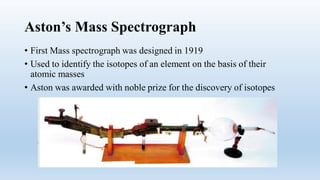
Aston’s Mass Spectrograph
• First Mass spectrograph was designed in 1919
• Used to identify the isotopes of an element on the basis of their
atomic masses
• Aston was awarded with noble prize for the discovery of isotopes
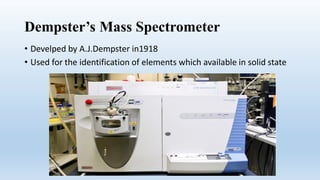
Dempster’s Mass Spectrometer
• Develped by A.J.Dempster in1918
• Used for the identification of elements which available in solid state
PRINCIPLE OF MASS SPECTROMETRY
In this technique, a substance is first volatilized and then
ionized with the help of high energy beam of electrons. The
gaseous positive ions, thus formed, are separated on the
basis of their mass to charge ratio (m/e) and then recorded
in the form of peaks.
Construction And Working Of
Dempster’s Mass
Spectrometer
Determination Of Exact Masses And Relative Abundance Of Isotopes
MASS SPECTROMETER
STEPS INVOLVED DURING THE WORKING:
Vaporization
Ionization
Acceleration
Deflection
Collection
Vaporization/ Volatilization
• The substance whose analysis for the separation of isotopes is
required, is converted into vapor phase
• Vaporization is done in vaporizing chamber
• The pressure kept for this step is very low 10-6 to 10-7 torr
• Solid and liquid are changed into vapor phase
• Vaporization is not required for the gases because these are already
present in vapor phase
Ionization
• Vapor are allowed to enter in ionization chamber
• Vapors are ionized with the help of high energy electrons
• These positively charged ions of isotopes of an element have different
masses depending upon the nature of isotope
Ionization
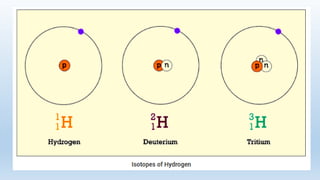
• We have sample of hydrogen for ionization
• When high energy electrons are thrown on hydrogen atoms, its
electron are knocked out
• Uni positive cation are formed because only one electron is removed
from its each atom
• Masses of ions are different because isotopes of hydrogen have
different mass
• That’s why these have differet m/e Value
Acceleration
• This step is required to speed up the movement of cations
• Cations are speed up by providing electric field
E= 500-2000 volts
• Greater the strength of electric field, greater will be the speed of
cations toward the negative Grid
• Now, Beam of cation is formed which is travelled in straight line
Deflection
• The beam of accelerated positive ions are allowed to pass through
the magnetic field
• Magnetic field is perpendicular to the direction of positive ions
• Positive ion are separated due to deflection of magnetic field
• This separation is based on m/e ratio
• Greater the value of m/e, lower will be the deflection
• lower the value of m/e, greater will be the deflection
• Heavy ions are slightly deflected and Vice versa
MASS SPECTROMETER
Deflection
Mathematical Expression
m/e = H2r/E
H = strength of magnetic field
E = strength of electric field
R = radius of circular path
Larger the m/e value, larger will be the radius
Greater the value of H, Smaller will the radius
Greater the value of E, larger will be the radius
Collection
• This process is done by Detector, Electrometer and ion collector
• Electrometer develops the electric current
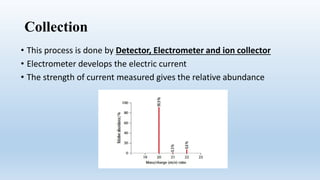
• The strength of current measured gives the relative abundance
Comparison with C-12
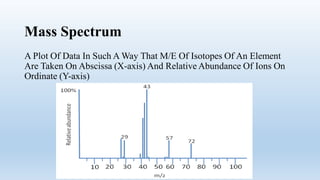
Mass Spectrum
A Plot Of Data In Such A Way That M/E Of Isotopes Of An Element
Are Taken On Abscissa (X-axis) And Relative Abundance Of Ions On
Ordinate (Y-axis)

Mass spectrometry

  • 2.
    Prof. Sohaib Hasnain PunjabGroup of Colleges, Faisalabad CHEMISTRY
  • 4.
    MASS SPECTROMETRY IS ANANALYTICAL TECHNIQUE WHICH USED TO MEASURE:  EXACT MASSES OF ISOTOPES  RELATIVE ABUNDANCE OF IOSTOPES  MOLECULAR MASSES OF COMPOUNDS  MOLECULAR STRUCTURE
  • 5.
    WHAT IS MASS SPECTROMETER/ SPECTROGRAPH? MassSpectrometer Is An Instrument Which Is Used To Measure The Exact Masses Of Different Isotopes Of An Element.
  • 6.
    Aston’s Mass Spectrograph •First Mass spectrograph was designed in 1919 • Used to identify the isotopes of an element on the basis of their atomic masses • Aston was awarded with noble prize for the discovery of isotopes
  • 7.
    Dempster’s Mass Spectrometer •Develped by A.J.Dempster in1918 • Used for the identification of elements which available in solid state
  • 8.
    PRINCIPLE OF MASSSPECTROMETRY In this technique, a substance is first volatilized and then ionized with the help of high energy beam of electrons. The gaseous positive ions, thus formed, are separated on the basis of their mass to charge ratio (m/e) and then recorded in the form of peaks.
  • 9.
    Construction And WorkingOf Dempster’s Mass Spectrometer Determination Of Exact Masses And Relative Abundance Of Isotopes
  • 10.
  • 11.
    STEPS INVOLVED DURINGTHE WORKING: Vaporization Ionization Acceleration Deflection Collection
  • 12.
    Vaporization/ Volatilization • Thesubstance whose analysis for the separation of isotopes is required, is converted into vapor phase • Vaporization is done in vaporizing chamber • The pressure kept for this step is very low 10-6 to 10-7 torr • Solid and liquid are changed into vapor phase • Vaporization is not required for the gases because these are already present in vapor phase
  • 13.
    Ionization • Vapor areallowed to enter in ionization chamber • Vapors are ionized with the help of high energy electrons • These positively charged ions of isotopes of an element have different masses depending upon the nature of isotope
  • 14.
    Ionization • We havesample of hydrogen for ionization • When high energy electrons are thrown on hydrogen atoms, its electron are knocked out • Uni positive cation are formed because only one electron is removed from its each atom • Masses of ions are different because isotopes of hydrogen have different mass • That’s why these have differet m/e Value
  • 16.
    Acceleration • This stepis required to speed up the movement of cations • Cations are speed up by providing electric field E= 500-2000 volts • Greater the strength of electric field, greater will be the speed of cations toward the negative Grid • Now, Beam of cation is formed which is travelled in straight line
  • 17.
    Deflection • The beamof accelerated positive ions are allowed to pass through the magnetic field • Magnetic field is perpendicular to the direction of positive ions • Positive ion are separated due to deflection of magnetic field • This separation is based on m/e ratio • Greater the value of m/e, lower will be the deflection • lower the value of m/e, greater will be the deflection • Heavy ions are slightly deflected and Vice versa
  • 18.
  • 19.
    Deflection Mathematical Expression m/e =H2r/E H = strength of magnetic field E = strength of electric field R = radius of circular path Larger the m/e value, larger will be the radius Greater the value of H, Smaller will the radius Greater the value of E, larger will be the radius
  • 20.
    Collection • This processis done by Detector, Electrometer and ion collector • Electrometer develops the electric current • The strength of current measured gives the relative abundance
  • 21.
  • 22.
    Mass Spectrum A PlotOf Data In Such A Way That M/E Of Isotopes Of An Element Are Taken On Abscissa (X-axis) And Relative Abundance Of Ions On Ordinate (Y-axis)