•Compounds and
Chemical Change
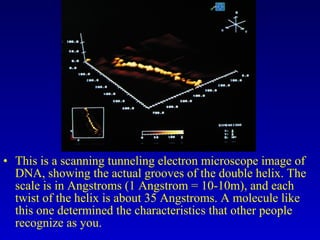
• This is a scanning tunneling electron microscope image of
DNA, showing the actual grooves of the double helix. The
scale is in Angstroms (1 Angstrom = 10-10m), and each
twist of the helix is about 35 Angstroms. A molecule like
this one determined the characteristics that other people
recognize as you.
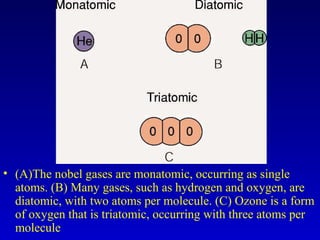
• (A)The nobel gases are monatomic, occurring as single
atoms. (B) Many gases, such as hydrogen and oxygen, are
diatomic, with two atoms per molecule. (C) Ozone is a form
of oxygen that is triatomic, occurring with three atoms per
molecule
• Compounds and Chemical Change
• An atom is the smallest unit of an element that can
exist alone or in combination with other elements.
• A molecule is the smallest particle of a compound,
or a gaseous element, that can exist and still retain
the characteristic chemical properties of a substance.
• A chemical reaction is a change in matter in which
different chemical substances are created by
forming or breaking chemical bonds.
– Chemical bonds are formed when atoms of elements bind
together to form compounds.
– Chemical bonds are broken when a compound is
decomposed into simpler substances.
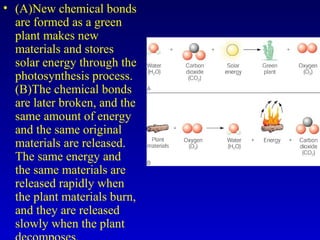
• (A)New chemical bonds
are formed as a green
plant makes new
materials and stores
solar energy through the
photosynthesis process.
(B)The chemical bonds
are later broken, and the
same amount of energy
and the same original
materials are released.
The same energy and
the same materials are
released rapidly when
the plant materials burn,
and they are released
slowly when the plant
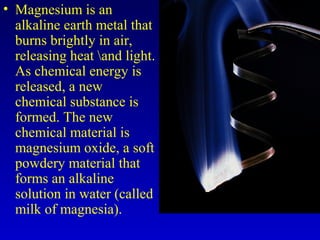
• Magnesium is an
alkaline earth metal that
burns brightly in air,
releasing heat and light.
As chemical energy is
released, a new
chemical substance is
formed. The new
chemical material is
magnesium oxide, a soft
powdery material that
forms an alkaline
solution in water (called
milk of magnesia).
• A chemical equation is a shorthand representation
of a chemical reaction.
– The substances that are changed in to reaction are called
the reactants.
– The substances that are formed in the reaction are called
the products.
• Valence Electrons and Ions
• Valence electrons are those electrons that occur on
the outer shell of atoms.
– These are the electrons that are responsible for chemical
reactions
– Inner electrons are in lower energy levels and the orbitals
are filled.
• These electrons are therefore not available for interactions with
other electrons.
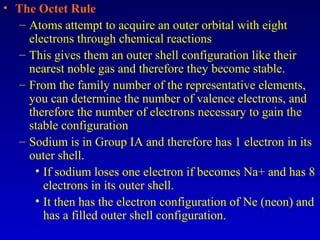
• The Octet Rule
– Atoms attempt to acquire an outer orbital with eight
electrons through chemical reactions
– This gives them an outer shell configuration like their
nearest noble gas and therefore they become stable.
– From the family number of the representative elements,
you can determine the number of valence electrons, and
therefore the number of electrons necessary to gain the
stable configuration
– Sodium is in Group IA and therefore has 1 electron in its
outer shell.
• If sodium loses one electron if becomes Na+ and has 8
electrons in its outer shell.
• It then has the electron configuration of Ne (neon) and
has a filled outer shell configuration.
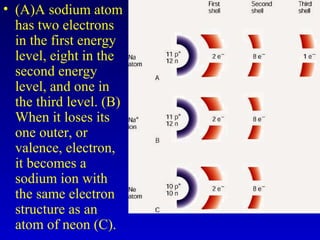
• (A)A sodium atom
has two electrons
in the first energy
level, eight in the
second energy
level, and one in
the third level. (B)
When it loses its
one outer, or
valence, electron,
it becomes a
sodium ion with
the same electron
structure as an
atom of neon (C).
• Chemical Bonds
• Introduction
– Atoms gain or lose electrons through chemical reactions
to gain a filled outer shell and therefore a lower energy
level.
– A chemical reaction forms a chemical bond that is an
attractive force that holds atoms together in a compound.
– Ionic bonds are formed when an atom transfers an
electron to another atom during a chemical reaction
• The opposite charges resulting forms an electrostatic attraction
between the ions that are formed.
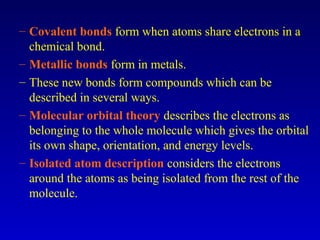
– Covalent bonds form when atoms share electrons in a
chemical bond.
– Metallic bonds form in metals.
– These new bonds form compounds which can be
described in several ways.
– Molecular orbital theory describes the electrons as
belonging to the whole molecule which gives the orbital
its own shape, orientation, and energy levels.
– Isolated atom description considers the electrons
around the atoms as being isolated from the rest of the
molecule.
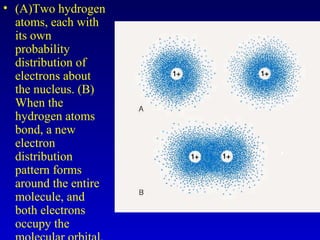
• (A)Two hydrogen
atoms, each with
its own
probability
distribution of
electrons about
the nucleus. (B)
When the
hydrogen atoms
bond, a new
electron
distribution
pattern forms
around the entire
molecule, and
both electrons
occupy the
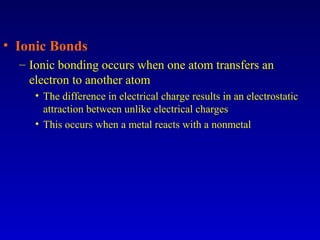
• Ionic Bonds
– Ionic bonding occurs when one atom transfers an
electron to another atom
• The difference in electrical charge results in an electrostatic
attraction between unlike electrical charges
• This occurs when a metal reacts with a nonmetal
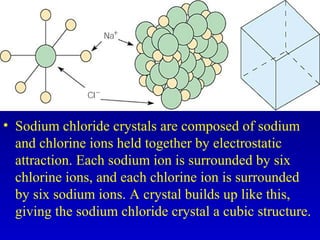
• Sodium chloride crystals are composed of sodium
and chlorine ions held together by electrostatic
attraction. Each sodium ion is surrounded by six
chlorine ions, and each chlorine ion is surrounded
by six sodium ions. A crystal builds up like this,
giving the sodium chloride crystal a cubic structure.
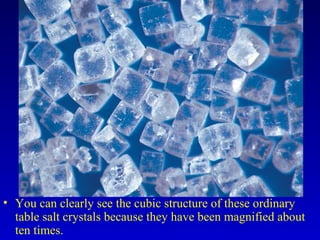
• You can clearly see the cubic structure of these ordinary
table salt crystals because they have been magnified about
ten times.
– Energy and Electrons in Ionic Bonding
• Example:
–energy + Na+
 Na+
+ e-
–Cl + e-  Cl-
+ energy
–Na+
+ Cl-
 Na+
Cl-
+ energy
• The energy that is released in steps 2 and 3 is greater
that that absorbed in step one and an ionic bond is
formed.
–This energy is called the heat of formation.
• Two rules for keeping track of electrons in ionic
bonding reactions.
–Ions are formed when atoms gain or lose electrons
to achieve a noble gas configuration
–The number of electrons that are lost must equal
the number of electrons that are gained.
– Ionic Compounds and Formulas
• The formula of a compound describes what elements
are in the compound and in what proportions.
• Compounds that are held together by ionic bonds are
called ionic compounds.
• The elements in Group IA and IIA tend to lose
electrons for form positive ions
• The elements in Group VIA and VIIA tend to gain
electrons to form negative ions.
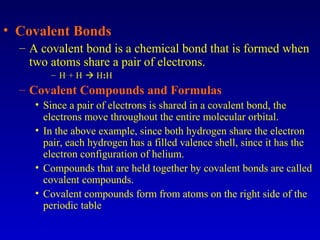
• Covalent Bonds
– A covalent bond is a chemical bond that is formed when
two atoms share a pair of electrons.
– H.
+ H.
 H:H
– Covalent Compounds and Formulas
• Since a pair of electrons is shared in a covalent bond, the
electrons move throughout the entire molecular orbital.
• In the above example, since both hydrogen share the electron
pair, each hydrogen has a filled valence shell, since it has the
electron configuration of helium.
• Compounds that are held together by covalent bonds are called
covalent compounds.
• Covalent compounds form from atoms on the right side of the
periodic table
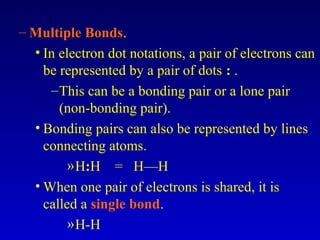
– Multiple Bonds.
• In electron dot notations, a pair of electrons can
be represented by a pair of dots : .
–This can be a bonding pair or a lone pair
(non-bonding pair).
• Bonding pairs can also be represented by lines
connecting atoms.
»H:H = H—H
• When one pair of electrons is shared, it is
called a single bond.
»H-H
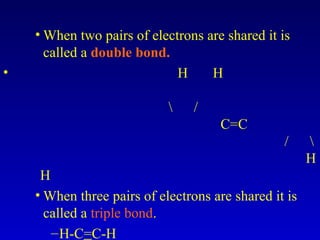
• When two pairs of electrons are shared it is
called a double bond.
• H H
 /
C=C
/ 
H
H
• When three pairs of electrons are shared it is
called a triple bond.
–H-C=C-H
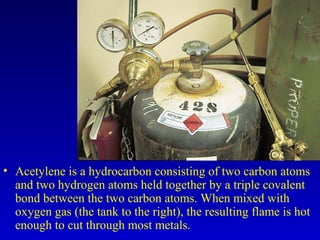
• Acetylene is a hydrocarbon consisting of two carbon atoms
and two hydrogen atoms held together by a triple covalent
bond between the two carbon atoms. When mixed with
oxygen gas (the tank to the right), the resulting flame is hot
enough to cut through most metals.
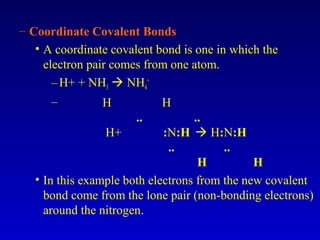
– Coordinate Covalent Bonds
• A coordinate covalent bond is one in which the
electron pair comes from one atom.
–H+ + NH3  NH4
+
– H H
.. ..
H+ :N:H  H:N:H
.. ..
H H
• In this example both electrons from the new covalent
bond come from the lone pair (non-bonding electrons)
around the nitrogen.
Bond Polarity
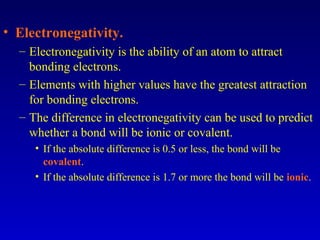
• Electronegativity.
– Electronegativity is the ability of an atom to attract
bonding electrons.
– Elements with higher values have the greatest attraction
for bonding electrons.
– The difference in electronegativity can be used to predict
whether a bond will be ionic or covalent.
• If the absolute difference is 0.5 or less, the bond will be
covalent.
• If the absolute difference is 1.7 or more the bond will be ionic.
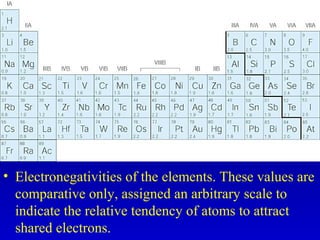
• Electronegativities of the elements. These values are
comparative only, assigned an arbitrary scale to
indicate the relative tendency of atoms to attract
shared electrons.
– When the absolute difference is between 0.5 and 1.7 a
covalent bond is formed, but one in which the electron
pair is not shared equally.
– This type of bond is called a polar covalent bond.
– A polar covalent bond results in areas of partial positive
charge and areas of partial negative charge since the
electrons spend more time around the more
electronegative atom.
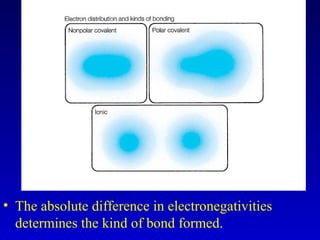
• The absolute difference in electronegativities
determines the kind of bond formed.
• Composition of Compounds
• Ionic Compound Names
– Ionic compounds that are formed from metal ions are
named by naming the metal ion (electropositive ion) first,
followed by the nonmetal (electronegative ion)
– The ending of the nonmetal is changed to end in -ide
– When a metal can have various oxidation states the
oxidation state is give by roman numerals in parenthesis
after the name of the metal.
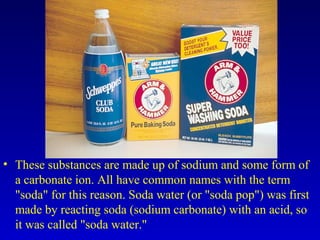
• These substances are made up of sodium and some form of
a carbonate ion. All have common names with the term
"soda" for this reason. Soda water (or "soda pop") was first
made by reacting soda (sodium carbonate) with an acid, so
it was called "soda water."
• Ionic Compound Formulas
– Rules
• The symbol for the positive element is written first,
followed by the symbol of the negative element
• Subscripts are used to indicate the numbers of ions
needed to produce an electrically neutral compound.
• Example calcium chloride
–calcium is Ca2+
and chlorine is Cl-
–in order to balance charges there needs to be two
negative charges to balance the 2+ on the calcium
–the formula is therefore CaCl2
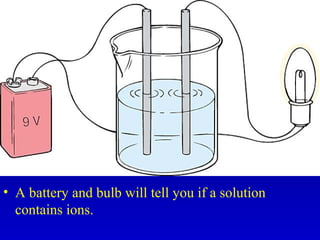
• A battery and bulb will tell you if a solution
contains ions.
• Covalent Compound Names
– Names for covalent compounds uses Greek prefixes to indicate
numbers of atoms of each element
• The first element in the formula is named first with a prefix
indicating the number of atoms if the number is greater than
one.
• The stem name of the second element in the formula is named
next, with a prefix used with the stem name if two elements can
form more than one compound
– The suffix –ide is again used.
• Example
– CO = carbon monoxide
– CO2 = carbon dioxide
• Covalent Compound Formulas
– The systematic name tells you the formula
– Formulas indicate how many atoms of one element
combine with atoms of another element.
– The number of covalent bonds that an atom can form is
called its valence.
– Lone pairs create the possibility of creating coordinate
covalent compounds.
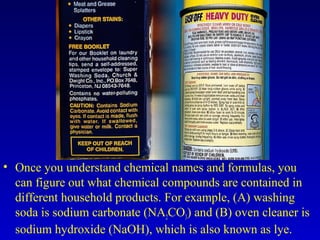
• Once you understand chemical names and formulas, you
can figure out what chemical compounds are contained in
different household products. For example, (A) washing
soda is sodium carbonate (NA2CO3) and (B) oven cleaner is
sodium hydroxide (NaOH), which is also known as lye.
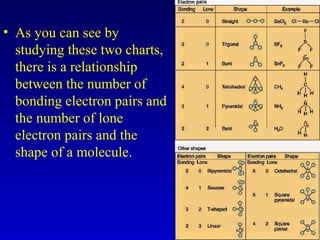
• As you can see by
studying these two charts,
there is a relationship
between the number of
bonding electron pairs and
the number of lone
electron pairs and the
shape of a molecule.

Ch9 chemical bonds (1)

  • 1.
  • 2.
    • This isa scanning tunneling electron microscope image of DNA, showing the actual grooves of the double helix. The scale is in Angstroms (1 Angstrom = 10-10m), and each twist of the helix is about 35 Angstroms. A molecule like this one determined the characteristics that other people recognize as you.
  • 3.
    • (A)The nobelgases are monatomic, occurring as single atoms. (B) Many gases, such as hydrogen and oxygen, are diatomic, with two atoms per molecule. (C) Ozone is a form of oxygen that is triatomic, occurring with three atoms per molecule
  • 4.
    • Compounds andChemical Change
  • 5.
    • An atomis the smallest unit of an element that can exist alone or in combination with other elements. • A molecule is the smallest particle of a compound, or a gaseous element, that can exist and still retain the characteristic chemical properties of a substance.
  • 6.
    • A chemicalreaction is a change in matter in which different chemical substances are created by forming or breaking chemical bonds. – Chemical bonds are formed when atoms of elements bind together to form compounds. – Chemical bonds are broken when a compound is decomposed into simpler substances.
  • 7.
    • (A)New chemicalbonds are formed as a green plant makes new materials and stores solar energy through the photosynthesis process. (B)The chemical bonds are later broken, and the same amount of energy and the same original materials are released. The same energy and the same materials are released rapidly when the plant materials burn, and they are released slowly when the plant
  • 8.
    • Magnesium isan alkaline earth metal that burns brightly in air, releasing heat and light. As chemical energy is released, a new chemical substance is formed. The new chemical material is magnesium oxide, a soft powdery material that forms an alkaline solution in water (called milk of magnesia).
  • 9.
    • A chemicalequation is a shorthand representation of a chemical reaction. – The substances that are changed in to reaction are called the reactants. – The substances that are formed in the reaction are called the products.
  • 10.
  • 11.
    • Valence electronsare those electrons that occur on the outer shell of atoms. – These are the electrons that are responsible for chemical reactions – Inner electrons are in lower energy levels and the orbitals are filled. • These electrons are therefore not available for interactions with other electrons.
  • 12.
    • The OctetRule – Atoms attempt to acquire an outer orbital with eight electrons through chemical reactions – This gives them an outer shell configuration like their nearest noble gas and therefore they become stable. – From the family number of the representative elements, you can determine the number of valence electrons, and therefore the number of electrons necessary to gain the stable configuration – Sodium is in Group IA and therefore has 1 electron in its outer shell. • If sodium loses one electron if becomes Na+ and has 8 electrons in its outer shell. • It then has the electron configuration of Ne (neon) and has a filled outer shell configuration.
  • 13.
    • (A)A sodiumatom has two electrons in the first energy level, eight in the second energy level, and one in the third level. (B) When it loses its one outer, or valence, electron, it becomes a sodium ion with the same electron structure as an atom of neon (C).
  • 14.
  • 15.
    • Introduction – Atomsgain or lose electrons through chemical reactions to gain a filled outer shell and therefore a lower energy level. – A chemical reaction forms a chemical bond that is an attractive force that holds atoms together in a compound. – Ionic bonds are formed when an atom transfers an electron to another atom during a chemical reaction • The opposite charges resulting forms an electrostatic attraction between the ions that are formed.
  • 16.
    – Covalent bondsform when atoms share electrons in a chemical bond. – Metallic bonds form in metals. – These new bonds form compounds which can be described in several ways. – Molecular orbital theory describes the electrons as belonging to the whole molecule which gives the orbital its own shape, orientation, and energy levels. – Isolated atom description considers the electrons around the atoms as being isolated from the rest of the molecule.
  • 17.
    • (A)Two hydrogen atoms,each with its own probability distribution of electrons about the nucleus. (B) When the hydrogen atoms bond, a new electron distribution pattern forms around the entire molecule, and both electrons occupy the
  • 18.
    • Ionic Bonds –Ionic bonding occurs when one atom transfers an electron to another atom • The difference in electrical charge results in an electrostatic attraction between unlike electrical charges • This occurs when a metal reacts with a nonmetal
  • 19.
    • Sodium chloridecrystals are composed of sodium and chlorine ions held together by electrostatic attraction. Each sodium ion is surrounded by six chlorine ions, and each chlorine ion is surrounded by six sodium ions. A crystal builds up like this, giving the sodium chloride crystal a cubic structure.
  • 20.
    • You canclearly see the cubic structure of these ordinary table salt crystals because they have been magnified about ten times.
  • 21.
    – Energy andElectrons in Ionic Bonding • Example: –energy + Na+  Na+ + e- –Cl + e-  Cl- + energy –Na+ + Cl-  Na+ Cl- + energy • The energy that is released in steps 2 and 3 is greater that that absorbed in step one and an ionic bond is formed. –This energy is called the heat of formation.
  • 22.
    • Two rulesfor keeping track of electrons in ionic bonding reactions. –Ions are formed when atoms gain or lose electrons to achieve a noble gas configuration –The number of electrons that are lost must equal the number of electrons that are gained.
  • 23.
    – Ionic Compoundsand Formulas • The formula of a compound describes what elements are in the compound and in what proportions. • Compounds that are held together by ionic bonds are called ionic compounds. • The elements in Group IA and IIA tend to lose electrons for form positive ions • The elements in Group VIA and VIIA tend to gain electrons to form negative ions.
  • 24.
    • Covalent Bonds –A covalent bond is a chemical bond that is formed when two atoms share a pair of electrons. – H. + H.  H:H – Covalent Compounds and Formulas • Since a pair of electrons is shared in a covalent bond, the electrons move throughout the entire molecular orbital. • In the above example, since both hydrogen share the electron pair, each hydrogen has a filled valence shell, since it has the electron configuration of helium. • Compounds that are held together by covalent bonds are called covalent compounds. • Covalent compounds form from atoms on the right side of the periodic table
  • 25.
    – Multiple Bonds. •In electron dot notations, a pair of electrons can be represented by a pair of dots : . –This can be a bonding pair or a lone pair (non-bonding pair). • Bonding pairs can also be represented by lines connecting atoms. »H:H = H—H • When one pair of electrons is shared, it is called a single bond. »H-H
  • 26.
    • When twopairs of electrons are shared it is called a double bond. • H H / C=C / H H • When three pairs of electrons are shared it is called a triple bond. –H-C=C-H
  • 27.
    • Acetylene isa hydrocarbon consisting of two carbon atoms and two hydrogen atoms held together by a triple covalent bond between the two carbon atoms. When mixed with oxygen gas (the tank to the right), the resulting flame is hot enough to cut through most metals.
  • 28.
    – Coordinate CovalentBonds • A coordinate covalent bond is one in which the electron pair comes from one atom. –H+ + NH3  NH4 + – H H .. .. H+ :N:H  H:N:H .. .. H H • In this example both electrons from the new covalent bond come from the lone pair (non-bonding electrons) around the nitrogen.
  • 29.
  • 30.
    • Electronegativity. – Electronegativityis the ability of an atom to attract bonding electrons. – Elements with higher values have the greatest attraction for bonding electrons. – The difference in electronegativity can be used to predict whether a bond will be ionic or covalent. • If the absolute difference is 0.5 or less, the bond will be covalent. • If the absolute difference is 1.7 or more the bond will be ionic.
  • 31.
    • Electronegativities ofthe elements. These values are comparative only, assigned an arbitrary scale to indicate the relative tendency of atoms to attract shared electrons.
  • 32.
    – When theabsolute difference is between 0.5 and 1.7 a covalent bond is formed, but one in which the electron pair is not shared equally. – This type of bond is called a polar covalent bond. – A polar covalent bond results in areas of partial positive charge and areas of partial negative charge since the electrons spend more time around the more electronegative atom.
  • 33.
    • The absolutedifference in electronegativities determines the kind of bond formed.
  • 34.
  • 35.
    • Ionic CompoundNames – Ionic compounds that are formed from metal ions are named by naming the metal ion (electropositive ion) first, followed by the nonmetal (electronegative ion) – The ending of the nonmetal is changed to end in -ide – When a metal can have various oxidation states the oxidation state is give by roman numerals in parenthesis after the name of the metal.
  • 36.
    • These substancesare made up of sodium and some form of a carbonate ion. All have common names with the term "soda" for this reason. Soda water (or "soda pop") was first made by reacting soda (sodium carbonate) with an acid, so it was called "soda water."
  • 37.
    • Ionic CompoundFormulas – Rules • The symbol for the positive element is written first, followed by the symbol of the negative element • Subscripts are used to indicate the numbers of ions needed to produce an electrically neutral compound. • Example calcium chloride –calcium is Ca2+ and chlorine is Cl- –in order to balance charges there needs to be two negative charges to balance the 2+ on the calcium –the formula is therefore CaCl2
  • 38.
    • A batteryand bulb will tell you if a solution contains ions.
  • 39.
    • Covalent CompoundNames – Names for covalent compounds uses Greek prefixes to indicate numbers of atoms of each element • The first element in the formula is named first with a prefix indicating the number of atoms if the number is greater than one. • The stem name of the second element in the formula is named next, with a prefix used with the stem name if two elements can form more than one compound – The suffix –ide is again used. • Example – CO = carbon monoxide – CO2 = carbon dioxide
  • 40.
    • Covalent CompoundFormulas – The systematic name tells you the formula – Formulas indicate how many atoms of one element combine with atoms of another element. – The number of covalent bonds that an atom can form is called its valence. – Lone pairs create the possibility of creating coordinate covalent compounds.
  • 41.
    • Once youunderstand chemical names and formulas, you can figure out what chemical compounds are contained in different household products. For example, (A) washing soda is sodium carbonate (NA2CO3) and (B) oven cleaner is sodium hydroxide (NaOH), which is also known as lye.
  • 42.
    • As youcan see by studying these two charts, there is a relationship between the number of bonding electron pairs and the number of lone electron pairs and the shape of a molecule.