The  attraction between atoms in a molecule or crystalline structure When elements react atoms must collide
Bond that results when metal atoms release their valence electrons to a pool of electrons shared by all the metal atoms  Holds metals together Results in high conductivity, malleability, and ductility
Composed of positively and negatively  charged atoms Metals on left form compounds with nonmetals on right Form  ionic bonds-  a chemical bond between two ions with opposite charges
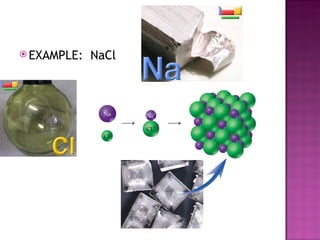
EXAMPLE:  NaCl
 
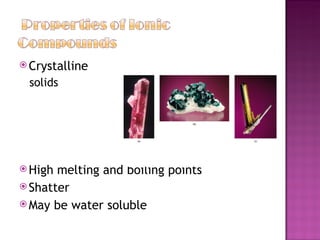
Crystalline solids High melting and boiling points Shatter May be water soluble
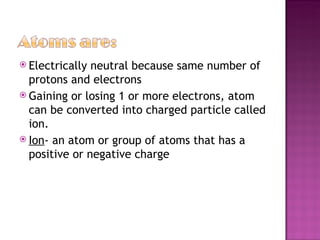
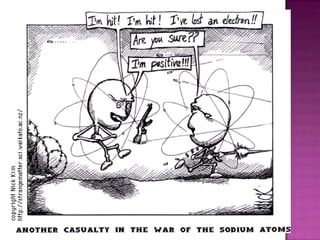
Electrically neutral because same number of protons and electrons Gaining or losing 1 or more electrons, atom can be converted into charged particle called ion. Ion - an atom or group of atoms that has a positive or negative charge
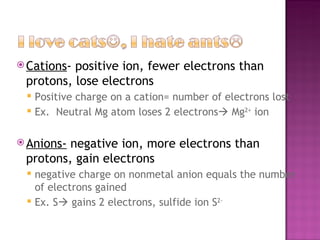
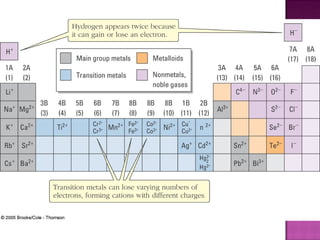
Cations - positive ion, fewer electrons than protons, lose electrons Positive charge on a cation= number of electrons lost Ex.  Neutral Mg atom loses 2 electrons   Mg 2+  ion Anions-  negative ion, more electrons than protons, gain electrons negative charge on nonmetal anion equals the number of electrons gained Ex. S   gains 2 electrons, sulfide ion S 2-
 
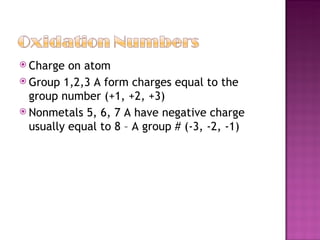
Charge on atom Group 1,2,3 A form charges equal to the group number (+1, +2, +3) Nonmetals 5, 6, 7 A have negative charge usually equal to 8 – A group # (-3, -2, -1)
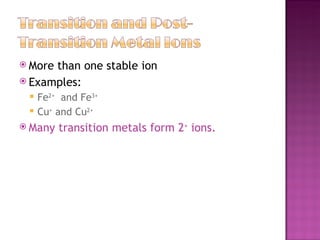
More than one stable ion  Examples: Fe 2+   and Fe 3+ Cu +  and Cu 2+ Many transition metals form 2 +  ions.
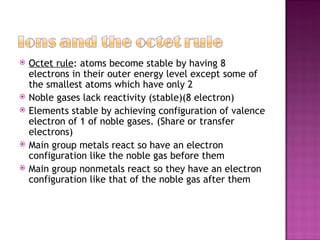
Octet rule : atoms become stable by having 8 electrons in their outer energy level except some of the smallest atoms which have only 2 Noble gases lack reactivity (stable)(8 electron) Elements stable by achieving configuration of valence electron of 1 of noble gases. (Share or transfer electrons) Main group metals react so have an electron configuration like the noble gas before them Main group nonmetals react so they have an electron configuration like that of the noble gas after them
 
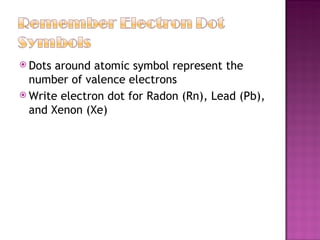
Dots around atomic symbol represent the number of valence electrons Write electron dot for Radon (Rn), Lead (Pb), and Xenon (Xe)
 
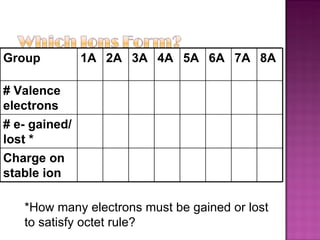
*How many electrons must be gained or lost to satisfy octet rule? Group 1A 2A 3A 4A 5A 6A 7A 8A # Valence electrons # e- gained/ lost * Charge on stable ion
 
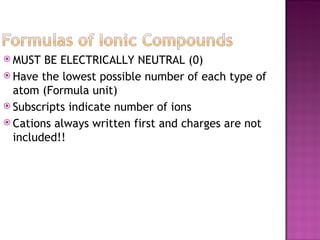
MUST BE ELECTRICALLY NEUTRAL (0) Have the lowest possible number of each type of atom (Formula unit) Subscripts indicate number of ions Cations always written first and charges are not included!!
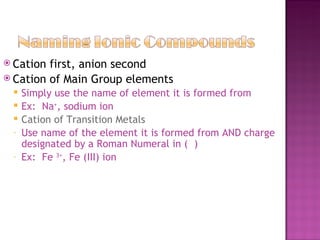
Cation first, anion second Cation of Main Group elements Simply use the name of element it is formed from Ex:  Na + , sodium ion Cation of Transition Metals Use name of the element it is formed from AND charge designated by a Roman Numeral in (  ) Ex:  Fe  3+ , Fe (III) ion
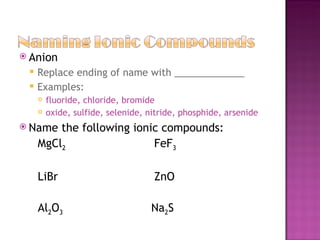
Anion Replace ending of name with _____________ Examples:  fluoride, chloride, bromide oxide, sulfide, selenide, nitride, phosphide, arsenide Name the following ionic compounds: MgCl 2   FeF 3 LiBr   ZnO Al 2 O 3   Na 2 S
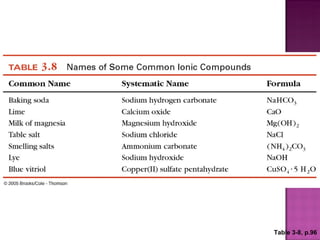
Table 3-8, p.96
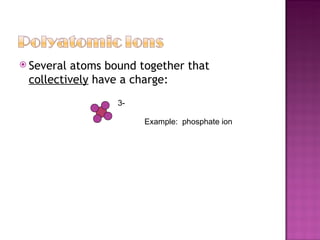
Several atoms bound together that  collectively  have a charge: 3- Example:  phosphate ion
 
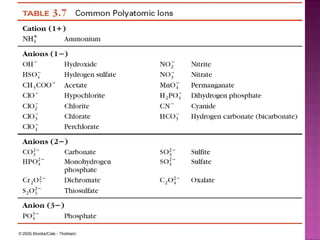
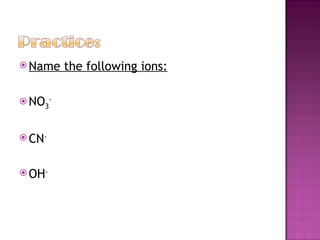
Name the following ions: NO 3 -  CN - OH -
Write the formulas of the following ions: Phosphate ion Ammonium ion Permanganate ion
Parentheses  may  be needed for polyatomic ions EXAMPLE: aluminum hydroxide ____________________ ammonium phosphate___________________ sodium sulfate_________________________
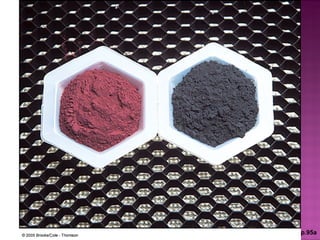
p.95a
A Little Trick Magnesium phosphate
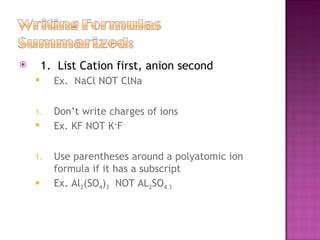
1.  List Cation first, anion second Ex.  NaCl NOT ClNa Don’t write charges of ions Ex. KF NOT K + F - Use parentheses around a polyatomic ion formula if it has a subscript Ex. Al 2 (SO 4 ) 3   NOT AL 2 SO 4 3
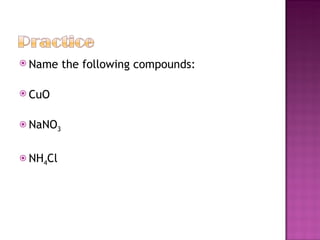
Name the following compounds: CuO NaNO 3 NH 4 Cl
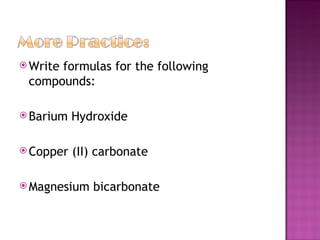
Write formulas for the following compounds: Barium Hydroxide Copper (II) carbonate Magnesium bicarbonate
 

Bonding Teacher Note

  • 1.
  • 2.
    The attractionbetween atoms in a molecule or crystalline structure When elements react atoms must collide
  • 3.
    Bond that resultswhen metal atoms release their valence electrons to a pool of electrons shared by all the metal atoms Holds metals together Results in high conductivity, malleability, and ductility
  • 4.
    Composed of positivelyand negatively charged atoms Metals on left form compounds with nonmetals on right Form ionic bonds- a chemical bond between two ions with opposite charges
  • 5.
  • 6.
  • 7.
    Crystalline solids Highmelting and boiling points Shatter May be water soluble
  • 8.
    Electrically neutral becausesame number of protons and electrons Gaining or losing 1 or more electrons, atom can be converted into charged particle called ion. Ion - an atom or group of atoms that has a positive or negative charge
  • 9.
    Cations - positiveion, fewer electrons than protons, lose electrons Positive charge on a cation= number of electrons lost Ex. Neutral Mg atom loses 2 electrons  Mg 2+ ion Anions- negative ion, more electrons than protons, gain electrons negative charge on nonmetal anion equals the number of electrons gained Ex. S  gains 2 electrons, sulfide ion S 2-
  • 10.
  • 11.
    Charge on atomGroup 1,2,3 A form charges equal to the group number (+1, +2, +3) Nonmetals 5, 6, 7 A have negative charge usually equal to 8 – A group # (-3, -2, -1)
  • 12.
    More than onestable ion Examples: Fe 2+ and Fe 3+ Cu + and Cu 2+ Many transition metals form 2 + ions.
  • 13.
    Octet rule :atoms become stable by having 8 electrons in their outer energy level except some of the smallest atoms which have only 2 Noble gases lack reactivity (stable)(8 electron) Elements stable by achieving configuration of valence electron of 1 of noble gases. (Share or transfer electrons) Main group metals react so have an electron configuration like the noble gas before them Main group nonmetals react so they have an electron configuration like that of the noble gas after them
  • 14.
  • 15.
    Dots around atomicsymbol represent the number of valence electrons Write electron dot for Radon (Rn), Lead (Pb), and Xenon (Xe)
  • 16.
  • 17.
    *How many electronsmust be gained or lost to satisfy octet rule? Group 1A 2A 3A 4A 5A 6A 7A 8A # Valence electrons # e- gained/ lost * Charge on stable ion
  • 18.
  • 19.
    MUST BE ELECTRICALLYNEUTRAL (0) Have the lowest possible number of each type of atom (Formula unit) Subscripts indicate number of ions Cations always written first and charges are not included!!
  • 20.
    Cation first, anionsecond Cation of Main Group elements Simply use the name of element it is formed from Ex: Na + , sodium ion Cation of Transition Metals Use name of the element it is formed from AND charge designated by a Roman Numeral in ( ) Ex: Fe 3+ , Fe (III) ion
  • 21.
    Anion Replace endingof name with _____________ Examples: fluoride, chloride, bromide oxide, sulfide, selenide, nitride, phosphide, arsenide Name the following ionic compounds: MgCl 2 FeF 3 LiBr ZnO Al 2 O 3 Na 2 S
  • 22.
  • 23.
    Several atoms boundtogether that collectively have a charge: 3- Example: phosphate ion
  • 24.
  • 25.
    Name the followingions: NO 3 - CN - OH -
  • 26.
    Write the formulasof the following ions: Phosphate ion Ammonium ion Permanganate ion
  • 27.
    Parentheses may be needed for polyatomic ions EXAMPLE: aluminum hydroxide ____________________ ammonium phosphate___________________ sodium sulfate_________________________
  • 28.
  • 29.
    A Little TrickMagnesium phosphate
  • 30.
    1. ListCation first, anion second Ex. NaCl NOT ClNa Don’t write charges of ions Ex. KF NOT K + F - Use parentheses around a polyatomic ion formula if it has a subscript Ex. Al 2 (SO 4 ) 3 NOT AL 2 SO 4 3
  • 31.
    Name the followingcompounds: CuO NaNO 3 NH 4 Cl
  • 32.
    Write formulas forthe following compounds: Barium Hydroxide Copper (II) carbonate Magnesium bicarbonate
  • 33.