Prepared By:
Mohammed Jasir PV
Assist. Professor
MIIMS Puthanangadi
Inventory and Inventory Management
Key Inventory Terms
Cost of Inventory
Inventory Management Techniques
Topics
• Inventory and Inventory Management
• Key Inventory Terms
• Cost of Inventory
• Inventory Management Techniques
Inventory
• The dictionary meaning of Inventory is STOCK OF GOODS.
• The word inventory is understood differently by various authors.
• In accounting it may mean stock of finished goods only.
• In a manufacturing concern, it may include raw materials, work in
progress and stores, etc.
• In Retail, the amount of stock present in a retail outlet and ready to be
distributed.
• Inventory is a list for goods and materials, or those goods and materials
themselves, held available in stock by a business
Inventory Management
• Inventory Management is a Science primarily about specifying the shape and
percentage of stocked goods.
• A proper planning of purchasing, storing, and accounting should form a part of
inventory management.
• An efficient system of inventory management will determine:
1) What to purchase
2) How much to purchase
3) From where to purchase.
4) Where to Store.
• The purpose of inventory management is to keep the stock in such a way that
neither there is over- stocking nor under- stocking.
Flow of Inventory
• Delivery from supplier
• Quality checking
• Warehouse
• Material Movement (Production process)
• Warehouse
• Shipment
Why Inventory Management
• To meet sales
• To continue uninterrupted production
• To reduce cost
• To keep sufficient inventory (Under – Over)
STAGES OF INVENTORY MANAGEMENT
• Decision Stage : Co-ordination of purchasing, supplier development, guiding design
decisions, introducing new inventory and some minor changes in the production
process.
• Sourcing Stage : Make or buy decision, procurement facilities etc.
• Production Planning Stage : Preparation of master schedule, calculation of
inventory requirements etc.
• Stage of Ordering : Placing the orders, follow-up, packaging and transportation.
• Receiving Stage : Receiving the items, inspection of inventory, quality problems etc.
• Inventory Control : Determination of economic lot sizes, safety margins and
inventory costs.
Key Inventory Terms
• Safety Stock / buffer stock
• Order Quantity
• Minimum Order Quantity
• Reorder Level
• Lead Time
Key Inventory Terms
• Safety Stock
– Safety stock or the buffer stock is an ideal quantity of material that has to
be always maintained and it is drawn only in the emergency situation
• Lead Time
– It is the time lapse between placement of an order and receipt of items
including their approval by quality control department
– This is counted on past experiences
– Procurement of material has a long lead time
• Order quantity
– The quantity of an item to be ordered when STOCKS of the item fall to a
predetermined minimum stock level
– The reorder quantity should serve to replenish stock to the planned maximu
m stock level
• Reorder Level
– It indicates that level of material stock at which it is necessary to take the
steps for the procurement of further lots of material.
– The reorder level is slightly more than minimum stock level to guard against
abnormal use of item and abnormal delay in supply.
– Reorder level= Maximum lead time × Maximum uses
• Minimum Order Quantity
– A minimum order quantity (MOQ) is the lowest set amount of stock that a
supplier is willing to sell. If you can’t purchase the MOQ of a specific
product, then the supplier won’t sell it to you.
Cost of Inventory
• Ordering cost
– Order placing cost
– Order Proceedings
• Carrying cost
– Storage, insurance, risk of damage, Depreciation, Price fall
• Stock out cost
– Out of stock, immediate purchase, customer value
Inventory Management Techniques
EOQ ABC Analysis
VED Analysis JIT
Others
EOQ - Economic Order Quantity
• EOQ is a quantity of inventory which can reasonably be ordered economically
at time
• In determining this point, ordering costs and Carrying Costs are taken into
consideration
– Ordering costs are basically the cost of placing an order
– Carrying cost includes costs of storage facilities and loss of value through
physical deterioration, cost of obsolescence
• The balancing point is known as Economic Order Quantity
Definition
• Economic Order Quantity is one of the techniques of inventory control
which minimizes total holding and ordering costs for the year
• Definition of EOQ :- EOQ is essentially an accounting formula that
determines at which the combination of order, costs and inventory
carrying cost are at the least.
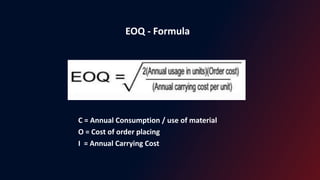
EOQ - Formula
C = Annual Consumption / use of material
O = Cost of order placing
I = Annual Carrying Cost
Advantages
• Each material can be procured in the most economical quantity.
• Purchasing and inventory control personnel automatically devote
attention to the items that are needed only when required.
• Positive control can easily be exerted to maintain total inventory
investment at the desired level simply by manipulating the planned
maximum and minimum value.
• Minimizes Storage and Holding Costs
• Specific to the Business
Disadvantages
• Complicated Math Calculations
• Based on Assumptions
• The orders are raised at irregular intervals which may not be convenient to the
suppliers
• In case the lead time is very high supply of inventory may interpret
• EOQ may give you an order quantity which is much below the supplier
minimum, and there is always a chance that the ordering level for an item has
been reached but not noticed in which case a stock out may occur; and
• The items cannot be group and ordered at a time since the recorder points
occur irregularly
“The Pareto Principle”
• “The Pareto Principle” / 80/20 rule
• This principle suggests that 80% of the total output is generated only by
20% of the valuable efforts.
ABC Analysis
ABC Analysis
• It means Always Better Control
• Under this the inventory is classified into 3 categories viz. A, B and C
• These categories are based upon the inventory value and cost significance
• Items of High value and small in no. are termed as A
• Items of moderate value and moderate in no. are termed as B
• Items of small value and large in no. are in category C
Item A
• Small in number, but consume large amount of resources
• Must have:
– Tight control
– Rigid estimate of requirements
– Strict & closer watch
– Low safety stocks
– Managed by top management
Item B
• Intermediate
• Must have:
– Moderate control
– Purchase based on rigid requirements
– Reasonably strict watch & control
– Moderate safety stocks
– Managed by middle level management
Item C
• Larger in number, but consume lesser amount of resources
• Must have:
– Ordinary control measures
– Purchase based on usage estimates
– High safety stocks
• ABC analysis does not stress on items those are less costly but may be vital
• Item A:
– Items categorized under A are goods that register the highest value in terms of
annual consumption. It is interesting to note that the top 70 to 80 percent of the
yearly consumption value of the company comes from only about 10 to 20
percent of the total inventory items. Hence, it is crucial to prioritize these items.
• Item B:
– These are items that have a medium consumption value. These amount to about
30 percent of the total inventory in a company which accounts for about 15 to 20
percent of annual consumption value.
• Item C:
– The items placed in this category have the lowest consumption value and
account for less than 5 percent of the annual consumption value that comes
from about 50 percent of the total inventory items.
Price v/s Inventory
ABC - STEPS
1. Find out future use of each item of stock in terms of physical quantities for
the review forecast period.
2. Determine the price per unit for each item.
3. Determine the total project cost of each item by multiplying its expected
units to be used by the price per unit of such item.
4. Beginning with the item with the highest total cost, arrange different
items in order of their total cost as computed under step (iii) above.
5. Express the units of each item as a percentage of total costs of all items.
6. Compute the total cost of each item as a percentage of total costs of all
items.
Advantages of ABC Analysis
• It ensures a closer and a more strict control over such items, which are
having a sizable investment in there
• It releases working capital, which would otherwise have been locked up for
a more profitable channel of investment
• It reduces inventory-carrying cost.
• It enables the relaxation of control for the ‘C’ items and thus makes it
possible for a sufficient buffer stock to be created
• It enables the maintenance of high inventory turn over rate
Disadvantages of ABC Analysis
• Proper standardization & codification of inventory items needed
• Considers only money value of items & neglects the importance of items
for the production process or assembly or functioning
• Periodic review becomes difficult if only ABC analysis is recalled
• When other important factors make it obligatory to concentrate on “C”
items more, the purpose of ABC analysis is defeated
VED ANALYSIS
VED analysis
• Inventory is classified as per the functional importance under the
following three categories:
• Vital (V)
• Essential (E)
• Desirable(D)
• Vital-
– Items without which treatment comes to standstill: i.e. non- availability can not
be tolerated. The vital items are stocked in abundance , essential items and very
strict control
• Essential-
– Items whose non- availability can be tolerated for 2-3 days, because similar or
alternative items are available. Essential items are stocked in medium amounts,
purchase is based on rigid requirements and reasonably strict watch.
• Desirable-
– Items whose non –availability can be tolerated for a long period. Desirable items
are stocked in small amounts and purchase is based on usage estimates.
VED Analysis
• VED ranking may be done on the basis of the shortage costs of materials, which
can be either quantified or qualitatively expressed.
• The fundamental question behind VED analysis is: what items could your
business not operate without?
• In most manufacturing environments there are a few components without
which production will grind to a halt.
• Failing to order those items on time is clearly an expensive mistake.
VED Analysis
• In VED method (vital, essential, and desirable), each stock items is classified
on either vital, essential or desirable based on how critical the item is for
providing health services
• The vital items are stocked in abundance , essential items are stocked in
medium amounts and desirable items we socked in small amounts
• Vital and essential items are always in stock which means a minimum
disruption in the services offered to the people
Advantages
• It is useful for monitoring and control of stores and spares inventory by
classifying them into three categories
• Determine the criticality of an item and its effect on production and
other services
• It is useful for controlling and maintain the stock of various types
Just-in-Time Management
• Originated in Japan in the 1960s and 1970s by Toyota Motor Corp.
• The method allows companies to save significant amounts of money and
reduce waste by keeping only the inventory they need to produce and sell
products.
• This approach reduces storage and insurance costs, as well as the cost of
liquidating or discarding excess inventory.
JIT
• JIT inventory management can be risky
• If demand unexpectedly spikes, the manufacturer may not be able to
source the inventory it needs to meet that demand, damaging its
reputation with customers and driving business toward competitors
• Even the smallest delays can be problematic; if a key input does not
arrive "just in time," a bottleneck can result
Materials Requirement Planning
• This method is sales-forecast dependent
• Meaning that manufacturers must have accurate sales records to enable
accurate planning of inventory needs and to communicate those needs with
materials suppliers in a timely manner
• Inability to accurately forecast sales and plan inventory acquisitions results in a
manufacturer's inability to fulfill orders
Other Techniques
• FSN
• LIFO
• FIFO
• HIFO
FSN Analysis
• Fast-moving
• Slow-moving
• Non-moving Items
FIFO & LIFO
HIFO - Highest In First Out
In Stock
Material X
$ 40
Material Y
$ 80
Material Z
$ 60
Material A
$ 75
Material X
$ 40
Using / Process - Highest priced material process first
Material Y
$ 80
Material Z
$ 60
Material A
$ 75
FM Session 4
Work
Write a note on NIFO (Next In First Out) and SDE Analysis with an example
Thank You

Inventory and inventory management

  • 1.
    Prepared By: Mohammed JasirPV Assist. Professor MIIMS Puthanangadi Inventory and Inventory Management Key Inventory Terms Cost of Inventory Inventory Management Techniques
  • 2.
    Topics • Inventory andInventory Management • Key Inventory Terms • Cost of Inventory • Inventory Management Techniques
  • 3.
    Inventory • The dictionarymeaning of Inventory is STOCK OF GOODS. • The word inventory is understood differently by various authors. • In accounting it may mean stock of finished goods only. • In a manufacturing concern, it may include raw materials, work in progress and stores, etc. • In Retail, the amount of stock present in a retail outlet and ready to be distributed. • Inventory is a list for goods and materials, or those goods and materials themselves, held available in stock by a business
  • 4.
    Inventory Management • InventoryManagement is a Science primarily about specifying the shape and percentage of stocked goods. • A proper planning of purchasing, storing, and accounting should form a part of inventory management. • An efficient system of inventory management will determine: 1) What to purchase 2) How much to purchase 3) From where to purchase. 4) Where to Store. • The purpose of inventory management is to keep the stock in such a way that neither there is over- stocking nor under- stocking.
  • 5.
    Flow of Inventory •Delivery from supplier • Quality checking • Warehouse • Material Movement (Production process) • Warehouse • Shipment
  • 6.
    Why Inventory Management •To meet sales • To continue uninterrupted production • To reduce cost • To keep sufficient inventory (Under – Over)
  • 8.
    STAGES OF INVENTORYMANAGEMENT • Decision Stage : Co-ordination of purchasing, supplier development, guiding design decisions, introducing new inventory and some minor changes in the production process. • Sourcing Stage : Make or buy decision, procurement facilities etc. • Production Planning Stage : Preparation of master schedule, calculation of inventory requirements etc. • Stage of Ordering : Placing the orders, follow-up, packaging and transportation. • Receiving Stage : Receiving the items, inspection of inventory, quality problems etc. • Inventory Control : Determination of economic lot sizes, safety margins and inventory costs.
  • 9.
    Key Inventory Terms •Safety Stock / buffer stock • Order Quantity • Minimum Order Quantity • Reorder Level • Lead Time
  • 10.
    Key Inventory Terms •Safety Stock – Safety stock or the buffer stock is an ideal quantity of material that has to be always maintained and it is drawn only in the emergency situation • Lead Time – It is the time lapse between placement of an order and receipt of items including their approval by quality control department – This is counted on past experiences – Procurement of material has a long lead time
  • 11.
    • Order quantity –The quantity of an item to be ordered when STOCKS of the item fall to a predetermined minimum stock level – The reorder quantity should serve to replenish stock to the planned maximu m stock level • Reorder Level – It indicates that level of material stock at which it is necessary to take the steps for the procurement of further lots of material. – The reorder level is slightly more than minimum stock level to guard against abnormal use of item and abnormal delay in supply. – Reorder level= Maximum lead time × Maximum uses
  • 12.
    • Minimum OrderQuantity – A minimum order quantity (MOQ) is the lowest set amount of stock that a supplier is willing to sell. If you can’t purchase the MOQ of a specific product, then the supplier won’t sell it to you.
  • 14.
    Cost of Inventory •Ordering cost – Order placing cost – Order Proceedings • Carrying cost – Storage, insurance, risk of damage, Depreciation, Price fall • Stock out cost – Out of stock, immediate purchase, customer value
  • 15.
    Inventory Management Techniques EOQABC Analysis VED Analysis JIT Others
  • 16.
    EOQ - EconomicOrder Quantity • EOQ is a quantity of inventory which can reasonably be ordered economically at time • In determining this point, ordering costs and Carrying Costs are taken into consideration – Ordering costs are basically the cost of placing an order – Carrying cost includes costs of storage facilities and loss of value through physical deterioration, cost of obsolescence • The balancing point is known as Economic Order Quantity
  • 17.
    Definition • Economic OrderQuantity is one of the techniques of inventory control which minimizes total holding and ordering costs for the year • Definition of EOQ :- EOQ is essentially an accounting formula that determines at which the combination of order, costs and inventory carrying cost are at the least.
  • 18.
    EOQ - Formula C= Annual Consumption / use of material O = Cost of order placing I = Annual Carrying Cost
  • 19.
    Advantages • Each materialcan be procured in the most economical quantity. • Purchasing and inventory control personnel automatically devote attention to the items that are needed only when required. • Positive control can easily be exerted to maintain total inventory investment at the desired level simply by manipulating the planned maximum and minimum value. • Minimizes Storage and Holding Costs • Specific to the Business
  • 20.
    Disadvantages • Complicated MathCalculations • Based on Assumptions • The orders are raised at irregular intervals which may not be convenient to the suppliers • In case the lead time is very high supply of inventory may interpret • EOQ may give you an order quantity which is much below the supplier minimum, and there is always a chance that the ordering level for an item has been reached but not noticed in which case a stock out may occur; and • The items cannot be group and ordered at a time since the recorder points occur irregularly
  • 21.
    “The Pareto Principle” •“The Pareto Principle” / 80/20 rule • This principle suggests that 80% of the total output is generated only by 20% of the valuable efforts.
  • 22.
  • 23.
    ABC Analysis • Itmeans Always Better Control • Under this the inventory is classified into 3 categories viz. A, B and C • These categories are based upon the inventory value and cost significance • Items of High value and small in no. are termed as A • Items of moderate value and moderate in no. are termed as B • Items of small value and large in no. are in category C
  • 25.
    Item A • Smallin number, but consume large amount of resources • Must have: – Tight control – Rigid estimate of requirements – Strict & closer watch – Low safety stocks – Managed by top management
  • 26.
    Item B • Intermediate •Must have: – Moderate control – Purchase based on rigid requirements – Reasonably strict watch & control – Moderate safety stocks – Managed by middle level management
  • 27.
    Item C • Largerin number, but consume lesser amount of resources • Must have: – Ordinary control measures – Purchase based on usage estimates – High safety stocks • ABC analysis does not stress on items those are less costly but may be vital
  • 28.
    • Item A: –Items categorized under A are goods that register the highest value in terms of annual consumption. It is interesting to note that the top 70 to 80 percent of the yearly consumption value of the company comes from only about 10 to 20 percent of the total inventory items. Hence, it is crucial to prioritize these items. • Item B: – These are items that have a medium consumption value. These amount to about 30 percent of the total inventory in a company which accounts for about 15 to 20 percent of annual consumption value. • Item C: – The items placed in this category have the lowest consumption value and account for less than 5 percent of the annual consumption value that comes from about 50 percent of the total inventory items.
  • 29.
  • 30.
    ABC - STEPS 1.Find out future use of each item of stock in terms of physical quantities for the review forecast period. 2. Determine the price per unit for each item. 3. Determine the total project cost of each item by multiplying its expected units to be used by the price per unit of such item. 4. Beginning with the item with the highest total cost, arrange different items in order of their total cost as computed under step (iii) above. 5. Express the units of each item as a percentage of total costs of all items. 6. Compute the total cost of each item as a percentage of total costs of all items.
  • 31.
    Advantages of ABCAnalysis • It ensures a closer and a more strict control over such items, which are having a sizable investment in there • It releases working capital, which would otherwise have been locked up for a more profitable channel of investment • It reduces inventory-carrying cost. • It enables the relaxation of control for the ‘C’ items and thus makes it possible for a sufficient buffer stock to be created • It enables the maintenance of high inventory turn over rate
  • 32.
    Disadvantages of ABCAnalysis • Proper standardization & codification of inventory items needed • Considers only money value of items & neglects the importance of items for the production process or assembly or functioning • Periodic review becomes difficult if only ABC analysis is recalled • When other important factors make it obligatory to concentrate on “C” items more, the purpose of ABC analysis is defeated
  • 33.
  • 34.
    VED analysis • Inventoryis classified as per the functional importance under the following three categories: • Vital (V) • Essential (E) • Desirable(D)
  • 35.
    • Vital- – Itemswithout which treatment comes to standstill: i.e. non- availability can not be tolerated. The vital items are stocked in abundance , essential items and very strict control • Essential- – Items whose non- availability can be tolerated for 2-3 days, because similar or alternative items are available. Essential items are stocked in medium amounts, purchase is based on rigid requirements and reasonably strict watch. • Desirable- – Items whose non –availability can be tolerated for a long period. Desirable items are stocked in small amounts and purchase is based on usage estimates.
  • 36.
    VED Analysis • VEDranking may be done on the basis of the shortage costs of materials, which can be either quantified or qualitatively expressed. • The fundamental question behind VED analysis is: what items could your business not operate without? • In most manufacturing environments there are a few components without which production will grind to a halt. • Failing to order those items on time is clearly an expensive mistake.
  • 37.
    VED Analysis • InVED method (vital, essential, and desirable), each stock items is classified on either vital, essential or desirable based on how critical the item is for providing health services • The vital items are stocked in abundance , essential items are stocked in medium amounts and desirable items we socked in small amounts • Vital and essential items are always in stock which means a minimum disruption in the services offered to the people
  • 38.
    Advantages • It isuseful for monitoring and control of stores and spares inventory by classifying them into three categories • Determine the criticality of an item and its effect on production and other services • It is useful for controlling and maintain the stock of various types
  • 39.
    Just-in-Time Management • Originatedin Japan in the 1960s and 1970s by Toyota Motor Corp. • The method allows companies to save significant amounts of money and reduce waste by keeping only the inventory they need to produce and sell products. • This approach reduces storage and insurance costs, as well as the cost of liquidating or discarding excess inventory.
  • 41.
    JIT • JIT inventorymanagement can be risky • If demand unexpectedly spikes, the manufacturer may not be able to source the inventory it needs to meet that demand, damaging its reputation with customers and driving business toward competitors • Even the smallest delays can be problematic; if a key input does not arrive "just in time," a bottleneck can result
  • 42.
    Materials Requirement Planning •This method is sales-forecast dependent • Meaning that manufacturers must have accurate sales records to enable accurate planning of inventory needs and to communicate those needs with materials suppliers in a timely manner • Inability to accurately forecast sales and plan inventory acquisitions results in a manufacturer's inability to fulfill orders
  • 44.
    Other Techniques • FSN •LIFO • FIFO • HIFO
  • 45.
    FSN Analysis • Fast-moving •Slow-moving • Non-moving Items
  • 47.
  • 49.
    HIFO - HighestIn First Out In Stock Material X $ 40 Material Y $ 80 Material Z $ 60 Material A $ 75 Material X $ 40 Using / Process - Highest priced material process first Material Y $ 80 Material Z $ 60 Material A $ 75
  • 50.
    FM Session 4 Work Writea note on NIFO (Next In First Out) and SDE Analysis with an example
  • 51.