Management Information Systems
Information
Concept of information
Process of Information Generation and Communication
Types of Information
Forms of Information
Modes of Information Generation
Prepared By:
Mohammed Jasir PV
Asst. Professor
NBS, Koratty
Contact: 9605 69 32 66
Topics
• Concept of information
• Information – Features / Characteristics
• Process of Information Generation and Communication
• Role of Information in Decision Making
• Types of Information
• Forms of Information
• Modes of Information Generation
Concept of information
• Definition, features, types, process of generation and
communication
• Quality and value of information
• Information overload, Techniques for managing overload
(summarizing; filtering; inferences and message routing)
Information
• The data which has been converted to meaningful and useful form
• Information means “The Processed Data”
Information – Features / Characteristics
• Improves representation of an entity
• Updates the level of knowledge
• Has a surprise value
• Reduces uncertainty
• Aids in decision making
• Availability and accessibility
• Accuracy
• Reliability and objectivity
• Relevance and appropriateness
• Completeness
• Level of detail / Conciseness
• Presentation
• Timing
Modes of Information Generation
• Processing of Data
• Observation
• Thought Process and Imagination
• Experimentation
• Events
• Evolution
• Dream
Forms of Information
• Oral Form
• Sign Language
• Hand-written Form
• Pictorial Form
• Printed Form
• Digitised Form
• Condensed Form
• Coded Form
• Simplified Form
• Translated Form
Forms of Information
• Oral Form (Talking, Phone)
• Information in Sign Language (Hands, Fingers & parts of body)
• Hand-written Form (Written form of information)
• Pictorial Form and Printed Form
• Digitised Form (Recorded using only two digits 0 and 1)
• Condensed Form (Abstracts and summaries)
• Coded Form (Numbers, letters and symbols)
• Simplified Form (Laymen, school children)
• Translated Form (Oral to Oral, Oral to written, Written to oral,
Written to written)
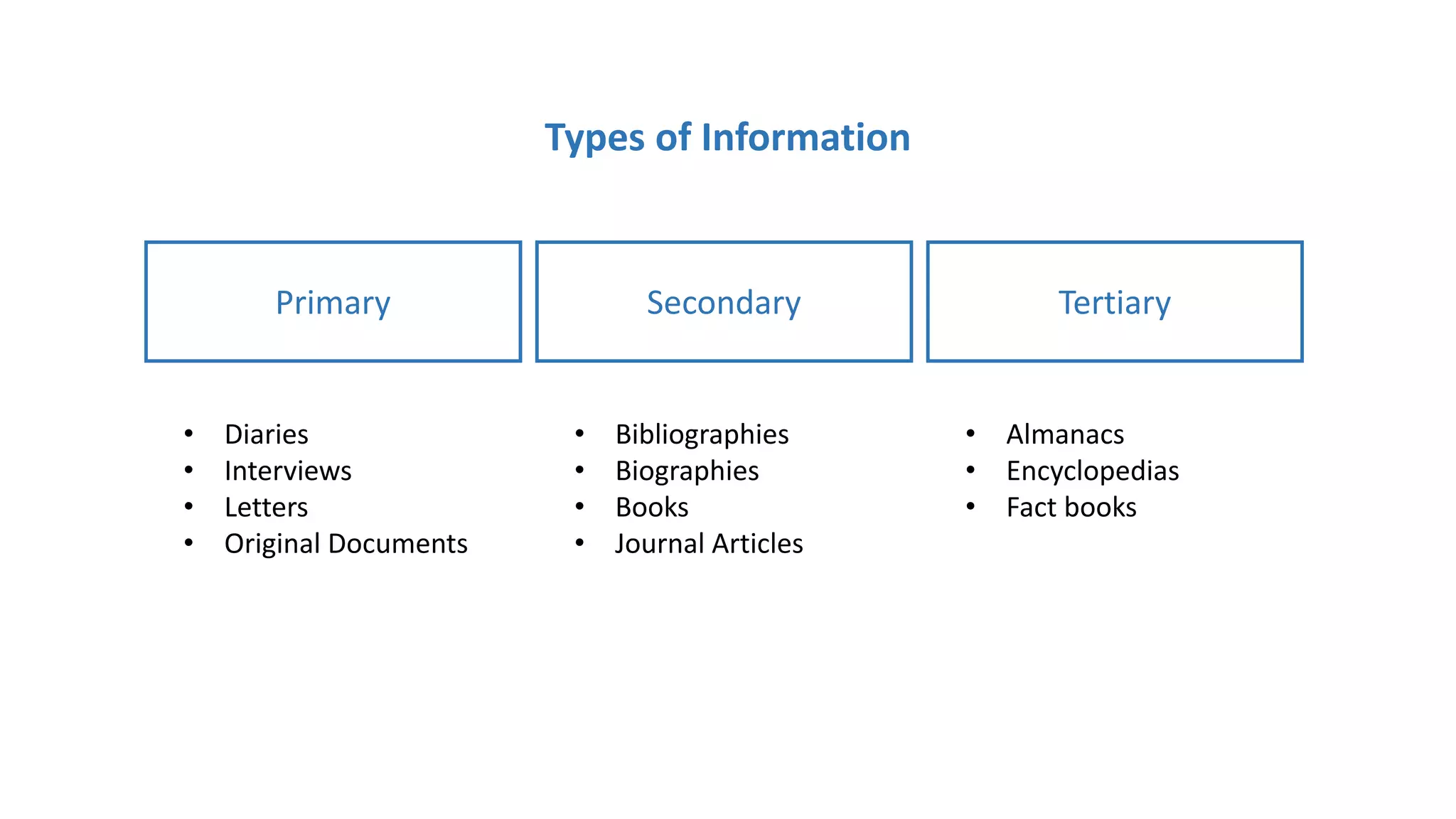
Types of Information
Primary Secondary Tertiary
• Diaries
• Interviews
• Letters
• Original Documents
• Bibliographies
• Biographies
• Books
• Journal Articles
• Almanacs
• Encyclopedias
• Fact books
Primary (Think of this as Firsthand)
• Primary information is comprised of original materials that were created first
hand.
• This type of information is from the time period involved and has not been
filtered through interpretation.
• Examples are:
• Diaries, Interviews (legal proceedings, personal, telephone, email), Letters,
Original Documents (i.e. birth certificate or a trial transcript), Patents,
Photographs, Proceedings of Meetings, Conferences and Symposia., Survey
Research (such as market surveys and public opinion polls), Works of
Literature
Secondary (Think of this as Second Hand)
• Secondary information is made up of accounts written after the fact with
the benefit of hindsight.
• It is comprised of interpretations and evaluations of primary information.
Secondary information is not evidence, but rather commentary on and
discussion of evidence.
• Examples are: Biographies, Books, Commentaries, Dissertations, Indexes,
Abstracts, Bibliographies (used to locate primary & secondary sources),
Journal Articles
Tertiary (Think of this as Third Hand)
• Tertiary information is a distillation and collection of primary and
secondary information.
• Examples are: Almanacs, Encyclopedias, Fact books
Role of Information in Decision Making
• Identification and structuring of problem: One needs information to
identify a problem and put it in a structured manner.
• Putting the problem in a context: Without information about the context in
which the problem has occurred, one cannot take any decision on it. In a
way , the context defines the problem.
• Generation of alternatives: Information is a key ingredient in the
generation of alternatives for decision-making.
• Choice of the best alternative: Based on the information about he
suitability of the alternatives, a choice is made to select the best
alternative.
Process of Information Generation and Communication
• Data processing can be defined as the processing of data to make it
more usable and meaningful and thus converting into information.
• It covers all activities required for generating information from data
Steps in the process of generation and communication of information
1. Origination
2. Input
3. Processing
4. Storing
5. Data retrieval
6. Production of documents
7. Data communication
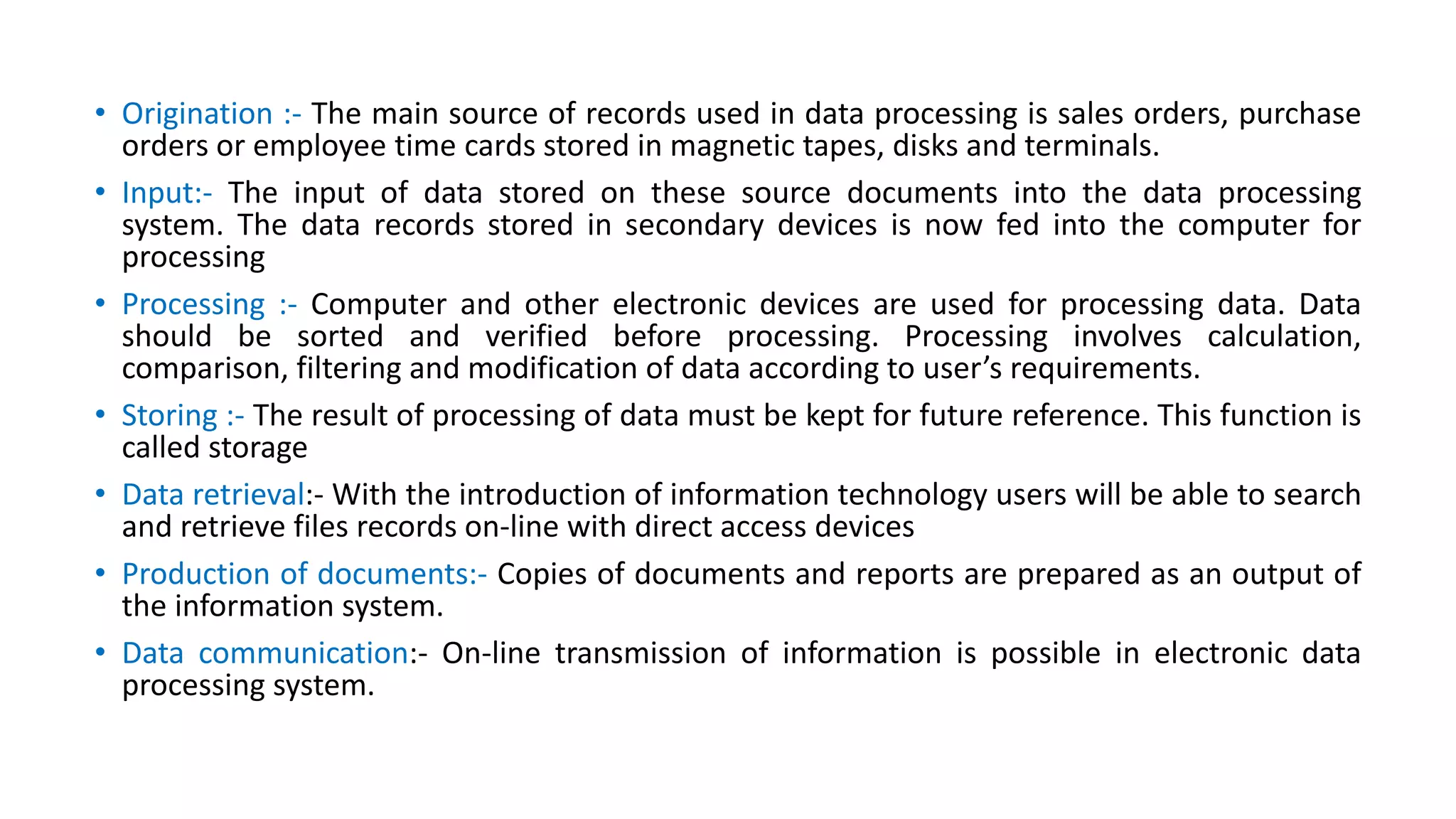
• Origination :- The main source of records used in data processing is sales orders, purchase
orders or employee time cards stored in magnetic tapes, disks and terminals.
• Input:- The input of data stored on these source documents into the data processing
system. The data records stored in secondary devices is now fed into the computer for
processing
• Processing :- Computer and other electronic devices are used for processing data. Data
should be sorted and verified before processing. Processing involves calculation,
comparison, filtering and modification of data according to user’s requirements.
• Storing :- The result of processing of data must be kept for future reference. This function is
called storage
• Data retrieval:- With the introduction of information technology users will be able to search
and retrieve files records on-line with direct access devices
• Production of documents:- Copies of documents and reports are prepared as an output of
the information system.
• Data communication:- On-line transmission of information is possible in electronic data
processing system.
THANK YOU

Introduction to Information

  • 1.
    Management Information Systems Information Conceptof information Process of Information Generation and Communication Types of Information Forms of Information Modes of Information Generation Prepared By: Mohammed Jasir PV Asst. Professor NBS, Koratty Contact: 9605 69 32 66
  • 2.
    Topics • Concept ofinformation • Information – Features / Characteristics • Process of Information Generation and Communication • Role of Information in Decision Making • Types of Information • Forms of Information • Modes of Information Generation
  • 3.
    Concept of information •Definition, features, types, process of generation and communication • Quality and value of information • Information overload, Techniques for managing overload (summarizing; filtering; inferences and message routing)
  • 4.
    Information • The datawhich has been converted to meaningful and useful form • Information means “The Processed Data”
  • 5.
    Information – Features/ Characteristics • Improves representation of an entity • Updates the level of knowledge • Has a surprise value • Reduces uncertainty • Aids in decision making • Availability and accessibility • Accuracy • Reliability and objectivity • Relevance and appropriateness • Completeness • Level of detail / Conciseness • Presentation • Timing
  • 6.
    Modes of InformationGeneration • Processing of Data • Observation • Thought Process and Imagination • Experimentation • Events • Evolution • Dream
  • 7.
    Forms of Information •Oral Form • Sign Language • Hand-written Form • Pictorial Form • Printed Form • Digitised Form • Condensed Form • Coded Form • Simplified Form • Translated Form
  • 8.
    Forms of Information •Oral Form (Talking, Phone) • Information in Sign Language (Hands, Fingers & parts of body) • Hand-written Form (Written form of information) • Pictorial Form and Printed Form • Digitised Form (Recorded using only two digits 0 and 1) • Condensed Form (Abstracts and summaries) • Coded Form (Numbers, letters and symbols) • Simplified Form (Laymen, school children) • Translated Form (Oral to Oral, Oral to written, Written to oral, Written to written)
  • 9.
    Types of Information PrimarySecondary Tertiary • Diaries • Interviews • Letters • Original Documents • Bibliographies • Biographies • Books • Journal Articles • Almanacs • Encyclopedias • Fact books
  • 10.
    Primary (Think ofthis as Firsthand) • Primary information is comprised of original materials that were created first hand. • This type of information is from the time period involved and has not been filtered through interpretation. • Examples are: • Diaries, Interviews (legal proceedings, personal, telephone, email), Letters, Original Documents (i.e. birth certificate or a trial transcript), Patents, Photographs, Proceedings of Meetings, Conferences and Symposia., Survey Research (such as market surveys and public opinion polls), Works of Literature
  • 11.
    Secondary (Think ofthis as Second Hand) • Secondary information is made up of accounts written after the fact with the benefit of hindsight. • It is comprised of interpretations and evaluations of primary information. Secondary information is not evidence, but rather commentary on and discussion of evidence. • Examples are: Biographies, Books, Commentaries, Dissertations, Indexes, Abstracts, Bibliographies (used to locate primary & secondary sources), Journal Articles
  • 12.
    Tertiary (Think ofthis as Third Hand) • Tertiary information is a distillation and collection of primary and secondary information. • Examples are: Almanacs, Encyclopedias, Fact books
  • 13.
    Role of Informationin Decision Making • Identification and structuring of problem: One needs information to identify a problem and put it in a structured manner. • Putting the problem in a context: Without information about the context in which the problem has occurred, one cannot take any decision on it. In a way , the context defines the problem. • Generation of alternatives: Information is a key ingredient in the generation of alternatives for decision-making. • Choice of the best alternative: Based on the information about he suitability of the alternatives, a choice is made to select the best alternative.
  • 14.
    Process of InformationGeneration and Communication • Data processing can be defined as the processing of data to make it more usable and meaningful and thus converting into information. • It covers all activities required for generating information from data
  • 15.
    Steps in theprocess of generation and communication of information 1. Origination 2. Input 3. Processing 4. Storing 5. Data retrieval 6. Production of documents 7. Data communication
  • 16.
    • Origination :-The main source of records used in data processing is sales orders, purchase orders or employee time cards stored in magnetic tapes, disks and terminals. • Input:- The input of data stored on these source documents into the data processing system. The data records stored in secondary devices is now fed into the computer for processing • Processing :- Computer and other electronic devices are used for processing data. Data should be sorted and verified before processing. Processing involves calculation, comparison, filtering and modification of data according to user’s requirements. • Storing :- The result of processing of data must be kept for future reference. This function is called storage • Data retrieval:- With the introduction of information technology users will be able to search and retrieve files records on-line with direct access devices • Production of documents:- Copies of documents and reports are prepared as an output of the information system. • Data communication:- On-line transmission of information is possible in electronic data processing system.
  • 17.