Inventory
Management
Presented by:
Pratigya
Pankaj
Rajeev
Raj
Robin
Rohit
Supriya
Inventory Management
“Successful inventory management involves creating a
purchasing plan that will ensure that items are
available when they are needed (but that neither too
much nor too little is purchased) and keeping track of
existing inventory and its use”
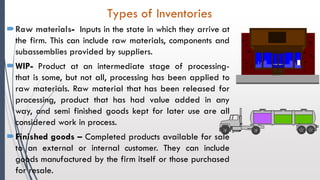
Raw materials- Inputs in the state in which they arrive at
the firm. This can include raw materials, components and
subassemblies provided by suppliers.
WIP- Product at an intermediate stage of processing-
that is some, but not all, processing has been applied to
raw materials. Raw material that has been released for
processing, product that has had value added in any
way, and semi finished goods kept for later use are all
considered work in process.
Finished goods – Completed products available for sale
to an external or internal customer. They can include
goods manufactured by the firm itself or those purchased
for resale.
Types of Inventories
Functions of Inventory
To meet anticipated demand
To smooth production requirements
To protect against stock-outs
To take advantage of order cycles
To permit operations
Inventory performance measures and levels
Inventory level
Low or high
Customer service levels
Can you deliver what customer wants?
Right goods, right place, right time, right quantity
 Inventory turnover
Cost of goods sold per year or Sales/ average inventory
Inventory costs
Costs of ordering & carrying inventories
Inventory Counting Systems
A physical count of items in inventory
Periodic/Cycle Counting System: Physical count
of items made at periodic intervals
How much accuracy is needed?
When should cycle counting be performed?
Who should do it?
Continuous Counting System
System that keeps track of removals from
inventory continuously, thus monitoring levels
of each item
Inventory Counting Systems (Cont’d)
Two-Bin System - Two containers of inventory; reorder when
the first is empty
Universal Bar Code - Bar code
printed on a label that has
information about the item
to which it is attached
RFID: Radio Frequency Identification
0
214800 232087768
Key Inventory Terms
Lead time: time interval between ordering and receiving the order,
denoted by LT
Holding (carrying) costs: cost to carry an item in inventory for a length
of time, usually a year, denoted by H
Ordering costs: costs of ordering and receiving inventory, denoted by S
Shortage costs: costs when demand exceeds supply
Effective Inventory Management
A system to keep track of inventory
A reliable forecast of demand
Knowledge of lead times
Reasonable estimates of
Holding costs
Ordering costs
Shortage costs
A classification system
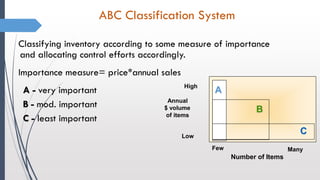
ABC Classification System
Classifying inventory according to some measure of importance
and allocating control efforts accordingly.
Importance measure= price*annual sales
A - very important
B - mod. important
C - least important
Annual
$ volume
of items
A
B
C
High
Low
Few Many
Number of Items
Inventory Models
Fixed Order Size - Variable Order Interval Models:
1. Economic Order Quantity
2. Economic Production Quantity
3. EOQ with quantity discounts
4. Reorder point
5. Fixed Order Interval model
EOQ Model
Assumptions:
Only one product is involved
Annual demand requirements known
Demand is even throughout the year
Lead time does not vary
Each order is received in a single delivery
Infinite production capacity
There are no quantity discounts
Use of EOQ
Make-to-stock
Carrying and setup costs are known and relatively stable
Calculating EOQ
Annual holding cost
Annual holding cost = (Average cycle inventory)  (Unit holding cost)
 Annual ordering cost
Annual ordering cost = (Number of orders/Year)  Ordering or setup costs
 Total annual cycle-inventory cost
Total costs = Annual holding cost + Annual ordering or setup cost
Deriving the EOQ
Using calculus, we take the derivative of the total cost function and
set the derivative (slope) equal to zero and solve for Q.
The total cost curve reaches its minimum where the carrying and
ordering costs are equal.
Q =
2DS
H
=
2(Annual Demand )(Order or Setup Cost )
Annual Holding Cost
OPT
DSHEOQQ 2)cost(Total 
Finding the EOQ, Total Cost, TBO
EXAMPLE
For the bird feeders calculate the EOQ and its total annual cycle-
inventory cost. How frequently will orders be placed if the EOQ is used?
SOLUTION
Using the formulas for EOQ and annual cost, we get
EOQ = =2DS
H
= 74.94 or 75 units2(936)(45)
15
Managerial Insights
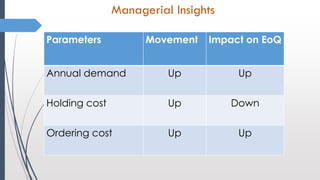
Parameters Movement Impact on EoQ
Annual demand Up Up
Holding cost Up Down
Ordering cost Up Up
2. Economic Production Quantity
Production done in batches or lots
Capacity to produce a part exceeds the part’s usage or demand
rate
This corresponds to producing for an order with finite production
capacity
Types of inventories (stocks) by function
Deterministic demand case
Anticipation stock- For known future demand
Cycle stock- For convenience, some operations are performed
occasionally and stock is used at other times
Pipeline stock or Work in Process- Stock in transfer, transformation.
Necessary for operations
Stochastic demand case
Safety stock- Stock against demand variations
4. When to Reorder with EOQ Ordering
Reorder Point - When the quantity on hand of an item drops to this
amount, the item is reordered. We call it.
Safety Stock - Stock that is held in excess of expected demand due
to variable demand rate and/or lead time. We call it.
(lead time) Service Level - Probability that demand will not exceed
supply during lead time. We call this cycle service level.
Reorder Point
The reorder point (ROP) is the level of inventory which triggers
an action to replenish that particular inventory stock. It is
normally calculated as the forecast usage during the
replenishment lead time plus safety stock
1. Determine the demand during lead time
probability distribution
2. Determine the safety stock and reorder point
levels
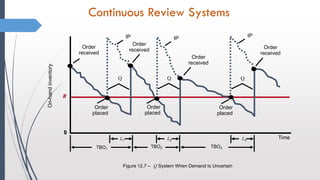
Continuous Review Systems
Time
On-handinventory
TBO1
TBO2 TBO3
L1 L2 L3
R
Order
received
Q
Order
placed
Order
placed
Order
received
IP IP
Q
Order
placed
Q
Order
received
Order
received
0
IP
Figure 12.7 – Q System When Demand Is Uncertain
Periodic Review System (P)
Fixed interval reorder system or periodic reorder system
 Four of the original EOQ assumptions maintained
No constraints are placed on lot size
Holding and ordering costs
Independent demand
Lead times are certain
 Order is placed to bring the inventory position up to the target
inventory level, T, when the predetermined time, P, has elapsed
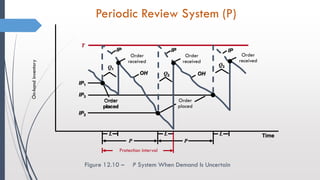
Periodic Review System (P)
P P
T
L L L
Protection interval
Time
On-handinventory
IP3
IP1
IP2
Order
placed
Order
placed
Order
placed
Order
received
Order
received
Order
received
IP IPIP
OH OH
Q1
Q2
Q3
Figure 12.10 – P System When Demand Is Uncertain
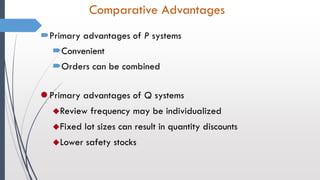
Comparative Advantages
Primary advantages of P systems
Convenient
Orders can be combined
 Primary advantages of Q systems
Review frequency may be individualized
Fixed lot sizes can result in quantity discounts
Lower safety stocks
Safety Stock
LT Time
Expected demand
during lead time
Maximum probable demand
during lead time
ROP
Quantity
Safety stock
Determinants of the Reorder Point
The rate of demand
The lead time
Demand and/or lead time variability
Stock out risk (safety stock)
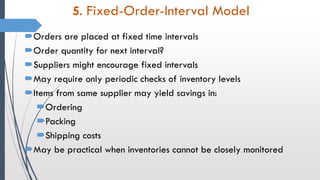
5. Fixed-Order-Interval Model
Orders are placed at fixed time intervals
Order quantity for next interval?
Suppliers might encourage fixed intervals
May require only periodic checks of inventory levels
Items from same supplier may yield savings in:
Ordering
Packing
Shipping costs
May be practical when inventories cannot be closely monitored
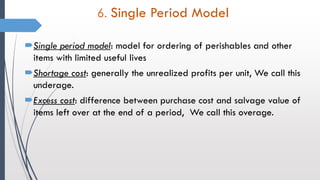
6. Single Period Model
Single period model: model for ordering of perishables and other
items with limited useful lives
Shortage cost: generally the unrealized profits per unit, We call this
underage.
Excess cost: difference between purchase cost and salvage value of
items left over at the end of a period, We call this overage.
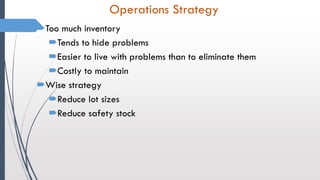
Operations Strategy
Too much inventory
Tends to hide problems
Easier to live with problems than to eliminate them
Costly to maintain
Wise strategy
Reduce lot sizes
Reduce safety stock
Video
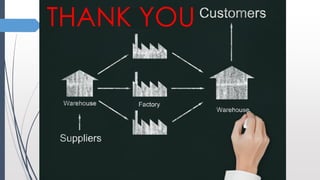
THANK YOU

Inventory management

  • 1.
  • 2.
    Inventory Management “Successful inventorymanagement involves creating a purchasing plan that will ensure that items are available when they are needed (but that neither too much nor too little is purchased) and keeping track of existing inventory and its use”
  • 3.
    Raw materials- Inputsin the state in which they arrive at the firm. This can include raw materials, components and subassemblies provided by suppliers. WIP- Product at an intermediate stage of processing- that is some, but not all, processing has been applied to raw materials. Raw material that has been released for processing, product that has had value added in any way, and semi finished goods kept for later use are all considered work in process. Finished goods – Completed products available for sale to an external or internal customer. They can include goods manufactured by the firm itself or those purchased for resale. Types of Inventories
  • 4.
    Functions of Inventory Tomeet anticipated demand To smooth production requirements To protect against stock-outs To take advantage of order cycles To permit operations
  • 5.
    Inventory performance measuresand levels Inventory level Low or high Customer service levels Can you deliver what customer wants? Right goods, right place, right time, right quantity  Inventory turnover Cost of goods sold per year or Sales/ average inventory Inventory costs Costs of ordering & carrying inventories
  • 6.
    Inventory Counting Systems Aphysical count of items in inventory Periodic/Cycle Counting System: Physical count of items made at periodic intervals How much accuracy is needed? When should cycle counting be performed? Who should do it? Continuous Counting System System that keeps track of removals from inventory continuously, thus monitoring levels of each item
  • 7.
    Inventory Counting Systems(Cont’d) Two-Bin System - Two containers of inventory; reorder when the first is empty Universal Bar Code - Bar code printed on a label that has information about the item to which it is attached RFID: Radio Frequency Identification 0 214800 232087768
  • 8.
    Key Inventory Terms Leadtime: time interval between ordering and receiving the order, denoted by LT Holding (carrying) costs: cost to carry an item in inventory for a length of time, usually a year, denoted by H Ordering costs: costs of ordering and receiving inventory, denoted by S Shortage costs: costs when demand exceeds supply
  • 9.
    Effective Inventory Management Asystem to keep track of inventory A reliable forecast of demand Knowledge of lead times Reasonable estimates of Holding costs Ordering costs Shortage costs A classification system
  • 10.
    ABC Classification System Classifyinginventory according to some measure of importance and allocating control efforts accordingly. Importance measure= price*annual sales A - very important B - mod. important C - least important Annual $ volume of items A B C High Low Few Many Number of Items
  • 11.
    Inventory Models Fixed OrderSize - Variable Order Interval Models: 1. Economic Order Quantity 2. Economic Production Quantity 3. EOQ with quantity discounts 4. Reorder point 5. Fixed Order Interval model
  • 12.
    EOQ Model Assumptions: Only oneproduct is involved Annual demand requirements known Demand is even throughout the year Lead time does not vary Each order is received in a single delivery Infinite production capacity There are no quantity discounts Use of EOQ Make-to-stock Carrying and setup costs are known and relatively stable
  • 13.
    Calculating EOQ Annual holdingcost Annual holding cost = (Average cycle inventory)  (Unit holding cost)  Annual ordering cost Annual ordering cost = (Number of orders/Year)  Ordering or setup costs  Total annual cycle-inventory cost Total costs = Annual holding cost + Annual ordering or setup cost
  • 14.
    Deriving the EOQ Usingcalculus, we take the derivative of the total cost function and set the derivative (slope) equal to zero and solve for Q. The total cost curve reaches its minimum where the carrying and ordering costs are equal. Q = 2DS H = 2(Annual Demand )(Order or Setup Cost ) Annual Holding Cost OPT DSHEOQQ 2)cost(Total 
  • 15.
    Finding the EOQ,Total Cost, TBO EXAMPLE For the bird feeders calculate the EOQ and its total annual cycle- inventory cost. How frequently will orders be placed if the EOQ is used? SOLUTION Using the formulas for EOQ and annual cost, we get EOQ = =2DS H = 74.94 or 75 units2(936)(45) 15
  • 16.
    Managerial Insights Parameters MovementImpact on EoQ Annual demand Up Up Holding cost Up Down Ordering cost Up Up
  • 17.
    2. Economic ProductionQuantity Production done in batches or lots Capacity to produce a part exceeds the part’s usage or demand rate This corresponds to producing for an order with finite production capacity
  • 18.
    Types of inventories(stocks) by function Deterministic demand case Anticipation stock- For known future demand Cycle stock- For convenience, some operations are performed occasionally and stock is used at other times Pipeline stock or Work in Process- Stock in transfer, transformation. Necessary for operations Stochastic demand case Safety stock- Stock against demand variations
  • 19.
    4. When toReorder with EOQ Ordering Reorder Point - When the quantity on hand of an item drops to this amount, the item is reordered. We call it. Safety Stock - Stock that is held in excess of expected demand due to variable demand rate and/or lead time. We call it. (lead time) Service Level - Probability that demand will not exceed supply during lead time. We call this cycle service level.
  • 20.
    Reorder Point The reorderpoint (ROP) is the level of inventory which triggers an action to replenish that particular inventory stock. It is normally calculated as the forecast usage during the replenishment lead time plus safety stock 1. Determine the demand during lead time probability distribution 2. Determine the safety stock and reorder point levels
  • 21.
    Continuous Review Systems Time On-handinventory TBO1 TBO2TBO3 L1 L2 L3 R Order received Q Order placed Order placed Order received IP IP Q Order placed Q Order received Order received 0 IP Figure 12.7 – Q System When Demand Is Uncertain
  • 22.
    Periodic Review System(P) Fixed interval reorder system or periodic reorder system  Four of the original EOQ assumptions maintained No constraints are placed on lot size Holding and ordering costs Independent demand Lead times are certain  Order is placed to bring the inventory position up to the target inventory level, T, when the predetermined time, P, has elapsed
  • 23.
    Periodic Review System(P) P P T L L L Protection interval Time On-handinventory IP3 IP1 IP2 Order placed Order placed Order placed Order received Order received Order received IP IPIP OH OH Q1 Q2 Q3 Figure 12.10 – P System When Demand Is Uncertain
  • 24.
    Comparative Advantages Primary advantagesof P systems Convenient Orders can be combined  Primary advantages of Q systems Review frequency may be individualized Fixed lot sizes can result in quantity discounts Lower safety stocks
  • 25.
    Safety Stock LT Time Expecteddemand during lead time Maximum probable demand during lead time ROP Quantity Safety stock
  • 26.
    Determinants of theReorder Point The rate of demand The lead time Demand and/or lead time variability Stock out risk (safety stock)
  • 27.
    5. Fixed-Order-Interval Model Ordersare placed at fixed time intervals Order quantity for next interval? Suppliers might encourage fixed intervals May require only periodic checks of inventory levels Items from same supplier may yield savings in: Ordering Packing Shipping costs May be practical when inventories cannot be closely monitored
  • 28.
    6. Single PeriodModel Single period model: model for ordering of perishables and other items with limited useful lives Shortage cost: generally the unrealized profits per unit, We call this underage. Excess cost: difference between purchase cost and salvage value of items left over at the end of a period, We call this overage.
  • 29.
    Operations Strategy Too muchinventory Tends to hide problems Easier to live with problems than to eliminate them Costly to maintain Wise strategy Reduce lot sizes Reduce safety stock
  • 30.
  • 31.