Presented By
Simran
M.Pharmacy 1st year
GGSCOP, YNR
Inventory Management and Control,
Production Planning and Control
CONTENTS
• Introduction
• Objectives of Inventory Management
• Benefits
• Inventory cost
• Inventory control
• Techniques in inventory management and control
• Perpetual inventory system
• Production planning and control
• Objectives
• Functions of production control
• Production planning
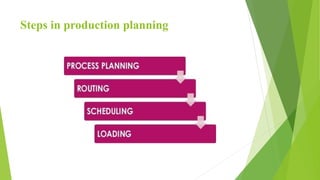
• Steps in production planning
• Production control
INTRODUCTION
DEFINITION:
The 'inventory' can be defined as stock of items(includes raw materials, in process goods, finished
goods, packaging, & other spares ) in order to meet an unexpected demand / distribution in the future.
The term ‘inventory’ refers to the stockpile of production a firm is offering for sale and the
components that make up the production.
The amount of material, a company has in stock at a specific time is known as inventory or in terms
of money it can be defined as the total capital investment over all the materials stocked in the
company at any specific time.
Inventory may be in the form of,
 raw material inventory
 in process inventory
 finished goods inventory
 spare parts inventory
 office stationary etc.
Category
 PRODUCTION INVENTORY: Special items manufactured to company specification.
 MRO INVENTORY :Maintenance, repair & operating supplies which is consumed in
production process. Do not become part of the product.
 IN-PROCESS INVENTORY: Semi finished products found at various stages in the
production operation.
 FINISHED GOODS INVENTORY: Complete product ready for shipment.
Objectives of Inventory Management
 To reduce dependence of one another
 To enable each organisation schedule its operation independently of another.
 To reduce material handling costs.
 Maximize customer service
 Flexibility in production scheduling.
 To avoid stock out and shortage.
 To minimize the possibility of disruption in the production schedule of a firm for want of raw
material, stock and spares.
 ensure that materials are available for use in production and production services as and when
required.
 ensure that finished goods are available for delivery to customers to fulfil orders
 maintain sufficient stock of raw material in period of short supply
 control investment in inventories and keep it at an optimum level.
Benefits
 inventory control ensures an adequate supply of material & stores , minimizes stock
out & shortage & avoid costly interruption .
 it keeps down the investment in inventory.
 Eliminate duplication in ordering / replenishing stocks.
 better utilization of available stocks by facilitating inter —dept transfer within a
company a Serves as means for the location and disposition of inactive & obsolete item
of services.
 provide a consistent and reliable basis for preparing financial statement.
Inventory Cost
 Cost factors must be considered while taking any decision regarding inventories.
 Includes ordering costs , carrying cost, out of stock/shortage cost and set up cost.
1. ORDERING COST:
a) Costs of placing an order with a vendor of material such as preparing a purchase
order(receiving and ordering calls), processing payments(typing costs), transportation, receiving
& inspecting the material.
b) This cost does not depend on or vary on the number ordered.
2. CARRYING COSTS/HOLDING:
a) Costs connected directly with material such as deterioration, pilferage, storage facilities,
obsolescence.
b) Financial costs includes taxes, insurance ,handling charges & interest
3. OUT OF STOCK/SHORTAGE COST:
a) Back ordering
b) Lost sales
c) Customers goodwill
4. COST OF ITEM:
Direct cost of item
5. SET UP COST:
It include production charge- equipment change over, report preparation etc.
INVENTORY CONTROL
Drug store management is based on principles of inventory control.
Objective of Inventory Control
(i) To supply drug in time.
(ii) To reduce investment in inventories and made effective use of capital investment.
(iii) Efforts are made to procure goods at minimum price without bargaining the quality.
(iv) To avoid stock out and shortage.
(v) Wastage are avoided
TECHNIQUES IN INVENTORY
MANAGEMENT AND CONTROL
(i) ABC analysis
(ii) VED analysis
(iii) EOQ
(iv) Lead time
(v) Buffer stock
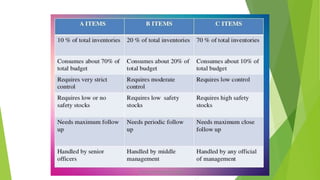
(i) ABC analysis ABC analysis is an inventory categorization technique. It is a basic tool with a
selective approach for concentration upon the items. As ABC analysis the items are divided into three
categories—
"A items" with very tight control and accurate records,
"B items" with less tightly controlled and good records, and
"C items" with the simplest controls possible and minimal records.
(ii) VED analysis is an inventory management technique. VED analysis stands for Vital, Essential, and
Desirable.
1.V- Vital Category
“Vital” includes inventory, which is necessary for production or any other process in an organization.
The shortage of items under this category can severely hamper or disrupt the proper functioning of
operations. Hence, continuous checking, evaluation, and replenishment happen for such stocks.
If any of such inventories are unavailable, the entire production chain may stop.
2. E- Essential category
These are very important for any organization because they may lead to a stoppage of production or
hamper some other process. But the loss due to their unavailability may be temporary, or it might be
possible to repair the stock item or part.The management should ensure optimum availability and
maintenance of inventory under the “Essential” category too.
3. D- Desirable Category
The desirable category of inventory is the least important among the three, and their unavailability may
result in minor stoppages in production or other processes. Moreover, the easy replenishment of such
shortages is possible in a short duration of time.
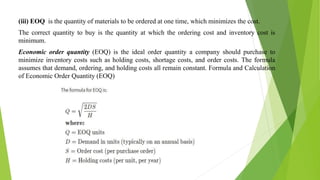
(iii) EOQ is the quantity of materials to be ordered at one time, which minimizes the cost.
The correct quantity to buy is the quantity at which the ordering cost and inventory cost is
minimum.
Economic order quantity (EOQ) is the ideal order quantity a company should purchase to
minimize inventory costs such as holding costs, shortage costs, and order costs. The formula
assumes that demand, ordering, and holding costs all remain constant. Formula and Calculation
of Economic Order Quantity (EOQ)
The goal of the EOQ formula is to identify the optimal number of product units to order. If achieved, a
company can minimize its costs for buying, delivery, and storing units. The EOQ formula can be
modified to determine different production levels or order intervals, and corporations with large
supply chains and high variable costs use an algorithm in their computer software to determine EOQ.
(iv) Lead time
The lead time is the sum of the supply delay and the reordering delay. The lead time is the applicable
duration to calculate the lead demand, the safety stock or the reorder point through a direct quantile
forecast.
The longer the lead time, the higher the total inventory level or the larger is the safety stock,
resulting in excess of investment in inventories. As far as possible efforts should be made to decrease
the lead time for effective inventory control.
(V) Buffer stock
Buffer stock is used in emergency to meet the unforeseen demands. In other words it refers to minimum
quantity of a particular item which must be kept in the stores of all time. Buffer stocks can be calculated
using the following formula ;
Buffer stocks= (Maximum consumption rate / day average- consumption rate / day)X lead time
Buffer stocks needs following factors to be taken into consideration like;
(i) Lead time
(ii) Nature of item and rate of consumption
(iii) Availability of substitutes
(iv) Re-order level
(v) Stock out cost
PERPETUAL INVENTORY SYSTEM
The method of recording the store balance after every receipt and issue to facilitate regular
checking and to prevent closing down for stock taking.
It comprises of :
1. Bin Card
2. Store ledger
3. Continuous stock taking
Bin Card
 Is a document maintained by the store keeper in his store
 It serves the purpose of ready reference.
 It shows quantity of each material received, issued and in stock.
Store Ledger
 It is kept in the accounting department.
 Generally maintained in form of loose leaf cards, so that they can be easily
removed and inserted.
CONTINUOUS STOCK TAKING
 Only a limited no. of items are verified on a day.
 Selection of the item should be such that each item gets checked at least a certain
no. of times in a year, and checking is evenly distributed during the period.
PRODUCTION AND
PLANNING CONTROL
PRODUCTION and PLANNING CONTROL
Production Planning is a managerial function which is mainly concerned with the
following important issues:
 What production facilities are required?
 How these production facilities should be laid down in the space available for
production? And
 How they should be used to produce the desired products at the desired rate of
production?
Broadly speaking, production planning is concerned with two main aspects:
(i) routing or planning work tasks
(ii) layout or spatial relationship between the resources. Production planning is dynamic
in nature and always remains in fluid state as plans may have to be changed according to
the changes in circumstances.
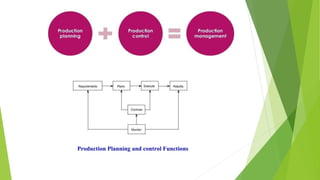
Production control is a mechanism to monitor the execution of the plans. It has several
important functions:
Making sure that production operations are started at planned places and planned times.
Observing progress of the operations and recording it properly.
Analysing the recorded data with the plans and measuring the deviations.
Taking immediate corrective actions to minimize the negative impact of deviations from
the plans.
Feeding back the recorded information to the planning section in order to improve
future plans.
PRODUCTION: Transformation of raw materials to finished goods
PRODUCTION MANAGEMENT: Application of management principles to the process of
production in an industry to produce desired goods in economical manner by co-ordinating the
efforts of men, material & machine.
PRODUCTION PLANNING: It is a technique which helps in planning & scheduling the work in
the manufacturing plant to obtain the desired quality of products with optimum efficiency & at
minimum cost.
PRODUCTION CONTROL: It ensures that the work is being done according to the plan
This phase includes a sequence of ideas to perform a task in an orderly manner by the utilization of
available manufacturing facilities.
Objectives of production planning
 Minimize costs / maximize profits
 Maximize customer service
 Minimize inventory investment
 Minimize changes in production rates
 Minimize changes in work-force levels
 Maximize the utilization of plant and equipment
 Planning is required to produce economical products with in time
 To avoid difficulties in production and marketing of products
 Planning is needed for meeting and changing economic social conditions seasonal
demands and marketing fluctuations
 In case of series of operations are involved in the production of a product then planning
will improves the efficiency and effectiveness.
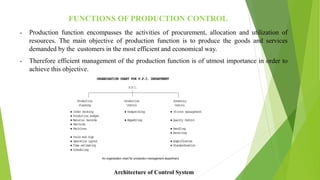
FUNCTIONS OF PRODUCTION CONTROL
• Production function encompasses the activities of procurement, allocation and utilization of
resources. The main objective of production function is to produce the goods and services
demanded by the customers in the most efficient and economical way.
• Therefore efficient management of the production function is of utmost importance in order to
achieve this objective.
Architecture of Control System
Production Planning and control Functions
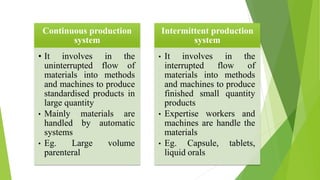
Continuous production
system
• It involves in the
uninterrupted flow of
materials into methods
and machines to produce
standardised products in
large quantity
• Mainly materials are
handled by automatic
systems
• Eg. Large volume
parenteral
Intermittent production
system
• It involves in the
interrupted flow of
materials into methods
and machines to produce
finished small quantity
products
• Expertise workers and
machines are handle the
materials
• Eg. Capsule, tablets,
liquid orals
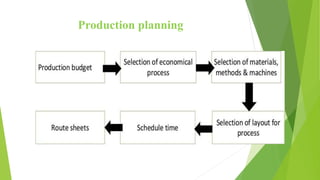
Production planning
Steps in production planning
Process Planning
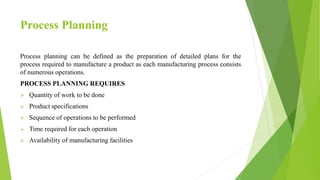
Process planning can be defined as the preparation of detailed plans for the
process required to manufacture a product as each manufacturing process consists
of numerous operations.
PROCESS PLANNING REQUIRES
 Quantity of work to be done
 Product specifications
 Sequence of operations to be performed
 Time required for each operation
 Availability of manufacturing facilities
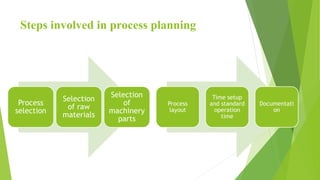
Steps involved in process planning
Process
selection
Selection
of raw
materials
Selection
of
machinery
parts
Process
layout
Time setup
and standard
operation
time
Documentati
on
a) PROCESS SELECTION:
 The operations selected for a particular process should be most economical
 Should satisfy the product specifications
 Selection mainly depends upon quality, quantity, time period & machines available
b) SELECTION OF RAW MATERIALS:
 Should meet quality standards
 Should show chemical compatibility
c) SELECTION OF MACHINERY PARTS:
 selection of machinery attachments like inspection gauges, jigs, etc., is necessary for the
smooth functioning of machines. This helps in reducing the costs & duration of production &
results in high output.
d) PROCESS LAYOUT:
 It describes every step of operation as well as the sequence in which each operation is to be
carried out.
e) TIME SETUP & STANDARD OPERATION TIME:
 They should be established to complete the production within the time.
f) DOCUMENTATION:
 Process planning should be clearly summarized in documents such as operation & route sheets.
Routing
Routing is the process of determining the sequence of operations to be carried out
Determines the path for flow of work right from the selection of raw materials until the
completion of production of finished goods.
Routing is summarized in route sheets. Prepared sheets are then dispatched to the production
department
Route sheets summarizes processes like
Description of operations
 Sequence of operations
 Type of machinery
 Setup time
 Operation time
Scheduling
Scheduling concerns with time element. It refers to the time frame of all production activities
therefore scheduling is also known as time phase of loading
OBJECTIVE:
To reduce the time of production
To ensure that the products can be delivered before the due date
TECHNIQUES:
 Master schedule
 Perpetual schedule
 Order schedule
Loading
Loading is the relationship between load and capacity at work place. It gives the information
about number of machines, available, their speed, capacity, capability. It helps to determine
work load and actual capacity of production.
Production control
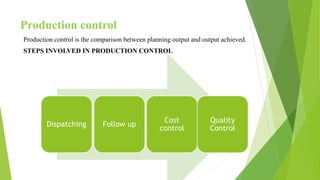
Production control is the comparison between planning output and output achieved.
STEPS INVOLVED IN PRODUCTION CONTROL
Dispatching Follow up
Cost
control
Quality
Control
Dispatching
 It is the process of issuing orders & instructions to a particular operating section of
industry to start the processing of a given job on an assigned machine in accordance with
the previously planned sequence & time as detailed in route sheets & schedule charts
 Movement of materials to different work stations, movement of work from one operation
to another & supervision of work comes under this category.
Follow up
 It includes delays or deviations from the production plans
 It helps to reveal the defects in
 Routing Scheduling
 Loading
 Dispatching
 Misunderstanding of orders
Cost Control
The total cost for the production of goods is determined & is compared with standard
cost to calculate the deviations as well as to follow corrective action.
It can be controlled by
 Reducing wastage
 Value analysis
 Inventory control
Quality control
 It helps to avoid & detects the defects in production process & isolation of
defective finished goods
 Finished products are inspected to ensure their acceptable quality
 Quality control techniques
 Statistical quality control
 Probability concept
 Poisson distribution
 Sampling inspection
Thank You…

Inventory Management and Control, Production Planning and Control

  • 1.
    Presented By Simran M.Pharmacy 1styear GGSCOP, YNR Inventory Management and Control, Production Planning and Control
  • 2.
    CONTENTS • Introduction • Objectivesof Inventory Management • Benefits • Inventory cost • Inventory control • Techniques in inventory management and control • Perpetual inventory system • Production planning and control • Objectives • Functions of production control • Production planning • Steps in production planning • Production control
  • 3.
    INTRODUCTION DEFINITION: The 'inventory' canbe defined as stock of items(includes raw materials, in process goods, finished goods, packaging, & other spares ) in order to meet an unexpected demand / distribution in the future. The term ‘inventory’ refers to the stockpile of production a firm is offering for sale and the components that make up the production. The amount of material, a company has in stock at a specific time is known as inventory or in terms of money it can be defined as the total capital investment over all the materials stocked in the company at any specific time. Inventory may be in the form of,  raw material inventory  in process inventory  finished goods inventory  spare parts inventory  office stationary etc.
  • 4.
    Category  PRODUCTION INVENTORY:Special items manufactured to company specification.  MRO INVENTORY :Maintenance, repair & operating supplies which is consumed in production process. Do not become part of the product.  IN-PROCESS INVENTORY: Semi finished products found at various stages in the production operation.  FINISHED GOODS INVENTORY: Complete product ready for shipment.
  • 5.
    Objectives of InventoryManagement  To reduce dependence of one another  To enable each organisation schedule its operation independently of another.  To reduce material handling costs.  Maximize customer service  Flexibility in production scheduling.  To avoid stock out and shortage.  To minimize the possibility of disruption in the production schedule of a firm for want of raw material, stock and spares.  ensure that materials are available for use in production and production services as and when required.  ensure that finished goods are available for delivery to customers to fulfil orders  maintain sufficient stock of raw material in period of short supply  control investment in inventories and keep it at an optimum level.
  • 6.
    Benefits  inventory controlensures an adequate supply of material & stores , minimizes stock out & shortage & avoid costly interruption .  it keeps down the investment in inventory.  Eliminate duplication in ordering / replenishing stocks.  better utilization of available stocks by facilitating inter —dept transfer within a company a Serves as means for the location and disposition of inactive & obsolete item of services.  provide a consistent and reliable basis for preparing financial statement.
  • 7.
    Inventory Cost  Costfactors must be considered while taking any decision regarding inventories.  Includes ordering costs , carrying cost, out of stock/shortage cost and set up cost. 1. ORDERING COST: a) Costs of placing an order with a vendor of material such as preparing a purchase order(receiving and ordering calls), processing payments(typing costs), transportation, receiving & inspecting the material. b) This cost does not depend on or vary on the number ordered. 2. CARRYING COSTS/HOLDING: a) Costs connected directly with material such as deterioration, pilferage, storage facilities, obsolescence. b) Financial costs includes taxes, insurance ,handling charges & interest
  • 8.
    3. OUT OFSTOCK/SHORTAGE COST: a) Back ordering b) Lost sales c) Customers goodwill 4. COST OF ITEM: Direct cost of item 5. SET UP COST: It include production charge- equipment change over, report preparation etc.
  • 9.
    INVENTORY CONTROL Drug storemanagement is based on principles of inventory control. Objective of Inventory Control (i) To supply drug in time. (ii) To reduce investment in inventories and made effective use of capital investment. (iii) Efforts are made to procure goods at minimum price without bargaining the quality. (iv) To avoid stock out and shortage. (v) Wastage are avoided
  • 10.
    TECHNIQUES IN INVENTORY MANAGEMENTAND CONTROL (i) ABC analysis (ii) VED analysis (iii) EOQ (iv) Lead time (v) Buffer stock (i) ABC analysis ABC analysis is an inventory categorization technique. It is a basic tool with a selective approach for concentration upon the items. As ABC analysis the items are divided into three categories— "A items" with very tight control and accurate records, "B items" with less tightly controlled and good records, and "C items" with the simplest controls possible and minimal records.
  • 12.
    (ii) VED analysisis an inventory management technique. VED analysis stands for Vital, Essential, and Desirable. 1.V- Vital Category “Vital” includes inventory, which is necessary for production or any other process in an organization. The shortage of items under this category can severely hamper or disrupt the proper functioning of operations. Hence, continuous checking, evaluation, and replenishment happen for such stocks. If any of such inventories are unavailable, the entire production chain may stop. 2. E- Essential category These are very important for any organization because they may lead to a stoppage of production or hamper some other process. But the loss due to their unavailability may be temporary, or it might be possible to repair the stock item or part.The management should ensure optimum availability and maintenance of inventory under the “Essential” category too. 3. D- Desirable Category The desirable category of inventory is the least important among the three, and their unavailability may result in minor stoppages in production or other processes. Moreover, the easy replenishment of such shortages is possible in a short duration of time.
  • 13.
    (iii) EOQ isthe quantity of materials to be ordered at one time, which minimizes the cost. The correct quantity to buy is the quantity at which the ordering cost and inventory cost is minimum. Economic order quantity (EOQ) is the ideal order quantity a company should purchase to minimize inventory costs such as holding costs, shortage costs, and order costs. The formula assumes that demand, ordering, and holding costs all remain constant. Formula and Calculation of Economic Order Quantity (EOQ)
  • 14.
    The goal ofthe EOQ formula is to identify the optimal number of product units to order. If achieved, a company can minimize its costs for buying, delivery, and storing units. The EOQ formula can be modified to determine different production levels or order intervals, and corporations with large supply chains and high variable costs use an algorithm in their computer software to determine EOQ. (iv) Lead time The lead time is the sum of the supply delay and the reordering delay. The lead time is the applicable duration to calculate the lead demand, the safety stock or the reorder point through a direct quantile forecast. The longer the lead time, the higher the total inventory level or the larger is the safety stock, resulting in excess of investment in inventories. As far as possible efforts should be made to decrease the lead time for effective inventory control.
  • 15.
    (V) Buffer stock Bufferstock is used in emergency to meet the unforeseen demands. In other words it refers to minimum quantity of a particular item which must be kept in the stores of all time. Buffer stocks can be calculated using the following formula ; Buffer stocks= (Maximum consumption rate / day average- consumption rate / day)X lead time Buffer stocks needs following factors to be taken into consideration like; (i) Lead time (ii) Nature of item and rate of consumption (iii) Availability of substitutes (iv) Re-order level (v) Stock out cost
  • 16.
    PERPETUAL INVENTORY SYSTEM Themethod of recording the store balance after every receipt and issue to facilitate regular checking and to prevent closing down for stock taking. It comprises of : 1. Bin Card 2. Store ledger 3. Continuous stock taking
  • 17.
    Bin Card  Isa document maintained by the store keeper in his store  It serves the purpose of ready reference.  It shows quantity of each material received, issued and in stock.
  • 18.
    Store Ledger  Itis kept in the accounting department.  Generally maintained in form of loose leaf cards, so that they can be easily removed and inserted.
  • 19.
    CONTINUOUS STOCK TAKING Only a limited no. of items are verified on a day.  Selection of the item should be such that each item gets checked at least a certain no. of times in a year, and checking is evenly distributed during the period.
  • 20.
  • 21.
    PRODUCTION and PLANNINGCONTROL Production Planning is a managerial function which is mainly concerned with the following important issues:  What production facilities are required?  How these production facilities should be laid down in the space available for production? And  How they should be used to produce the desired products at the desired rate of production? Broadly speaking, production planning is concerned with two main aspects: (i) routing or planning work tasks (ii) layout or spatial relationship between the resources. Production planning is dynamic in nature and always remains in fluid state as plans may have to be changed according to the changes in circumstances.
  • 22.
    Production control isa mechanism to monitor the execution of the plans. It has several important functions: Making sure that production operations are started at planned places and planned times. Observing progress of the operations and recording it properly. Analysing the recorded data with the plans and measuring the deviations. Taking immediate corrective actions to minimize the negative impact of deviations from the plans. Feeding back the recorded information to the planning section in order to improve future plans.
  • 23.
    PRODUCTION: Transformation ofraw materials to finished goods PRODUCTION MANAGEMENT: Application of management principles to the process of production in an industry to produce desired goods in economical manner by co-ordinating the efforts of men, material & machine. PRODUCTION PLANNING: It is a technique which helps in planning & scheduling the work in the manufacturing plant to obtain the desired quality of products with optimum efficiency & at minimum cost. PRODUCTION CONTROL: It ensures that the work is being done according to the plan This phase includes a sequence of ideas to perform a task in an orderly manner by the utilization of available manufacturing facilities.
  • 24.
    Objectives of productionplanning  Minimize costs / maximize profits  Maximize customer service  Minimize inventory investment  Minimize changes in production rates  Minimize changes in work-force levels  Maximize the utilization of plant and equipment  Planning is required to produce economical products with in time  To avoid difficulties in production and marketing of products  Planning is needed for meeting and changing economic social conditions seasonal demands and marketing fluctuations  In case of series of operations are involved in the production of a product then planning will improves the efficiency and effectiveness.
  • 25.
    FUNCTIONS OF PRODUCTIONCONTROL • Production function encompasses the activities of procurement, allocation and utilization of resources. The main objective of production function is to produce the goods and services demanded by the customers in the most efficient and economical way. • Therefore efficient management of the production function is of utmost importance in order to achieve this objective. Architecture of Control System
  • 26.
    Production Planning andcontrol Functions
  • 27.
    Continuous production system • Itinvolves in the uninterrupted flow of materials into methods and machines to produce standardised products in large quantity • Mainly materials are handled by automatic systems • Eg. Large volume parenteral Intermittent production system • It involves in the interrupted flow of materials into methods and machines to produce finished small quantity products • Expertise workers and machines are handle the materials • Eg. Capsule, tablets, liquid orals
  • 28.
  • 29.
  • 30.
    Process Planning Process planningcan be defined as the preparation of detailed plans for the process required to manufacture a product as each manufacturing process consists of numerous operations. PROCESS PLANNING REQUIRES  Quantity of work to be done  Product specifications  Sequence of operations to be performed  Time required for each operation  Availability of manufacturing facilities
  • 31.
    Steps involved inprocess planning Process selection Selection of raw materials Selection of machinery parts Process layout Time setup and standard operation time Documentati on
  • 32.
    a) PROCESS SELECTION: The operations selected for a particular process should be most economical  Should satisfy the product specifications  Selection mainly depends upon quality, quantity, time period & machines available b) SELECTION OF RAW MATERIALS:  Should meet quality standards  Should show chemical compatibility
  • 33.
    c) SELECTION OFMACHINERY PARTS:  selection of machinery attachments like inspection gauges, jigs, etc., is necessary for the smooth functioning of machines. This helps in reducing the costs & duration of production & results in high output. d) PROCESS LAYOUT:  It describes every step of operation as well as the sequence in which each operation is to be carried out. e) TIME SETUP & STANDARD OPERATION TIME:  They should be established to complete the production within the time. f) DOCUMENTATION:  Process planning should be clearly summarized in documents such as operation & route sheets.
  • 34.
    Routing Routing is theprocess of determining the sequence of operations to be carried out Determines the path for flow of work right from the selection of raw materials until the completion of production of finished goods. Routing is summarized in route sheets. Prepared sheets are then dispatched to the production department Route sheets summarizes processes like Description of operations  Sequence of operations  Type of machinery  Setup time  Operation time
  • 35.
    Scheduling Scheduling concerns withtime element. It refers to the time frame of all production activities therefore scheduling is also known as time phase of loading OBJECTIVE: To reduce the time of production To ensure that the products can be delivered before the due date TECHNIQUES:  Master schedule  Perpetual schedule  Order schedule
  • 36.
    Loading Loading is therelationship between load and capacity at work place. It gives the information about number of machines, available, their speed, capacity, capability. It helps to determine work load and actual capacity of production.
  • 37.
    Production control Production controlis the comparison between planning output and output achieved. STEPS INVOLVED IN PRODUCTION CONTROL Dispatching Follow up Cost control Quality Control
  • 38.
    Dispatching  It isthe process of issuing orders & instructions to a particular operating section of industry to start the processing of a given job on an assigned machine in accordance with the previously planned sequence & time as detailed in route sheets & schedule charts  Movement of materials to different work stations, movement of work from one operation to another & supervision of work comes under this category.
  • 39.
    Follow up  Itincludes delays or deviations from the production plans  It helps to reveal the defects in  Routing Scheduling  Loading  Dispatching  Misunderstanding of orders
  • 40.
    Cost Control The totalcost for the production of goods is determined & is compared with standard cost to calculate the deviations as well as to follow corrective action. It can be controlled by  Reducing wastage  Value analysis  Inventory control
  • 41.
    Quality control  Ithelps to avoid & detects the defects in production process & isolation of defective finished goods  Finished products are inspected to ensure their acceptable quality  Quality control techniques  Statistical quality control  Probability concept  Poisson distribution  Sampling inspection
  • 42.