Management Information Systems
System Concept in MIS
Prepared By:
Mohammed Jasir PV
Asst. Professor
NBS, Koratty
Contact: 9605 69 32 66
System concept
Definition, Types & Characteristics of System
System Concept
• Derived from Greek word 'Systema’ - means an organised relationship
among functional units or components
• Definition :- A system is an orderly grouping of interdependent
components linked together according to a plan to achieve a specific
objective
Definitions
• A system is a group of interrelated components, with a clearly defined
boundary, working toward the attainment of a common goal by accepting
inputs and producing outputs in an organized transformation process
• It can be defined as a set of interacting entities with interrelationships /
interconnections amongst each other forming an integrated whole
• A set of components that interact to accomplish goals
• Systems can be viewed as process models in terms of their inputs, outputs,
processing, and feedback/control mechanisms
What is a System?
A system is…
o A set of interrelated components
o With a clearly defined boundary
o Working together
o To achieve a common set of objectives
o By accepting inputs and producing outputs
o In an organized transformation process
System
A set of
components
that work
together to
achieve a
common goal
Definition Components
Processing
Feedback / Control
Input Output
Boundaries
Environment
System - Examples
NBS
• Inputs: Students, Faculty, Textbooks
• Processing mechanisms: Teaching, Research, Service
• Output: Graduates
• Goal: Acquisition of knowledge
System - Examples
Toyota Plant
• Inputs: raw materials, components
• Processes: assembly line
• Output: mini-vans, cars etc
• Feedback: customer surveys, quality reports
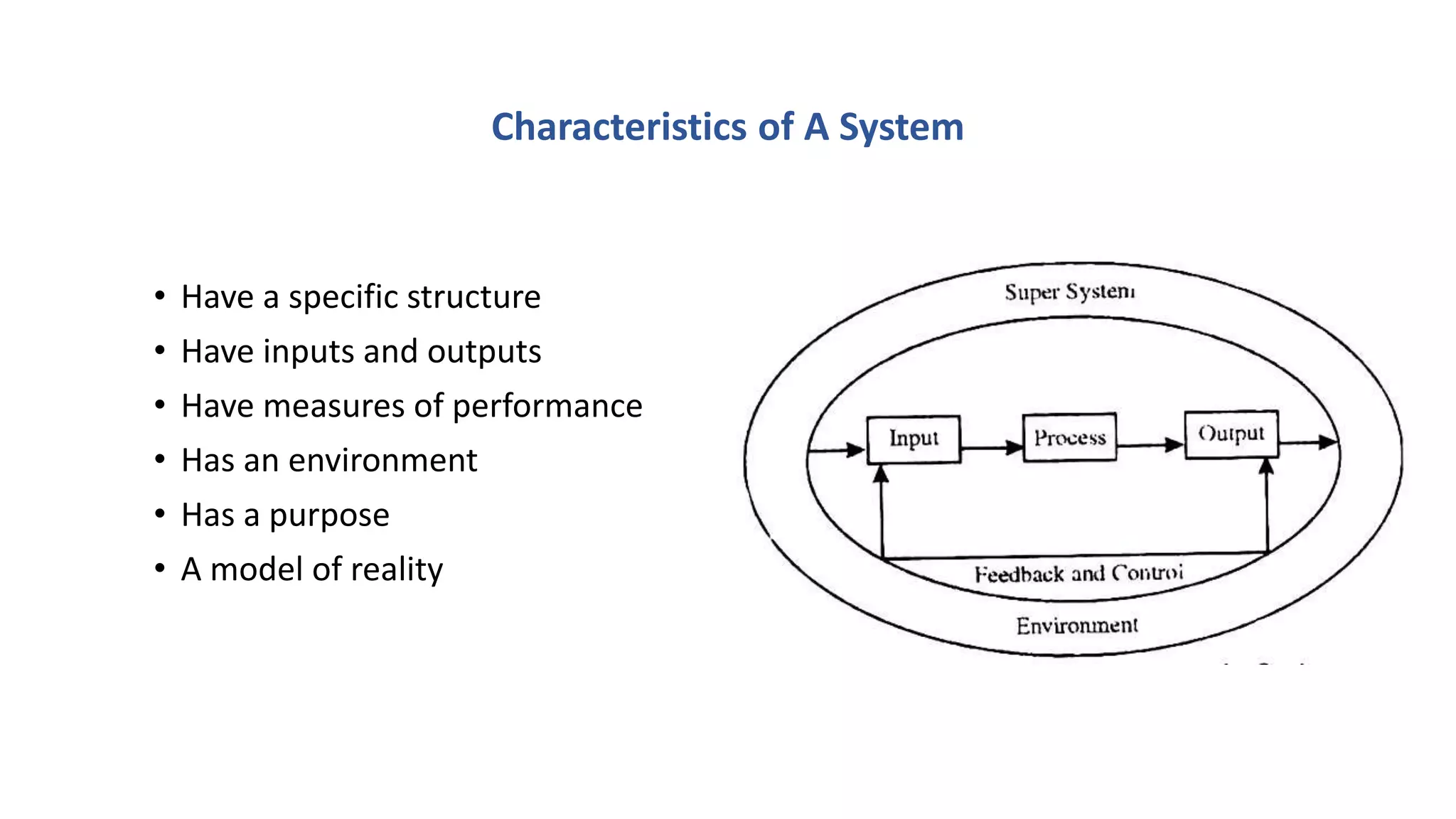
Characteristics of A System
• Have a specific structure
• Have inputs and outputs
• Have measures of performance
• Has an environment
• Has a purpose
• A model of reality
Elements or components of a system & its role
 Input - Capturing and assembling
 Processor - Transformation
 Outputs - Value to user
 Controls - Guides the system
 Feedback - Actual against standard
 Environment - Super system
 Boundaries and interface - Limits when interfaces with another
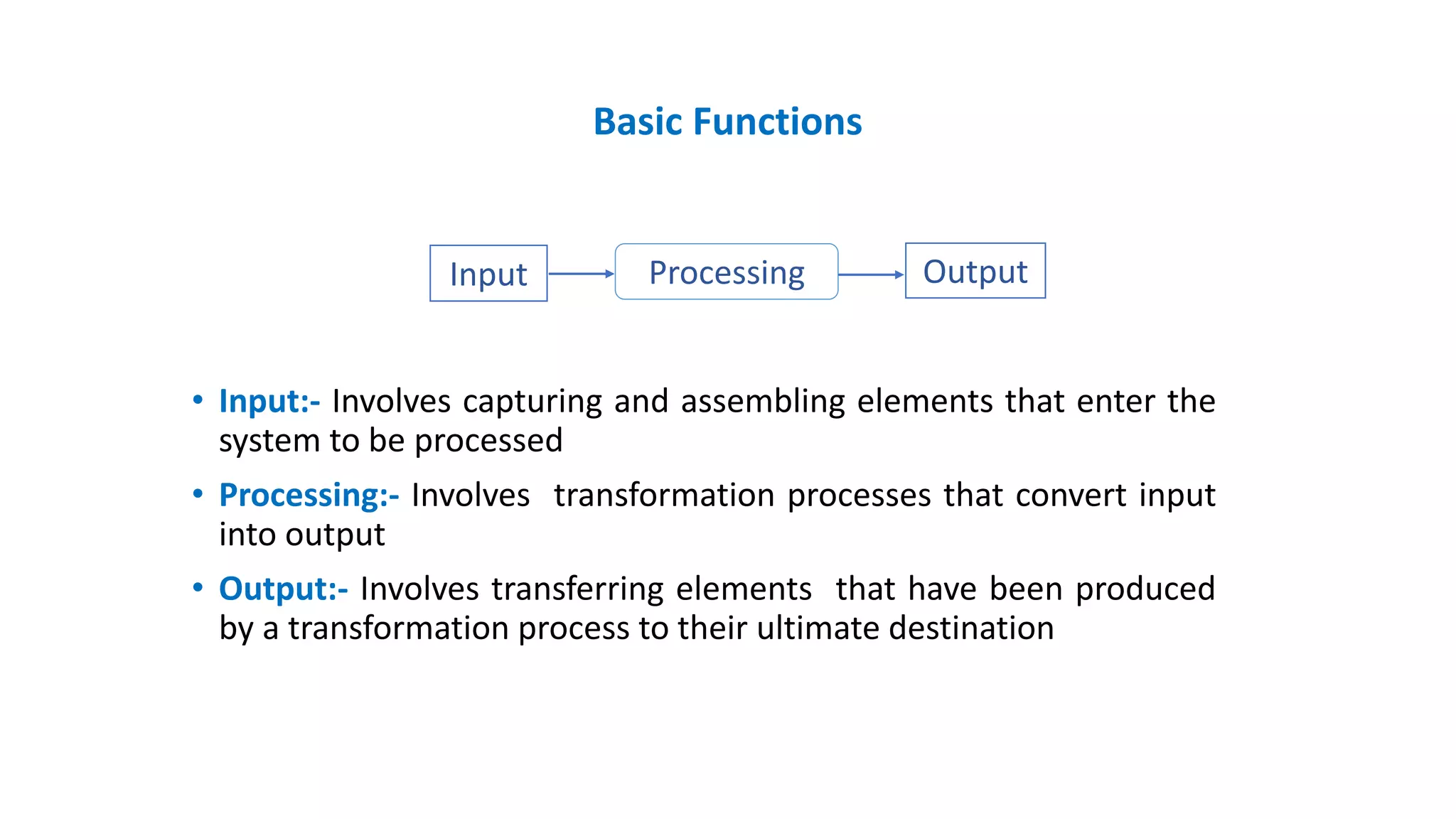
Basic Functions
• Input:- Involves capturing and assembling elements that enter the
system to be processed
• Processing:- Involves transformation processes that convert input
into output
• Output:- Involves transferring elements that have been produced
by a transformation process to their ultimate destination
Processing
Input Output
Types of Systems
1. Closed and Open system
2. Deterministic, Probabilistic and Random systems
3. Human, Machine and Human-machine system
4. Adaptive and Non-adaptive systems
5. Simple and Complex Systems
6. Abstract and Concrete Systems
Types of Systems (Contd..)
1. Closed and Open system
• A system is said to be closed if it does not interact with
the environment in which it exists
It is in the state of isolation
• A system is said to be open when it interacts with the
environment in which it exists
It exchanges inputs and outputs with the environment
2. Deterministic, Probabilistic and Random systems
• A system is deterministic if its outputs are certain and fully known
• A probabilistic system is one where the output from the system
behaves probabilistically, ie, the output is predictable according to
probability values
• Random systems are completely unpredictable systems
Types of Systems (Contd..)
3. Human, Machine and Human-machine system
• A human system consists of humans as components
It is an open system exhibiting probabilistic behavior
Eg: Department
• A machine system is composed entirely of machines and machine
subsystems
It is deterministic and relatively closed
Eg: Fire alarm system.
• A human-machine system which consist of humans and machines
Eg: information system
Types of Systems (Contd..)
4. Adaptive and Non-adaptive systems
• A system is said to be adaptive if it modifies itself with the changes
in its environment
• A non-adaptive system does not react to changes in its environment
Types of Systems (Contd..)
5. Simple and Complex Systems
• A simple system is one in which there are few interrelated entities
• A complex system is one in which there a lot of components with a
lot of interrelations amongst them
Types of Systems (Contd..)
6. Abstract and Concrete System
• An abstract system is an ordered arrangement of concepts
It can be procedural or conceptual
• Concrete systems are systems in which at least two
components are objects
It can be physical or social systems
Types of Systems (Contd..)
THANK YOU

System concept in MIS

  • 1.
    Management Information Systems SystemConcept in MIS Prepared By: Mohammed Jasir PV Asst. Professor NBS, Koratty Contact: 9605 69 32 66
  • 2.
    System concept Definition, Types& Characteristics of System
  • 3.
    System Concept • Derivedfrom Greek word 'Systema’ - means an organised relationship among functional units or components • Definition :- A system is an orderly grouping of interdependent components linked together according to a plan to achieve a specific objective
  • 4.
    Definitions • A systemis a group of interrelated components, with a clearly defined boundary, working toward the attainment of a common goal by accepting inputs and producing outputs in an organized transformation process • It can be defined as a set of interacting entities with interrelationships / interconnections amongst each other forming an integrated whole • A set of components that interact to accomplish goals • Systems can be viewed as process models in terms of their inputs, outputs, processing, and feedback/control mechanisms
  • 5.
    What is aSystem? A system is… o A set of interrelated components o With a clearly defined boundary o Working together o To achieve a common set of objectives o By accepting inputs and producing outputs o In an organized transformation process
  • 6.
    System A set of components thatwork together to achieve a common goal Definition Components Processing Feedback / Control Input Output Boundaries Environment
  • 7.
    System - Examples NBS •Inputs: Students, Faculty, Textbooks • Processing mechanisms: Teaching, Research, Service • Output: Graduates • Goal: Acquisition of knowledge
  • 8.
    System - Examples ToyotaPlant • Inputs: raw materials, components • Processes: assembly line • Output: mini-vans, cars etc • Feedback: customer surveys, quality reports
  • 9.
    Characteristics of ASystem • Have a specific structure • Have inputs and outputs • Have measures of performance • Has an environment • Has a purpose • A model of reality
  • 10.
    Elements or componentsof a system & its role  Input - Capturing and assembling  Processor - Transformation  Outputs - Value to user  Controls - Guides the system  Feedback - Actual against standard  Environment - Super system  Boundaries and interface - Limits when interfaces with another
  • 11.
    Basic Functions • Input:-Involves capturing and assembling elements that enter the system to be processed • Processing:- Involves transformation processes that convert input into output • Output:- Involves transferring elements that have been produced by a transformation process to their ultimate destination Processing Input Output
  • 12.
    Types of Systems 1.Closed and Open system 2. Deterministic, Probabilistic and Random systems 3. Human, Machine and Human-machine system 4. Adaptive and Non-adaptive systems 5. Simple and Complex Systems 6. Abstract and Concrete Systems
  • 13.
    Types of Systems(Contd..) 1. Closed and Open system • A system is said to be closed if it does not interact with the environment in which it exists It is in the state of isolation • A system is said to be open when it interacts with the environment in which it exists It exchanges inputs and outputs with the environment
  • 14.
    2. Deterministic, Probabilisticand Random systems • A system is deterministic if its outputs are certain and fully known • A probabilistic system is one where the output from the system behaves probabilistically, ie, the output is predictable according to probability values • Random systems are completely unpredictable systems Types of Systems (Contd..)
  • 15.
    3. Human, Machineand Human-machine system • A human system consists of humans as components It is an open system exhibiting probabilistic behavior Eg: Department • A machine system is composed entirely of machines and machine subsystems It is deterministic and relatively closed Eg: Fire alarm system. • A human-machine system which consist of humans and machines Eg: information system Types of Systems (Contd..)
  • 16.
    4. Adaptive andNon-adaptive systems • A system is said to be adaptive if it modifies itself with the changes in its environment • A non-adaptive system does not react to changes in its environment Types of Systems (Contd..)
  • 17.
    5. Simple andComplex Systems • A simple system is one in which there are few interrelated entities • A complex system is one in which there a lot of components with a lot of interrelations amongst them Types of Systems (Contd..)
  • 18.
    6. Abstract andConcrete System • An abstract system is an ordered arrangement of concepts It can be procedural or conceptual • Concrete systems are systems in which at least two components are objects It can be physical or social systems Types of Systems (Contd..)
  • 19.