




Subject: Management Information System
Topic: Information Overload
Prepared By:
Mohammed Jasir PV
Asst. Professor
NBS, Koratty
Phone: 9605 69 32 66
Snapshot
Information overload
– Causes for Information Overload
– Tips for reducing Information Overload
– Techniques for managing overload
• Summarizing
• Filtering
• Inferences and message routing
MIS
• MIS – Stands for Management Information System. As the name implies,
MIS is a system that generates and provides Information to Management,
for the purpose of managing and improving the business processes
• It is a computer based system that provides data and required
information to management for supporting and enabling them in their
decision making process
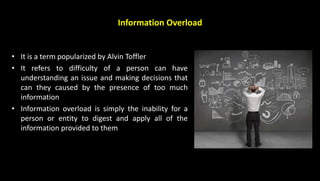
Information Overload
• It is a term popularized by Alvin Toffler
• It refers to difficulty of a person can have
understanding an issue and making decisions that
can they caused by the presence of too much
information
• Information overload is simply the inability for a
person or entity to digest and apply all of the
information provided to them
Contd..
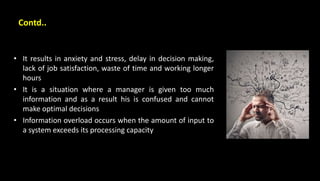
• It results in anxiety and stress, delay in decision making,
lack of job satisfaction, waste of time and working longer
hours
• It is a situation where a manager is given too much
information and as a result his is confused and cannot
make optimal decisions
• Information overload occurs when the amount of input to
a system exceeds its processing capacity
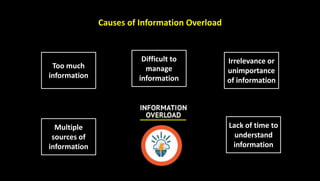
Causes of Information Overload
Too much
information
Difficult to
manage
information
Irrelevance or
unimportance
of information
Multiple
sources of
information
Lack of time to
understand
information
Causes of Information Overload
• A rapidly increasing rate of new information
• The ease of duplication and transmission of data across the Internet
• An increase in the available channels of incoming information (e.g.
telephone, e-mail, instant messaging)
• Large amounts of historical information to dig through
• Contradictions and inaccuracies in available information
• A low signal-to-noise ratio
• A lack of a method for comparing and processing different kinds of
information
Tips to solve information overload problem
1. Focus and specialize in one thing
2. Take Control
3. Follow only valuable sources
4. Unsubscribe from most of the unwanted subscription
5. Organize the time
Techniques of Managing Overload
1. Data summarizing
2. Message modification or filtering
3. Inferences
4. Message routing
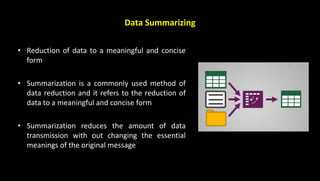
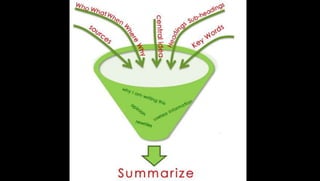
Data Summarizing
• Reduction of data to a meaningful and concise
form
• Summarization is a commonly used method of
data reduction and it refers to the reduction of
data to a meaningful and concise form
• Summarization reduces the amount of data
transmission with out changing the essential
meanings of the original message
2. Message modification or filtering
• It refers to the removal of unwanted and irrelevant data so as to
make the information more useful to the recipient
• Under this method the meaning of the message is altered before
it is transmitted
• In order to prevent information overload, the data can be
reduced to a manageable size through the process of filtering
3. Inferences
Process of reaching a conclusion based on facts or evidence
Conclusion based on facts
• This must be either a new pencil or one which has not been used a lot
“a long pencil with an eraser”
• This must be either an old pencil or one which has been used for a
long period
“a small pencil without an eraser”
3. Inferences
• Process of reaching a conclusion based on facts or
evidence
• Inferences are drawn form a large volume of data and
these inferences are transmitted or communicated in
the organization instead of original data
• This process reduces the volume of data considerably
• Inferences may be based on quantitative data such as
statistical inference or may be more subjective
• The quality of inference depends on the ability and
skill of the person who makes the inference
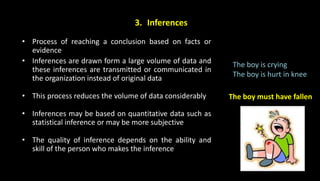
The boy is crying
The boy is hurt in knee
The boy must have fallen
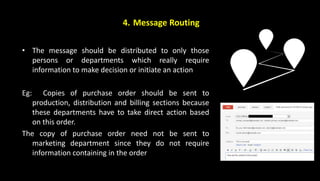
4. Message Routing
• The message should be distributed to only those
persons or departments which really require
information to make decision or initiate an action
Eg: Copies of purchase order should be sent to
production, distribution and billing sections because
these departments have to take direct action based
on this order.
The copy of purchase order need not be sent to
marketing department since they do not require
information containing in the order
Thank You

Information overload - MIS

  • 1.
    Subject: Management InformationSystem Topic: Information Overload Prepared By: Mohammed Jasir PV Asst. Professor NBS, Koratty Phone: 9605 69 32 66
  • 2.
    Snapshot Information overload – Causesfor Information Overload – Tips for reducing Information Overload – Techniques for managing overload • Summarizing • Filtering • Inferences and message routing
  • 3.
    MIS • MIS –Stands for Management Information System. As the name implies, MIS is a system that generates and provides Information to Management, for the purpose of managing and improving the business processes • It is a computer based system that provides data and required information to management for supporting and enabling them in their decision making process
  • 4.
    Information Overload • Itis a term popularized by Alvin Toffler • It refers to difficulty of a person can have understanding an issue and making decisions that can they caused by the presence of too much information • Information overload is simply the inability for a person or entity to digest and apply all of the information provided to them
  • 5.
    Contd.. • It resultsin anxiety and stress, delay in decision making, lack of job satisfaction, waste of time and working longer hours • It is a situation where a manager is given too much information and as a result his is confused and cannot make optimal decisions • Information overload occurs when the amount of input to a system exceeds its processing capacity
  • 6.
    Causes of InformationOverload Too much information Difficult to manage information Irrelevance or unimportance of information Multiple sources of information Lack of time to understand information
  • 7.
    Causes of InformationOverload • A rapidly increasing rate of new information • The ease of duplication and transmission of data across the Internet • An increase in the available channels of incoming information (e.g. telephone, e-mail, instant messaging) • Large amounts of historical information to dig through • Contradictions and inaccuracies in available information • A low signal-to-noise ratio • A lack of a method for comparing and processing different kinds of information
  • 10.
    Tips to solveinformation overload problem 1. Focus and specialize in one thing 2. Take Control 3. Follow only valuable sources 4. Unsubscribe from most of the unwanted subscription 5. Organize the time
  • 11.
    Techniques of ManagingOverload 1. Data summarizing 2. Message modification or filtering 3. Inferences 4. Message routing
  • 12.
    Data Summarizing • Reductionof data to a meaningful and concise form • Summarization is a commonly used method of data reduction and it refers to the reduction of data to a meaningful and concise form • Summarization reduces the amount of data transmission with out changing the essential meanings of the original message
  • 14.
    2. Message modificationor filtering • It refers to the removal of unwanted and irrelevant data so as to make the information more useful to the recipient • Under this method the meaning of the message is altered before it is transmitted • In order to prevent information overload, the data can be reduced to a manageable size through the process of filtering
  • 17.
    3. Inferences Process ofreaching a conclusion based on facts or evidence Conclusion based on facts • This must be either a new pencil or one which has not been used a lot “a long pencil with an eraser” • This must be either an old pencil or one which has been used for a long period “a small pencil without an eraser”
  • 19.
    3. Inferences • Processof reaching a conclusion based on facts or evidence • Inferences are drawn form a large volume of data and these inferences are transmitted or communicated in the organization instead of original data • This process reduces the volume of data considerably • Inferences may be based on quantitative data such as statistical inference or may be more subjective • The quality of inference depends on the ability and skill of the person who makes the inference The boy is crying The boy is hurt in knee The boy must have fallen
  • 20.
    4. Message Routing •The message should be distributed to only those persons or departments which really require information to make decision or initiate an action Eg: Copies of purchase order should be sent to production, distribution and billing sections because these departments have to take direct action based on this order. The copy of purchase order need not be sent to marketing department since they do not require information containing in the order
  • 21.