Welcome to our Presentation
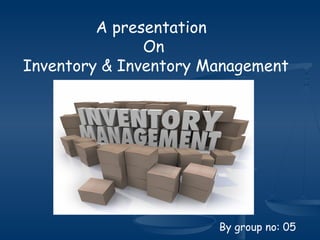
A presentation
On
Inventory & Inventory Management
By group no: 05
Department of Accounting & Information Systems (2nd
Batch)
University of Barisal
Group members
ID Number1 Name
13 AIS 002 Sarmin Akter Mitu
13 AIS 018 Shariful Islam
13 AIS 029 Sabina Akter
13 AIS 038 Ranu Mondal
13 AIS 040 Shuvankar Halder
13 AIS 046 Md. Zebon hossain
13 AIS 081
Rafiq-Al-Azad
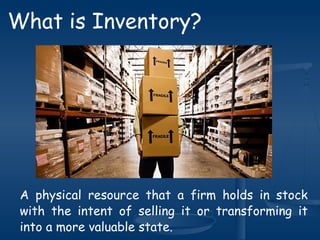
What is Inventory?
A physical resource that a firm holds in stock
with the intent of selling it or transforming it
into a more valuable state.
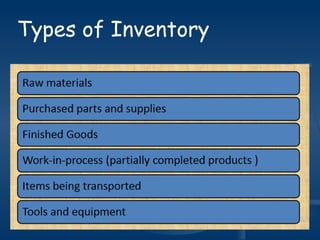
Types of Inventory
Classification of Inventories Cost:
Purchase Cost
Ordering Cost
Holding Cost
Shortage Cost
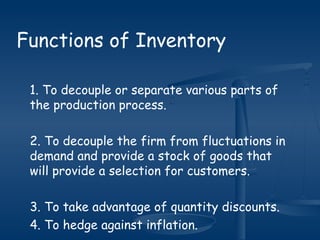
Functions of Inventory
1. To decouple or separate various parts of
the production process.
2. To decouple the firm from fluctuations in
demand and provide a stock of goods that
will provide a selection for customers.
3. To take advantage of quantity discounts.
4. To hedge against inflation.
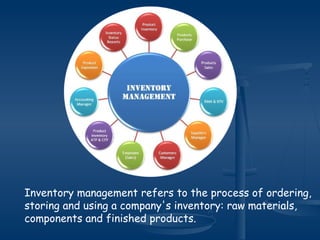
Inventory management refers to the process of ordering,
storing and using a company's inventory: raw materials,
components and finished products.
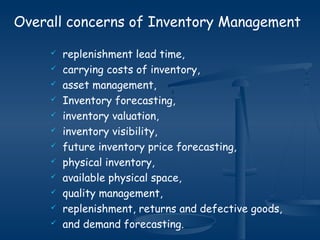
Overall concerns of Inventory Management
 replenishment lead time,
 carrying costs of inventory,
 asset management,
 Inventory forecasting,
 inventory valuation,
 inventory visibility,
 future inventory price forecasting,
 physical inventory,
 available physical space,
 quality management,
 replenishment, returns and defective goods,
 and demand forecasting.
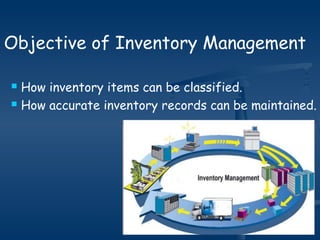
Objective of Inventory Management
 How inventory items can be classified.
 How accurate inventory records can be maintained.
 Unnecessary tying down of firm’s
funds and loss of profit.
 Excessive carrying costs.
 Risk of liquidity- difficult to convert
into cash.
 Physical deterioration of inventories
while in storage due to mishandling
and improper storage facilities.
What if we over react?
 Production hold-ups – loss of labor hours.
 Failure to meet delivery commitments.
 Customers may shift to competitors
which will amount to a permanent loss to
the firm.
 May affect the goodwill and image of the
firm.
What if one is too cool!
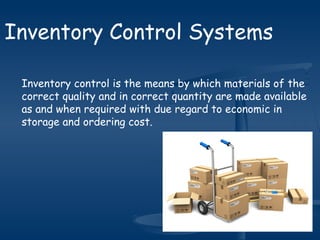
Inventory control is the means by which materials of the
correct quality and in correct quantity are made available
as and when required with due regard to economic in
storage and ordering cost.
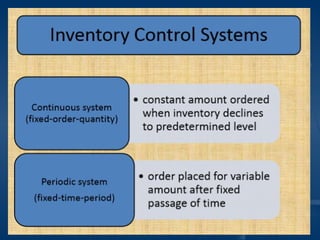
Inventory Control Systems
Objectives of inventory control
• To ensure smooth flow of stock.
• To provide for required quality of materials.
• To control investments in stock.
• Protection against fluctuating demand.
• Protection against fluctuations in output.
• Minimization of risk and uncertainty.
• Risk of obsolescence.
• Minimization of material cost.
Scope of inventory control
• Determination of inventory policies.
• Determining various stock levels
• Determining economic order size
• Safety or buffer stock
• Determining lead time
• Examining the work of inventory policy
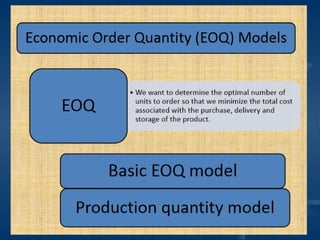
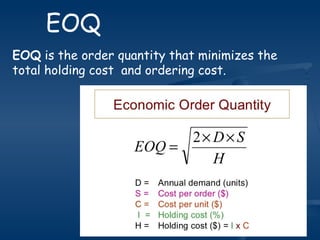
EOQ
EOQ is the order quantity that minimizes the
total holding cost  and ordering cost.
1. Only one product is involved.
2. Annual demand requirement is known.
3. Demand is spread evenly throughout the years so
that the demand rate is seasonally constant.
4. Lead time does not vary.
5. Each order is received in a single delivery.
6. There are no quantity discounts.
Assumptions of Basic EOQ Model
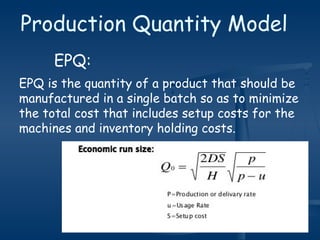
Production Quantity Model
EPQ is the quantity of a product that should be
manufactured in a single batch so as to minimize
the total cost that includes setup costs for the
machines and inventory holding costs.
EPQ:
1. Only one item is involved.
2. Annual demand is known.
3. The usage rate is constant.
4. Usage occurs continually, but production occurs
periodically.
5. The production rate is constant.
6. Lead time does not vary.
7. There are no quantity discounts.
Assumptions of Production Quantity
Model
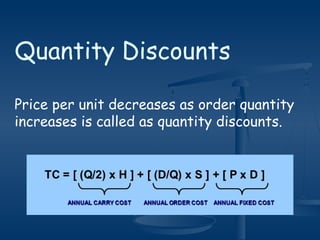
Quantity Discounts
Price per unit decreases as order quantity
increases is called as quantity discounts.
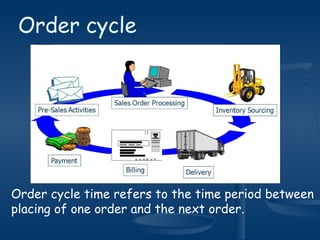
Order cycle
Order cycle time refers to the time period between
placing of one order and the next order.
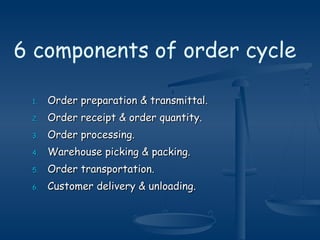
1.1. Order preparation & transmittal.Order preparation & transmittal.
2.2. Order receipt & order quantity.Order receipt & order quantity.
3.3. Order processing.Order processing.
4.4. Warehouse picking & packing.Warehouse picking & packing.
5.5. Order transportation.Order transportation.
6.6. Customer delivery & unloading.Customer delivery & unloading.
6 components of order cycle
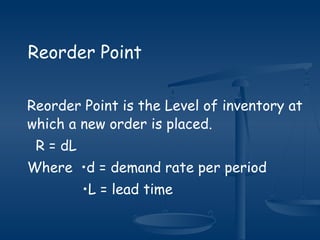
Reorder Point
Reorder Point is the Level of inventory at
which a new order is placed.
R = dL
Where •d = demand rate per period
•L = lead time
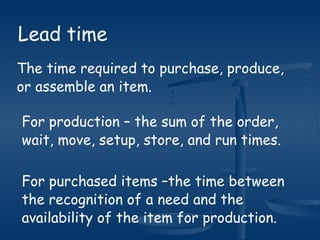
Lead time
The time required to purchase, produce,
or assemble an item.
For production – the sum of the order,
wait, move, setup, store, and run times.
For purchased items –the time between
the recognition of a need and the
availability of the item for production.
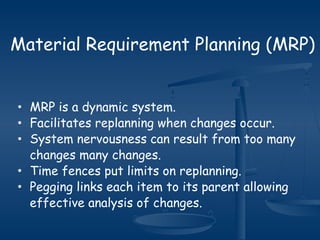
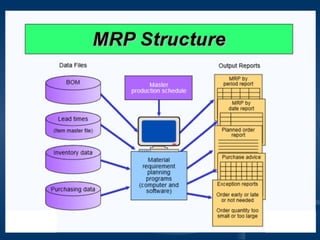
Material Requirement Planning (MRP)
• MRP is a dynamic system.
• Facilitates replanning when changes occur.
• System nervousness can result from too many
changes many changes.
• Time fences put limits on replanning.
• Pegging links each item to its parent allowing
effective analysis of changes.
Benefits of MRP
1. Better response to customer orders Better
response to customer orders
2. Faster response to market changes.
3. Improved utilization of facilities and labor.
4. Reduced inventory levels
Enterprise Resource Planning
(ERP)
An extension of the MRP system to tie in customers and
suppliers is called Enterprise Resource Planning. It also
coordinates business from supplier evaluation to
customer invoicing.
ERP also:
1. Allows automation and integration of many business
processes.
2. Shares common data bases and business practices
3. Produces information in real time.
Advantages of ERP Systems
1. Provides integration of the supply chain,
production, and administration.
2. Creates commonality of databases.
3. Can incorporate improved best processes.
4. Increases communication and collaboration
between business units and sites.
5. Has an off-the-shelf software database.
6. May provide a strategic advantage.
Disadvantages of ERP Systems
1. ERP is very expensive to purchase and to customize.
2. Implementation may require major changes in the
company and its processes.
3. It is so complex.
4. Involves an ongoing, possibly never completed, process
for implementation.
5 Expertise is limited with ongoing staffing problems.
ERP in the Service Sector
 ERP systems have been developed for health
care, government, retail stores, hotels, and
financial services
 Also called efficient consumer response (ECR)
systems
 Objective is to tie sales to buying, inventory,
logistics, and production
Any questions?

Inventory & Inventory Management ( By BU AIS 2nd Batch)

  • 1.
    Welcome to ourPresentation
  • 2.
    A presentation On Inventory &Inventory Management By group no: 05
  • 3.
    Department of Accounting& Information Systems (2nd Batch) University of Barisal
  • 4.
    Group members ID Number1Name 13 AIS 002 Sarmin Akter Mitu 13 AIS 018 Shariful Islam 13 AIS 029 Sabina Akter 13 AIS 038 Ranu Mondal 13 AIS 040 Shuvankar Halder 13 AIS 046 Md. Zebon hossain 13 AIS 081 Rafiq-Al-Azad
  • 5.
    What is Inventory? Aphysical resource that a firm holds in stock with the intent of selling it or transforming it into a more valuable state.
  • 6.
  • 7.
    Classification of InventoriesCost: Purchase Cost Ordering Cost Holding Cost Shortage Cost
  • 8.
    Functions of Inventory 1.To decouple or separate various parts of the production process. 2. To decouple the firm from fluctuations in demand and provide a stock of goods that will provide a selection for customers. 3. To take advantage of quantity discounts. 4. To hedge against inflation.
  • 9.
    Inventory management refersto the process of ordering, storing and using a company's inventory: raw materials, components and finished products.
  • 10.
    Overall concerns ofInventory Management  replenishment lead time,  carrying costs of inventory,  asset management,  Inventory forecasting,  inventory valuation,  inventory visibility,  future inventory price forecasting,  physical inventory,  available physical space,  quality management,  replenishment, returns and defective goods,  and demand forecasting.
  • 11.
    Objective of InventoryManagement  How inventory items can be classified.  How accurate inventory records can be maintained.
  • 13.
     Unnecessary tyingdown of firm’s funds and loss of profit.  Excessive carrying costs.  Risk of liquidity- difficult to convert into cash.  Physical deterioration of inventories while in storage due to mishandling and improper storage facilities. What if we over react?
  • 14.
     Production hold-ups– loss of labor hours.  Failure to meet delivery commitments.  Customers may shift to competitors which will amount to a permanent loss to the firm.  May affect the goodwill and image of the firm. What if one is too cool!
  • 15.
    Inventory control isthe means by which materials of the correct quality and in correct quantity are made available as and when required with due regard to economic in storage and ordering cost. Inventory Control Systems
  • 18.
    Objectives of inventorycontrol • To ensure smooth flow of stock. • To provide for required quality of materials. • To control investments in stock. • Protection against fluctuating demand. • Protection against fluctuations in output. • Minimization of risk and uncertainty. • Risk of obsolescence. • Minimization of material cost.
  • 19.
    Scope of inventorycontrol • Determination of inventory policies. • Determining various stock levels • Determining economic order size • Safety or buffer stock • Determining lead time • Examining the work of inventory policy
  • 21.
    EOQ EOQ is theorder quantity that minimizes the total holding cost  and ordering cost.
  • 22.
    1. Only oneproduct is involved. 2. Annual demand requirement is known. 3. Demand is spread evenly throughout the years so that the demand rate is seasonally constant. 4. Lead time does not vary. 5. Each order is received in a single delivery. 6. There are no quantity discounts. Assumptions of Basic EOQ Model
  • 23.
    Production Quantity Model EPQis the quantity of a product that should be manufactured in a single batch so as to minimize the total cost that includes setup costs for the machines and inventory holding costs. EPQ:
  • 24.
    1. Only oneitem is involved. 2. Annual demand is known. 3. The usage rate is constant. 4. Usage occurs continually, but production occurs periodically. 5. The production rate is constant. 6. Lead time does not vary. 7. There are no quantity discounts. Assumptions of Production Quantity Model
  • 25.
    Quantity Discounts Price perunit decreases as order quantity increases is called as quantity discounts.
  • 26.
    Order cycle Order cycletime refers to the time period between placing of one order and the next order.
  • 27.
    1.1. Order preparation& transmittal.Order preparation & transmittal. 2.2. Order receipt & order quantity.Order receipt & order quantity. 3.3. Order processing.Order processing. 4.4. Warehouse picking & packing.Warehouse picking & packing. 5.5. Order transportation.Order transportation. 6.6. Customer delivery & unloading.Customer delivery & unloading. 6 components of order cycle
  • 28.
    Reorder Point Reorder Pointis the Level of inventory at which a new order is placed. R = dL Where •d = demand rate per period •L = lead time
  • 29.
    Lead time The timerequired to purchase, produce, or assemble an item. For production – the sum of the order, wait, move, setup, store, and run times. For purchased items –the time between the recognition of a need and the availability of the item for production.
  • 30.
    Material Requirement Planning(MRP) • MRP is a dynamic system. • Facilitates replanning when changes occur. • System nervousness can result from too many changes many changes. • Time fences put limits on replanning. • Pegging links each item to its parent allowing effective analysis of changes.
  • 31.
    Benefits of MRP 1.Better response to customer orders Better response to customer orders 2. Faster response to market changes. 3. Improved utilization of facilities and labor. 4. Reduced inventory levels
  • 33.
    Enterprise Resource Planning (ERP) Anextension of the MRP system to tie in customers and suppliers is called Enterprise Resource Planning. It also coordinates business from supplier evaluation to customer invoicing. ERP also: 1. Allows automation and integration of many business processes. 2. Shares common data bases and business practices 3. Produces information in real time.
  • 34.
    Advantages of ERPSystems 1. Provides integration of the supply chain, production, and administration. 2. Creates commonality of databases. 3. Can incorporate improved best processes. 4. Increases communication and collaboration between business units and sites. 5. Has an off-the-shelf software database. 6. May provide a strategic advantage.
  • 35.
    Disadvantages of ERPSystems 1. ERP is very expensive to purchase and to customize. 2. Implementation may require major changes in the company and its processes. 3. It is so complex. 4. Involves an ongoing, possibly never completed, process for implementation. 5 Expertise is limited with ongoing staffing problems.
  • 36.
    ERP in theService Sector  ERP systems have been developed for health care, government, retail stores, hotels, and financial services  Also called efficient consumer response (ECR) systems  Objective is to tie sales to buying, inventory, logistics, and production
  • 37.