Purchase Management
PURCHASE MANAGEMENT
One of the most important activities of Materials
Management is Purchasing.
Purchasing ensures the following:
• RIGHT MATERIALS are purchased, at
• RIGHT PRICE, from
• RIGHT SUPPLIERS, at
• RIGHT TIME, & delivered to the
• RIGHT PLACE.
Purchasing Department –
The Purchasing Department is the interface between the
Supplier of Materials and the Production Function.
Materials comprise one of the largest components of
expenditure in any manufacturing firm, hence their
procurement requires careful management.
The Responsibilities of Purchasing Department include
the following:
• Learning the material needs of the organization.
• Selecting suppliers and negotiating the price.
• Ensuring delivery.
• Monitoring the cost.
• Monitoring the quality and delivery performance.
Objectives
 To buy competitively
 To buy wisely
 To keep inventory investment and inventory losses at
a practical minimum
 To develop effective and reliable sources of supply
 To develop good relationships with the supplier
community and good continuing relationships with
active suppliers
 To achieve maximum integration with other
departments of the firm
 To handle the purchasing and supply management
function in professional, cost-effective manner
Functions of Purchasing Management
1. Receive Purchase Requisition
- Starting point of procurement activity.
- It is the Statement of Requirement of Production.
- Also called ‘Indent’
2. Review and evaluate Requisitions
Purchase Department reviews the following:-
 Item description
 Quantity
 Estimated purchase price or last purchased price
 Consumption pattern in the last 3 years
 When the material is required
 Provisions etc..
3. Supplier selection
- Deciding on the mode of procurement
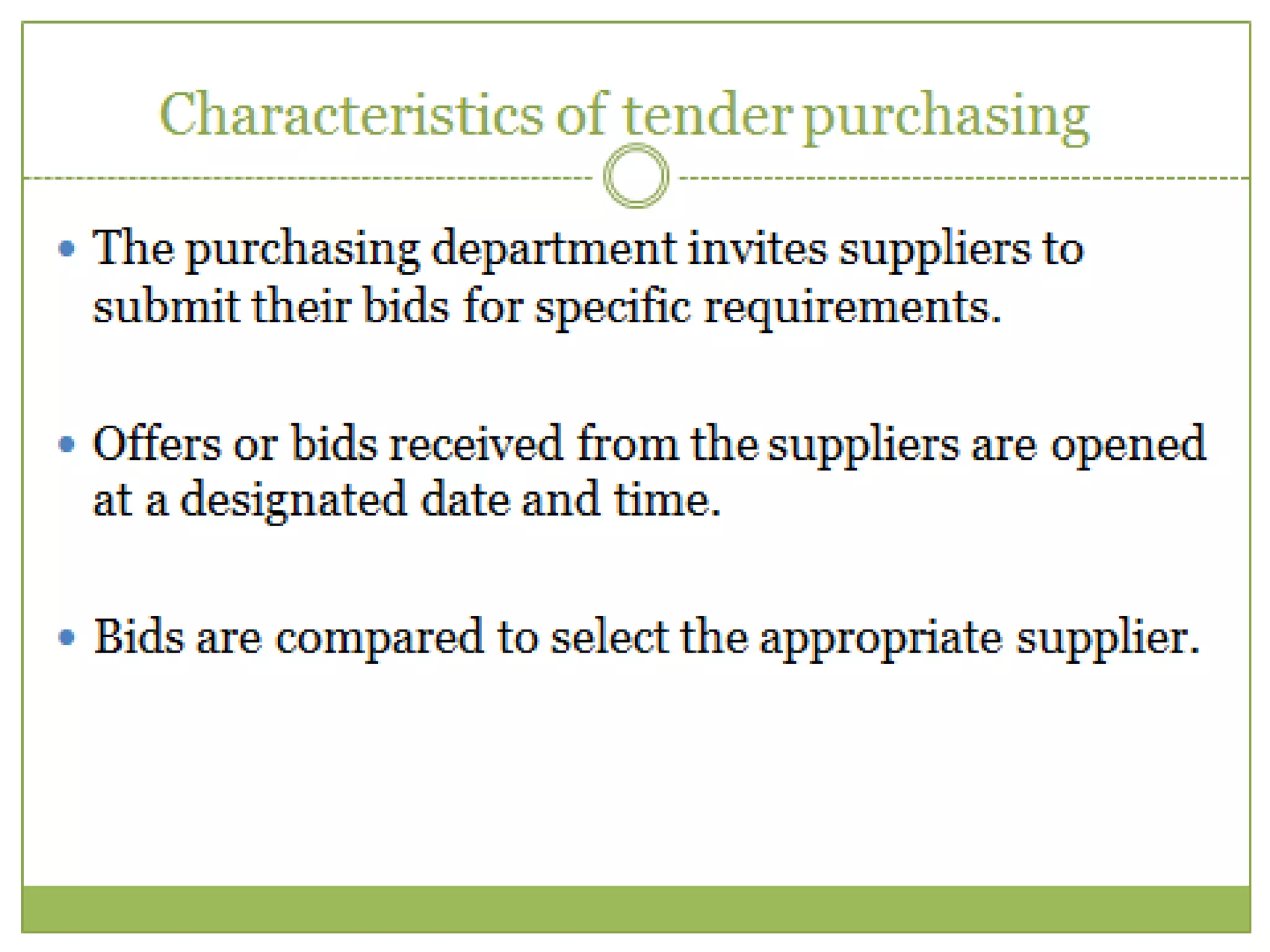
- Invitation to tender is issued to prospective suppliers.
4. Scrutiny of Offers
- Reply of a supplier to the invitation to tender is called an
Offer.
- An offer is scrutinized for its specifications, price and
other terms and conditions.
5. Order placement
- Purchasing Department selects
the supplier & places order.
7. Market research and Information
- Discussions & meetings between supplier representatives
& company officials.
- Keeps in check, the latest developments with respect to
the company and its product .
- Studies the market and keeps in track of new suppliers.
- Studies new developments in production materials &
processes.
8. Payment Authorization
- Ensuring all goods are delivered before payment is made.
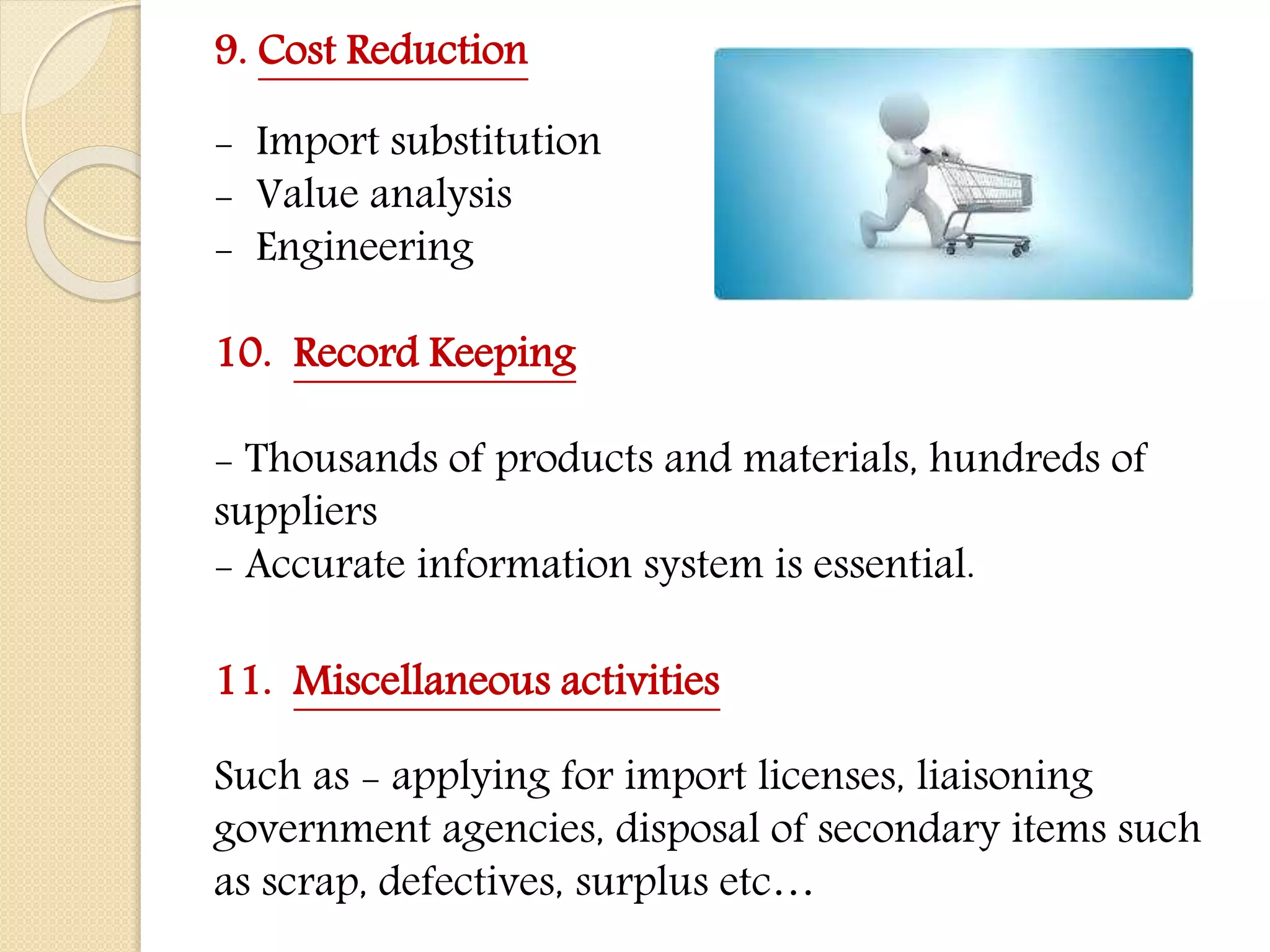
9. Cost Reduction
- Import substitution
- Value analysis
- Engineering
10. Record Keeping
- Thousands of products and materials, hundreds of
suppliers
- Accurate information system is essential.
11. Miscellaneous activities
Such as - applying for import licenses, liaisoning
government agencies, disposal of secondary items such
as scrap, defectives, surplus etc…
IMPORTANCE OF PURCHASING
 Purchasing function provides materials to the factory
 A one percent saving in materials cost is equivalent to a
10 percent increase in turnover.
 Purchasing manager is the custodian of firm's purse as
they spends more than 50% of company's earnings on
purchases.
 Purchasing can contribute to import substitution and
save foreign exchange.
 Purchasing is the main factor in timely execution of
industrial projects.
 Material management organizations that exist now have
evolved out of purchasing departments
Purchase Organization
Definition
The Purchase organization is an organizational
unit within logistics.
Almost all business transactions related to
procurement are carried out in a purchasing
organization.
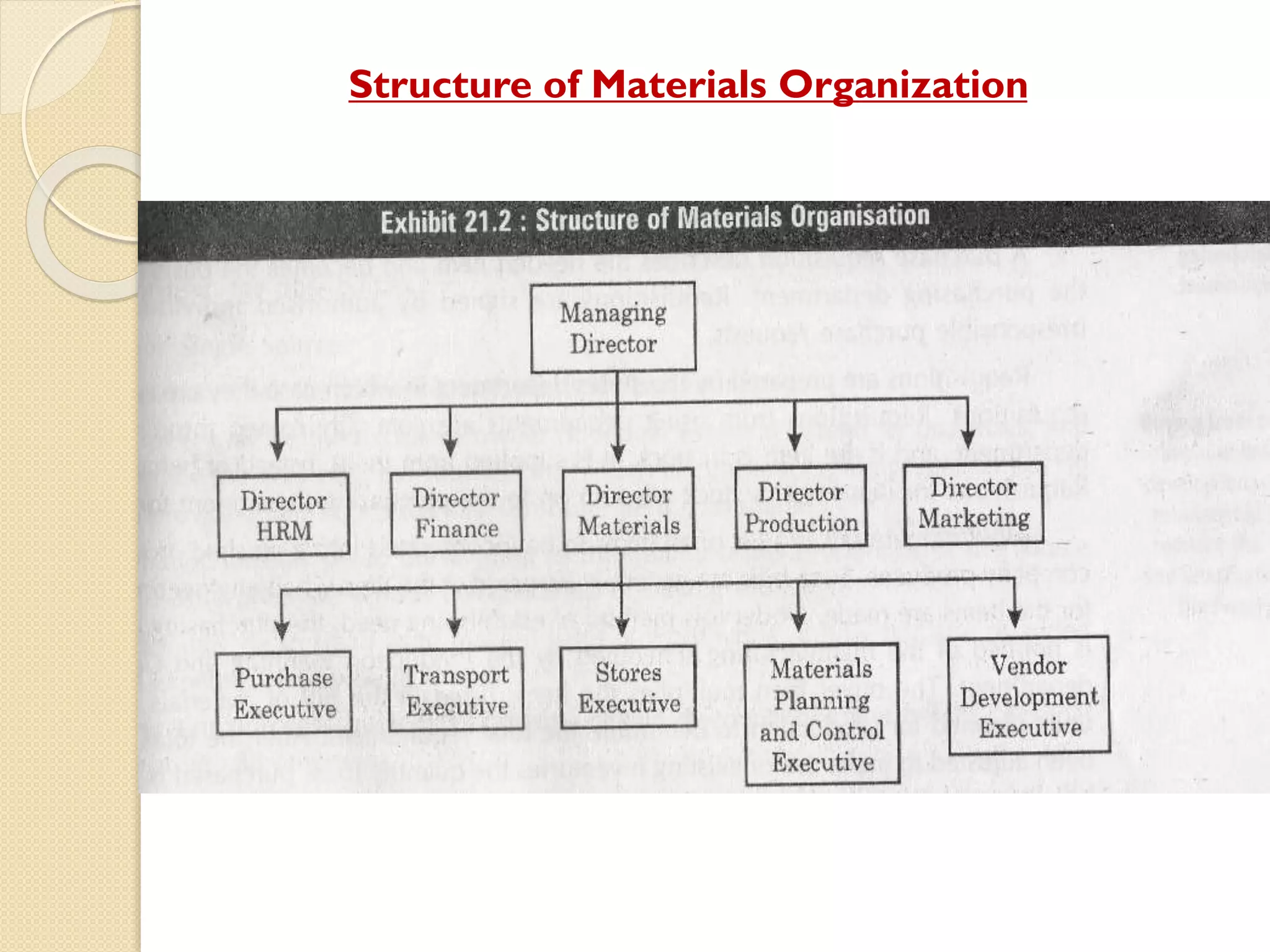
Structure of Materials Organization
 Make or buy decision is normally taken by
a committee comprising representatives
from different departments
Role of Purchasing Manager
Speculative buying
Speculative buying is conducted with the
hope of making profit out of price
changes.
Vendor rating
It’s the process of rating a supplier based
on some rating techniques
Rating techniques
 Categorical plan
 The weighted point plan
 Critical incidents method
 Check list system
Categorical plan
 Under this plan, the performance from
various divisions maintain informal
evaluation records.
Weighted point plan
The performance factors to be evaluated by
giving weighted
Critical incidents method
 It is based on buyer -vendor relationship.
Check list system
Use simple check list for evaluate vendors.
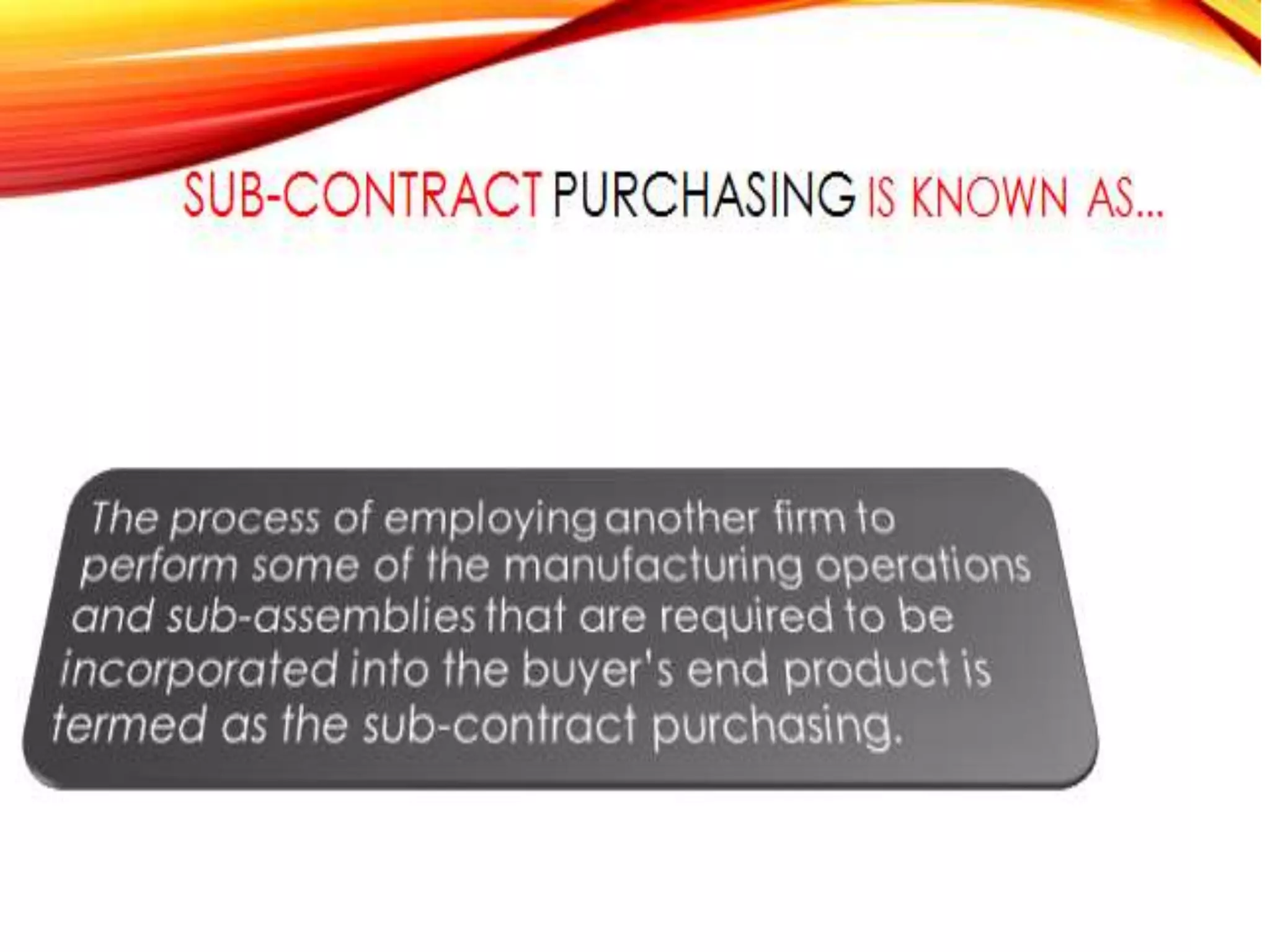
Ancillary Development: When a company decides
to buy a part from outside suppliers, it is usually sub-
contracted in most cases , the sub-contactor is an
ancillary unit.
Policy circular
 Production process/method , equipment selection and
layout
 Manpower planning
 Organisation and procedure for production planning,
progressing and control
 Sources of financing and procedure for obtaining
them.
 Process quality control equipment and training
facilities for the development of supervisory and
artisan skills
PURCHASING POLICIES
Ancilllarisation Advantages
 It results in spread of entrepreneurial
base.
 It promotes industrial development
 Regular supply of right quality items is
assured.
PURCHASING CYCLE
The purchase requisition described the required
item.
In order to assure complete and accurate
information for ordering, the requisition must
include all necessary information.
A regular list of approved suppliers, called register of
suppliers, is maintained by the purchasing
department.
A right supplier is one who delivers materials of the
correct specifications on the stipulated delivery
dates
•Single supplier helps develop long-term relationship
and reduce the risk and interruption in the supply.
•Multiple suppliers may not help in maintaining
quality and helps get material at competitive prices.
1. Vendor’s catalogues and price list are
available for standard items
2. Negotiation : bargaining between buyer and
seller
3. Inviting tenders or quotations
Methods :
Purchase order
The legal order is placed with the
supplier on a form is known as
purchase order
Order acknowledgement is to get a
definite commitment from the
supplier about the supply of items
on time.
Follow up is done to ensure that the items ordered
are delivered by the supplier on time.
Though a general policy should be established for the
entire purchasing department, the immediate
responsibility for expediting is likely to rest on the
buyer who placed the order
Check the invoice and approve it for payment
Blanket Order
Buyer issues an order covering the requirement of a
small item for one year
Stockless buying
In stockless buying stock of items is kept in buyers
plant, ownership of the stock being with the supplier
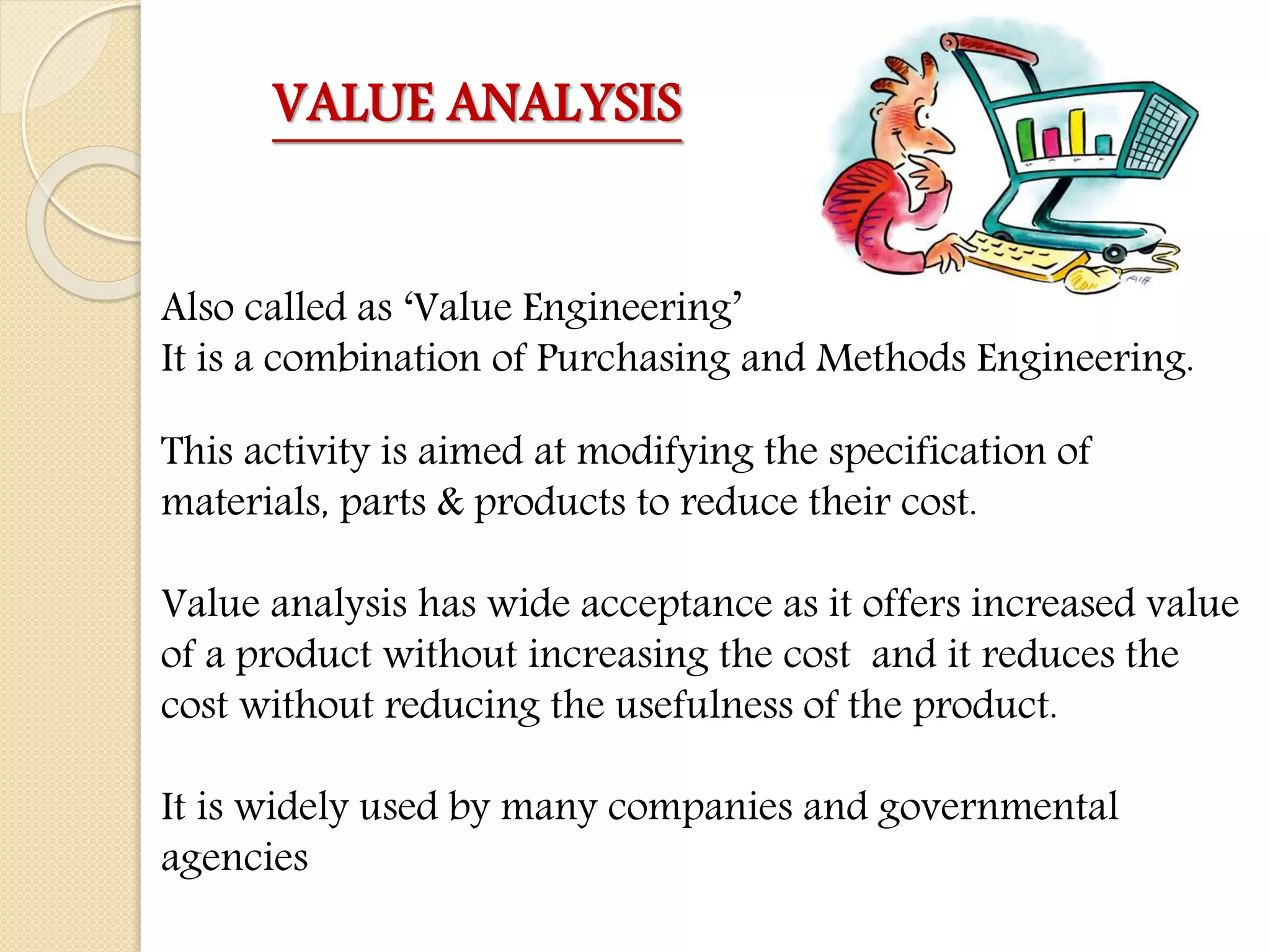
VALUE ANALYSIS
Also called as ‘Value Engineering’
It is a combination of Purchasing and Methods Engineering.
This activity is aimed at modifying the specification of
materials, parts & products to reduce their cost.
Value analysis has wide acceptance as it offers increased value
of a product without increasing the cost and it reduces the
cost without reducing the usefulness of the product.
It is widely used by many companies and governmental
agencies
Steps:
• A value analysis team or committee takes a product, which
has been designed or produced.
• Then they attempt to define what function, product should
fulfill.
• Next, the analysis committee tries to perform that function at
the lowest possible cost.
Comparative Analysis
Another approach is to do comparative analysis.
Value analysis may investigate all identical parts purchased by
the company and this investigation can reveal opportunities to
cut costs of some of these parts.
Supplier contacts
Supplier contacts is yet another approach to value analysis. Smart
purchasing personnel maintain close contact with suppliers who
suggest improvement and cost-reduction ideas.

Purchase management

  • 1.
  • 2.
    PURCHASE MANAGEMENT One ofthe most important activities of Materials Management is Purchasing. Purchasing ensures the following: • RIGHT MATERIALS are purchased, at • RIGHT PRICE, from • RIGHT SUPPLIERS, at • RIGHT TIME, & delivered to the • RIGHT PLACE. Purchasing Department – The Purchasing Department is the interface between the Supplier of Materials and the Production Function.
  • 3.
    Materials comprise oneof the largest components of expenditure in any manufacturing firm, hence their procurement requires careful management. The Responsibilities of Purchasing Department include the following: • Learning the material needs of the organization. • Selecting suppliers and negotiating the price. • Ensuring delivery. • Monitoring the cost. • Monitoring the quality and delivery performance.
  • 4.
    Objectives  To buycompetitively  To buy wisely  To keep inventory investment and inventory losses at a practical minimum  To develop effective and reliable sources of supply  To develop good relationships with the supplier community and good continuing relationships with active suppliers  To achieve maximum integration with other departments of the firm  To handle the purchasing and supply management function in professional, cost-effective manner
  • 5.
    Functions of PurchasingManagement 1. Receive Purchase Requisition - Starting point of procurement activity. - It is the Statement of Requirement of Production. - Also called ‘Indent’ 2. Review and evaluate Requisitions Purchase Department reviews the following:-  Item description  Quantity  Estimated purchase price or last purchased price  Consumption pattern in the last 3 years  When the material is required  Provisions etc..
  • 6.
    3. Supplier selection -Deciding on the mode of procurement - Invitation to tender is issued to prospective suppliers. 4. Scrutiny of Offers - Reply of a supplier to the invitation to tender is called an Offer. - An offer is scrutinized for its specifications, price and other terms and conditions. 5. Order placement - Purchasing Department selects the supplier & places order.
  • 7.
    7. Market researchand Information - Discussions & meetings between supplier representatives & company officials. - Keeps in check, the latest developments with respect to the company and its product . - Studies the market and keeps in track of new suppliers. - Studies new developments in production materials & processes. 8. Payment Authorization - Ensuring all goods are delivered before payment is made.
  • 8.
    9. Cost Reduction -Import substitution - Value analysis - Engineering 10. Record Keeping - Thousands of products and materials, hundreds of suppliers - Accurate information system is essential. 11. Miscellaneous activities Such as - applying for import licenses, liaisoning government agencies, disposal of secondary items such as scrap, defectives, surplus etc…
  • 9.
    IMPORTANCE OF PURCHASING Purchasing function provides materials to the factory  A one percent saving in materials cost is equivalent to a 10 percent increase in turnover.  Purchasing manager is the custodian of firm's purse as they spends more than 50% of company's earnings on purchases.  Purchasing can contribute to import substitution and save foreign exchange.  Purchasing is the main factor in timely execution of industrial projects.  Material management organizations that exist now have evolved out of purchasing departments
  • 10.
    Purchase Organization Definition The Purchaseorganization is an organizational unit within logistics. Almost all business transactions related to procurement are carried out in a purchasing organization.
  • 11.
  • 36.
     Make orbuy decision is normally taken by a committee comprising representatives from different departments Role of Purchasing Manager
  • 37.
    Speculative buying Speculative buyingis conducted with the hope of making profit out of price changes. Vendor rating It’s the process of rating a supplier based on some rating techniques
  • 38.
    Rating techniques  Categoricalplan  The weighted point plan  Critical incidents method  Check list system
  • 39.
    Categorical plan  Underthis plan, the performance from various divisions maintain informal evaluation records. Weighted point plan The performance factors to be evaluated by giving weighted
  • 40.
    Critical incidents method It is based on buyer -vendor relationship. Check list system Use simple check list for evaluate vendors.
  • 41.
    Ancillary Development: Whena company decides to buy a part from outside suppliers, it is usually sub- contracted in most cases , the sub-contactor is an ancillary unit. Policy circular  Production process/method , equipment selection and layout  Manpower planning  Organisation and procedure for production planning, progressing and control  Sources of financing and procedure for obtaining them.  Process quality control equipment and training facilities for the development of supervisory and artisan skills PURCHASING POLICIES
  • 42.
    Ancilllarisation Advantages  Itresults in spread of entrepreneurial base.  It promotes industrial development  Regular supply of right quality items is assured.
  • 43.
  • 45.
    The purchase requisitiondescribed the required item. In order to assure complete and accurate information for ordering, the requisition must include all necessary information.
  • 46.
    A regular listof approved suppliers, called register of suppliers, is maintained by the purchasing department. A right supplier is one who delivers materials of the correct specifications on the stipulated delivery dates •Single supplier helps develop long-term relationship and reduce the risk and interruption in the supply. •Multiple suppliers may not help in maintaining quality and helps get material at competitive prices.
  • 47.
    1. Vendor’s cataloguesand price list are available for standard items 2. Negotiation : bargaining between buyer and seller 3. Inviting tenders or quotations Methods :
  • 48.
    Purchase order The legalorder is placed with the supplier on a form is known as purchase order
  • 49.
    Order acknowledgement isto get a definite commitment from the supplier about the supply of items on time.
  • 50.
    Follow up isdone to ensure that the items ordered are delivered by the supplier on time. Though a general policy should be established for the entire purchasing department, the immediate responsibility for expediting is likely to rest on the buyer who placed the order
  • 51.
    Check the invoiceand approve it for payment Blanket Order Buyer issues an order covering the requirement of a small item for one year Stockless buying In stockless buying stock of items is kept in buyers plant, ownership of the stock being with the supplier
  • 52.
    VALUE ANALYSIS Also calledas ‘Value Engineering’ It is a combination of Purchasing and Methods Engineering. This activity is aimed at modifying the specification of materials, parts & products to reduce their cost. Value analysis has wide acceptance as it offers increased value of a product without increasing the cost and it reduces the cost without reducing the usefulness of the product. It is widely used by many companies and governmental agencies
  • 53.
    Steps: • A valueanalysis team or committee takes a product, which has been designed or produced. • Then they attempt to define what function, product should fulfill. • Next, the analysis committee tries to perform that function at the lowest possible cost. Comparative Analysis Another approach is to do comparative analysis. Value analysis may investigate all identical parts purchased by the company and this investigation can reveal opportunities to cut costs of some of these parts. Supplier contacts Supplier contacts is yet another approach to value analysis. Smart purchasing personnel maintain close contact with suppliers who suggest improvement and cost-reduction ideas.