


Financial Engineering
Prepared By:
Mohammed Jasir PV
Assist. Professor
MIIMS, Puthanangadi
Contact No: 9605 69 32 66
Session Topic
• Financial Engineering
Financial Engineering
Introduction
• Financial engineering is an engineering discipline which deals with the
creation of new and improved financial products through innovative design
or repackaging of existing financial instruments
• Financial engineering and innovations are seen in bonds, equity, derivatives
and in fields like mergers, acquisitions and corporate restructuring
• Some of the innovations in the Indian financial market are debt-oriented
schemes of mutual funds, interest rate futures, interest rate swaps, currency
swaps, floating rate bonds, money market mutual funds, etc.
Definition - Financial Engineering
• Generalizing: Financial Engineering involves the design, the development,
and the implementation of innovative financial instruments and
processes, and the formulation of creative solutions to problems in
finance
– John Finnerty
• Specializing: Financial Engineering is risk management via creative
structural tools
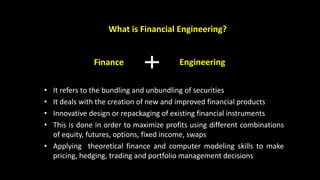
What is Financial Engineering?
• It refers to the bundling and unbundling of securities
• It deals with the creation of new and improved financial products
• Innovative design or repackaging of existing financial instruments
• This is done in order to maximize profits using different combinations
of equity, futures, options, fixed income, swaps
• Applying theoretical finance and computer modeling skills to make
pricing, hedging, trading and portfolio management decisions
Finance Engineering
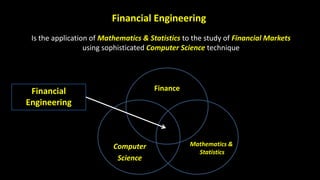
Financial Engineering
Is the application of Mathematics & Statistics to the study of Financial Markets
using sophisticated Computer Science technique
Finance
Mathematics &
Statistics
Computer
Science
Financial
Engineering
Financial engineering
• Financial engineering is a discipline which deals with the creation of new and
improved financial products through innovative design or repackaging of
existing financial instruments
• Financial engineering and innovations are seen in bonds, equity, derivatives and
in fields like mergers, acquisitions and corporate restructuring
• Some of the innovations in the Indian financial market are debt-oriented
schemes of mutual funds, interest rate futures, interest rate swaps, currency
swaps, floating rate bonds, money market mutual funds, etc.
Financial engineering
• Financial engineering and innovations are seen in bonds, equity,
derivatives and in fields like mergers, acquisitions and corporate
restructuring
• Some of the innovations in the Indian financial market are
• Debt-oriented Schemes Of Mutual Funds
• Interest Rate Futures
• Interest Rate Swaps, Currency Swaps
• Floating Rate Bonds, Money Market Mutual Funds, Etc.
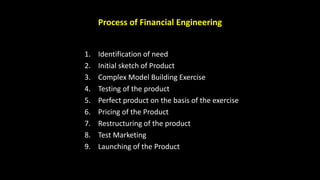
1. Identification of need
2. Initial sketch of Product
3. Complex Model Building Exercise
4. Testing of the product
5. Perfect product on the basis of the exercise
6. Pricing of the Product
7. Restructuring of the product
8. Test Marketing
9. Launching of the Product
Process of Financial Engineering
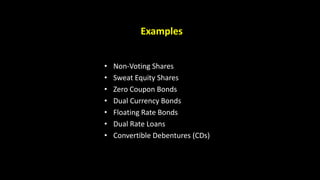
Examples
• Non-Voting Shares
• Sweat Equity Shares
• Zero Coupon Bonds
• Dual Currency Bonds
• Floating Rate Bonds
• Dual Rate Loans
• Convertible Debentures (CDs)
• Non-Voting Shares
• If such kind of equity securities are issued, it would have the following benefits:
• It would enable management to retain their control; and
• It can be bought by retail investors who do not bother about voting rights, but
are more concerned about dividends and returns
• Employee Stock Option Plan
• It is offered to employees and directors of the company to give them a sense of
ownership of the company and to encourage them to participate actively in the
management of the company.
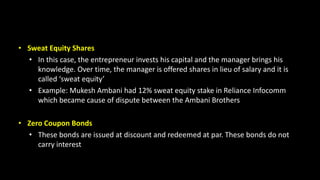
• Sweat Equity Shares
• In this case, the entrepreneur invests his capital and the manager brings his
knowledge. Over time, the manager is offered shares in lieu of salary and it is
called ‘sweat equity’
• Example: Mukesh Ambani had 12% sweat equity stake in Reliance Infocomm
which became cause of dispute between the Ambani Brothers
• Zero Coupon Bonds
• These bonds are issued at discount and redeemed at par. These bonds do not
carry interest
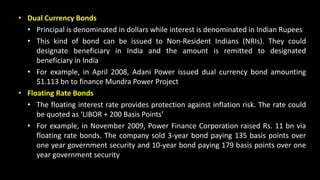
• Dual Currency Bonds
• Principal is denominated in dollars while interest is denominated in Indian Rupees
• This kind of bond can be issued to Non-Resident Indians (NRIs). They could
designate beneficiary in India and the amount is remitted to designated
beneficiary in India
• For example, in April 2008, Adani Power issued dual currency bond amounting
$1.113 bn to finance Mundra Power Project
• Floating Rate Bonds
• The floating interest rate provides protection against inflation risk. The rate could
be quoted as ‘LIBOR + 200 Basis Points’
• For example, in November 2009, Power Finance Corporation raised Rs. 11 bn via
floating rate bonds. The company sold 3-year bond paying 135 basis points over
one year government security and 10-year bond paying 179 basis points over one
year government security
• Dual Rate Loans
– In dual rate loans, fixed interest rate is charged to the borrower up to prefixed
period and thereafter loan is linked to benchmark rate
– For example, HDFC recently announced dual rate loan
Financial Engineering - Applications
• Investment Banking
• Corporate Strategic Planning
• Risk Management
• Primary and Derivatives Securities Valuation
• Financial Information System Management
• Portfolio Management
• Security Trading
Process of Financial Engineering
• Financial engineers work at investment banks, which cater to the
requirements of institutional clients. Identification of need involves the
objective which the investor wants to achieve through financially
engineered products
• For example, individual investors wanted to reduce their tax liability. To
help achieve this objective, mutual funds managers developed debt
oriented mutual fund schemes by introducing variations in mutual fund
schemes. Similarly, some investor might want to increase his exposure to a
particular sector like the real estate sector. So, he can invest in
infrastructure funds introduced by mutual fund managers
Thank You

Financial Engineering

  • 1.
    Financial Engineering Prepared By: MohammedJasir PV Assist. Professor MIIMS, Puthanangadi Contact No: 9605 69 32 66
  • 2.
  • 3.
  • 4.
    Introduction • Financial engineeringis an engineering discipline which deals with the creation of new and improved financial products through innovative design or repackaging of existing financial instruments • Financial engineering and innovations are seen in bonds, equity, derivatives and in fields like mergers, acquisitions and corporate restructuring • Some of the innovations in the Indian financial market are debt-oriented schemes of mutual funds, interest rate futures, interest rate swaps, currency swaps, floating rate bonds, money market mutual funds, etc.
  • 5.
    Definition - FinancialEngineering • Generalizing: Financial Engineering involves the design, the development, and the implementation of innovative financial instruments and processes, and the formulation of creative solutions to problems in finance – John Finnerty • Specializing: Financial Engineering is risk management via creative structural tools
  • 6.
    What is FinancialEngineering? • It refers to the bundling and unbundling of securities • It deals with the creation of new and improved financial products • Innovative design or repackaging of existing financial instruments • This is done in order to maximize profits using different combinations of equity, futures, options, fixed income, swaps • Applying theoretical finance and computer modeling skills to make pricing, hedging, trading and portfolio management decisions Finance Engineering
  • 7.
    Financial Engineering Is theapplication of Mathematics & Statistics to the study of Financial Markets using sophisticated Computer Science technique Finance Mathematics & Statistics Computer Science Financial Engineering
  • 8.
    Financial engineering • Financialengineering is a discipline which deals with the creation of new and improved financial products through innovative design or repackaging of existing financial instruments • Financial engineering and innovations are seen in bonds, equity, derivatives and in fields like mergers, acquisitions and corporate restructuring • Some of the innovations in the Indian financial market are debt-oriented schemes of mutual funds, interest rate futures, interest rate swaps, currency swaps, floating rate bonds, money market mutual funds, etc.
  • 9.
    Financial engineering • Financialengineering and innovations are seen in bonds, equity, derivatives and in fields like mergers, acquisitions and corporate restructuring • Some of the innovations in the Indian financial market are • Debt-oriented Schemes Of Mutual Funds • Interest Rate Futures • Interest Rate Swaps, Currency Swaps • Floating Rate Bonds, Money Market Mutual Funds, Etc.
  • 10.
    1. Identification ofneed 2. Initial sketch of Product 3. Complex Model Building Exercise 4. Testing of the product 5. Perfect product on the basis of the exercise 6. Pricing of the Product 7. Restructuring of the product 8. Test Marketing 9. Launching of the Product Process of Financial Engineering
  • 11.
    Examples • Non-Voting Shares •Sweat Equity Shares • Zero Coupon Bonds • Dual Currency Bonds • Floating Rate Bonds • Dual Rate Loans • Convertible Debentures (CDs)
  • 12.
    • Non-Voting Shares •If such kind of equity securities are issued, it would have the following benefits: • It would enable management to retain their control; and • It can be bought by retail investors who do not bother about voting rights, but are more concerned about dividends and returns • Employee Stock Option Plan • It is offered to employees and directors of the company to give them a sense of ownership of the company and to encourage them to participate actively in the management of the company.
  • 13.
    • Sweat EquityShares • In this case, the entrepreneur invests his capital and the manager brings his knowledge. Over time, the manager is offered shares in lieu of salary and it is called ‘sweat equity’ • Example: Mukesh Ambani had 12% sweat equity stake in Reliance Infocomm which became cause of dispute between the Ambani Brothers • Zero Coupon Bonds • These bonds are issued at discount and redeemed at par. These bonds do not carry interest
  • 14.
    • Dual CurrencyBonds • Principal is denominated in dollars while interest is denominated in Indian Rupees • This kind of bond can be issued to Non-Resident Indians (NRIs). They could designate beneficiary in India and the amount is remitted to designated beneficiary in India • For example, in April 2008, Adani Power issued dual currency bond amounting $1.113 bn to finance Mundra Power Project • Floating Rate Bonds • The floating interest rate provides protection against inflation risk. The rate could be quoted as ‘LIBOR + 200 Basis Points’ • For example, in November 2009, Power Finance Corporation raised Rs. 11 bn via floating rate bonds. The company sold 3-year bond paying 135 basis points over one year government security and 10-year bond paying 179 basis points over one year government security
  • 15.
    • Dual RateLoans – In dual rate loans, fixed interest rate is charged to the borrower up to prefixed period and thereafter loan is linked to benchmark rate – For example, HDFC recently announced dual rate loan
  • 16.
    Financial Engineering -Applications • Investment Banking • Corporate Strategic Planning • Risk Management • Primary and Derivatives Securities Valuation • Financial Information System Management • Portfolio Management • Security Trading
  • 17.
    Process of FinancialEngineering • Financial engineers work at investment banks, which cater to the requirements of institutional clients. Identification of need involves the objective which the investor wants to achieve through financially engineered products • For example, individual investors wanted to reduce their tax liability. To help achieve this objective, mutual funds managers developed debt oriented mutual fund schemes by introducing variations in mutual fund schemes. Similarly, some investor might want to increase his exposure to a particular sector like the real estate sector. So, he can invest in infrastructure funds introduced by mutual fund managers
  • 18.