Inventory Control
IntroductionThe term inventory means the value or amount of materials or resource on hand. It includes raw material, work-in-process, finished goods & stores & spares. Inventory Control is the process by which inventory is measured and regulated according to predetermined norms such as economic lot size for order or production, safety stock, minimum level, maximum level, order level etc. Inventory control pertains primarily to the administration of established policies, systems & procedures in order to reduce the inventory cost.
Objectives of Inventory Control To meet unforeseen future demand due to variation in forecast figures and actual figures.To average out demand fluctuations due to seasonal or cyclic variations.To meet the customer requirement timely, effectively, efficiently, smoothly and satisfactorily.To smoothen the production process.To facilitate intermittent production of several products on the same facility.To gain economy of production or purchase in lots.
To reduce loss due to changes in prices of inventory items.To meet the time lag for transportation of goods.To meet the technological constraints of production/process.To balance various costs of inventory such as order cost or set up cost and inventory carrying cost.To balance the stock out cost/opportunity cost due to loss of sales against the costs of inventory.To minimize losses due to deterioration, obsolescence, damage, pilferage etc. To stabilize employment and improve lab our relations by inventory of human resources and machine efforts.
Factors Affecting Inventory ControlType of productType of manufactureVolume of production
Benefits of Inventory Control Ensures an adequate supply of materialsMinimizes inventory costsFacilitates purchasing economiesEliminates duplication  in orderingBetter utilization of available stocksProvides a check against the loss of materialsFacilitates cost accounting activitiesEnables management in cost comparisonLocates & disposes inactive & obsolete store itemsConsistent & reliable basis for financial statements
Inventory
Nature of InventoryDependent demand- Demand for one product is linked with demand for another product, such as components, subassemblies etc.Independent demand- Demand for a product/ service occurs independently of demand for any other for any other product or service, such as finished product, service parts, lubricants, cutting oil, greases, preservatives etc.
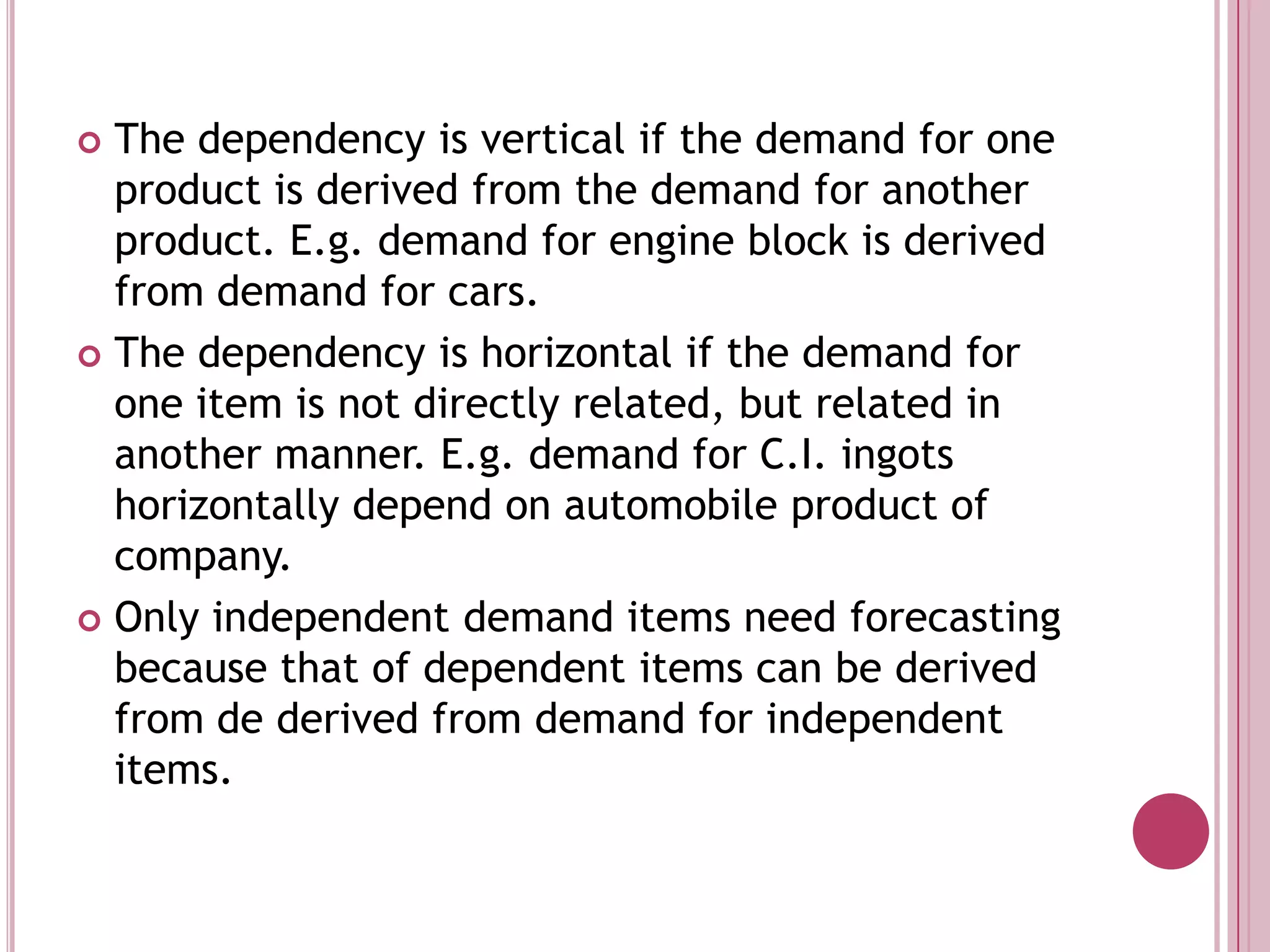
The dependency is vertical if the demand for one product is derived from the demand for another product. E.g. demand for engine block is derived from demand for cars.The dependency is horizontal if the demand for one item is not directly related, but related in another manner. E.g. demand for C.I. ingots horizontally depend on automobile product of company.Only independent demand items need forecasting because that of dependent items can be derived from de derived from demand for independent items.
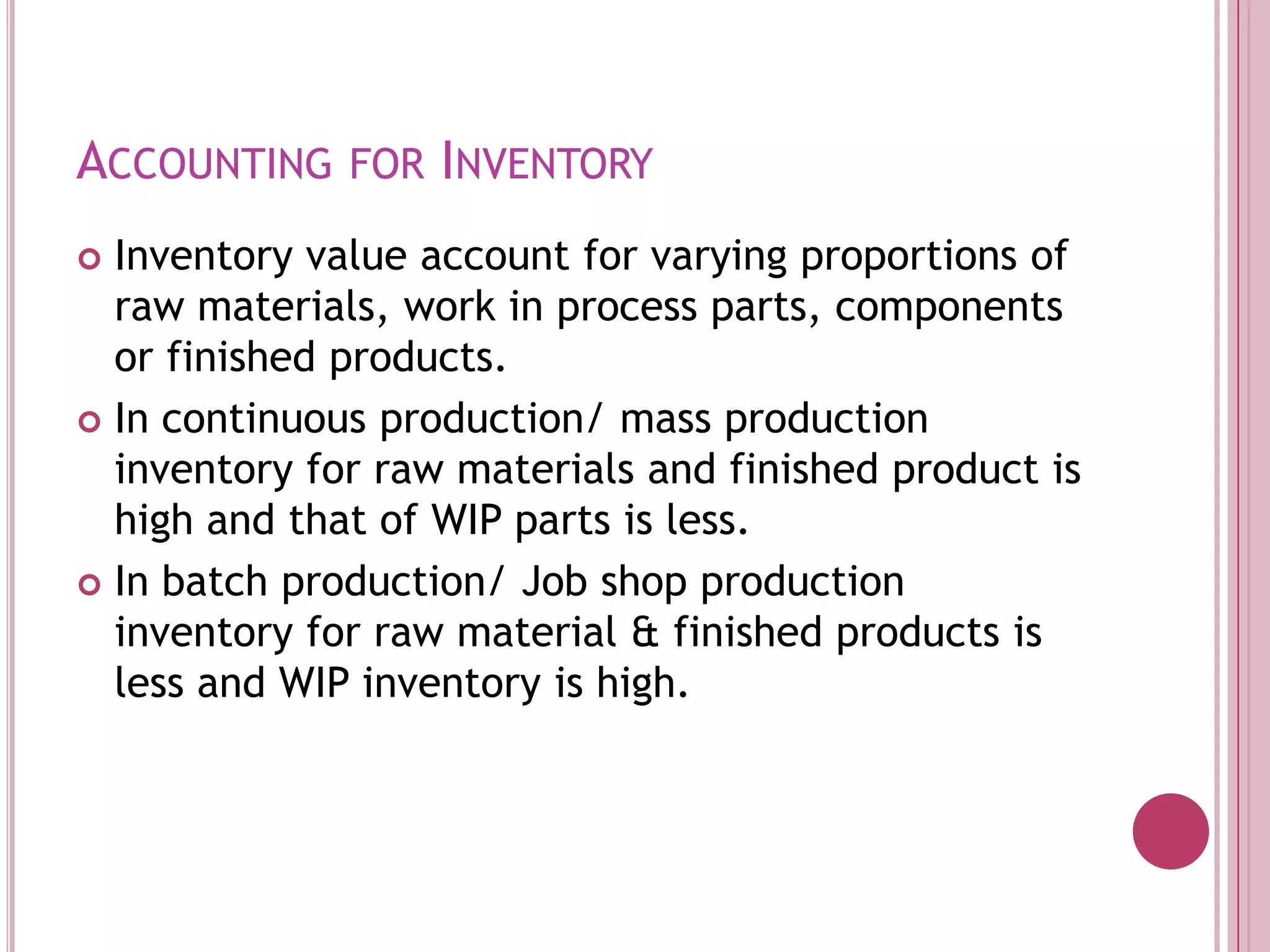
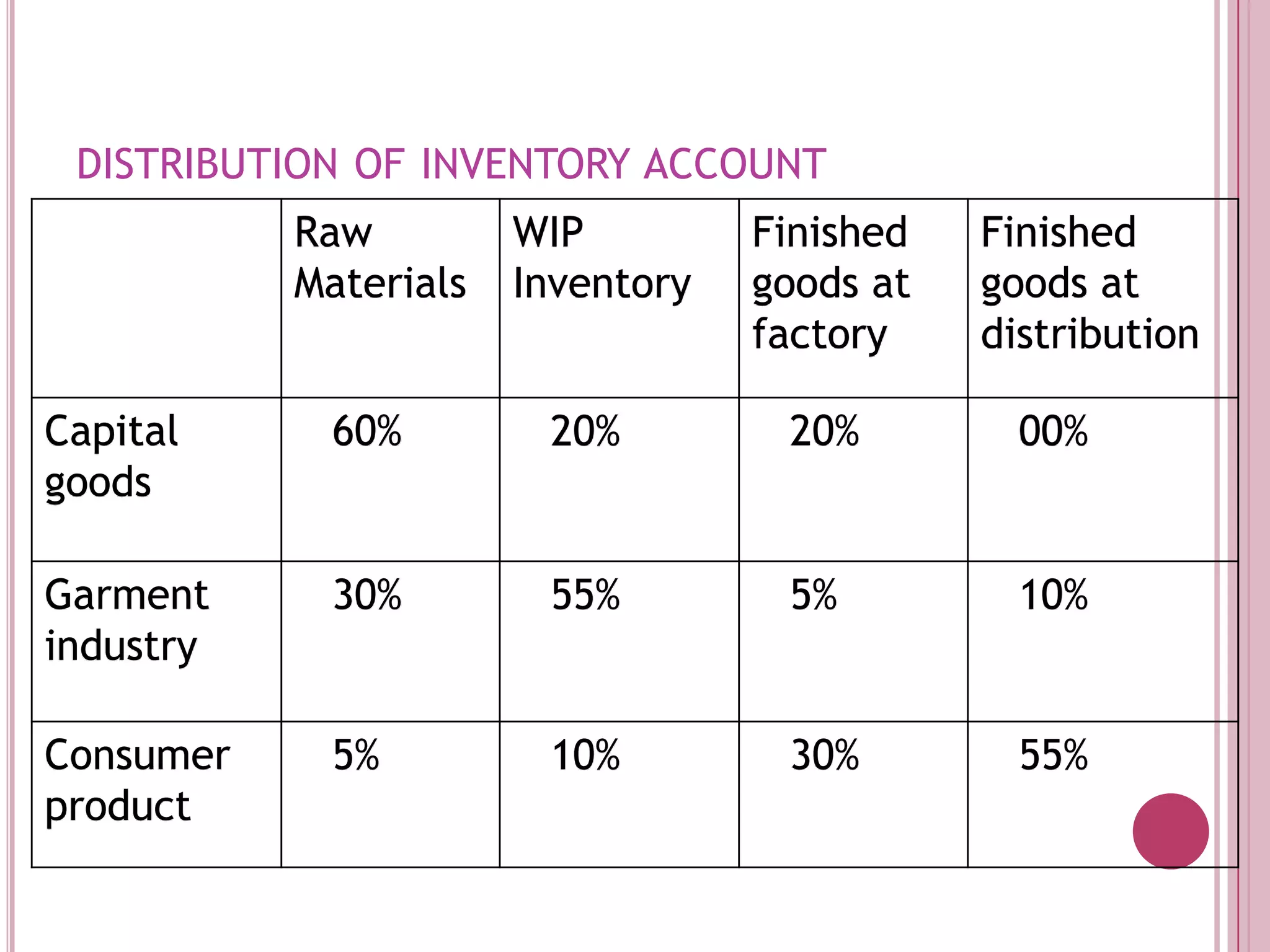
Accounting for Inventory Inventory value account for varying proportions of raw materials, work in process parts, components or finished products. In continuous production/ mass production inventory for raw materials and finished product is high and that of WIP parts is less. In batch production/ Job shop production inventory for raw material & finished products is less and WIP inventory is high.
distribution of inventory account
Inventory Costs
Types of Inventory CostsOrdering (purchasing) costsInventory carrying (holding) costsOut of stock/shortage costsOther costs
Ordering CostsIt is the cost of ordering the item and securing its supply. Includes-Expenses from raising the indentPurchase requisition by user department till the execution of orderReceipt and inspection of material
Inventory Carrying CostsCosts incurred for holding the volume of inventory and measured as a percentage of unit cost of an item.It includes-Capital costObsolescence costDeterioration costTaxes on inventoryInsurance costStorage & handling cost
Aljian states carrying costs as-Capital costsStorage space costsInventory service costsHandling-equipment costsInventory risk costs
Out-of-Stock CostsIt is the loss which occurs or which may occur due to non availability of material.It includes-Break down/delay in productionBack orderingLost salesLoss of service to customers, loss of goodwill, loss due to lagging behind the competitors, etc.
Other CostsCapacity CostsOver-time paymentsLay-offs & idle timeSet-up CostsMachine set-upStart-up scrap generated from getting a production run startedOver-stocking Costs
Inventory Models
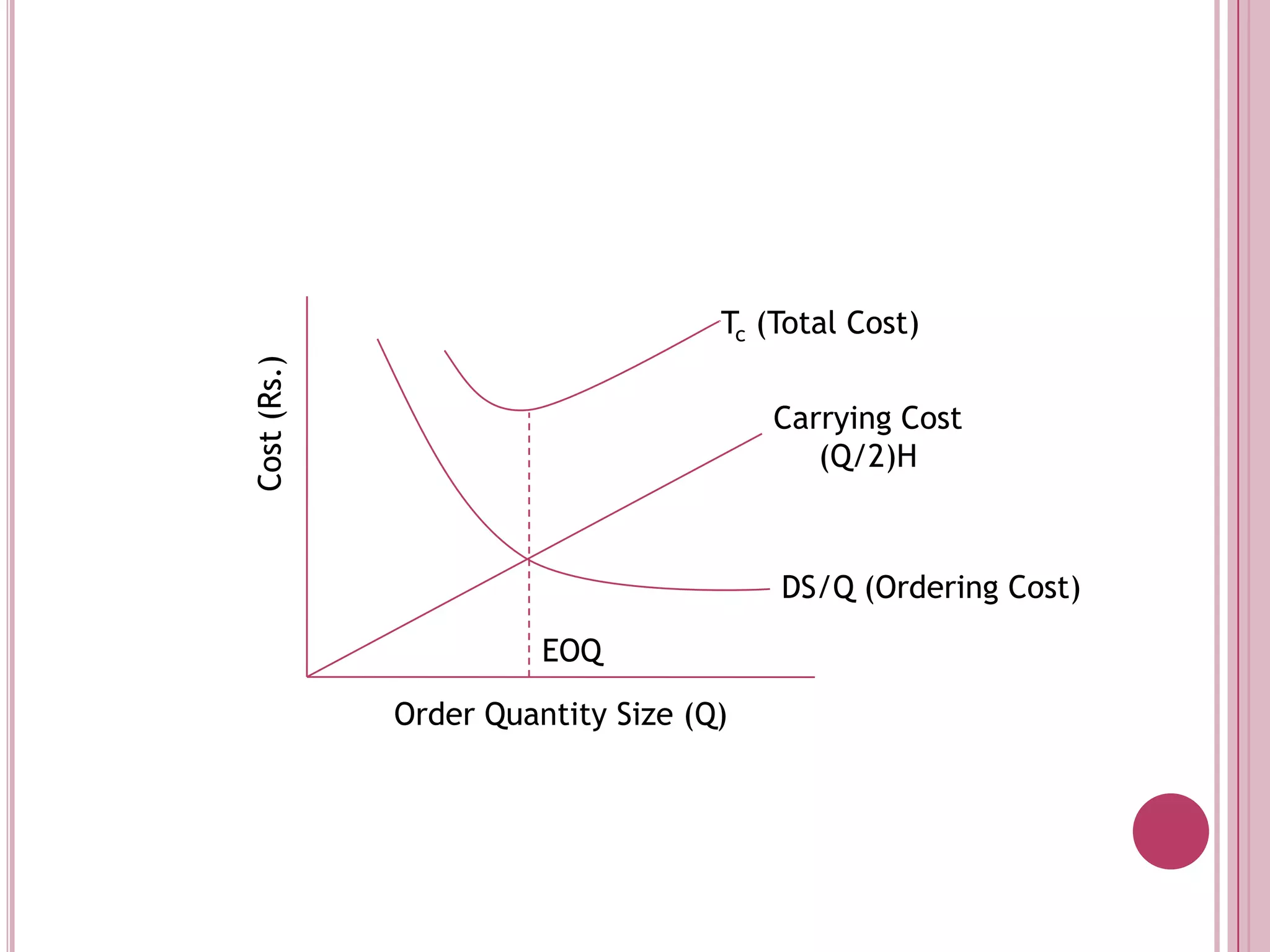
Economic Order Quantity (EOQ)EOQ or Fixed Order Quantity system is the technique of ordering materials whenever stock reaches the reorder point.Economic order quality deals when the cost of procurement and handling of inventory are at optimum level and total cost is  minimum.In this technique, the order quantity is larger than a single period’s ne requirement so that ordering costs & holding costs balance out.
Tc (Total Cost)Carrying Cost (Q/2)HCost (Rs.)DS/Q (Ordering Cost)EOQOrder Quantity Size (Q)
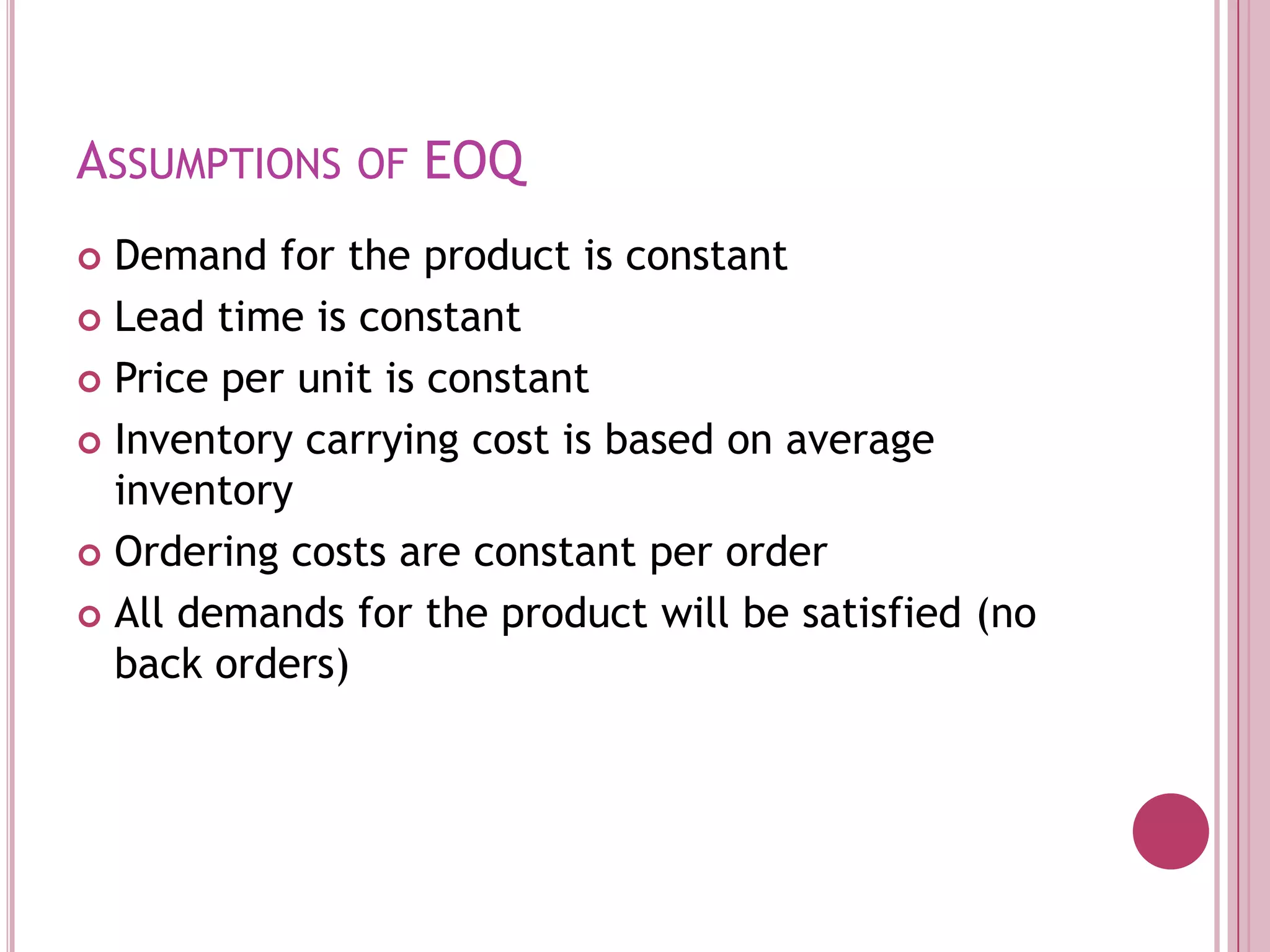
Assumptions of EOQDemand for the product is constantLead time is constantPrice per unit is constantInventory carrying cost is based on average inventoryOrdering costs are constant per orderAll demands for the product will be satisfied (no back orders)
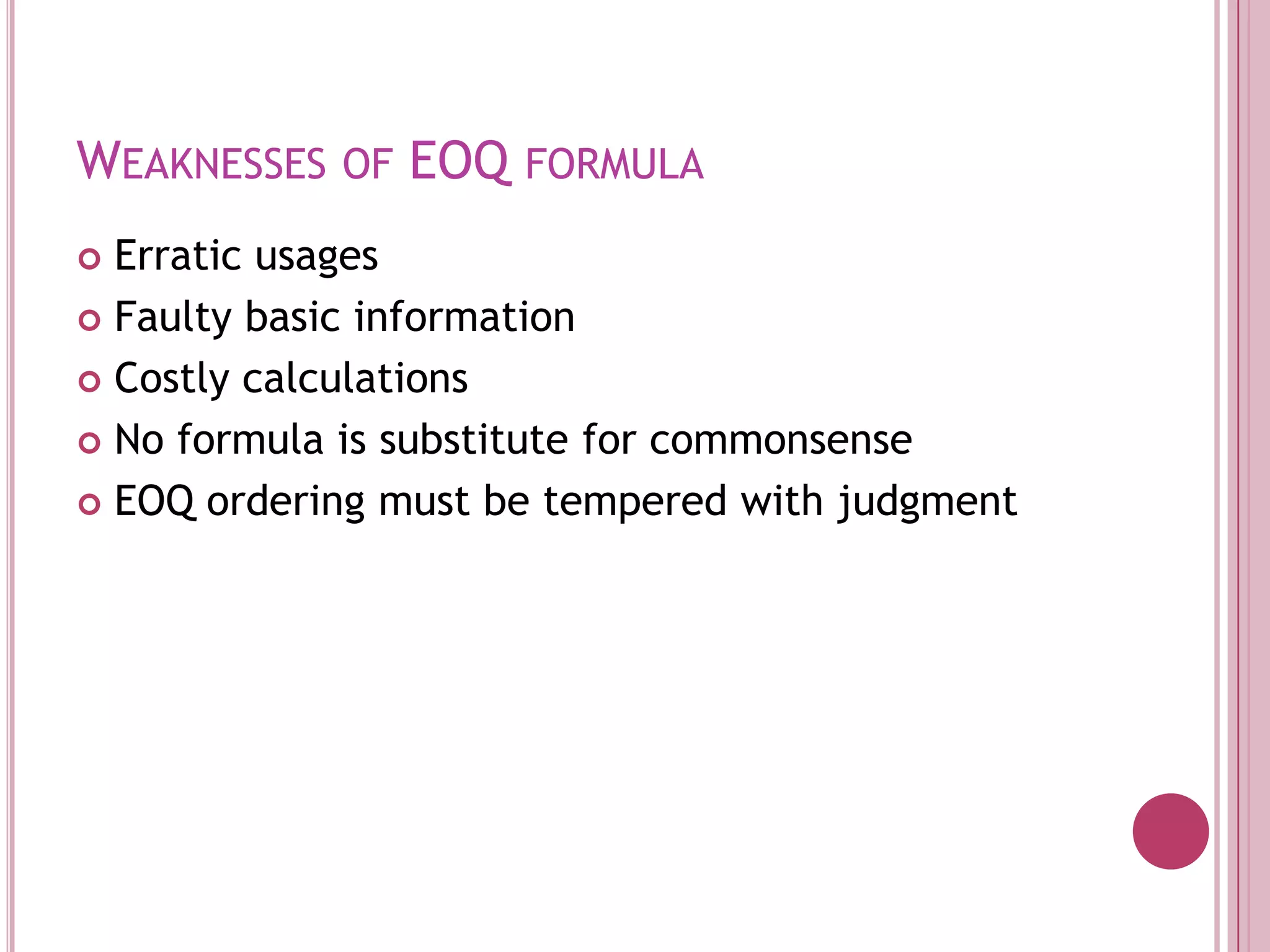
Weaknesses of EOQ formulaErratic usagesFaulty basic informationCostly calculationsNo formula is substitute for commonsenseEOQ ordering must be tempered with judgment
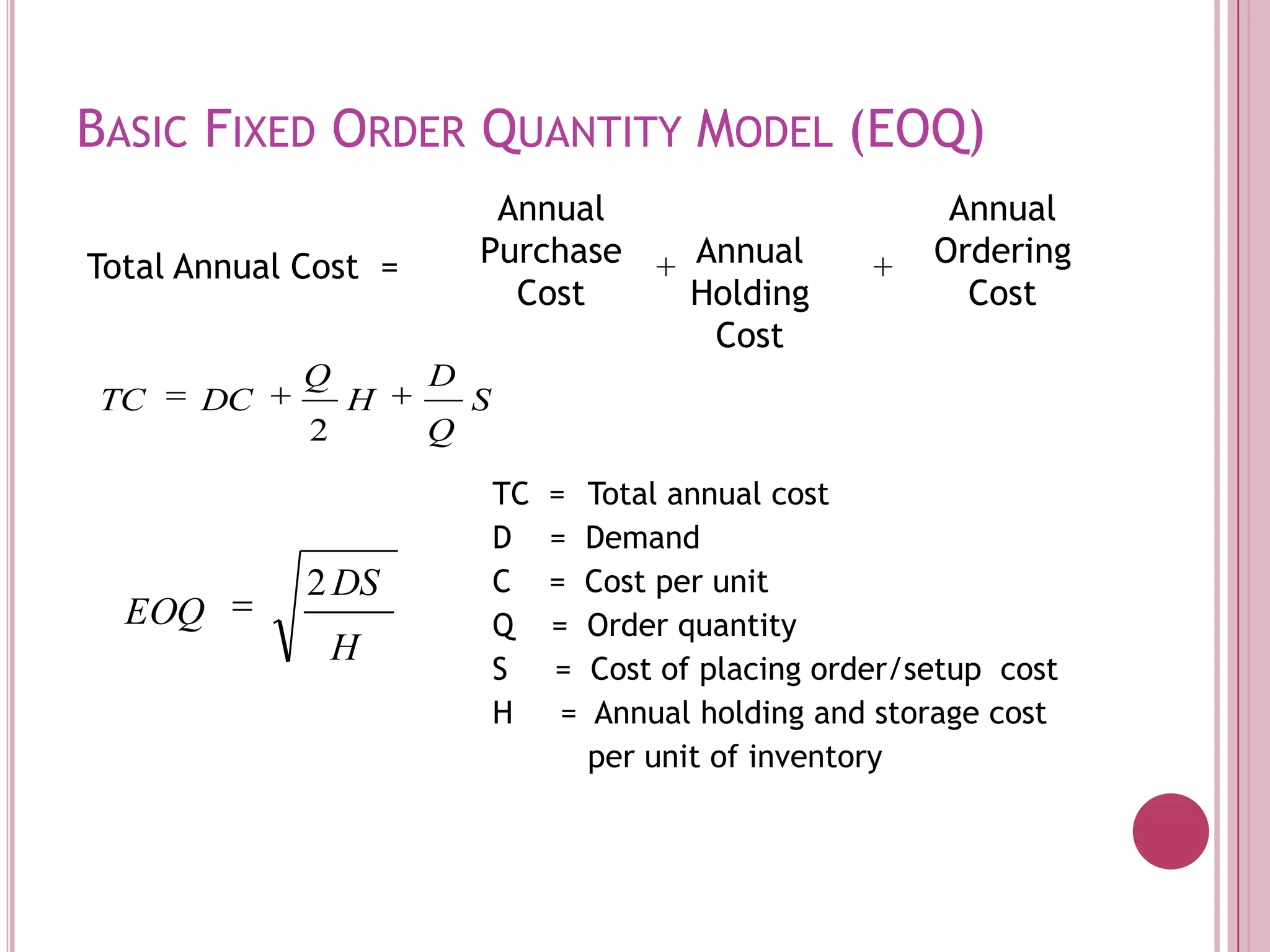
AnnualPurchaseCostAnnualOrderingCostTotal Annual Cost  =++TC  =	Total annual costD    =  DemandC    =  Cost per unitQ    =  Order quantityS     =  Cost of placing order/setup 	costH     =  Annual holding and storage cost 	per unit of inventory Basic Fixed Order Quantity Model (EOQ)AnnualHoldingCost
Order Points & Service levels
Important TermsMinimum Level – It is the minimum stock to be maintained for smooth production.Maximum Level – It is the level of stock, beyond which a firm should not maintain the stock.Reorder Level – The stock level at which an order should be placed.Safety Stock – Stock for usage at normal rate during the extension of lead time.Reserve Stock - Excess usage requirement during normal lead time.Buffer Stock – Normal lead time consumption.
Classification of Inventory Control
Always Better Control (ABC) AnalysisThis technique divides inventory into three categories A, B & C based on their annual consumption value.It is also known as Selective Inventory Control Method (SIM)This method is a means of categorizing inventory items according to the potential amount to be controlled.ABC analysis has universal application for fields requiring selective control.
Procedure for ABC AnalysisMake the list of all items of inventory.Determine the annual volume of usage & money value of each item.Multiply each item’s annual volume by its rupee value. Compute each item’s percentage of the total inventory in terms of annual usage in rupees.Select the top 10% of all items which have the highest rupee percentages & classify them as “A” items.Select the next 20% of all items with the next highest rupee percentages & designate them “B” items.The next 70% of all items with the lowest rupee percentages are “C” items.
Advantages of ABC AnalysisHelps to exercise selective controlGives rewarding results quicklyHelps to point out obsolete stocks easily.In case of “A” items careful attention can be paid at every step such as estimate of requirements, purchase, safety stock, receipts, inspections, issues, etc. & close control is maintained.In case of “C” items, recording & follow up, etc. may be dispensed with or combined. Helps better planning of inventory controlProvides sound basis for allocation of funds & human resources.
Disadvantages of ABC AnalysisProper standardization & codification of inventory items needed.Considers only money value of items & neglects the importance of items for the production process or assembly or functioning.Periodic review becomes difficult if only ABC analysis is recalled. When other important factors make it obligatory to concentrate on “C” items more, the purpose of ABC analysis is defeated.
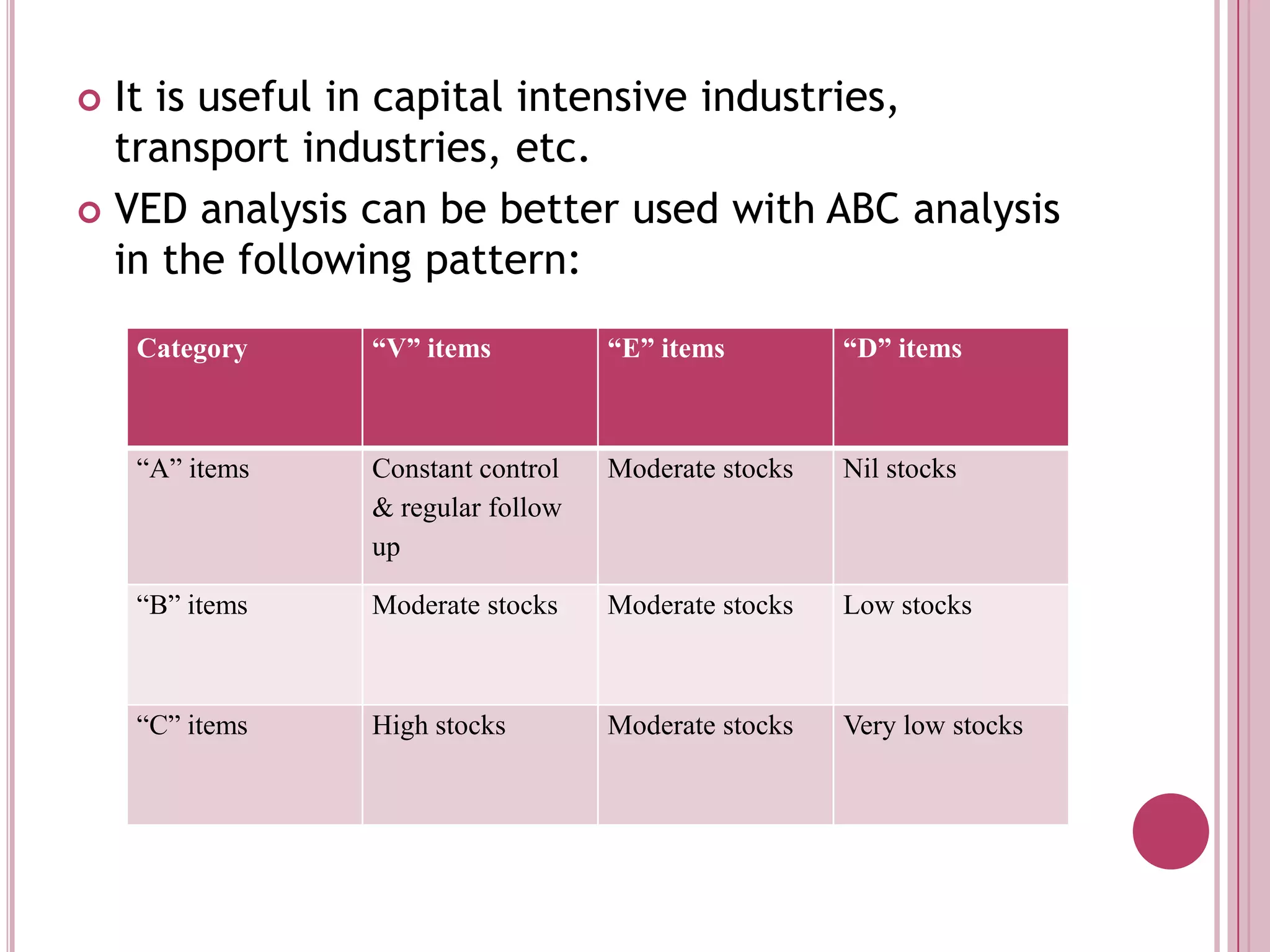
VED ClassificationVED: Vital, Essential & Desirable classificationVED classification is based on the criticality of the inventories.Vital items – Its shortage may cause havoc & stop the work in organization. They are stocked adequately to ensure smooth operation.Essential items -  Here, reasonable risk can be taken. If not available, the plant does not stop; but the efficiency of operations is adversely affected due to expediting expenses. They should be sufficiently stocked to ensure regular flow of work.Desirable items – Its non availability does not stop the work because they can be easily purchased from the market as & when needed. They may be stocked very low or not stocked.
It is useful in capital intensive industries, transport industries, etc. VED analysis can be better used with ABC analysis in the following pattern:
FSN AnalysisFSN: Fast moving, slow moving & non movingClassification is based on the pattern of issues from stores & is useful in controlling obsolescence.Date of receipt or last date of issue, whichever is later, is taken to determine the no. of months which have lapsed since the last transaction.The items are usually grouped in periods of 12 months.It helps to avoid investments in non moving or slow items. It is also useful in facilitating timely control.
For analysis, the issues of items in past two or three years are considered. If there are no issues of an item during the period, it is “N” item. Then up to certain limit, say 10-15 issues in the period, the item is “S” itemThe items exceeding such limit of no. of issues during the period are “F” items. The period of consideration & the limiting number of issues vary from organization to organization.

Inventory Control

  • 1.
  • 2.
    IntroductionThe term inventorymeans the value or amount of materials or resource on hand. It includes raw material, work-in-process, finished goods & stores & spares. Inventory Control is the process by which inventory is measured and regulated according to predetermined norms such as economic lot size for order or production, safety stock, minimum level, maximum level, order level etc. Inventory control pertains primarily to the administration of established policies, systems & procedures in order to reduce the inventory cost.
  • 3.
    Objectives of InventoryControl To meet unforeseen future demand due to variation in forecast figures and actual figures.To average out demand fluctuations due to seasonal or cyclic variations.To meet the customer requirement timely, effectively, efficiently, smoothly and satisfactorily.To smoothen the production process.To facilitate intermittent production of several products on the same facility.To gain economy of production or purchase in lots.
  • 4.
    To reduce lossdue to changes in prices of inventory items.To meet the time lag for transportation of goods.To meet the technological constraints of production/process.To balance various costs of inventory such as order cost or set up cost and inventory carrying cost.To balance the stock out cost/opportunity cost due to loss of sales against the costs of inventory.To minimize losses due to deterioration, obsolescence, damage, pilferage etc. To stabilize employment and improve lab our relations by inventory of human resources and machine efforts.
  • 5.
    Factors Affecting InventoryControlType of productType of manufactureVolume of production
  • 6.
    Benefits of InventoryControl Ensures an adequate supply of materialsMinimizes inventory costsFacilitates purchasing economiesEliminates duplication in orderingBetter utilization of available stocksProvides a check against the loss of materialsFacilitates cost accounting activitiesEnables management in cost comparisonLocates & disposes inactive & obsolete store itemsConsistent & reliable basis for financial statements
  • 7.
  • 8.
    Nature of InventoryDependentdemand- Demand for one product is linked with demand for another product, such as components, subassemblies etc.Independent demand- Demand for a product/ service occurs independently of demand for any other for any other product or service, such as finished product, service parts, lubricants, cutting oil, greases, preservatives etc.
  • 9.
    The dependency isvertical if the demand for one product is derived from the demand for another product. E.g. demand for engine block is derived from demand for cars.The dependency is horizontal if the demand for one item is not directly related, but related in another manner. E.g. demand for C.I. ingots horizontally depend on automobile product of company.Only independent demand items need forecasting because that of dependent items can be derived from de derived from demand for independent items.
  • 10.
    Accounting for InventoryInventory value account for varying proportions of raw materials, work in process parts, components or finished products. In continuous production/ mass production inventory for raw materials and finished product is high and that of WIP parts is less. In batch production/ Job shop production inventory for raw material & finished products is less and WIP inventory is high.
  • 11.
  • 12.
  • 13.
    Types of InventoryCostsOrdering (purchasing) costsInventory carrying (holding) costsOut of stock/shortage costsOther costs
  • 14.
    Ordering CostsIt isthe cost of ordering the item and securing its supply. Includes-Expenses from raising the indentPurchase requisition by user department till the execution of orderReceipt and inspection of material
  • 15.
    Inventory Carrying CostsCostsincurred for holding the volume of inventory and measured as a percentage of unit cost of an item.It includes-Capital costObsolescence costDeterioration costTaxes on inventoryInsurance costStorage & handling cost
  • 16.
    Aljian states carryingcosts as-Capital costsStorage space costsInventory service costsHandling-equipment costsInventory risk costs
  • 17.
    Out-of-Stock CostsIt isthe loss which occurs or which may occur due to non availability of material.It includes-Break down/delay in productionBack orderingLost salesLoss of service to customers, loss of goodwill, loss due to lagging behind the competitors, etc.
  • 18.
    Other CostsCapacity CostsOver-timepaymentsLay-offs & idle timeSet-up CostsMachine set-upStart-up scrap generated from getting a production run startedOver-stocking Costs
  • 19.
  • 20.
    Economic Order Quantity(EOQ)EOQ or Fixed Order Quantity system is the technique of ordering materials whenever stock reaches the reorder point.Economic order quality deals when the cost of procurement and handling of inventory are at optimum level and total cost is minimum.In this technique, the order quantity is larger than a single period’s ne requirement so that ordering costs & holding costs balance out.
  • 21.
    Tc (Total Cost)CarryingCost (Q/2)HCost (Rs.)DS/Q (Ordering Cost)EOQOrder Quantity Size (Q)
  • 22.
    Assumptions of EOQDemandfor the product is constantLead time is constantPrice per unit is constantInventory carrying cost is based on average inventoryOrdering costs are constant per orderAll demands for the product will be satisfied (no back orders)
  • 23.
    Weaknesses of EOQformulaErratic usagesFaulty basic informationCostly calculationsNo formula is substitute for commonsenseEOQ ordering must be tempered with judgment
  • 24.
    AnnualPurchaseCostAnnualOrderingCostTotal Annual Cost =++TC = Total annual costD = DemandC = Cost per unitQ = Order quantityS = Cost of placing order/setup costH = Annual holding and storage cost per unit of inventory Basic Fixed Order Quantity Model (EOQ)AnnualHoldingCost
  • 25.
    Order Points &Service levels
  • 26.
    Important TermsMinimum Level– It is the minimum stock to be maintained for smooth production.Maximum Level – It is the level of stock, beyond which a firm should not maintain the stock.Reorder Level – The stock level at which an order should be placed.Safety Stock – Stock for usage at normal rate during the extension of lead time.Reserve Stock - Excess usage requirement during normal lead time.Buffer Stock – Normal lead time consumption.
  • 27.
  • 28.
    Always Better Control(ABC) AnalysisThis technique divides inventory into three categories A, B & C based on their annual consumption value.It is also known as Selective Inventory Control Method (SIM)This method is a means of categorizing inventory items according to the potential amount to be controlled.ABC analysis has universal application for fields requiring selective control.
  • 29.
    Procedure for ABCAnalysisMake the list of all items of inventory.Determine the annual volume of usage & money value of each item.Multiply each item’s annual volume by its rupee value. Compute each item’s percentage of the total inventory in terms of annual usage in rupees.Select the top 10% of all items which have the highest rupee percentages & classify them as “A” items.Select the next 20% of all items with the next highest rupee percentages & designate them “B” items.The next 70% of all items with the lowest rupee percentages are “C” items.
  • 30.
    Advantages of ABCAnalysisHelps to exercise selective controlGives rewarding results quicklyHelps to point out obsolete stocks easily.In case of “A” items careful attention can be paid at every step such as estimate of requirements, purchase, safety stock, receipts, inspections, issues, etc. & close control is maintained.In case of “C” items, recording & follow up, etc. may be dispensed with or combined. Helps better planning of inventory controlProvides sound basis for allocation of funds & human resources.
  • 31.
    Disadvantages of ABCAnalysisProper standardization & codification of inventory items needed.Considers only money value of items & neglects the importance of items for the production process or assembly or functioning.Periodic review becomes difficult if only ABC analysis is recalled. When other important factors make it obligatory to concentrate on “C” items more, the purpose of ABC analysis is defeated.
  • 32.
    VED ClassificationVED: Vital,Essential & Desirable classificationVED classification is based on the criticality of the inventories.Vital items – Its shortage may cause havoc & stop the work in organization. They are stocked adequately to ensure smooth operation.Essential items - Here, reasonable risk can be taken. If not available, the plant does not stop; but the efficiency of operations is adversely affected due to expediting expenses. They should be sufficiently stocked to ensure regular flow of work.Desirable items – Its non availability does not stop the work because they can be easily purchased from the market as & when needed. They may be stocked very low or not stocked.
  • 33.
    It is usefulin capital intensive industries, transport industries, etc. VED analysis can be better used with ABC analysis in the following pattern:
  • 34.
    FSN AnalysisFSN: Fastmoving, slow moving & non movingClassification is based on the pattern of issues from stores & is useful in controlling obsolescence.Date of receipt or last date of issue, whichever is later, is taken to determine the no. of months which have lapsed since the last transaction.The items are usually grouped in periods of 12 months.It helps to avoid investments in non moving or slow items. It is also useful in facilitating timely control.
  • 35.
    For analysis, theissues of items in past two or three years are considered. If there are no issues of an item during the period, it is “N” item. Then up to certain limit, say 10-15 issues in the period, the item is “S” itemThe items exceeding such limit of no. of issues during the period are “F” items. The period of consideration & the limiting number of issues vary from organization to organization.