
Prepared By:
Mohammed Jasir PV
Assist. Professor
MIIMS, Puthanangadi
Contact No: 9605 69 32 66
Corporate Governance
• Overview
• Pillars
• Parties
• Elements
What is Corporate Governance?
• If management is about running the business, corporate
governance is about seeing that it is run properly
• All companies need managing and governing
Definition
• “Corporate governance involves a set of relationships between a company’s
management, its board, its shareholders and other stakeholders. Corporate
governance also provides the structure through which the objectives of the
company are set, and the means of attaining those objectives and
monitoring performance are determined.”
Corporate Governance
• It refers to the way a corporation is governed
• It is the technique by which companies are directed and managed
• It means carrying the business as per the stakeholders’ desires
• It is actually conducted by the board of Directors and the concerned
committees for the company’s stakeholder’s benefit
• It is all about balancing individual and societal goals, as well as,
economic and social goals
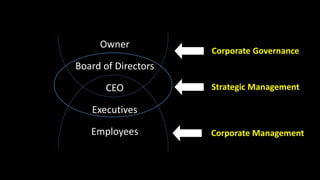
Owner
Board of Directors
CEO
Executives
Employees
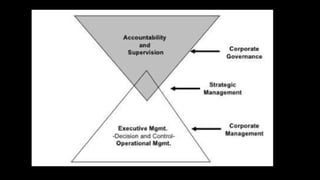
Corporate Governance
Strategic Management
Corporate Management
Why Corporate Governance?
• Better access to external finance
• Lower costs of capital – (interest rates on loans )
• Improved company performance – (sustainability)
• Higher firm valuation and share performance
• Reduced risk
Corporate Governance - Parties
• Share holders – Those who own the company
• Manager - Guardians of the Company’s assets for the Shareholders
• Directors - Who use the Company’s assets
Corporate Governance is NOT
• Corporate governance ≠ corporate / financial management
• Corporate governance ≠ corporate social responsibility or
business ethics
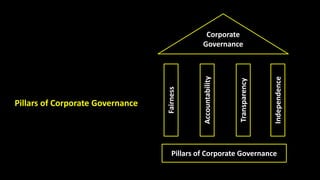
Pillars of Corporate Governance
Fairness
Accountability
Transparency
Independence
Corporate
Governance
Pillars of Corporate Governance
• Accountability
• Ensure that management is accountable to the Board
• Ensure that the Board is accountable to shareholders
• Fairness
• Protect Shareholders rights
• Treat all shareholders including minorities, equitably
• Provide effective redress for violations
• Transparency
• Ensure timely, accurate disclosure on all material matters, including
the financial situation, performance, ownership and corporate
governance
• Independence
• Procedures and structures are in place so as to minimise, or avoid
completely conflicts of interest
• Independent Directors and Advisers i.e. free from the influence of
others
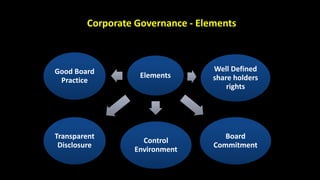
Corporate Governance - Elements
Elements
Well Defined
share holders
rights
Board
Commitment
Control
Environment
Transparent
Disclosure
Good Board
Practice
Good Board Practices
• Clearly defined roles and authorities
• Duties and responsibilities of Directors understood
• Board is well structured
• Appropriate composition and mix of skills
• Appropriate Board procedures
• Director remuneration in line with best practice
• Board self-evaluation and training conducted
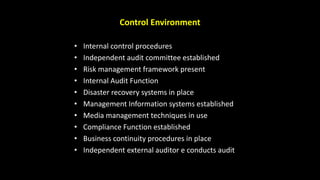
Control Environment
• Internal control procedures
• Independent audit committee established
• Risk management framework present
• Internal Audit Function
• Disaster recovery systems in place
• Management Information systems established
• Media management techniques in use
• Compliance Function established
• Business continuity procedures in place
• Independent external auditor e conducts audit
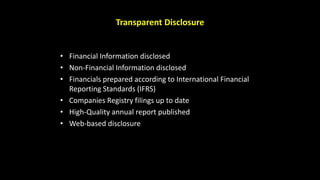
Transparent Disclosure
• Financial Information disclosed
• Non-Financial Information disclosed
• Financials prepared according to International Financial
Reporting Standards (IFRS)
• Companies Registry filings up to date
• High-Quality annual report published
• Web-based disclosure
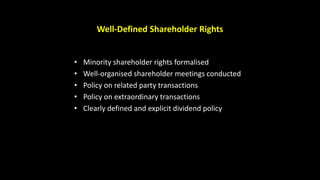
Well-Defined Shareholder Rights
• Minority shareholder rights formalised
• Well-organised shareholder meetings conducted
• Policy on related party transactions
• Policy on extraordinary transactions
• Clearly defined and explicit dividend policy
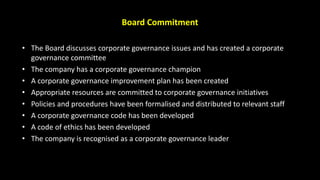
Board Commitment
• The Board discusses corporate governance issues and has created a corporate
governance committee
• The company has a corporate governance champion
• A corporate governance improvement plan has been created
• Appropriate resources are committed to corporate governance initiatives
• Policies and procedures have been formalised and distributed to relevant staff
• A corporate governance code has been developed
• A code of ethics has been developed
• The company is recognised as a corporate governance leader
Thank You

Corporate Governance

  • 1.
    Prepared By: Mohammed JasirPV Assist. Professor MIIMS, Puthanangadi Contact No: 9605 69 32 66
  • 2.
    Corporate Governance • Overview •Pillars • Parties • Elements
  • 3.
    What is CorporateGovernance? • If management is about running the business, corporate governance is about seeing that it is run properly • All companies need managing and governing
  • 4.
    Definition • “Corporate governanceinvolves a set of relationships between a company’s management, its board, its shareholders and other stakeholders. Corporate governance also provides the structure through which the objectives of the company are set, and the means of attaining those objectives and monitoring performance are determined.”
  • 5.
    Corporate Governance • Itrefers to the way a corporation is governed • It is the technique by which companies are directed and managed • It means carrying the business as per the stakeholders’ desires • It is actually conducted by the board of Directors and the concerned committees for the company’s stakeholder’s benefit • It is all about balancing individual and societal goals, as well as, economic and social goals
  • 6.
    Owner Board of Directors CEO Executives Employees CorporateGovernance Strategic Management Corporate Management
  • 8.
    Why Corporate Governance? •Better access to external finance • Lower costs of capital – (interest rates on loans ) • Improved company performance – (sustainability) • Higher firm valuation and share performance • Reduced risk
  • 9.
    Corporate Governance -Parties • Share holders – Those who own the company • Manager - Guardians of the Company’s assets for the Shareholders • Directors - Who use the Company’s assets
  • 10.
    Corporate Governance isNOT • Corporate governance ≠ corporate / financial management • Corporate governance ≠ corporate social responsibility or business ethics
  • 11.
    Pillars of CorporateGovernance Fairness Accountability Transparency Independence Corporate Governance Pillars of Corporate Governance
  • 12.
    • Accountability • Ensurethat management is accountable to the Board • Ensure that the Board is accountable to shareholders • Fairness • Protect Shareholders rights • Treat all shareholders including minorities, equitably • Provide effective redress for violations
  • 13.
    • Transparency • Ensuretimely, accurate disclosure on all material matters, including the financial situation, performance, ownership and corporate governance • Independence • Procedures and structures are in place so as to minimise, or avoid completely conflicts of interest • Independent Directors and Advisers i.e. free from the influence of others
  • 14.
    Corporate Governance -Elements Elements Well Defined share holders rights Board Commitment Control Environment Transparent Disclosure Good Board Practice
  • 15.
    Good Board Practices •Clearly defined roles and authorities • Duties and responsibilities of Directors understood • Board is well structured • Appropriate composition and mix of skills • Appropriate Board procedures • Director remuneration in line with best practice • Board self-evaluation and training conducted
  • 16.
    Control Environment • Internalcontrol procedures • Independent audit committee established • Risk management framework present • Internal Audit Function • Disaster recovery systems in place • Management Information systems established • Media management techniques in use • Compliance Function established • Business continuity procedures in place • Independent external auditor e conducts audit
  • 17.
    Transparent Disclosure • FinancialInformation disclosed • Non-Financial Information disclosed • Financials prepared according to International Financial Reporting Standards (IFRS) • Companies Registry filings up to date • High-Quality annual report published • Web-based disclosure
  • 18.
    Well-Defined Shareholder Rights •Minority shareholder rights formalised • Well-organised shareholder meetings conducted • Policy on related party transactions • Policy on extraordinary transactions • Clearly defined and explicit dividend policy
  • 19.
    Board Commitment • TheBoard discusses corporate governance issues and has created a corporate governance committee • The company has a corporate governance champion • A corporate governance improvement plan has been created • Appropriate resources are committed to corporate governance initiatives • Policies and procedures have been formalised and distributed to relevant staff • A corporate governance code has been developed • A code of ethics has been developed • The company is recognised as a corporate governance leader
  • 20.