
Management Information Systems
Basics of MIS
Prepared By:
Mohammed Jasir PV
Asst. Professor
NBS, Koratty
Contact: 9605 69 32 66
Topics
• Management Information System
• Concept - MIS
• Components of MIS
• MIS Activites
• MIS Fonctions
• Characteristics of MIS
• Advantages of MIS
• Disadvantages of MIS
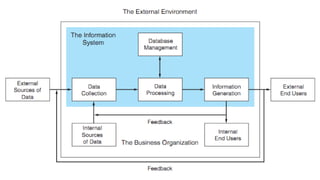
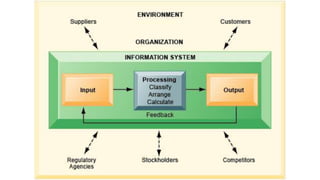
Management Information System
MIS – A Concept
The MIS is an idea which is associated with man, machine,
marketing and methods for collecting information’s from the
internal and external source and processing this information for the
purpose of facilitating the process of decision-making of the
business
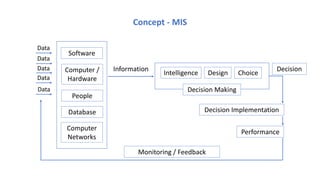
Concept - MIS
Software
Computer /
Hardware
People
Database
Computer
Networks
Information
Intelligence Design Choice
Decision Implementation
Performance
Data
Data
Data
Data
Data Decision Making
Decision
Monitoring / Feedback
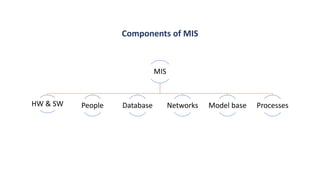
Components of MIS
MIS
HW & SW People Database Networks Model base Processes
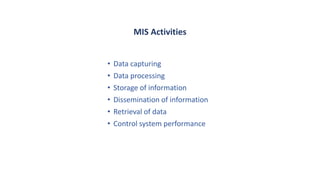
MIS Activities
• Data capturing
• Data processing
• Storage of information
• Dissemination of information
• Retrieval of data
• Control system performance
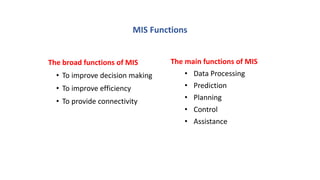
MIS Functions
The broad functions of MIS
• To improve decision making
• To improve efficiency
• To provide connectivity
The main functions of MIS
• Data Processing
• Prediction
• Planning
• Control
• Assistance
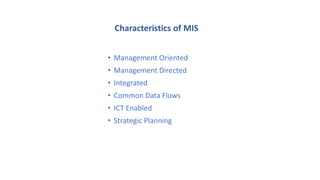
Characteristics of MIS
• Management Oriented
• Management Directed
• Integrated
• Common Data Flows
• ICT Enabled
• Strategic Planning
• Management oriented: - Top down design. Focus is to satisfy the information
needs of the management
• Management directed:- Management is involved in the design process,
continuous review and up gradation of MIS in order to develop a good quality
system. The system is structured. Minimizes the gap between expectation of the
management and the actual system
• Integrated:- Integrated with all the operations and functional activities of the
management. Only an integrated system can provide the complete picture of the
scenario.
Characteristics of MIS
• Common data Flows:- Data being stored into the system, retrieved from the
system, disseminated within the system or processed by the system can be
handled in an integrated manner. Avoids data duplication, data redundancy,
and help simplify operations
• Strategic Planning:- A high degree of planning goes into creating an MIS
• Bias towards centralization:- Centralized data management helps an MIS to
exercise version control as well as provide an integrated view of data to the
managers
• ICT enabled:- Information should be timely and accurate for effective
decision making
Advantages of MIS
• Smooth data flow
• Easy access to information
• Fast data processing and information retrieval
• Evaluation of the performance
• Cost control and time saving
• Compares budgets and actual performances
• Improved backup systems
• Takes away the uncertainty and risks
Disadvantages of MIS
• It is expensive to set up and configure
• Heavy reliance on technology
• Risk of fraud
THANK YOU

Basics of MIS

  • 1.
    Management Information Systems Basicsof MIS Prepared By: Mohammed Jasir PV Asst. Professor NBS, Koratty Contact: 9605 69 32 66
  • 2.
    Topics • Management InformationSystem • Concept - MIS • Components of MIS • MIS Activites • MIS Fonctions • Characteristics of MIS • Advantages of MIS • Disadvantages of MIS
  • 3.
  • 4.
    MIS – AConcept The MIS is an idea which is associated with man, machine, marketing and methods for collecting information’s from the internal and external source and processing this information for the purpose of facilitating the process of decision-making of the business
  • 5.
    Concept - MIS Software Computer/ Hardware People Database Computer Networks Information Intelligence Design Choice Decision Implementation Performance Data Data Data Data Data Decision Making Decision Monitoring / Feedback
  • 7.
    Components of MIS MIS HW& SW People Database Networks Model base Processes
  • 9.
    MIS Activities • Datacapturing • Data processing • Storage of information • Dissemination of information • Retrieval of data • Control system performance
  • 10.
    MIS Functions The broadfunctions of MIS • To improve decision making • To improve efficiency • To provide connectivity The main functions of MIS • Data Processing • Prediction • Planning • Control • Assistance
  • 11.
    Characteristics of MIS •Management Oriented • Management Directed • Integrated • Common Data Flows • ICT Enabled • Strategic Planning
  • 12.
    • Management oriented:- Top down design. Focus is to satisfy the information needs of the management • Management directed:- Management is involved in the design process, continuous review and up gradation of MIS in order to develop a good quality system. The system is structured. Minimizes the gap between expectation of the management and the actual system • Integrated:- Integrated with all the operations and functional activities of the management. Only an integrated system can provide the complete picture of the scenario. Characteristics of MIS
  • 13.
    • Common dataFlows:- Data being stored into the system, retrieved from the system, disseminated within the system or processed by the system can be handled in an integrated manner. Avoids data duplication, data redundancy, and help simplify operations • Strategic Planning:- A high degree of planning goes into creating an MIS • Bias towards centralization:- Centralized data management helps an MIS to exercise version control as well as provide an integrated view of data to the managers • ICT enabled:- Information should be timely and accurate for effective decision making
  • 14.
    Advantages of MIS •Smooth data flow • Easy access to information • Fast data processing and information retrieval • Evaluation of the performance • Cost control and time saving • Compares budgets and actual performances • Improved backup systems • Takes away the uncertainty and risks
  • 15.
    Disadvantages of MIS •It is expensive to set up and configure • Heavy reliance on technology • Risk of fraud
  • 16.