
Inventory Management and
Control
Foram Machhar
Samia Bula
Index
• Introduction
– What is inventory?
– How it is classified?
• Need of inventory- Why?
– Objectives and functions
• How inventory control can be done?
– Techniques
What is Inventory Control?
Inventory may be defined as usable but idle
resources that have economic value. Inventory is
a stock of direct or indirect material, from raw
material to finished goods stocked in order to
meet an unexpected future demand. In other
words inventory is a physical stock of goods kept
for the future purposes
Inventory Classification
Inventory indicates that it may be available in
different forms depending upon the production
cycle stage it is in.
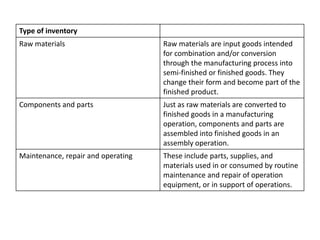
Type of inventory
Raw materials Raw materials are input goods intended
for combination and/or conversion
through the manufacturing process into
semi-finished or finished goods. They
change their form and become part of the
finished product.
Components and parts Just as raw materials are converted to
finished goods in a manufacturing
operation, components and parts are
assembled into finished goods in an
assembly operation.
Maintenance, repair and operating These include parts, supplies, and
materials used in or consumed by routine
maintenance and repair of operation
equipment, or in support of operations.
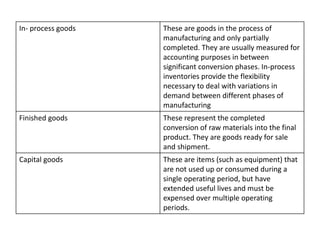
In- process goods These are goods in the process of
manufacturing and only partially
completed. They are usually measured for
accounting purposes in between
significant conversion phases. In-process
inventories provide the flexibility
necessary to deal with variations in
demand between different phases of
manufacturing
Finished goods These represent the completed
conversion of raw materials into the final
product. They are goods ready for sale
and shipment.
Capital goods These are items (such as equipment) that
are not used up or consumed during a
single operating period, but have
extended useful lives and must be
expensed over multiple operating
periods.
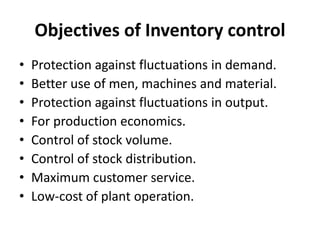
Objectives of Inventory control
• Protection against fluctuations in demand.
• Better use of men, machines and material.
• Protection against fluctuations in output.
• For production economics.
• Control of stock volume.
• Control of stock distribution.
• Maximum customer service.
• Low-cost of plant operation.
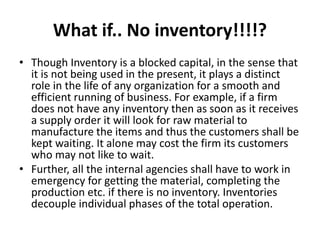
What if.. No inventory!!!!?
• Though Inventory is a blocked capital, in the sense that
it is not being used in the present, it plays a distinct
role in the life of any organization for a smooth and
efficient running of business. For example, if a firm
does not have any inventory then as soon as it receives
a supply order it will look for raw material to
manufacture the items and thus the customers shall be
kept waiting. It alone may cost the firm its customers
who may not like to wait.
• Further, all the internal agencies shall have to work in
emergency for getting the material, completing the
production etc. if there is no inventory. Inventories
decouple individual phases of the total operation.
Thus the functions of inventory are to :
• Protect against unpredictable fluctuations in
demand and supply.
• Take the advantage of price discounts through
bulk purchases.
• Take the advantage of batches and longer
production run.
• Provide flexibility to allow changes in
production plan in view of changes in demands
etc.
• Facilitate intermittent production
• To keep the inventories as low as possible to be
consistent with the market conditions.
• To minimize the ‘out of stock’ danger that results in
crash purchase at uneconomical rates.
• To maintain a sufficient stock of the finished products
and to meet the reasonable expectations of customers
for a prompt delivery of goods.
• To maintain proper records so as to supply an accurate
and regular material reports to the managements.
• To forecast the market and economic conditions of
supply as regards the availability of the materials.
Techniques to control inventory
1. ABC analysis
2. Economic order quantity.
3. VED (Vital Essential Desirable) analysis
4. Perpetual inventory system.
5. Review of slow and non moving items.
6. Input-output ratio analysis.
7. Setting of various levels.
8. Materials budgeting.
9. Establishing an effective purchase procedure.
The ABC analysis
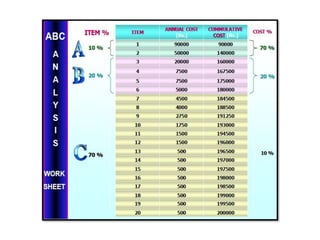
The ABC analysis is a business term used to define an
inventory
categorization technique often used in material
management. It is
also known as "Selective Inventory Control. " Policies
based on
ABC analysis:
• A ITEMS: very tight control and accurate records
• B ITEMS: less tightly controlled and good records
• C ITEMS: simplest controls possible and minimal records
• The ABC analysis provides a mechanism for
identifying items that will have a significant
impact on overall inventory cost, while also
providing a mechanism for identifying different
categories of stock that will require different
management and controls.
• The ABC analysis suggests that inventories of an
organization are not of equal value. Thus, the
inventory is grouped into three categories (A, B,
and C) in order of their estimated importance.
• A items are very important for an organization.
Because of the high value of these A items,
frequent value analysis is required.
In addition to that, an organization needs to choose
an appropriate order pattern (e.g., "Just- in- time")
to avoid excess capacity.
• B items are important, but of course less
important, than A items and more important
than C items. Therefore, B items are intergroup
items.
• C items are marginally important.
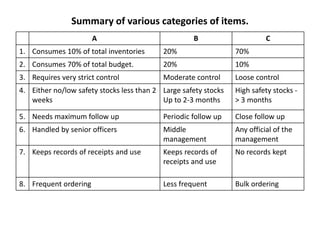
Summary of various categories of items.
A B C
1. Consumes 10% of total inventories 20% 70%
2. Consumes 70% of total budget. 20% 10%
3. Requires very strict control Moderate control Loose control
4. Either no/low safety stocks less than 2
weeks
Large safety stocks
Up to 2-3 months
High safety stocks -
> 3 months
5. Needs maximum follow up Periodic follow up Close follow up
6. Handled by senior officers Middle
management
Any official of the
management
7. Keeps records of receipts and use Keeps records of
receipts and use
No records kept
8. Frequent ordering Less frequent Bulk ordering
The following is an example of the Application of Weighed Operation based
on ABC class in the electronics manufacturing
company with 4,000 active parts.
Uniform Purchase: When you apply equal purchasing policy to all 4,000
components, example weekly delivery and re-order point (safety stock) of
two-week supply assuming that there are no lot size constraints, the factory
will have a 16,000 delivery in four weeks and the average inventory will be 2.5
weeks supply.
Weighed Purchase: In comparison, when weighed purchasing policy applied
based on ABC class, example C class monthly (every four weeks) delivery with
re-order point of three-week supply, B class Bi-weekly delivery with re-order
point of two week supply, A class weekly delivery with re-order point of one
week supply, total number of delivery in four weeks will be (A 200x4=800)+(B
400 x2=800) + (C 3400x1=3400)=5000 and average inventory will be (A
75%x1.5weeks)+(B 15%x3weeks)+ (C 10%x3.5weeks)= 1.925 week supply.
By applying weighed control based on ABC classification, required man hours
and inventory level are drastically reduced.
Advantages of ABC analysis
• Investment in the inventory can be regulated
and funds can be utilized in the best possible
manner.
• Closer and strict control on those items which
represent a major portion of total stock value.
• Helps in maintaining enough safety stock of C
categories of items.
• Scientific and selective control helps in the
maintenance of high stock turnover rate.
Application of ABC analysis
• Information of items which require higher
degree of control
• To evolve useful re-ordering strategy.
• Stock records.
• Priority treatment to different items.
• Determination of safety stock limits.
• Stores layout
• Value analysis.
VED analysis
• This system is based on the utility of the material.
• Useful in the drug store in controlling and
maintaining the stock of various types of
formulations of a particular group of drugs.
• The older the brand, the greater will be its
requirement.
• Thus, the best way to classify the different brands
into any one of the following categories.
• V=vital, E= essential and D= Desirable items
For example,
• Quinine is available as quinine sulphate,
quinine hydrochloride, quinine ethyl
carbonate and quinine bisulphate.
• Then, quinine sulphate is vital (more demand),
Quinine hydrochloride is essential (less
demand) and quinine ethyl carbonate is
desirable ( very less prescriptions).
• Therefore, maximum inventory of quinine
sulfate should be kept.
Economic Order Quantity (EOQ)
Economic Order Quantity (EOQ) models are the
most basic models of inventory management.
The approach in EOQ models is essentially to
trade-off various relevant costs and derive an
order quantity and time for placing an order
such, that the total costs are minimized. This
note discusses the basic EOQ model and the
sensitivity of costs in EOQ model to various
parameters.
The following costs are considered
• Ordering cost.
• Inadequate inventory or stock out cost.
• Inventory carrying cost.
Methods for determining EOQ
• Graphical method.
• Tabular determination of EOQ
• Algebraic formula.
Perpetual inventory system
It is a method of recording the store balance after every
receipt and issue to facilitate a regular checking and to
prevent the closing down for stocktaking. After every
receipt and issue, the entry is made in the bin card and
the balance is adjusted. Thus, the bin card becomes a
perpetual inventory record and the store balance is
recorded continuously after every receipt and issue. All
errors detected are adjusted both in the bin card as well
as in the stores ledger under proper authority
Thus, perpetual inventory system comprises of- bin card,
store ledger and continuous stocktaking
Review of slow and nonmoving items
• Inventory is an important constituent of the total cost
and as such a proper system of inventory control leads
to a significant economy in the total cost of production.
So a proper system must be enforced to detect and
control the slow moving items, obsolete items and
dormant stocks. Slow moving items- moving at slow
rates ( valued at cost, replacement price or net
realizable value, whichever is less).
• Obsolete items- that have become useless due to a
change in design, method of manufacture, product or
process.
Following steps to be taken to detect slow and
non moving items.
• Periodic report
• Obsolete items
• Moving ratios
Inventory management and control

Inventory management and control

  • 1.
  • 2.
    Index • Introduction – Whatis inventory? – How it is classified? • Need of inventory- Why? – Objectives and functions • How inventory control can be done? – Techniques
  • 3.
    What is InventoryControl? Inventory may be defined as usable but idle resources that have economic value. Inventory is a stock of direct or indirect material, from raw material to finished goods stocked in order to meet an unexpected future demand. In other words inventory is a physical stock of goods kept for the future purposes
  • 4.
    Inventory Classification Inventory indicatesthat it may be available in different forms depending upon the production cycle stage it is in.
  • 5.
    Type of inventory Rawmaterials Raw materials are input goods intended for combination and/or conversion through the manufacturing process into semi-finished or finished goods. They change their form and become part of the finished product. Components and parts Just as raw materials are converted to finished goods in a manufacturing operation, components and parts are assembled into finished goods in an assembly operation. Maintenance, repair and operating These include parts, supplies, and materials used in or consumed by routine maintenance and repair of operation equipment, or in support of operations.
  • 6.
    In- process goodsThese are goods in the process of manufacturing and only partially completed. They are usually measured for accounting purposes in between significant conversion phases. In-process inventories provide the flexibility necessary to deal with variations in demand between different phases of manufacturing Finished goods These represent the completed conversion of raw materials into the final product. They are goods ready for sale and shipment. Capital goods These are items (such as equipment) that are not used up or consumed during a single operating period, but have extended useful lives and must be expensed over multiple operating periods.
  • 7.
    Objectives of Inventorycontrol • Protection against fluctuations in demand. • Better use of men, machines and material. • Protection against fluctuations in output. • For production economics. • Control of stock volume. • Control of stock distribution. • Maximum customer service. • Low-cost of plant operation.
  • 8.
    What if.. Noinventory!!!!? • Though Inventory is a blocked capital, in the sense that it is not being used in the present, it plays a distinct role in the life of any organization for a smooth and efficient running of business. For example, if a firm does not have any inventory then as soon as it receives a supply order it will look for raw material to manufacture the items and thus the customers shall be kept waiting. It alone may cost the firm its customers who may not like to wait. • Further, all the internal agencies shall have to work in emergency for getting the material, completing the production etc. if there is no inventory. Inventories decouple individual phases of the total operation.
  • 9.
    Thus the functionsof inventory are to : • Protect against unpredictable fluctuations in demand and supply. • Take the advantage of price discounts through bulk purchases. • Take the advantage of batches and longer production run. • Provide flexibility to allow changes in production plan in view of changes in demands etc. • Facilitate intermittent production
  • 10.
    • To keepthe inventories as low as possible to be consistent with the market conditions. • To minimize the ‘out of stock’ danger that results in crash purchase at uneconomical rates. • To maintain a sufficient stock of the finished products and to meet the reasonable expectations of customers for a prompt delivery of goods. • To maintain proper records so as to supply an accurate and regular material reports to the managements. • To forecast the market and economic conditions of supply as regards the availability of the materials.
  • 11.
    Techniques to controlinventory 1. ABC analysis 2. Economic order quantity. 3. VED (Vital Essential Desirable) analysis 4. Perpetual inventory system. 5. Review of slow and non moving items. 6. Input-output ratio analysis. 7. Setting of various levels. 8. Materials budgeting. 9. Establishing an effective purchase procedure.
  • 12.
    The ABC analysis TheABC analysis is a business term used to define an inventory categorization technique often used in material management. It is also known as "Selective Inventory Control. " Policies based on ABC analysis: • A ITEMS: very tight control and accurate records • B ITEMS: less tightly controlled and good records • C ITEMS: simplest controls possible and minimal records
  • 13.
    • The ABCanalysis provides a mechanism for identifying items that will have a significant impact on overall inventory cost, while also providing a mechanism for identifying different categories of stock that will require different management and controls. • The ABC analysis suggests that inventories of an organization are not of equal value. Thus, the inventory is grouped into three categories (A, B, and C) in order of their estimated importance.
  • 14.
    • A itemsare very important for an organization. Because of the high value of these A items, frequent value analysis is required. In addition to that, an organization needs to choose an appropriate order pattern (e.g., "Just- in- time") to avoid excess capacity. • B items are important, but of course less important, than A items and more important than C items. Therefore, B items are intergroup items. • C items are marginally important.
  • 15.
    Summary of variouscategories of items. A B C 1. Consumes 10% of total inventories 20% 70% 2. Consumes 70% of total budget. 20% 10% 3. Requires very strict control Moderate control Loose control 4. Either no/low safety stocks less than 2 weeks Large safety stocks Up to 2-3 months High safety stocks - > 3 months 5. Needs maximum follow up Periodic follow up Close follow up 6. Handled by senior officers Middle management Any official of the management 7. Keeps records of receipts and use Keeps records of receipts and use No records kept 8. Frequent ordering Less frequent Bulk ordering
  • 17.
    The following isan example of the Application of Weighed Operation based on ABC class in the electronics manufacturing company with 4,000 active parts. Uniform Purchase: When you apply equal purchasing policy to all 4,000 components, example weekly delivery and re-order point (safety stock) of two-week supply assuming that there are no lot size constraints, the factory will have a 16,000 delivery in four weeks and the average inventory will be 2.5 weeks supply. Weighed Purchase: In comparison, when weighed purchasing policy applied based on ABC class, example C class monthly (every four weeks) delivery with re-order point of three-week supply, B class Bi-weekly delivery with re-order point of two week supply, A class weekly delivery with re-order point of one week supply, total number of delivery in four weeks will be (A 200x4=800)+(B 400 x2=800) + (C 3400x1=3400)=5000 and average inventory will be (A 75%x1.5weeks)+(B 15%x3weeks)+ (C 10%x3.5weeks)= 1.925 week supply. By applying weighed control based on ABC classification, required man hours and inventory level are drastically reduced.
  • 18.
    Advantages of ABCanalysis • Investment in the inventory can be regulated and funds can be utilized in the best possible manner. • Closer and strict control on those items which represent a major portion of total stock value. • Helps in maintaining enough safety stock of C categories of items. • Scientific and selective control helps in the maintenance of high stock turnover rate.
  • 19.
    Application of ABCanalysis • Information of items which require higher degree of control • To evolve useful re-ordering strategy. • Stock records. • Priority treatment to different items. • Determination of safety stock limits. • Stores layout • Value analysis.
  • 20.
    VED analysis • Thissystem is based on the utility of the material. • Useful in the drug store in controlling and maintaining the stock of various types of formulations of a particular group of drugs. • The older the brand, the greater will be its requirement. • Thus, the best way to classify the different brands into any one of the following categories. • V=vital, E= essential and D= Desirable items
  • 21.
    For example, • Quinineis available as quinine sulphate, quinine hydrochloride, quinine ethyl carbonate and quinine bisulphate. • Then, quinine sulphate is vital (more demand), Quinine hydrochloride is essential (less demand) and quinine ethyl carbonate is desirable ( very less prescriptions). • Therefore, maximum inventory of quinine sulfate should be kept.
  • 22.
    Economic Order Quantity(EOQ) Economic Order Quantity (EOQ) models are the most basic models of inventory management. The approach in EOQ models is essentially to trade-off various relevant costs and derive an order quantity and time for placing an order such, that the total costs are minimized. This note discusses the basic EOQ model and the sensitivity of costs in EOQ model to various parameters.
  • 23.
    The following costsare considered • Ordering cost. • Inadequate inventory or stock out cost. • Inventory carrying cost. Methods for determining EOQ • Graphical method. • Tabular determination of EOQ • Algebraic formula.
  • 24.
    Perpetual inventory system Itis a method of recording the store balance after every receipt and issue to facilitate a regular checking and to prevent the closing down for stocktaking. After every receipt and issue, the entry is made in the bin card and the balance is adjusted. Thus, the bin card becomes a perpetual inventory record and the store balance is recorded continuously after every receipt and issue. All errors detected are adjusted both in the bin card as well as in the stores ledger under proper authority Thus, perpetual inventory system comprises of- bin card, store ledger and continuous stocktaking
  • 25.
    Review of slowand nonmoving items • Inventory is an important constituent of the total cost and as such a proper system of inventory control leads to a significant economy in the total cost of production. So a proper system must be enforced to detect and control the slow moving items, obsolete items and dormant stocks. Slow moving items- moving at slow rates ( valued at cost, replacement price or net realizable value, whichever is less). • Obsolete items- that have become useless due to a change in design, method of manufacture, product or process.
  • 26.
    Following steps tobe taken to detect slow and non moving items. • Periodic report • Obsolete items • Moving ratios